 Guided by
 Dr.Anjalatchi
 Vice principal
 Era college of Nursing
 Safrazganj
 Lucknow 226003
 Prepared by
 MISS ARTI CHAUDHARI
PBBSC NURSING 2nd YEAR
 Era college of Nursing
 Sarfrazganj
 Lucknow 226003
 Definition of defibrillator
 Purpose of defibrillator
 Principle of defibrillator
 Power of defibrillator
 Defibrillator electrodes
 Types of defibrillator
 Indication of defibrillator
 Contraindication of defibrillator
 Electrode position
 Equipment of defibrillator
 Procedure of defibrillator
 Nursing management
 Summary
 Conclusion
 References
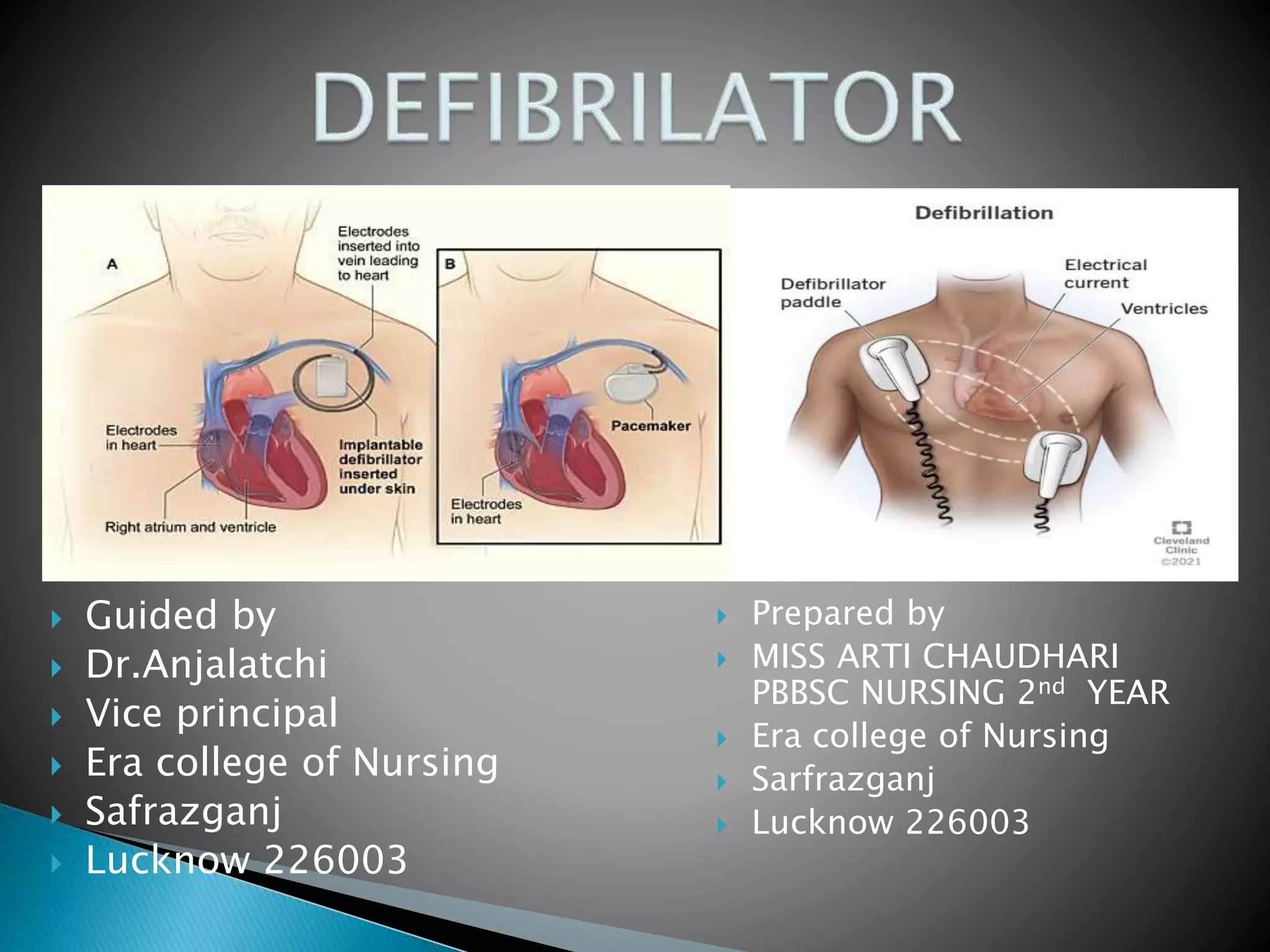
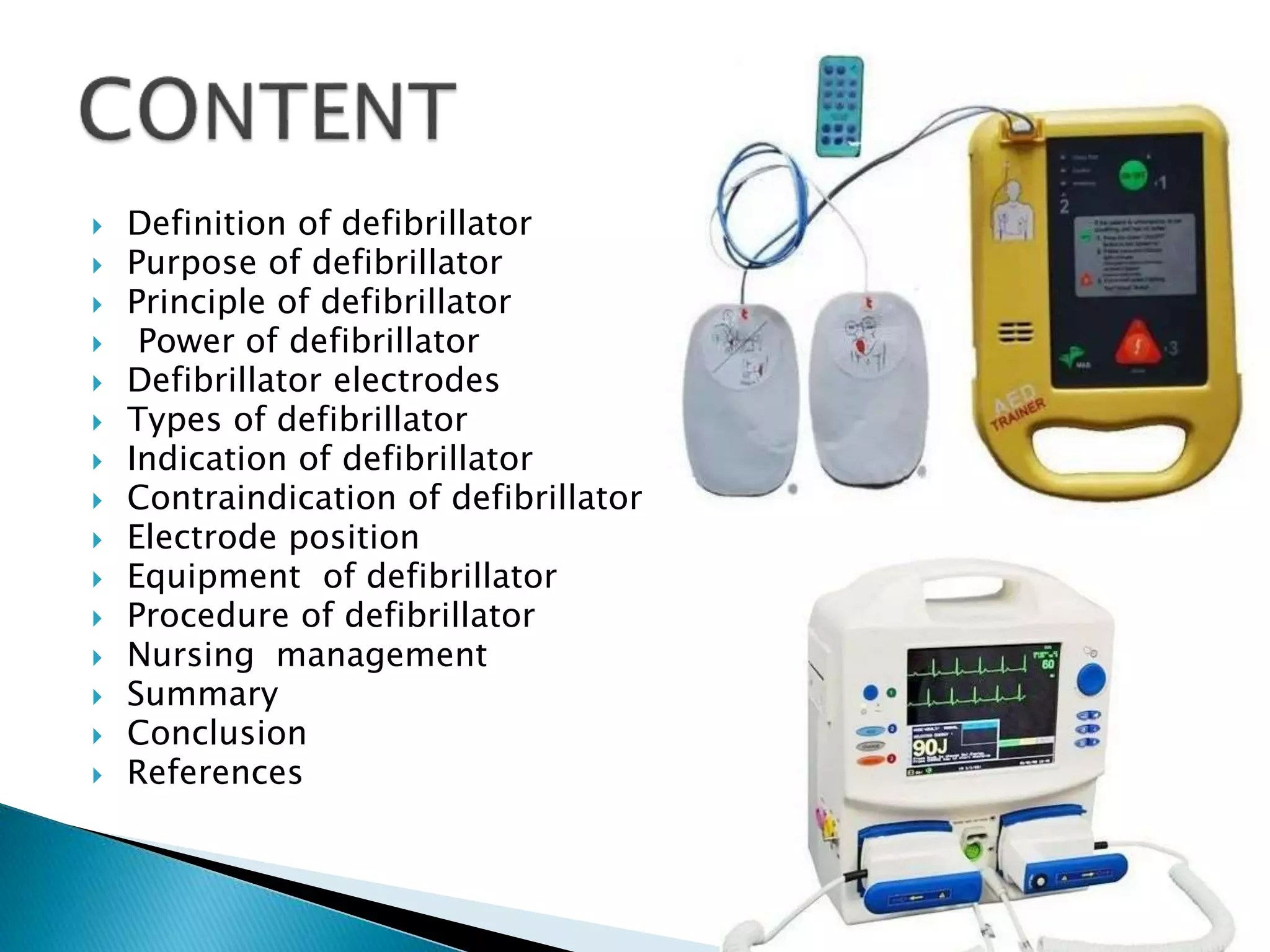
 A defibrillator is a device that provides an
electric shock to your heart to allow it to get
out of a potentially fatal abnormal heart
rhythm, or arrhythmia, — ventricular
tachycardia (with no pulse) or ventricular
fibrillation — and back to a normal rhythm.
 Both of these arrhythmias happen in your
heart’s ventricles or lower chambers.
 Defibrilator is a process in which an
electronic device sends an electric shock to
the heart to stop an extremely rapid ,irregular
heartbeat and restore the normal heart
rhythm .
 Defibrillator is performed to correct life
threatening fibrillation of the heart , which
could result in cardiac arrest . It should be
performed immediately after identifying that
the patient is experiencing a cardiac
emergency , has no pulse , and is
unresponsive .
 While cardiopulmonary resuscitation (CPR)
provides temporary assistance, a defibrillator
can help you survive sudden cardiac arrest.
 You can even use a defibrillator if someone
already has a pacemaker or implantable
cardioverter defibrillator (ICD).
 Energy storage capacitor is charged at relatively slow
rate from AC line .
 Energy stored in capacitor is then delivered at a
relatively rapid rate to chest of the patient.
 Simple arrangement involve the discharge of
capacitor energy through the patient’s own resistance
.
 The discharge resistance which the patient represents
as purely ohmic resistance of 50 to 100ohm
approximately for a typical electrode size of 80 cm2.
 This particular wave form fig is called ‘ Lown ’
waveform.
 The pulse width of this waveform is generally 10 ms .
 Higher voltages are required for external
defibrillation than for internal defibrillation .
 A corrective talk of 750 to 800 volts is
applied within a 10 of a second .
 That is the same voltage as 500 to 533
number of AA batteries !
 On a biphasic defibrillator, this is usually
between 120 joules to 200 joules.
 On a monophasic defibrillator, this is usually
360 joules.
 Spoon shaped electrode
Applied directly to he electrode .
 Paddle type electrode
Applied against the chest wall
 Pad type electrode
Applied directly on chest wall
 Internal defibrillator -Electrodes placed
directly to the heart .
example- pacemaker
 External defibrillator- Electrodes placed
directly on the heart .
example - AED
 Two types of defibrillators are showing
below.
 AC defibrillators
 DC defibrillators
 An AC defibrillator is the oldest and simplest
type. The construction of AC defibrillator is
such that appropriate values are available for
internal and external defibrillation. In AC
defibrillation, a shock of 50 Hz a.c frequency
is applied to the chest for a time of 0.25 to 1
second through electrodes. The procedure of
applying electric shock to resynchronize heart
is known as Countershock.
 DC defibrillator does not produce side effects
and produces normal heartbeat. Ventricular
fibrillation is avoided when high-energy
shock is passed through discharging
capacitor that is exposed to heart or chest of
the patient. DC defibrillator consists of auto
transformer T1 that acts as primary of the
high voltage transformer T2.
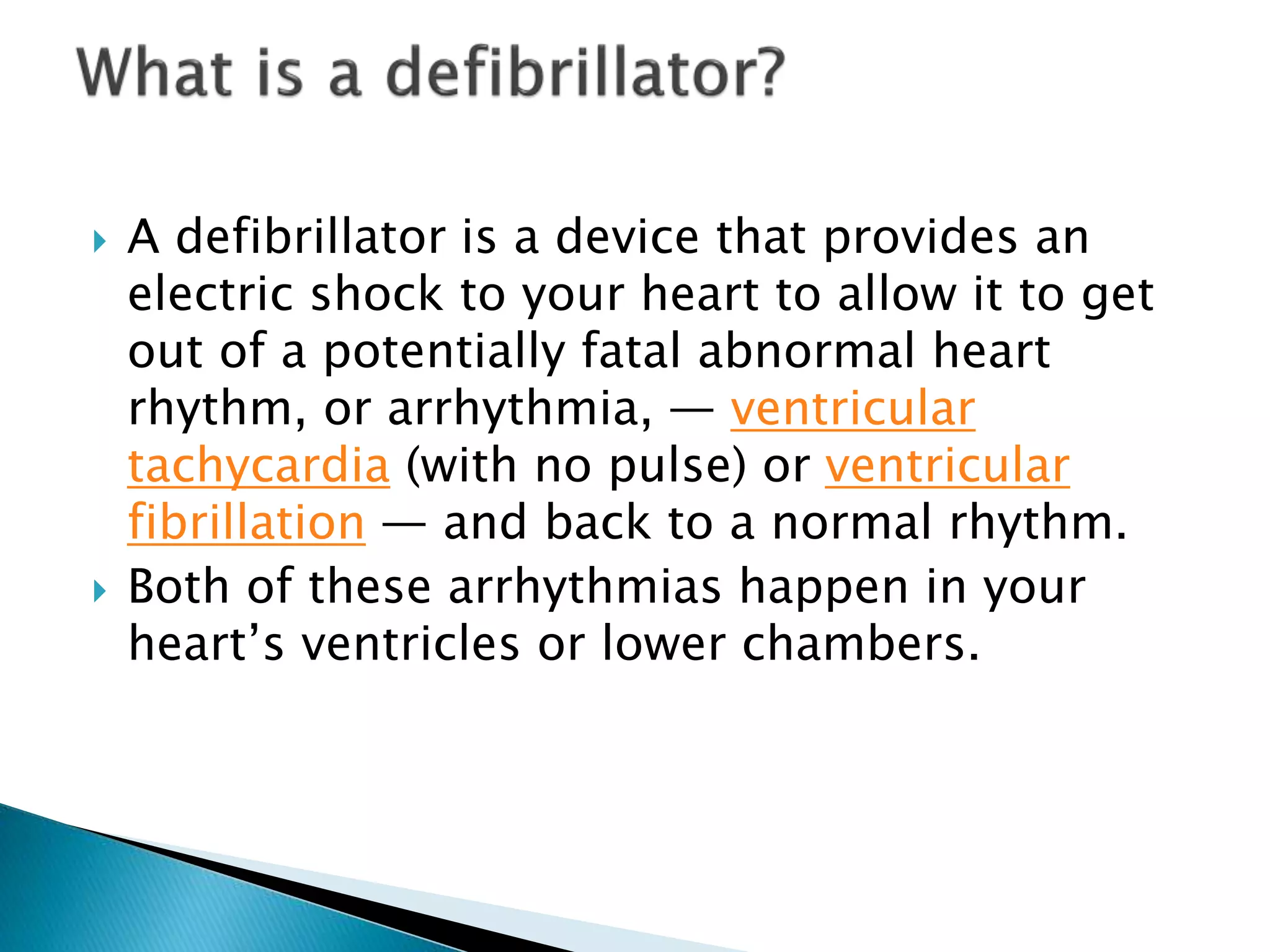
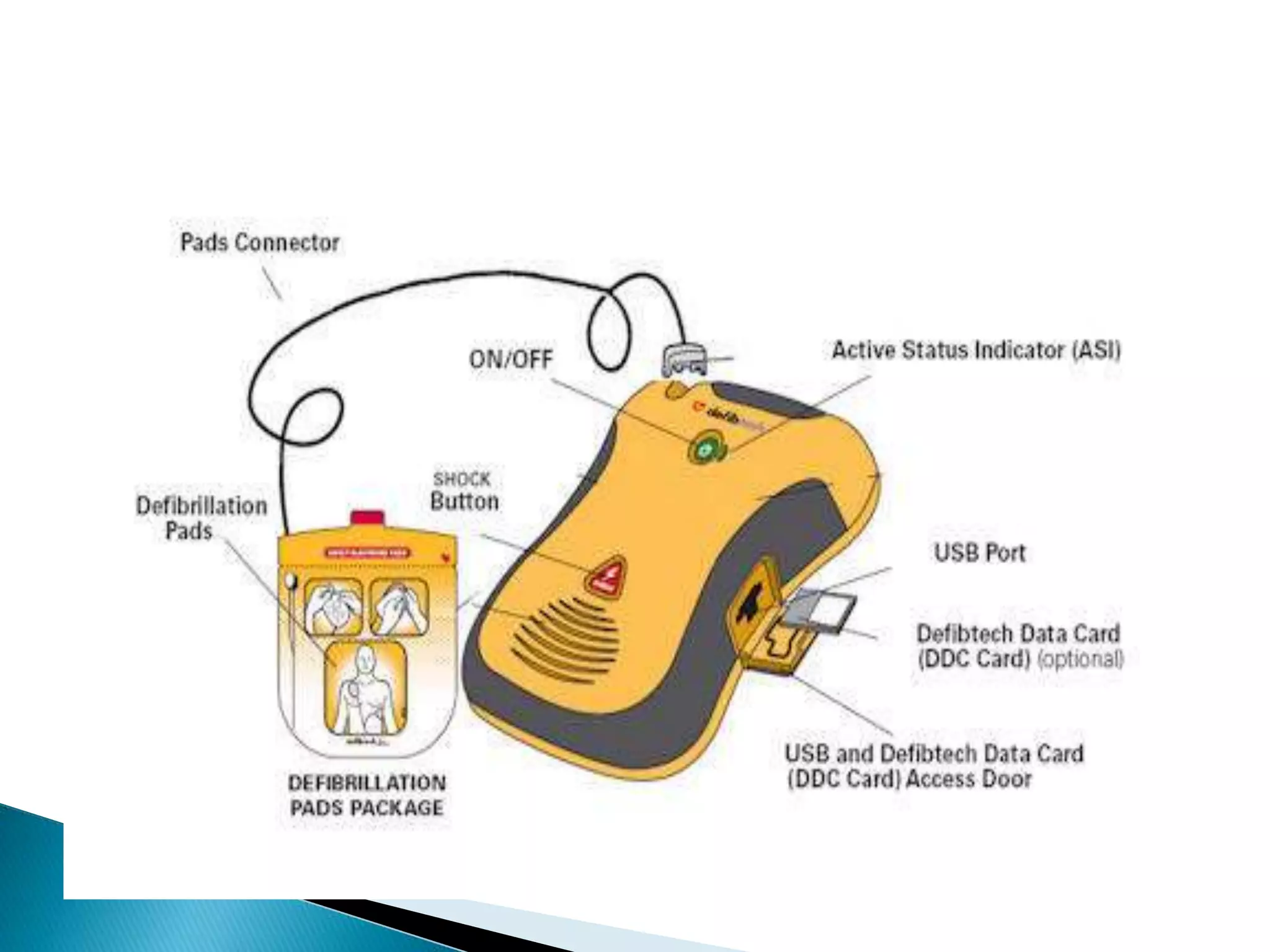
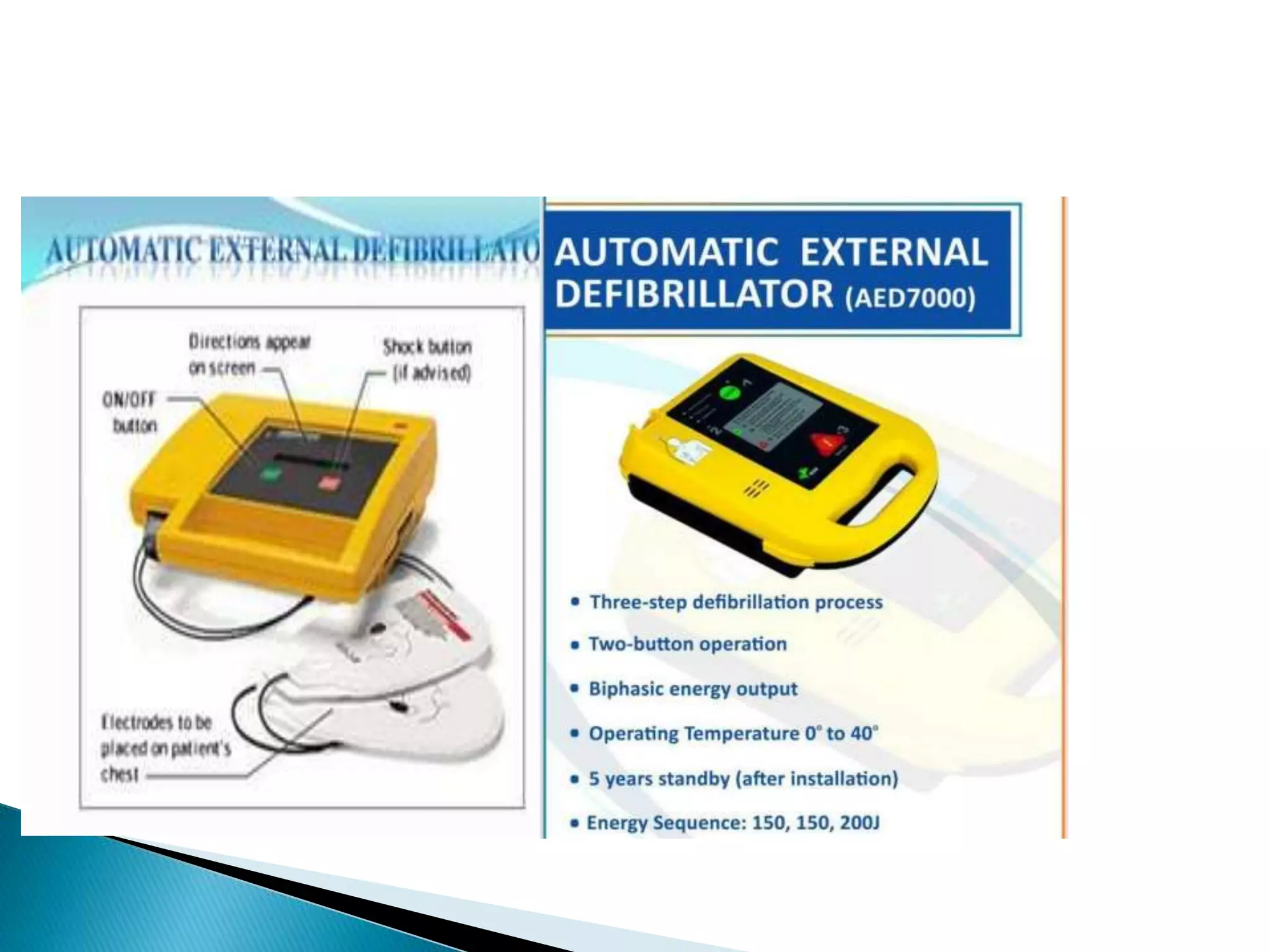
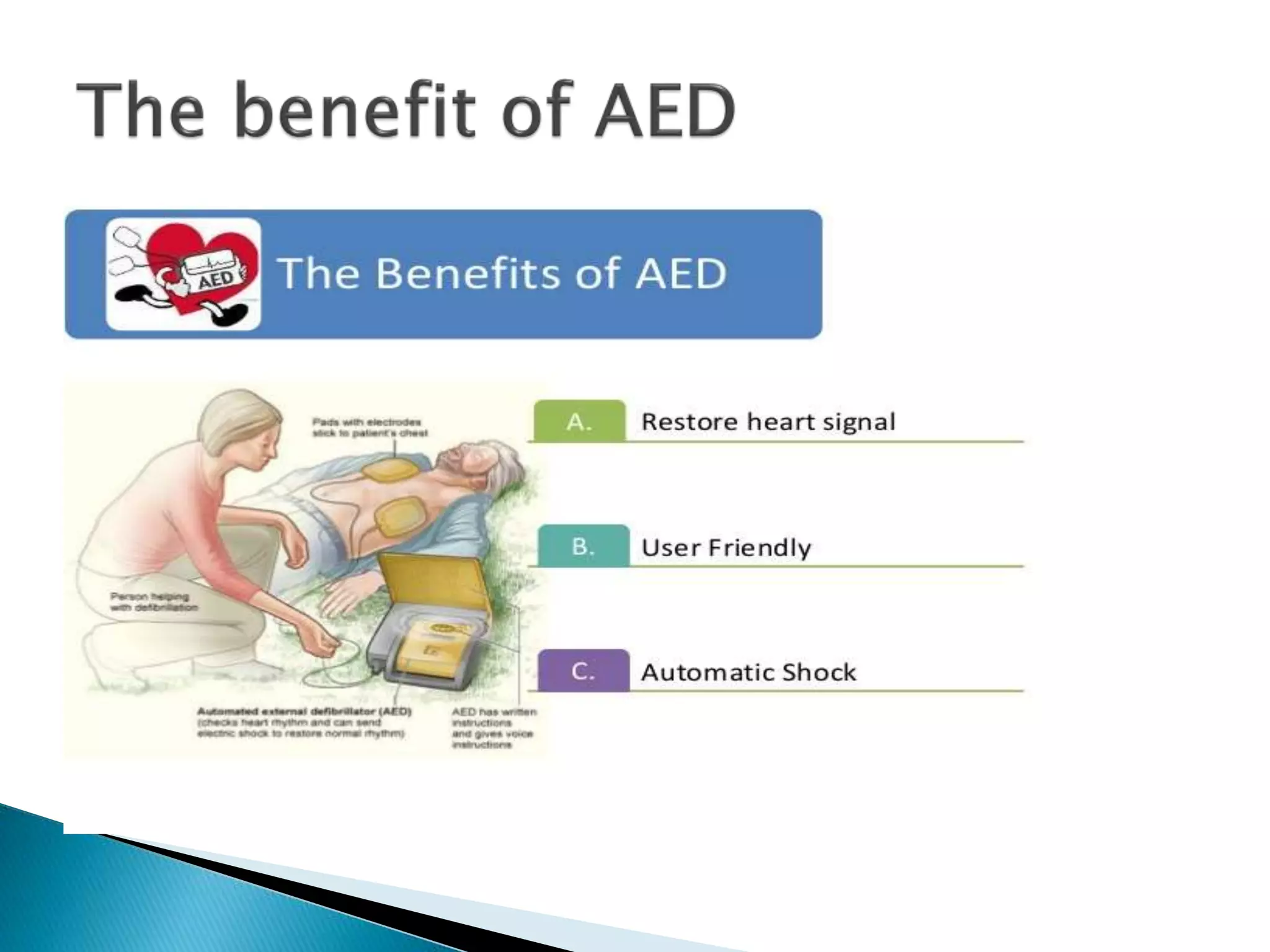
 An AED, or automated external defibrillator,
is used to help those experiencing sudden
cardiac arrest.
 It's a sophisticated, yet easy-to-use, medical
device that can analyze the heart's rhythm
and, if necessary, deliver an electrical shock,
or defibrillation, to help the heart re-
establish an effective rhythm.
 Pulseless ventricular tachycardia .
 Ventricular fibrillation
What are the 4 shockable rhythms?
 The two shockable rhythms are ventricular fibrillation (VF) and
pulseless ventricular tachycardia (VT) while
the non–shockable rhythms include sinus rhythm (SR),
supraventricular tachycardia (SVT), premature ventricualr
contraction (PVC), atrial fibrilation (AF) and so on.
Function Component In Defibrillator
The electrodes send information about the person's heart
rhythm to a computer in the AED. The computer analyzes the
heart rhythm to find out whether an electric shock is needed. If
it is needed, the electrodes deliver the shock.
 Patient who are conscious or have a pulse .
 Non shockable rhythm – asystole ,pulseless
,electrical activity.
 Multifocal atrial tachycardia .
 Dysrhythmia due to enhanced automaticity
such as digitalis toxicity .
 Sterno apical position
 Anterior posterior position
 BI- Axillary position
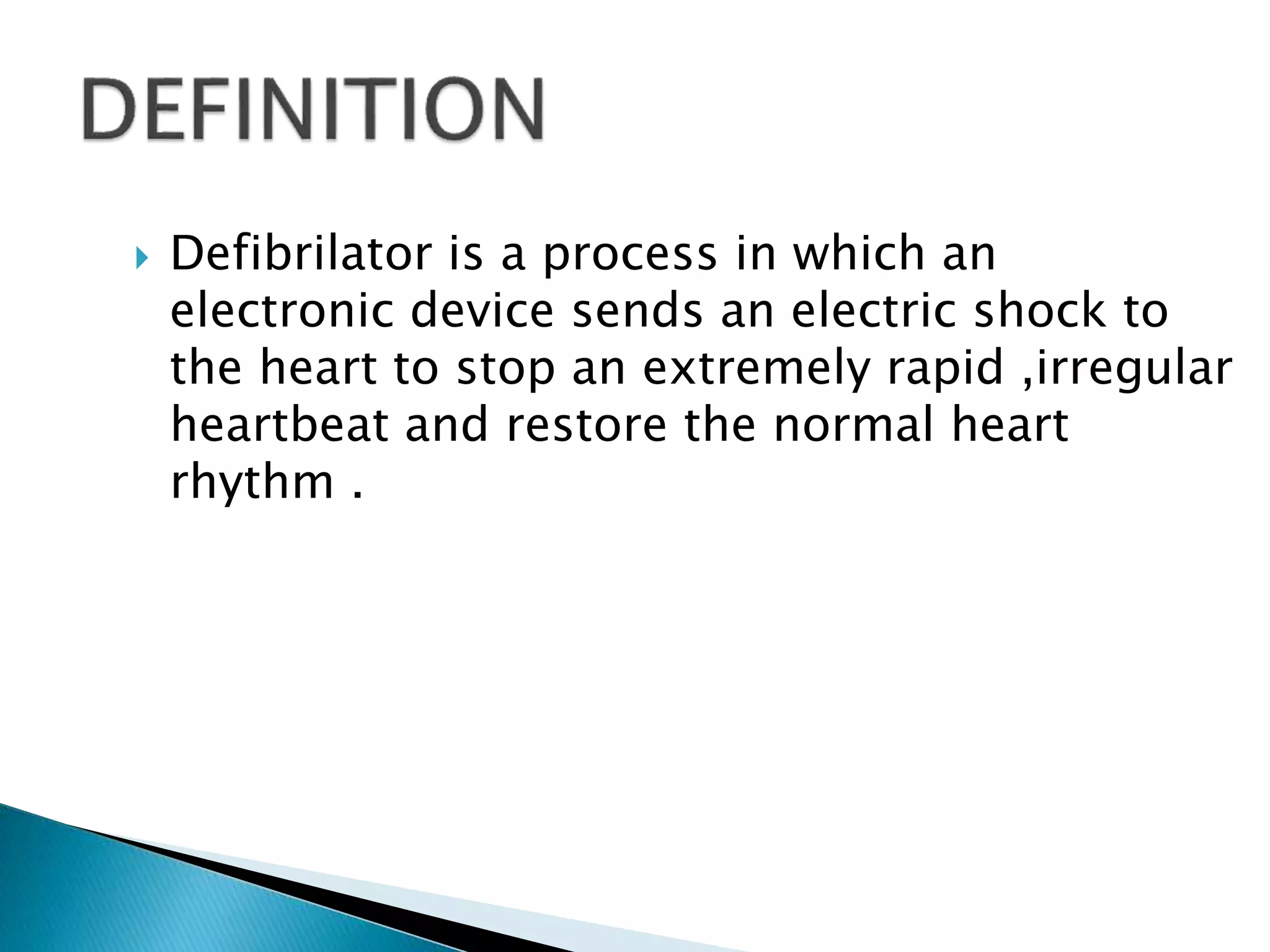
 Defibrillator with paddle or adhesive patches
 Conductive gel
 ECG monitor with recorder
 Oxygen supply
 Incubation kit
 Multi para monitor – BP,Pulse,Spo2
 Intravenous access
 Suction device
 Code cart with ACLS medication
 Confirm cardiac arrest – check for signs life.
 CPR should be on going .
 Turn the defibrillator on .
 Stop chest compression confirm VT
(Ventricular tachycardia) from the ECG.
 Squeeze generous amount of jelly on the
defibrillator paddles .
 The designated person select the appropriate energy on the
defibrillator . 150-200 jule for biphasic defibrillator and 150-
360 J for monophasic defibrillator .
 Press ‘charge’button to charge the capacitor.
 While the defibrillator is charging ,warn all rescuers other then
the individual performing the chest compressions to ‘stand clear
‘ and remove any oxygen delivery device as appropriate .
 Once the defibrillator is charged , tell the rescuer doing the chest
compression to “ Stand clear “ .
 When clear , discharge the current by pressing both paddle of
discharge buttons sinultaneously .Give shock .
 To examing the patients ECG to see whether debifrillation as
altered the patients condition and restored the normal rhythm.
 Continue CPR for 2 minutes .
 If desired outcome is not restored ,defibillate again following
same procedure .
 Perform the 3 counter shocks in rapid succession .
 If the patient no pulse after 3 initial defibrillation .
 Resume CPR .
 Give supplemental oxygen .
 Begin administrating epine phrine and switch to non
shockable algorithm
 If further defibrillation is unnecessary ,discharge the
machine by turning off .
 Once machine if discharge , clean the paddles
/making sure to remove conductive jelly .
 Any jelly remains the patients level of status .
 Obtain baseline data / ABG levels and 12 lead ECG.
 Provide supplemental oxygen ventilation .
 Document the procedure .
 A defibrillator can save your life if it’s used
for the correct arrhythmia and it’s done
within 10 minutes after the abnormal rhythm
starts.
 A defibrillator needs to be used for
ventricular tachycardia (without a pulse) or
for ventricular fibrillation.
 If you use it for any other kind of arrhythmia,
it could give someone ventricular fibrillation
and cardiac arrest.
 Monitor cardiovascular status
 Monitor respiratory status
 Monitor neurologic status
 Initiate IV antiarrythmic therapy
 Monitor for burns
 Documentation
 Patient /family education
 Wipe the defibrillator and case over
thoroughly with an antibacterial cleansing
wipe.
 Once it's clean, check there is no obvious
damage and see if the battery/self-test
indicator is still showing OK as per the
manufacturer's instructions.
 If the battery needs to be replaced, follow
the manufacturer's instructions.
 Pads, Paddle, and Accessories Cleaning
 Step 1: For the conventional defibrillators, use pre-saturated
alcohol wipes to clean the surface of the paddle and the other
accessories. This is a routine step that should be performed after
each usage. For the pads of AED, check whether the pads are
expired. Standard expiration is 2 years from the manufacturing
date. Pads determine how many joules will be delivered to the
patient; if the pads have expired, the adhesive may not ensure a
good connection and it might fail to operate normally.
 Step 2: Use a dry microfiber cloth or alcohol wipes to clean the
display and overall appearance of the machine.
 Step 3: Power off the defibrillator. Use aerosol contact
cleaners to clean the connectors and connection ports. Insert the
extension tube into the actuator to remove soil from tight areas.
Allow the solvent to evaporate before reenergizing the
equipment.
 Keep Your AED Properly Maintained
 Place your AED in a visible and unobstructed location.
 Verify the battery installation is correct.
 Check the status / service indicator light.
 Note the absence of the visual/ audio service alarm.
 Inspect exterior components and sockets for cracks.
 Confirm that you have two sets of sealed AED pads
that have not expired
 Keep accurate records and replace the AED battery as
recommended for your particular device
 Refer to the manufacturer manual for more
information and proper maintenance procedures for
your particular device
 Clean the devices as per disinfectant advices
 Disinfect the devices
 Keep cover the devices appropriate
 Store away from rat, mouse etc
 Avoid dry, moisture , leaking area to store
 Maintain appropriate temperature
 The lifespans of different defib units vary
from model to model. Most AEDs will be
supplied with warranties spanning from 5
to 10 years but the actual life expectancy of
most defib units will be 10 years.
 Define defibrillator ?
 Purpose of defibrillator?
 What is the joules for defibrillator ?
 Which area pad has to keep for shocks?
 What are the indication for shock?
Defibrillator ppt.pptx

Defibrillator ppt.pptx

  • 1.
     Guided by Dr.Anjalatchi  Vice principal  Era college of Nursing  Safrazganj  Lucknow 226003  Prepared by  MISS ARTI CHAUDHARI PBBSC NURSING 2nd YEAR  Era college of Nursing  Sarfrazganj  Lucknow 226003
  • 2.
     Definition ofdefibrillator  Purpose of defibrillator  Principle of defibrillator  Power of defibrillator  Defibrillator electrodes  Types of defibrillator  Indication of defibrillator  Contraindication of defibrillator  Electrode position  Equipment of defibrillator  Procedure of defibrillator  Nursing management  Summary  Conclusion  References
  • 3.
     A defibrillatoris a device that provides an electric shock to your heart to allow it to get out of a potentially fatal abnormal heart rhythm, or arrhythmia, — ventricular tachycardia (with no pulse) or ventricular fibrillation — and back to a normal rhythm.  Both of these arrhythmias happen in your heart’s ventricles or lower chambers.
  • 5.
     Defibrilator isa process in which an electronic device sends an electric shock to the heart to stop an extremely rapid ,irregular heartbeat and restore the normal heart rhythm .
  • 6.
     Defibrillator isperformed to correct life threatening fibrillation of the heart , which could result in cardiac arrest . It should be performed immediately after identifying that the patient is experiencing a cardiac emergency , has no pulse , and is unresponsive .
  • 8.
     While cardiopulmonaryresuscitation (CPR) provides temporary assistance, a defibrillator can help you survive sudden cardiac arrest.  You can even use a defibrillator if someone already has a pacemaker or implantable cardioverter defibrillator (ICD).
  • 9.
     Energy storagecapacitor is charged at relatively slow rate from AC line .  Energy stored in capacitor is then delivered at a relatively rapid rate to chest of the patient.  Simple arrangement involve the discharge of capacitor energy through the patient’s own resistance .  The discharge resistance which the patient represents as purely ohmic resistance of 50 to 100ohm approximately for a typical electrode size of 80 cm2.  This particular wave form fig is called ‘ Lown ’ waveform.  The pulse width of this waveform is generally 10 ms .
  • 10.
     Higher voltagesare required for external defibrillation than for internal defibrillation .  A corrective talk of 750 to 800 volts is applied within a 10 of a second .  That is the same voltage as 500 to 533 number of AA batteries !
  • 11.
     On abiphasic defibrillator, this is usually between 120 joules to 200 joules.  On a monophasic defibrillator, this is usually 360 joules.
  • 12.
     Spoon shapedelectrode Applied directly to he electrode .  Paddle type electrode Applied against the chest wall  Pad type electrode Applied directly on chest wall
  • 13.
     Internal defibrillator-Electrodes placed directly to the heart . example- pacemaker  External defibrillator- Electrodes placed directly on the heart . example - AED
  • 14.
     Two typesof defibrillators are showing below.  AC defibrillators  DC defibrillators
  • 15.
     An ACdefibrillator is the oldest and simplest type. The construction of AC defibrillator is such that appropriate values are available for internal and external defibrillation. In AC defibrillation, a shock of 50 Hz a.c frequency is applied to the chest for a time of 0.25 to 1 second through electrodes. The procedure of applying electric shock to resynchronize heart is known as Countershock.
  • 16.
     DC defibrillatordoes not produce side effects and produces normal heartbeat. Ventricular fibrillation is avoided when high-energy shock is passed through discharging capacitor that is exposed to heart or chest of the patient. DC defibrillator consists of auto transformer T1 that acts as primary of the high voltage transformer T2.
  • 17.
     An AED,or automated external defibrillator, is used to help those experiencing sudden cardiac arrest.  It's a sophisticated, yet easy-to-use, medical device that can analyze the heart's rhythm and, if necessary, deliver an electrical shock, or defibrillation, to help the heart re- establish an effective rhythm.
  • 21.
     Pulseless ventriculartachycardia .  Ventricular fibrillation What are the 4 shockable rhythms?  The two shockable rhythms are ventricular fibrillation (VF) and pulseless ventricular tachycardia (VT) while the non–shockable rhythms include sinus rhythm (SR), supraventricular tachycardia (SVT), premature ventricualr contraction (PVC), atrial fibrilation (AF) and so on. Function Component In Defibrillator The electrodes send information about the person's heart rhythm to a computer in the AED. The computer analyzes the heart rhythm to find out whether an electric shock is needed. If it is needed, the electrodes deliver the shock.
  • 22.
     Patient whoare conscious or have a pulse .  Non shockable rhythm – asystole ,pulseless ,electrical activity.  Multifocal atrial tachycardia .  Dysrhythmia due to enhanced automaticity such as digitalis toxicity .
  • 23.
     Sterno apicalposition  Anterior posterior position  BI- Axillary position
  • 24.
     Defibrillator withpaddle or adhesive patches  Conductive gel  ECG monitor with recorder  Oxygen supply  Incubation kit  Multi para monitor – BP,Pulse,Spo2  Intravenous access  Suction device  Code cart with ACLS medication
  • 25.
     Confirm cardiacarrest – check for signs life.  CPR should be on going .  Turn the defibrillator on .  Stop chest compression confirm VT (Ventricular tachycardia) from the ECG.  Squeeze generous amount of jelly on the defibrillator paddles .
  • 28.
     The designatedperson select the appropriate energy on the defibrillator . 150-200 jule for biphasic defibrillator and 150- 360 J for monophasic defibrillator .  Press ‘charge’button to charge the capacitor.  While the defibrillator is charging ,warn all rescuers other then the individual performing the chest compressions to ‘stand clear ‘ and remove any oxygen delivery device as appropriate .  Once the defibrillator is charged , tell the rescuer doing the chest compression to “ Stand clear “ .  When clear , discharge the current by pressing both paddle of discharge buttons sinultaneously .Give shock .  To examing the patients ECG to see whether debifrillation as altered the patients condition and restored the normal rhythm.  Continue CPR for 2 minutes .  If desired outcome is not restored ,defibillate again following same procedure .  Perform the 3 counter shocks in rapid succession .
  • 29.
     If thepatient no pulse after 3 initial defibrillation .  Resume CPR .  Give supplemental oxygen .  Begin administrating epine phrine and switch to non shockable algorithm  If further defibrillation is unnecessary ,discharge the machine by turning off .  Once machine if discharge , clean the paddles /making sure to remove conductive jelly .  Any jelly remains the patients level of status .  Obtain baseline data / ABG levels and 12 lead ECG.  Provide supplemental oxygen ventilation .  Document the procedure .
  • 31.
     A defibrillatorcan save your life if it’s used for the correct arrhythmia and it’s done within 10 minutes after the abnormal rhythm starts.
  • 32.
     A defibrillatorneeds to be used for ventricular tachycardia (without a pulse) or for ventricular fibrillation.  If you use it for any other kind of arrhythmia, it could give someone ventricular fibrillation and cardiac arrest.
  • 33.
     Monitor cardiovascularstatus  Monitor respiratory status  Monitor neurologic status  Initiate IV antiarrythmic therapy  Monitor for burns  Documentation  Patient /family education
  • 34.
     Wipe thedefibrillator and case over thoroughly with an antibacterial cleansing wipe.  Once it's clean, check there is no obvious damage and see if the battery/self-test indicator is still showing OK as per the manufacturer's instructions.  If the battery needs to be replaced, follow the manufacturer's instructions.
  • 35.
     Pads, Paddle,and Accessories Cleaning  Step 1: For the conventional defibrillators, use pre-saturated alcohol wipes to clean the surface of the paddle and the other accessories. This is a routine step that should be performed after each usage. For the pads of AED, check whether the pads are expired. Standard expiration is 2 years from the manufacturing date. Pads determine how many joules will be delivered to the patient; if the pads have expired, the adhesive may not ensure a good connection and it might fail to operate normally.  Step 2: Use a dry microfiber cloth or alcohol wipes to clean the display and overall appearance of the machine.  Step 3: Power off the defibrillator. Use aerosol contact cleaners to clean the connectors and connection ports. Insert the extension tube into the actuator to remove soil from tight areas. Allow the solvent to evaporate before reenergizing the equipment.
  • 36.
     Keep YourAED Properly Maintained  Place your AED in a visible and unobstructed location.  Verify the battery installation is correct.  Check the status / service indicator light.  Note the absence of the visual/ audio service alarm.  Inspect exterior components and sockets for cracks.  Confirm that you have two sets of sealed AED pads that have not expired  Keep accurate records and replace the AED battery as recommended for your particular device  Refer to the manufacturer manual for more information and proper maintenance procedures for your particular device
  • 37.
     Clean thedevices as per disinfectant advices  Disinfect the devices  Keep cover the devices appropriate  Store away from rat, mouse etc  Avoid dry, moisture , leaking area to store  Maintain appropriate temperature
  • 38.
     The lifespansof different defib units vary from model to model. Most AEDs will be supplied with warranties spanning from 5 to 10 years but the actual life expectancy of most defib units will be 10 years.
  • 39.
     Define defibrillator?  Purpose of defibrillator?  What is the joules for defibrillator ?  Which area pad has to keep for shocks?  What are the indication for shock?