Adult Basic Life Support (BLS )
                 of
Cardiopulmonary Resuscitation (CPR)


    Clinicalstudio.blogspot.com
Our job includes:
(1.) Look for safety
(2.) Check for response
(3.) Call for help
(4.) Airway
(5.)Breathing
(6.) Check Carotid Pulse
(7.) Chest Compression
(8.) Defibrillation
(9.) Medication
(1.)Look for Safety

-Before approaching the victim, the rescuer
  must ensure that the scene is safe
- See your surroundings carefully .Make
  sure that you are not going to be
  responsible incase the patient dies.
(2.) Check for Response


               Tap the victim on the
                 shoulder. And ask
                 him 2 questions:
               “Are you all right?”
               “Can you hear me?”
(3.) Call for help
-Dial Phone number 911,120
-Inform your location
-Tell What has happened
-Tell to bring defibrillator and medicines
(4.)Airway
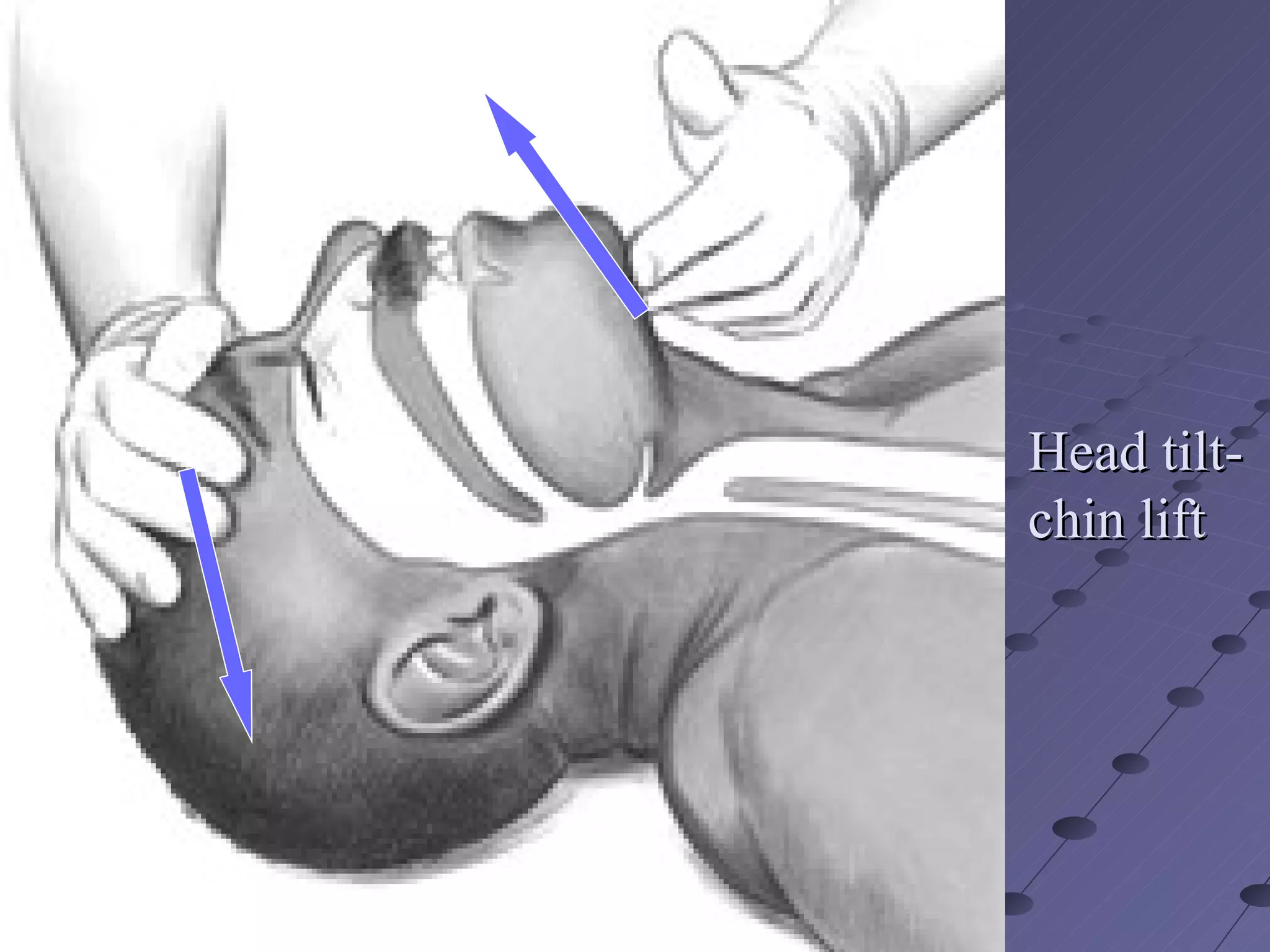
Head tilt-chin lift
*Place one hand on the victim’s forehead and
  push with your palm to tilt the head back
*Place the fingers of the other hand under the
  bony part of the lower jaw near the chin
*Lift the jaw to bring the chin forward
Jaw thrust
Head tilt-
chin lift
(5.)Breathing
-Look
-Listen
-Feel
 -Total time : 5-10 seconds
Give Rescue Breaths

Give 2 rescue breaths
  Each over 1 second
  Produce visible chest rise
Mouth-to-mouth/nose/barrier device
Bag-mask ventilation
Advanced airway
Mouth to mask
Ventilation with bag and mask
Cricoid pressure
(6.) Check Carotid Pulse
-Check for 5 to 10 seconds
Checking carotid
 pulse
(7.) Chest Compression

The low half of the victim’s sternum
Depress the sternum 1/2 to 2 inches ( 4to 5 cm )
Allow the chest to return to its normal position
Compression and chest recoil/relaxation times
 should be approximately equal
To limit interruptions to no longer than 10
 seconds
Compression-Ventilation Ratio

  -If the patient is adult the ratio shoul
     be 30:2 .It means that you have to
     give the victim 2 complete
     breathings and 30 chest
     compressions.
   -If the victim is Children and infants,
     the ration should be: 15:2
Chest Compression
-Your hand
-You should
compress
                      should be
 the lower middle   perpendicular
Of the victim’s      to the chest
chest                 wall of the
wall                     victim
-Every 30
compressions
should be followed
by 2 complete
breathings .
-You should check
if there is carotid
pulse after 2-3
cycles.
- You should keep
on repeating the
cycle until carotid
pulse is seen.
Recovery Position

Unresponsive adult victims who have normal
 breathing and effective circulation
Maintain a patent airway
Reduce the risk of airway obstruction and
 aspiration
Recovery Position
(8.)Automated External Defibrillator
             ( AED )
Sophisticated, reliable computerized devices
Use voice and visual prompts to guide lay
  rescuers and healthcare provider to safely
  defibrillate VF SCA
AEDs are of no value for arrest not caused by
  VF/pulseless VT, and they are not effective
  for treatment of nonshockable rhythms
Relationship between survival and interruption of shock
                  in victims VF SCA
Use of AED
Power on the AED and follow voice prompt
Attach the adhesive pads to the bare skin of the
   victim’s chest
Allow the AED to analyze the victim’s rhythm
Deliver a “shock” if needed
If no shock is needed and after any shock
   delivery, resume CPR beginning with chest
   compression
Roadmap:
   -Defibrillate with 200
            joules
 -Defibrillate with 200-300
            joules
   -Establish IV access,
           intubate
  -Adrenaline 1 mg push
   -Defibrillate with 360
            joules
-Lidocaine 1 mg/kg IV, ET
   -Defibrillate with 360
            joules
(9.)Drugs used in CPR:
Atropine – can be injected bolus, max 3 mg to
block vagal tone, which plays significant role in
some cases of cardiac arrest
Adrenaline – large doses have been withdrawn
from the algorithm. The recommended dose is 1
mg in each 3-5 min.
Vasopresine – in some cases 40 U can replace
adrenaline
Amiodarone - should be included in algorithm
Lidocaine – should be used only in ventricular
fibrillation
io

CPR( Cardiopulmonary Resuscitation

  • 1.
    Adult Basic LifeSupport (BLS ) of Cardiopulmonary Resuscitation (CPR) Clinicalstudio.blogspot.com
  • 2.
    Our job includes: (1.)Look for safety (2.) Check for response (3.) Call for help (4.) Airway (5.)Breathing (6.) Check Carotid Pulse (7.) Chest Compression (8.) Defibrillation (9.) Medication
  • 3.
    (1.)Look for Safety -Beforeapproaching the victim, the rescuer must ensure that the scene is safe - See your surroundings carefully .Make sure that you are not going to be responsible incase the patient dies.
  • 4.
    (2.) Check forResponse Tap the victim on the shoulder. And ask him 2 questions: “Are you all right?” “Can you hear me?”
  • 5.
  • 6.
    -Dial Phone number911,120 -Inform your location -Tell What has happened -Tell to bring defibrillator and medicines
  • 7.
    (4.)Airway Head tilt-chin lift *Placeone hand on the victim’s forehead and push with your palm to tilt the head back *Place the fingers of the other hand under the bony part of the lower jaw near the chin *Lift the jaw to bring the chin forward Jaw thrust
  • 8.
  • 10.
  • 12.
    Give Rescue Breaths Give2 rescue breaths Each over 1 second Produce visible chest rise Mouth-to-mouth/nose/barrier device Bag-mask ventilation Advanced airway
  • 16.
  • 17.
  • 19.
  • 20.
    (6.) Check CarotidPulse -Check for 5 to 10 seconds
  • 21.
  • 22.
    (7.) Chest Compression Thelow half of the victim’s sternum Depress the sternum 1/2 to 2 inches ( 4to 5 cm ) Allow the chest to return to its normal position Compression and chest recoil/relaxation times should be approximately equal To limit interruptions to no longer than 10 seconds
  • 23.
    Compression-Ventilation Ratio -If the patient is adult the ratio shoul be 30:2 .It means that you have to give the victim 2 complete breathings and 30 chest compressions. -If the victim is Children and infants, the ration should be: 15:2
  • 24.
  • 25.
    -Your hand -You should compress should be the lower middle perpendicular Of the victim’s to the chest chest wall of the wall victim
  • 26.
    -Every 30 compressions should befollowed by 2 complete breathings . -You should check if there is carotid pulse after 2-3 cycles. - You should keep on repeating the cycle until carotid pulse is seen.
  • 27.
    Recovery Position Unresponsive adultvictims who have normal breathing and effective circulation Maintain a patent airway Reduce the risk of airway obstruction and aspiration
  • 28.
  • 29.
    (8.)Automated External Defibrillator ( AED ) Sophisticated, reliable computerized devices Use voice and visual prompts to guide lay rescuers and healthcare provider to safely defibrillate VF SCA AEDs are of no value for arrest not caused by VF/pulseless VT, and they are not effective for treatment of nonshockable rhythms
  • 30.
    Relationship between survivaland interruption of shock in victims VF SCA
  • 31.
    Use of AED Poweron the AED and follow voice prompt Attach the adhesive pads to the bare skin of the victim’s chest Allow the AED to analyze the victim’s rhythm Deliver a “shock” if needed If no shock is needed and after any shock delivery, resume CPR beginning with chest compression
  • 34.
    Roadmap: -Defibrillate with 200 joules -Defibrillate with 200-300 joules -Establish IV access, intubate -Adrenaline 1 mg push -Defibrillate with 360 joules -Lidocaine 1 mg/kg IV, ET -Defibrillate with 360 joules
  • 36.
    (9.)Drugs used inCPR: Atropine – can be injected bolus, max 3 mg to block vagal tone, which plays significant role in some cases of cardiac arrest Adrenaline – large doses have been withdrawn from the algorithm. The recommended dose is 1 mg in each 3-5 min. Vasopresine – in some cases 40 U can replace adrenaline Amiodarone - should be included in algorithm Lidocaine – should be used only in ventricular fibrillation
  • 37.