CARDIAC EMERGENCY
   AND ARREST


    MANALI H SOLANKI
    F.Y.M.SC.NURSING
    J G COLLEGE OF
    NURSING
The amount of myocardial stretch just before
systole caused by the pressure created by the
volume of blood within a ventricle


The amount of resistance to ejection of blood
from a ventricle
The inability of the heart to pump sufficient
blood to meet the needs of the tissues for
oxygen and nutrients; signs and symptoms of
pulmonary and systemic congestion may or
may not be present


Amount of blood pumped out of the
ventricle with each contraction
INTRODUCTION

• Cardiovascular disease is the
  number one killer of adults.
  Prompt recognition and initiation
  of appropriate treatment can
  save lives during three of the
  most deadly cardiac
  emergencies: angina
  pectoris, myocardial infarction
  and congestive cardiac failure.
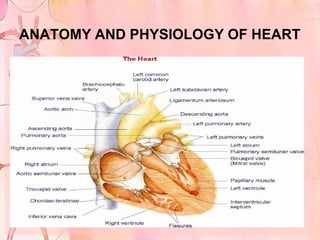
ANATOMY AND PHYSIOLOGY OF HEART
• DEFINITION:
   Angina (angina pectoris - Latin
  for squeezing of the chest) is
  chest discomfort that occurs when
  there is a decreased blood
  oxygen supply to an area of the
  heart muscle.
• The major types of angina are
  stable, unstable, variant
  (Prinzmetal's), and microvascular.
• Stable angina is the most common
  type of angina. It occurs when the
  heart is working harder than usual.
  Stable angina has a regular pattern.

• Stable angina isn't a heart
  attack, but it suggests that a heart
  attack is more likely to happen in
  the future.
• Unstable angina doesn't follow a
  pattern. It may occur more often
  and be more severe than stable
  angina.

• Unstable angina is very dangerous
  and requires emergency treatment.
  This type of angina is a sign that a
  heart attack may happen soon.
• Variant angina is rare. A spasm in
  a coronary artery causes this type
  of angina. Variant angina usually
  occurs while you're at rest, and the
  pain can be severe. It usually
  happens between midnight and
  early morning. Medicine can
  relieve this type of angina
• Microvascular angina can be more
  severe and last longer than other
  types of angina. Medicine may not
  relieve this type of angina.
• Coronary artery spasm
• Coronary-artery disease with
  partial blockage or spasm of
  arteries that supply blood to the
  heart.
• Anaemia.
• Overactive thyroid gland.
• Heart-valve disease.
Diabetes

Family history of coronary heart disease before age 50

High blood pressure

High LDL cholesterol and low HDL cholesterol

Obesity

Smoking

Cold weather

Emotional stress

Large meals
• Tightness, squeezing, pressure or ache in
  the chest.
• Sudden breathing difficulty (sometimes).
• Chest pain similar to indigestion.
• A choking feeling in the throat.
• Chest pain that radiates to the jaw, teeth
  or earlobes.
• Heaviness, numbness, tingling or ache in
  the chest, arm, shoulder, elbow or hand
  usually on the left side.
•   A feeling of indigestion or heartburn
•   Dizziness or light-headedness
•   Nausea, vomiting, and sweating
•   Palpitations
•   Shortness of breath
•   Unexplained tiredness after activity
Thallium stress test
• Nitrates
  Glyceryl Trinitrate

• Isosorbide dinitrate

• Beta blockers
  e.g. Propranolol, Atenolol, Metoprolol,
  Pindolol, Oxprenolol
• Coronary Angioplasty
Coronary artery bypass grafting
NURSING MANAGEMENT
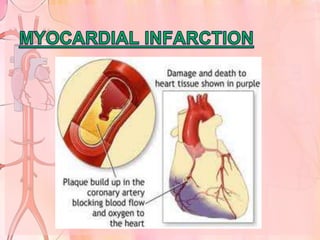
• Myocardial infarction (MI) or acute
  myocardial infarction (AMI), commonly
  known as a heart attack, is the interruption
  of blood supply to a part of the
  heart, causing heart cells to die
CAUSES
   •   Atherosclerosis
   •   High cholesterol levels
   •   High blood pressure
   •   Diabetes
   •   Obesity and Overweight
   •   Smoking
   •   Heredity
SIGN AND SYMPTOMS

•   Chest discomfort, mild pain
•   Coughing
•   Crushing chest pain
•   Dizziness
•   Dyspnea (shortness of breath)
•   Face seems gray
• A feeling of terror that your life is
  coming to its end
• Feeling really awful (general
  feeling)
• Nausea
• Restlessness
• The person is clammy and sweaty
• Vomiting
ASSESSMENT AND DIAGNOSTIC
         FINDINGS
• Physical examination
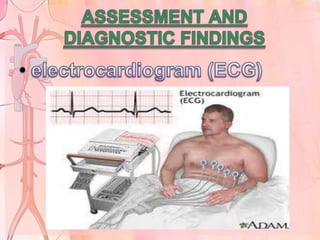
• Electrocardiogram
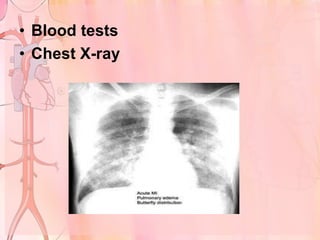
• Blood tests
• Chest X-ray
COMPLICATIONS
•   Arrhythmia.
•   Cardiogenic shock.
•   Heart failure
•   Pulmonary edema
•   Pericarditis.
Other complications for Myocardial
Infarction (MI) include:

• Rupture of the atrial or Ventricular
  septum,

• Ventricular wall, or valves;

• Ventricular aneurysms

• Cerebral or pulmonary emboli
• Anti-platelet medicines
• Nitroglycerin
• ACE (angiotensin converting enzyme)
  inhibitors
• Beta-blocking agents
• Coronary Angioplasty
• Coronary Artery Bypass Grafting
NURSING MANAGEMENT
DEFINITION
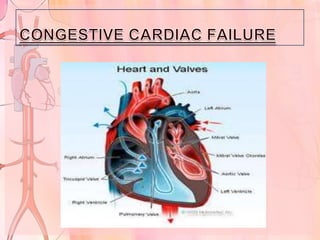
• Heart failure, also called "congestive
  heart failure," is a disorder where the
  heart loses its ability to pump blood
  efficiently.
CAUSES:
• coronary artery disease and heart
  attack (which may be "silent")
• cardiomyopathy
• high blood pressure (hypertension)
• heart valve disease
• congenital heart disease
• alcoholism and drug abuse
SIGN AND SYMPTOMS
• Fatigue
• Swelling (oedema) of the ankles and
  legs or abdomen
• An increase in body weight
• Shortness of breath
• Increased urination
•   Chest x-ray
•   Electrocardiogram (ECG)
•   Blood tests
•   Echocardiogram
•   MUGA scan
•   Stress test
• Angiotensin II receptor blockers (ARBs)
• Vasodilators/Nitrates
• Potassium or magnesium
• Aldosterone inhibitors (spironolactone)
• Calcium channel blockers (for diastolic
  dysfunction only)
• Inotropic therapy
• Angiotensin-converting enzyme (ACE)
  inhibitors
• Beta blockers
NURSING MANAGEMENT
• Sudden cardiac arrest (SCA) is a
  condition in which the heart suddenly
  and unexpectedly stops beating. If
  this happens, blood stops flowing to
  the brain and other vital organs.
•   Coronary artery disease
•   Heart attack
•   Enlarged heart (cardiomyopathy)
•   Valvular heart disease
•   Congenital heart disease
•   Electrical problems in the heart
Risk Factors

• Who have had a heart attack (myocardial
  infarction)
• Who have experienced heart failure (poor
  pumping heart)
• Who have survived a previous sudden
  cardiac arrest
• With a family history of sudden cardiac
  arrest
• With a low ejection fraction
SIGN AND SYMPTOMS

 •   Breathlessness
 •   Fatigue
 •   Breathlessness on lying down
 •   Waking up gasping for breath at night
 •   Swollen abdomen
 •   Enlarged liver
 •   Visible venous pulse in neck
 •   Swollen legs and ankles
 •   Decreased exercise tolerance
 •   Enlarged heart
• Echocardiogram
• Electrocardiogram (ECG)
• Chest x-ray
• Exercise test (stress test)
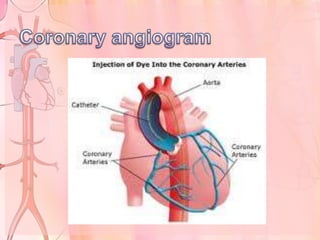
• Cardiac catheterization
• Laboratory studies may include
  CBC, ESR, electrolytes, BUN/creatinine, gluc
  ose, TSH, calcium, magnesium, and
  phosphorus
• Blood cultures
• Angiotensin II receptor blockers (ARBs)
• Vasodilators/Nitrates
• Potassium or magnesium
• Aldosterone inhibitors (spironolactone)
• Calcium channel blockers (for diastolic
  dysfunction only)
• Inotropic therapy
• Diuretics
• Angiotensin-converting enzyme (ACE)
  inhibitors
• Coronary artery bypass surgery
Heart transplant
NURSING MANAGEMENT
Nursing Diagnosis
• Decreased Cardiac Output related to
  impaired contractility and increased
  preload and afterload

• Impaired Gas Exchange related to
  alveolar edema due to elevated
  ventricular pressures
• Excess Fluid Volume related to sodium
  and water retention

• Activity Intolerance related to oxygen
  supply and demand imbalance
BIBLIOGRAPHY:
Cardiac emergency ppt

Cardiac emergency ppt

  • 1.
    CARDIAC EMERGENCY AND ARREST MANALI H SOLANKI F.Y.M.SC.NURSING J G COLLEGE OF NURSING
  • 2.
    The amount ofmyocardial stretch just before systole caused by the pressure created by the volume of blood within a ventricle The amount of resistance to ejection of blood from a ventricle
  • 3.
    The inability ofthe heart to pump sufficient blood to meet the needs of the tissues for oxygen and nutrients; signs and symptoms of pulmonary and systemic congestion may or may not be present Amount of blood pumped out of the ventricle with each contraction
  • 4.
    INTRODUCTION • Cardiovascular diseaseis the number one killer of adults. Prompt recognition and initiation of appropriate treatment can save lives during three of the most deadly cardiac emergencies: angina pectoris, myocardial infarction and congestive cardiac failure.
  • 5.
  • 7.
    • DEFINITION: Angina (angina pectoris - Latin for squeezing of the chest) is chest discomfort that occurs when there is a decreased blood oxygen supply to an area of the heart muscle.
  • 8.
    • The majortypes of angina are stable, unstable, variant (Prinzmetal's), and microvascular.
  • 9.
    • Stable anginais the most common type of angina. It occurs when the heart is working harder than usual. Stable angina has a regular pattern. • Stable angina isn't a heart attack, but it suggests that a heart attack is more likely to happen in the future.
  • 10.
    • Unstable anginadoesn't follow a pattern. It may occur more often and be more severe than stable angina. • Unstable angina is very dangerous and requires emergency treatment. This type of angina is a sign that a heart attack may happen soon.
  • 11.
    • Variant anginais rare. A spasm in a coronary artery causes this type of angina. Variant angina usually occurs while you're at rest, and the pain can be severe. It usually happens between midnight and early morning. Medicine can relieve this type of angina
  • 12.
    • Microvascular anginacan be more severe and last longer than other types of angina. Medicine may not relieve this type of angina.
  • 13.
    • Coronary arteryspasm • Coronary-artery disease with partial blockage or spasm of arteries that supply blood to the heart. • Anaemia. • Overactive thyroid gland. • Heart-valve disease.
  • 14.
    Diabetes Family history ofcoronary heart disease before age 50 High blood pressure High LDL cholesterol and low HDL cholesterol Obesity Smoking Cold weather Emotional stress Large meals
  • 16.
    • Tightness, squeezing,pressure or ache in the chest. • Sudden breathing difficulty (sometimes). • Chest pain similar to indigestion. • A choking feeling in the throat. • Chest pain that radiates to the jaw, teeth or earlobes. • Heaviness, numbness, tingling or ache in the chest, arm, shoulder, elbow or hand usually on the left side.
  • 17.
    A feeling of indigestion or heartburn • Dizziness or light-headedness • Nausea, vomiting, and sweating • Palpitations • Shortness of breath • Unexplained tiredness after activity
  • 20.
  • 22.
    • Nitrates Glyceryl Trinitrate • Isosorbide dinitrate • Beta blockers e.g. Propranolol, Atenolol, Metoprolol, Pindolol, Oxprenolol
  • 23.
  • 24.
  • 25.
  • 27.
    • Myocardial infarction(MI) or acute myocardial infarction (AMI), commonly known as a heart attack, is the interruption of blood supply to a part of the heart, causing heart cells to die
  • 28.
    CAUSES • Atherosclerosis • High cholesterol levels • High blood pressure • Diabetes • Obesity and Overweight • Smoking • Heredity
  • 30.
    SIGN AND SYMPTOMS • Chest discomfort, mild pain • Coughing • Crushing chest pain • Dizziness • Dyspnea (shortness of breath) • Face seems gray
  • 31.
    • A feelingof terror that your life is coming to its end • Feeling really awful (general feeling) • Nausea • Restlessness • The person is clammy and sweaty • Vomiting
  • 32.
    ASSESSMENT AND DIAGNOSTIC FINDINGS • Physical examination • Electrocardiogram
  • 33.
  • 34.
    COMPLICATIONS • Arrhythmia. • Cardiogenic shock. • Heart failure • Pulmonary edema • Pericarditis.
  • 35.
    Other complications forMyocardial Infarction (MI) include: • Rupture of the atrial or Ventricular septum, • Ventricular wall, or valves; • Ventricular aneurysms • Cerebral or pulmonary emboli
  • 36.
    • Anti-platelet medicines •Nitroglycerin • ACE (angiotensin converting enzyme) inhibitors • Beta-blocking agents • Coronary Angioplasty • Coronary Artery Bypass Grafting
  • 37.
  • 39.
    DEFINITION • Heart failure,also called "congestive heart failure," is a disorder where the heart loses its ability to pump blood efficiently.
  • 40.
    CAUSES: • coronary arterydisease and heart attack (which may be "silent") • cardiomyopathy • high blood pressure (hypertension) • heart valve disease • congenital heart disease • alcoholism and drug abuse
  • 42.
    SIGN AND SYMPTOMS •Fatigue • Swelling (oedema) of the ankles and legs or abdomen • An increase in body weight • Shortness of breath • Increased urination
  • 43.
    Chest x-ray • Electrocardiogram (ECG) • Blood tests • Echocardiogram • MUGA scan • Stress test
  • 44.
    • Angiotensin IIreceptor blockers (ARBs) • Vasodilators/Nitrates • Potassium or magnesium • Aldosterone inhibitors (spironolactone) • Calcium channel blockers (for diastolic dysfunction only) • Inotropic therapy • Angiotensin-converting enzyme (ACE) inhibitors • Beta blockers
  • 45.
  • 47.
    • Sudden cardiacarrest (SCA) is a condition in which the heart suddenly and unexpectedly stops beating. If this happens, blood stops flowing to the brain and other vital organs.
  • 48.
    Coronary artery disease • Heart attack • Enlarged heart (cardiomyopathy) • Valvular heart disease • Congenital heart disease • Electrical problems in the heart
  • 49.
    Risk Factors • Whohave had a heart attack (myocardial infarction) • Who have experienced heart failure (poor pumping heart) • Who have survived a previous sudden cardiac arrest • With a family history of sudden cardiac arrest • With a low ejection fraction
  • 51.
    SIGN AND SYMPTOMS • Breathlessness • Fatigue • Breathlessness on lying down • Waking up gasping for breath at night • Swollen abdomen • Enlarged liver • Visible venous pulse in neck • Swollen legs and ankles • Decreased exercise tolerance • Enlarged heart
  • 52.
    • Echocardiogram • Electrocardiogram(ECG) • Chest x-ray • Exercise test (stress test) • Cardiac catheterization • Laboratory studies may include CBC, ESR, electrolytes, BUN/creatinine, gluc ose, TSH, calcium, magnesium, and phosphorus • Blood cultures
  • 53.
    • Angiotensin IIreceptor blockers (ARBs) • Vasodilators/Nitrates • Potassium or magnesium • Aldosterone inhibitors (spironolactone) • Calcium channel blockers (for diastolic dysfunction only) • Inotropic therapy • Diuretics • Angiotensin-converting enzyme (ACE) inhibitors
  • 54.
    • Coronary arterybypass surgery
  • 55.
  • 56.
  • 57.
    Nursing Diagnosis • DecreasedCardiac Output related to impaired contractility and increased preload and afterload • Impaired Gas Exchange related to alveolar edema due to elevated ventricular pressures
  • 58.
    • Excess FluidVolume related to sodium and water retention • Activity Intolerance related to oxygen supply and demand imbalance
  • 61.