OBJECTIVES
• DEFINE BLS
• EXPLAIN STEPS AND COMPONENETS OF BLS
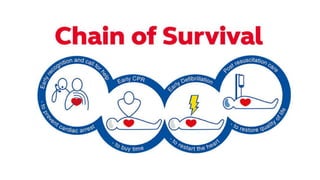
• CHAIN OF SURVIVAL
• DEFIBRILLATOR
INTRODUCTION
• According to recent statistics, cardiac arrest is recently becoming the
leading cause of death
• Once heart ceases to function, healthy human brain may survive
without oxygen for approximately 4 minutes without suffering any
permanant damage
• Unfortunately , a typical EMS response may take 6, 8 or even 10
minutes
• IT IS DURING THIS CRITICAL MOMENT THAT CPR
(CARDIOPULMONARY RESUSCITATION) CAN PROVIDE OXYGENATED
BLOOD TO THE VICTIM’S BRAIN AND HEART, DRAMATICALLY
INCREASING THE CHANCES OF SURVIVAL
WHAT IS BLS ?
• Refers to the sequences of procedures performed to restore the
circulation of oxygenated blood after sudden pulmonary or cardiac
arrest until they can be given complete medical care at a hospital
• Includes psychomotor skills for performing high quality CPR, using
AED and relieving obstructed airway for patients of all ages
• NO USE OF DRUGS OR INVASIVE SKILLS
RESPIRATORY ARREST
• PATIENT IS NOT BREATHING, BUT HAS A DEFINITIVE PULSE
• Ventilations must be given to a patient experiencing Respiratory
arrest
CARDIAC ARREST
• PATIENT HAS NO BREATHING , NO PULSE AND IS UNRESPONSIVE
• CPR must be started
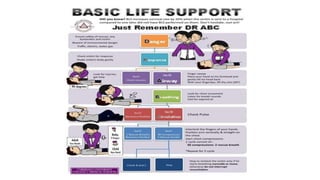
COMPONENTS OF BLS
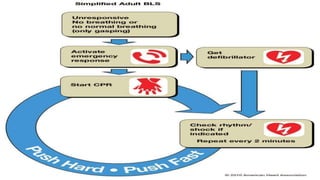
• ENSURE SAFETY
• CHECK FOR RESPONSE
• ACTIVATE EMS (102/108/112)
• CHEST COMPRESSIONS
• CHECK AIRWAY AND VENTILATE
• DEFIBRILLATE
ENSURE SAFETY
• Safety Of Self
• Safety Of Patient
• Movement of a trauma victim – only when absolutely necessary
[unstable cervical spine – injured spinal cord]
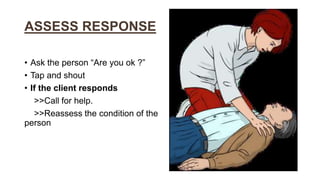
ASSESS RESPONSE
• Ask the person “Are you ok ?”
• Tap and shout
• If the client responds
>>Call for help.
>>Reassess the condition of the
person
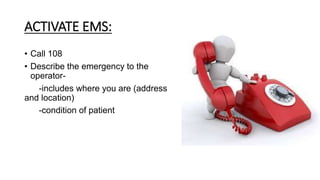
ACTIVATE EMS:
• Call 108
• Describe the emergency to the
operator-
-includes where you are (address
and location)
-condition of patient
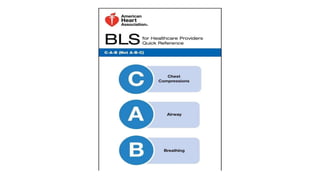
CHANGE FROM A-B-C TO C-A-B
• The vast majority of cardiac arrests occur in adults, and the highest
survival rates from cardiac arrest are reported among patients of all ages
who have a witnessed arrest and an initial rhythm of VF or pulseless VT.
• In these patients, the critical initial elements of BLS are chest
compressions and early defibrillation.
• In the A-B-C sequence, chest compressions are often delayed while
the responder opens the airway to give mouth-to-mouth breaths,
retrieves a barrier device, or gathers and assembles ventilation
equipment.
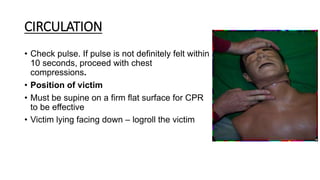
CIRCULATION
• Check pulse. If pulse is not definitely felt within
10 seconds, proceed with chest
compressions.
• Position of victim
• Must be supine on a firm flat surface for CPR
to be effective
• Victim lying facing down – logroll the victim
Pregnancy
• During pregnancy when a woman is lying on her back, the uterus may compress the
inferior vena cava and thus decrease venous return.
• It is therefore recommended that the uterus be pushed to the woman's left; if this is not
effective, either roll the woman 30°.
Cervical spine stabilization
• Use cervical collar if available
• Any hard objects that restrict neck movement
• Firm surface(backboard or floor)
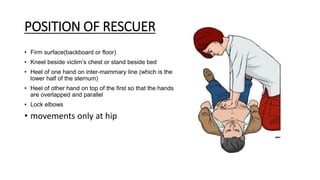
POSITION OF RESCUER
• Firm surface(backboard or floor)
• Kneel beside victim’s chest or stand beside bed
• Heel of one hand on inter-mammary line (which is the
lower half of the sternum)
• Heel of other hand on top of the first so that the hands
are overlapped and parallel
• Lock elbows
• movements only at hip
CIRCULATION
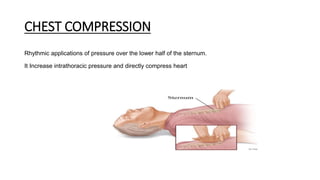
CHEST COMPRESSION
Rhythmic applications of pressure over the lower half of the sternum.
It Increase intrathoracic pressure and directly compress heart
CHARACTERISTICS OF GOOD
COMPRESSION
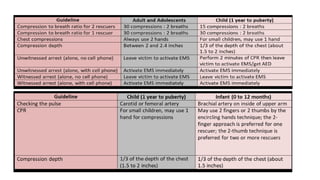
• “Push hard push fast”. Push at a rate of 100-120 min.
• Compression depth- at least 2 inches(5cm) not more than 2.5
inches
• Release completely to allow the chest to fully recoil.
• A compression-ventilation ratio of 30:2 .
• Do not bounce your hands up and down on the victim’s chest.
• Never use the palm of your hand, use the heel of your hand
AIRWAY
2 / more rescuers
• Chest compressions
• Switch the compressor about every 2 minutes (or after 5 cycles of
compressions and ventilations at a ratio of 30:2).
• Accomplish this switch in ≤5 seconds.
• Advanced airway and 2 rescuers-
• Continuous chest compressions at a rate of 100-120 /min without pauses
for ventilation.
• The rescuer delivering ventilation provides 8 to 10 breaths per minute.
• Lay rescuers should continue CPR until an AED arrives
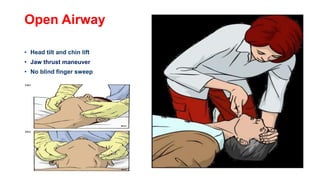
Open Airway
• Head tilt and chin lift
• Jaw thrust maneuver
• No blind finger sweep
BREATHING
BREATHING
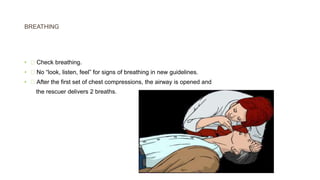
• Check breathing.
• No “look, listen, feel” for signs of breathing in new guidelines.
• After the first set of chest compressions, the airway is opened and
the rescuer delivers 2 breaths.
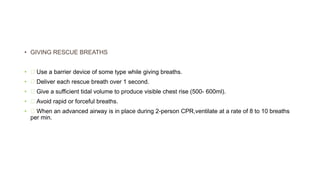
• GIVING RESCUE BREATHS
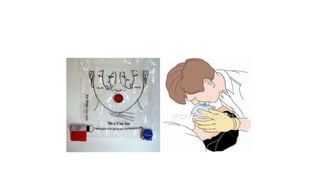
• Use a barrier device of some type while giving breaths.
• Deliver each rescue breath over 1 second.
• Give a sufficient tidal volume to produce visible chest rise (500- 600ml).
• Avoid rapid or forceful breaths.
• When an advanced airway is in place during 2-person CPR,ventilate at a rate of 8 to 10 breaths
per min.
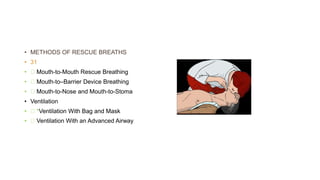
• METHODS OF RESCUE BREATHS
• 31
• Mouth-to-Mouth Rescue Breathing
• Mouth-to–Barrier Device Breathing
• Mouth-to-Nose and Mouth-to-Stoma
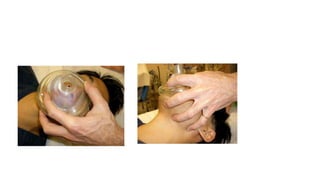
• Ventilation
• *Ventilation With Bag and Mask
• Ventilation With an Advanced Airway
• EARLY DEFIBRILLATION
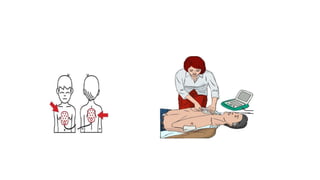
• AED – Automatic external Defibrillator
• A battery operated device
• On applying to victim - detects and assesses cardiac rhythm and
• prompts the user for further action
• AED BOX contains –
• AED machine with battery and charger
• Two self sticking pads with cables & connectors
• one razor
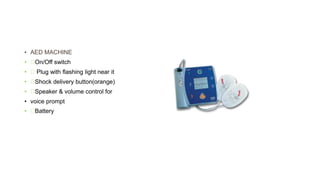
• AED MACHINE
• On/Off switch
• Plug with flashing light near it
• Shock delivery button(orange)
• Speaker & volume control for
• voice prompt
• Battery
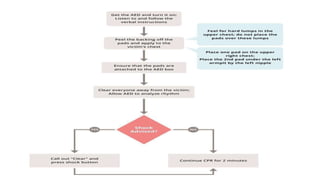
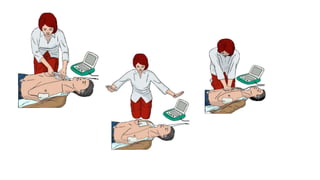
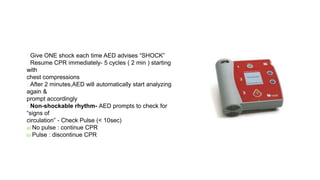
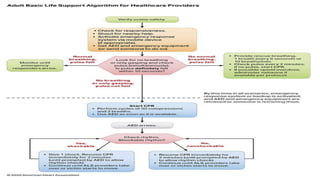
Give ONE shock each time AED advises “SHOCK”
Resume CPR immediately- 5 cycles ( 2 min ) starting
with
chest compressions
After 2 minutes,AED will automatically start analyzing
again &
prompt accordingly
Non-shockable rhythm- AED prompts to check for
“signs of
circulation” - Check Pulse (< 10sec)
a) No pulse : continue CPR
b) Pulse : discontinue CPR
40
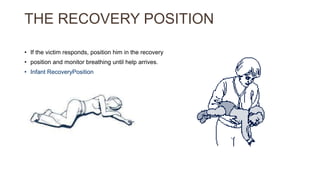
THE RECOVERY POSITION
• If the victim responds, position him in the recovery
• position and monitor breathing until help arrives.
• Infant RecoveryPosition
• 5641
• CONTINUE RESUSCITATION UNTIL
• 43
• Qualified help arrives and takes over
• Victim revives: The victim starts breathing normally
• Rescuer becomes exhausted
BLS.pptx
BLS.pptx
BLS.pptx
BLS.pptx

BLS.pptx

  • 1.
    OBJECTIVES • DEFINE BLS •EXPLAIN STEPS AND COMPONENETS OF BLS • CHAIN OF SURVIVAL • DEFIBRILLATOR
  • 2.
    INTRODUCTION • According torecent statistics, cardiac arrest is recently becoming the leading cause of death • Once heart ceases to function, healthy human brain may survive without oxygen for approximately 4 minutes without suffering any permanant damage • Unfortunately , a typical EMS response may take 6, 8 or even 10 minutes
  • 3.
    • IT ISDURING THIS CRITICAL MOMENT THAT CPR (CARDIOPULMONARY RESUSCITATION) CAN PROVIDE OXYGENATED BLOOD TO THE VICTIM’S BRAIN AND HEART, DRAMATICALLY INCREASING THE CHANCES OF SURVIVAL
  • 4.
    WHAT IS BLS? • Refers to the sequences of procedures performed to restore the circulation of oxygenated blood after sudden pulmonary or cardiac arrest until they can be given complete medical care at a hospital • Includes psychomotor skills for performing high quality CPR, using AED and relieving obstructed airway for patients of all ages • NO USE OF DRUGS OR INVASIVE SKILLS
  • 5.
    RESPIRATORY ARREST • PATIENTIS NOT BREATHING, BUT HAS A DEFINITIVE PULSE • Ventilations must be given to a patient experiencing Respiratory arrest
  • 6.
    CARDIAC ARREST • PATIENTHAS NO BREATHING , NO PULSE AND IS UNRESPONSIVE • CPR must be started
  • 9.
    COMPONENTS OF BLS •ENSURE SAFETY • CHECK FOR RESPONSE • ACTIVATE EMS (102/108/112) • CHEST COMPRESSIONS • CHECK AIRWAY AND VENTILATE • DEFIBRILLATE
  • 11.
    ENSURE SAFETY • SafetyOf Self • Safety Of Patient • Movement of a trauma victim – only when absolutely necessary [unstable cervical spine – injured spinal cord]
  • 12.
    ASSESS RESPONSE • Askthe person “Are you ok ?” • Tap and shout • If the client responds >>Call for help. >>Reassess the condition of the person
  • 13.
    ACTIVATE EMS: • Call108 • Describe the emergency to the operator- -includes where you are (address and location) -condition of patient
  • 15.
    CHANGE FROM A-B-CTO C-A-B • The vast majority of cardiac arrests occur in adults, and the highest survival rates from cardiac arrest are reported among patients of all ages who have a witnessed arrest and an initial rhythm of VF or pulseless VT. • In these patients, the critical initial elements of BLS are chest compressions and early defibrillation. • In the A-B-C sequence, chest compressions are often delayed while the responder opens the airway to give mouth-to-mouth breaths, retrieves a barrier device, or gathers and assembles ventilation equipment.
  • 16.
    CIRCULATION • Check pulse.If pulse is not definitely felt within 10 seconds, proceed with chest compressions. • Position of victim • Must be supine on a firm flat surface for CPR to be effective • Victim lying facing down – logroll the victim
  • 17.
    Pregnancy • During pregnancywhen a woman is lying on her back, the uterus may compress the inferior vena cava and thus decrease venous return. • It is therefore recommended that the uterus be pushed to the woman's left; if this is not effective, either roll the woman 30°.
  • 18.
    Cervical spine stabilization •Use cervical collar if available • Any hard objects that restrict neck movement • Firm surface(backboard or floor)
  • 19.
    POSITION OF RESCUER •Firm surface(backboard or floor) • Kneel beside victim’s chest or stand beside bed • Heel of one hand on inter-mammary line (which is the lower half of the sternum) • Heel of other hand on top of the first so that the hands are overlapped and parallel • Lock elbows • movements only at hip
  • 20.
  • 21.
    CHEST COMPRESSION Rhythmic applicationsof pressure over the lower half of the sternum. It Increase intrathoracic pressure and directly compress heart
  • 22.
    CHARACTERISTICS OF GOOD COMPRESSION •“Push hard push fast”. Push at a rate of 100-120 min. • Compression depth- at least 2 inches(5cm) not more than 2.5 inches • Release completely to allow the chest to fully recoil. • A compression-ventilation ratio of 30:2 . • Do not bounce your hands up and down on the victim’s chest. • Never use the palm of your hand, use the heel of your hand
  • 23.
  • 24.
    2 / morerescuers • Chest compressions • Switch the compressor about every 2 minutes (or after 5 cycles of compressions and ventilations at a ratio of 30:2). • Accomplish this switch in ≤5 seconds. • Advanced airway and 2 rescuers- • Continuous chest compressions at a rate of 100-120 /min without pauses for ventilation. • The rescuer delivering ventilation provides 8 to 10 breaths per minute. • Lay rescuers should continue CPR until an AED arrives
  • 25.
    Open Airway • Headtilt and chin lift • Jaw thrust maneuver • No blind finger sweep
  • 26.
  • 27.
    BREATHING • Check breathing. •No “look, listen, feel” for signs of breathing in new guidelines. • After the first set of chest compressions, the airway is opened and the rescuer delivers 2 breaths.
  • 28.
    • GIVING RESCUEBREATHS • Use a barrier device of some type while giving breaths. • Deliver each rescue breath over 1 second. • Give a sufficient tidal volume to produce visible chest rise (500- 600ml). • Avoid rapid or forceful breaths. • When an advanced airway is in place during 2-person CPR,ventilate at a rate of 8 to 10 breaths per min.
  • 29.
    • METHODS OFRESCUE BREATHS • 31 • Mouth-to-Mouth Rescue Breathing • Mouth-to–Barrier Device Breathing • Mouth-to-Nose and Mouth-to-Stoma • Ventilation • *Ventilation With Bag and Mask • Ventilation With an Advanced Airway
  • 32.
    • EARLY DEFIBRILLATION •AED – Automatic external Defibrillator • A battery operated device • On applying to victim - detects and assesses cardiac rhythm and • prompts the user for further action • AED BOX contains – • AED machine with battery and charger • Two self sticking pads with cables & connectors • one razor
  • 33.
    • AED MACHINE •On/Off switch • Plug with flashing light near it • Shock delivery button(orange) • Speaker & volume control for • voice prompt • Battery
  • 37.
    Give ONE shockeach time AED advises “SHOCK” Resume CPR immediately- 5 cycles ( 2 min ) starting with chest compressions After 2 minutes,AED will automatically start analyzing again & prompt accordingly Non-shockable rhythm- AED prompts to check for “signs of circulation” - Check Pulse (< 10sec) a) No pulse : continue CPR b) Pulse : discontinue CPR 40
  • 38.
    THE RECOVERY POSITION •If the victim responds, position him in the recovery • position and monitor breathing until help arrives. • Infant RecoveryPosition • 5641
  • 39.
    • CONTINUE RESUSCITATIONUNTIL • 43 • Qualified help arrives and takes over • Victim revives: The victim starts breathing normally • Rescuer becomes exhausted