
NURSES role in COVID19 Management
Presented by:
Prof.Vijayreddy Vandali
PhD Scholar, MSN,PGDHA,PGCDE,MIPHA,.
Faculty
Department of Medical Surgical Nursing
ESIC College of Nursing
INDIA.
Introduction
• In honor of nurses and midwives’ commitment to their profession
WHO designated 2020 as the “International Year of the Nurse and
the Midwife,” prior to the COVID-19 pandemic.
• It’s a great honor and proud moment for entire nursing profession
across the globe and also it will be an utmost motivation for nurses to
work still much better in upcoming days
Contd…
Nurses are always the backbone in every health care system such
as hospitals, community health centers, old age care homes, and also
called the brain of the hospital and the largest manpower of the health
care system in every country. Nurses play a vital role in all the levels of
the health care system including infection control or prevention of
disease, screening/diagnosis of the diseases, treatment, and even in
rehabilitation care also.
COVID-19
• All of us knew that COVID-19 which had an epicenter in Wuhan
province in China since December-2019 and has already spread
across the globe.
• It claimed 1.2 million plus lives and 50 Million plus infected peoples as
on 11th November 2020 and still not under control in most of the
parts in the world except few countries.
• 36.397,164 recovery across the world.
• Yet struggling to find vaccine
• Treatment only depend on symptoms
NURSES Role in
Management of
COVID19
Caring for COVID-19 patients is a challenge for the nurses because the
patient’s health problems due to covid-19 are varied from patient to patient.
Accurate treatment and vaccination not yet found for the same even though
after struggling hard from most developed countries such as the India, USA,
UK, Russia, Australia, Israel, Italy, etc.
Nursing Assessment
• Careful assessment is essential in the evaluation and management of
patients who may have COVID-19, and particularly in those with fever,
acute respiratory illness, and other symptoms of infection. Nursing
assessments of these patients should include:
• Travel history – a detailed travel history should include travel to other
countries, states, or cities with active COVID-19 cases; resources such as
Johns Hopkins Coronavirus Resource Center can be helpful in
determining geographic “hotspots” in the United States and worldwide.
• Physical examination – careful documentation of the patient’s signs and
symptoms, which may develop 2 to 14 days after exposure to the virus;
the Centers for Disease Control and Prevention (CDC) lists the following
symptoms of COVID-19:
Contd…
• Fever, chills
• Cough
• Dyspnea
• Headache
• Fatigue
• Myalgia
• Sore throat
• New loss of smell (anosmia) or taste (ageusia)
• Congestion or runny nose
• Nausea or vomiting
• Diarrhea
Contd…
• Not every patient with COVID-19 experiences all of these symptoms.
In fact, a study published on June 23, 2020, found that 78 percent of
COVID-19 patients had a fever, 57 percent reported a cough, and 31
percent said they had suffered fatigue. Interestingly, 25 percent had
lost their sense of smell and 23 percent lost their sense of taste.
Nursing Diagnosis
• A nursing diagnosis provides clinical judgment about the patient’s
experiences and responses to potential coronavirus infection. Nursing
diagnosis for a patient with COVID-19 can include:
• Possible exposure to the virus that causes COVID-19
• The patient’s level of knowledge about the transmission of COVID-19
• Fever
• Impaired breathing pattern related to shortness of breath
• Anxiety associated with the unknown etiology of the disease
Nursing Care Planning and Goals
• Establishing nursing care plan goals can help improve patient outcomes and
decrease the transmission of COVID-19. Major nursing care planning goals for
COVID-19 may include:
• Establishing goals, interventions
• Assessing altered skin integrity risks, fatigue, impaired comfort, gas exchange,
nutritional needs, and nausea
• Preventing the spread of coronavirus infection to the patient’s family
members, community, and healthcare providers
• Providing more information about COVID-19 and its management to the
patient – in a Pew Research Center poll released June 29, 2020, only 64
percent of adults said the CDC “mostly gets the facts about the outbreak
right”
• Reducing fever
• Restoring normal respiratory patterns
Nursing Interventions
• Based on assessment data, nursing interventions for COVID-19 should focus on
monitoring vital signs, maintaining respiratory function, managing hyperthermia,
and reducing transmission.
• Monitor vital signs – particularly temperature and respiratory rate, as fever and
dyspnea are common symptoms of COVID-19.
• Monitor O2 saturation – normal O2 saturation as measured with pulse oximeter
should be 94 or higher; patients with severe COVID-19 symptoms can develop
hypoxia, with values dropping low enough to warrant supplemental oxygen.
• Manage fever – use appropriate therapy for hyperthermia, including adjusting
room temperature, eliminating excess clothing and covers, using cooling
mattresses, applying cold packs to major blood vessels, starting or increasing
intravenous (IV) fluids as allowed, administering antipyretic medications as
prescribed, and readying oxygen therapy in the event of respiratory problems
resulting from the metabolic demands for oxygen during a fever.
Contd…
• Maintain respiratory isolation – isolation rooms should be well-
marked with limited access; all who enter the restricted-access room
should use personal protective equipment, such as masks and gowns.
• Enforce strict hand hygiene – to reduce or prevent transmission of
coronavirus, patients should wash hands after coughing, as should all
who enter or leave the room.
• Provide information – educate the patient and patient’s family
members of the transmission of COVID-19, the tests to diagnose the
disease, disease process, possible complications, and ways to protect
oneself and one’s family from coronavirus.
Contd…
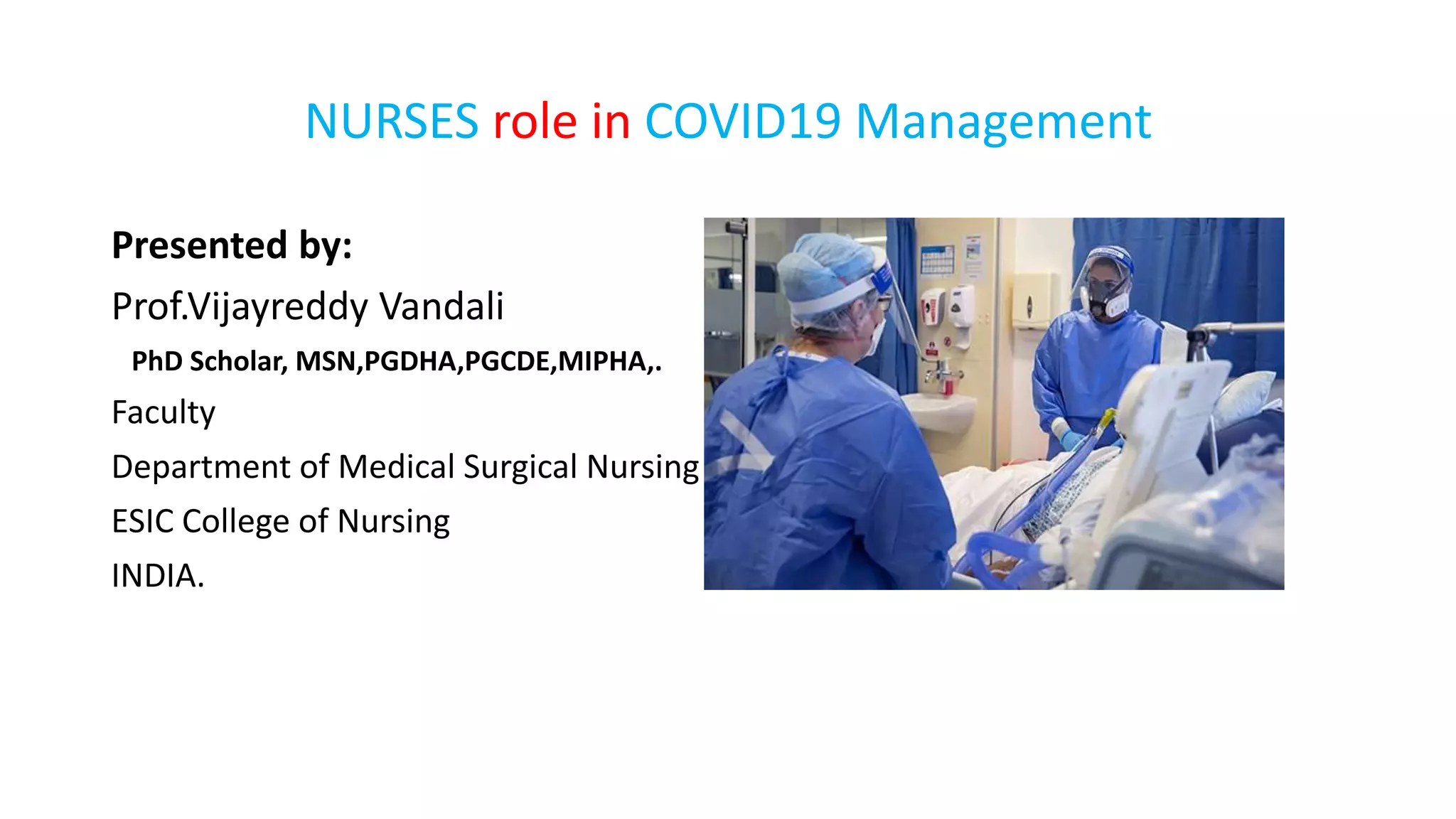
• Nurses are taking care of COVID-19 positive patients as frontline
health care staff as well in the ICUs by strict monitoring of TPR BP,
Oxygen delivery, medicines, and diet also for 24x7 caring for the same
without a step back.
• Even though they knew that 500 plus nurses lost their lives while
caring for COVID-19 patients across the world.
• England Prime Minister Mr. Borrison thanked nurses for caring in an
excellent manner hence many patients recovering from the deadly
pandemic.
Evaluation
• Evaluation helps nurses determine if they have met their goals.
Evidence for meeting nursing goals for COVID-19 might include:
• The patient successfully prevented the spread of infection to family,
the community, or to healthcare staff
• The patient learned more about COVID-19 and its management
• The patient had improved body temperature levels
• Restoration to normal breathing patterns
• Reduced anxiety
Documentation Guidelines
• Documentation is always important, but perhaps more so when caring for
patients with COVID-19. Documentation guidelines for COVID-19 patients
include:
• Individual findings, including any external factors affecting the patient’s
illness, interactions, nature of social exchanges, and specifics patient
behaviors
• Cultural and religious beliefs expressed by the patient
• Patient expectations
• Care plan
• Teaching plan
• Responses to nursing interventions, education, and information, and
nursing actions performed
• Attainment of, or progress toward, the desired clinical outcome and
fulfillment of patient expectations
THANKING YOU ALL DEAR FRIENDS
References
1.https://www.afro.who.In/
2. https://everynurse.org/
3. https://www.slideshare.net/vijayvandali/prevention-of-corona-virus
4. https://rcni.com/
5. https:// rcni.com/nursing-standard/newsroom/news/covid-19-
critical-care-nurse-to-patient-ratio-redefined-21-second-wave-1689166
6. https://www.nursingcenter.com/
7.

Nurses role in COVID-19 Management

  • 1.
    NURSES role inCOVID19 Management Presented by: Prof.Vijayreddy Vandali PhD Scholar, MSN,PGDHA,PGCDE,MIPHA,. Faculty Department of Medical Surgical Nursing ESIC College of Nursing INDIA.
  • 2.
    Introduction • In honorof nurses and midwives’ commitment to their profession WHO designated 2020 as the “International Year of the Nurse and the Midwife,” prior to the COVID-19 pandemic. • It’s a great honor and proud moment for entire nursing profession across the globe and also it will be an utmost motivation for nurses to work still much better in upcoming days
  • 3.
    Contd… Nurses are alwaysthe backbone in every health care system such as hospitals, community health centers, old age care homes, and also called the brain of the hospital and the largest manpower of the health care system in every country. Nurses play a vital role in all the levels of the health care system including infection control or prevention of disease, screening/diagnosis of the diseases, treatment, and even in rehabilitation care also.
  • 4.
    COVID-19 • All ofus knew that COVID-19 which had an epicenter in Wuhan province in China since December-2019 and has already spread across the globe. • It claimed 1.2 million plus lives and 50 Million plus infected peoples as on 11th November 2020 and still not under control in most of the parts in the world except few countries. • 36.397,164 recovery across the world. • Yet struggling to find vaccine • Treatment only depend on symptoms
  • 5.
    NURSES Role in Managementof COVID19 Caring for COVID-19 patients is a challenge for the nurses because the patient’s health problems due to covid-19 are varied from patient to patient. Accurate treatment and vaccination not yet found for the same even though after struggling hard from most developed countries such as the India, USA, UK, Russia, Australia, Israel, Italy, etc.
  • 6.
    Nursing Assessment • Carefulassessment is essential in the evaluation and management of patients who may have COVID-19, and particularly in those with fever, acute respiratory illness, and other symptoms of infection. Nursing assessments of these patients should include: • Travel history – a detailed travel history should include travel to other countries, states, or cities with active COVID-19 cases; resources such as Johns Hopkins Coronavirus Resource Center can be helpful in determining geographic “hotspots” in the United States and worldwide. • Physical examination – careful documentation of the patient’s signs and symptoms, which may develop 2 to 14 days after exposure to the virus; the Centers for Disease Control and Prevention (CDC) lists the following symptoms of COVID-19:
  • 7.
    Contd… • Fever, chills •Cough • Dyspnea • Headache • Fatigue • Myalgia • Sore throat • New loss of smell (anosmia) or taste (ageusia) • Congestion or runny nose • Nausea or vomiting • Diarrhea
  • 8.
    Contd… • Not everypatient with COVID-19 experiences all of these symptoms. In fact, a study published on June 23, 2020, found that 78 percent of COVID-19 patients had a fever, 57 percent reported a cough, and 31 percent said they had suffered fatigue. Interestingly, 25 percent had lost their sense of smell and 23 percent lost their sense of taste.
  • 9.
    Nursing Diagnosis • Anursing diagnosis provides clinical judgment about the patient’s experiences and responses to potential coronavirus infection. Nursing diagnosis for a patient with COVID-19 can include: • Possible exposure to the virus that causes COVID-19 • The patient’s level of knowledge about the transmission of COVID-19 • Fever • Impaired breathing pattern related to shortness of breath • Anxiety associated with the unknown etiology of the disease
  • 10.
    Nursing Care Planningand Goals • Establishing nursing care plan goals can help improve patient outcomes and decrease the transmission of COVID-19. Major nursing care planning goals for COVID-19 may include: • Establishing goals, interventions • Assessing altered skin integrity risks, fatigue, impaired comfort, gas exchange, nutritional needs, and nausea • Preventing the spread of coronavirus infection to the patient’s family members, community, and healthcare providers • Providing more information about COVID-19 and its management to the patient – in a Pew Research Center poll released June 29, 2020, only 64 percent of adults said the CDC “mostly gets the facts about the outbreak right” • Reducing fever • Restoring normal respiratory patterns
  • 11.
    Nursing Interventions • Basedon assessment data, nursing interventions for COVID-19 should focus on monitoring vital signs, maintaining respiratory function, managing hyperthermia, and reducing transmission. • Monitor vital signs – particularly temperature and respiratory rate, as fever and dyspnea are common symptoms of COVID-19. • Monitor O2 saturation – normal O2 saturation as measured with pulse oximeter should be 94 or higher; patients with severe COVID-19 symptoms can develop hypoxia, with values dropping low enough to warrant supplemental oxygen. • Manage fever – use appropriate therapy for hyperthermia, including adjusting room temperature, eliminating excess clothing and covers, using cooling mattresses, applying cold packs to major blood vessels, starting or increasing intravenous (IV) fluids as allowed, administering antipyretic medications as prescribed, and readying oxygen therapy in the event of respiratory problems resulting from the metabolic demands for oxygen during a fever.
  • 12.
    Contd… • Maintain respiratoryisolation – isolation rooms should be well- marked with limited access; all who enter the restricted-access room should use personal protective equipment, such as masks and gowns. • Enforce strict hand hygiene – to reduce or prevent transmission of coronavirus, patients should wash hands after coughing, as should all who enter or leave the room. • Provide information – educate the patient and patient’s family members of the transmission of COVID-19, the tests to diagnose the disease, disease process, possible complications, and ways to protect oneself and one’s family from coronavirus.
  • 13.
    Contd… • Nurses aretaking care of COVID-19 positive patients as frontline health care staff as well in the ICUs by strict monitoring of TPR BP, Oxygen delivery, medicines, and diet also for 24x7 caring for the same without a step back. • Even though they knew that 500 plus nurses lost their lives while caring for COVID-19 patients across the world. • England Prime Minister Mr. Borrison thanked nurses for caring in an excellent manner hence many patients recovering from the deadly pandemic.
  • 14.
    Evaluation • Evaluation helpsnurses determine if they have met their goals. Evidence for meeting nursing goals for COVID-19 might include: • The patient successfully prevented the spread of infection to family, the community, or to healthcare staff • The patient learned more about COVID-19 and its management • The patient had improved body temperature levels • Restoration to normal breathing patterns • Reduced anxiety
  • 15.
    Documentation Guidelines • Documentationis always important, but perhaps more so when caring for patients with COVID-19. Documentation guidelines for COVID-19 patients include: • Individual findings, including any external factors affecting the patient’s illness, interactions, nature of social exchanges, and specifics patient behaviors • Cultural and religious beliefs expressed by the patient • Patient expectations • Care plan • Teaching plan • Responses to nursing interventions, education, and information, and nursing actions performed • Attainment of, or progress toward, the desired clinical outcome and fulfillment of patient expectations
  • 16.
    THANKING YOU ALLDEAR FRIENDS
  • 17.
    References 1.https://www.afro.who.In/ 2. https://everynurse.org/ 3. https://www.slideshare.net/vijayvandali/prevention-of-corona-virus 4.https://rcni.com/ 5. https:// rcni.com/nursing-standard/newsroom/news/covid-19- critical-care-nurse-to-patient-ratio-redefined-21-second-wave-1689166 6. https://www.nursingcenter.com/ 7.