Presentation on
Cardiac Emergencies and its
Nursing Responsibilities
Bsc (h) Nursing
RAKCON
Content
■ Introduction
■ Definition
■ Types or cardiac Emergencies
■ Clinical example
■ Research
■ Summary and conclusion
Introduction
■Cardiac emergency disease is the
number one killer of adults prompts
recognition and of appropriate
treatment can save lives during three of
the most deadly cardiac emergencies,
sudden cardiac death, heart failure and
acute pericarditis.
Anatomy andPhysiology of Heart
Definition
■ Cardiovascular emergencies are
life threatening conditions that
must be recognised
immediately to avoid delay in
treatment and minimise
morbidity and mortality.
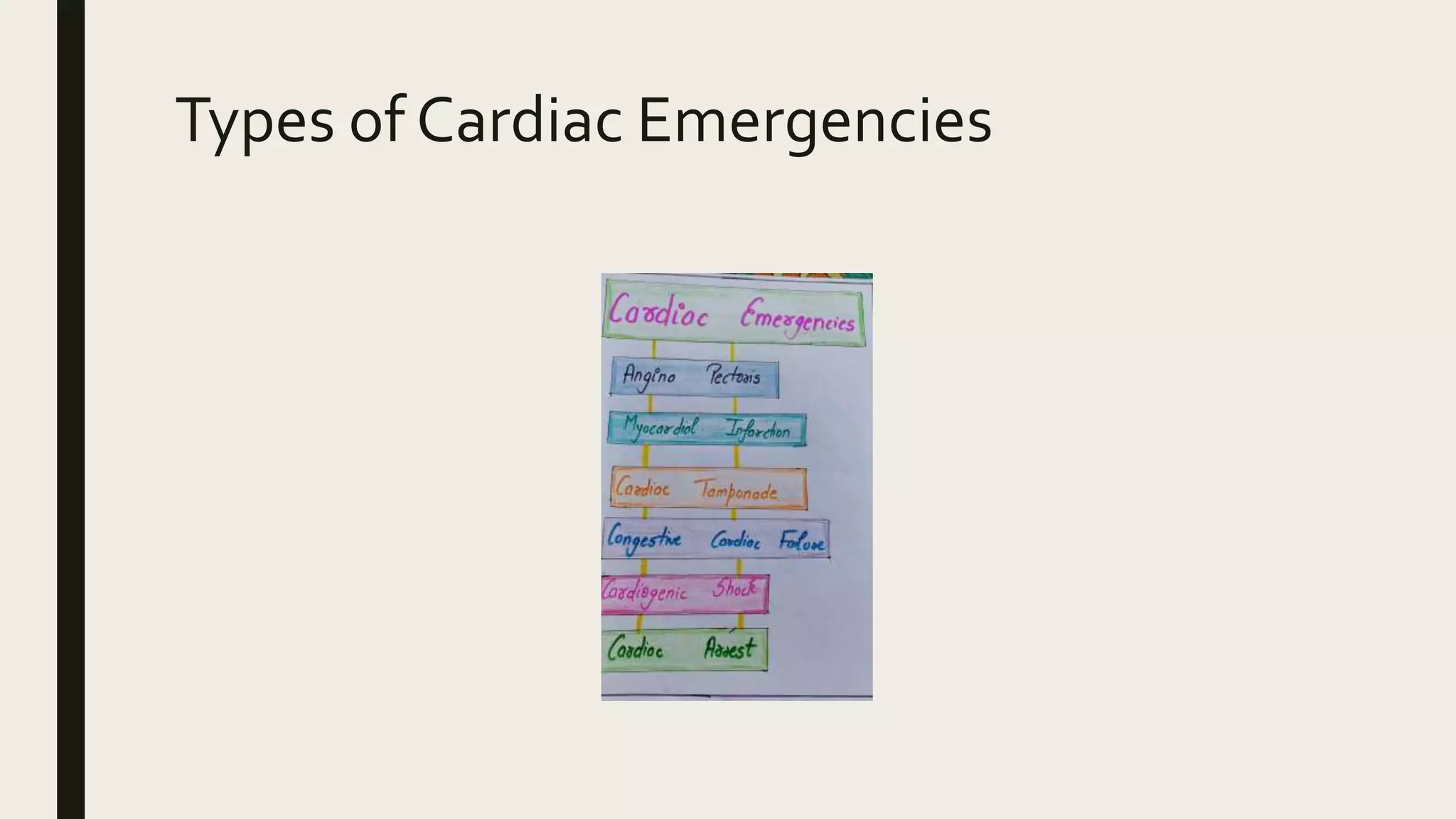
Types of Cardiac Emergencies
1 ANGINA PECTORIS
■ Angina pectoris is a clinical syndrome
usually characterised by episodes or
paroxyms of pain or pressure in the anterior
chest.The cause is insufficient coronary
blood flow resulting in a decreased oxygen
supply where there is increased myocardial
demand for oxygen.
This Photo by Unknown author is licensed under CC BY-SA.
Pathophysiology
Risk factors
■ Diabetes
■ Family history of coronary heart disease
■ High BP
■ Obesity
■ Smoking
■ Cold weather
■ Emotional stress, large meals.
Sign and symptoms
■Shortness of breath
■A feeling of indigestion or heart burn
■Dizziness
■Nausea, vomiting ,sweating
■Palpitations
■Chest pain, indigestion
■Sudden breathing difficulties
Assessment and diagnostic
findings
■1.ECG
■2 EXERCISE STRESSTEST
■3.THALLIUM STRESSTEST
■4. CORONARY Angiography
Medical and surgical management
■Nitroglycerin-Nitrostat,nitrobid
■Calcium channel blockers-Amlodipine
■Anticoagulants -Heparin
■Beta blockers (eg. Propranol, atenolol
etc)
Surgical management
Nursing management
2. Myocardial
infarction
Definition
■Myocardial infarction Is also known
as acute coronary syndrome.
■Myocardial infarction is an emergent
situation characterised by an acute
onset of myocardial ischemia result
in myocardial death
Pathophysiology
Sign and symptoms
Assessment and diagnostic
findings
■Physical examination
■Electrocardiogram
■Blood test
■Chest x - ray
Medical and surgical management
■ Anti platelet medicine -Aspirin
■ Nitroglycerin-Nitrostat,nitrobid
■ ACE-Enalapril,Benazepril
■ Beta blockers-Metoprolol
■ Coronary angioplasty
■ Coronary artery bypass grafting
Nursing management
 Assess for chest pain not relieved by medication
 Monitor vital signs ,especially BP
 Assess for shortness of breath
 Assess for nausea and vomiting
 Perform physical examination
 Assess IV sites frequently
3 CONGESTIVE CARDIAC
FAILURE
Definition
■Heart failure is the inability of heart
to pump sufficient blood to meet the
tissue for oxygen and nutrients. In
past it is also known as congenital
heart disease.
Pathophysiology
Sign and symptoms
Assessment and diagnostic
findings
■ Chest x ray
■ ECG
■ Blood test
■ Echocardiogram
■ MUGA scan
■ Stress test
Medical and surgical management
Angiotensin receptors blockers -
Valsartan,Losartan
. Calcium channel blockers-
Amlodipine
. Beta blockers-Metoprolol
. ACE-Vasotec,Ramipril
Nursing management
■ Nursing assessment
■ Health history
■ Manage fluid volume
■ Improve myocardial contracting
■ Prevent complications
■ Maintain blood pressure and respiratory rate
■ Shecdule activites to conserve energy and reduce fatigue and dyspnea
■ Teach patient self care at home
4 Cardiac tamponade
DEFINITION
■Pericardial effusion(accumulation of
excess fluid in the pericardial sac)
may accompany advanced Hf,
pericarditis, metastatic carcinoma,
cardiac surgery or trauma.
Pathophysiology
Sign and symptoms
Assessment and diagnostic findings
■ Physical examination
■ History collection
■ Ecg
■ Chest x ray
Medical and surgical
management
To perform pericardiocentesis
To perform pericardiotomy
This Photo by Unknown author is licensed under CC BY-SA-NC.
Nursing management
■ Assess the patient
■ Monitor vital signs
■ Monitor the patient for dyssrhthmia
■ Give semi-fowler position if needed
■ Give oxygen as indicated
■ Monitor urine output hourly
5 cardiogenic shock
Definition
■ Cardiogenic shock occurs when increased
cardiac output leads to inadequate tissue
perfusion and initiation of the shock
syndrome.
Pathophysiology
Risk factors
■ Old age
■ Have a history of heart failure
■ Diabetes
■ High BP
■ Existing cardiac disease
SIGN AND SYMPTOMS
ASSESSMENT AND DIAGNOSTIC
FINDINGS
. Chest x ray
. Echocardiogram
. Cardiac catheterization
MEDICAL AND
SURGICAL
MANAGEMENT
■ Aspirin-To reduce blood clotting
■ Anticoagulants- Heparin
■ Inortopic agents - Dopamine
■ Vasopressors -Adernaline
■ Coronary artery bypass surgery
Nursing management
■ Constant monitoring
■ Patient is treated in intensive care unit
■ Carefully assess the p[atient
■ Observe cardiac rhythm
■ Monitor fluid status
■ Adjust medication and therapies based on assessment data
6.Cardiac arrest
Definition
■ Cardiac arrest occurs when the heart
ceases to produce an effective pulse and
circulates blood.
Pathophysiology
RISK FACTORS
■ Seizures
■ Age
■ Family history of heart disease
■ Previous cardiac arrest
SIGN AND SYMPTOMS
MEDICAL AND SURGICAL
MANAGEMENT
■ CPR
■ Calcium channel blockers-Amlodipine
■ Vasopressors-Epinephrine ,dopamine
■ Coronary artery bypass surgery
Nursing management
■ Assess vitals of patient
■ Perform CPR
■ Give oxygen as indicated
■ Teach clients breathing exercises
■ Assess patient with medications.
Nursing diagnosis
■ 1.Acute pain related to imabalance between oxygen supply and increased myocardial
demand
Interventions-
■ Assess the location , duration and nature of pain
■ Assess the signs of hypoxia
■ Record vital signs
■ Administer nitroglycerin and analgesics to reduce pain
2.Decreased cardiac output related to
impaired contractility and increased preload
and afterload
Interventions-
■ Assess pulse and BP
■ Assess the signs of restlessness
■ Give adrenaline if ordered
■ Encourage for small meals
3.Impaired gas exchange related to
altered pulmonary congestion
Interventions-
■ Assess the respiratory rate
■ Maintain normal oxygen saturation
■ Administer prescribed medication
4.Excess fluid volume related to sodium
water retention
Interventions-
■ Assess the fluid status of patient
■ Monitor I/O charting
■ Monitor daily weight to assess fluid status
■ Encourage for low sodium diet
Health teaching
■ Eat healthy diet
■ Exercise daily
■ Stop smoking and alcohol
■ stop chewing tobacco
CLINICAL EXAMPLE
IDENTIFICATION DATA OF PATIENT
NAME-Gopal
SEX-male
AGE-52yrs
BEDNO-01
MRDNO.-55539
RELIGION-hindu
MARITAL STATUS-married
DIAGNOSIS- CONGESTIVE CARDIAC FAILURE
. GENERAL CONDITIONS OF PATIENT
-Patient Is conscious and oriented
Patient complain of Chest pain and shortness of breath
T-97.8F
P-90/MIN
R-20b/min
BP-129/94mmhg
Patient has coated tongue and dry lips.
Doctor’s order
■ Nitroglycerin -30mg
Action –To improve blood flow of the heart
■ Ecospirin -75mg
Action -clot removal
■ Pantop -40 mg
■ Action –To treat acid reflux
RESEARCH
SUMMARYAND CONCLUSION
■ Cardiovascular emergencies are life threatening disorders that must be recognised
immediately to avoid delay in treatment and to minimise the morbidity and mortality
rate.
BIbliography
■ Brunner and Suddharths textbook of Medical Surgical Nursing 5th edition Page no.-
626-647,762-764
■ Https;www.reseach gate.net/publication/35602727
■ Siddharth textbook of medica surgical nursing 11th edition pg no.-432-438
■ http://www.ncbi.nlm.nih.gov
■Thank you 🙏🏻

Cardiac emergencies and it's nursing management