

PRESENTED BY:-
PROF. VIJAYREDDY VANDALI
M. SC. (NSG), PGDHA,
DEPARTMENT OF MEDICAL–SURGICAL NURSING .
INDIA
DEFINITION
The term Nephrotic syndrome describes a
clinical course that can be associated with a
number of disease conditions. Nephrotic
syndrome is not a single diseases entirely
but a constellation of symptoms including
albuminuria, hypoalbuminuria, edema,
hyperlipidemia, and lipduria. This
syndrome causes damage to the glomeruli
with resultant Proteinuria.
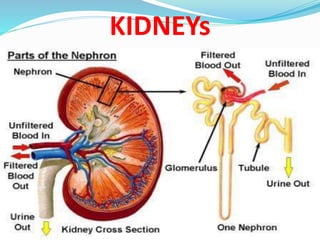
KIDNEYs
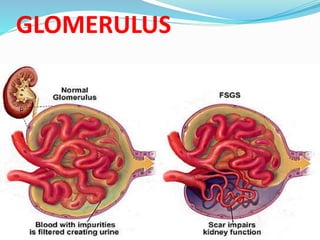
GLOMERULUS
ETIOLOGY
Primary Glomeruli Disease
 Membranous proliferative
glomerulonephritis.
 Primary Nephrotic syndrome.
 Focal glomerulonephritis.
 Inherited Nephrotic syndrome.
CONTD…..
External causes
1) Multisystem disease
Systematic lupus erythematous
Diabetes Mellitus.
Sickle cell anemia.
Amyloidosis
2)Infections
Bacterial (streptococcal, syphilis)
Viral (herpes zoster, HIV, hepatitis)
Protozoa (malaria)
3) Neoplasm
Hodgkin’s disease
Solid tumors of lung, colon, stomach
and breast.
Leukemia.
4) Circulatory problems
Severe congestive heart failure
Chronic constructive Pericarditis
5) Allergic reaction
Insect bites, bee sting and pollen
Drugs (penicillamine, non steroidal
anti inflammatory drugs)
Clinical manifestation
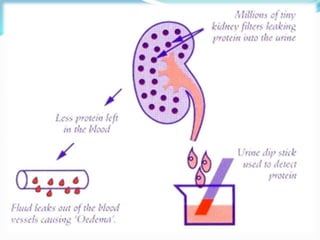
It is characterized by Proteinuria
(>3.5g/day), hypoalbuminuria,
hyperlipidemia and edema which is
generalized & also known as anasarca
or dropsy. The edema begins in the
face. Lipduria (lipids in urine) can also
occur, but is not essential for the
diagnosis of Nephrotic syndrome.
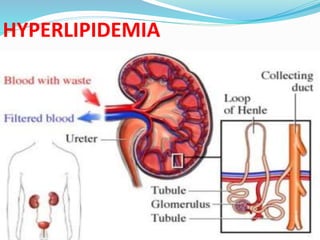
HYPERLIPIDEMIA
EDEMA
CONTD…
Anemia
Dyspnea
Some patients may notice foamy or
frothy urine
Complications
Venous thrombosis
Infection
Acute renal failure
Pulmonary edema
Growth retardation
Hypovolamia
TREATMENT
Monitoring and maintaining
hypovolemia (the correct amount of
fluid in the body):
Monitoring urine output, BP
regularly.
Fluid restrict to 1 L.
Diuretics (IV furosemide).
CONTD…
Monitoring kidney function:
Do EUCs daily and calculating GFR.
Treat hyperlipidemia to prevent further
atherosclerosis.
Prophylactic anticoagulation may be
appropriate in some circumstances.
CONTD…
Specific treatment of underlying cause
Immunosuppressant for the
glomerulonephritides (corticosteroids,
cyclosporine).
Standard regime for first episode:
prednisolone-60 mg/m2/day in 3 divided
doses for 4 weeks followed by
40 mg/m2/day in a single dose on every
alternate day for 4 weeks.
CONTD…
Relapses by prednisolone 2 mg/kg/day till
urine becomes negative for protein. Then,
1.5 mg/kg/day for 4 weeks.
Frequent relapses treated by:
cyclophosphamide or nitrogen mustard or
cyclosporine or levamisole.
Achieving better blood glucose level control
if the patient is diabetic.
THANK YOU

Nephrotic Syndrome PPT