Cardiac CT-CCTA
Dr.Sahar Gamal El-Din ,CBCCT
National Heart Institute
Performing CCT
Patient Preparation:
Ensure patient comfort
•Explain breathing instructions clearly
•Discuss contrast effects
•Antecubital IV 18-20g suggested
•Beta-blockade
•Target heart rate 50-65 bpm
•Nitroglycerine
Initial Scanning: Ca Score
1. Helps to identify how the coronary
vessels will behave (especially the RCA)
during the scan.
2. Points out the “ possible” atherosclerotic
vascular tree.
3. High Ca score is not equivalent to “not to
perform the test ( but be wise ).
Coronary Disease Progression
Calcified Plaque Detected by CT
• Atherosclerosis is the only disease
process known to cause calcium to
deposit in coronary artery walls.
• Calcification is not a degenerative
disease, it is not a part of the “normal”
aging process.
• Calcium is not found in normal CA.
Radiology 2002; 223:474–480.
• Since calcium deposits start to develop
during the early stages of atherosclerosis
and if we are able to identify the
presence of calcium we are able to
identify preclinical coronary artery
disease during the asymptomatic stage.
• This can allow for the implementation of
early aggressive risk factor reduction.
• Coronary artery calcification has been
shown to be a marker for coronary artery
atherosclerosis .
• Calcification can be seen with fluoroscopy
and on chest x-ray.
• Computed tomography allows
quantification of this calcium.
• The amount of calcium deposited in
coronary arteries is added up and a “score” is
given.
• The amount of calcium in the coronary
arteries varies considerably with age and
gender.
• For this reason, coronary calcium scores are
presented as percentile scores telling you
how much calcium you have compared to
other men or women of your age.
Methods
• Agatston Score :Traditional method
(EBCT : MDCT)
• Volume Score : Plaque area x slice
thickness (mm³)
• Mass Score : Plaque volume x mean
plaque density .
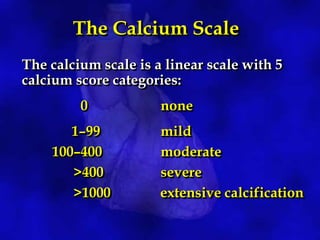
The Calcium Scale
The calcium scale is a linear scale with 5
calcium score categories:
0 none
1–99 mild
100–400 moderate
>400 severe
>1000 extensive calcification
Image acquisition and
reconstruction
• The acquisition of the dataset for coronary
CTA consists of 3 steps :
1. Topogram
2. Contrast medium protocol : to ensure
homogeneous contrast enhancement of the
entire coronary artery tree
3. Coronary CTA scan
Topogram
• Native coronary arteries
# Begin 1–2 cm below the carina
# Tortuous aorta or prominent
upper left heart border – begin
scan 1-2cm higher
• Bypass Grafts
 Veins: top of arch
 LIMA: above clavicles
Scan ending position
• Image acquisition end 2 cm
below the diaphragm
Scan Start Position
Contrast Injection
1. Iodine Content
2. Volume
3. Rate
4. Synchronization Techniques:
a. Fixed Delay
b. Test Bolus
c. Bolus Tracking
Phase Synchronization
1.Retrospective ECG gating (Continuous
Scanning).
2.Prospective ECG triggering (step-and-shoot
technique).
Retrospective ECG gating
• The most commonly used data
reconstruction technique
•Advantage: any desired phase of the
cardiac cycle can be reconstructed
•Disadvantage: increased radiation dose
Prospective ECG gating
 Data are only acquired at predefined time points
of the cardiac cycle when the data acquisition is
considered relevant.
The X-ray tube is turned on at a priori chosen time
interval from the last monitored R–R peak.
Advantage: dcreased radiation dose
Disadvantage: limited information & no function
Scanning protocol
Post processing protocol
• The axial source images obtained are utilized for
multiplanar reconstructions in at least 2 planes
• Commonly used techniques are :
 Multiplanar reconstruction (MPR)
 Curved planar reconstruction (CPR)
 Maximum intensity projection (MIP)
 Volume rendering (VR)
Multiplanar reconstruction (MPR) Curved MPR reconstruction (CMPR)
Maximum intensity projection (MIP)VRT reconstruction image
Anatomy & Views
Axial Sagital
Coronal
Normal Coronary Anatomy
• Left Coronary Artery and its Branches :
• The left main artery normally arises from the
posteriorly positioned left sinus of Valsalva and
bifurcates into the LAD & LCX .
• The LAD courses through the anterior
interventricular groove and provides diagonal
branches to the anterior left ventricle and septal
branches to the anterior interventricular
septum.
LMT
• The LCX gives off obtuse marginal branches
(OM), which supply the lateral wall of the left
ventricle.
• Occasionally, the left main artery can trifurcate
into the LAD, the LCX, and a third vessel
between the LAD and LCX termed the ramus
intermedius artery.
• The course and vascular territory of the ramus
intermedius artery are similar to those of the
diagonal and/or obtuse marginal arteries.
OM
Diag.
LMT
Different types of LMCA bifurcation.
Oblique transverse thin-slab maximum-intensity projection images.
The LMCA is shown bifurcating into the LAD and LCX (Panel A),
the LM with trifurcation into the LAD and the LCX, and in between an
intermediate branch (IMB, Panel B). Note the high diagonal branch (D)
from the LAD (Panel B).
Curved MPR of LAD
Curved MPR of LCX
• Right Coronary Artery and its Branches:
• The RCA arises from the anteriorly positioned
right sinus of Valsalva and courses through the
right AV groove.
• The conus artery is the first branch of RCA in
50% of cases, and it supplies the right
ventricular infundibulum. In the remaining
50% of cases, the conus artery arises directly
from the aorta.
• The sinoatrial (SA) nodal branch arises from the
RCA in most patients (60%) & courses
posteriorly. In the remaining patients it arises as
a branch of the LCX.
• Other branches supply the right atrium and
free wall of the right ventricle.
• The largest of these arises from the RCA at the
acute margin of the heart and is termed the
acute marginal branch.
• At the crux of the heart the RCA gives off the
posterior descending artery ( PDA ), which
supplies the posterior interventricular septum.
• The posterolateral branch (PLB) is a
continuation of the RCA in the posterior
atrioventricular groove & supplies the
posterior and inferior wall of the LV
PL
Curved MPR of RCA
Maximum intensity projection (MIP) of RCA
Dominance
• Generally, the artery that supplies the inferior
1/3 of the interventricular septum is considered
to be the dominant coronary artery.
• The RCA is dominant in most subjects (85%),
while in 7% to 8% of cases the LCX gives rise to
the posterior descending artery (PDA), a left
dominant system.
• In the remaining patients, a codominant, or
balanced circulation, system exists; examples
include a small PDA originating from the RCA
with posterolateral branches from the LCX
artery, and PDAs from both the RCA and LCX.
PL
Rt.Dominant
RCA
LCX
Lt.Dominant Co.Dominant
• The coronary artery nomenclature is based
on the intermediate and distal vascular
territory of the artery; this is particularly
important when vessels are anomalous.
• In these circumstances, the proximal
course or coronary origin cannot be
considered when defining or naming the
respective coronary artery.
• For example, a subepicardial artery that courses
through the anterior interventricular groove
and provides septal branches is termed the
LAD, regardless of its origin from the aorta.
• Similarly, for an artery to be defined as the
LCX, it should course through the left
atrioventricular sulcus and provide at least one
obtuse marginal (OM) branch.
• The RCA is defined as an artery that runs in
the right atrioventricular sulcus and gives off
RV or acute marginal branches.
Coronary artery assessment
• The best evaluated coronary artery is the LAD
as it runs along the axis of the scan and is not
significantly affected by cardiac movements.
• The LAD is well visualized in 76-96% of cases
• The left CX artery may be affected by cardiac
motion artifacts and can be assessed in 52-95%
of cases.
• RCA is most affected by cardiac movement
• Proximal coronary segments are better
visualized than distal ones.
Normal Coronary Artery Diameter
– Each coronary artery vary, ranging from
5 mm (LMT in males) to 2 mm (PDA in
females).
– Abnormal dilatation to more than 1.5
times the diameter of an adjacent normal
coronary artery is defined as ectasia.
Coronary artery aneurysms
• Classification :
• Vessel wall composition
• True aneurysm Vessel wall composed of three layers:
adventitia, media, and intima
• False aneurysm Vessel wall composed of one or two
layers
• Shape/gross structure
• Saccular aneurysm Transverse > longitudinal diameter
• Fusiform aneurysm Longitudinal > transverse diameter
• Giant aneurysm
• Adults >20 mm–150 mm in diameter
• Children >8 mm in diameter
Types of plaques
1. Non-calcified
2. Partly calcified
3. Mixed
4. Calcified
• Positive remodelling : outward plaque
growth leading to arterial wall expansion
in an attempt to avoid luminal stenosis.
Eccentric - Concentric
Recommended stenosis grading
• Normal : Absence of plaque & no
luminal stenosis.
• Minimal : Plaque with < 25% stenosis.
• Mild : Plaque with 25% to 49 stenosis.
• Moderate : Plaque with 50% to 69
stenosis.
• Severe : Plaque with 70% to 99 stenosis.
• Occluded.
JCVCT 2014;342-358
Cardiac ct ccta2
Cardiac ct ccta2
Cardiac ct ccta2
Cardiac ct ccta2
Cardiac ct ccta2

Cardiac ct ccta2

  • 1.
    Cardiac CT-CCTA Dr.Sahar GamalEl-Din ,CBCCT National Heart Institute
  • 2.
  • 3.
    Patient Preparation: Ensure patientcomfort •Explain breathing instructions clearly •Discuss contrast effects •Antecubital IV 18-20g suggested •Beta-blockade •Target heart rate 50-65 bpm •Nitroglycerine
  • 4.
    Initial Scanning: CaScore 1. Helps to identify how the coronary vessels will behave (especially the RCA) during the scan. 2. Points out the “ possible” atherosclerotic vascular tree. 3. High Ca score is not equivalent to “not to perform the test ( but be wise ).
  • 5.
  • 6.
    • Atherosclerosis isthe only disease process known to cause calcium to deposit in coronary artery walls. • Calcification is not a degenerative disease, it is not a part of the “normal” aging process. • Calcium is not found in normal CA. Radiology 2002; 223:474–480.
  • 7.
    • Since calciumdeposits start to develop during the early stages of atherosclerosis and if we are able to identify the presence of calcium we are able to identify preclinical coronary artery disease during the asymptomatic stage. • This can allow for the implementation of early aggressive risk factor reduction.
  • 8.
    • Coronary arterycalcification has been shown to be a marker for coronary artery atherosclerosis . • Calcification can be seen with fluoroscopy and on chest x-ray. • Computed tomography allows quantification of this calcium.
  • 9.
    • The amountof calcium deposited in coronary arteries is added up and a “score” is given. • The amount of calcium in the coronary arteries varies considerably with age and gender. • For this reason, coronary calcium scores are presented as percentile scores telling you how much calcium you have compared to other men or women of your age.
  • 10.
    Methods • Agatston Score:Traditional method (EBCT : MDCT) • Volume Score : Plaque area x slice thickness (mm³) • Mass Score : Plaque volume x mean plaque density .
  • 13.
    The Calcium Scale Thecalcium scale is a linear scale with 5 calcium score categories: 0 none 1–99 mild 100–400 moderate >400 severe >1000 extensive calcification
  • 14.
  • 15.
    • The acquisitionof the dataset for coronary CTA consists of 3 steps : 1. Topogram 2. Contrast medium protocol : to ensure homogeneous contrast enhancement of the entire coronary artery tree 3. Coronary CTA scan
  • 16.
    Topogram • Native coronaryarteries # Begin 1–2 cm below the carina # Tortuous aorta or prominent upper left heart border – begin scan 1-2cm higher • Bypass Grafts  Veins: top of arch  LIMA: above clavicles Scan ending position • Image acquisition end 2 cm below the diaphragm Scan Start Position
  • 17.
    Contrast Injection 1. IodineContent 2. Volume 3. Rate 4. Synchronization Techniques: a. Fixed Delay b. Test Bolus c. Bolus Tracking
  • 18.
    Phase Synchronization 1.Retrospective ECGgating (Continuous Scanning). 2.Prospective ECG triggering (step-and-shoot technique).
  • 19.
    Retrospective ECG gating •The most commonly used data reconstruction technique •Advantage: any desired phase of the cardiac cycle can be reconstructed •Disadvantage: increased radiation dose
  • 20.
    Prospective ECG gating Data are only acquired at predefined time points of the cardiac cycle when the data acquisition is considered relevant. The X-ray tube is turned on at a priori chosen time interval from the last monitored R–R peak. Advantage: dcreased radiation dose Disadvantage: limited information & no function
  • 21.
  • 22.
    Post processing protocol •The axial source images obtained are utilized for multiplanar reconstructions in at least 2 planes • Commonly used techniques are :  Multiplanar reconstruction (MPR)  Curved planar reconstruction (CPR)  Maximum intensity projection (MIP)  Volume rendering (VR)
  • 23.
    Multiplanar reconstruction (MPR)Curved MPR reconstruction (CMPR) Maximum intensity projection (MIP)VRT reconstruction image
  • 24.
  • 25.
  • 42.
    Normal Coronary Anatomy •Left Coronary Artery and its Branches : • The left main artery normally arises from the posteriorly positioned left sinus of Valsalva and bifurcates into the LAD & LCX . • The LAD courses through the anterior interventricular groove and provides diagonal branches to the anterior left ventricle and septal branches to the anterior interventricular septum.
  • 43.
  • 44.
    • The LCXgives off obtuse marginal branches (OM), which supply the lateral wall of the left ventricle. • Occasionally, the left main artery can trifurcate into the LAD, the LCX, and a third vessel between the LAD and LCX termed the ramus intermedius artery. • The course and vascular territory of the ramus intermedius artery are similar to those of the diagonal and/or obtuse marginal arteries.
  • 45.
  • 47.
    Different types ofLMCA bifurcation. Oblique transverse thin-slab maximum-intensity projection images. The LMCA is shown bifurcating into the LAD and LCX (Panel A), the LM with trifurcation into the LAD and the LCX, and in between an intermediate branch (IMB, Panel B). Note the high diagonal branch (D) from the LAD (Panel B).
  • 48.
  • 49.
  • 50.
    • Right CoronaryArtery and its Branches: • The RCA arises from the anteriorly positioned right sinus of Valsalva and courses through the right AV groove. • The conus artery is the first branch of RCA in 50% of cases, and it supplies the right ventricular infundibulum. In the remaining 50% of cases, the conus artery arises directly from the aorta. • The sinoatrial (SA) nodal branch arises from the RCA in most patients (60%) & courses posteriorly. In the remaining patients it arises as a branch of the LCX.
  • 51.
    • Other branchessupply the right atrium and free wall of the right ventricle. • The largest of these arises from the RCA at the acute margin of the heart and is termed the acute marginal branch. • At the crux of the heart the RCA gives off the posterior descending artery ( PDA ), which supplies the posterior interventricular septum. • The posterolateral branch (PLB) is a continuation of the RCA in the posterior atrioventricular groove & supplies the posterior and inferior wall of the LV
  • 52.
  • 55.
  • 56.
  • 60.
    Dominance • Generally, theartery that supplies the inferior 1/3 of the interventricular septum is considered to be the dominant coronary artery. • The RCA is dominant in most subjects (85%), while in 7% to 8% of cases the LCX gives rise to the posterior descending artery (PDA), a left dominant system. • In the remaining patients, a codominant, or balanced circulation, system exists; examples include a small PDA originating from the RCA with posterolateral branches from the LCX artery, and PDAs from both the RCA and LCX.
  • 61.
  • 62.
  • 63.
    • The coronaryartery nomenclature is based on the intermediate and distal vascular territory of the artery; this is particularly important when vessels are anomalous. • In these circumstances, the proximal course or coronary origin cannot be considered when defining or naming the respective coronary artery.
  • 64.
    • For example,a subepicardial artery that courses through the anterior interventricular groove and provides septal branches is termed the LAD, regardless of its origin from the aorta. • Similarly, for an artery to be defined as the LCX, it should course through the left atrioventricular sulcus and provide at least one obtuse marginal (OM) branch. • The RCA is defined as an artery that runs in the right atrioventricular sulcus and gives off RV or acute marginal branches.
  • 65.
    Coronary artery assessment •The best evaluated coronary artery is the LAD as it runs along the axis of the scan and is not significantly affected by cardiac movements. • The LAD is well visualized in 76-96% of cases • The left CX artery may be affected by cardiac motion artifacts and can be assessed in 52-95% of cases. • RCA is most affected by cardiac movement • Proximal coronary segments are better visualized than distal ones.
  • 66.
    Normal Coronary ArteryDiameter – Each coronary artery vary, ranging from 5 mm (LMT in males) to 2 mm (PDA in females). – Abnormal dilatation to more than 1.5 times the diameter of an adjacent normal coronary artery is defined as ectasia.
  • 68.
    Coronary artery aneurysms •Classification : • Vessel wall composition • True aneurysm Vessel wall composed of three layers: adventitia, media, and intima • False aneurysm Vessel wall composed of one or two layers • Shape/gross structure • Saccular aneurysm Transverse > longitudinal diameter • Fusiform aneurysm Longitudinal > transverse diameter • Giant aneurysm • Adults >20 mm–150 mm in diameter • Children >8 mm in diameter
  • 70.
    Types of plaques 1.Non-calcified 2. Partly calcified 3. Mixed 4. Calcified • Positive remodelling : outward plaque growth leading to arterial wall expansion in an attempt to avoid luminal stenosis. Eccentric - Concentric
  • 71.
    Recommended stenosis grading •Normal : Absence of plaque & no luminal stenosis. • Minimal : Plaque with < 25% stenosis. • Mild : Plaque with 25% to 49 stenosis. • Moderate : Plaque with 50% to 69 stenosis. • Severe : Plaque with 70% to 99 stenosis. • Occluded. JCVCT 2014;342-358