Myocardial Perfusion Imaging SPECT
Basics
Imaging and Protocol Basics
Indications of MPI
 Detection of CAD
 Assessing functional significance of coronary
stenosis
 Evaluating prognosis and risk stratification
 Assessing medical therapy of CAD
 Assessing cardiac viability
Coronary Artery Disease
 Cardiovascular disease is the leading cause of death
in the United States
 Accounts for nearly 1 million deaths, half of which are the
result of CAD
 CAD is a condition in which the heart does not
receive enough blood
 Caused by accumulation of plaques in the coronary
arteries
 Causes stenosis of the lumen of the vessels
 Decreases ability of the walls of the affected vessels to
contract which inhibits cardiac function
 Occlusion of the vessels can also be caused by thrombus
or embolus in a coronary artery or an artery spasm
Risk Factors CAD
 High cholesterol
 High blood pressure
 Cigarette smoking
 Obesity
 Diabetes
 Sedentary lifestyle
 Family history of CAD
 Gender (more prevalent in males)
Symptoms of CAD
 Angina pectoris
 Transient pain or discomfort resulting from a temporary lack of
oxygen and nutrients to the heart muscle
 Myocardial Infarction
 A portion of the heart muscle dies resulting from inadequate
blood flow
 Changes the electrical activity of the heart
 Decreases contractility of heart in fibrous area
 Difficulty breathing
 Weakness
 Dizziness
 Perspiration
 CAD progresses over time and a person may be
asymptomatic in the early stages of the disease
Manifestations of CAD
 Before reaching > 70-80% vessel occlusion CAD
may have little or no effect on resting heart function
 When demands of the heart muscle are increased
diseased vessels cannot produce adequate blood
flow
 Coronary reserve: the ability to increase coronary
blood flow when needed
 Decreases in CAD due to increased metabolic demands
of the diseased vessels
 Patients with severe CAD will usually have
homogeneous resting regional myocardial blood flow
 Diminished blood flow at stress because of the
inability to increase blood flow when needed
Treatment of CAD
 Drug therapy
 Nitroglycerin
 Relaxes smooth muscle causing blood vessels to dilate
 Beta blockers
 Depress cardiac function and decrease cardiac output
 Cholesterol-lowering drugs
 Clot-dissolving agents
 Low-fat diet
 Exercise
Treatment of CAD
 CABG (coronary artery bypass graft)
 Blood vessels from one part of the body are used to
bypass a blocked region of a coronary artery to improve
blood supply to the affected area of the heart muscle
 PTCA (percutaneous transluminal coronary
angioplasty)
 Lumen of a stenotic vessel is dilated
 Atherectomy
 Obstructive plaque or thrombus is removed sing lasers or
mechanical devices
 Intracoronary stents
Patient Prep MPI Stress Test
 NPO 4 hours prior to test
 No caffeine within 24 hours
 Restrict cardiac medication if possible
 Consent for stress
 Pregnancy consent
 Skin prep/lead placement 12 lead EKG
 IV placement
Contraindications
 Pregnancy
 Food within 4 hours of stress study
 Caffeine within 24 hours (for pharmaceutical stress)
 Bronchospasm or severe obstructive lung disease
(for pharmaceutical stress)
 Hypotension (BP < 90)
 Xanthine-containing drugs
Protocols
 One-day
 Rest Thallium 3-5mCi/Stress Sestamibi or Tetrofosmin 20-
40mCi
 Rest Sestamibi or Tetrofosmin 10-15mCi/Stress
Sestamibi or Tetrofosmin 30-45mCi
 Two-day
 Stress Day 1
 25-45mCi Sestamibi or Tetrofosmin
 Rest Day 2 (if needed)
 25-45mCi Sestamibi or Tetrofosmin
Imaging Protocols maiCAM180
 Rest 30-40 seconds/step
 Stress 20-30 seconds a step
 16/32 steps 32/64 projections
 64x64 matrix
 Non-circular orbit
 Limiting patient motion is essential during acquisition
for quality images
 Movement can appear differently on upright imaging
systems than supine
Processing
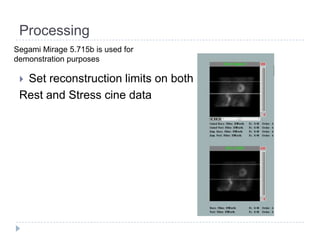
 Set reconstruction limits on both
Rest and Stress cine data
Segami Mirage 5.715b is used for
demonstration purposes
Processing
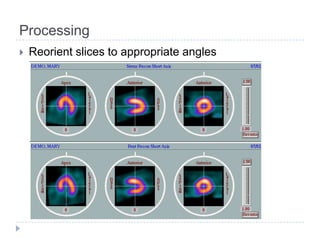
 Reorient slices to appropriate angles
Processing
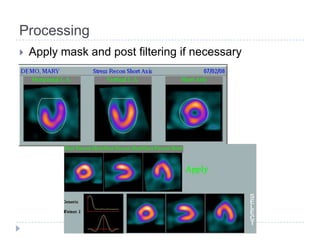
 Apply mask and post filtering if necessary
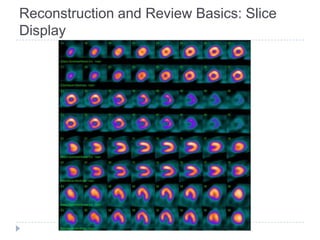
Reconstruction and Review Basics: Slice
Display
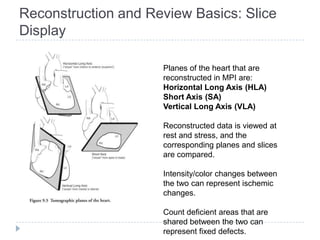
Planes of the heart that are
reconstructed in MPI are:
Horizontal Long Axis (HLA)
Short Axis (SA)
Vertical Long Axis (VLA)
Reconstructed data is viewed at
rest and stress, and the
corresponding planes and slices
are compared.
Intensity/color changes between
the two can represent ischemic
changes.
Count deficient areas that are
shared between the two can
represent fixed defects.
Reconstruction and Review Basics: Slice
Display
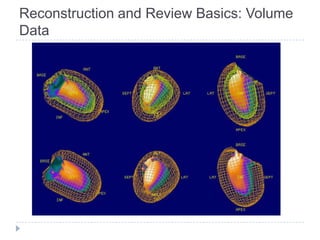
Reconstruction and Review Basics: Volume
Data
 3-D view of the heart that can be viewed from all
angles
 Gated data can be viewed as cine volume data to
assess wall motion
 Surface of the heart can be viewed separately or
simultaneously in both systole and diastole
Reconstruction and Review Basics: Volume
Data
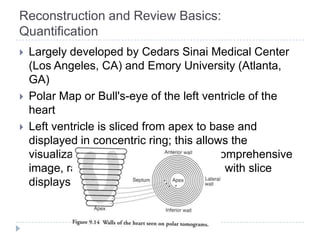
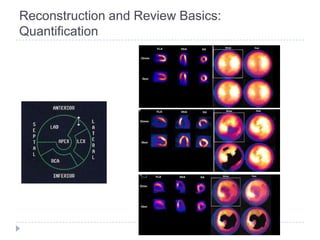
Reconstruction and Review Basics:
Quantification
 Largely developed by Cedars Sinai Medical Center
(Los Angeles, CA) and Emory University (Atlanta,
GA)
 Polar Map or Bull's-eye of the left ventricle of the
heart
 Left ventricle is sliced from apex to base and
displayed in concentric ring; this allows the
visualization of the left ventricle in a comprehensive
image, rather than multiple images as with slice
displays
Reconstruction and Review Basics:
Quantification
References
 Nuclear Cardiac Imaging: Terminology and Technical
Aspects; Crawford and Husain; 2003; SNM
 Diagrams taken from Nuclear Cardiac Imaging:
Terminology and Technical Aspects; Crawford and
Husain; 2003; SNM
 Nuclear Cardiac images taken from MAI Demo
database using Cedars Sinai and Segami Mirage
processing applications

Myocardial perfusion imaging SPECT basics

  • 1.
    Myocardial Perfusion ImagingSPECT Basics Imaging and Protocol Basics
  • 2.
    Indications of MPI Detection of CAD  Assessing functional significance of coronary stenosis  Evaluating prognosis and risk stratification  Assessing medical therapy of CAD  Assessing cardiac viability
  • 3.
    Coronary Artery Disease Cardiovascular disease is the leading cause of death in the United States  Accounts for nearly 1 million deaths, half of which are the result of CAD  CAD is a condition in which the heart does not receive enough blood  Caused by accumulation of plaques in the coronary arteries  Causes stenosis of the lumen of the vessels  Decreases ability of the walls of the affected vessels to contract which inhibits cardiac function  Occlusion of the vessels can also be caused by thrombus or embolus in a coronary artery or an artery spasm
  • 4.
    Risk Factors CAD High cholesterol  High blood pressure  Cigarette smoking  Obesity  Diabetes  Sedentary lifestyle  Family history of CAD  Gender (more prevalent in males)
  • 5.
    Symptoms of CAD Angina pectoris  Transient pain or discomfort resulting from a temporary lack of oxygen and nutrients to the heart muscle  Myocardial Infarction  A portion of the heart muscle dies resulting from inadequate blood flow  Changes the electrical activity of the heart  Decreases contractility of heart in fibrous area  Difficulty breathing  Weakness  Dizziness  Perspiration  CAD progresses over time and a person may be asymptomatic in the early stages of the disease
  • 6.
    Manifestations of CAD Before reaching > 70-80% vessel occlusion CAD may have little or no effect on resting heart function  When demands of the heart muscle are increased diseased vessels cannot produce adequate blood flow  Coronary reserve: the ability to increase coronary blood flow when needed  Decreases in CAD due to increased metabolic demands of the diseased vessels  Patients with severe CAD will usually have homogeneous resting regional myocardial blood flow  Diminished blood flow at stress because of the inability to increase blood flow when needed
  • 7.
    Treatment of CAD Drug therapy  Nitroglycerin  Relaxes smooth muscle causing blood vessels to dilate  Beta blockers  Depress cardiac function and decrease cardiac output  Cholesterol-lowering drugs  Clot-dissolving agents  Low-fat diet  Exercise
  • 8.
    Treatment of CAD CABG (coronary artery bypass graft)  Blood vessels from one part of the body are used to bypass a blocked region of a coronary artery to improve blood supply to the affected area of the heart muscle  PTCA (percutaneous transluminal coronary angioplasty)  Lumen of a stenotic vessel is dilated  Atherectomy  Obstructive plaque or thrombus is removed sing lasers or mechanical devices  Intracoronary stents
  • 9.
    Patient Prep MPIStress Test  NPO 4 hours prior to test  No caffeine within 24 hours  Restrict cardiac medication if possible  Consent for stress  Pregnancy consent  Skin prep/lead placement 12 lead EKG  IV placement
  • 10.
    Contraindications  Pregnancy  Foodwithin 4 hours of stress study  Caffeine within 24 hours (for pharmaceutical stress)  Bronchospasm or severe obstructive lung disease (for pharmaceutical stress)  Hypotension (BP < 90)  Xanthine-containing drugs
  • 11.
    Protocols  One-day  RestThallium 3-5mCi/Stress Sestamibi or Tetrofosmin 20- 40mCi  Rest Sestamibi or Tetrofosmin 10-15mCi/Stress Sestamibi or Tetrofosmin 30-45mCi  Two-day  Stress Day 1  25-45mCi Sestamibi or Tetrofosmin  Rest Day 2 (if needed)  25-45mCi Sestamibi or Tetrofosmin
  • 12.
    Imaging Protocols maiCAM180 Rest 30-40 seconds/step  Stress 20-30 seconds a step  16/32 steps 32/64 projections  64x64 matrix  Non-circular orbit  Limiting patient motion is essential during acquisition for quality images  Movement can appear differently on upright imaging systems than supine
  • 13.
    Processing  Set reconstructionlimits on both Rest and Stress cine data Segami Mirage 5.715b is used for demonstration purposes
  • 14.
    Processing  Reorient slicesto appropriate angles
  • 15.
    Processing  Apply maskand post filtering if necessary
  • 16.
    Reconstruction and ReviewBasics: Slice Display Planes of the heart that are reconstructed in MPI are: Horizontal Long Axis (HLA) Short Axis (SA) Vertical Long Axis (VLA) Reconstructed data is viewed at rest and stress, and the corresponding planes and slices are compared. Intensity/color changes between the two can represent ischemic changes. Count deficient areas that are shared between the two can represent fixed defects.
  • 17.
    Reconstruction and ReviewBasics: Slice Display
  • 18.
    Reconstruction and ReviewBasics: Volume Data  3-D view of the heart that can be viewed from all angles  Gated data can be viewed as cine volume data to assess wall motion  Surface of the heart can be viewed separately or simultaneously in both systole and diastole
  • 19.
    Reconstruction and ReviewBasics: Volume Data
  • 20.
    Reconstruction and ReviewBasics: Quantification  Largely developed by Cedars Sinai Medical Center (Los Angeles, CA) and Emory University (Atlanta, GA)  Polar Map or Bull's-eye of the left ventricle of the heart  Left ventricle is sliced from apex to base and displayed in concentric ring; this allows the visualization of the left ventricle in a comprehensive image, rather than multiple images as with slice displays
  • 21.
    Reconstruction and ReviewBasics: Quantification
  • 22.
    References  Nuclear CardiacImaging: Terminology and Technical Aspects; Crawford and Husain; 2003; SNM  Diagrams taken from Nuclear Cardiac Imaging: Terminology and Technical Aspects; Crawford and Husain; 2003; SNM  Nuclear Cardiac images taken from MAI Demo database using Cedars Sinai and Segami Mirage processing applications