Resistant HypertensionResistant Hypertension
Resistant hypertension is defined asResistant hypertension is defined as
blood pressure above goal (>140/90blood pressure above goal (>140/90
mmHg; >130–139/80–85 mmHg inmmHg; >130–139/80–85 mmHg in
patients with diabetes mellitus; >130/80patients with diabetes mellitus; >130/80
mmHg in chronic kidney disease), despitemmHg in chronic kidney disease), despite
treatment with ≥3 antihypertensive drugstreatment with ≥3 antihypertensive drugs
of different classes, including a diuretic, atof different classes, including a diuretic, at
optimal doses.optimal doses.
PrevalencePrevalence
 Approximately 25% of adults worldwide areApproximately 25% of adults worldwide are
affected by hypertension.affected by hypertension.
 Hypertension is responsible for 13% of totalHypertension is responsible for 13% of total
worldwide deaths.worldwide deaths.
 Resistant hypertension is found in up to 10-20%Resistant hypertension is found in up to 10-20%
of patients with hypertension.of patients with hypertension.
 It is estimated that patients with resistantIt is estimated that patients with resistant
hypertension are almost 50% more likely tohypertension are almost 50% more likely to
experience an adverse cardiovascular eventexperience an adverse cardiovascular event
compared with patients with blood pressurecompared with patients with blood pressure
controlled by three or fewer antihypertensivecontrolled by three or fewer antihypertensive
agents.agents.
EtiologyEtiology
 The etiology of Resistant HypertensionThe etiology of Resistant Hypertension
can be classified as :can be classified as :
1.1. Primary causesPrimary causes
2.2. Secondary causesSecondary causes
3.3. Factors contributing to resistantFactors contributing to resistant
hypertensionhypertension
The primary causesThe primary causes
 Older age; especially >75 yearsOlder age; especially >75 years
 High baseline blood pressure and chronicity of uncontrolledHigh baseline blood pressure and chronicity of uncontrolled
hypertensionhypertension
 Target organ damage (left ventricular hypertrophy, chronic kidneyTarget organ damage (left ventricular hypertrophy, chronic kidney
disease)disease)
 DiabetesDiabetes
 ObesityObesity
 Atherosclerotic vascular diseaseAtherosclerotic vascular disease
 Aortic stiffeningAortic stiffening
 Sex (women)Sex (women)
 Ethnicity (black)Ethnicity (black)
 Excessive dietary sodiumExcessive dietary sodium
Secondary causes of resistantSecondary causes of resistant
hypertensionhypertension
 Primary hyperaldosteronismPrimary hyperaldosteronism
 Renal artery stenosisRenal artery stenosis
 Renal parenchymal diseaseRenal parenchymal disease
 Obstructive sleep apnoeaObstructive sleep apnoea
 PhaeochromocytomaPhaeochromocytoma
 Thyroid diseasesThyroid diseases
 Cushing’s syndromeCushing’s syndrome
 Coarctation of the aortaCoarctation of the aorta
 Intracranial tumoursIntracranial tumours
Factors contributing to resistantFactors contributing to resistant
hypertensionhypertension
Lifestyle factorsLifestyle factors
 ObesityObesity
 Excess alcohol intakeExcess alcohol intake
 Excess dietary sodiumExcess dietary sodium
 Cocaine and amphetamines misuseCocaine and amphetamines misuse
Drug related causesDrug related causes
 Non-steroidal anti-inflammatory drugsNon-steroidal anti-inflammatory drugs
 Contraceptive hormones—Combined oral contraceptives are more oftenContraceptive hormones—Combined oral contraceptives are more often
associated with elevated blood pressure, whereas menopausal hormoneassociated with elevated blood pressure, whereas menopausal hormone
therapy has minimal effects on blood pressuretherapy has minimal effects on blood pressure
 Adrenal steroid hormonesAdrenal steroid hormones
 Sympathomimetic agents (nasal decongestants, diet pills)Sympathomimetic agents (nasal decongestants, diet pills)
 Erythropoeitin, ciclosporin, and tacrolimusErythropoeitin, ciclosporin, and tacrolimus
 Liquorice (suppresses the metabolism of cortisol)Liquorice (suppresses the metabolism of cortisol)
 Herbal supplements (ephedra, bitter orange, etc)Herbal supplements (ephedra, bitter orange, etc)
Volume overloadVolume overload
 Progressive renal insufficiencyProgressive renal insufficiency
 High salt intakeHigh salt intake
 Inadequate diuretic therapyInadequate diuretic therapy
Pseudo-resistancePseudo-resistance
 Blood pressure can be overestimated as a consequenceBlood pressure can be overestimated as a consequence
of inaccurate measurement techniqueof inaccurate measurement technique ..
 The most common causes of overestimated bloodThe most common causes of overestimated blood
pressure are :pressure are :
 using a cuff that is too small.using a cuff that is too small.
 measuring blood pressure before the patient is sitting quietly.measuring blood pressure before the patient is sitting quietly.

nonadherence to prescribed antihypertensive therapy.nonadherence to prescribed antihypertensive therapy.
DiagnosisDiagnosis
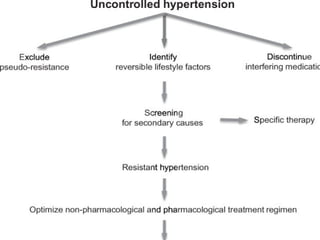
 The diagnosis of resistant hypertensionThe diagnosis of resistant hypertension
requires exclusion of both pseudo-requires exclusion of both pseudo-
resistance and reversible or organicresistance and reversible or organic
causescauses
Biochemical evaluation for patients withBiochemical evaluation for patients with
suspected resistant hypertensionsuspected resistant hypertension
These help to delineate :These help to delineate :
 a potential secondary cause of resistanta potential secondary cause of resistant
hypertension.hypertension.
 signal the development of renalsignal the development of renal
dysfunction.dysfunction.
 help to monitor response and side effectshelp to monitor response and side effects
of antihypertensive agents.of antihypertensive agents.
InvestigationsInvestigations
 Urea and electrolytesUrea and electrolytes
 Estimated glomerular filtration rateEstimated glomerular filtration rate
 Plasma glucosePlasma glucose
 Plasma renin or aldosterone levelsPlasma renin or aldosterone levels
 24 hour urinary metanephrines or normetanephrines (for24 hour urinary metanephrines or normetanephrines (for
phaeochromocytoma)phaeochromocytoma)
 Urine analysis—microalbuminuria andUrine analysis—microalbuminuria and
macroalbuminuria, haematuriamacroalbuminuria, haematuria).).
 ElectrocardiographyElectrocardiography
 echocardiography should be performed, alongechocardiography should be performed, along
with fundoscopywith fundoscopy
 renal imaging.renal imaging.
Target organ damage in resistantTarget organ damage in resistant
hypertensionhypertension
 left ventricular hypertrophyleft ventricular hypertrophy
 Hypertensive retinopathyHypertensive retinopathy
 Renal disease (that is, persistentlyRenal disease (that is, persistently
elevated urinary albumin excretion rate,elevated urinary albumin excretion rate,
haematuria, or renal impairment)haematuria, or renal impairment)
Treatments available forTreatments available for
resistant hypertensionresistant hypertension
 Non-pharmacologic interventionNon-pharmacologic intervention
 Drug interventionDrug intervention
 Device therapyDevice therapy
Non-pharmacologic interventionNon-pharmacologic intervention
 weight loss.weight loss.
 regular exercise.regular exercise.
 a high fibre, low fat, low salt diet.a high fibre, low fat, low salt diet.
 moderation of alcohol and caffeine.moderation of alcohol and caffeine.
 cessation or down-titration ofcessation or down-titration of
interfering exogenous substances.interfering exogenous substances.
Drug interventionDrug intervention
 Patients defined as having resistant hypertension will already bePatients defined as having resistant hypertension will already be
receiving or have received at least three antihypertensive drugs thatreceiving or have received at least three antihypertensive drugs that
is, an ACE inhibitor or angiotensin receptor blocker plus a calciumis, an ACE inhibitor or angiotensin receptor blocker plus a calcium
channel blocker plus a thiazide-type diuretic (A+C+D).channel blocker plus a thiazide-type diuretic (A+C+D).
 The next question is what to add as the fourth agent to treatThe next question is what to add as the fourth agent to treat
resistant hypertensionresistant hypertension
 Spironolactone (that is, 25 mg once daily, increasing to 50 mg onceSpironolactone (that is, 25 mg once daily, increasing to 50 mg once
daily) as thedaily) as the preferredpreferred fourth agent if the blood potassiumfourth agent if the blood potassium
concentration is ≤4.5 mmol/L.concentration is ≤4.5 mmol/L.
 Centrally acting α agonists (methyldopa and clonidine) or directCentrally acting α agonists (methyldopa and clonidine) or direct
vasodilators (hydralazine and minoxidil) are further options.vasodilators (hydralazine and minoxidil) are further options.
 The potential roles of other agents such as endothelin receptorThe potential roles of other agents such as endothelin receptor
antagonists have yet to be clearly defined.antagonists have yet to be clearly defined.
Device therapyDevice therapy
 Two techniques have recently beenTwo techniques have recently been
evaluated:evaluated:
1.1. Percutaneous transluminalPercutaneous transluminal
radiofrequency sympathetic denervationradiofrequency sympathetic denervation
of the renal arteries (RDN).of the renal arteries (RDN).
2.2. Carotid baroreflex activation.Carotid baroreflex activation.
Renal sympathetic denervationRenal sympathetic denervation
 Recently, a catheter-based approach hasRecently, a catheter-based approach has
been developed selectively targeting thebeen developed selectively targeting the
renal sympathetic nerves.renal sympathetic nerves.
 Five CE-marked devices for renalFive CE-marked devices for renal
sympathetic denervation are hithertosympathetic denervation are hitherto
availableavailable
 The most clinical experience and evidenceThe most clinical experience and evidence
exist for Medtronic’s Symplicity device.exist for Medtronic’s Symplicity device.
Procedure of Renal sympatheticProcedure of Renal sympathetic
denervation( RDN)denervation( RDN)
 The radiofrequency catheter is inserted percutaneouslyThe radiofrequency catheter is inserted percutaneously
via the femoral artery and advanced into the renalvia the femoral artery and advanced into the renal
arteries under fluoroscopy using a guiding catheter.arteries under fluoroscopy using a guiding catheter.
 After placement, the catheter is withdrawn from distal toAfter placement, the catheter is withdrawn from distal to
proximal segments and four to eight ablations areproximal segments and four to eight ablations are
administered within each artery.administered within each artery.
 Focally applied heat (maximum 70°C) destroys theFocally applied heat (maximum 70°C) destroys the
sympathetic nerve fibers located in the adventitia.sympathetic nerve fibers located in the adventitia.
 Simultaneously, the high renal blood flow cools theSimultaneously, the high renal blood flow cools the
vessel wall.vessel wall.
 Due to the close proximity of sympathetic nerve fibersDue to the close proximity of sympathetic nerve fibers
with C pain fibers, the procedure is painful and requireswith C pain fibers, the procedure is painful and requires
analgosedation-anesthesia.analgosedation-anesthesia.
Indications for RDNIndications for RDN
 RDN should be considered in patients with severe resistantRDN should be considered in patients with severe resistant
hypertension, defined as office systolic blood pressure (SBP) ≥160hypertension, defined as office systolic blood pressure (SBP) ≥160
mmHg (≥150 mmHg in patients with type 2 diabetes) despitemmHg (≥150 mmHg in patients with type 2 diabetes) despite
treatment with ≥3 antihypertensive drugs of different classes,treatment with ≥3 antihypertensive drugs of different classes,
including a diuretic, at optimal doses.including a diuretic, at optimal doses.
 Elevated office SBP should be confirmed by ambulatory bloodElevated office SBP should be confirmed by ambulatory blood
pressure monitoring.pressure monitoring.
 Reversible lifestyle factors have to be identified and interferingReversible lifestyle factors have to be identified and interfering
medications should be discontinued.medications should be discontinued.
 Exclude, pseudo-resistance and secondary causes for elevatedExclude, pseudo-resistance and secondary causes for elevated
blood pressure must be systematically excluded .blood pressure must be systematically excluded .
 Noninvasive imaging of renal artery (duplex ultrasound or magneticNoninvasive imaging of renal artery (duplex ultrasound or magnetic
resonance imaging) should be performed to check whether theresonance imaging) should be performed to check whether the
procedure is anatomically feasible.procedure is anatomically feasible.
Contraindications to RDNContraindications to RDN
RDN should not be performed in patientsRDN should not be performed in patients
with:with:
 anatomically unsuitable renal arteriesanatomically unsuitable renal arteries
(diameter <4 mm; length <20 mm;(diameter <4 mm; length <20 mm;
fibromuscular dysplasia.fibromuscular dysplasia.
 significant renal artery stenosis.significant renal artery stenosis.
 in patients with an eGFR <45 mL/min/1.73in patients with an eGFR <45 mL/min/1.73
m2.m2.
Benefits of RDNBenefits of RDN
 Clinical trials have demonstrated that RDN significantlyClinical trials have demonstrated that RDN significantly
reduces blood pressure in patients with resistantreduces blood pressure in patients with resistant
hypertension.hypertension.
 Experimental studies and small clinical studies indicateExperimental studies and small clinical studies indicate
that RDN might also have beneficial effects in otherthat RDN might also have beneficial effects in other
diseases and comorbidities, characterized by increaseddiseases and comorbidities, characterized by increased
sympathetic activity, such as left ventricular hypertrophy,sympathetic activity, such as left ventricular hypertrophy,
heart failure, metabolic syndrome and hyperinsulinemia,heart failure, metabolic syndrome and hyperinsulinemia,
atrial fibrillation, obstructive sleep apnea, and chronicatrial fibrillation, obstructive sleep apnea, and chronic
kidney disease.kidney disease.
 Further controlled studies are required to investigate theFurther controlled studies are required to investigate the
role of RDN beyond blood pressure control.role of RDN beyond blood pressure control.
Unanswered questionsUnanswered questions
 Is there one class of drug that is commonly the most effective in resistantIs there one class of drug that is commonly the most effective in resistant
hypertension?hypertension?
 What patient characteristics, if any, define which drug is likely to be the mostWhat patient characteristics, if any, define which drug is likely to be the most
effective?effective?
 What are the ideal constituents of multidrug regimens in resistant hypertension? AWhat are the ideal constituents of multidrug regimens in resistant hypertension? A
prospective randomised controlled trial of different drug combinations is requiredprospective randomised controlled trial of different drug combinations is required
 Is there a role for routine plasma renin measurements to stratify drug treatment forIs there a role for routine plasma renin measurements to stratify drug treatment for
resistant hypertension, and would this be cost effective? Is there a role for reninresistant hypertension, and would this be cost effective? Is there a role for renin
profiling in the management of resistant hypertension?profiling in the management of resistant hypertension?
 Is there clinical benefit from chronotherapy (when one antihypertensive agent is takenIs there clinical benefit from chronotherapy (when one antihypertensive agent is taken
at night rather than all being taken together in the morning)?at night rather than all being taken together in the morning)?
 What is the future role of device therapies in resistant hypertension management? DoWhat is the future role of device therapies in resistant hypertension management? Do
they have an additive effect to antihypertensive drugs?they have an additive effect to antihypertensive drugs?
 What strategies are most effective in supporting adherence to drug regimens andWhat strategies are most effective in supporting adherence to drug regimens and
lifestyle factors?lifestyle factors?
 Are there system based or team based strategies that can organise the health systemAre there system based or team based strategies that can organise the health system
to better identify, monitor, and treat resistant hypertension?to better identify, monitor, and treat resistant hypertension?
Ongoing researchOngoing research
 The Resistant Arterial Hypertension CohortThe Resistant Arterial Hypertension Cohort
Study (RAHyCo) is investigating theStudy (RAHyCo) is investigating the
epidemiology of resistant hypertension andepidemiology of resistant hypertension and
evaluating the efficacy and feasibility of aevaluating the efficacy and feasibility of a
standardised treatment regimen (includingstandardised treatment regimen (including
randomisation of two doses of chlortalidone).randomisation of two doses of chlortalidone).
 It is also studying two interventions in a group ofIt is also studying two interventions in a group of
non-compliant patients, and will studynon-compliant patients, and will study
environmental and genetic variables ofenvironmental and genetic variables of
individuals with resistant hypertension within aindividuals with resistant hypertension within a
family design. It plans to enroll 200 patients andfamily design. It plans to enroll 200 patients and
is due to complete in April 2018.is due to complete in April 2018.
Ongoing researchOngoing research
 St Jude Medical, Inc announced the start of theSt Jude Medical, Inc announced the start of the
EnligHTNmentEnligHTNment
 It is prospective, randomized, controlled study ofIt is prospective, randomized, controlled study of
approximately 4,000 patients with a SBP ≥160approximately 4,000 patients with a SBP ≥160
mmHg enrolled around the world at up to 150mmHg enrolled around the world at up to 150
sites.sites.
 Patients will be randomized to medical therapyPatients will be randomized to medical therapy
plus RDN or medical therapy alone and will beplus RDN or medical therapy alone and will be
followed for 5 years .followed for 5 years .
 Primary endpoints include major cardiovascularPrimary endpoints include major cardiovascular
events such as heart attack, stroke, heart failureevents such as heart attack, stroke, heart failure
with hospitalization and cardiovascular death.with hospitalization and cardiovascular death.
ReferencesReferences
 1. Fagard RH. Resistant hypertension. Heart. 2012;98(3):254–261. [1. Fagard RH. Resistant hypertension. Heart. 2012;98(3):254–261. [
PubMedPubMed]]
 2. Calhoun DA, Jones D, Textor S, et al. American Heart Association2. Calhoun DA, Jones D, Textor S, et al. American Heart Association
Professional Education Committee Resistant hypertension: diagnosis,Professional Education Committee Resistant hypertension: diagnosis,
evaluation, and treatment: a scientific statement from the American Heartevaluation, and treatment: a scientific statement from the American Heart
Association Professional Education Committee of the Council for High BloodAssociation Professional Education Committee of the Council for High Blood
Pressure Research. Circulation. 2008;117(25):e510–e526. [Pressure Research. Circulation. 2008;117(25):e510–e526. [PubMedPubMed]]
 3. Daugherty SL, Powers JD, Magid DJ, et al. Incidence and prognosis of3. Daugherty SL, Powers JD, Magid DJ, et al. Incidence and prognosis of
resistant hypertension in hypertensive patients. Circulation.resistant hypertension in hypertensive patients. Circulation.
2012;125(13):1635–1642. [2012;125(13):1635–1642. [PMC free articlePMC free article] [] [PubMedPubMed]]
 4. Grassi G. Assessment of sympathetic cardiovascular drive in human4. Grassi G. Assessment of sympathetic cardiovascular drive in human
hypertension: achievements and perspectives. Hypertension.hypertension: achievements and perspectives. Hypertension.
2009;54(4):690–697. [2009;54(4):690–697. [PubMedPubMed]]
 5. DiBona GF, Kopp UC. Neural control of renal function. Physiol Rev.5. DiBona GF, Kopp UC. Neural control of renal function. Physiol Rev.
1997;77(1):75–197. [1997;77(1):75–197. [PubMedPubMed]]
 6. Tsioufis C, Kordalis A, Flessas D, et al. Pathophysiology of resistant6. Tsioufis C, Kordalis A, Flessas D, et al. Pathophysiology of resistant
hypertension: the role of sympathetic nervous system. Int J Hypertens.hypertension: the role of sympathetic nervous system. Int J Hypertens.
2011;642416 [2011;642416 [PMC free articlePMC free article] [] [PubMedPubMed]]
ReferencesReferences
 7. Krum H, Schlaich M, Whitbourn R, et al. Catheter-based renal sympathetic7. Krum H, Schlaich M, Whitbourn R, et al. Catheter-based renal sympathetic
denervation for resistant hypertension: a multicentre safety and proof-of-principledenervation for resistant hypertension: a multicentre safety and proof-of-principle
cohort study. Lancet. 2009;373(9671):1275–1281. [cohort study. Lancet. 2009;373(9671):1275–1281. [PubMedPubMed]]
 8. Symplicity HTN-2 Investigators. Esler MD, Krum H, et al. Renal sympathetic8. Symplicity HTN-2 Investigators. Esler MD, Krum H, et al. Renal sympathetic
denervation in patients with treatment-resistant hypertension (The Symplicity HTN-2denervation in patients with treatment-resistant hypertension (The Symplicity HTN-2
Trial): a randomised controlled trial. Lancet. 2010;376(9756):1903–1909. [PubMed]Trial): a randomised controlled trial. Lancet. 2010;376(9756):1903–1909. [PubMed]
 9. Mancia G. Optimal control of blood pressure in patients with diabetes reduces the9. Mancia G. Optimal control of blood pressure in patients with diabetes reduces the
incidence of macro and microvascular events. J Hypertens Suppl. 2007;25(1):S7–incidence of macro and microvascular events. J Hypertens Suppl. 2007;25(1):S7–
S12. [PubMed]S12. [PubMed]
 10. Persell SD. Prevalence of resistant hypertension in the United States, 2003–2008.10. Persell SD. Prevalence of resistant hypertension in the United States, 2003–2008.
Hypertension. 2011;6(57):1076–1080. [PubMed]Hypertension. 2011;6(57):1076–1080. [PubMed]
 11. Lloyd-Jones DM, Evans JC, Larson MG, O’Donnell CJ, Roccella EJ, Levy D.11. Lloyd-Jones DM, Evans JC, Larson MG, O’Donnell CJ, Roccella EJ, Levy D.
Differential control of systolic and diastolic blood pressure: factors associated withDifferential control of systolic and diastolic blood pressure: factors associated with
lack of blood pressure control in the community. Hypertension. 2000;36(4):594–599.lack of blood pressure control in the community. Hypertension. 2000;36(4):594–599.
[PubMed][PubMed]
 12. Löwel H, Meisinger C, Heier M, Hymer H, Alte D, Völzke H. Epidemiology of12. Löwel H, Meisinger C, Heier M, Hymer H, Alte D, Völzke H. Epidemiology of
hypertension in Germany.hypertension in Germany.
ReferencesReferences
 Selected results of population-representative cross-sectional studies. DtschSelected results of population-representative cross-sectional studies. Dtsch
Med Wochenschr. 2006;131(46):2586–2591. German. [PubMed]Med Wochenschr. 2006;131(46):2586–2591. German. [PubMed]
 13. Dahlöf B, Sever PS, Poulter NR, et al. ASCOT Investigators Prevention13. Dahlöf B, Sever PS, Poulter NR, et al. ASCOT Investigators Prevention
of cardiovascular events with an antihypertensive regimen of amlodipineof cardiovascular events with an antihypertensive regimen of amlodipine
adding perindopril as required versus atenolol adding bendroflumethiazideadding perindopril as required versus atenolol adding bendroflumethiazide
as required, in the Anglo-Scandinavian Cardiac Outcomes Trial-Bloodas required, in the Anglo-Scandinavian Cardiac Outcomes Trial-Blood
Pressure Lowering Arm (ASCOT-BPLA): a multicentre randomisedPressure Lowering Arm (ASCOT-BPLA): a multicentre randomised
controlled trial. Lancet. 2005;366(9489):895–906. [PubMed]controlled trial. Lancet. 2005;366(9489):895–906. [PubMed]
 14. Gupta AK, Nasothimiou EG, Chang CL, Sever PS, Dahlöf B, Poulter14. Gupta AK, Nasothimiou EG, Chang CL, Sever PS, Dahlöf B, Poulter
NR, ASCOT investigators Baseline predictors of resistant hypertension inNR, ASCOT investigators Baseline predictors of resistant hypertension in
the Anglo-Scandinavian Cardiac Outcome Trial (ASCOT): a risk score tothe Anglo-Scandinavian Cardiac Outcome Trial (ASCOT): a risk score to
identify those at high-risk. J Hypertens. 2011;29(10):2004–2013. [PubMed]identify those at high-risk. J Hypertens. 2011;29(10):2004–2013. [PubMed]
 15. Clark D, III, Ahmed MI, Calhoun DA. Resistant hypertension and15. Clark D, III, Ahmed MI, Calhoun DA. Resistant hypertension and
aldosterone: an update. Can J Cardiol. 2012;28(3):318–325. [PubMed]aldosterone: an update. Can J Cardiol. 2012;28(3):318–325. [PubMed]
 16. http://www.ncbi.nlm.nih.gov/pmc/articles/PMC3791632 accessed on16. http://www.ncbi.nlm.nih.gov/pmc/articles/PMC3791632 accessed on
August 1, 2014 at 4 PM.August 1, 2014 at 4 PM.
Thank YouThank You

Resistant hypertension

  • 1.
    Resistant HypertensionResistant Hypertension Resistanthypertension is defined asResistant hypertension is defined as blood pressure above goal (>140/90blood pressure above goal (>140/90 mmHg; >130–139/80–85 mmHg inmmHg; >130–139/80–85 mmHg in patients with diabetes mellitus; >130/80patients with diabetes mellitus; >130/80 mmHg in chronic kidney disease), despitemmHg in chronic kidney disease), despite treatment with ≥3 antihypertensive drugstreatment with ≥3 antihypertensive drugs of different classes, including a diuretic, atof different classes, including a diuretic, at optimal doses.optimal doses.
  • 2.
    PrevalencePrevalence  Approximately 25%of adults worldwide areApproximately 25% of adults worldwide are affected by hypertension.affected by hypertension.  Hypertension is responsible for 13% of totalHypertension is responsible for 13% of total worldwide deaths.worldwide deaths.  Resistant hypertension is found in up to 10-20%Resistant hypertension is found in up to 10-20% of patients with hypertension.of patients with hypertension.  It is estimated that patients with resistantIt is estimated that patients with resistant hypertension are almost 50% more likely tohypertension are almost 50% more likely to experience an adverse cardiovascular eventexperience an adverse cardiovascular event compared with patients with blood pressurecompared with patients with blood pressure controlled by three or fewer antihypertensivecontrolled by three or fewer antihypertensive agents.agents.
  • 3.
    EtiologyEtiology  The etiologyof Resistant HypertensionThe etiology of Resistant Hypertension can be classified as :can be classified as : 1.1. Primary causesPrimary causes 2.2. Secondary causesSecondary causes 3.3. Factors contributing to resistantFactors contributing to resistant hypertensionhypertension
  • 4.
    The primary causesTheprimary causes  Older age; especially >75 yearsOlder age; especially >75 years  High baseline blood pressure and chronicity of uncontrolledHigh baseline blood pressure and chronicity of uncontrolled hypertensionhypertension  Target organ damage (left ventricular hypertrophy, chronic kidneyTarget organ damage (left ventricular hypertrophy, chronic kidney disease)disease)  DiabetesDiabetes  ObesityObesity  Atherosclerotic vascular diseaseAtherosclerotic vascular disease  Aortic stiffeningAortic stiffening  Sex (women)Sex (women)  Ethnicity (black)Ethnicity (black)  Excessive dietary sodiumExcessive dietary sodium
  • 5.
    Secondary causes ofresistantSecondary causes of resistant hypertensionhypertension  Primary hyperaldosteronismPrimary hyperaldosteronism  Renal artery stenosisRenal artery stenosis  Renal parenchymal diseaseRenal parenchymal disease  Obstructive sleep apnoeaObstructive sleep apnoea  PhaeochromocytomaPhaeochromocytoma  Thyroid diseasesThyroid diseases  Cushing’s syndromeCushing’s syndrome  Coarctation of the aortaCoarctation of the aorta  Intracranial tumoursIntracranial tumours
  • 6.
    Factors contributing toresistantFactors contributing to resistant hypertensionhypertension Lifestyle factorsLifestyle factors  ObesityObesity  Excess alcohol intakeExcess alcohol intake  Excess dietary sodiumExcess dietary sodium  Cocaine and amphetamines misuseCocaine and amphetamines misuse Drug related causesDrug related causes  Non-steroidal anti-inflammatory drugsNon-steroidal anti-inflammatory drugs  Contraceptive hormones—Combined oral contraceptives are more oftenContraceptive hormones—Combined oral contraceptives are more often associated with elevated blood pressure, whereas menopausal hormoneassociated with elevated blood pressure, whereas menopausal hormone therapy has minimal effects on blood pressuretherapy has minimal effects on blood pressure  Adrenal steroid hormonesAdrenal steroid hormones  Sympathomimetic agents (nasal decongestants, diet pills)Sympathomimetic agents (nasal decongestants, diet pills)  Erythropoeitin, ciclosporin, and tacrolimusErythropoeitin, ciclosporin, and tacrolimus  Liquorice (suppresses the metabolism of cortisol)Liquorice (suppresses the metabolism of cortisol)  Herbal supplements (ephedra, bitter orange, etc)Herbal supplements (ephedra, bitter orange, etc) Volume overloadVolume overload  Progressive renal insufficiencyProgressive renal insufficiency  High salt intakeHigh salt intake  Inadequate diuretic therapyInadequate diuretic therapy
  • 7.
    Pseudo-resistancePseudo-resistance  Blood pressurecan be overestimated as a consequenceBlood pressure can be overestimated as a consequence of inaccurate measurement techniqueof inaccurate measurement technique ..  The most common causes of overestimated bloodThe most common causes of overestimated blood pressure are :pressure are :  using a cuff that is too small.using a cuff that is too small.  measuring blood pressure before the patient is sitting quietly.measuring blood pressure before the patient is sitting quietly.  nonadherence to prescribed antihypertensive therapy.nonadherence to prescribed antihypertensive therapy.
  • 8.
    DiagnosisDiagnosis  The diagnosisof resistant hypertensionThe diagnosis of resistant hypertension requires exclusion of both pseudo-requires exclusion of both pseudo- resistance and reversible or organicresistance and reversible or organic causescauses
  • 9.
    Biochemical evaluation forpatients withBiochemical evaluation for patients with suspected resistant hypertensionsuspected resistant hypertension These help to delineate :These help to delineate :  a potential secondary cause of resistanta potential secondary cause of resistant hypertension.hypertension.  signal the development of renalsignal the development of renal dysfunction.dysfunction.  help to monitor response and side effectshelp to monitor response and side effects of antihypertensive agents.of antihypertensive agents.
  • 10.
    InvestigationsInvestigations  Urea andelectrolytesUrea and electrolytes  Estimated glomerular filtration rateEstimated glomerular filtration rate  Plasma glucosePlasma glucose  Plasma renin or aldosterone levelsPlasma renin or aldosterone levels  24 hour urinary metanephrines or normetanephrines (for24 hour urinary metanephrines or normetanephrines (for phaeochromocytoma)phaeochromocytoma)  Urine analysis—microalbuminuria andUrine analysis—microalbuminuria and macroalbuminuria, haematuriamacroalbuminuria, haematuria).).  ElectrocardiographyElectrocardiography  echocardiography should be performed, alongechocardiography should be performed, along with fundoscopywith fundoscopy  renal imaging.renal imaging.
  • 12.
    Target organ damagein resistantTarget organ damage in resistant hypertensionhypertension  left ventricular hypertrophyleft ventricular hypertrophy  Hypertensive retinopathyHypertensive retinopathy  Renal disease (that is, persistentlyRenal disease (that is, persistently elevated urinary albumin excretion rate,elevated urinary albumin excretion rate, haematuria, or renal impairment)haematuria, or renal impairment)
  • 13.
    Treatments available forTreatmentsavailable for resistant hypertensionresistant hypertension  Non-pharmacologic interventionNon-pharmacologic intervention  Drug interventionDrug intervention  Device therapyDevice therapy
  • 14.
    Non-pharmacologic interventionNon-pharmacologic intervention weight loss.weight loss.  regular exercise.regular exercise.  a high fibre, low fat, low salt diet.a high fibre, low fat, low salt diet.  moderation of alcohol and caffeine.moderation of alcohol and caffeine.  cessation or down-titration ofcessation or down-titration of interfering exogenous substances.interfering exogenous substances.
  • 15.
    Drug interventionDrug intervention Patients defined as having resistant hypertension will already bePatients defined as having resistant hypertension will already be receiving or have received at least three antihypertensive drugs thatreceiving or have received at least three antihypertensive drugs that is, an ACE inhibitor or angiotensin receptor blocker plus a calciumis, an ACE inhibitor or angiotensin receptor blocker plus a calcium channel blocker plus a thiazide-type diuretic (A+C+D).channel blocker plus a thiazide-type diuretic (A+C+D).  The next question is what to add as the fourth agent to treatThe next question is what to add as the fourth agent to treat resistant hypertensionresistant hypertension  Spironolactone (that is, 25 mg once daily, increasing to 50 mg onceSpironolactone (that is, 25 mg once daily, increasing to 50 mg once daily) as thedaily) as the preferredpreferred fourth agent if the blood potassiumfourth agent if the blood potassium concentration is ≤4.5 mmol/L.concentration is ≤4.5 mmol/L.  Centrally acting α agonists (methyldopa and clonidine) or directCentrally acting α agonists (methyldopa and clonidine) or direct vasodilators (hydralazine and minoxidil) are further options.vasodilators (hydralazine and minoxidil) are further options.  The potential roles of other agents such as endothelin receptorThe potential roles of other agents such as endothelin receptor antagonists have yet to be clearly defined.antagonists have yet to be clearly defined.
  • 16.
    Device therapyDevice therapy Two techniques have recently beenTwo techniques have recently been evaluated:evaluated: 1.1. Percutaneous transluminalPercutaneous transluminal radiofrequency sympathetic denervationradiofrequency sympathetic denervation of the renal arteries (RDN).of the renal arteries (RDN). 2.2. Carotid baroreflex activation.Carotid baroreflex activation.
  • 17.
    Renal sympathetic denervationRenalsympathetic denervation  Recently, a catheter-based approach hasRecently, a catheter-based approach has been developed selectively targeting thebeen developed selectively targeting the renal sympathetic nerves.renal sympathetic nerves.  Five CE-marked devices for renalFive CE-marked devices for renal sympathetic denervation are hithertosympathetic denervation are hitherto availableavailable  The most clinical experience and evidenceThe most clinical experience and evidence exist for Medtronic’s Symplicity device.exist for Medtronic’s Symplicity device.
  • 18.
    Procedure of RenalsympatheticProcedure of Renal sympathetic denervation( RDN)denervation( RDN)  The radiofrequency catheter is inserted percutaneouslyThe radiofrequency catheter is inserted percutaneously via the femoral artery and advanced into the renalvia the femoral artery and advanced into the renal arteries under fluoroscopy using a guiding catheter.arteries under fluoroscopy using a guiding catheter.  After placement, the catheter is withdrawn from distal toAfter placement, the catheter is withdrawn from distal to proximal segments and four to eight ablations areproximal segments and four to eight ablations are administered within each artery.administered within each artery.  Focally applied heat (maximum 70°C) destroys theFocally applied heat (maximum 70°C) destroys the sympathetic nerve fibers located in the adventitia.sympathetic nerve fibers located in the adventitia.  Simultaneously, the high renal blood flow cools theSimultaneously, the high renal blood flow cools the vessel wall.vessel wall.  Due to the close proximity of sympathetic nerve fibersDue to the close proximity of sympathetic nerve fibers with C pain fibers, the procedure is painful and requireswith C pain fibers, the procedure is painful and requires analgosedation-anesthesia.analgosedation-anesthesia.
  • 19.
    Indications for RDNIndicationsfor RDN  RDN should be considered in patients with severe resistantRDN should be considered in patients with severe resistant hypertension, defined as office systolic blood pressure (SBP) ≥160hypertension, defined as office systolic blood pressure (SBP) ≥160 mmHg (≥150 mmHg in patients with type 2 diabetes) despitemmHg (≥150 mmHg in patients with type 2 diabetes) despite treatment with ≥3 antihypertensive drugs of different classes,treatment with ≥3 antihypertensive drugs of different classes, including a diuretic, at optimal doses.including a diuretic, at optimal doses.  Elevated office SBP should be confirmed by ambulatory bloodElevated office SBP should be confirmed by ambulatory blood pressure monitoring.pressure monitoring.  Reversible lifestyle factors have to be identified and interferingReversible lifestyle factors have to be identified and interfering medications should be discontinued.medications should be discontinued.  Exclude, pseudo-resistance and secondary causes for elevatedExclude, pseudo-resistance and secondary causes for elevated blood pressure must be systematically excluded .blood pressure must be systematically excluded .  Noninvasive imaging of renal artery (duplex ultrasound or magneticNoninvasive imaging of renal artery (duplex ultrasound or magnetic resonance imaging) should be performed to check whether theresonance imaging) should be performed to check whether the procedure is anatomically feasible.procedure is anatomically feasible.
  • 20.
    Contraindications to RDNContraindicationsto RDN RDN should not be performed in patientsRDN should not be performed in patients with:with:  anatomically unsuitable renal arteriesanatomically unsuitable renal arteries (diameter <4 mm; length <20 mm;(diameter <4 mm; length <20 mm; fibromuscular dysplasia.fibromuscular dysplasia.  significant renal artery stenosis.significant renal artery stenosis.  in patients with an eGFR <45 mL/min/1.73in patients with an eGFR <45 mL/min/1.73 m2.m2.
  • 21.
    Benefits of RDNBenefitsof RDN  Clinical trials have demonstrated that RDN significantlyClinical trials have demonstrated that RDN significantly reduces blood pressure in patients with resistantreduces blood pressure in patients with resistant hypertension.hypertension.  Experimental studies and small clinical studies indicateExperimental studies and small clinical studies indicate that RDN might also have beneficial effects in otherthat RDN might also have beneficial effects in other diseases and comorbidities, characterized by increaseddiseases and comorbidities, characterized by increased sympathetic activity, such as left ventricular hypertrophy,sympathetic activity, such as left ventricular hypertrophy, heart failure, metabolic syndrome and hyperinsulinemia,heart failure, metabolic syndrome and hyperinsulinemia, atrial fibrillation, obstructive sleep apnea, and chronicatrial fibrillation, obstructive sleep apnea, and chronic kidney disease.kidney disease.  Further controlled studies are required to investigate theFurther controlled studies are required to investigate the role of RDN beyond blood pressure control.role of RDN beyond blood pressure control.
  • 22.
    Unanswered questionsUnanswered questions Is there one class of drug that is commonly the most effective in resistantIs there one class of drug that is commonly the most effective in resistant hypertension?hypertension?  What patient characteristics, if any, define which drug is likely to be the mostWhat patient characteristics, if any, define which drug is likely to be the most effective?effective?  What are the ideal constituents of multidrug regimens in resistant hypertension? AWhat are the ideal constituents of multidrug regimens in resistant hypertension? A prospective randomised controlled trial of different drug combinations is requiredprospective randomised controlled trial of different drug combinations is required  Is there a role for routine plasma renin measurements to stratify drug treatment forIs there a role for routine plasma renin measurements to stratify drug treatment for resistant hypertension, and would this be cost effective? Is there a role for reninresistant hypertension, and would this be cost effective? Is there a role for renin profiling in the management of resistant hypertension?profiling in the management of resistant hypertension?  Is there clinical benefit from chronotherapy (when one antihypertensive agent is takenIs there clinical benefit from chronotherapy (when one antihypertensive agent is taken at night rather than all being taken together in the morning)?at night rather than all being taken together in the morning)?  What is the future role of device therapies in resistant hypertension management? DoWhat is the future role of device therapies in resistant hypertension management? Do they have an additive effect to antihypertensive drugs?they have an additive effect to antihypertensive drugs?  What strategies are most effective in supporting adherence to drug regimens andWhat strategies are most effective in supporting adherence to drug regimens and lifestyle factors?lifestyle factors?  Are there system based or team based strategies that can organise the health systemAre there system based or team based strategies that can organise the health system to better identify, monitor, and treat resistant hypertension?to better identify, monitor, and treat resistant hypertension?
  • 23.
    Ongoing researchOngoing research The Resistant Arterial Hypertension CohortThe Resistant Arterial Hypertension Cohort Study (RAHyCo) is investigating theStudy (RAHyCo) is investigating the epidemiology of resistant hypertension andepidemiology of resistant hypertension and evaluating the efficacy and feasibility of aevaluating the efficacy and feasibility of a standardised treatment regimen (includingstandardised treatment regimen (including randomisation of two doses of chlortalidone).randomisation of two doses of chlortalidone).  It is also studying two interventions in a group ofIt is also studying two interventions in a group of non-compliant patients, and will studynon-compliant patients, and will study environmental and genetic variables ofenvironmental and genetic variables of individuals with resistant hypertension within aindividuals with resistant hypertension within a family design. It plans to enroll 200 patients andfamily design. It plans to enroll 200 patients and is due to complete in April 2018.is due to complete in April 2018.
  • 24.
    Ongoing researchOngoing research St Jude Medical, Inc announced the start of theSt Jude Medical, Inc announced the start of the EnligHTNmentEnligHTNment  It is prospective, randomized, controlled study ofIt is prospective, randomized, controlled study of approximately 4,000 patients with a SBP ≥160approximately 4,000 patients with a SBP ≥160 mmHg enrolled around the world at up to 150mmHg enrolled around the world at up to 150 sites.sites.  Patients will be randomized to medical therapyPatients will be randomized to medical therapy plus RDN or medical therapy alone and will beplus RDN or medical therapy alone and will be followed for 5 years .followed for 5 years .  Primary endpoints include major cardiovascularPrimary endpoints include major cardiovascular events such as heart attack, stroke, heart failureevents such as heart attack, stroke, heart failure with hospitalization and cardiovascular death.with hospitalization and cardiovascular death.
  • 25.
    ReferencesReferences  1. FagardRH. Resistant hypertension. Heart. 2012;98(3):254–261. [1. Fagard RH. Resistant hypertension. Heart. 2012;98(3):254–261. [ PubMedPubMed]]  2. Calhoun DA, Jones D, Textor S, et al. American Heart Association2. Calhoun DA, Jones D, Textor S, et al. American Heart Association Professional Education Committee Resistant hypertension: diagnosis,Professional Education Committee Resistant hypertension: diagnosis, evaluation, and treatment: a scientific statement from the American Heartevaluation, and treatment: a scientific statement from the American Heart Association Professional Education Committee of the Council for High BloodAssociation Professional Education Committee of the Council for High Blood Pressure Research. Circulation. 2008;117(25):e510–e526. [Pressure Research. Circulation. 2008;117(25):e510–e526. [PubMedPubMed]]  3. Daugherty SL, Powers JD, Magid DJ, et al. Incidence and prognosis of3. Daugherty SL, Powers JD, Magid DJ, et al. Incidence and prognosis of resistant hypertension in hypertensive patients. Circulation.resistant hypertension in hypertensive patients. Circulation. 2012;125(13):1635–1642. [2012;125(13):1635–1642. [PMC free articlePMC free article] [] [PubMedPubMed]]  4. Grassi G. Assessment of sympathetic cardiovascular drive in human4. Grassi G. Assessment of sympathetic cardiovascular drive in human hypertension: achievements and perspectives. Hypertension.hypertension: achievements and perspectives. Hypertension. 2009;54(4):690–697. [2009;54(4):690–697. [PubMedPubMed]]  5. DiBona GF, Kopp UC. Neural control of renal function. Physiol Rev.5. DiBona GF, Kopp UC. Neural control of renal function. Physiol Rev. 1997;77(1):75–197. [1997;77(1):75–197. [PubMedPubMed]]  6. Tsioufis C, Kordalis A, Flessas D, et al. Pathophysiology of resistant6. Tsioufis C, Kordalis A, Flessas D, et al. Pathophysiology of resistant hypertension: the role of sympathetic nervous system. Int J Hypertens.hypertension: the role of sympathetic nervous system. Int J Hypertens. 2011;642416 [2011;642416 [PMC free articlePMC free article] [] [PubMedPubMed]]
  • 26.
    ReferencesReferences  7. KrumH, Schlaich M, Whitbourn R, et al. Catheter-based renal sympathetic7. Krum H, Schlaich M, Whitbourn R, et al. Catheter-based renal sympathetic denervation for resistant hypertension: a multicentre safety and proof-of-principledenervation for resistant hypertension: a multicentre safety and proof-of-principle cohort study. Lancet. 2009;373(9671):1275–1281. [cohort study. Lancet. 2009;373(9671):1275–1281. [PubMedPubMed]]  8. Symplicity HTN-2 Investigators. Esler MD, Krum H, et al. Renal sympathetic8. Symplicity HTN-2 Investigators. Esler MD, Krum H, et al. Renal sympathetic denervation in patients with treatment-resistant hypertension (The Symplicity HTN-2denervation in patients with treatment-resistant hypertension (The Symplicity HTN-2 Trial): a randomised controlled trial. Lancet. 2010;376(9756):1903–1909. [PubMed]Trial): a randomised controlled trial. Lancet. 2010;376(9756):1903–1909. [PubMed]  9. Mancia G. Optimal control of blood pressure in patients with diabetes reduces the9. Mancia G. Optimal control of blood pressure in patients with diabetes reduces the incidence of macro and microvascular events. J Hypertens Suppl. 2007;25(1):S7–incidence of macro and microvascular events. J Hypertens Suppl. 2007;25(1):S7– S12. [PubMed]S12. [PubMed]  10. Persell SD. Prevalence of resistant hypertension in the United States, 2003–2008.10. Persell SD. Prevalence of resistant hypertension in the United States, 2003–2008. Hypertension. 2011;6(57):1076–1080. [PubMed]Hypertension. 2011;6(57):1076–1080. [PubMed]  11. Lloyd-Jones DM, Evans JC, Larson MG, O’Donnell CJ, Roccella EJ, Levy D.11. Lloyd-Jones DM, Evans JC, Larson MG, O’Donnell CJ, Roccella EJ, Levy D. Differential control of systolic and diastolic blood pressure: factors associated withDifferential control of systolic and diastolic blood pressure: factors associated with lack of blood pressure control in the community. Hypertension. 2000;36(4):594–599.lack of blood pressure control in the community. Hypertension. 2000;36(4):594–599. [PubMed][PubMed]  12. Löwel H, Meisinger C, Heier M, Hymer H, Alte D, Völzke H. Epidemiology of12. Löwel H, Meisinger C, Heier M, Hymer H, Alte D, Völzke H. Epidemiology of hypertension in Germany.hypertension in Germany.
  • 27.
    ReferencesReferences  Selected resultsof population-representative cross-sectional studies. DtschSelected results of population-representative cross-sectional studies. Dtsch Med Wochenschr. 2006;131(46):2586–2591. German. [PubMed]Med Wochenschr. 2006;131(46):2586–2591. German. [PubMed]  13. Dahlöf B, Sever PS, Poulter NR, et al. ASCOT Investigators Prevention13. Dahlöf B, Sever PS, Poulter NR, et al. ASCOT Investigators Prevention of cardiovascular events with an antihypertensive regimen of amlodipineof cardiovascular events with an antihypertensive regimen of amlodipine adding perindopril as required versus atenolol adding bendroflumethiazideadding perindopril as required versus atenolol adding bendroflumethiazide as required, in the Anglo-Scandinavian Cardiac Outcomes Trial-Bloodas required, in the Anglo-Scandinavian Cardiac Outcomes Trial-Blood Pressure Lowering Arm (ASCOT-BPLA): a multicentre randomisedPressure Lowering Arm (ASCOT-BPLA): a multicentre randomised controlled trial. Lancet. 2005;366(9489):895–906. [PubMed]controlled trial. Lancet. 2005;366(9489):895–906. [PubMed]  14. Gupta AK, Nasothimiou EG, Chang CL, Sever PS, Dahlöf B, Poulter14. Gupta AK, Nasothimiou EG, Chang CL, Sever PS, Dahlöf B, Poulter NR, ASCOT investigators Baseline predictors of resistant hypertension inNR, ASCOT investigators Baseline predictors of resistant hypertension in the Anglo-Scandinavian Cardiac Outcome Trial (ASCOT): a risk score tothe Anglo-Scandinavian Cardiac Outcome Trial (ASCOT): a risk score to identify those at high-risk. J Hypertens. 2011;29(10):2004–2013. [PubMed]identify those at high-risk. J Hypertens. 2011;29(10):2004–2013. [PubMed]  15. Clark D, III, Ahmed MI, Calhoun DA. Resistant hypertension and15. Clark D, III, Ahmed MI, Calhoun DA. Resistant hypertension and aldosterone: an update. Can J Cardiol. 2012;28(3):318–325. [PubMed]aldosterone: an update. Can J Cardiol. 2012;28(3):318–325. [PubMed]  16. http://www.ncbi.nlm.nih.gov/pmc/articles/PMC3791632 accessed on16. http://www.ncbi.nlm.nih.gov/pmc/articles/PMC3791632 accessed on August 1, 2014 at 4 PM.August 1, 2014 at 4 PM.
  • 28.