Carbohydrate Metabolism
Mr.Tapeshwar Yadav.
II year M.Sc. Biochemistry
Mamata Medical College
Khammam
Carbohydrates
Definition : Carbohydrates are
polyhydroxy aldehydes or ketones.
Biological significance of
Carbohydrates
•These are major source of energy for
living organisms.
•Supplying a huge array of metabolic
intermediates for biosynthetic
reactions.
•The structural elements in cell coat
or connective tissues.
Digestion :
• Partly digested in mouth by salivary
amylase.
• In stomach there is no digestion takes
place.
• Complete digestion and absorption
will be taken place at small intestine
Glucose transporters (GLUT)
• There are 5 types GLUT
–GLUT1: RBC
–GLUT4: Adipose tissue, Muscle
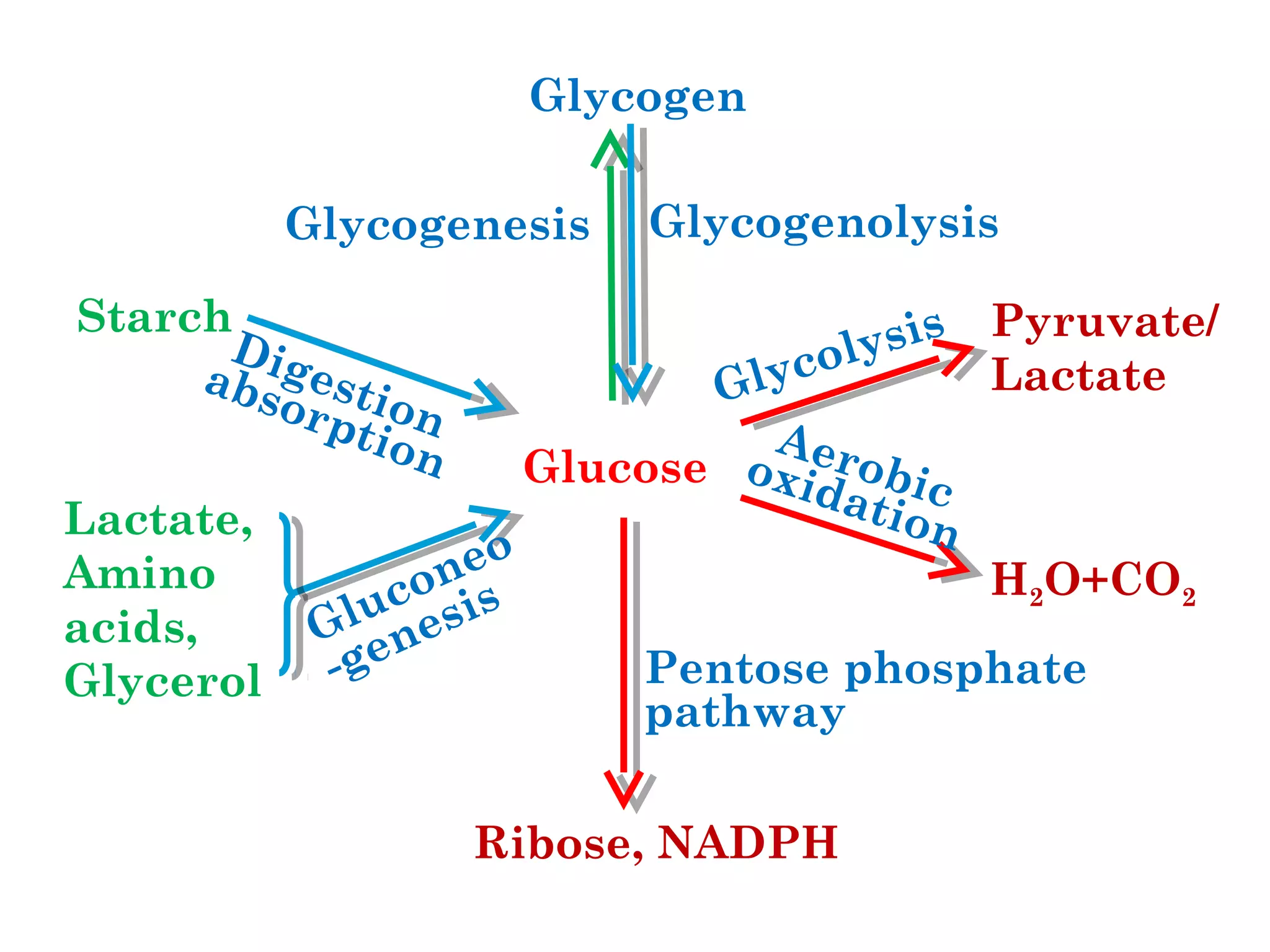
The metabolism of glucose
•Aerobic oxidation
•Glycolysis
•Gluconeogenesis
•Pentose phosphate pathway
•Glycogenesis
•Glycogenolysis
•Uronic acid pathway
Glycogen
Glycogenesis Glycogenolysis
Pentose phosphate
pathway
Ribose, NADPH
Glycolysis Pyruvate/
Lactate
H2O+CO2
Aerobicoxidation
Digestion
absorption
Starch
Lactate,
Amino
acids,
Glycerol
Glucose
Gluconeo
-genesis
Aerobic oxidation
• C6H12O6 6H2O+6CO2 + Energy
(in the form of heat)
Glycolysis
•The anaerobic catabolic pathway by
which a molecule of glucose is
broken down into two molecules of
lactate.
Glucose → 2 Lactic acid (lack of O2)
•All of the enzymes of glycolysis
locate in cytosol.
Glycolysis overview
Glucose
Pyruvate
Lactic acid
Glycolysis
If O2 is not available
1) Glycolytic pathway :
Glucose → Pyruvate
including 10 reactions.
•Phosphorylated Glucose cannot get
out from cell.
•Hexokinase (having 4 Isoenzymes).
•Glucokinase, GK in liver.
•Irreversible.
(1) Glucose is phosphorylated to
Glucose 6-phosphate
OH
OH
H
OH
H
OHH
OH
CH2
H
HO
OH
OH
H
OH
H
OHH
OH
CH2
H
OP
ATP ADP
Hexokinase
Mg2+
G G-6-P
Particulars Hexokinase Glucokinase
Occurrence in all tissues only in liver
Km value 0.1mmol/L 10mmol/L
Substrate Glucose,
Fructose,
Mannose
Glucose
Regulation G-6-P Insulin
Comparison of
Hexokinase and Glucokinase
(2) G-6-P is isomerised to Fructose 6-P
OH
OH
H
OH
H
OHH
OH
CH2
H
OP
G-6-P
isomerase OH
CH2OH
H
CH2
OH H
H OH
O
OP
F-6-P
(3) F-6-P is phosphorylated Fructose
1,6-bisphosphate
•The second phosphorylation
•Phosphofructokinase-1, PFK-1
OH
CH2OH
H
CH2
OH H
H OH
O
OP
F-1,6-BP
OH
CH2
H
CH2
OH H
H OH
O
OP O P
ATP ADP
Mg2+
F-6-P
PFK-1
(4) F-1,6-BP cleaved to 2 Triose
phosphates
•Reversible
F-1,6-BP
CH2
C O
C HHO
C OHH
C OHH
CH2
O P
O P
CH2
C O
O P CHO
CHOH
CH2 O PCH2OH
+
aldolase
dihydroxyacetone
phosphate,
DHAP
glyceraldehyde
3-phosphate,
GAP
(5) Triose phosphate isomerization
G→2 molecule glyceraldehyde-3-
phosphate, consume 2 ATP .
CH2
C O
O P CHO
CHOH
CH2 O PCH2OH
DHAP GAP
phosphotriose
isomerase
(6) Glyceraldehyde 3-phosphate oxidised
1,3-bisphospho glycerate
CHO
CHOH
CH2 O P
NAD+
NADH+H +
Pi
glyceraldehyde
3-phosphate
dehydrogenase,
GAPDH
C
CHOH
CH2 O P
O O~ P
glycerate
1,3-bisphosphate,
1,3-BPG
glyceraldehyde
3-phosphate
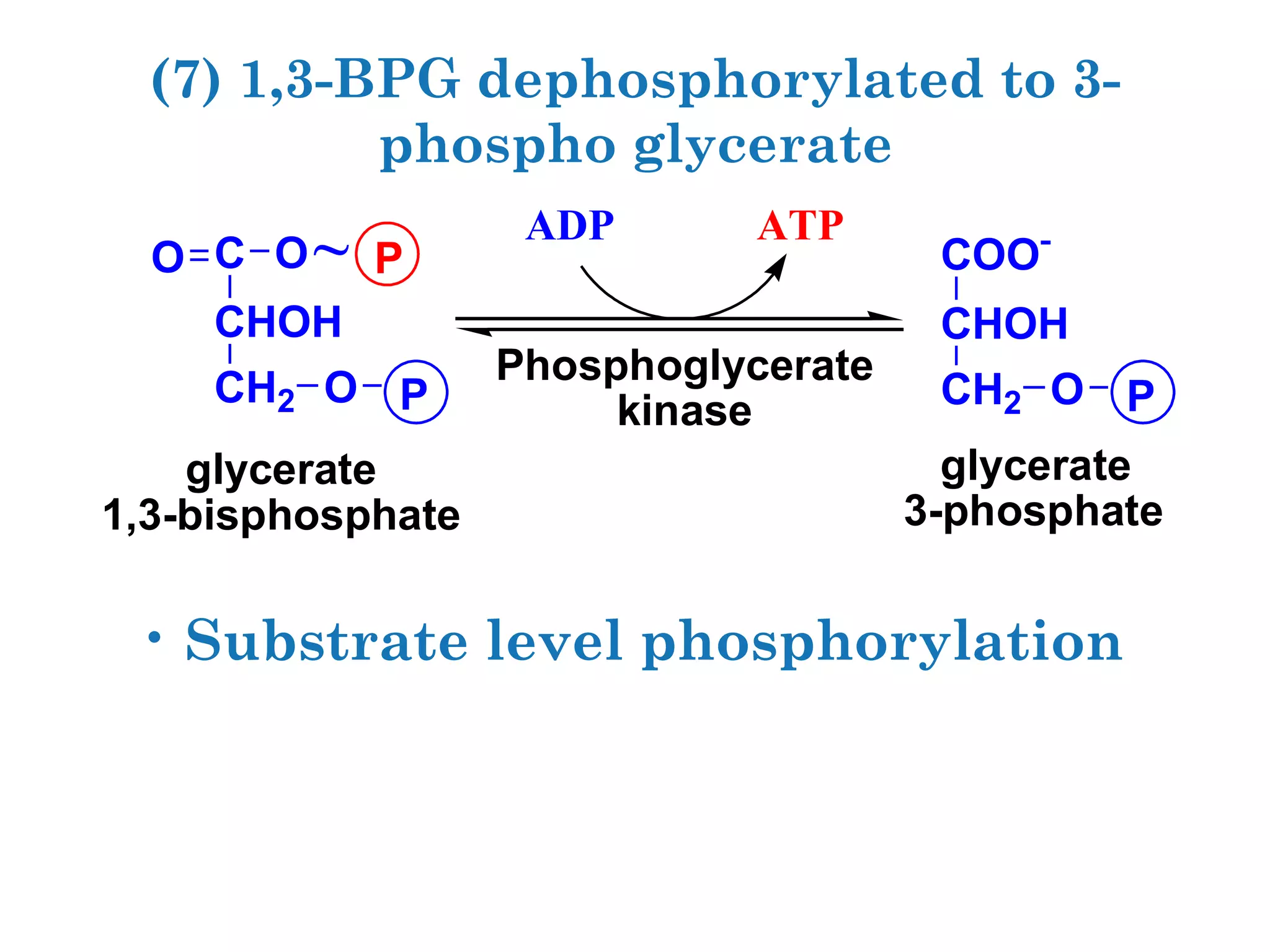
(7) 1,3-BPG dephosphorylated to 3-
phospho glycerate
• Substrate level phosphorylation
COO-
CHOH
CH2 O P
C
CHOH
CH2 O P
O O~ P
ADP ATP
glycerate
1,3-bisphosphate
glycerate
3-phosphate
Phosphoglycerate
kinase
(8) Glycerate 3-phosphate mutated
glycerate 2-phosphate
COO-
CHOH
CH2 O P
COO-
CH
CH2OH
O P
glycerate
3-phosphate
glycerate
2-phosphate
Mutase
(9) Glycerate 2-phosphate →
phosphoenol pyruvate
COO-
CH
CH2OH
O P
COO-
C
CH2
O
PEP
~ P + H2O
enolase
glycerate
2-phosphate
(10) PEP →pyruvate
• Second substrate level
phosphorylation
• irreversible
COO-
C
CH3
ADP ATP
COO-
C
CH2
O
PEP
~ P
pyruvate kinase
O
Pyruvate
2) Pyruvate → lactate
COO
C
CH3
NAD+NADH + H+
O
Pyr
COO
CHOH
CH3
Lactate dehydrogenase,
LDH
Lactic acid
Summary of Glycolysis
ATP
ADP
Mg2+
PFK-1
GAP DHAP
glycerate
1,3-bisphosphate
NADH+H+
glyceraldehyde
3-phosphate
dehydrogenase
H3PO4
NADH+H+
NAD+
ADP
ATP
glycerate
3-phosphate
glycerate
2-phosphate
H2O
PEP
ATP
ADP
pyruvate kinase
lactate
pyruvate
G G-6-P F- 6-P F- 1,6-BP
NAD+
Phosphoglycerate
kinase
Isomerase
Aldolase
Mutase
Enolase
LDH
HK
ATP
ADP
Mg2+
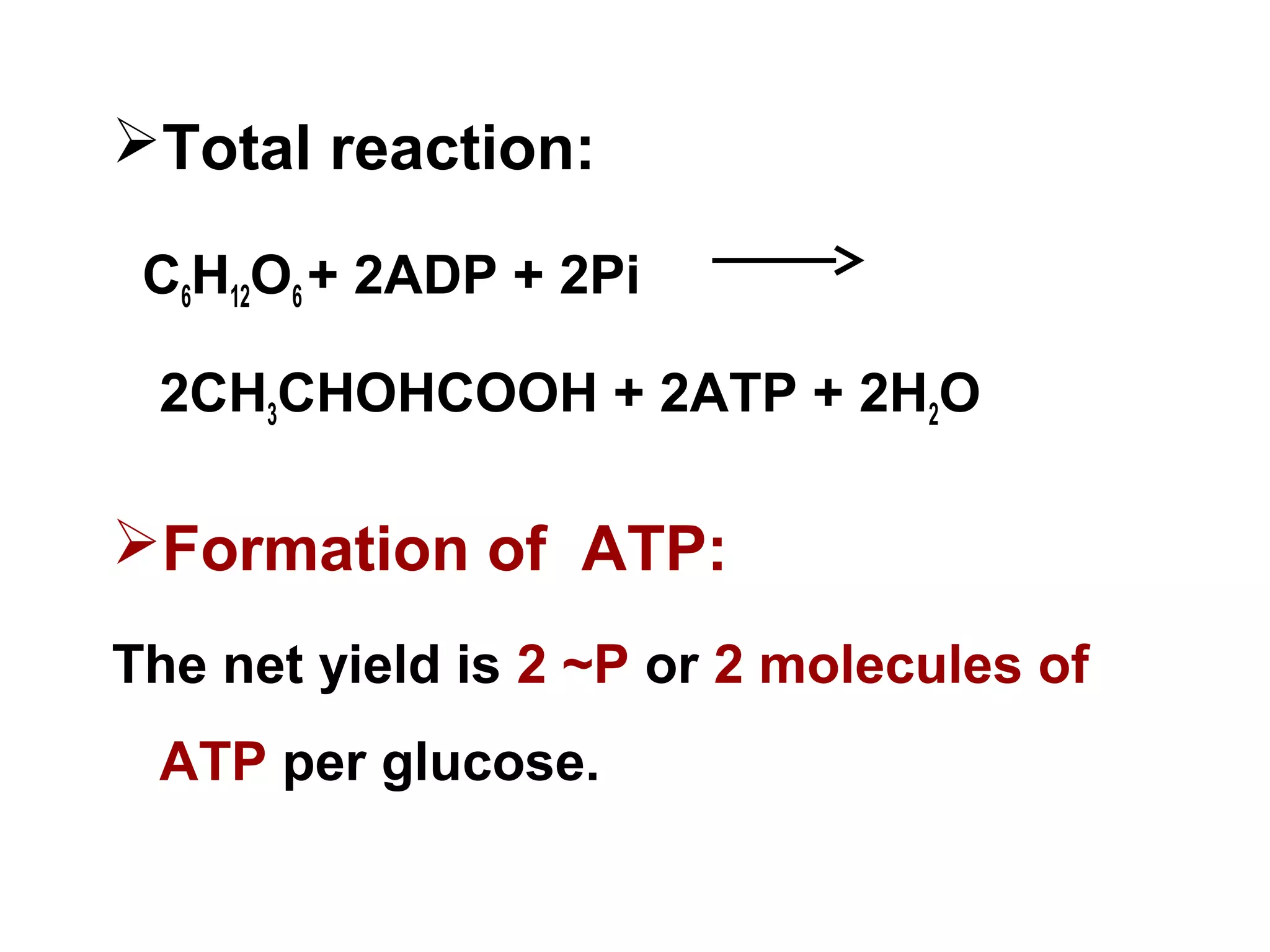
Total reaction:
C6H12O6 + 2ADP + 2Pi
2CH3CHOHCOOH + 2ATP + 2H2O
Formation of ATP:
The net yield is 2 ~P or 2 molecules of
ATP per glucose.
2. Regulation of Glycolysis
• Three key enzymes catalyze
irreversible reactions : Hexokinase,
Phosphofructokinase & Pyruvate
Kinase.
1) PFK-1
The reaction catalyzed by PFK-1 is
usually the rate-limiting step of the
Glycolysis pathway.
This enzyme is regulated by covalent
modification, allosteric regulation.
bifunctional
enzyme
2) Pyruvate kinase
• Allosteric regulation:
F-1,6-BP acts as allosteric activator ;
ATP and Ala in liver act as allosteric
inhibitors;
• Covalent modification:
phosphorylated by Glucagon
through cAMP and PKA and inhibited.
ATP ADP
PKA
Glucagon
Pyruvate Kinase
(active)
Pyruvate Kinase- P
(inactive)
cAMP
3) Hexokinase and glucokinase
• This enzyme is regulated by covalent
modification, allosteric regulation and
isoenzyme regulation.
• Inhibited by its product G-6-P.
• Insulin induces synthesis of
glucokinase.
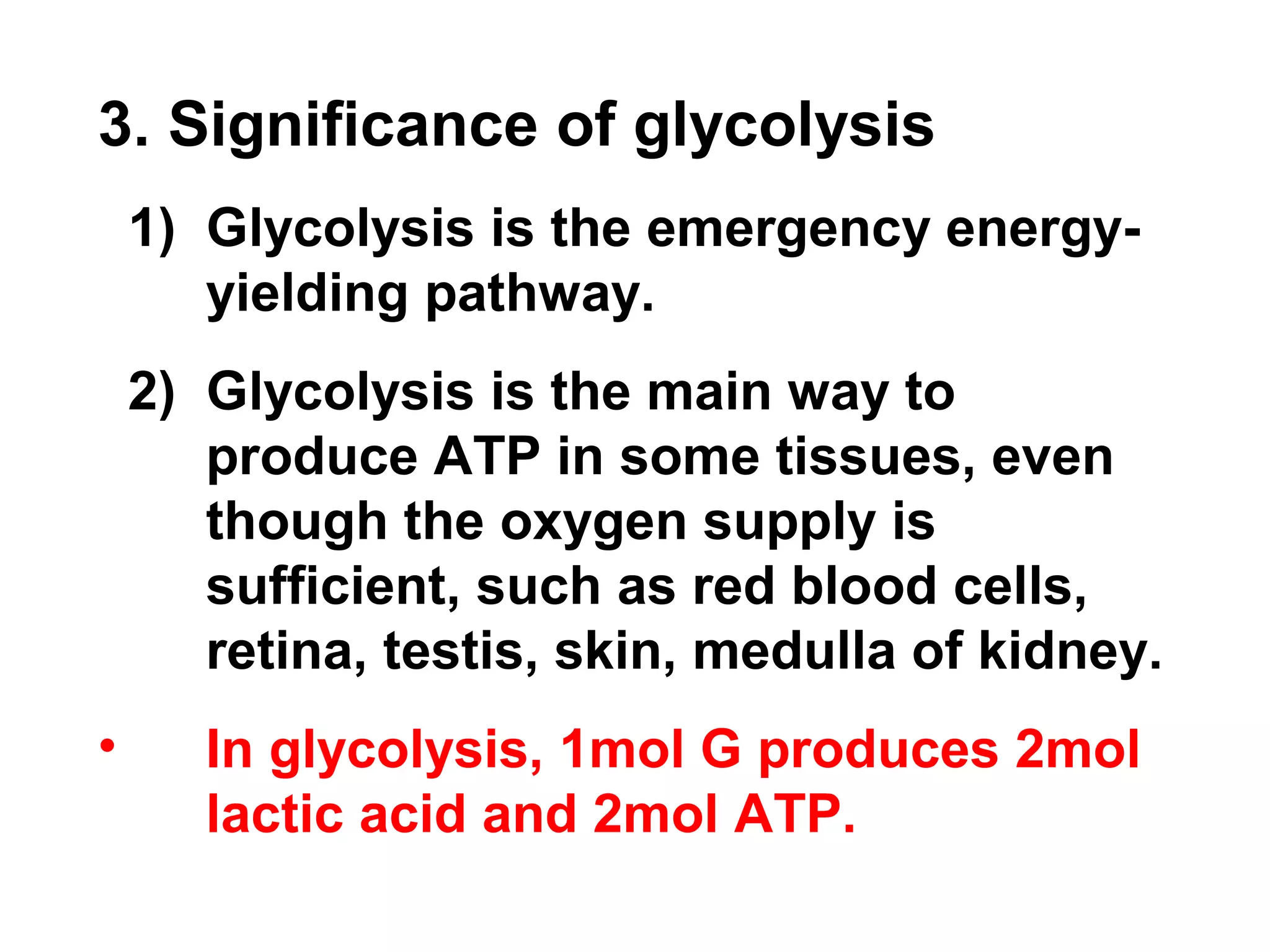
3. Significance of glycolysis
1) Glycolysis is the emergency energy-
yielding pathway.
2) Glycolysis is the main way to
produce ATP in some tissues, even
though the oxygen supply is
sufficient, such as red blood cells,
retina, testis, skin, medulla of kidney.
• In glycolysis, 1mol G produces 2mol
lactic acid and 2mol ATP.
§ 3 Aerobic Oxidation of
Glucose
• The process of complete
oxidation of glucose to CO2 and
water with liberation of energy as
the form of ATP is named aerobic
oxidation.
• The main pathway of G oxidation.
1. Process of aerobic oxidation
G Pyr
cytosol Mitochodria
glycolytic
pathway
second
stage
third
stage
CO2 + H2O+ATPPyr CH3CO~SCoA
first
stage
TAC
1) Oxidative decarboxylation of
Pyruvate to Acetyl CoA
• irreversible;
• in mitochodria.
COO-
C
CH3
NAD+
NADH + H +
O
pyruvate
CH3C
Pyruvate
dehydrogenase
complex
Acetyl CoA
O
~SCoA+ HSCoA + CO2
Pyruvate dehydrogenase complex:
E1 pyruvate dehydrogenase
Es E2 dihydrolipoyl transacetylase
E3 dihydrolipoyl dehydrogenase
thiamine pyrophosphate, TPP (VB1
)
HSCoA (pantothenic acid)
cofactors lipoic Acid
NAD+
(Vpp)
FAD (VB2
)
HSCoA
NAD+
Pyruvate dehydrogenase complex:
The structure of
pyruvate dehydrogenase complex
S S
CH
H2
C
H2C (CH2)4 COOH
SH SH
CH
H2
C
H2C (CH2)4 COOH
+2H
- 2H
lipoic acid dihydrolipoic acid
C
C
NH2
HC
N
C
H2
S
C
C
N
C
N
C
H
CH3
CH2CH2H3C O P O
O-
O
P
O
O-
O-
+
TPP
HSCoA
HS CH2 CH2 NH C CH2
O
CH2 NH C C
O
OH
H
C CH2
CH3
CH3
O P O
OH
O
P
OH
O
O
3'AMP
¦Â-alanine pantoic acid pyrophosphate
pantothenic acid
4'-phosphopantotheine
¦Â-mercapto-
ethylamine
CO2
CoASH
NAD+
NADH
+H+
2) Tricarboxylic acid cycle, TCAC
• The cycle comprises the combination of a
molecule of acetyl-CoA with oxaloacetate,
resulting in the formation of a six-carbon
tricarboxylic acid, citrate. There follows a
series of reactions in the course of which
two molecules of CO2 are released and
oxaloacetate is regenerated.
• Also called citrate cycle or Krebs cycle.
(1) Process of reactions
Citrate cycle
CO
CH2
COO
COO
CH3CO~SCoA
C
CH2
COO
COO
CH2
HO
COO
C
CH
COO
COO
CH2 COO
CH
CH
COO
COO
CH2 COO
H2O
H2O
HO
CO2
CH2
CH2
COCOO
COOCH2
CH2
COO
CO~ SCoA CO2
NAD+NADH+H+
CH2
CH2
COO
COO
GDP+PiGTP
CH
CH2
COO
COO
OOC CH
C COOH
HO
NAD+
NADH+H+
FAD
FADH2
H2O
acetyl CoA
H2O
oxaloacetate
citrate
synthase
citrate
aconitase
cis-aconitate
aconitase
isocitrate
NAD+
NADH+H+
isocitrate dehydrogenase
¦Á-keto-
glutarate
¦Á-ketoglutarate
dehydrogenase
complex
succinyl-CoA
ADP ATP
CoASH
succinyl CoA
syntetase
succinate dehydrogenase
fumarate
succinate
fumarase
malate
malate dehydrogenase
HSCoA
HSCoA
Summary of
Krebs Cycle
①
Reducing
equivalents
② The net reaction of the TCAC:
acetylCoA+3NAD+
+FAD+GDP+Pi+2H2O
→2CO2+3NADH+3H+
+FADH2+GTP+
HSCoA
③ Irreversible and aerobic reaction
④ The enzymes are located in the
mitochondrial matrix.
⑤ Anaplerotic reaction of
oxaloacetate
pyruvate carboxylase
Biotin
ATP ADP + Pi
+ CO2C
CH3
COOH
O
C
C
COOH
COOH
O
H2
NAD+
NADH+H+
malic acid DH
+ CO2
malic enzyme
C
CH3
COOH
O
NADPH+H+
NADP+
CHOH
C
COOH
COOH
C
C
COOH
COOH
O
H2H2
(2) Bio-significance of TCAC
① Acts as the final common pathway for
the oxidation of carbohydrates, lipids,
and proteins.
② Serves as the crossroad for the
interconversion among carbohydrates,
lipids, and non-essential amino acids,
and as a source of biosynthetic
intermediates.
Krebs Cycle is at the
hinge of metabolism.
2. ATP produced in the aerobic
oxidation
• acetyl CoA → TCAC : 3 (NADH+H+
) +
FADH2 + 1GTP → 12 ATP.
• pyruvate →acetyl CoA: NADH+H+
→3 ATP
• 1 G → 2 pyruvate : 2(NADH+H+
) → 6 or
8ATP
1mol G : 36 or 38mol ATP
( 12 + 3 ) ×2 + 6 ( 8 )=
36 ( 38 )
3. The regulation of aerobic
oxidation
• The Key Enzymes of aerobic oxidation
The Key Enzymes of glycolysis
Pyruvate Dehydrogenase Complex
Citrate synthase
Isocitrate dehydrogenase (rate-limiting )
α-Ketoglutarate dehydrogenase
(1) Pyruvate dehydrogenase complex
Pyruvate dehydrogenase
(active form)
allosteric inhibitors:
ATP, acetyl CoA,
NADH, FA
allosteric activators:
AMP, CoA,
NAD+
,Ca2+
pyruvate dehydrogenase
(inactive form)
P
pyruvate dehydrogenase
kinase
pyruvate dehydrogenase
phosphatase
ATP
ADPH2O
Pi
Ca2+
,insulin acetyl CoA,
NADH
ADP,
NAD+
(2) Citrate synthase
• Allosteric activator: ADP
• Allosteric inhibitor: NADH, succinyl CoA,
citrate, ATP
(3) Isocitrate dehydrogenase
• Allosteric activator: ADP, Ca2+
• Allosteric inhibitor: ATP
(4) α-Ketoglutarate dehydrogenase
• Similar with Pyruvate dehydrogenase complex
Oxidative
phosphorylation→TCAC↑
•ATP/ADP↑ inhibit TCAC,
Oxidative phosphorylation ↓
•ATP/ADP↓ , promote
TCAC ,
Oxidative phosphorylation ↑
4. Pasteur Effect
• Under aerobic conditions, glycolysis is
inhibited and this inhibitory effect of
oxygen on glycolysis is known as
Pasteur effect.
• The key point is NADH :
NADH mitochondria
Pyr TCAC CO2 + H2O
Pyr can’t produce to lactate.
§4 Pentose Phosphate
Pathway
1. The procedure of pentose
phosphate pathway/shunt
 In cytosol
1) Oxidative Phase
NADP+
NADPH+H+
H2O
CO2
G-6-P
Xylulose 5-P
Ribulose 5-P
Ribose 5-P
G-6-P
dehydrogenase
6-Phosphogluconate
6-phosphogluconate
dehydrogenase
6-Phospho
gluconolactonase
6-phosphogluco-
nolactone
Epimerase
Isomerase
NADP+
NADPH+H+
2) Non-Oxidative Phase
Ribose 5-p
Xylulose 5-p
Xylulose 5-p
Fructose 6-p
Glyceraldehyde 3-p
Fructose 6-p
• Transketolase: requires TPP
• Transaldolase
Glycolysis
The net reation:
3G-6-P + 6NADP+
→
2F-6-P + GAP + 6NADPH + H+
+ 3CO2
2. Regulation of pentose phosphate
pathway
 Glucose-6-phosphate Dehydrogenase is the
rate-limiting enzyme.
NADPH/NADP+
↑, inhibit;
NADPH/NADP+
↓, activate.
3. Significance of pentose
Phosphate pathway
1) To supply ribose 5-phosphate for bio-
synthesis of nucleic acid;
2) To supply NADPH as H-donor in
metabolism;
 NADPH is very important “reducing
power” for the synthesis of fatty acids
and cholesterol, and amino acids, etc.
 NADPH is the coenzyme of glutathione
reductase to keep the normal level of
reduced glutathione;
So, NADPH, glutathione and glutathione
reductase together will preserved the integrity
of RBC membrane.
2GSH
G-S-S-G NADPH + H+
glutathione reductase
NADP+H2O2
2H2O
Deficiency of glucose 6-phosphate
dehydrogenase results in hemolytic
anemia.
favism
 NADPH serves as the coenzyme of
mixed function oxidases (mono-
oxygenases). In liver this enzyme
participates in biotransformation.
§5 Glycogen synthesis and
catabolism
Glycogen is a polymer of glucose
residues linked by
 α (1→4) glycosidic bonds, mainly
 α (1→6) glycosidic bonds, at
branch points.
• The process of glycogenesis
occurs in cytosol of liver and
skeletal muscle mainly.
1. Glycogen synthesis (Glycogenesis)
• UDPG: G active pattern, G active donor.
• In glycogen anabolism, 1 G consumes
2~P.
• Glycogen synthase: key E.
G
HK or GK
G-6-P
ATP ADP
G-1-P
UDPG
pyrophosphorylase
UDPG
UTP PPi Gn UDP
Gn+1
glycogen
synthase
O
O
OHOH
HH
H
CH2
H
HN
N
O
O
OP
O
O−
P
O
O−
H O
OH
H
OHH
OH
CH2OH
H
O
H
UDPG
Branching enzyme
Phosphorylase: key E;
The end products: 85% of G-1-P and 15%
of free G;
There is no the activity of glucose 6-
phosphatase (G-6-Pase) in skeletal
muscle.
Gn
Pi Gn-1
G-1-P G-6-P
G-6-Pase
H2O Pi
G
Phosphorylase
2. Glycogen catabolism (glycogenolysis)
Debranching enzyme:
glucan transferase
α-1,6-glucosidase
Nonreducing ends
(α1→6) linkage
Glycogen
phosphorylase
(α1→6) glucosidase activity of
debranching enzyme Glucose
Transferase activity of
debranching enzyme
3. Regulation of glycogenesis and
glycogenolysis
1) Allosteric regulation
In liver:
G phosphorylase
glycogenolysis
In muscle:AMP phosphorylase-b
ATP
G-6-P
phosphorylase-a
glycogenolysis
Ca2+
2) Covalent modification
Glucagon
epinephrine
Adenylyl
cyclase
cAMP
G proteinreceptor
PKA
glycogenolysis
Phosphorylase
Glycogen synthase
glycogenesis
Blood sugar
glucagon, epinephrine
inactive
adenylate cyclase
active
adenylate cyclase
ATP cAMP
inactive
PKA
active
PKA
phosphorylase b
kinase
phosphorylase b
kinase
P
ATP
ADP
H2O
Pi
phosphorylase b
P
P
ATP ADP
Pi
H2O
ATP ADP
glycogen
synthase
glycogen
synthase
P
H2OPi
protein
phosphatase-1
(active) (inactive)
inhibitor-1
(active)
inhibitor-1
(inactive)
phosphorylase a
ATP
§6 Gluconeogenesis
• Concept:
The process of transformation of non-
carbohydrates to glucose or glycogen
is termed as gluconeogenesis.
• Materials: lactate, glycerol, pyruvate
and glucogenic amino acid.
• Site: mainly liver, kidney.
1. Gluconeogenic pathway
• The main pathway for gluconeogenesis
is essentially a reversal of glycolysis,
but there are three energy barriers
obstructing a simple reversal of
glycolysis.
1) The shunt of carboxylation of Pyr
PEP
ADP
ATP
oxaloacetic acid
Pyr carboxylase
ADP+Pi ATP CO2
Biotin
GTP
GDP
CO2
PEP carboxykinase
Pyr kinase
COO
-
C
CH3
COO
-
CH
CH2
O~ P
O
pyruvate
COO
-
C
CH2
O
COOH £¨ Mt.£©
£¨ 1/3Mt. 2/3cytosal£©.
2) F-1, 6-BP →F-6-P
F-6-P F-1,6-BP
ATP ADP
Pi H2O
PFK-1
Fructose-
bisphosphatase
3) G-6-P →G
• 2 lactic acid G consume
ATP?
G G-6-P
ATP ADP
Pi H2O
Glucose-6-
phosphatase
HK
gluconeogenesis
glucose
G-6-P
glycogen
F-1,6BP
glyceral-
dehyde 3-P
glycerol
1.3-bisphospho-
glycerate
glycerate 3-P
glycerate 2-P
lactate
G-1-P
malic acid
phosphoenol
pyruvate
pyruvate
GTP
GDP
CO2
2/3
malic acid
pyruvate
phosphoenol
pyruvate
GTP
GDP
CO2
1/3
CO2
CYTOSOL MITOCHONDRIA
NAD+
NADH+H+
NAD+
NADH+H+
NAD+
NADH+H+
glutamate
¦Á-ketoglutarate ¦Á-ketoglutarate
glutamate
OAAAspAspOAADHAP
ATP
ADP
ATP
ADP
PK
ADP
ATP
F-6-P
2. Regulation of gluconeogenesis
• Substrate cycle:
The interconversion of two substrates
catalyzed by different enzymes for
singly direction reactions is called
“substrate cycle”.
• The substrate cycle produces net
hydrolysis of ATP or GTP.------futile
cycle
Key enzymes of gluconeogenesis
PEP carboxykinase
Pyr carboxylase
Fructose-bisphosphatase
Glucose-6-phosphatase
F-1,6-BP
ATP
ADP
Pi
H2O
PFK-1FBPase-1
F-6-P
F-2,6-BP
AMP
glycolysis
gluconeogenesis:
F-1,6-BP
ATP
ADP
F-2,6-BP
PEP
Pyr
acetyl CoA
glucagon
insulin
glucagon
Ala in liver
OAA
3. Significance of gluconeogenesis
(1) Replenishment of Glucose by
Gluconeogenesis and Maintaining
Normal Blood Sugar Level.
(2) Replenishment of Liver Glycogen.
(3) Regulation of Acid-base Balance.
First stages
(cytosol)
Second stages
(Mt.)
Third stages
(Mt.)
Lactic acid (Cori) cycle
• Lactate, formed by the oxidation of
glucose in skeletal muscle and by
blood, is transported to the liver where
it re-forms glucose, which again
becomes available via the circulation
for oxidation in the tissues. This
process is known as the lactic acid
cycle or Cori cycle.
• prevent acidosis ; reused lactate
muscle
glucose
pyruvate
lactate
glucose
blood
pyruvate
lactate
glycolytic
pathway
glucose
liver
lactate
NAD+
NADH+H+
NADH+H+
NAD+
gluconeo-
genesis
Lactic acid cycle
§6 Blood Sugar and Its
Regulation
1. The source and fate of blood sugar
blood sugar
3.89¡« 6.11mmol/L
dietary supply
liver glycogen
(gluconeogenesis)
other saccharides
CO2 + H2O + energy
glycogen
other saccharides
non-carbohydrates
>8.89¡«10.00mmol/L
(threshold of kidney)
non-carbohydrate
(lipids and some
amino acids)
urine glucose
origin (income) fate (outcome)
Blood sugar level must be maintained
within a limited range to ensure the
supply of glucose to brain.
The blood glucose concentration is 3.89
~ 6.11mmol/L normally.
2. Regulation of blood sugar level
1 ) insulin : for decreasing blood sugar
levels.
2 ) glucagon : for increasing blood sugar
levels.
3 ) glucocorticoid: for increasing blood
sugar levels.
4 ) adrenaline : for increasing blood
sugar levels.
3. Abnormal Blood Sugar Level
• Hyperglycemia: > 7.22 ~ 7.78 mmol/L
• The renal threshold for glucose: 8.89
~ 10.00mmol/L
• Hypoglycemia: < 3.33 ~ 3.89mmol/L
Pyruvate as a junction point
Carbohydrate metabolism

Carbohydrate metabolism

  • 1.
    Carbohydrate Metabolism Mr.Tapeshwar Yadav. IIyear M.Sc. Biochemistry Mamata Medical College Khammam
  • 2.
    Carbohydrates Definition : Carbohydratesare polyhydroxy aldehydes or ketones.
  • 3.
    Biological significance of Carbohydrates •Theseare major source of energy for living organisms. •Supplying a huge array of metabolic intermediates for biosynthetic reactions. •The structural elements in cell coat or connective tissues.
  • 4.
    Digestion : • Partlydigested in mouth by salivary amylase. • In stomach there is no digestion takes place. • Complete digestion and absorption will be taken place at small intestine
  • 5.
    Glucose transporters (GLUT) •There are 5 types GLUT –GLUT1: RBC –GLUT4: Adipose tissue, Muscle
  • 6.
    The metabolism ofglucose •Aerobic oxidation •Glycolysis •Gluconeogenesis •Pentose phosphate pathway •Glycogenesis •Glycogenolysis •Uronic acid pathway
  • 7.
    Glycogen Glycogenesis Glycogenolysis Pentose phosphate pathway Ribose,NADPH Glycolysis Pyruvate/ Lactate H2O+CO2 Aerobicoxidation Digestion absorption Starch Lactate, Amino acids, Glycerol Glucose Gluconeo -genesis
  • 8.
    Aerobic oxidation • C6H12O66H2O+6CO2 + Energy (in the form of heat)
  • 11.
  • 12.
    •The anaerobic catabolicpathway by which a molecule of glucose is broken down into two molecules of lactate. Glucose → 2 Lactic acid (lack of O2) •All of the enzymes of glycolysis locate in cytosol.
  • 13.
  • 14.
    1) Glycolytic pathway: Glucose → Pyruvate including 10 reactions.
  • 15.
    •Phosphorylated Glucose cannotget out from cell. •Hexokinase (having 4 Isoenzymes). •Glucokinase, GK in liver. •Irreversible. (1) Glucose is phosphorylated to Glucose 6-phosphate OH OH H OH H OHH OH CH2 H HO OH OH H OH H OHH OH CH2 H OP ATP ADP Hexokinase Mg2+ G G-6-P
  • 16.
    Particulars Hexokinase Glucokinase Occurrencein all tissues only in liver Km value 0.1mmol/L 10mmol/L Substrate Glucose, Fructose, Mannose Glucose Regulation G-6-P Insulin Comparison of Hexokinase and Glucokinase
  • 17.
    (2) G-6-P isisomerised to Fructose 6-P OH OH H OH H OHH OH CH2 H OP G-6-P isomerase OH CH2OH H CH2 OH H H OH O OP F-6-P
  • 18.
    (3) F-6-P isphosphorylated Fructose 1,6-bisphosphate •The second phosphorylation •Phosphofructokinase-1, PFK-1 OH CH2OH H CH2 OH H H OH O OP F-1,6-BP OH CH2 H CH2 OH H H OH O OP O P ATP ADP Mg2+ F-6-P PFK-1
  • 19.
    (4) F-1,6-BP cleavedto 2 Triose phosphates •Reversible F-1,6-BP CH2 C O C HHO C OHH C OHH CH2 O P O P CH2 C O O P CHO CHOH CH2 O PCH2OH + aldolase dihydroxyacetone phosphate, DHAP glyceraldehyde 3-phosphate, GAP
  • 20.
    (5) Triose phosphateisomerization G→2 molecule glyceraldehyde-3- phosphate, consume 2 ATP . CH2 C O O P CHO CHOH CH2 O PCH2OH DHAP GAP phosphotriose isomerase
  • 21.
    (6) Glyceraldehyde 3-phosphateoxidised 1,3-bisphospho glycerate CHO CHOH CH2 O P NAD+ NADH+H + Pi glyceraldehyde 3-phosphate dehydrogenase, GAPDH C CHOH CH2 O P O O~ P glycerate 1,3-bisphosphate, 1,3-BPG glyceraldehyde 3-phosphate
  • 22.
    (7) 1,3-BPG dephosphorylatedto 3- phospho glycerate • Substrate level phosphorylation COO- CHOH CH2 O P C CHOH CH2 O P O O~ P ADP ATP glycerate 1,3-bisphosphate glycerate 3-phosphate Phosphoglycerate kinase
  • 23.
    (8) Glycerate 3-phosphatemutated glycerate 2-phosphate COO- CHOH CH2 O P COO- CH CH2OH O P glycerate 3-phosphate glycerate 2-phosphate Mutase
  • 24.
    (9) Glycerate 2-phosphate→ phosphoenol pyruvate COO- CH CH2OH O P COO- C CH2 O PEP ~ P + H2O enolase glycerate 2-phosphate
  • 25.
    (10) PEP →pyruvate •Second substrate level phosphorylation • irreversible COO- C CH3 ADP ATP COO- C CH2 O PEP ~ P pyruvate kinase O Pyruvate
  • 26.
    2) Pyruvate →lactate COO C CH3 NAD+NADH + H+ O Pyr COO CHOH CH3 Lactate dehydrogenase, LDH Lactic acid
  • 27.
    Summary of Glycolysis ATP ADP Mg2+ PFK-1 GAPDHAP glycerate 1,3-bisphosphate NADH+H+ glyceraldehyde 3-phosphate dehydrogenase H3PO4 NADH+H+ NAD+ ADP ATP glycerate 3-phosphate glycerate 2-phosphate H2O PEP ATP ADP pyruvate kinase lactate pyruvate G G-6-P F- 6-P F- 1,6-BP NAD+ Phosphoglycerate kinase Isomerase Aldolase Mutase Enolase LDH HK ATP ADP Mg2+
  • 28.
    Total reaction: C6H12O6 +2ADP + 2Pi 2CH3CHOHCOOH + 2ATP + 2H2O Formation of ATP: The net yield is 2 ~P or 2 molecules of ATP per glucose.
  • 29.
    2. Regulation ofGlycolysis • Three key enzymes catalyze irreversible reactions : Hexokinase, Phosphofructokinase & Pyruvate Kinase.
  • 30.
    1) PFK-1 The reactioncatalyzed by PFK-1 is usually the rate-limiting step of the Glycolysis pathway. This enzyme is regulated by covalent modification, allosteric regulation.
  • 31.
  • 32.
    2) Pyruvate kinase •Allosteric regulation: F-1,6-BP acts as allosteric activator ; ATP and Ala in liver act as allosteric inhibitors;
  • 33.
    • Covalent modification: phosphorylatedby Glucagon through cAMP and PKA and inhibited. ATP ADP PKA Glucagon Pyruvate Kinase (active) Pyruvate Kinase- P (inactive) cAMP
  • 34.
    3) Hexokinase andglucokinase • This enzyme is regulated by covalent modification, allosteric regulation and isoenzyme regulation. • Inhibited by its product G-6-P. • Insulin induces synthesis of glucokinase.
  • 35.
    3. Significance ofglycolysis 1) Glycolysis is the emergency energy- yielding pathway. 2) Glycolysis is the main way to produce ATP in some tissues, even though the oxygen supply is sufficient, such as red blood cells, retina, testis, skin, medulla of kidney. • In glycolysis, 1mol G produces 2mol lactic acid and 2mol ATP.
  • 36.
    § 3 AerobicOxidation of Glucose
  • 37.
    • The processof complete oxidation of glucose to CO2 and water with liberation of energy as the form of ATP is named aerobic oxidation. • The main pathway of G oxidation.
  • 38.
    1. Process ofaerobic oxidation G Pyr cytosol Mitochodria glycolytic pathway second stage third stage CO2 + H2O+ATPPyr CH3CO~SCoA first stage TAC
  • 39.
    1) Oxidative decarboxylationof Pyruvate to Acetyl CoA • irreversible; • in mitochodria. COO- C CH3 NAD+ NADH + H + O pyruvate CH3C Pyruvate dehydrogenase complex Acetyl CoA O ~SCoA+ HSCoA + CO2
  • 40.
    Pyruvate dehydrogenase complex: E1pyruvate dehydrogenase Es E2 dihydrolipoyl transacetylase E3 dihydrolipoyl dehydrogenase thiamine pyrophosphate, TPP (VB1 ) HSCoA (pantothenic acid) cofactors lipoic Acid NAD+ (Vpp) FAD (VB2 )
  • 41.
  • 42.
    The structure of pyruvatedehydrogenase complex
  • 43.
    S S CH H2 C H2C (CH2)4COOH SH SH CH H2 C H2C (CH2)4 COOH +2H - 2H lipoic acid dihydrolipoic acid C C NH2 HC N C H2 S C C N C N C H CH3 CH2CH2H3C O P O O- O P O O- O- + TPP
  • 44.
    HSCoA HS CH2 CH2NH C CH2 O CH2 NH C C O OH H C CH2 CH3 CH3 O P O OH O P OH O O 3'AMP ¦Â-alanine pantoic acid pyrophosphate pantothenic acid 4'-phosphopantotheine ¦Â-mercapto- ethylamine
  • 45.
  • 46.
    2) Tricarboxylic acidcycle, TCAC • The cycle comprises the combination of a molecule of acetyl-CoA with oxaloacetate, resulting in the formation of a six-carbon tricarboxylic acid, citrate. There follows a series of reactions in the course of which two molecules of CO2 are released and oxaloacetate is regenerated. • Also called citrate cycle or Krebs cycle.
  • 47.
    (1) Process ofreactions
  • 51.
    Citrate cycle CO CH2 COO COO CH3CO~SCoA C CH2 COO COO CH2 HO COO C CH COO COO CH2 COO CH CH COO COO CH2COO H2O H2O HO CO2 CH2 CH2 COCOO COOCH2 CH2 COO CO~ SCoA CO2 NAD+NADH+H+ CH2 CH2 COO COO GDP+PiGTP CH CH2 COO COO OOC CH C COOH HO NAD+ NADH+H+ FAD FADH2 H2O acetyl CoA H2O oxaloacetate citrate synthase citrate aconitase cis-aconitate aconitase isocitrate NAD+ NADH+H+ isocitrate dehydrogenase ¦Á-keto- glutarate ¦Á-ketoglutarate dehydrogenase complex succinyl-CoA ADP ATP CoASH succinyl CoA syntetase succinate dehydrogenase fumarate succinate fumarase malate malate dehydrogenase HSCoA HSCoA
  • 52.
  • 53.
    ② The netreaction of the TCAC: acetylCoA+3NAD+ +FAD+GDP+Pi+2H2O →2CO2+3NADH+3H+ +FADH2+GTP+ HSCoA ③ Irreversible and aerobic reaction ④ The enzymes are located in the mitochondrial matrix.
  • 54.
    ⑤ Anaplerotic reactionof oxaloacetate pyruvate carboxylase Biotin ATP ADP + Pi + CO2C CH3 COOH O C C COOH COOH O H2 NAD+ NADH+H+ malic acid DH + CO2 malic enzyme C CH3 COOH O NADPH+H+ NADP+ CHOH C COOH COOH C C COOH COOH O H2H2
  • 55.
    (2) Bio-significance ofTCAC ① Acts as the final common pathway for the oxidation of carbohydrates, lipids, and proteins. ② Serves as the crossroad for the interconversion among carbohydrates, lipids, and non-essential amino acids, and as a source of biosynthetic intermediates.
  • 56.
    Krebs Cycle isat the hinge of metabolism.
  • 57.
    2. ATP producedin the aerobic oxidation • acetyl CoA → TCAC : 3 (NADH+H+ ) + FADH2 + 1GTP → 12 ATP. • pyruvate →acetyl CoA: NADH+H+ →3 ATP • 1 G → 2 pyruvate : 2(NADH+H+ ) → 6 or 8ATP 1mol G : 36 or 38mol ATP ( 12 + 3 ) ×2 + 6 ( 8 )= 36 ( 38 )
  • 58.
    3. The regulationof aerobic oxidation • The Key Enzymes of aerobic oxidation The Key Enzymes of glycolysis Pyruvate Dehydrogenase Complex Citrate synthase Isocitrate dehydrogenase (rate-limiting ) α-Ketoglutarate dehydrogenase
  • 59.
    (1) Pyruvate dehydrogenasecomplex Pyruvate dehydrogenase (active form) allosteric inhibitors: ATP, acetyl CoA, NADH, FA allosteric activators: AMP, CoA, NAD+ ,Ca2+ pyruvate dehydrogenase (inactive form) P pyruvate dehydrogenase kinase pyruvate dehydrogenase phosphatase ATP ADPH2O Pi Ca2+ ,insulin acetyl CoA, NADH ADP, NAD+
  • 60.
    (2) Citrate synthase •Allosteric activator: ADP • Allosteric inhibitor: NADH, succinyl CoA, citrate, ATP (3) Isocitrate dehydrogenase • Allosteric activator: ADP, Ca2+ • Allosteric inhibitor: ATP (4) α-Ketoglutarate dehydrogenase • Similar with Pyruvate dehydrogenase complex
  • 62.
    Oxidative phosphorylation→TCAC↑ •ATP/ADP↑ inhibit TCAC, Oxidativephosphorylation ↓ •ATP/ADP↓ , promote TCAC , Oxidative phosphorylation ↑
  • 63.
    4. Pasteur Effect •Under aerobic conditions, glycolysis is inhibited and this inhibitory effect of oxygen on glycolysis is known as Pasteur effect. • The key point is NADH : NADH mitochondria Pyr TCAC CO2 + H2O Pyr can’t produce to lactate.
  • 64.
  • 65.
    1. The procedureof pentose phosphate pathway/shunt  In cytosol
  • 66.
    1) Oxidative Phase NADP+ NADPH+H+ H2O CO2 G-6-P Xylulose5-P Ribulose 5-P Ribose 5-P G-6-P dehydrogenase 6-Phosphogluconate 6-phosphogluconate dehydrogenase 6-Phospho gluconolactonase 6-phosphogluco- nolactone Epimerase Isomerase NADP+ NADPH+H+
  • 67.
    2) Non-Oxidative Phase Ribose5-p Xylulose 5-p Xylulose 5-p Fructose 6-p Glyceraldehyde 3-p Fructose 6-p • Transketolase: requires TPP • Transaldolase Glycolysis
  • 68.
    The net reation: 3G-6-P+ 6NADP+ → 2F-6-P + GAP + 6NADPH + H+ + 3CO2 2. Regulation of pentose phosphate pathway  Glucose-6-phosphate Dehydrogenase is the rate-limiting enzyme. NADPH/NADP+ ↑, inhibit; NADPH/NADP+ ↓, activate.
  • 69.
    3. Significance ofpentose Phosphate pathway 1) To supply ribose 5-phosphate for bio- synthesis of nucleic acid; 2) To supply NADPH as H-donor in metabolism;  NADPH is very important “reducing power” for the synthesis of fatty acids and cholesterol, and amino acids, etc.
  • 70.
     NADPH isthe coenzyme of glutathione reductase to keep the normal level of reduced glutathione; So, NADPH, glutathione and glutathione reductase together will preserved the integrity of RBC membrane. 2GSH G-S-S-G NADPH + H+ glutathione reductase NADP+H2O2 2H2O
  • 71.
    Deficiency of glucose6-phosphate dehydrogenase results in hemolytic anemia. favism  NADPH serves as the coenzyme of mixed function oxidases (mono- oxygenases). In liver this enzyme participates in biotransformation.
  • 72.
    §5 Glycogen synthesisand catabolism
  • 73.
    Glycogen is apolymer of glucose residues linked by  α (1→4) glycosidic bonds, mainly  α (1→6) glycosidic bonds, at branch points.
  • 75.
    • The processof glycogenesis occurs in cytosol of liver and skeletal muscle mainly. 1. Glycogen synthesis (Glycogenesis)
  • 76.
    • UDPG: Gactive pattern, G active donor. • In glycogen anabolism, 1 G consumes 2~P. • Glycogen synthase: key E. G HK or GK G-6-P ATP ADP G-1-P UDPG pyrophosphorylase UDPG UTP PPi Gn UDP Gn+1 glycogen synthase
  • 77.
  • 79.
  • 80.
    Phosphorylase: key E; Theend products: 85% of G-1-P and 15% of free G; There is no the activity of glucose 6- phosphatase (G-6-Pase) in skeletal muscle. Gn Pi Gn-1 G-1-P G-6-P G-6-Pase H2O Pi G Phosphorylase 2. Glycogen catabolism (glycogenolysis)
  • 81.
  • 82.
    Nonreducing ends (α1→6) linkage Glycogen phosphorylase (α1→6)glucosidase activity of debranching enzyme Glucose Transferase activity of debranching enzyme
  • 83.
    3. Regulation ofglycogenesis and glycogenolysis 1) Allosteric regulation In liver: G phosphorylase glycogenolysis In muscle:AMP phosphorylase-b ATP G-6-P phosphorylase-a glycogenolysis Ca2+
  • 84.
    2) Covalent modification Glucagon epinephrine Adenylyl cyclase cAMP Gproteinreceptor PKA glycogenolysis Phosphorylase Glycogen synthase glycogenesis Blood sugar
  • 85.
    glucagon, epinephrine inactive adenylate cyclase active adenylatecyclase ATP cAMP inactive PKA active PKA phosphorylase b kinase phosphorylase b kinase P ATP ADP H2O Pi phosphorylase b P P ATP ADP Pi H2O ATP ADP glycogen synthase glycogen synthase P H2OPi protein phosphatase-1 (active) (inactive) inhibitor-1 (active) inhibitor-1 (inactive) phosphorylase a ATP
  • 86.
  • 87.
    • Concept: The processof transformation of non- carbohydrates to glucose or glycogen is termed as gluconeogenesis. • Materials: lactate, glycerol, pyruvate and glucogenic amino acid. • Site: mainly liver, kidney.
  • 88.
    1. Gluconeogenic pathway •The main pathway for gluconeogenesis is essentially a reversal of glycolysis, but there are three energy barriers obstructing a simple reversal of glycolysis.
  • 89.
    1) The shuntof carboxylation of Pyr PEP ADP ATP oxaloacetic acid Pyr carboxylase ADP+Pi ATP CO2 Biotin GTP GDP CO2 PEP carboxykinase Pyr kinase COO - C CH3 COO - CH CH2 O~ P O pyruvate COO - C CH2 O COOH £¨ Mt.£© £¨ 1/3Mt. 2/3cytosal£©.
  • 90.
    2) F-1, 6-BP→F-6-P F-6-P F-1,6-BP ATP ADP Pi H2O PFK-1 Fructose- bisphosphatase
  • 91.
    3) G-6-P →G •2 lactic acid G consume ATP? G G-6-P ATP ADP Pi H2O Glucose-6- phosphatase HK
  • 92.
    gluconeogenesis glucose G-6-P glycogen F-1,6BP glyceral- dehyde 3-P glycerol 1.3-bisphospho- glycerate glycerate 3-P glycerate2-P lactate G-1-P malic acid phosphoenol pyruvate pyruvate GTP GDP CO2 2/3 malic acid pyruvate phosphoenol pyruvate GTP GDP CO2 1/3 CO2 CYTOSOL MITOCHONDRIA NAD+ NADH+H+ NAD+ NADH+H+ NAD+ NADH+H+ glutamate ¦Á-ketoglutarate ¦Á-ketoglutarate glutamate OAAAspAspOAADHAP ATP ADP ATP ADP PK ADP ATP F-6-P
  • 93.
    2. Regulation ofgluconeogenesis • Substrate cycle: The interconversion of two substrates catalyzed by different enzymes for singly direction reactions is called “substrate cycle”. • The substrate cycle produces net hydrolysis of ATP or GTP.------futile cycle
  • 94.
    Key enzymes ofgluconeogenesis PEP carboxykinase Pyr carboxylase Fructose-bisphosphatase Glucose-6-phosphatase
  • 95.
  • 96.
  • 97.
    3. Significance ofgluconeogenesis (1) Replenishment of Glucose by Gluconeogenesis and Maintaining Normal Blood Sugar Level. (2) Replenishment of Liver Glycogen. (3) Regulation of Acid-base Balance.
  • 98.
  • 99.
    Lactic acid (Cori)cycle • Lactate, formed by the oxidation of glucose in skeletal muscle and by blood, is transported to the liver where it re-forms glucose, which again becomes available via the circulation for oxidation in the tissues. This process is known as the lactic acid cycle or Cori cycle. • prevent acidosis ; reused lactate
  • 100.
  • 101.
    §6 Blood Sugarand Its Regulation
  • 102.
    1. The sourceand fate of blood sugar blood sugar 3.89¡« 6.11mmol/L dietary supply liver glycogen (gluconeogenesis) other saccharides CO2 + H2O + energy glycogen other saccharides non-carbohydrates >8.89¡«10.00mmol/L (threshold of kidney) non-carbohydrate (lipids and some amino acids) urine glucose origin (income) fate (outcome)
  • 103.
    Blood sugar levelmust be maintained within a limited range to ensure the supply of glucose to brain. The blood glucose concentration is 3.89 ~ 6.11mmol/L normally.
  • 104.
    2. Regulation ofblood sugar level 1 ) insulin : for decreasing blood sugar levels. 2 ) glucagon : for increasing blood sugar levels. 3 ) glucocorticoid: for increasing blood sugar levels. 4 ) adrenaline : for increasing blood sugar levels.
  • 105.
    3. Abnormal BloodSugar Level • Hyperglycemia: > 7.22 ~ 7.78 mmol/L • The renal threshold for glucose: 8.89 ~ 10.00mmol/L • Hypoglycemia: < 3.33 ~ 3.89mmol/L
  • 106.
    Pyruvate as ajunction point