Carbohydrate Metabolism
Metabolism
• Metabolism is all the chemical reactions that occur in
an organism
• Cellular metabolism
– Cells break down excess carbohydrates first, then lipids,
finally amino acids if energy needs are not met by
carbohydrates and fat
– Nutrients not used for energy are used to build up structure,
are stored, or they are excreted
– 40% of the energy released in catabolism is captured in ATP,
the rest is released as heat
Metabolism
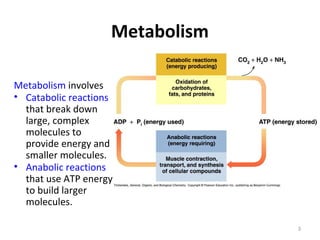
Metabolism involves
• Catabolic reactions
that break down
large, complex
molecules to
provide energy and
smaller molecules.
• Anabolic reactions
that use ATP energy
to build larger
molecules.
3
Anabolism
• Performance of structural maintenance
and repairs
• Support of growth
• Production of secretions
• Building of nutrient reserves
Stages of Metabolism
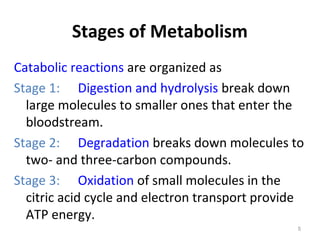
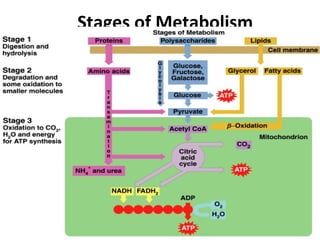
Catabolic reactions are organized as
Stage 1: Digestion and hydrolysis break down
large molecules to smaller ones that enter the
bloodstream.
Stage 2: Degradation breaks down molecules to
two- and three-carbon compounds.
Stage 3: Oxidation of small molecules in the
citric acid cycle and electron transport provide
ATP energy.
5
Stages of Metabolism
6
Metabolism of Carbohydrates
 
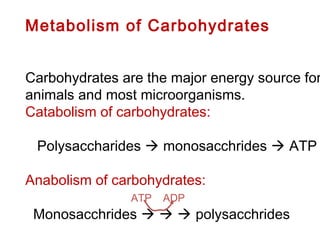
Carbohydrates are the major energy source for
animals and most microorganisms.
Catabolism of carbohydrates:
Polysaccharides  monosacchrides  ATP
Anabolism of carbohydrates:
Monosacchrides    polysacchrides 
ATP ADP
• All organisms obtain energy from the
oxidation of glucose and other carbohydrates.
• In some cells and organisms, glucose is the
major or sole source of energy:
• brainbrain
• erythrocyteserythrocytes
• many bacteriamany bacteria
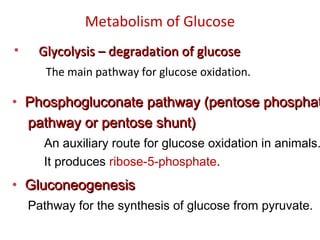
Metabolism of Glucose
• Glycolysis – degradation of glucoseGlycolysis – degradation of glucose
The main pathway for glucose oxidation.
• Phosphogluconate pathway (pentose phosphatPhosphogluconate pathway (pentose phosphat
pathway or pentose shunt)pathway or pentose shunt)
An auxiliary route for glucose oxidation in animals.
It produces ribose-5-phosphate.
• GluconeogenesisGluconeogenesis
Pathway for the synthesis of glucose from pyruvate.
Catabolism of glucose can be aerobic and
anaerobic.
Aerobic metabolism of glucose relies on O2
and is the major way for animals to obtain
energy.
Anaerobic metabolism is an energy producing
process without O2.
- Fermentation is an anaerobic metabolic
process in microorganisms.
Carbohydrate Metabolism
• Primarily glucose
– Fructose and galactose enter the pathways at various points
• All cells can utilize glucose for energy production
– Glucose uptake from blood to cells usually mediated by
insulin and transporters
• Liver is central site for carbohydrate metabolism
– Glucose uptake independent of insulin
– The only exporter of glucose
Blood Glucose Homeostasis
• Several cell types prefer glucose as energy
source (ex., CNS)
 80-100 mg/dl is normal range of blood
glucose in non-ruminant animals
 45-65 mg/dl is normal range of blood
glucose in ruminant animals
 Uses of glucose:
 Energy source for cells
 Muscle glycogen
 Fat synthesis if in excess of needs
Fate of Absorbed Glucose
• 1st
Priority: glycogen storage
– Stored in muscle and liver
• 2nd
Priority: provide energy
– Oxidized to ATP
• 3rd
Priority: stored as fat
– Only excess glucose
– Stored as triglycerides in adipose
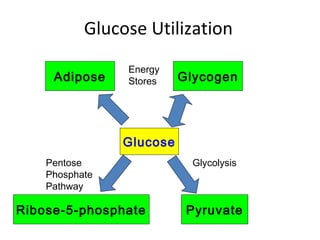
Glucose Utilization
Glucose
PyruvateRibose-5-phosphate
Glycogen
Energy
Stores
Pentose
Phosphate
Pathway
Glycolysis
Adipose
Glycolysis
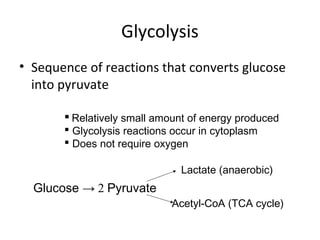
• Sequence of reactions that converts glucose
into pyruvate
 Relatively small amount of energy produced
 Glycolysis reactions occur in cytoplasm
 Does not require oxygen
Glucose → 2 Pyruvate
Lactate (anaerobic)
Acetyl-CoA (TCA cycle)
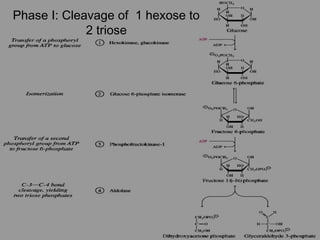
Phase I: Cleavage of 1 hexose to
2 triose
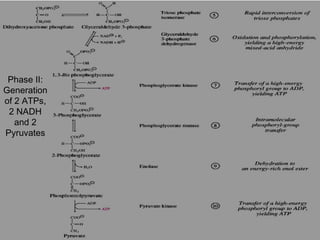
Phase II:
Generation
of 2 ATPs,
2 NADH
and 2
Pyruvates
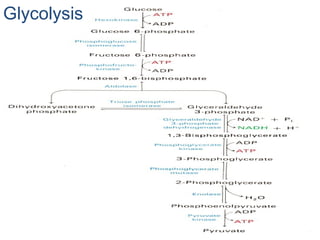
Glycolysis
Hexose Kinase
• 1st step in glycolysis;2 enzymes glucokinase &
hexokinase
• Glucose 6-p phosphatase for reversal of reaction
• ATP is consumed here in order to get more later
• ATP makes the phosphorylation of glucose
spontaneous
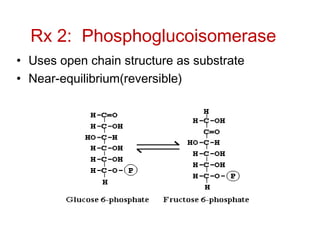
Rx 2: Phosphoglucoisomerase
• Uses open chain structure as substrate
• Near-equilibrium(reversible)
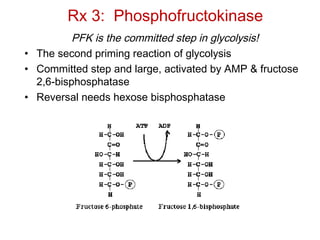
Rx 3: Phosphofructokinase
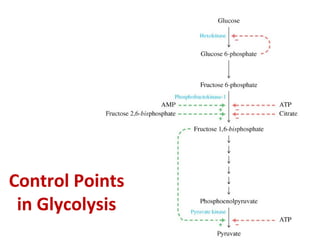
PFK is the committed step in glycolysis!
• The second priming reaction of glycolysis
• Committed step and large, activated by AMP & fructose
2,6-bisphosphatase
• Reversal needs hexose bisphosphatase
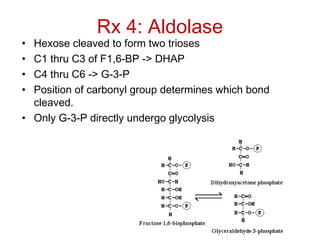
Rx 4: Aldolase
• Hexose cleaved to form two trioses
• C1 thru C3 of F1,6-BP -> DHAP
• C4 thru C6 -> G-3-P
• Position of carbonyl group determines which bond
cleaved.
• Only G-3-P directly undergo glycolysis
Rx 5: Triose Phosphate Isomerase (TPI)
• Conversion of DHAP to G-3-P by TPI
maintains steady state [G-3-P]
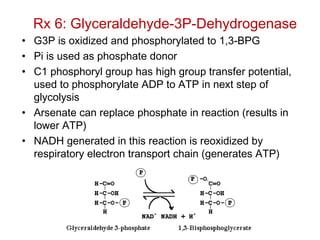
Rx 6: Glyceraldehyde-3P-Dehydrogenase
• G3P is oxidized and phosphorylated to 1,3-BPG
• Pi is used as phosphate donor
• C1 phosphoryl group has high group transfer potential,
used to phosphorylate ADP to ATP in next step of
glycolysis
• Arsenate can replace phosphate in reaction (results in
lower ATP)
• NADH generated in this reaction is reoxidized by
respiratory electron transport chain (generates ATP)
Rx 7: Phosphoglycerate Kinase (PGK)
• ATP synthesis from a high-energy phosphate
• This is referred to as "substrate-level phosphorylation"
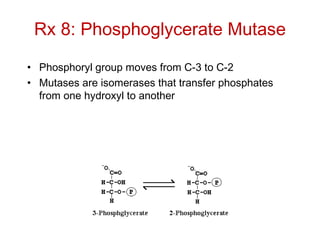
Rx 8: Phosphoglycerate Mutase
• Phosphoryl group moves from C-3 to C-2
• Mutases are isomerases that transfer phosphates
from one hydroxyl to another
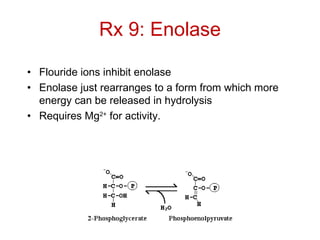
Rx 9: Enolase
• Flouride ions inhibit enolase
• Enolase just rearranges to a form from which more
energy can be released in hydrolysis
• Requires Mg2+
for activity.
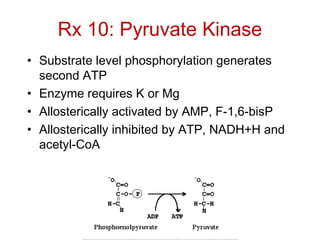
Rx 10: Pyruvate Kinase
• Substrate level phosphorylation generates
second ATP
• Enzyme requires K or Mg
• Allosterically activated by AMP, F-1,6-bisP
• Allosterically inhibited by ATP, NADH+H and
acetyl-CoA
Control Points
in Glycolysis
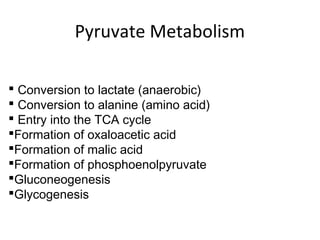
Pyruvate Metabolism
 Conversion to lactate (anaerobic)
 Conversion to alanine (amino acid)
 Entry into the TCA cycle
Formation of oxaloacetic acid
Formation of malic acid
Formation of phosphoenolpyruvate
Gluconeogenesis
Glycogenesis
Anaerobic Metabolism of
Pyruvate
COO–
C O
CH3
COO–
HC OH
CH3
LactatePyruvate
Lactate dehydrogenase
NADH+H+
NAD+
(oxidized) (reduced)
Anaerobic Metabolism of
Pyruvate
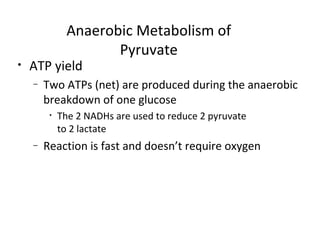
• ATP yield
– Two ATPs (net) are produced during the anaerobic
breakdown of one glucose
• The 2 NADHs are used to reduce 2 pyruvate
to 2 lactate
– Reaction is fast and doesn’t require oxygen
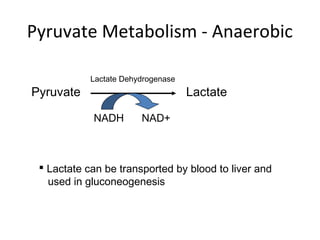
Pyruvate Metabolism - Anaerobic
Pyruvate Lactate
NADH NAD+
Lactate Dehydrogenase
 Lactate can be transported by blood to liver and
used in gluconeogenesis
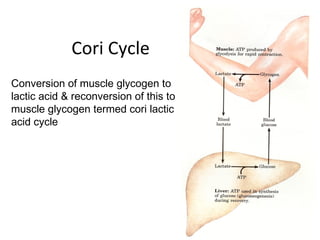
Cori Cycle
Conversion of muscle glycogen to
lactic acid & reconversion of this to
muscle glycogen termed cori lactic
acid cycle
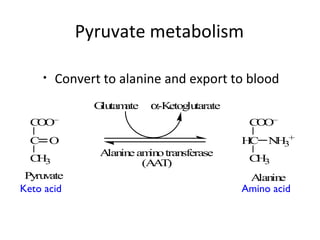
Pyruvate metabolism
• Convert to alanine and export to blood
COO–
C O
CH3
COO–
HC NH3
+
CH3
Alanineaminotransferase
(AAT)
AlaninePyruvate
Glutamate α-Ketoglutarate
Keto acid Amino acid
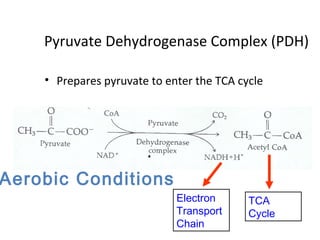
Pyruvate Dehydrogenase Complex (PDH)
• Prepares pyruvate to enter the TCA cycle
Electron
Transport
Chain
TCA
Cycle
Aerobic Conditions
Total ATP from Glucose
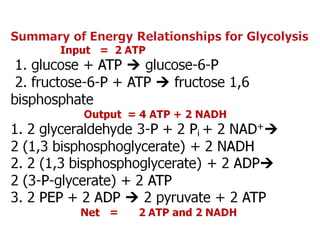
• Anaerobic glycolysis – 2 ATP + 2 NADH
• Aerobic metabolism – glycolysis + TCA
31 ATP from 1 glucose molecule

Carbohydrte metabolism

  • 1.
  • 2.
    Metabolism • Metabolism isall the chemical reactions that occur in an organism • Cellular metabolism – Cells break down excess carbohydrates first, then lipids, finally amino acids if energy needs are not met by carbohydrates and fat – Nutrients not used for energy are used to build up structure, are stored, or they are excreted – 40% of the energy released in catabolism is captured in ATP, the rest is released as heat
  • 3.
    Metabolism Metabolism involves • Catabolicreactions that break down large, complex molecules to provide energy and smaller molecules. • Anabolic reactions that use ATP energy to build larger molecules. 3
  • 4.
    Anabolism • Performance ofstructural maintenance and repairs • Support of growth • Production of secretions • Building of nutrient reserves
  • 5.
    Stages of Metabolism Catabolicreactions are organized as Stage 1: Digestion and hydrolysis break down large molecules to smaller ones that enter the bloodstream. Stage 2: Degradation breaks down molecules to two- and three-carbon compounds. Stage 3: Oxidation of small molecules in the citric acid cycle and electron transport provide ATP energy. 5
  • 6.
  • 7.
    Metabolism of Carbohydrates   Carbohydratesare the major energy source for animals and most microorganisms. Catabolism of carbohydrates: Polysaccharides  monosacchrides  ATP Anabolism of carbohydrates: Monosacchrides    polysacchrides  ATP ADP
  • 8.
    • All organismsobtain energy from the oxidation of glucose and other carbohydrates. • In some cells and organisms, glucose is the major or sole source of energy: • brainbrain • erythrocyteserythrocytes • many bacteriamany bacteria
  • 9.
    Metabolism of Glucose •Glycolysis – degradation of glucoseGlycolysis – degradation of glucose The main pathway for glucose oxidation. • Phosphogluconate pathway (pentose phosphatPhosphogluconate pathway (pentose phosphat pathway or pentose shunt)pathway or pentose shunt) An auxiliary route for glucose oxidation in animals. It produces ribose-5-phosphate. • GluconeogenesisGluconeogenesis Pathway for the synthesis of glucose from pyruvate.
  • 10.
    Catabolism of glucosecan be aerobic and anaerobic. Aerobic metabolism of glucose relies on O2 and is the major way for animals to obtain energy. Anaerobic metabolism is an energy producing process without O2. - Fermentation is an anaerobic metabolic process in microorganisms.
  • 11.
    Carbohydrate Metabolism • Primarilyglucose – Fructose and galactose enter the pathways at various points • All cells can utilize glucose for energy production – Glucose uptake from blood to cells usually mediated by insulin and transporters • Liver is central site for carbohydrate metabolism – Glucose uptake independent of insulin – The only exporter of glucose
  • 12.
    Blood Glucose Homeostasis •Several cell types prefer glucose as energy source (ex., CNS)  80-100 mg/dl is normal range of blood glucose in non-ruminant animals  45-65 mg/dl is normal range of blood glucose in ruminant animals  Uses of glucose:  Energy source for cells  Muscle glycogen  Fat synthesis if in excess of needs
  • 13.
    Fate of AbsorbedGlucose • 1st Priority: glycogen storage – Stored in muscle and liver • 2nd Priority: provide energy – Oxidized to ATP • 3rd Priority: stored as fat – Only excess glucose – Stored as triglycerides in adipose
  • 14.
  • 15.
    Glycolysis • Sequence ofreactions that converts glucose into pyruvate  Relatively small amount of energy produced  Glycolysis reactions occur in cytoplasm  Does not require oxygen Glucose → 2 Pyruvate Lactate (anaerobic) Acetyl-CoA (TCA cycle)
  • 16.
    Phase I: Cleavageof 1 hexose to 2 triose
  • 17.
    Phase II: Generation of 2ATPs, 2 NADH and 2 Pyruvates
  • 18.
  • 19.
    Hexose Kinase • 1ststep in glycolysis;2 enzymes glucokinase & hexokinase • Glucose 6-p phosphatase for reversal of reaction • ATP is consumed here in order to get more later • ATP makes the phosphorylation of glucose spontaneous
  • 21.
    Rx 2: Phosphoglucoisomerase •Uses open chain structure as substrate • Near-equilibrium(reversible)
  • 22.
    Rx 3: Phosphofructokinase PFKis the committed step in glycolysis! • The second priming reaction of glycolysis • Committed step and large, activated by AMP & fructose 2,6-bisphosphatase • Reversal needs hexose bisphosphatase
  • 23.
    Rx 4: Aldolase •Hexose cleaved to form two trioses • C1 thru C3 of F1,6-BP -> DHAP • C4 thru C6 -> G-3-P • Position of carbonyl group determines which bond cleaved. • Only G-3-P directly undergo glycolysis
  • 24.
    Rx 5: TriosePhosphate Isomerase (TPI) • Conversion of DHAP to G-3-P by TPI maintains steady state [G-3-P]
  • 25.
    Rx 6: Glyceraldehyde-3P-Dehydrogenase •G3P is oxidized and phosphorylated to 1,3-BPG • Pi is used as phosphate donor • C1 phosphoryl group has high group transfer potential, used to phosphorylate ADP to ATP in next step of glycolysis • Arsenate can replace phosphate in reaction (results in lower ATP) • NADH generated in this reaction is reoxidized by respiratory electron transport chain (generates ATP)
  • 26.
    Rx 7: PhosphoglycerateKinase (PGK) • ATP synthesis from a high-energy phosphate • This is referred to as "substrate-level phosphorylation"
  • 27.
    Rx 8: PhosphoglycerateMutase • Phosphoryl group moves from C-3 to C-2 • Mutases are isomerases that transfer phosphates from one hydroxyl to another
  • 28.
    Rx 9: Enolase •Flouride ions inhibit enolase • Enolase just rearranges to a form from which more energy can be released in hydrolysis • Requires Mg2+ for activity.
  • 29.
    Rx 10: PyruvateKinase • Substrate level phosphorylation generates second ATP • Enzyme requires K or Mg • Allosterically activated by AMP, F-1,6-bisP • Allosterically inhibited by ATP, NADH+H and acetyl-CoA
  • 30.
  • 32.
    Pyruvate Metabolism  Conversionto lactate (anaerobic)  Conversion to alanine (amino acid)  Entry into the TCA cycle Formation of oxaloacetic acid Formation of malic acid Formation of phosphoenolpyruvate Gluconeogenesis Glycogenesis
  • 33.
    Anaerobic Metabolism of Pyruvate COO– CO CH3 COO– HC OH CH3 LactatePyruvate Lactate dehydrogenase NADH+H+ NAD+ (oxidized) (reduced)
  • 34.
    Anaerobic Metabolism of Pyruvate •ATP yield – Two ATPs (net) are produced during the anaerobic breakdown of one glucose • The 2 NADHs are used to reduce 2 pyruvate to 2 lactate – Reaction is fast and doesn’t require oxygen
  • 35.
    Pyruvate Metabolism -Anaerobic Pyruvate Lactate NADH NAD+ Lactate Dehydrogenase  Lactate can be transported by blood to liver and used in gluconeogenesis
  • 36.
    Cori Cycle Conversion ofmuscle glycogen to lactic acid & reconversion of this to muscle glycogen termed cori lactic acid cycle
  • 37.
    Pyruvate metabolism • Convertto alanine and export to blood COO– C O CH3 COO– HC NH3 + CH3 Alanineaminotransferase (AAT) AlaninePyruvate Glutamate α-Ketoglutarate Keto acid Amino acid
  • 38.
    Pyruvate Dehydrogenase Complex(PDH) • Prepares pyruvate to enter the TCA cycle Electron Transport Chain TCA Cycle Aerobic Conditions
  • 39.
    Total ATP fromGlucose • Anaerobic glycolysis – 2 ATP + 2 NADH • Aerobic metabolism – glycolysis + TCA 31 ATP from 1 glucose molecule