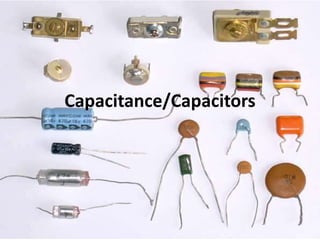
Capacitance/Capacitors
CapacitanceCapacitance is the ability of a dielectric (insulator) to store an electrical chargeCharge = Coulomb = Q = 6.25 X 10¹⁸ electrons
CapacitorsA capacitor is a component that stores electrical chargeSchematicMake up of a capacitorThe unit of measurement for                       capacitance is the Farad+-Non-Polarity SensitivePolarity Sensitive2 Conducting PlatesDielectric (Insulator)Note to teacher: charge up a 470 µF cap to 30v and then discharge
Farad1 Farad: when 1 coulomb is stored in a dielectric with a potential of 1 volt1 Farad is a very large valueTypical values of capacitance are in: microfarads (ÎĽF) (10-6) picofarads (pF) (10-12) Higher farad value = more stored chargeNote: Charge up 470 ÎĽF and 1000 ÎĽF to show differenceQC=VCoulombFarad=Volt1 Volt1 coulomb
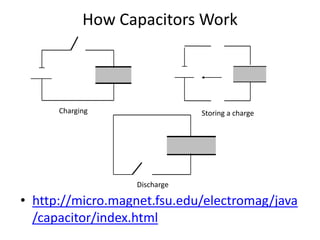
How Capacitors WorkChargingStoring a chargeDischargehttp://micro.magnet.fsu.edu/electromag/java/capacitor/index.html
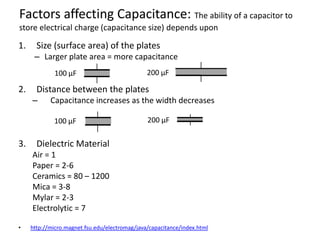
Factors affecting Capacitance: The ability of a capacitor to store electrical charge (capacitance size) depends upon  Size (surface area) of the platesLarger plate area = more capacitanceDistance between the platesCapacitance increases as the width decreasesDielectric MaterialAir = 1Paper = 2-6Ceramics = 80 – 1200Mica = 3-8Mylar = 2-3Electrolytic = 7http://micro.magnet.fsu.edu/electromag/java/capacitance/index.html200 μF100 μF200 μF100 μF
Three Important Facts When Choosing a CapacitorCapacitance ValueVoltage RatingPolarity
Capacitance ValueRules of thumb (as in 99% of the time)MF or mF on an old capacitor = µF .If a capacitor has a value of 1 µF or more it is usually an electrolytic (canister) capacitor.  Conversely, if the capacitance value is less than 1 µF it is usually a disc or chicklet variety.
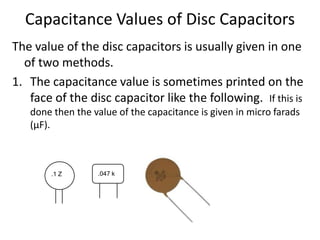
.047 k.1 ZCapacitance Values of Disc CapacitorsThe value of the disc capacitors is usually given in one of two methods.  The capacitance value is sometimes printed on the face of the disc capacitor like the following.  If this is done then the value of the capacitance is given in micro farads (µF).
Capacitance Values of Disc CapacitorsThe capacitance value is sometimes printed in code on the face of the disc as shown below.  If this is the case then the capacitance value is given in picofarads (pF).  The code given is the same as the code used to determine resistor values.  For example:  102  would represent		1= 1st digit of value, 0 = 2nd digit of value, 2= multiplier (how many zeros)	Therefore 102 = 1000 picofarads (pF) or  .001 micro farads (µF)
Capacitors in Series and ParallelCapacitors in SeriesCapacitors in ParallelIn series the width of the dielectric is additive10 ÎĽF10 ÎĽFCT = 5 ÎĽFNotice that they are exactly opposite of resistors!!!!!!!!10 ÎĽF10 ÎĽFCT = 20 ÎĽFIn parallel the plate surface area is additive
Resistor/Capacitor Time Constants

10 capacitors

  • 1.
  • 2.
    CapacitanceCapacitance is theability of a dielectric (insulator) to store an electrical chargeCharge = Coulomb = Q = 6.25 X 10¹⁸ electrons
  • 3.
    CapacitorsA capacitor isa component that stores electrical chargeSchematicMake up of a capacitorThe unit of measurement for capacitance is the Farad+-Non-Polarity SensitivePolarity Sensitive2 Conducting PlatesDielectric (Insulator)Note to teacher: charge up a 470 µF cap to 30v and then discharge
  • 4.
    Farad1 Farad: when1 coulomb is stored in a dielectric with a potential of 1 volt1 Farad is a very large valueTypical values of capacitance are in: microfarads (ÎĽF) (10-6) picofarads (pF) (10-12) Higher farad value = more stored chargeNote: Charge up 470 ÎĽF and 1000 ÎĽF to show differenceQC=VCoulombFarad=Volt1 Volt1 coulomb
  • 5.
    How Capacitors WorkChargingStoringa chargeDischargehttp://micro.magnet.fsu.edu/electromag/java/capacitor/index.html
  • 6.
    Factors affecting Capacitance:The ability of a capacitor to store electrical charge (capacitance size) depends upon Size (surface area) of the platesLarger plate area = more capacitanceDistance between the platesCapacitance increases as the width decreasesDielectric MaterialAir = 1Paper = 2-6Ceramics = 80 – 1200Mica = 3-8Mylar = 2-3Electrolytic = 7http://micro.magnet.fsu.edu/electromag/java/capacitance/index.html200 μF100 μF200 μF100 μF
  • 7.
    Three Important FactsWhen Choosing a CapacitorCapacitance ValueVoltage RatingPolarity
  • 8.
    Capacitance ValueRules ofthumb (as in 99% of the time)MF or mF on an old capacitor = µF .If a capacitor has a value of 1 µF or more it is usually an electrolytic (canister) capacitor. Conversely, if the capacitance value is less than 1 µF it is usually a disc or chicklet variety.
  • 9.
    .047 k.1 ZCapacitanceValues of Disc CapacitorsThe value of the disc capacitors is usually given in one of two methods. The capacitance value is sometimes printed on the face of the disc capacitor like the following. If this is done then the value of the capacitance is given in micro farads (µF).
  • 10.
    Capacitance Values ofDisc CapacitorsThe capacitance value is sometimes printed in code on the face of the disc as shown below. If this is the case then the capacitance value is given in picofarads (pF). The code given is the same as the code used to determine resistor values. For example: 102 would represent 1= 1st digit of value, 0 = 2nd digit of value, 2= multiplier (how many zeros) Therefore 102 = 1000 picofarads (pF) or .001 micro farads (µF)
  • 11.
    Capacitors in Seriesand ParallelCapacitors in SeriesCapacitors in ParallelIn series the width of the dielectric is additive10 ÎĽF10 ÎĽFCT = 5 ÎĽFNotice that they are exactly opposite of resistors!!!!!!!!10 ÎĽF10 ÎĽFCT = 20 ÎĽFIn parallel the plate surface area is additive
  • 12.