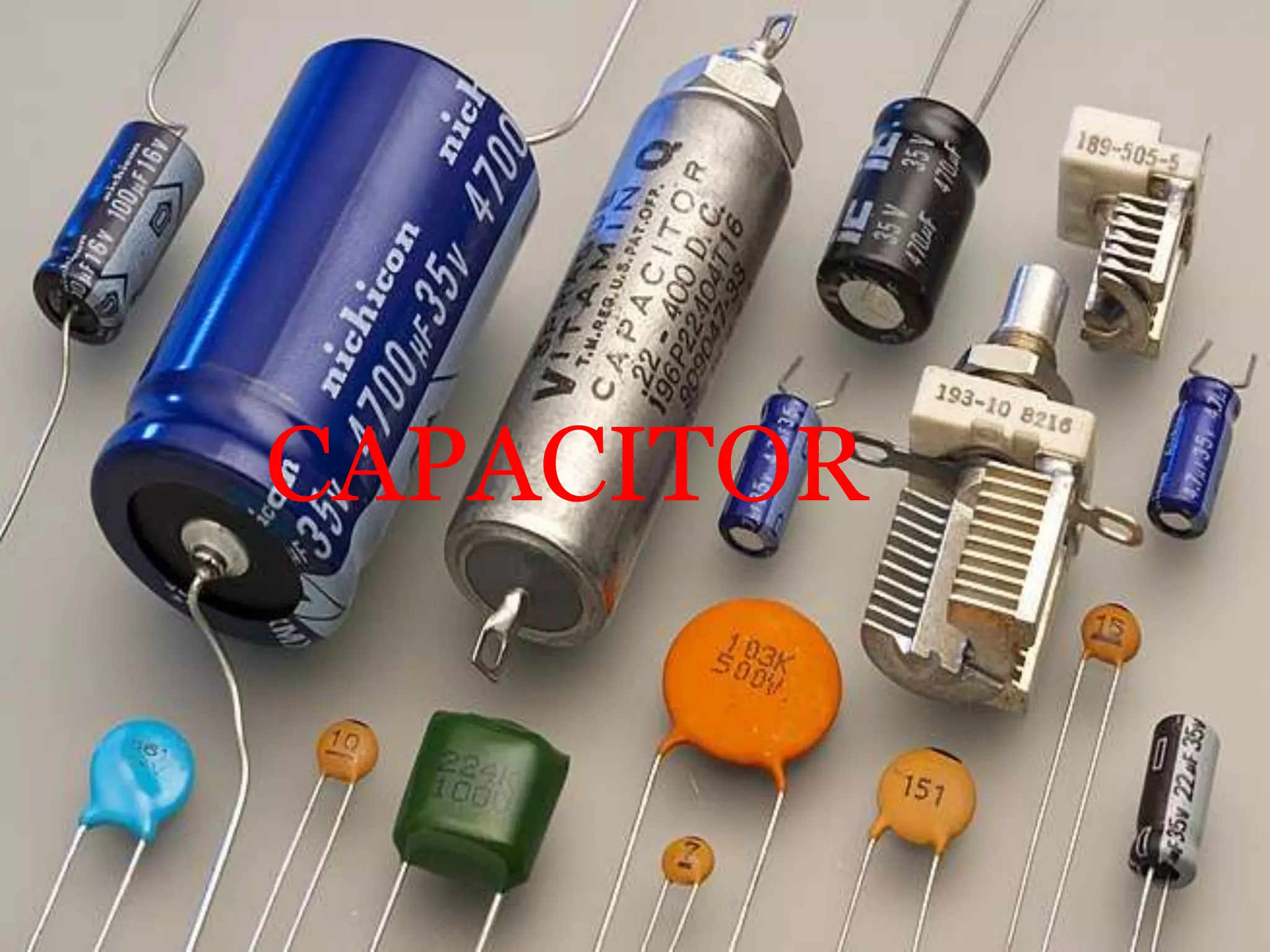
TOPIC-4CAPACITOR
CONTENT
• INTRODUCTION
• TYPES
• CAPACITANCE
• BASIC CONSTRUCTION
• STORING CHARGE
• CAPAITOR IN PARALLEL AND SERIES
• USES
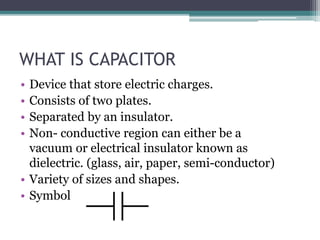
WHAT IS CAPACITOR
• Device that store electric charges.
• Consists of two plates.
• Separated by an insulator.
• Non- conductive region can either be a
vacuum or electrical insulator known as
dielectric. (glass, air, paper, semi-conductor)
• Variety of sizes and shapes.
• Symbol
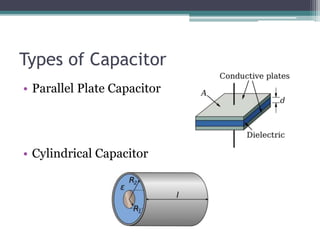
Types of Capacitor
• Parallel Plate Capacitor
• Cylindrical Capacitor
Capacitance
• Ability to store charge.
• Unint of capacitance is Farad (F)
• Capacitance values are normally smaller such as
micro Farad, nano Farad, pico Farad.
• C=Q/V
• Capacitance of capacitor is directly proportional
to charger store on that capacitor and inversely
proportional to voltage.
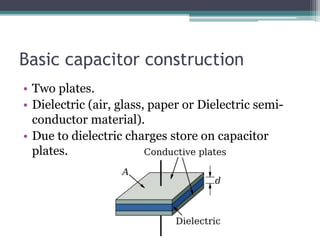
Basic capacitor construction
• Two plates.
• Dielectric (air, glass, paper or Dielectric semi-
conductor material).
• Due to dielectric charges store on capacitor
plates.
Storing Charge On Capacitor
• Connect to a voltage source.
• Positive charges start flowing one plate of
capacitor and negative towards other.
• Due to dielectric charges start accumulating on
plate surface .
• Potential rises from zero.
• Flow of charges stop when capacitor potential
become equal to potential of battery.
• Same case with negative charges.
• So, charges store on the capacitor.
Uses of Capacitor
• Used as Batteries.
• Used as sensing devices
• Used to separate AC and DC
• Used in Vehicle audio system

Topic 4 capacitor

  • 1.
  • 2.
    CONTENT • INTRODUCTION • TYPES •CAPACITANCE • BASIC CONSTRUCTION • STORING CHARGE • CAPAITOR IN PARALLEL AND SERIES • USES
  • 3.
    WHAT IS CAPACITOR •Device that store electric charges. • Consists of two plates. • Separated by an insulator. • Non- conductive region can either be a vacuum or electrical insulator known as dielectric. (glass, air, paper, semi-conductor) • Variety of sizes and shapes. • Symbol
  • 4.
    Types of Capacitor •Parallel Plate Capacitor • Cylindrical Capacitor
  • 5.
    Capacitance • Ability tostore charge. • Unint of capacitance is Farad (F) • Capacitance values are normally smaller such as micro Farad, nano Farad, pico Farad. • C=Q/V • Capacitance of capacitor is directly proportional to charger store on that capacitor and inversely proportional to voltage.
  • 6.
    Basic capacitor construction •Two plates. • Dielectric (air, glass, paper or Dielectric semi- conductor material). • Due to dielectric charges store on capacitor plates.
  • 7.
    Storing Charge OnCapacitor • Connect to a voltage source. • Positive charges start flowing one plate of capacitor and negative towards other. • Due to dielectric charges start accumulating on plate surface . • Potential rises from zero. • Flow of charges stop when capacitor potential become equal to potential of battery. • Same case with negative charges. • So, charges store on the capacitor.
  • 8.
    Uses of Capacitor •Used as Batteries. • Used as sensing devices • Used to separate AC and DC • Used in Vehicle audio system