
Capacitance
Capacitance
Capacitance
Ability to store electrical energy in an electrostatic field
Basic unit is the farad (F)
Represented by letter C
Capacitor
Possesses a specific amount of capacitance
Either fixed or variable
Capacitance (cont’d.)
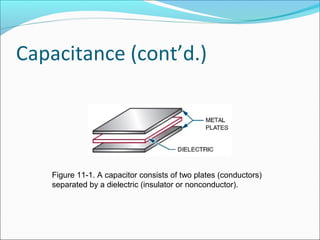
Figure 11-1. A capacitor consists of two plates (conductors)
separated by a dielectric (insulator or nonconductor).
Dielectric
A dielectric material (dielectric for short) is an
electrical insulator that can be polarized by an applied
electric field. When a dielectric is placed in an electric
field, electric charges do not flow through the
material as they do in a conductor
Capacitors
Factors that affect capacitance
Area of the plate
Distance between the plates
Type of dielectric material
Temperature
Figure 11-3. Electrolytic capacitors.
Capacitors (cont’d.)
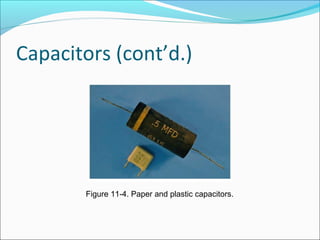
Figure 11-4. Paper and plastic capacitors.
Capacitors (cont’d.)
Figure 11-5. Ceramic disk capacitors.
Capacitors (cont’d.)
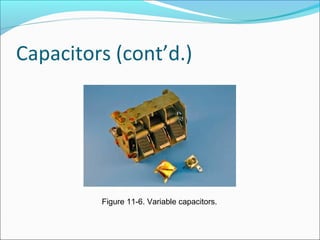
Figure 11-6. Variable capacitors.
Capacitors (cont’d.)
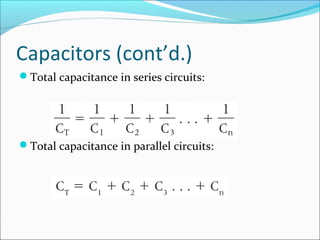
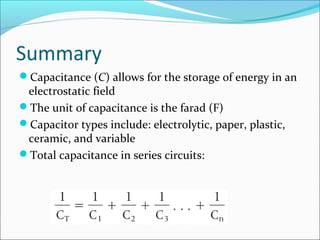
Total capacitance in series circuits:
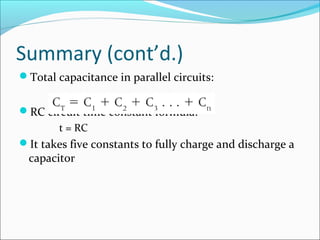
Total capacitance in parallel circuits:
RC Time Constants
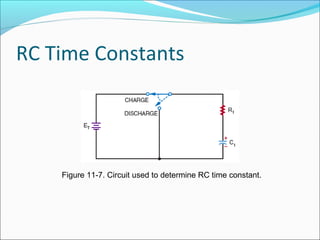
Figure 11-7. Circuit used to determine RC time constant.
RC Time Constants (cont’d.)
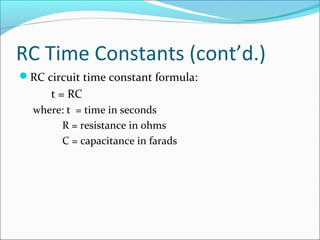
RC circuit time constant formula:
t = RC
where: t = time in seconds
R = resistance in ohms
C = capacitance in farads
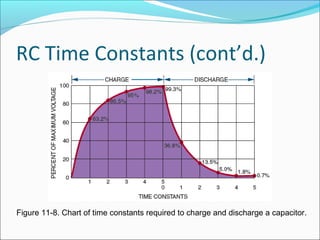
The RC time constant, also called tau, is the
time constant (in seconds) of an RC circuit, is equal to
the product of the circuit resistance (in ohms) and the
circuit capacitance (in farads), i.e.
It is the time required to charge the capacitor, through the
resistor, by ≈ 63.2 percent of the difference between the
initial value and final value or discharge the capacitor to
≈36.8 percent.
RC Time Constants (cont’d.)
Figure 11-8. Chart of time constants required to charge and discharge a capacitor.
Summary
Capacitance (C) allows for the storage of energy in an
electrostatic field
The unit of capacitance is the farad (F)
Capacitor types include: electrolytic, paper, plastic,
ceramic, and variable
Total capacitance in series circuits:
Summary (cont’d.)
Total capacitance in parallel circuits:
RC circuit time constant formula:
t = RC
It takes five constants to fully charge and discharge a
capacitor

capacitance