
Transformers
Electromagnetic Induction
Transformer
Consists of two coils, a primary winding and a
secondary winding
Rated in volt-amperes (VA)
Primary winding
Coil containing the AC voltage
Secondary winding
Coil in which the voltage is induced
Mutual Inductance
Expanding magnetic field in loaded secondary causes
current increase in primary
Figure 18-4.Transformer with a loaded secondary.
Turns Ratio
Turns ratio
Determines whether the transformer is used to step up,
step down, or pass voltage unchanged
Can be expressed as:
turns ratio = NS/NP
where: N = number of turns
Turns Ratio (cont’d.)
Step-up transformer
Produces a secondary voltage greater than its primary
voltage
Turns ratio is always greater than one
Turns Ratio (cont’d.)
Step-down transformer
Produces secondary voltage less than its primary
voltage
Turns ratio is always less than one
Applications
Transformer applications include:
Stepping up/down voltage and current
Impedance matching
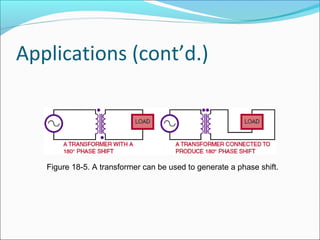
Phase shifting
Isolation
Blocking DC while passing AC
Producing several signals at various voltage levels
Applications (cont’d.)
Figure 18-5. A transformer can be used to generate a phase shift.
Applications (cont’d.)
Figure 18-6. A transformer can be used to block DC voltage.
Applications (cont’d.)
Figure 18-7. An isolation transformer prevents electrical
shock by isolating the equipment from ground.
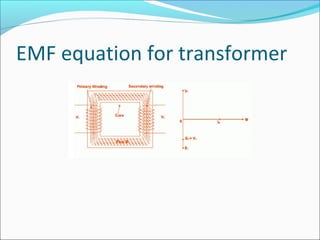
EMF equation for transformer
Open circuit test
To find no load losses
Watt meter reading represents core losses
Short circuit test
Used for finding equivalent impedence and leakage
reactance
Cu losses at full load(for efficiency)
Regulation of transformer
Z01=Vsc/I1
W=I1xI1xR01 =>R01=W/R1xR1
X01=(Z01^2-R01^2)^1/2
Losses in transformer
Core loss or iron loss
Hysteresis loss
Applications (cont’d.)
Figure 18-8. An autotransformer is a special type of transformer
used to step up or step down the voltage.
Applications (cont’d.)
Figure 18-9. A variable autotransformer.
Summary
A transformer consists of two coils, a primary
winding and a secondary winding
 An AC voltage is put across the primary winding,
inducing a voltage in the secondary winding
Transformers allow an AC signal to be transferred
from one circuit to another
Summary (cont’d.)
Transformers are rated in volt-amperes(VA)
The turns ratio determines whether a transformer is
used to step up, step down, or pass voltage
unchanged
Transformer applications: impedance matching,
phase shifting, isolation, blocking DC while passing
AC, etc.

transformers