Binary Number System
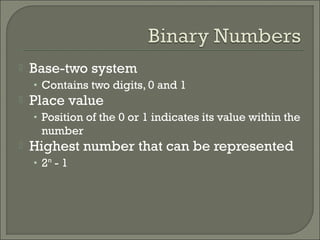
 Base-two system
• Contains two digits, 0 and 1
 Place value
• Position of the 0 or 1 indicates its value within the
number
 Highest number that can be represented
• 2 - 1ⁿ
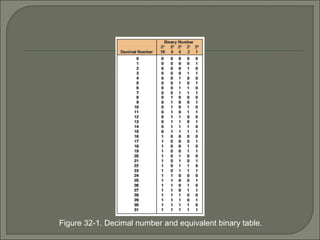
Figure 32-1. Decimal number and equivalent binary table.
 To convert decimal numbers to binary
• Divide the decimal number by 2
• Write down the remainder after each division
• The remainders, taken in reverse order, form the
binary number
 Octal numbers
• Allow reading of large binary numbers
• Breaks binary number into groups of three
• Base 8
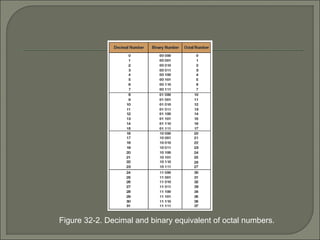
Figure 32-2. Decimal and binary equivalent of octal numbers.
 To convert binary to an octal number
• Divide the binary number into groups of three
starting from the right
 To convert an octal number to binary
• Reverse process
• Convert the octal number to binary groups of
three
Figure 32-3. Place values of octal numbers.
 Hexadecimal number system
• Used with microprocessor-based systems
• Breaks binary number into groups of four
• Reduces error when entering data
• Base 16
 To convert binary to hexadecimal
number
• Divide the binary number into groups of four
starting from the right
 To convert hexadecimal number to
binary
• Reverse the process
• Convert the hexadecimal number to binary
groups of four
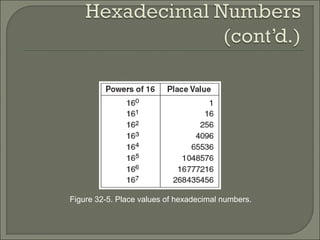
Figure 32-5. Place values of hexadecimal numbers.
 Binary-coded-decimal (BCD)
• 8421 code
• Consists of four binary digits
• Represents the digits 0 through 9
• Permits easy conversion between decimal and
binary form
 To express a decimal number in the 8421
code:
• Replace each decimal digit by the 4-bit code
 To determine a decimal number from an
8421 code:
• Break the code into groups of 4 bits
• Write the decimal digit represented by each 4-
bit group
 The binary number system contains two
digits, 0 and 1
• Place value increases by a power of 2
 To convert from decimal to binary:
• Divide the decimal number by 2
• Write down the remainder after each division
• The remainders, taken in reverse order, form the
binary number
 Similar steps are used to convert octal
and hexadecimal numbers to and from
decimal numbers as with the binary
number system
 The 8421 code (BCD) is used to represent
digits 0 through 9

binary number system

  • 1.
  • 2.
     Base-two system •Contains two digits, 0 and 1  Place value • Position of the 0 or 1 indicates its value within the number  Highest number that can be represented • 2 - 1ⁿ
  • 3.
    Figure 32-1. Decimalnumber and equivalent binary table.
  • 4.
     To convertdecimal numbers to binary • Divide the decimal number by 2 • Write down the remainder after each division • The remainders, taken in reverse order, form the binary number
  • 5.
     Octal numbers •Allow reading of large binary numbers • Breaks binary number into groups of three • Base 8
  • 6.
    Figure 32-2. Decimaland binary equivalent of octal numbers.
  • 7.
     To convertbinary to an octal number • Divide the binary number into groups of three starting from the right  To convert an octal number to binary • Reverse process • Convert the octal number to binary groups of three
  • 8.
    Figure 32-3. Placevalues of octal numbers.
  • 9.
     Hexadecimal numbersystem • Used with microprocessor-based systems • Breaks binary number into groups of four • Reduces error when entering data • Base 16
  • 10.
     To convertbinary to hexadecimal number • Divide the binary number into groups of four starting from the right  To convert hexadecimal number to binary • Reverse the process • Convert the hexadecimal number to binary groups of four
  • 11.
    Figure 32-5. Placevalues of hexadecimal numbers.
  • 12.
     Binary-coded-decimal (BCD) •8421 code • Consists of four binary digits • Represents the digits 0 through 9 • Permits easy conversion between decimal and binary form
  • 13.
     To expressa decimal number in the 8421 code: • Replace each decimal digit by the 4-bit code  To determine a decimal number from an 8421 code: • Break the code into groups of 4 bits • Write the decimal digit represented by each 4- bit group
  • 14.
     The binarynumber system contains two digits, 0 and 1 • Place value increases by a power of 2  To convert from decimal to binary: • Divide the decimal number by 2 • Write down the remainder after each division • The remainders, taken in reverse order, form the binary number
  • 15.
     Similar stepsare used to convert octal and hexadecimal numbers to and from decimal numbers as with the binary number system  The 8421 code (BCD) is used to represent digits 0 through 9