Objectives
1. Determine the effects of simple capacitors on the
capacitance, charge, and potential difference; and
2.Calculate the equivalent capacitance of a network
of capacitors connected in series/parallel.
3. Explain the concepts of a capacitor and its
capacitance
4. Describe how to evaluate the capacitance of a
system of conductors
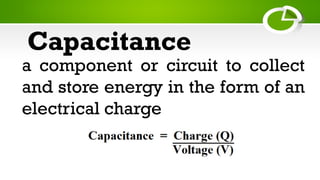
Capacitance
a component or circuit to collect
and store energy in the form of an
electrical charge
Word of the day
Farad
feh ruhd
·
the SI unit of electrical capacitance, equal to the
capacitance of a capacitor in which one coulomb of
charge causes a potential difference of one volt.
SAMPLE PROBLEM
Determine the capacitance of a capacitor
if it has a charge of 5 C and a voltage of 12
V is passing through it.
SAMPLE PROBLEM
Determine the amount of charge stored on
either plate of a capacitor (4x10⁻⁶ F) when
connected across a 12 volt battery.
depends on the shapes, sizes and relative positions of the
conductors and on the nature of insulator between them
it is calculated by finding the potential difference Vab
between the conductors for a given magnitude of
charge Q.
V =VB –VA
Δ
The SI unit of capacitance is the farad
(F), named after Michael Faraday
(1791–1867).
Capacitor
devices that are charge by current
 an essential component of an electronic
equipment and invariably used in electric
circuits
electrons that transferred by one
conductor to other is called charging a
capacitor
net charge on the capacitor as a whole
remains zero
Capacitors in circuits are illustrated in following
figures:
The vertical lines (straight or
curved ) represent the
conductors.
The horizontal lines represent
wires connected to conductor.
How to charge a capacitor?
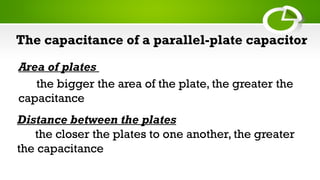
The capacitance of a parallel-plate capacitor
Area of plates
the bigger the area of the plate, the greater the
capacitance
Distance between the plates
the closer the plates to one another, the greater
the capacitance
The capacitance depends on the parallel/
geometry of the capacitor.
Where:
C – capacitance
𝜀0 permittivity of the insulating
−
material or dielectric
A – area of each plates
d – distance between plates
Q- magnitude of charge on each plate
Vab- potential difference between
plates
SAMPLE PROBLEM
A parallel plate capacitor has square plates of
side 5 cm and separated by a distance of 1
mm. (a) Calculate the capacitance of this
capacitor. (b) If a 10 V battery is connected to
the capacitor, what is the charge stored in any
one of the plates?
Q = CV
SAMPLE PROBLEM
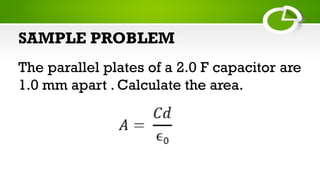
The parallel plates of a 2.0 F capacitor are
1.0 mm apart . Calculate the area.
TRY IT!
A parallel plate capacitor filled with mica
having εr = 5 is connected to a 10 V battery.
The area of the parallel plate is 6 m2
and
separation distance is 6 mm.
Find the capacitance and stored charge.
Capacitors in Series
Objectives
1. Determine the effects of simple capacitors on the
capacitance, charge, and potential difference; and
2.Calculate the equivalent capacitance of a network
of capacitors connected in series/parallel.
3. Explain the concepts of a capacitor and its
capacitance
4. Describe how to evaluate the capacitance of a
system of conductors
Compare and contrast battery and capacitor
using a Venn Diagram
Capacitors in Parallel
Capacitors in Series and Parallel
Word of the day
Dielectrics
dai·uh·lek·truhks
a medium or substance that transmits
electric force without conduction
Dielectrics
• non-conducting materials inserted between the
plates of a capacitor
• used to increase the capacitance of a capacitor
Examples of dielectrics are ceramics, paper and
air
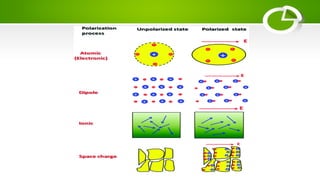
Word of the day
polarization
pow lr uh zay shn
· · · ·
the separation of center of positive charge
and the center of negative charge in a
material
Polarization
• cancels the contribution of the pair of charges to
the voltage across the capacitor
• division between charges
• the atoms of the dielectric material will again
occur causing the voltage across the capacitor to
decrease
Polar Dielectrics
-the dielectrics that have permanent electric
dipole moments
Dipole moments
-a measure of the separation of negative and
positive charges in a system
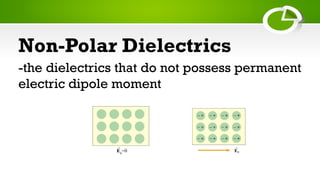
Non-Polar Dielectrics
-the dielectrics that do not possess permanent
electric dipole moment
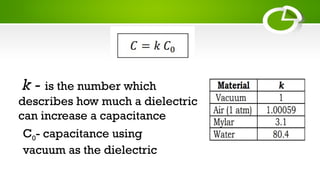
k - is the number which
describes how much a dielectric
can increase a capacitance
C0- capacitance using
vacuum as the dielectric
Capacitance C increases when the space
between the conductors is filled with dielectrics.
GENERAL PHYSICS POWERPOINTCAPACITANCE.pptx

GENERAL PHYSICS POWERPOINTCAPACITANCE.pptx

  • 1.
    Objectives 1. Determine theeffects of simple capacitors on the capacitance, charge, and potential difference; and 2.Calculate the equivalent capacitance of a network of capacitors connected in series/parallel. 3. Explain the concepts of a capacitor and its capacitance 4. Describe how to evaluate the capacitance of a system of conductors
  • 2.
    Capacitance a component orcircuit to collect and store energy in the form of an electrical charge
  • 3.
    Word of theday Farad feh ruhd · the SI unit of electrical capacitance, equal to the capacitance of a capacitor in which one coulomb of charge causes a potential difference of one volt.
  • 4.
    SAMPLE PROBLEM Determine thecapacitance of a capacitor if it has a charge of 5 C and a voltage of 12 V is passing through it.
  • 5.
    SAMPLE PROBLEM Determine theamount of charge stored on either plate of a capacitor (4x10⁻⁶ F) when connected across a 12 volt battery.
  • 6.
    depends on theshapes, sizes and relative positions of the conductors and on the nature of insulator between them it is calculated by finding the potential difference Vab between the conductors for a given magnitude of charge Q. V =VB –VA Δ
  • 7.
    The SI unitof capacitance is the farad (F), named after Michael Faraday (1791–1867).
  • 8.
    Capacitor devices that arecharge by current  an essential component of an electronic equipment and invariably used in electric circuits electrons that transferred by one conductor to other is called charging a capacitor
  • 9.
    net charge onthe capacitor as a whole remains zero
  • 10.
    Capacitors in circuitsare illustrated in following figures: The vertical lines (straight or curved ) represent the conductors. The horizontal lines represent wires connected to conductor. How to charge a capacitor?
  • 11.
    The capacitance ofa parallel-plate capacitor Area of plates the bigger the area of the plate, the greater the capacitance Distance between the plates the closer the plates to one another, the greater the capacitance
  • 12.
    The capacitance dependson the parallel/ geometry of the capacitor. Where: C – capacitance 𝜀0 permittivity of the insulating − material or dielectric A – area of each plates d – distance between plates Q- magnitude of charge on each plate Vab- potential difference between plates
  • 13.
    SAMPLE PROBLEM A parallelplate capacitor has square plates of side 5 cm and separated by a distance of 1 mm. (a) Calculate the capacitance of this capacitor. (b) If a 10 V battery is connected to the capacitor, what is the charge stored in any one of the plates? Q = CV
  • 14.
    SAMPLE PROBLEM The parallelplates of a 2.0 F capacitor are 1.0 mm apart . Calculate the area.
  • 15.
    TRY IT! A parallelplate capacitor filled with mica having εr = 5 is connected to a 10 V battery. The area of the parallel plate is 6 m2 and separation distance is 6 mm. Find the capacitance and stored charge.
  • 16.
  • 17.
    Objectives 1. Determine theeffects of simple capacitors on the capacitance, charge, and potential difference; and 2.Calculate the equivalent capacitance of a network of capacitors connected in series/parallel. 3. Explain the concepts of a capacitor and its capacitance 4. Describe how to evaluate the capacitance of a system of conductors
  • 18.
    Compare and contrastbattery and capacitor using a Venn Diagram
  • 19.
  • 20.
  • 21.
    Word of theday Dielectrics dai·uh·lek·truhks a medium or substance that transmits electric force without conduction
  • 22.
    Dielectrics • non-conducting materialsinserted between the plates of a capacitor • used to increase the capacitance of a capacitor Examples of dielectrics are ceramics, paper and air
  • 23.
    Word of theday polarization pow lr uh zay shn · · · · the separation of center of positive charge and the center of negative charge in a material
  • 24.
    Polarization • cancels thecontribution of the pair of charges to the voltage across the capacitor • division between charges • the atoms of the dielectric material will again occur causing the voltage across the capacitor to decrease
  • 25.
    Polar Dielectrics -the dielectricsthat have permanent electric dipole moments
  • 26.
    Dipole moments -a measureof the separation of negative and positive charges in a system
  • 27.
    Non-Polar Dielectrics -the dielectricsthat do not possess permanent electric dipole moment
  • 29.
    k - isthe number which describes how much a dielectric can increase a capacitance C0- capacitance using vacuum as the dielectric
  • 30.
    Capacitance C increaseswhen the space between the conductors is filled with dielectrics.