Govind Ballabh Pant University of
Agriculture and Technology
Pantnagar
Subtropical and temperate fruit production (APH 542)
TITLE :Training and Pruning in Apple and Pear
Presented By:Zeba Malik
Mohd. Azam
Yashpal Singh Bisht
Tribhuwan Singh Negi
Submitted to : Dr. P.N. Rai
Dr. Rajesh Kumar Shukla
 Apple and Pear are important temperate fruit
crop
 They can also be a pleasing addition to the
landscape
 They require an annual training and pruning in
order to get an attractive and productive tree
 Proper training and pruning are a valuable part
of an effective pest management
 Training and pruning cannot entirely
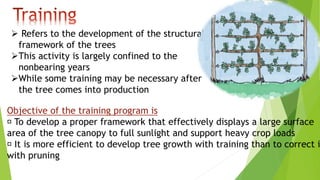
 Refers to the development of the structural
framework of the trees
This activity is largely confined to the
nonbearing years
While some training may be necessary after
the tree comes into production
Objective of the training program is
To develop a proper framework that effectively displays a large surface
area of the tree canopy to full sunlight and support heavy crop loads
It is more efficient to develop tree growth with training than to correct i
with pruning
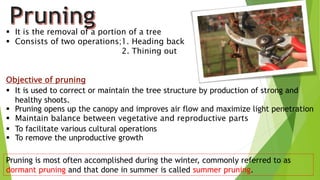
 It is the removal of a portion of a tree
 Consists of two operations;1. Heading back
2. Thining out
Objective of pruning
 It is used to correct or maintain the tree structure by production of strong and
healthy shoots.
 Pruning opens up the canopy and improves air flow and maximize light penetration
 Maintain balance between vegetative and reproductive parts
 To facilitate various cultural operations
 To remove the unproductive growth
Pruning is most often accomplished during the winter, commonly referred to as
dormant pruning and that done in summer is called summer pruning.
I. Open centre system
II. Modified central leader system
I. Spindle bush system
II. Cordons
III.Tatura Trellis
IV.Dwarf pyramid, fans or palmettes
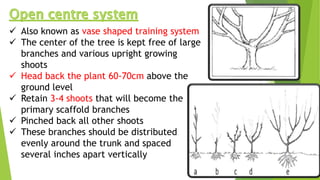
 Also known as vase shaped training system
 The center of the tree is kept free of large
branches and various upright growing
shoots
 Head back the plant 60-70cm above the
ground level
 Retain 3-4 shoots that will become the
primary scaffold branches
 Pinched back all other shoots
 These branches should be distributed
evenly around the trunk and spaced
several inches apart vertically
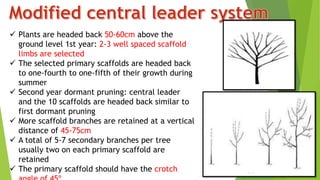
 Plants are headed back 50-60cm above the
ground level 1st year: 2-3 well spaced scaffold
limbs are selected
 The selected primary scaffolds are headed back
to one-fourth to one-fifth of their growth during
summer
 Second year dormant pruning: central leader
and the 10 scaffolds are headed back similar to
first dormant pruning
 More scaffold branches are retained at a vertical
distance of 45-75cm
 A total of 5-7 secondary branches per tree
usually two on each primary scaffold are
retained
 The primary scaffold should have the crotch
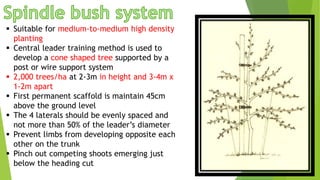
 Suitable for medium-to-medium high density
planting
 Central leader training method is used to
develop a cone shaped tree supported by a
post or wire support system
 2,000 trees/ha at 2-3m in height and 3-4m x
1-2m apart
 First permanent scaffold is maintain 45cm
above the ground level
 The 4 laterals should be evenly spaced and
not more than 50% of the leader’s diameter
 Prevent limbs from developing opposite each
other on the trunk
 Pinch out competing shoots emerging just
below the heading cut
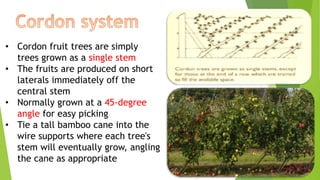
• Cordon fruit trees are simply
trees grown as a single stem
• The fruits are produced on short
laterals immediately off the
central stem
• Normally grown at a 45-degree
angle for easy picking
• Tie a tall bamboo cane into the
wire supports where each tree's
stem will eventually grow, angling
the cane as appropriate
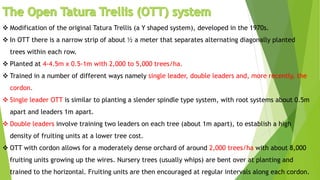
 Modification of the original Tatura Trellis (a Y shaped system), developed in the 1970s.
 In OTT there is a narrow strip of about ½ a meter that separates alternating diagonally planted
trees within each row.
 Planted at 4-4.5m x 0.5-1m with 2,000 to 5,000 trees/ha.
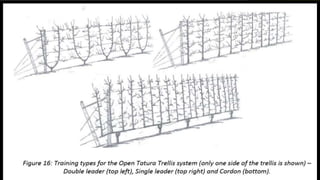
 Trained in a number of different ways namely single leader, double leaders and, more recently, the
cordon.
 Single leader OTT is similar to planting a slender spindle type system, with root systems about 0.5m
apart and leaders 1m apart.
 Double leaders involve training two leaders on each tree (about 1m apart), to establish a high
density of fruiting units at a lower tree cost.
 OTT with cordon allows for a moderately dense orchard of around 2,000 trees/ha with about 8,000
fruiting units growing up the wires. Nursery trees (usually whips) are bent over at planting and
trained to the horizontal. Fruiting units are then encouraged at regular intervals along each cordon.
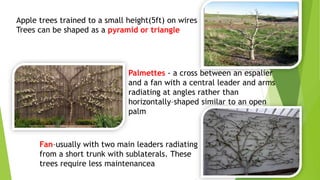
Apple trees trained to a small height(5ft) on wires
Trees can be shaped as a pyramid or triangle
Fan–usually with two main leaders radiating
from a short trunk with sublaterals. These
trees require less maintenancea
Palmettes - a cross between an espalier
and a fan with a central leader and arms
radiating at angles rather than
horizontally–shaped similar to an open
palm
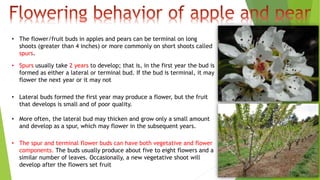
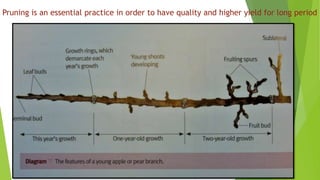
• The flower/fruit buds in apples and pears can be terminal on long
shoots (greater than 4 inches) or more commonly on short shoots called
spurs.
• Spurs usually take 2 years to develop; that is, in the first year the bud is
formed as either a lateral or terminal bud. If the bud is terminal, it may
flower the next year or it may not
• Lateral buds formed the first year may produce a flower, but the fruit
that develops is small and of poor quality.
• More often, the lateral bud may thicken and grow only a small amount
and develop as a spur, which may flower in the subsequent years.
• The spur and terminal flower buds can have both vegetative and flower
components. The buds usually produce about five to eight flowers and a
similar number of leaves. Occasionally, a new vegetative shoot will
develop after the flowers set fruit
Pruning is an essential practice in order to have quality and higher yield for long period
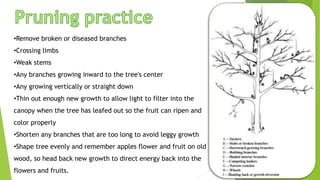
•Remove broken or diseased branches
•Crossing limbs
•Weak stems
•Any branches growing inward to the tree's center
•Any growing vertically or straight down
•Thin out enough new growth to allow light to filter into the
canopy when the tree has leafed out so the fruit can ripen and
color properly
•Shorten any branches that are too long to avoid leggy growth
•Shape tree evenly and remember apples flower and fruit on old
wood, so head back new growth to direct energy back into the
flowers and fruits.
 Dormant pruning is an invigorating process
 Dormant pruning is limited to cuts that remove dead, diseased and damaged wood and
those that develop the tree’s desired shape
 Summer pruning is limited to removal of upright growing shoots and vigorously
growing current season’s shoot
 Dormant pruning should begin as late in the winter as possible to avoid winter injury
 Summer pruning done when the buds start growing after the vegetative shoots are
several inches long
 Older trees are pruned first as the younger ones are more prone to winter injury
Proper training and pruning of trees is a major component of a profitable apple
orchard operation
Each tree is an individual and should be treated accordingly
Properly trained and pruned trees will yield high-quality fruit much sooner and live
significantly longer
In order to maintain a balance between vegetative growth and reproductive growth
efficient training and pruning is therefore necessary which will result in “calm
trees” that produce heavy annual crops and requires light annual pruning
Training and pruning in apple and pear

Training and pruning in apple and pear

  • 1.
    Govind Ballabh PantUniversity of Agriculture and Technology Pantnagar Subtropical and temperate fruit production (APH 542) TITLE :Training and Pruning in Apple and Pear Presented By:Zeba Malik Mohd. Azam Yashpal Singh Bisht Tribhuwan Singh Negi Submitted to : Dr. P.N. Rai Dr. Rajesh Kumar Shukla
  • 2.
     Apple andPear are important temperate fruit crop  They can also be a pleasing addition to the landscape  They require an annual training and pruning in order to get an attractive and productive tree  Proper training and pruning are a valuable part of an effective pest management  Training and pruning cannot entirely
  • 3.
     Refers tothe development of the structural framework of the trees This activity is largely confined to the nonbearing years While some training may be necessary after the tree comes into production Objective of the training program is To develop a proper framework that effectively displays a large surface area of the tree canopy to full sunlight and support heavy crop loads It is more efficient to develop tree growth with training than to correct i with pruning
  • 4.
     It isthe removal of a portion of a tree  Consists of two operations;1. Heading back 2. Thining out Objective of pruning  It is used to correct or maintain the tree structure by production of strong and healthy shoots.  Pruning opens up the canopy and improves air flow and maximize light penetration  Maintain balance between vegetative and reproductive parts  To facilitate various cultural operations  To remove the unproductive growth Pruning is most often accomplished during the winter, commonly referred to as dormant pruning and that done in summer is called summer pruning.
  • 5.
    I. Open centresystem II. Modified central leader system I. Spindle bush system II. Cordons III.Tatura Trellis IV.Dwarf pyramid, fans or palmettes
  • 6.
     Also knownas vase shaped training system  The center of the tree is kept free of large branches and various upright growing shoots  Head back the plant 60-70cm above the ground level  Retain 3-4 shoots that will become the primary scaffold branches  Pinched back all other shoots  These branches should be distributed evenly around the trunk and spaced several inches apart vertically
  • 7.
     Plants areheaded back 50-60cm above the ground level 1st year: 2-3 well spaced scaffold limbs are selected  The selected primary scaffolds are headed back to one-fourth to one-fifth of their growth during summer  Second year dormant pruning: central leader and the 10 scaffolds are headed back similar to first dormant pruning  More scaffold branches are retained at a vertical distance of 45-75cm  A total of 5-7 secondary branches per tree usually two on each primary scaffold are retained  The primary scaffold should have the crotch
  • 8.
     Suitable formedium-to-medium high density planting  Central leader training method is used to develop a cone shaped tree supported by a post or wire support system  2,000 trees/ha at 2-3m in height and 3-4m x 1-2m apart  First permanent scaffold is maintain 45cm above the ground level  The 4 laterals should be evenly spaced and not more than 50% of the leader’s diameter  Prevent limbs from developing opposite each other on the trunk  Pinch out competing shoots emerging just below the heading cut
  • 9.
    • Cordon fruittrees are simply trees grown as a single stem • The fruits are produced on short laterals immediately off the central stem • Normally grown at a 45-degree angle for easy picking • Tie a tall bamboo cane into the wire supports where each tree's stem will eventually grow, angling the cane as appropriate
  • 10.
     Modification ofthe original Tatura Trellis (a Y shaped system), developed in the 1970s.  In OTT there is a narrow strip of about ½ a meter that separates alternating diagonally planted trees within each row.  Planted at 4-4.5m x 0.5-1m with 2,000 to 5,000 trees/ha.  Trained in a number of different ways namely single leader, double leaders and, more recently, the cordon.  Single leader OTT is similar to planting a slender spindle type system, with root systems about 0.5m apart and leaders 1m apart.  Double leaders involve training two leaders on each tree (about 1m apart), to establish a high density of fruiting units at a lower tree cost.  OTT with cordon allows for a moderately dense orchard of around 2,000 trees/ha with about 8,000 fruiting units growing up the wires. Nursery trees (usually whips) are bent over at planting and trained to the horizontal. Fruiting units are then encouraged at regular intervals along each cordon.
  • 12.
    Apple trees trainedto a small height(5ft) on wires Trees can be shaped as a pyramid or triangle Fan–usually with two main leaders radiating from a short trunk with sublaterals. These trees require less maintenancea Palmettes - a cross between an espalier and a fan with a central leader and arms radiating at angles rather than horizontally–shaped similar to an open palm
  • 13.
    • The flower/fruitbuds in apples and pears can be terminal on long shoots (greater than 4 inches) or more commonly on short shoots called spurs. • Spurs usually take 2 years to develop; that is, in the first year the bud is formed as either a lateral or terminal bud. If the bud is terminal, it may flower the next year or it may not • Lateral buds formed the first year may produce a flower, but the fruit that develops is small and of poor quality. • More often, the lateral bud may thicken and grow only a small amount and develop as a spur, which may flower in the subsequent years. • The spur and terminal flower buds can have both vegetative and flower components. The buds usually produce about five to eight flowers and a similar number of leaves. Occasionally, a new vegetative shoot will develop after the flowers set fruit
  • 14.
    Pruning is anessential practice in order to have quality and higher yield for long period
  • 15.
    •Remove broken ordiseased branches •Crossing limbs •Weak stems •Any branches growing inward to the tree's center •Any growing vertically or straight down •Thin out enough new growth to allow light to filter into the canopy when the tree has leafed out so the fruit can ripen and color properly •Shorten any branches that are too long to avoid leggy growth •Shape tree evenly and remember apples flower and fruit on old wood, so head back new growth to direct energy back into the flowers and fruits.
  • 16.
     Dormant pruningis an invigorating process  Dormant pruning is limited to cuts that remove dead, diseased and damaged wood and those that develop the tree’s desired shape  Summer pruning is limited to removal of upright growing shoots and vigorously growing current season’s shoot  Dormant pruning should begin as late in the winter as possible to avoid winter injury  Summer pruning done when the buds start growing after the vegetative shoots are several inches long  Older trees are pruned first as the younger ones are more prone to winter injury
  • 17.
    Proper training andpruning of trees is a major component of a profitable apple orchard operation Each tree is an individual and should be treated accordingly Properly trained and pruned trees will yield high-quality fruit much sooner and live significantly longer In order to maintain a balance between vegetative growth and reproductive growth efficient training and pruning is therefore necessary which will result in “calm trees” that produce heavy annual crops and requires light annual pruning