Dr. Parshant Bakshi
Associate Professor (Fruit Science)
SKUAST - Jammu
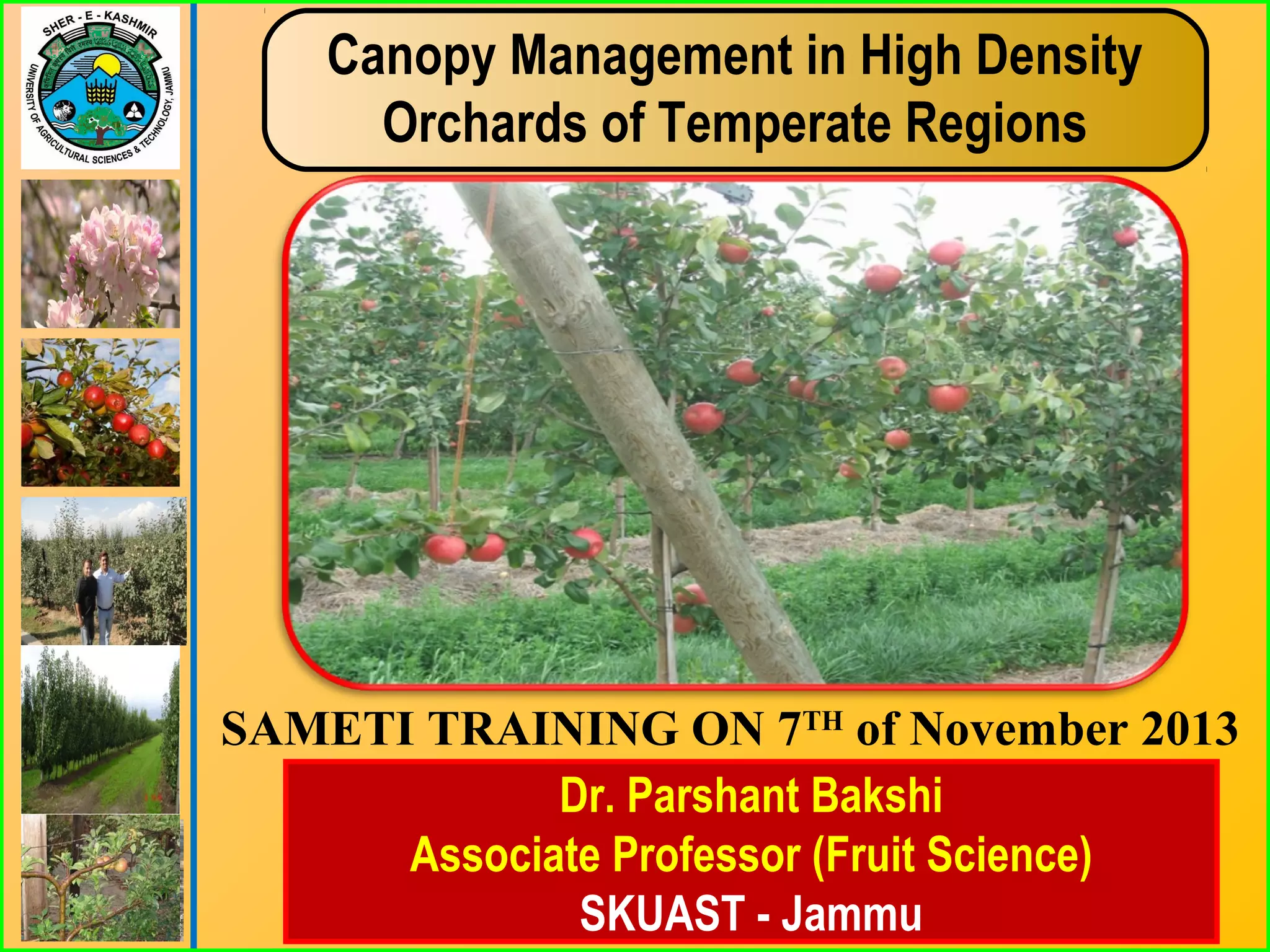
Canopy Management in High Density
Orchards of Temperate Regions
SAMETI TRAINING ON 7TH
of November 2013
Steps of Canopy Architecture Management
Applications of Canopy Architecture Management
Conclusion
Introduction
Objectives
Principles of Canopy Management
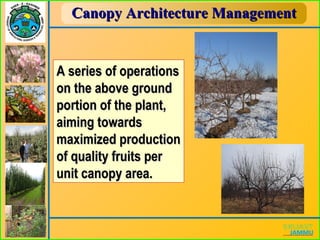
A series of operationsA series of operations
on the above groundon the above ground
portion of the plant,portion of the plant,
aiming towardsaiming towards
maximized productionmaximized production
of quality fruits perof quality fruits per
unit canopy area.unit canopy area.
Canopy Architecture ManagementCanopy Architecture Management
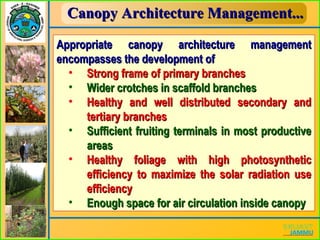
Appropriate canopy architecture managementAppropriate canopy architecture management
encompasses the development ofencompasses the development of
• Strong frame of primary branchesStrong frame of primary branches
• Wider crotches in scaffold branchesWider crotches in scaffold branches
• Healthy and well distributed secondary andHealthy and well distributed secondary and
tertiary branchestertiary branches
• Sufficient fruiting terminals in most productiveSufficient fruiting terminals in most productive
areasareas
• Healthy foliage with high photosyntheticHealthy foliage with high photosynthetic
efficiency to maximize the solar radiation useefficiency to maximize the solar radiation use
efficiencyefficiency
• Enough space for air circulation inside canopyEnough space for air circulation inside canopy
Canopy Architecture Management...Canopy Architecture Management...
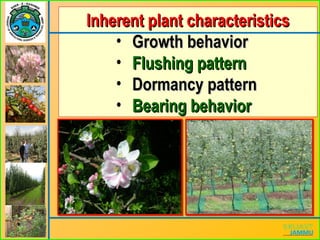
Inherent plant characteristicsInherent plant characteristics
• Growth behaviorGrowth behavior
• Flushing patternFlushing pattern
• Dormancy patternDormancy pattern
• Bearing behaviorBearing behavior
Set of conditions and resourcesSet of conditions and resources
• Planting systemPlanting system
• Spacing etc.Spacing etc.
• Solar radiationSolar radiation
• Wind velocityWind velocity
• Rainfall patternRainfall pattern
• Light distributionLight distribution
Principles of Canopy ArchitecturePrinciples of Canopy Architecture
ManagementManagement
• Facilitating aeration inside the canopyFacilitating aeration inside the canopy
• Maximizing light penetration in andMaximizing light penetration in and
outside of canopyoutside of canopy
• Facilitating conversion of sunlight intoFacilitating conversion of sunlight into
chemical energy by plant leafchemical energy by plant leaf
• Controlled plant structure includingControlled plant structure including
staturestature
• ImprovedImproved fruit colour, quality andfruit colour, quality and
yieldyield
Understanding Architectural behavior of plantsUnderstanding Architectural behavior of plants
Before, going for canopy management,Before, going for canopy management,
understanding of plant nature and behaviour i.e.understanding of plant nature and behaviour i.e.
Plant architecture is essentialPlant architecture is essential
Because,Because,
• The architecture of a plant depends on theThe architecture of a plant depends on the
nature and relative arrangement of its eachnature and relative arrangement of its each
part.part.
• The expression of an equilibrium betweenThe expression of an equilibrium between
endogenous growth process and exogenousendogenous growth process and exogenous
constraints exerted by the environmentconstraints exerted by the environment
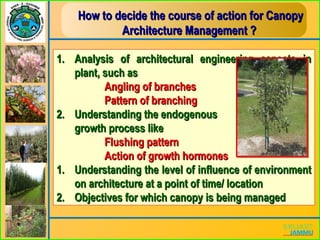
How to decide the course of action for CanopyHow to decide the course of action for Canopy
Architecture Management ?Architecture Management ?
1.1. Analysis of architectural engineering aspects inAnalysis of architectural engineering aspects in
plant, such asplant, such as
Angling of branchesAngling of branches
Pattern of branchingPattern of branching
2.2. Understanding the endogenousUnderstanding the endogenous
growth process likegrowth process like
Flushing patternFlushing pattern
Action of growth hormonesAction of growth hormones
1.1. Understanding the level of influence of environmentUnderstanding the level of influence of environment
on architecture at a point of time/ locationon architecture at a point of time/ location
2.2. Objectives for which canopy is being managedObjectives for which canopy is being managed
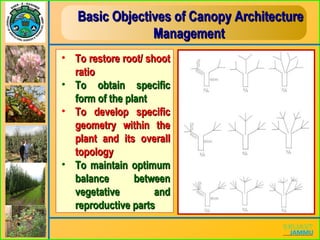
Basic Objectives of Canopy ArchitectureBasic Objectives of Canopy Architecture
ManagementManagement
• To restore root/ shootTo restore root/ shoot
ratioratio
• To obtain specificTo obtain specific
form of the plantform of the plant
• To develop specificTo develop specific
geometry within thegeometry within the
plant and its overallplant and its overall
topologytopology
• To maintain optimumTo maintain optimum
balance betweenbalance between
vegetative andvegetative and
reproductive partsreproductive parts
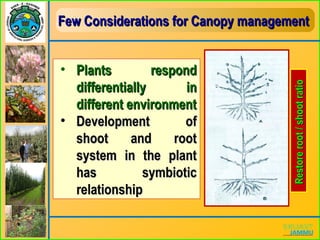
Restoreroot/shootratioRestoreroot/shootratio
Few Considerations for Canopy managementFew Considerations for Canopy management
• Plants respondPlants respond
differentially indifferentially in
different environmentdifferent environment
• Development ofDevelopment of
shoot and rootshoot and root
system in the plantsystem in the plant
has symbiotichas symbiotic
relationshiprelationship
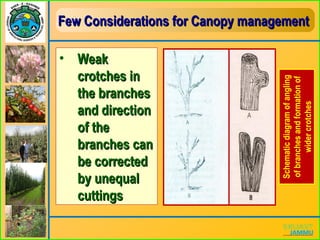
Few Considerations for Canopy managementFew Considerations for Canopy management
• WeakWeak
crotches incrotches in
the branchesthe branches
and directionand direction
of theof the
branches canbranches can
be correctedbe corrected
by unequalby unequal
cuttingscuttings
Schematicdiagramofangling
ofbranchesandformationof
widercrotches
Few Considerations for Canopy managementFew Considerations for Canopy management
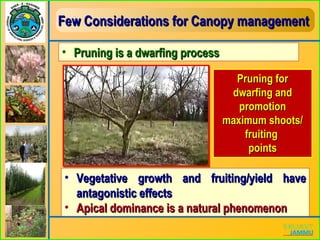
• Pruning is a dwarfing processPruning is a dwarfing process
• Vegetative growth and fruiting/yield haveVegetative growth and fruiting/yield have
antagonistic effectsantagonistic effects
• Apical dominance is a natural phenomenonApical dominance is a natural phenomenon
Pruning forPruning for
dwarfing anddwarfing and
promotionpromotion
maximum shoots/maximum shoots/
fruitingfruiting
pointspoints
Plant architecture development by PruningPlant architecture development by Pruning
Few Considerations for Canopy managementFew Considerations for Canopy management
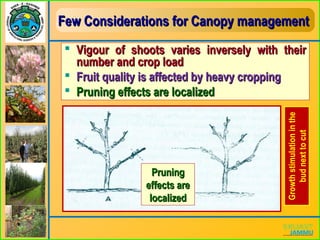
 Vigour of shoots varies inversely with theirVigour of shoots varies inversely with their
number and crop loadnumber and crop load
 Fruit quality is affected by heavy croppingFruit quality is affected by heavy cropping
 Pruning effects are localizedPruning effects are localized
Growthstimulationinthe
budnexttocut
PruningPruning
effects areeffects are
localizedlocalized
Few Considerations for Canopy managementFew Considerations for Canopy management
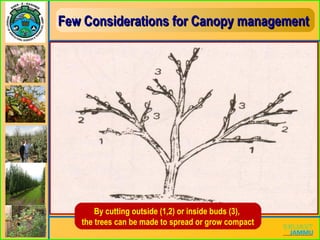
By cutting outside (1,2) or inside buds (3),
the trees can be made to spread or grow compact
Few Considerations for Canopy managementFew Considerations for Canopy management
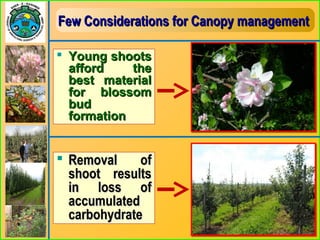
 Young shootsYoung shoots
afford theafford the
best materialbest material
for blossomfor blossom
budbud
formationformation
 Removal ofRemoval of
shoot resultsshoot results
in loss ofin loss of
accumulatedaccumulated
carbohydratecarbohydrate
Steps of Canopy managementSteps of Canopy management
• Selecting appropriate plantingSelecting appropriate planting
systemsystem
• Initial frame developmentInitial frame development
• Training the plants with open centreTraining the plants with open centre
• Centre opening of grownup treesCentre opening of grownup trees
• Allow the canopy to growAllow the canopy to grow
horizontallyhorizontally
• Pruning of the shoots andPruning of the shoots and
excessive growthexcessive growth
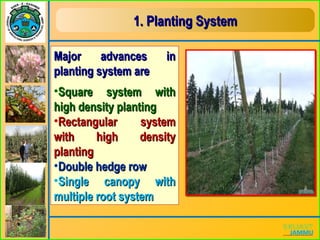
1. Planting System1. Planting System
Major advances inMajor advances in
planting system areplanting system are
•Square system withSquare system with
high density plantinghigh density planting
•Rectangular systemRectangular system
with high densitywith high density
plantingplanting
•Double hedge rowDouble hedge row
•Single canopy withSingle canopy with
multiple root systemmultiple root system
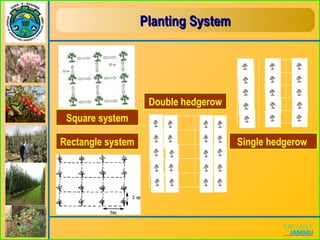
Planting SystemPlanting System
Square system
Single hedgerow
Double hedgerow
Rectangle system
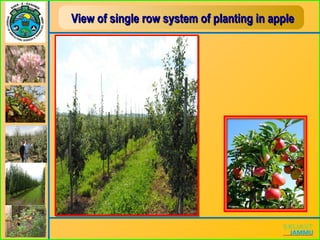
View of single row system of planting in appleView of single row system of planting in apple
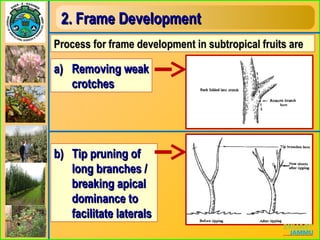
2. Frame Development2. Frame Development
a)a) Removing weakRemoving weak
crotchescrotches
b) Tip pruning ofb) Tip pruning of
long branches /long branches /
breaking apicalbreaking apical
dominance todominance to
facilitate lateralsfacilitate laterals
Process for frame development in subtropical fruits areProcess for frame development in subtropical fruits are
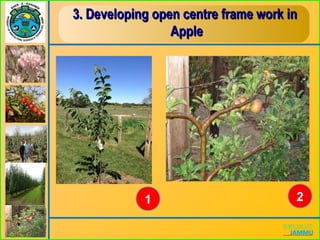
3. Developing open centre frame work in3. Developing open centre frame work in
AppleApple
1 2
Considerations for Frame DevelopmentConsiderations for Frame Development
A. Use Braces to support split branches and wood blocks toA. Use Braces to support split branches and wood blocks to
increase crotches while making the tree frame in subtropical fruitsincrease crotches while making the tree frame in subtropical fruits
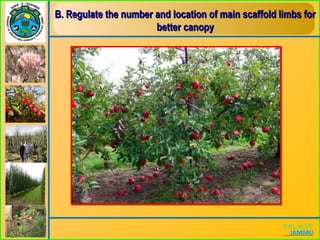
B. Regulate the number and location of main scaffold limbs forB. Regulate the number and location of main scaffold limbs for
better canopybetter canopy
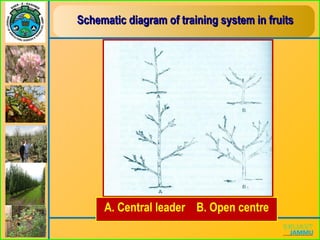
Schematic diagram of training system in fruitsSchematic diagram of training system in fruits
A. Central leader B. Open centre
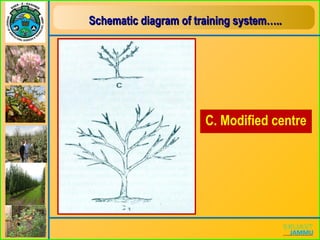
Schematic diagram of training system…..Schematic diagram of training system…..
C. Modified centre
4. Centre opening of grown up trees4. Centre opening of grown up trees
To have sterio fruiting through Centre opening inTo have sterio fruiting through Centre opening in
evergreen fruit plantsevergreen fruit plants
Considerations,Considerations,
•Long unfruitful branches due to overcrowding of centreLong unfruitful branches due to overcrowding of centre
•Heavy incidence of pest and diseaseHeavy incidence of pest and disease
•More economical fruit yield from 2/3More economical fruit yield from 2/3rdrd
lower canopylower canopy
MethodMethod
•Removal of upright branches from centre of treeRemoval of upright branches from centre of tree
ImpactImpact
•Emergence of higher number of healthy shoots inside theEmergence of higher number of healthy shoots inside the
canopycanopy
•More panicle and fruit set inside the canopyMore panicle and fruit set inside the canopy
5. Pruning of shoots and fruits5. Pruning of shoots and fruits
Pruning is judicious removal
of plant parts to maintain optimum
balance between vegetative and
reproductive growth for enhanced
productivity and fruit quality.
Considerations for pruningConsiderations for pruning
• PurposePurpose
• TimeTime
• SeveritySeverity
• MethodsMethods
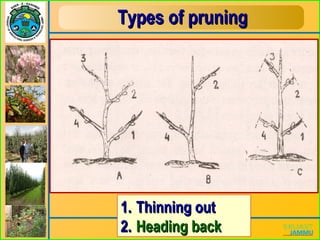
Types of pruningTypes of pruning
1.1. Thinning outThinning out
2.2. Heading backHeading back
 Restrain the exuberant vegetative growth of
temperate crop trees to manageable sizes and forms
thereby to achieve optimum production.
Regain overgrown, older orchard
 Stimulate flowering of new plantings
Increase productivity of orchard
 Increase air circulation in the orchard, which lowers
losses associated with diseases.
Pruning: An important tool in temperatePruning: An important tool in temperate
fruit productionfruit production
Pruning in apple treePruning in apple tree
High Density planting in appleHigh Density planting in apple
High density planting (HDP) means to increase the plant
population per unit area for increasing the production of
fruit crops.
 Semi-intensive system with 500-1,000 trees/ha,
 Intensive system accommodating 1,000 to 10,000 trees/ha
 Super-intensive system accommodating 10,000 to 1,00,000
per ha.
 Use of dwarf scion varieties;
 Adopting dwarfing rootstocks and inter-stocks;
 Efficient training and pruning,
 Use of plant growth regulating chemicals; and
 Suitable crop management practices.
Components of HDPComponents of HDP
 Best Utilization of land and resources;
 Quality production of fruit crops;
 Increase in yield per unit area,
 Easy for intercultural, plant protection and harvesting
 Obtain export quality of the harvest.
Advantages of HDPAdvantages of HDP
HDP in AppleHDP in Apple
There are 4 categories of HDP in apple
 Low (less than 250 plants/ha),
 Moderate (250 to 500 plants/ha),
 High (500 to 1,250 plants/ha) and
 Ultra-high (more than 1,250 plants/ha) density. -
Super high-density plantings or meadow orcharding (20,000
to 70,000 plants/ha)
Commonly used dwarfing/semi-dwarfing rootstocks for HDP:
M9, M26, M4, M7 and MM106
Meadow orchards: M27
Spur types: MM106 and MM109 for and M7 and
Non-spur types: MM111
For J&K: MM106
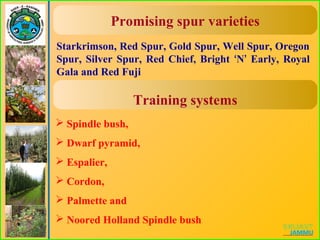
Starkrimson, Red Spur, Gold Spur, Well Spur, Oregon
Spur, Silver Spur, Red Chief, Bright ‘N’ Early, Royal
Gala and Red Fuji
 Spindle bush,
 Dwarf pyramid,
 Espalier,
 Cordon,
 Palmette and
 Noored Holland Spindle bush
Promising spur varieties
Training systems
Peach
 Bears fruit on one-year-old shoots, which require
regular annual pruning to make them suitable for high-
density orcharding.
 High density in peach has been tried with planting
varying from 930 to 2,050 trees per hectare yielding 13
to 34 t/ha.
 Training systems used viz., Hedge row, Y-shape
trellis, spindle, modified free spindle and modified
leader.
Pear
 In pear systems hedge row system gives a plant
density of 888 plants/ha and causes significant increase
in yields.
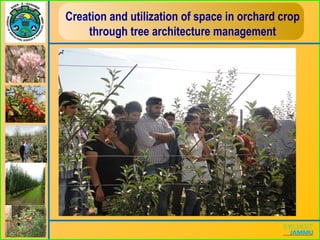
Creation and utilization of space in orchard crop
through tree architecture management
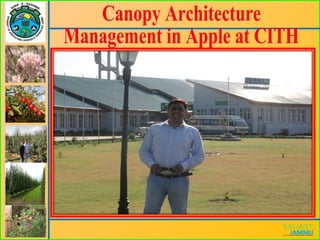
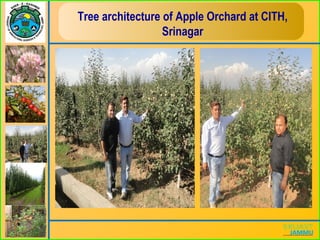
Tree architecture of Apple Orchard at CITH,
Srinagar
Frontier considerations of canopy managementFrontier considerations of canopy management
• Conservation of stored food
• Maintaining root : shoot : fruit by pinching
rather pruning.
• Pruning time and severity.
• Provision of more light and air inside the
canopy for stereo fruiting.
• Single canopy with multiple root system
concept.
• Boosting up of economical canopy formation.
• Exploring the possibilities of mechanization in
pruning
Canopy management is therefore,
an essential tree management
operation starts from the first year
of plant establishment and
enables the plant to produce/yield
high quality and quantity by
providing proper framework and
more fruiting / yielding area.
Canopy management in fruits

Canopy management in fruits

  • 1.
    Dr. Parshant Bakshi AssociateProfessor (Fruit Science) SKUAST - Jammu Canopy Management in High Density Orchards of Temperate Regions SAMETI TRAINING ON 7TH of November 2013
  • 2.
    Steps of CanopyArchitecture Management Applications of Canopy Architecture Management Conclusion Introduction Objectives Principles of Canopy Management
  • 3.
    A series ofoperationsA series of operations on the above groundon the above ground portion of the plant,portion of the plant, aiming towardsaiming towards maximized productionmaximized production of quality fruits perof quality fruits per unit canopy area.unit canopy area. Canopy Architecture ManagementCanopy Architecture Management
  • 4.
    Appropriate canopy architecturemanagementAppropriate canopy architecture management encompasses the development ofencompasses the development of • Strong frame of primary branchesStrong frame of primary branches • Wider crotches in scaffold branchesWider crotches in scaffold branches • Healthy and well distributed secondary andHealthy and well distributed secondary and tertiary branchestertiary branches • Sufficient fruiting terminals in most productiveSufficient fruiting terminals in most productive areasareas • Healthy foliage with high photosyntheticHealthy foliage with high photosynthetic efficiency to maximize the solar radiation useefficiency to maximize the solar radiation use efficiencyefficiency • Enough space for air circulation inside canopyEnough space for air circulation inside canopy Canopy Architecture Management...Canopy Architecture Management...
  • 5.
    Inherent plant characteristicsInherentplant characteristics • Growth behaviorGrowth behavior • Flushing patternFlushing pattern • Dormancy patternDormancy pattern • Bearing behaviorBearing behavior
  • 6.
    Set of conditionsand resourcesSet of conditions and resources • Planting systemPlanting system • Spacing etc.Spacing etc. • Solar radiationSolar radiation • Wind velocityWind velocity • Rainfall patternRainfall pattern • Light distributionLight distribution
  • 7.
    Principles of CanopyArchitecturePrinciples of Canopy Architecture ManagementManagement • Facilitating aeration inside the canopyFacilitating aeration inside the canopy • Maximizing light penetration in andMaximizing light penetration in and outside of canopyoutside of canopy • Facilitating conversion of sunlight intoFacilitating conversion of sunlight into chemical energy by plant leafchemical energy by plant leaf • Controlled plant structure includingControlled plant structure including staturestature • ImprovedImproved fruit colour, quality andfruit colour, quality and yieldyield
  • 8.
    Understanding Architectural behaviorof plantsUnderstanding Architectural behavior of plants Before, going for canopy management,Before, going for canopy management, understanding of plant nature and behaviour i.e.understanding of plant nature and behaviour i.e. Plant architecture is essentialPlant architecture is essential Because,Because, • The architecture of a plant depends on theThe architecture of a plant depends on the nature and relative arrangement of its eachnature and relative arrangement of its each part.part. • The expression of an equilibrium betweenThe expression of an equilibrium between endogenous growth process and exogenousendogenous growth process and exogenous constraints exerted by the environmentconstraints exerted by the environment
  • 9.
    How to decidethe course of action for CanopyHow to decide the course of action for Canopy Architecture Management ?Architecture Management ? 1.1. Analysis of architectural engineering aspects inAnalysis of architectural engineering aspects in plant, such asplant, such as Angling of branchesAngling of branches Pattern of branchingPattern of branching 2.2. Understanding the endogenousUnderstanding the endogenous growth process likegrowth process like Flushing patternFlushing pattern Action of growth hormonesAction of growth hormones 1.1. Understanding the level of influence of environmentUnderstanding the level of influence of environment on architecture at a point of time/ locationon architecture at a point of time/ location 2.2. Objectives for which canopy is being managedObjectives for which canopy is being managed
  • 10.
    Basic Objectives ofCanopy ArchitectureBasic Objectives of Canopy Architecture ManagementManagement • To restore root/ shootTo restore root/ shoot ratioratio • To obtain specificTo obtain specific form of the plantform of the plant • To develop specificTo develop specific geometry within thegeometry within the plant and its overallplant and its overall topologytopology • To maintain optimumTo maintain optimum balance betweenbalance between vegetative andvegetative and reproductive partsreproductive parts
  • 11.
    Restoreroot/shootratioRestoreroot/shootratio Few Considerations forCanopy managementFew Considerations for Canopy management • Plants respondPlants respond differentially indifferentially in different environmentdifferent environment • Development ofDevelopment of shoot and rootshoot and root system in the plantsystem in the plant has symbiotichas symbiotic relationshiprelationship
  • 12.
    Few Considerations forCanopy managementFew Considerations for Canopy management • WeakWeak crotches incrotches in the branchesthe branches and directionand direction of theof the branches canbranches can be correctedbe corrected by unequalby unequal cuttingscuttings Schematicdiagramofangling ofbranchesandformationof widercrotches
  • 13.
    Few Considerations forCanopy managementFew Considerations for Canopy management • Pruning is a dwarfing processPruning is a dwarfing process • Vegetative growth and fruiting/yield haveVegetative growth and fruiting/yield have antagonistic effectsantagonistic effects • Apical dominance is a natural phenomenonApical dominance is a natural phenomenon Pruning forPruning for dwarfing anddwarfing and promotionpromotion maximum shoots/maximum shoots/ fruitingfruiting pointspoints
  • 14.
    Plant architecture developmentby PruningPlant architecture development by Pruning
  • 15.
    Few Considerations forCanopy managementFew Considerations for Canopy management  Vigour of shoots varies inversely with theirVigour of shoots varies inversely with their number and crop loadnumber and crop load  Fruit quality is affected by heavy croppingFruit quality is affected by heavy cropping  Pruning effects are localizedPruning effects are localized Growthstimulationinthe budnexttocut PruningPruning effects areeffects are localizedlocalized
  • 16.
    Few Considerations forCanopy managementFew Considerations for Canopy management By cutting outside (1,2) or inside buds (3), the trees can be made to spread or grow compact
  • 17.
    Few Considerations forCanopy managementFew Considerations for Canopy management  Young shootsYoung shoots afford theafford the best materialbest material for blossomfor blossom budbud formationformation  Removal ofRemoval of shoot resultsshoot results in loss ofin loss of accumulatedaccumulated carbohydratecarbohydrate
  • 18.
    Steps of CanopymanagementSteps of Canopy management • Selecting appropriate plantingSelecting appropriate planting systemsystem • Initial frame developmentInitial frame development • Training the plants with open centreTraining the plants with open centre • Centre opening of grownup treesCentre opening of grownup trees • Allow the canopy to growAllow the canopy to grow horizontallyhorizontally • Pruning of the shoots andPruning of the shoots and excessive growthexcessive growth
  • 19.
    1. Planting System1.Planting System Major advances inMajor advances in planting system areplanting system are •Square system withSquare system with high density plantinghigh density planting •Rectangular systemRectangular system with high densitywith high density plantingplanting •Double hedge rowDouble hedge row •Single canopy withSingle canopy with multiple root systemmultiple root system
  • 20.
    Planting SystemPlanting System Squaresystem Single hedgerow Double hedgerow Rectangle system
  • 21.
    View of singlerow system of planting in appleView of single row system of planting in apple
  • 22.
    2. Frame Development2.Frame Development a)a) Removing weakRemoving weak crotchescrotches b) Tip pruning ofb) Tip pruning of long branches /long branches / breaking apicalbreaking apical dominance todominance to facilitate lateralsfacilitate laterals Process for frame development in subtropical fruits areProcess for frame development in subtropical fruits are
  • 23.
    3. Developing opencentre frame work in3. Developing open centre frame work in AppleApple 1 2
  • 24.
    Considerations for FrameDevelopmentConsiderations for Frame Development A. Use Braces to support split branches and wood blocks toA. Use Braces to support split branches and wood blocks to increase crotches while making the tree frame in subtropical fruitsincrease crotches while making the tree frame in subtropical fruits
  • 25.
    B. Regulate thenumber and location of main scaffold limbs forB. Regulate the number and location of main scaffold limbs for better canopybetter canopy
  • 26.
    Schematic diagram oftraining system in fruitsSchematic diagram of training system in fruits A. Central leader B. Open centre
  • 27.
    Schematic diagram oftraining system…..Schematic diagram of training system….. C. Modified centre
  • 28.
    4. Centre openingof grown up trees4. Centre opening of grown up trees To have sterio fruiting through Centre opening inTo have sterio fruiting through Centre opening in evergreen fruit plantsevergreen fruit plants Considerations,Considerations, •Long unfruitful branches due to overcrowding of centreLong unfruitful branches due to overcrowding of centre •Heavy incidence of pest and diseaseHeavy incidence of pest and disease •More economical fruit yield from 2/3More economical fruit yield from 2/3rdrd lower canopylower canopy MethodMethod •Removal of upright branches from centre of treeRemoval of upright branches from centre of tree ImpactImpact •Emergence of higher number of healthy shoots inside theEmergence of higher number of healthy shoots inside the canopycanopy •More panicle and fruit set inside the canopyMore panicle and fruit set inside the canopy
  • 29.
    5. Pruning ofshoots and fruits5. Pruning of shoots and fruits Pruning is judicious removal of plant parts to maintain optimum balance between vegetative and reproductive growth for enhanced productivity and fruit quality.
  • 30.
    Considerations for pruningConsiderationsfor pruning • PurposePurpose • TimeTime • SeveritySeverity • MethodsMethods
  • 31.
    Types of pruningTypesof pruning 1.1. Thinning outThinning out 2.2. Heading backHeading back
  • 32.
     Restrain theexuberant vegetative growth of temperate crop trees to manageable sizes and forms thereby to achieve optimum production. Regain overgrown, older orchard  Stimulate flowering of new plantings Increase productivity of orchard  Increase air circulation in the orchard, which lowers losses associated with diseases. Pruning: An important tool in temperatePruning: An important tool in temperate fruit productionfruit production
  • 33.
    Pruning in appletreePruning in apple tree
  • 34.
    High Density plantingin appleHigh Density planting in apple High density planting (HDP) means to increase the plant population per unit area for increasing the production of fruit crops.  Semi-intensive system with 500-1,000 trees/ha,  Intensive system accommodating 1,000 to 10,000 trees/ha  Super-intensive system accommodating 10,000 to 1,00,000 per ha.
  • 35.
     Use ofdwarf scion varieties;  Adopting dwarfing rootstocks and inter-stocks;  Efficient training and pruning,  Use of plant growth regulating chemicals; and  Suitable crop management practices. Components of HDPComponents of HDP  Best Utilization of land and resources;  Quality production of fruit crops;  Increase in yield per unit area,  Easy for intercultural, plant protection and harvesting  Obtain export quality of the harvest. Advantages of HDPAdvantages of HDP
  • 36.
    HDP in AppleHDPin Apple There are 4 categories of HDP in apple  Low (less than 250 plants/ha),  Moderate (250 to 500 plants/ha),  High (500 to 1,250 plants/ha) and  Ultra-high (more than 1,250 plants/ha) density. - Super high-density plantings or meadow orcharding (20,000 to 70,000 plants/ha) Commonly used dwarfing/semi-dwarfing rootstocks for HDP: M9, M26, M4, M7 and MM106 Meadow orchards: M27 Spur types: MM106 and MM109 for and M7 and Non-spur types: MM111 For J&K: MM106
  • 37.
    Starkrimson, Red Spur,Gold Spur, Well Spur, Oregon Spur, Silver Spur, Red Chief, Bright ‘N’ Early, Royal Gala and Red Fuji  Spindle bush,  Dwarf pyramid,  Espalier,  Cordon,  Palmette and  Noored Holland Spindle bush Promising spur varieties Training systems
  • 38.
    Peach  Bears fruiton one-year-old shoots, which require regular annual pruning to make them suitable for high- density orcharding.  High density in peach has been tried with planting varying from 930 to 2,050 trees per hectare yielding 13 to 34 t/ha.  Training systems used viz., Hedge row, Y-shape trellis, spindle, modified free spindle and modified leader. Pear  In pear systems hedge row system gives a plant density of 888 plants/ha and causes significant increase in yields.
  • 40.
    Creation and utilizationof space in orchard crop through tree architecture management
  • 41.
    Tree architecture ofApple Orchard at CITH, Srinagar
  • 42.
    Frontier considerations ofcanopy managementFrontier considerations of canopy management • Conservation of stored food • Maintaining root : shoot : fruit by pinching rather pruning. • Pruning time and severity. • Provision of more light and air inside the canopy for stereo fruiting. • Single canopy with multiple root system concept. • Boosting up of economical canopy formation. • Exploring the possibilities of mechanization in pruning
  • 43.
    Canopy management istherefore, an essential tree management operation starts from the first year of plant establishment and enables the plant to produce/yield high quality and quantity by providing proper framework and more fruiting / yielding area.