Presented By:
S.V. MAHESH
CB.AG.U4AGR19033
Course Teacher:
Dr. Priya R
Assistant Professor
Horticulture
TRAINING
 It concerns form
primarily.
It determines plant’s
outline, its branching and
frame work.
Generally concerned with
first few years of the tree
growth to determine its
annual frame work.
PRUNING
It affects functions
only.
Assists more in what
the tree does in respect
to fruiting.
Annually done.
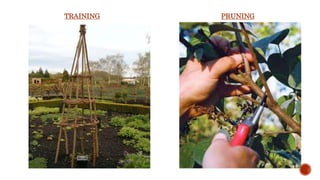
TRAINING PRUNING
HEIGHT OF HEAD
The distance from the ground level at which the main or
scaffold limbs branch from the trunk is known as ‘height of the head’
and this has to be decided before training is done. There are 3
classification based on it:
LOW HEADED
Trees in which scaffold branches come out within 0.7 to 0.9m .
HIGH HEADED
Those in which it ranges from 1.2 or more.
ADVANTAGES:
• High headed: Easy for
orchard cultivation.
• Low headed: Resist stormy
winds more effectively and
permit easy cultural
operations like pruning,
thinning….
DISADVANTAGES:
• High headed: Unsuitable as their
exposed trunks are subjected to
sunscald injuries.
NUMBER OF SCAFFOLD LIMBS
 The number of main branches or scaffold limbs to be allowed while
training varies from 2 to 15 or even more.
 If there are only 2 or 3 main scaffold limbs, there are almost certain to
form ‘crotches’.
DISTRIBUTION OF SCAFFOLD LIMBS
 If the scaffold branches arise sooner than when distributed at 45 to 60
cm distances of the trunk.
 The crotch angle should be also considered in selecting scaffold
branches.
 The branches with 45˚ to 90˚ are the strongest because the cambium is
continuous without phloem inclusion.
OPEN CENTRE
 Also known as vase-shaped system.
 In the system, main stem is allowed to grow only up to a certain height and
the leader stem is pruned to bring more scaffold branches.
CENTRAL LEADER
 Also is known as closed centred one.
MODIFIED LEADER
 Allow it to grow 4-5 years and they will cut tree, it will increase scaffold
branches and productivity.
TRAINING METHODS WHICH REQUIRE SUPPORT SYSTEM:
PANDAL/ ARBOUR/ PERGOLA/ BOWER
 When it reaches criss-cross wire pinch top of the plant and allow as many
branches as possible.
 MERIT: Yield and quality more.
DEMERIT: In plants like commeniphera sp, cultural operations difficult.
ESPALIAR/CORDON
 Only 2 branches allowed.
KNIFFER
 Only 3 branches are allowed to grow.
TATURA TRELLIS
 Two horizontal pillars are embedded in soil and angle between 2 tillers 60˚.
 Eg: Temperate fruit crops.
TELEPHONE
 Also known as overhead trellis system.
 Consists of 3 or 4 wires usually kept at 45-60 cm apart fixed to the cross-angle
arms supported by vertical pillars or posts.
TRAINING METHODS WHICH DOES’T REQUIRE SUPPORT
SYSTEM:
HEAD SYSTEM
 Usually followed in grapes.
 After it reaches 1.2 m, it is cut back to produce side shoots.
 Only 4 laterals 75 cm above the ground in all directions are alone retained, the
rest are thinned out.
 From these laterals, 2 secondaries are normally developed which bear 1 or 2
fruiting spurs.
PALMETTE SYSTEM
 Consists of trees in central leader system having 3 to 4 tiers of 2 opposite
branches trained at an angle 30˚ from the vertical.
 Branches against the row are removed.
SPINDLE BUSH SYSTEM
 Consists of central with 15-20 semi horizontal branches from it.
 The branches are kept spindly and secondary branches are encouraged on
primary branches.
DWARF PYRAMID SYSTEM
 Consists of full grown trees with 20-30 branches radiating from it at 45˚-90˚.
 It looks like a ‘pyramid’.
HEAD AND SPREAD SYSTEMS
 Simply, all branches grown in different directions.
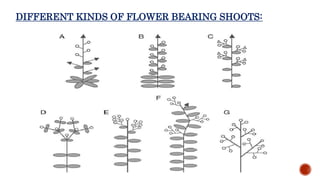
DIFFERENT KINDS OF FLOWER BEARING SHOOTS:
HEADING BACK:
 We’ll remove all branches without any remenent.
THINNING CUT:
 Remove small part of stem.
BULK PRUNING:
 Entire flower non-bearing branch removed.
SPECIAL PRUNING TECHNIQUES:
ROOT PRUNING
 Form circular trench of 45 cm and fill it with soil.
 To maintain dwarf structure in high density planting.
 Repeated in 4-5 years.
 Followed in orange in North India especially in Virdharba.
RINGING
 Removing a portion of bark.
 Accumulation of carbohydrate ~ high yield.
 Eg: Mango, grapes…
NOTCHING AND NICKING
 It is a partial ringing, removing a small portion just above and close to dormant
bud.
 It is proved to increase yield in fig trees in Pune.
 Notching below the bud is called ‘nicking’.
SMUDGING
 This is followed in mango to bring about off-season production in Phillipines.
 Smoke produced by burning leaves is allowed to pass through crown, for a week,
till buds swell.
 In India it is not reported.
BENDING
 Conducted in guava (Deccan region) in erect growing varieties.
 Lower part of branch dormant.
 Bent and tied on other trees.
COPPICING
 Complete removal of trunk in trees like Eucalyptus and Cinchona (leaving 30-
35 cm).
 In 6 months, vigorous shoots arise.
 Only 2-3 retained and others are thinned out.
POLLARDING
 Removal of growing point in shade trees especially in silver oak to encourage
side branching.
LOPPING
 Practice of reducing canopy cover in shade trees in order to permit more light.
PINCHING
 Terminal removal of growing point in herbaceous.
 Eg: Crnation, chrysanthemum.
DISBUDDING
 Removal of unwanted buds in a cluster.
 Eg: Carnation, dahlia, marigold, zinnia….
CONTAINMENT PRUNING
 Followed in high density plantation of temperate fruits.
 Provide space without affecting productivity.
 From the beginning itself it is pruned to produce small canopy.
 Annually 15-20% of branches are cut off.
ALTERNATE DIFFERENTIAL PRUNING
THINNING
In agriculture and gardening, thinning is the selective removal of flowers,
fruits, shoots, and seedlings or young plants to allow adequate space for the
remaining organs/plants to grow efficiently.
Types:
 Hand thinning: Manual thinning. Eg: Grapes, datepalm…
 Chemical thinning: Using chemicals. Eg: of such chemical is Naphthalene
Acetic Acid (NAA).
Training and pruning

Training and pruning

  • 1.
    Presented By: S.V. MAHESH CB.AG.U4AGR19033 CourseTeacher: Dr. Priya R Assistant Professor Horticulture
  • 2.
    TRAINING  It concernsform primarily. It determines plant’s outline, its branching and frame work. Generally concerned with first few years of the tree growth to determine its annual frame work. PRUNING It affects functions only. Assists more in what the tree does in respect to fruiting. Annually done.
  • 3.
  • 4.
    HEIGHT OF HEAD Thedistance from the ground level at which the main or scaffold limbs branch from the trunk is known as ‘height of the head’ and this has to be decided before training is done. There are 3 classification based on it: LOW HEADED Trees in which scaffold branches come out within 0.7 to 0.9m . HIGH HEADED Those in which it ranges from 1.2 or more.
  • 5.
    ADVANTAGES: • High headed:Easy for orchard cultivation. • Low headed: Resist stormy winds more effectively and permit easy cultural operations like pruning, thinning…. DISADVANTAGES: • High headed: Unsuitable as their exposed trunks are subjected to sunscald injuries.
  • 6.
    NUMBER OF SCAFFOLDLIMBS  The number of main branches or scaffold limbs to be allowed while training varies from 2 to 15 or even more.  If there are only 2 or 3 main scaffold limbs, there are almost certain to form ‘crotches’. DISTRIBUTION OF SCAFFOLD LIMBS  If the scaffold branches arise sooner than when distributed at 45 to 60 cm distances of the trunk.  The crotch angle should be also considered in selecting scaffold branches.  The branches with 45˚ to 90˚ are the strongest because the cambium is continuous without phloem inclusion.
  • 7.
    OPEN CENTRE  Alsoknown as vase-shaped system.  In the system, main stem is allowed to grow only up to a certain height and the leader stem is pruned to bring more scaffold branches. CENTRAL LEADER  Also is known as closed centred one. MODIFIED LEADER  Allow it to grow 4-5 years and they will cut tree, it will increase scaffold branches and productivity.
  • 8.
    TRAINING METHODS WHICHREQUIRE SUPPORT SYSTEM: PANDAL/ ARBOUR/ PERGOLA/ BOWER  When it reaches criss-cross wire pinch top of the plant and allow as many branches as possible.  MERIT: Yield and quality more. DEMERIT: In plants like commeniphera sp, cultural operations difficult. ESPALIAR/CORDON  Only 2 branches allowed. KNIFFER  Only 3 branches are allowed to grow. TATURA TRELLIS  Two horizontal pillars are embedded in soil and angle between 2 tillers 60˚.  Eg: Temperate fruit crops.
  • 9.
    TELEPHONE  Also knownas overhead trellis system.  Consists of 3 or 4 wires usually kept at 45-60 cm apart fixed to the cross-angle arms supported by vertical pillars or posts. TRAINING METHODS WHICH DOES’T REQUIRE SUPPORT SYSTEM: HEAD SYSTEM  Usually followed in grapes.  After it reaches 1.2 m, it is cut back to produce side shoots.  Only 4 laterals 75 cm above the ground in all directions are alone retained, the rest are thinned out.  From these laterals, 2 secondaries are normally developed which bear 1 or 2 fruiting spurs.
  • 10.
    PALMETTE SYSTEM  Consistsof trees in central leader system having 3 to 4 tiers of 2 opposite branches trained at an angle 30˚ from the vertical.  Branches against the row are removed. SPINDLE BUSH SYSTEM  Consists of central with 15-20 semi horizontal branches from it.  The branches are kept spindly and secondary branches are encouraged on primary branches. DWARF PYRAMID SYSTEM  Consists of full grown trees with 20-30 branches radiating from it at 45˚-90˚.  It looks like a ‘pyramid’. HEAD AND SPREAD SYSTEMS  Simply, all branches grown in different directions.
  • 11.
    DIFFERENT KINDS OFFLOWER BEARING SHOOTS:
  • 12.
    HEADING BACK:  We’llremove all branches without any remenent. THINNING CUT:  Remove small part of stem. BULK PRUNING:  Entire flower non-bearing branch removed. SPECIAL PRUNING TECHNIQUES: ROOT PRUNING  Form circular trench of 45 cm and fill it with soil.  To maintain dwarf structure in high density planting.  Repeated in 4-5 years.  Followed in orange in North India especially in Virdharba.
  • 13.
    RINGING  Removing aportion of bark.  Accumulation of carbohydrate ~ high yield.  Eg: Mango, grapes… NOTCHING AND NICKING  It is a partial ringing, removing a small portion just above and close to dormant bud.  It is proved to increase yield in fig trees in Pune.  Notching below the bud is called ‘nicking’. SMUDGING  This is followed in mango to bring about off-season production in Phillipines.  Smoke produced by burning leaves is allowed to pass through crown, for a week, till buds swell.  In India it is not reported.
  • 14.
    BENDING  Conducted inguava (Deccan region) in erect growing varieties.  Lower part of branch dormant.  Bent and tied on other trees. COPPICING  Complete removal of trunk in trees like Eucalyptus and Cinchona (leaving 30- 35 cm).  In 6 months, vigorous shoots arise.  Only 2-3 retained and others are thinned out. POLLARDING  Removal of growing point in shade trees especially in silver oak to encourage side branching.
  • 15.
    LOPPING  Practice ofreducing canopy cover in shade trees in order to permit more light. PINCHING  Terminal removal of growing point in herbaceous.  Eg: Crnation, chrysanthemum. DISBUDDING  Removal of unwanted buds in a cluster.  Eg: Carnation, dahlia, marigold, zinnia…. CONTAINMENT PRUNING  Followed in high density plantation of temperate fruits.  Provide space without affecting productivity.  From the beginning itself it is pruned to produce small canopy.
  • 16.
     Annually 15-20%of branches are cut off. ALTERNATE DIFFERENTIAL PRUNING THINNING In agriculture and gardening, thinning is the selective removal of flowers, fruits, shoots, and seedlings or young plants to allow adequate space for the remaining organs/plants to grow efficiently. Types:  Hand thinning: Manual thinning. Eg: Grapes, datepalm…  Chemical thinning: Using chemicals. Eg: of such chemical is Naphthalene Acetic Acid (NAA).