Pruning Mike Walsh  Forestry Programs Manager Forest ReLeaf of Missouri [email_address]
Background Mike Walsh B.S. Forestry, Missouri 2005 M.S. Forestry, Missouri 2007 ISA Certified Arborist 2008 MW-4822A Worked with the MDC, USDAFS, HARC, & MU Forestry Department conducting research in flood tolerance of MO hardwoods, controlled black walnut breeding, nursery production and more. I love trees, learning/teaching about trees, fishing, golfing, watching & listening to Cardinals Baseball, Rams Football?, & Tiger Football (& basketball).
Trick Question? If a tree branch is located five feet from the ground, and the tree grows 6” each year, how far from the ground will the branch be in 6 years?
Objectives Know why, when and how a tree should be pruned. Understand how trees respond to pruning and the effects of severe pruning on a tree. Understand the relationship of the branch collar and branch size to wound closure and the potential for decay. Describe the procedures and techniques used in pruning. Become familiar with the terms used to describe pruning techniques.
Key Terms The Key Terms as listed in the Arborist’s Certification Study Guide will be defined and  highlighted  throughout the presentation.
Key Terms - Chapter 8 ANSI 3000 standards Antigibberellins Branch bark ridge Branch collar Branch protection zone Codominant Compartmentalization Crown cleaning Espalier Fronds Heading back Included bark Internodal Lateral Leader Lion tailing Permanent branches Plant growth regulators Pollarding Raising Reduction Restoration Scaffold branches Structural pruning Subordinate Temporary branches Thinning Topping Utility pruning Vista pruning Watersprouts Wound dressing
Introduction to pruning Why prune? Who prunes trees in the woods? Open vs. forested grown trees People reasons – people stresses! Health, Safety, & Aesthetics Tree Biology (review) ANSI A300 Standards
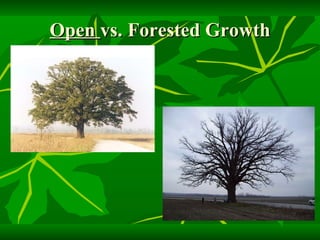
Open  vs. Forested Growth
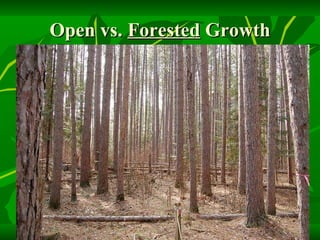
Open vs.  Forested  Growth
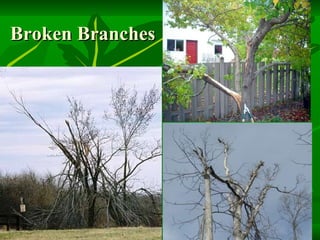
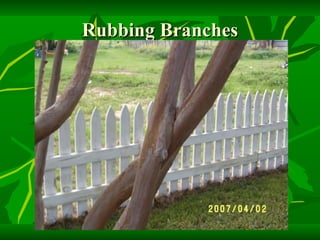
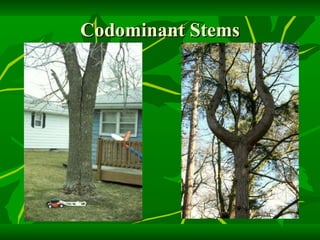
Why do we prune?  1) Health To maintain the overall health of the tree Remove broken & diseased branches Rubbing branches / limbs that create wounds Improve taper on branches and limbs Remove codominant stems Attempt to improve overall structure and health of the tree to reduce the risk of failures
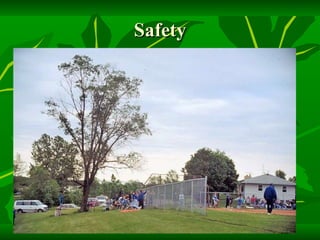
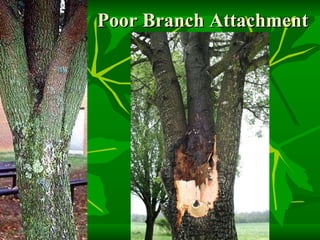
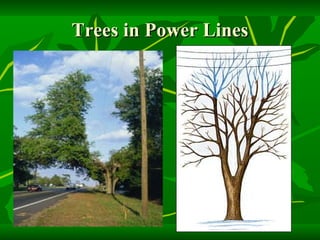
Why do we prune?  2) Safety Trees in high use areas (playgrounds, e.g.) Removal of broken and dead material (widow makers) Look for poor branch attachments (V-crotches) Excessive leaning (may indicate root problems) Trees in construction areas (10+ year lag time) Interference with line of sight  on streets Utility pruning (safety of workers, keep the lights on) Topped trees (will be a hazard down the road)
Why do we prune?  3) Aesthetics Improve views (vista pruning) Provide clearance (car, mowers, pedestrians) Pathways & sidewalks to 8’ Streets to 15’ Reduce shade & wind resistance Lawns, groundcovers, mulch beds with flowers Influence fruit & flower production
Broken Branches
Rubbing Branches
Codominant Stems
Safety
Poor Branch Attachment
Trees in Power Lines
Clearance
When to prune? (some examples) It depends on the desired results: Maximized growth = early spring Minimize risk of pests and decay = dormant season  Minimize effects to flowers and fruit = immediately after flowering Timing of year may not always be an option Storm Damage, e.g.
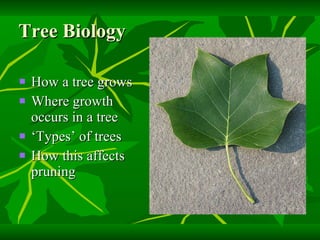
Tree Biology How a tree grows Where growth occurs in a tree ‘Types’ of trees How this affects pruning
Tree Biology Primary Growth Secondary Growth Branches and Trunk Attachments Excurrent/Decurrent
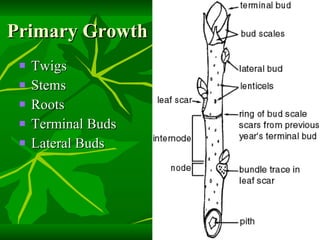
Primary Growth Twigs Stems Roots Terminal Buds Lateral Buds
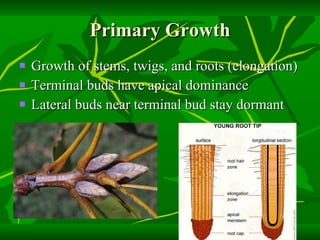
Primary Growth Growth of stems, twigs, and roots (elongation) Terminal buds have apical dominance Lateral buds near terminal bud stay dormant
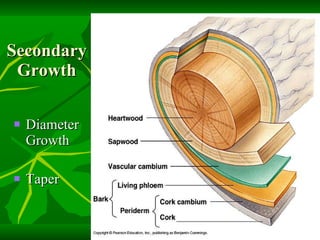
Secondary Growth Diameter Growth Taper
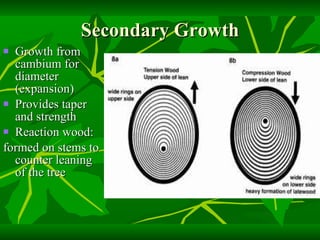
Secondary Growth Growth from cambium for diameter (expansion) Provides taper and strength Reaction wood:  formed on stems to counter leaning of the tree
Branches & Trunk Attachments Branch collar Included bark Codominant stems Crotches
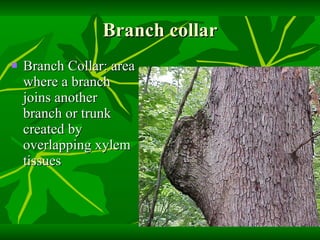
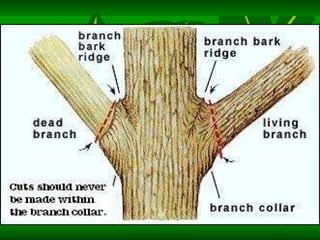
Branch collar Branch Collar: area where a branch joins another branch or trunk created by overlapping xylem tissues
 
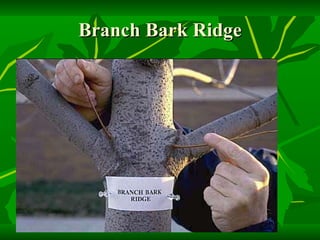
Branch Bark Ridge
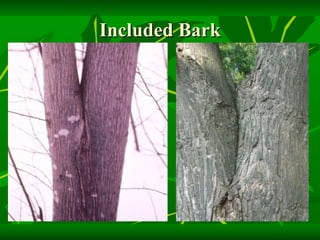
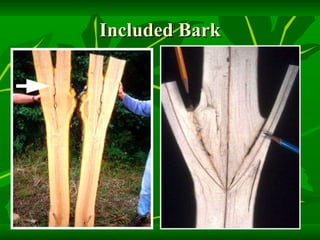
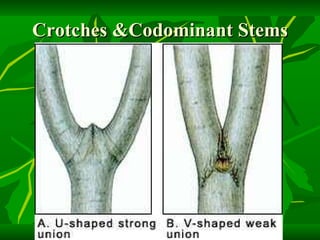
Codominant Stems  – forked branches of nearly the same size in diameter and lacking a normal branch union Frequent site of structural failure due to  included bark   [bark that becomes embedded in a crotch between branch and trunk or between codominant stems and causes a weak structure] Hmmm…what tree tends to form these?
Included Bark
Included Bark
Crotches &Codominant Stems
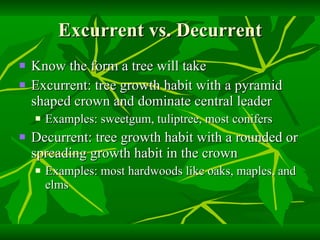
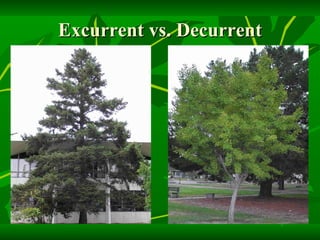
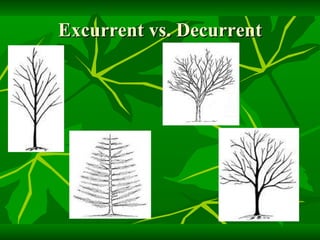
Excurrent vs. Decurrent Know the form a tree will take Excurrent: tree growth habit with a pyramid shaped crown and dominate central leader Examples: sweetgum, tuliptree, most conifers Decurrent: tree growth habit with a rounded or spreading growth habit in the crown  Examples: most hardwoods like oaks, maples, and elms
Excurrent vs. Decurrent
Break
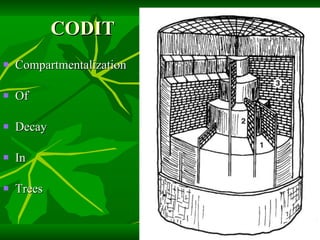
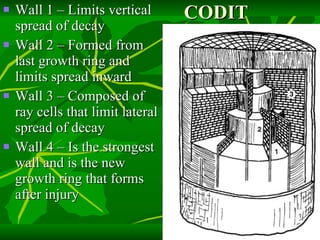
CODIT Compartmentalization Of Decay In Trees
CODIT Wall 1 – Limits vertical spread of decay Wall 2 – Formed from last growth ring and limits spread inward Wall 3 – Composed of ray cells that limit lateral spread of decay Wall 4 – Is the strongest wall and is the new growth ring that forms after injury
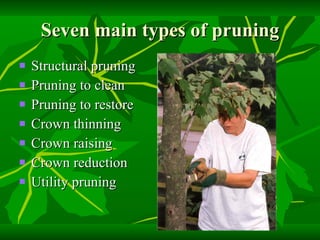
Seven main types of pruning Structural pruning Pruning to clean Pruning to restore Crown thinning Crown raising Crown reduction Utility pruning
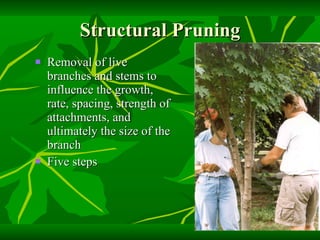
Structural Pruning Removal of live branches and stems to influence the growth, rate, spacing, strength of attachments, and ultimately the size of the branch Five steps
Structural Pruning Remove broken, dead, dying or damaged branches Select and establish a dominant  leader  [the primary terminal shoot or trunk of a tree]. Competing stems should be  subordinated  [pruning to reduce the size and growth of a branch in relation to other branches or leaders
Structural Pruning Select and establish the lowest  permanent branch  [branches that will be left in place, often forming the initial scaffold framework of a tree] Select and establish  scaffold branches  [the permanent or structural branches of a tree]; 12 -18” spacing depending on the ultimate size of the tree
Structural Pruning Select and subordinate  temporary branches  [branches left in place when training young trees; such branches will be removed later] Why leave them? Proper taper Prevent Sunscald Energy production Try to do this over time 25% rule
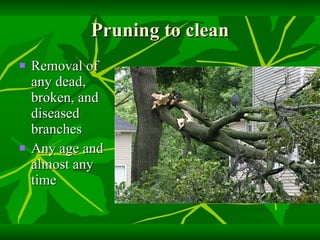
Pruning to clean Removal of any dead, broken, and diseased branches Any age and almost any time
Pruning to restore Select removal of branch, sprouts, and stems from trees that have been topped, headed, lion tailed, or broken in a storm Can take up to several years 1/3 of sprouts removed each year until sprouts have developed into branches
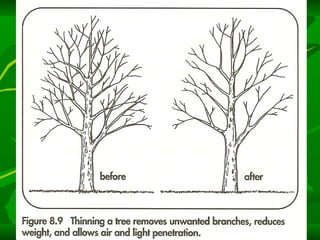
Crown thinning Select removal  of small live branches to reduce crown density Increases light penetration and air movement Avoid lion tailing: removal of excessive amount of foliage on inner branches and leaves most of foliage at end of canopy = weak branches Never remove more than 25% of the entire crown Water sprouts and sunscald may result
Dangers of over-thinning Sunscald Production of  watersprouts  [an upright, adventitious shoot arising from the trunk or branches of a plant; although incorrect, it is also called “sucker [shoot arising from the roots.” Lion tailing  [limbs are thinned from the inside of the crown to a clump of terminal foliage]
 
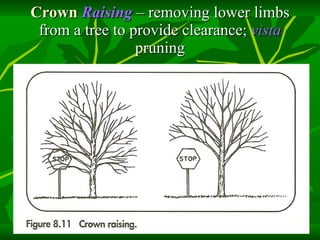
Crown raising Select removal of branches to provide vertical clearance On younger trees it can reduce taper like lion tailing On mature trees: Never remove a branch that is ½ the size of the diameter of the trunk Never take away more than 1/3 of the crown Raise limbs by removing small amounts of branches at a time
Crown  Raising  – removing lower limbs from a tree to provide clearance;  vista   pruning
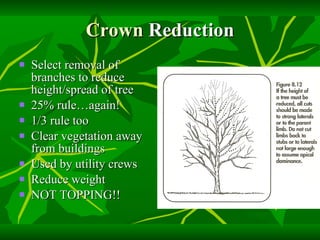
Crown  Reduction Select removal of branches to reduce height/spread of tree 25% rule…again! 1/3 rule too Clear vegetation away from buildings Used by utility crews Reduce weight NOT TOPPING!!
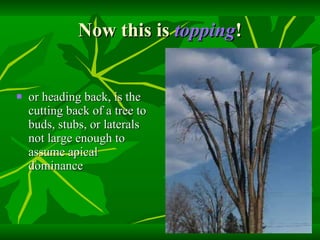
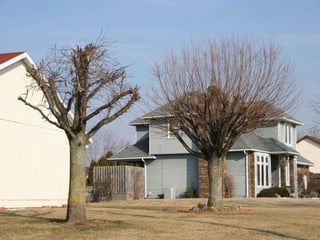
Now this is  topping ! or heading back, is the cutting back of a tree to buds, stubs, or laterals not large enough to assume apical dominance
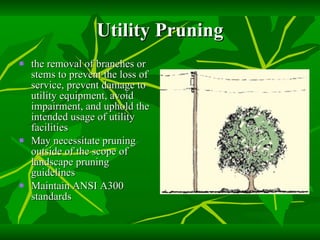
Utility Pruning the removal of branches or stems to prevent the loss of service, prevent damage to utility equipment, avoid impairment, and uphold the intended usage of utility facilities May necessitate pruning outside of the scope of landscape pruning guidelines Maintain ANSI A300 standards
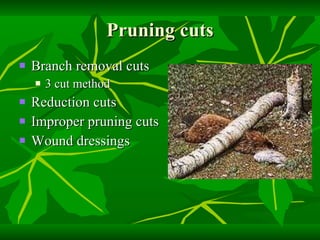
Pruning cuts Branch removal cuts 3 cut method Reduction cuts Improper pruning cuts  Wound dressings
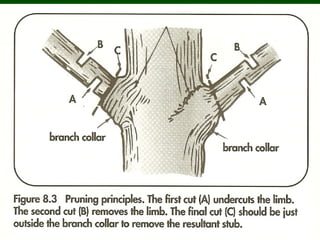
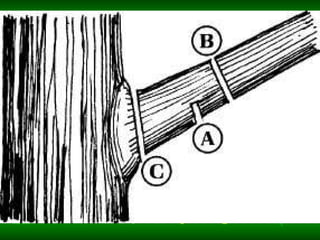
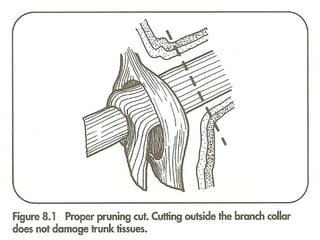
Branch removal cuts Removal of a branch at its point of origin on the trunk, stem, or limb Use the 3-cut method 1.) undercut the limb to prevent peeling (>1”) 2.) outside the undercut, begin 2 nd  cut from top of branch to remove it and leave a stub 3.) final cut is made just outside the branch collar Take care not to leave torn bark or jagged edges This allows for  compartmentalization   [natural process of defense in trees by which they wall off decay in the wood ] to occur – NOT HEALING!!


Some more terms… Branch protection zone  – tissues inside the trunk or parent branch at the base of a subordinate branch that protect against the spread of decay Laterals  [secondary or subordinate branch] don’t compartmentalize as well Compartmentalization ability depends on species, vigor, climate and size of cut.
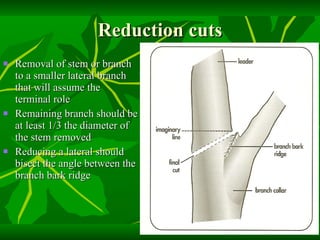
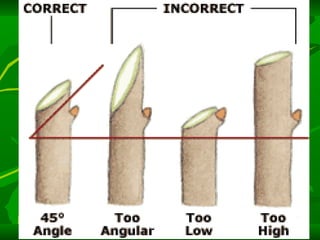
Reduction cuts Removal of stem or branch to a smaller lateral branch that will assume the terminal role Remaining branch should be at least 1/3 the diameter of the stem removed Reducing a lateral should bisect the angle between the branch bark ridge
 
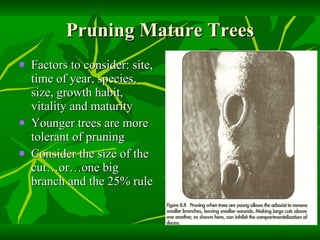
Pruning Mature Trees Factors to consider: site, time of year, species, size, growth habit, vitality and maturity Younger trees are more tolerant of pruning Consider the size of the cut…or…one big branch and the 25% rule
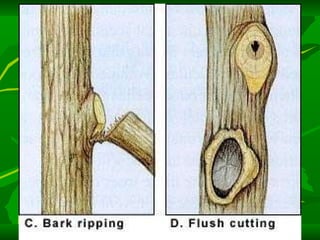
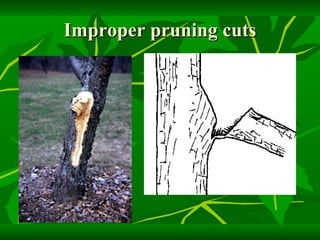
Improper pruning cuts
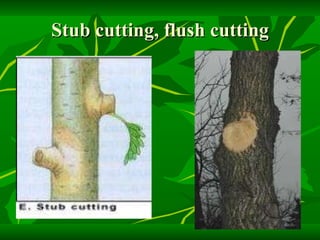
Stub cutting, flush cutting
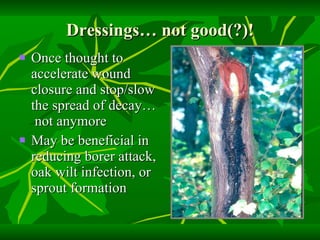
Dressings… not good(?)! Once thought to accelerate wound closure and stop/slow the spread of decay…  not anymore May be beneficial in reducing borer attack, oak wilt infection, or sprout formation
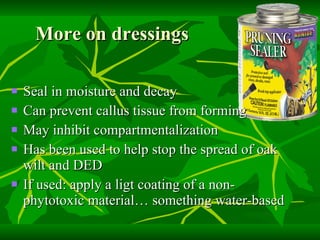
More on dressings Seal in moisture and decay Can prevent callus tissue from forming May inhibit compartmentalization Has been used to help stop the spread of oak wilt and DED If used: apply a ligt coating of a non-phytotoxic material… something water-based
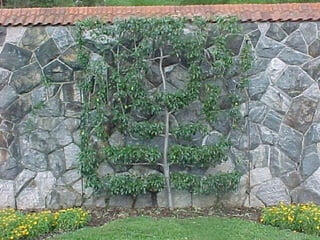
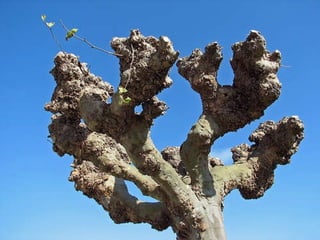
Specialty Pruning Espalier  – a combination of cutting and training branches that are oriented in one plane, usually supported on a wall, fence or trellis Used on fruit trees to grow on trellis Pollarding  – a training system that involves severe heading the first year, and sprout removal annually or every few years to keep large-growing trees to a modest size or maintain a formal appearance Internodal  – cuts are made at specific locations to begin the pollarding process. Trivia: Besides aesthetics, why was pollarding done?
 
 
Pruning tools
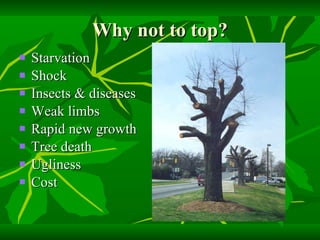
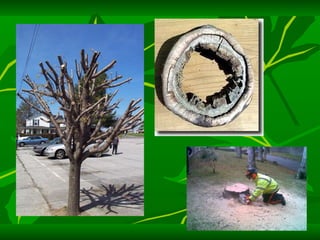
Why not to top? Starvation Shock Insects & diseases Weak limbs Rapid new growth Tree death Ugliness Cost
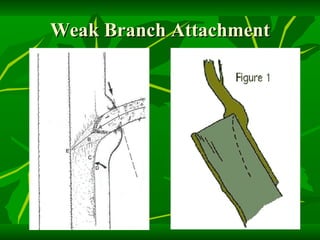
Weak Branch Attachment
 
 
Plant Growth Regulators PGR: compounds, effective in small quantities that affect the growth and development of plants Antigibberelllins: PGRs that inhibit the action of the plant hormone gibberellin Gibberellin: plant hormones that regulate growth and influence various developmental processes, including stem elongation, germination, dormancy, flowering, sex expression, enzyme induction and leaf and fruit senescence Why use PGR? Reduce rotation for utility crews, e.g.
Additional Resources ANSI A300. Standard Practices for Tree, Shrub and Other Woody Plant Maintenance, Part 1: Pruning Costello, 2000. Training Young Trees for Structure and Form.   Gilman, 1997. An Illustrated Guide to Pruning Trees. ISA, 1995. Tree Pruning Guidelines.
The end Questions? Complaints?

Isa pruning

  • 1.
    Pruning Mike Walsh Forestry Programs Manager Forest ReLeaf of Missouri [email_address]
  • 2.
    Background Mike WalshB.S. Forestry, Missouri 2005 M.S. Forestry, Missouri 2007 ISA Certified Arborist 2008 MW-4822A Worked with the MDC, USDAFS, HARC, & MU Forestry Department conducting research in flood tolerance of MO hardwoods, controlled black walnut breeding, nursery production and more. I love trees, learning/teaching about trees, fishing, golfing, watching & listening to Cardinals Baseball, Rams Football?, & Tiger Football (& basketball).
  • 3.
    Trick Question? Ifa tree branch is located five feet from the ground, and the tree grows 6” each year, how far from the ground will the branch be in 6 years?
  • 4.
    Objectives Know why,when and how a tree should be pruned. Understand how trees respond to pruning and the effects of severe pruning on a tree. Understand the relationship of the branch collar and branch size to wound closure and the potential for decay. Describe the procedures and techniques used in pruning. Become familiar with the terms used to describe pruning techniques.
  • 5.
    Key Terms TheKey Terms as listed in the Arborist’s Certification Study Guide will be defined and highlighted throughout the presentation.
  • 6.
    Key Terms -Chapter 8 ANSI 3000 standards Antigibberellins Branch bark ridge Branch collar Branch protection zone Codominant Compartmentalization Crown cleaning Espalier Fronds Heading back Included bark Internodal Lateral Leader Lion tailing Permanent branches Plant growth regulators Pollarding Raising Reduction Restoration Scaffold branches Structural pruning Subordinate Temporary branches Thinning Topping Utility pruning Vista pruning Watersprouts Wound dressing
  • 7.
    Introduction to pruningWhy prune? Who prunes trees in the woods? Open vs. forested grown trees People reasons – people stresses! Health, Safety, & Aesthetics Tree Biology (review) ANSI A300 Standards
  • 8.
    Open vs.Forested Growth
  • 9.
    Open vs. Forested Growth
  • 10.
    Why do weprune? 1) Health To maintain the overall health of the tree Remove broken & diseased branches Rubbing branches / limbs that create wounds Improve taper on branches and limbs Remove codominant stems Attempt to improve overall structure and health of the tree to reduce the risk of failures
  • 11.
    Why do weprune? 2) Safety Trees in high use areas (playgrounds, e.g.) Removal of broken and dead material (widow makers) Look for poor branch attachments (V-crotches) Excessive leaning (may indicate root problems) Trees in construction areas (10+ year lag time) Interference with line of sight on streets Utility pruning (safety of workers, keep the lights on) Topped trees (will be a hazard down the road)
  • 12.
    Why do weprune? 3) Aesthetics Improve views (vista pruning) Provide clearance (car, mowers, pedestrians) Pathways & sidewalks to 8’ Streets to 15’ Reduce shade & wind resistance Lawns, groundcovers, mulch beds with flowers Influence fruit & flower production
  • 13.
  • 14.
  • 15.
  • 16.
  • 17.
  • 18.
  • 19.
  • 20.
    When to prune?(some examples) It depends on the desired results: Maximized growth = early spring Minimize risk of pests and decay = dormant season Minimize effects to flowers and fruit = immediately after flowering Timing of year may not always be an option Storm Damage, e.g.
  • 21.
    Tree Biology Howa tree grows Where growth occurs in a tree ‘Types’ of trees How this affects pruning
  • 22.
    Tree Biology PrimaryGrowth Secondary Growth Branches and Trunk Attachments Excurrent/Decurrent
  • 23.
    Primary Growth TwigsStems Roots Terminal Buds Lateral Buds
  • 24.
    Primary Growth Growthof stems, twigs, and roots (elongation) Terminal buds have apical dominance Lateral buds near terminal bud stay dormant
  • 25.
  • 26.
    Secondary Growth Growthfrom cambium for diameter (expansion) Provides taper and strength Reaction wood: formed on stems to counter leaning of the tree
  • 27.
    Branches & TrunkAttachments Branch collar Included bark Codominant stems Crotches
  • 28.
    Branch collar BranchCollar: area where a branch joins another branch or trunk created by overlapping xylem tissues
  • 29.
  • 30.
  • 31.
    Codominant Stems – forked branches of nearly the same size in diameter and lacking a normal branch union Frequent site of structural failure due to included bark [bark that becomes embedded in a crotch between branch and trunk or between codominant stems and causes a weak structure] Hmmm…what tree tends to form these?
  • 32.
  • 33.
  • 34.
  • 35.
    Excurrent vs. DecurrentKnow the form a tree will take Excurrent: tree growth habit with a pyramid shaped crown and dominate central leader Examples: sweetgum, tuliptree, most conifers Decurrent: tree growth habit with a rounded or spreading growth habit in the crown Examples: most hardwoods like oaks, maples, and elms
  • 36.
  • 37.
  • 38.
  • 39.
  • 40.
    CODIT Wall 1– Limits vertical spread of decay Wall 2 – Formed from last growth ring and limits spread inward Wall 3 – Composed of ray cells that limit lateral spread of decay Wall 4 – Is the strongest wall and is the new growth ring that forms after injury
  • 41.
    Seven main typesof pruning Structural pruning Pruning to clean Pruning to restore Crown thinning Crown raising Crown reduction Utility pruning
  • 42.
    Structural Pruning Removalof live branches and stems to influence the growth, rate, spacing, strength of attachments, and ultimately the size of the branch Five steps
  • 43.
    Structural Pruning Removebroken, dead, dying or damaged branches Select and establish a dominant leader [the primary terminal shoot or trunk of a tree]. Competing stems should be subordinated [pruning to reduce the size and growth of a branch in relation to other branches or leaders
  • 44.
    Structural Pruning Selectand establish the lowest permanent branch [branches that will be left in place, often forming the initial scaffold framework of a tree] Select and establish scaffold branches [the permanent or structural branches of a tree]; 12 -18” spacing depending on the ultimate size of the tree
  • 45.
    Structural Pruning Selectand subordinate temporary branches [branches left in place when training young trees; such branches will be removed later] Why leave them? Proper taper Prevent Sunscald Energy production Try to do this over time 25% rule
  • 46.
    Pruning to cleanRemoval of any dead, broken, and diseased branches Any age and almost any time
  • 47.
    Pruning to restoreSelect removal of branch, sprouts, and stems from trees that have been topped, headed, lion tailed, or broken in a storm Can take up to several years 1/3 of sprouts removed each year until sprouts have developed into branches
  • 48.
    Crown thinning Selectremoval of small live branches to reduce crown density Increases light penetration and air movement Avoid lion tailing: removal of excessive amount of foliage on inner branches and leaves most of foliage at end of canopy = weak branches Never remove more than 25% of the entire crown Water sprouts and sunscald may result
  • 49.
    Dangers of over-thinningSunscald Production of watersprouts [an upright, adventitious shoot arising from the trunk or branches of a plant; although incorrect, it is also called “sucker [shoot arising from the roots.” Lion tailing [limbs are thinned from the inside of the crown to a clump of terminal foliage]
  • 50.
  • 51.
    Crown raising Selectremoval of branches to provide vertical clearance On younger trees it can reduce taper like lion tailing On mature trees: Never remove a branch that is ½ the size of the diameter of the trunk Never take away more than 1/3 of the crown Raise limbs by removing small amounts of branches at a time
  • 52.
    Crown Raising – removing lower limbs from a tree to provide clearance; vista pruning
  • 53.
    Crown ReductionSelect removal of branches to reduce height/spread of tree 25% rule…again! 1/3 rule too Clear vegetation away from buildings Used by utility crews Reduce weight NOT TOPPING!!
  • 54.
    Now this is topping ! or heading back, is the cutting back of a tree to buds, stubs, or laterals not large enough to assume apical dominance
  • 55.
    Utility Pruning theremoval of branches or stems to prevent the loss of service, prevent damage to utility equipment, avoid impairment, and uphold the intended usage of utility facilities May necessitate pruning outside of the scope of landscape pruning guidelines Maintain ANSI A300 standards
  • 56.
    Pruning cuts Branchremoval cuts 3 cut method Reduction cuts Improper pruning cuts Wound dressings
  • 57.
    Branch removal cutsRemoval of a branch at its point of origin on the trunk, stem, or limb Use the 3-cut method 1.) undercut the limb to prevent peeling (>1”) 2.) outside the undercut, begin 2 nd cut from top of branch to remove it and leave a stub 3.) final cut is made just outside the branch collar Take care not to leave torn bark or jagged edges This allows for compartmentalization [natural process of defense in trees by which they wall off decay in the wood ] to occur – NOT HEALING!!
  • 58.
  • 59.
  • 60.
  • 61.
  • 62.
    Some more terms…Branch protection zone – tissues inside the trunk or parent branch at the base of a subordinate branch that protect against the spread of decay Laterals [secondary or subordinate branch] don’t compartmentalize as well Compartmentalization ability depends on species, vigor, climate and size of cut.
  • 63.
    Reduction cuts Removalof stem or branch to a smaller lateral branch that will assume the terminal role Remaining branch should be at least 1/3 the diameter of the stem removed Reducing a lateral should bisect the angle between the branch bark ridge
  • 64.
  • 65.
    Pruning Mature TreesFactors to consider: site, time of year, species, size, growth habit, vitality and maturity Younger trees are more tolerant of pruning Consider the size of the cut…or…one big branch and the 25% rule
  • 66.
  • 67.
  • 68.
    Dressings… not good(?)!Once thought to accelerate wound closure and stop/slow the spread of decay… not anymore May be beneficial in reducing borer attack, oak wilt infection, or sprout formation
  • 69.
    More on dressingsSeal in moisture and decay Can prevent callus tissue from forming May inhibit compartmentalization Has been used to help stop the spread of oak wilt and DED If used: apply a ligt coating of a non-phytotoxic material… something water-based
  • 70.
    Specialty Pruning Espalier – a combination of cutting and training branches that are oriented in one plane, usually supported on a wall, fence or trellis Used on fruit trees to grow on trellis Pollarding – a training system that involves severe heading the first year, and sprout removal annually or every few years to keep large-growing trees to a modest size or maintain a formal appearance Internodal – cuts are made at specific locations to begin the pollarding process. Trivia: Besides aesthetics, why was pollarding done?
  • 71.
  • 72.
  • 73.
  • 74.
    Why not totop? Starvation Shock Insects & diseases Weak limbs Rapid new growth Tree death Ugliness Cost
  • 75.
  • 76.
  • 77.
  • 78.
    Plant Growth RegulatorsPGR: compounds, effective in small quantities that affect the growth and development of plants Antigibberelllins: PGRs that inhibit the action of the plant hormone gibberellin Gibberellin: plant hormones that regulate growth and influence various developmental processes, including stem elongation, germination, dormancy, flowering, sex expression, enzyme induction and leaf and fruit senescence Why use PGR? Reduce rotation for utility crews, e.g.
  • 79.
    Additional Resources ANSIA300. Standard Practices for Tree, Shrub and Other Woody Plant Maintenance, Part 1: Pruning Costello, 2000. Training Young Trees for Structure and Form. Gilman, 1997. An Illustrated Guide to Pruning Trees. ISA, 1995. Tree Pruning Guidelines.
  • 80.
    The end Questions?Complaints?

Editor's Notes

  • #5 Not specific disorders but what to look for to be able to tell Best part of this class is to learn this process (nothing) What is a physiological disorder? however…