CANOPY MANAGEMENT IN GUAVA
SUSHRITA NAYAK
OUAT
INTRODUCTION
 Guava ( Psidium guajava) belonged to the family of Myrtaceae. It is also called as “poor man’s
fruit” or “apple of the tropics” & is a popular fruit tree of the tropical and subtropical climate.
 It is one of the most exquisite and nutritionally valuable remunerative crop. It is used for both
table and processing purpose.
 It is native to tropical America & has been introduced to India in early 17th century by
portugese & gradually became the crop of commercial significance.
 It is claimed to be the 4th most imp. tropical fruit crops of India, after mango, banana & citrus .
 It excels most other fruit trees in productivity, adaptability & is a cheap source of vit- C & pectin.
It rank 3rd in vitamin-C content (260 mg/100g) after barbadose cherry & aonla.
 It occupies an area of 262 hectare with an annual production of 24.8 lakh MT.
 Major guava producing states in India are MH, Bihar, UP, AP, MP, Gujarat, Odisha, Punjab,
Karnataka and TN. MH is the leading producer both in area and production > Bihar > UP. But its
productivity is highest in KTK >Punjab>Bengal >Gujarat.
Plant description:
 It is a large dicotyledonous shrub /small evergreen hardy tree, with lt. to reddish brown,
smooth, continuously flaking bark ; root system is superficial with some deep roots but no
distinct taproot.
Flowering and Fruiting:
 In general, Guava tree flowers twice a year, i.e., in April-May & Aug- Sep of which fruits ripen
in rainy & winter season respectively. Sometimes, a 3rd flowering, aoccurs in Oct- Nov,
particularly in MH & TN.
 Flowers occur either singly or in cymose of current season growth on the leaf axils. The
blooming period varies from 25 to 45 days depending upon the cultivar, season and the region.
 Exogenous application of some chemicals can regulate flowering in guava. For e.g.,
 ethrel (1ml/lt) produces maximum no. flowers & fruits.
 Urea (25%) & ethrel (2000 ppm) increase flower production.(Chandra & Govind 1994).
 Early & maximum no. of flowers were recorded by spraying CCC (500 PPM) .
Fruit set:
 The initial fruit set is quite high i.e., approx. 80 % of the flowers became fruits. During severe
fruit drops only 34 to 56 % of the fruits reached maturity. Which can be prevented by Spraying
Of GA3 at 15-30 ppm (Rajput et al, 1997). Fruit formation could be noticed after 12 days from
flowering.
Crop regulation:
 Heaviest flowering has always been obtained in summer season & rainy season
flowering for winter crop is very less( Rathor 1975). It is also poor in quality & is
affected by many insect pest. The winter season fruits (ripens late- Oct to late Jan)
are superior in quality & fetch more price.
It can be regulated by following ways:
 Thinning of flowers is done during March-April which increases the of winter season
crop.(Kumar & Hoda 1977)
 Withholding irrigation during March-April results in flowers drop & thereby produce
more yield in winter season.
 Root exposure & root pruning are done during March- April to suppress rainy season
crop so as to get a good winter crop.
 Use of GR like NAA,PBZ,2,4-D,Ethephon,KI,urea to regulate crop.
Adoption of modern and hi-tech methods
 The traditional system of cultivation often posed problems in attaining desired
productivity due to large tree canopy. Hence, certain imp. strategies like modern,
innovative and hi-tech methods (HDP, ultra-HDP, meadow orchard) are adopted etc.
High density planting & Meadow Orcharding in Guava
 High density planting technique is a modern method of fruit cultivation
involving of planting of fruit trees densely.
 Meadow orchard system is a new concept of planting which has been
developed in Guava for the 1st time in India at CISH, Lucknow. It is fruit
cultivation using small / dwarf tree with modified canopy.
Basically, the availability of a dwarf plant is the 1st & foremost pre-requisite for
establishing any high density or meadow orchard.
 This system facilitates better light distribution within tree canopy which
increases the number of well illuminated leaves, promotes rate of
photosynthesis that leads to high yield per unit area.
 Fertilizer dose, spacings, growth regulation by training & pruning, use of
mechanical devises etc. may also be tried either singly or coupled with other
crop management practices for successful adoption of this concepts.
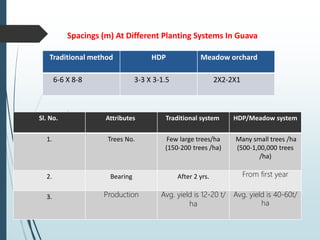
Spacings (m) At Different Planting Systems In Guava
Comparison between traditional and meadow orchard systems of guava
Traditional method HDP Meadow orchard
6-6 X 8-8 3-3 X 3-1.5 2X2-2X1
Sl. No. Attributes Traditional system HDP/Meadow system
1. Trees No. Few large trees/ha
(150-200 trees /ha)
Many small trees /ha
(500-1,00,000 trees
/ha)
2. Bearing After 2 yrs. From first year
3. Production Avg. yield is 12-20 t/
ha
Avg. yield is 40-60t/
ha
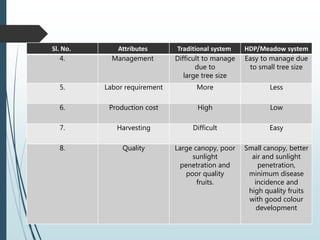
Sl. No. Attributes Traditional system HDP/Meadow system
4. Management Difficult to manage
due to
large tree size
Easy to manage due
to small tree size
5. Labor requirement More Less
6. Production cost High Low
7. Harvesting Difficult Easy
8. Quality Large canopy, poor
sunlight
penetration and
poor quality
fruits.
Small canopy, better
air and sunlight
penetration,
minimum disease
incidence and
high quality fruits
with good colour
development
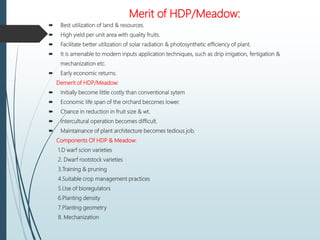
Merit of HDP/Meadow:
 Best utilization of land & resources.
 High yield per unit area with quality fruits.
 Facilitate better utilization of solar radiation & photosynthetic efficiency of plant.
 It is amenable to modern inputs application techniques, such as drip irrigation, fertigation &
mechanization etc.
 Early economic returns.
Demerit of HDP/Meadow:
 Initially become little costly than conventional sytem
 Economic life span of the orchard becomes lower.
 Chance in reduction in fruit size & wt.
 Intercultural operation becomes difficult.
 Maintainance of plant architecture becomes tedious job.
Components Of HDP & Meadow:
1.D warf scion varieties
2. Dwarf rootstock varieties
3.Training & pruning
4.Suitable crop management practices
5.Use of bioregulators
6.Planting density
7.Planting geometry
8. Mechanization
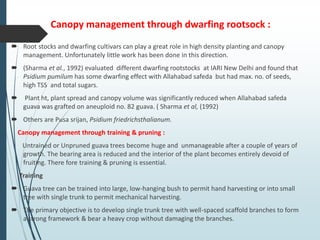
Canopy management through dwarfing rootsock :
 Root stocks and dwarfing cultivars can play a great role in high density planting and canopy
management. Unfortunately little work has been done in this direction.
 (Sharma et al., 1992) evaluated different dwarfing rootstocks at IARI New Delhi and found that
Psidium pumilum has some dwarfing effect with Allahabad safeda but had max. no. of seeds,
high TSS and total sugars.
 Plant ht, plant spread and canopy volume was significantly reduced when Allahabad safeda
guava was grafted on aneuploid no. 82 guava. ( Sharma et al, (1992)
 Others are Pusa srijan, Psidium friedrichsthalianum.
Canopy management through training & pruning :
Untrained or Unpruned guava trees become huge and unmanageable after a couple of years of
growth. The bearing area is reduced and the interior of the plant becomes entirely devoid of
fruiting. There fore training & pruning is essential.
Training
 Guava tree can be trained into large, low-hanging bush to permit hand harvesting or into small
tree with single trunk to permit mechanical harvesting.
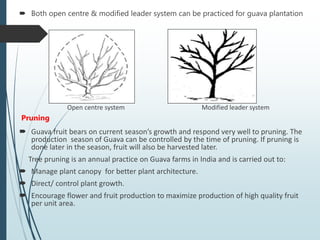
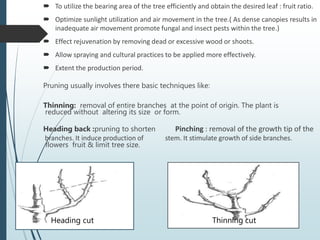
 The primary objective is to develop single trunk tree with well-spaced scaffold branches to form
a strong framework & bear a heavy crop without damaging the branches.
 Both open centre & modified leader system can be practiced for guava plantation
Open centre system Modified leader system
Pruning
 Guava fruit bears on current season’s growth and respond very well to pruning. The
production season of Guava can be controlled by the time of pruning. If pruning is
done later in the season, fruit will also be harvested later.
Tree pruning is an annual practice on Guava farms in India and is carried out to:
 Manage plant canopy for better plant architecture.
 Direct/ control plant growth.
 Encourage flower and fruit production to maximize production of high quality fruit
per unit area.
 To utilize the bearing area of the tree efficiently and obtain the desired leaf : fruit ratio.
 Optimize sunlight utilization and air movement in the tree.( As dense canopies results in
inadequate air movement promote fungal and insect pests within the tree.)
 Effect rejuvenation by removing dead or excessive wood or shoots.
 Allow spraying and cultural practices to be applied more effectively.
 Extent the production period.
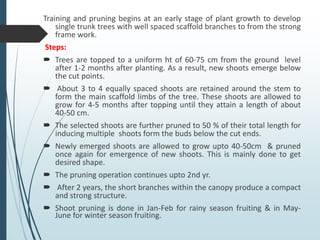
Pruning usually involves there basic techniques like:
Thinning: removal of entire branches at the point of origin. The plant is
reduced without altering its size or form.
Heading back :pruning to shorten Pinching : removal of the growth tip of the
branches. It induce production of stem. It stimulate growth of side branches.
flowers fruit & limit tree size.
Thinning cut
Heading cut
Training and pruning begins at an early stage of plant growth to develop
single trunk trees with well spaced scaffold branches to from the strong
frame work.
Steps:
 Trees are topped to a uniform ht of 60-75 cm from the ground level
after 1-2 months after planting. As a result, new shoots emerge below
the cut points.
 About 3 to 4 equally spaced shoots are retained around the stem to
form the main scaffold limbs of the tree. These shoots are allowed to
grow for 4-5 months after topping until they attain a length of about
40-50 cm.
 The selected shoots are further pruned to 50 % of their total length for
inducing multiple shoots form the buds below the cut ends.
 Newly emerged shoots are allowed to grow upto 40-50cm & pruned
once again for emergence of new shoots. This is mainly done to get
desired shape.
 The pruning operation continues upto 2nd yr.
 After 2 years, the short branches within the canopy produce a compact
and strong structure.
 Shoot pruning is done in Jan-Feb for rainy season fruiting & in May-
June for winter season fruiting.
Canopy management through Growth retardant:
Objective:
 Prolonging dormancy.
 Reducing vegetative growth
 Thinning of flowers
 Reducing fruit drop
In the absence of dwarfing rootstocks , techniques that restrict vegetative
growth and promote reproductive growth are imp in orchard
management. Therefore, apart from pruning and training of roots and
shoots, certain growth retaradants (alone or in combination) may be
exploited.
o Paclobutrazol and Ethephon may be very useful in HDP, as Paclobutrazol
make the plants dwarf by a retarding vegetative growth of the tree
while increasing the number of flower buds.
 Ethephon acts as a ripening hormone and enhances the ripening process
besides having a growth retarding effect.
 Paclobutrazol @ 500 ppm improved fruit set in winter season crop of
guava (Singh and Bal, 2006).
 80-100 ppm NAA was very effective in thinning of flowers in Allahabad
Safeda under Delhi condition.(Rathore 1975).
 Kumar & Hoda (1997) suggested application of 2,4-D @ 30ppm were
effective for deblossoming of summer flowers.
Canopy management through adoption of Suitable crop management practices:
 It includes Mulching, Fertigation, Organic farming, INM & IPM.
Adoption of suitable Planting Densities:
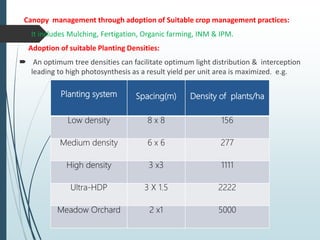
 An optimum tree densities can facilitate optimum light distribution & interception
leading to high photosynthesis as a result yield per unit area is maximized. e.g.
Planting system Spacing(m) Density of plants/ha
Low density 8 x 8 156
Medium density 6 x 6 277
High density 3 x3 1111
Ultra-HDP 3 X 1.5 2222
Meadow Orchard 2 x1 5000
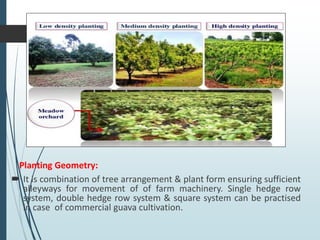
Planting Geometry:
 It is combination of tree arrangement & plant form ensuring sufficient
alleyways for movement of of farm machinery. Single hedge row
system, double hedge row system & square system can be practised
in case of commercial guava cultivation.
Mechanization:
 It include imp. farm operations that can be automated .i.e., irrigation &
fertigation which is a key factor for the success of HDP Orchards.
 Plants should not be kept under stress after pruning therefore, assured pruning
irrigation coupled with fertigation is essential after pruning & during fruit
development in high density orchards.
Irrigation:
 Newly planted plants should be watered at the time of planting, & every 2nd day
during the 1st week & afterwards once or twice a week during the initial
months.
 During long dry periods, newly planted young plants (1st yr) should be watered
twice a week. Once the rainy season sets in, irrigation is done as per the
requirement.
 For the of 2 years or above, irrigation becomes beneficial for growth and fruiting
during prolonged dry periods. Irrigation is required at intervals of 7-10 days in
summers and at 25 days in winters.
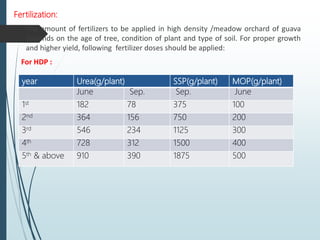
Fertilization:
 The amount of fertilizers to be applied in high density /meadow orchard of guava
depends on the age of tree, condition of plant and type of soil. For proper growth
and higher yield, following fertilizer doses should be applied:
For HDP :
year Urea(g/plant) SSP(g/plant) MOP(g/plant)
June Sep. Sep. June
1st 182 78 375 100
2nd 364 156 750 200
3rd 546 234 1125 300
4th 728 312 1500 400
5th & above 910 390 1875 500
Rejuvenation of old & senile guava orchard:
 Orchards lose their productivity beyond 25 years due to biotic stresses.
 CISH technology on rejuvenation involves heading back of trees to a level of
1.0-1.5 m from ground level.
 Emerging shoots are allowed to grow (40-50 cm) for 4-5 months after
heading back.
 Shoots are further pruned to 50 per cent of their length to allow emergence
of multiple shoots , these shoots offer fruit bearing surface in the following
season. Healthy and productive canopy develops.
 Profuse fruiting and yield increases to about 70-90 per cent over non-
rejuvenated trees is observed in the very first year of operation.
 Additional income from pruned wood and intercropping with short duration
vegetables and ornamental crops are the other advantage.
 Yield, fruit size and quality also increases due to better light penetration.
REFERENCES:
 South Asian J. Food Technol. Environ., 2(3&4): 458-464 (2016) ISSN 2394-
5168(Print), 2454- 6445(online) Response of pruning in canopy
management & high density planting in guava orchard under western
Uttar Pradesh condition Virendra Pal, Naveen Chandra, Anant Kumar and
Mukesh Kumar.
 High Density & Meadow orchard planting system in fruit crops. HD
Choudhury.
 Guava ( S.K. Mitra & D. Sanyal)- ICAR publication
 High Density and Meadow Orcharding of Guava –Gorakh Singh
Canopy managemnt in guava

Canopy managemnt in guava

  • 1.
    CANOPY MANAGEMENT INGUAVA SUSHRITA NAYAK OUAT
  • 2.
    INTRODUCTION  Guava (Psidium guajava) belonged to the family of Myrtaceae. It is also called as “poor man’s fruit” or “apple of the tropics” & is a popular fruit tree of the tropical and subtropical climate.  It is one of the most exquisite and nutritionally valuable remunerative crop. It is used for both table and processing purpose.  It is native to tropical America & has been introduced to India in early 17th century by portugese & gradually became the crop of commercial significance.  It is claimed to be the 4th most imp. tropical fruit crops of India, after mango, banana & citrus .  It excels most other fruit trees in productivity, adaptability & is a cheap source of vit- C & pectin. It rank 3rd in vitamin-C content (260 mg/100g) after barbadose cherry & aonla.  It occupies an area of 262 hectare with an annual production of 24.8 lakh MT.  Major guava producing states in India are MH, Bihar, UP, AP, MP, Gujarat, Odisha, Punjab, Karnataka and TN. MH is the leading producer both in area and production > Bihar > UP. But its productivity is highest in KTK >Punjab>Bengal >Gujarat.
  • 3.
    Plant description:  Itis a large dicotyledonous shrub /small evergreen hardy tree, with lt. to reddish brown, smooth, continuously flaking bark ; root system is superficial with some deep roots but no distinct taproot. Flowering and Fruiting:  In general, Guava tree flowers twice a year, i.e., in April-May & Aug- Sep of which fruits ripen in rainy & winter season respectively. Sometimes, a 3rd flowering, aoccurs in Oct- Nov, particularly in MH & TN.  Flowers occur either singly or in cymose of current season growth on the leaf axils. The blooming period varies from 25 to 45 days depending upon the cultivar, season and the region.  Exogenous application of some chemicals can regulate flowering in guava. For e.g.,  ethrel (1ml/lt) produces maximum no. flowers & fruits.  Urea (25%) & ethrel (2000 ppm) increase flower production.(Chandra & Govind 1994).  Early & maximum no. of flowers were recorded by spraying CCC (500 PPM) . Fruit set:  The initial fruit set is quite high i.e., approx. 80 % of the flowers became fruits. During severe fruit drops only 34 to 56 % of the fruits reached maturity. Which can be prevented by Spraying Of GA3 at 15-30 ppm (Rajput et al, 1997). Fruit formation could be noticed after 12 days from flowering.
  • 4.
    Crop regulation:  Heaviestflowering has always been obtained in summer season & rainy season flowering for winter crop is very less( Rathor 1975). It is also poor in quality & is affected by many insect pest. The winter season fruits (ripens late- Oct to late Jan) are superior in quality & fetch more price. It can be regulated by following ways:  Thinning of flowers is done during March-April which increases the of winter season crop.(Kumar & Hoda 1977)  Withholding irrigation during March-April results in flowers drop & thereby produce more yield in winter season.  Root exposure & root pruning are done during March- April to suppress rainy season crop so as to get a good winter crop.  Use of GR like NAA,PBZ,2,4-D,Ethephon,KI,urea to regulate crop. Adoption of modern and hi-tech methods  The traditional system of cultivation often posed problems in attaining desired productivity due to large tree canopy. Hence, certain imp. strategies like modern, innovative and hi-tech methods (HDP, ultra-HDP, meadow orchard) are adopted etc.
  • 5.
    High density planting& Meadow Orcharding in Guava  High density planting technique is a modern method of fruit cultivation involving of planting of fruit trees densely.  Meadow orchard system is a new concept of planting which has been developed in Guava for the 1st time in India at CISH, Lucknow. It is fruit cultivation using small / dwarf tree with modified canopy. Basically, the availability of a dwarf plant is the 1st & foremost pre-requisite for establishing any high density or meadow orchard.  This system facilitates better light distribution within tree canopy which increases the number of well illuminated leaves, promotes rate of photosynthesis that leads to high yield per unit area.  Fertilizer dose, spacings, growth regulation by training & pruning, use of mechanical devises etc. may also be tried either singly or coupled with other crop management practices for successful adoption of this concepts.
  • 6.
    Spacings (m) AtDifferent Planting Systems In Guava Comparison between traditional and meadow orchard systems of guava Traditional method HDP Meadow orchard 6-6 X 8-8 3-3 X 3-1.5 2X2-2X1 Sl. No. Attributes Traditional system HDP/Meadow system 1. Trees No. Few large trees/ha (150-200 trees /ha) Many small trees /ha (500-1,00,000 trees /ha) 2. Bearing After 2 yrs. From first year 3. Production Avg. yield is 12-20 t/ ha Avg. yield is 40-60t/ ha
  • 7.
    Sl. No. AttributesTraditional system HDP/Meadow system 4. Management Difficult to manage due to large tree size Easy to manage due to small tree size 5. Labor requirement More Less 6. Production cost High Low 7. Harvesting Difficult Easy 8. Quality Large canopy, poor sunlight penetration and poor quality fruits. Small canopy, better air and sunlight penetration, minimum disease incidence and high quality fruits with good colour development
  • 8.
    Merit of HDP/Meadow: Best utilization of land & resources.  High yield per unit area with quality fruits.  Facilitate better utilization of solar radiation & photosynthetic efficiency of plant.  It is amenable to modern inputs application techniques, such as drip irrigation, fertigation & mechanization etc.  Early economic returns. Demerit of HDP/Meadow:  Initially become little costly than conventional sytem  Economic life span of the orchard becomes lower.  Chance in reduction in fruit size & wt.  Intercultural operation becomes difficult.  Maintainance of plant architecture becomes tedious job. Components Of HDP & Meadow: 1.D warf scion varieties 2. Dwarf rootstock varieties 3.Training & pruning 4.Suitable crop management practices 5.Use of bioregulators 6.Planting density 7.Planting geometry 8. Mechanization
  • 9.
    Canopy management throughdwarfing rootsock :  Root stocks and dwarfing cultivars can play a great role in high density planting and canopy management. Unfortunately little work has been done in this direction.  (Sharma et al., 1992) evaluated different dwarfing rootstocks at IARI New Delhi and found that Psidium pumilum has some dwarfing effect with Allahabad safeda but had max. no. of seeds, high TSS and total sugars.  Plant ht, plant spread and canopy volume was significantly reduced when Allahabad safeda guava was grafted on aneuploid no. 82 guava. ( Sharma et al, (1992)  Others are Pusa srijan, Psidium friedrichsthalianum. Canopy management through training & pruning : Untrained or Unpruned guava trees become huge and unmanageable after a couple of years of growth. The bearing area is reduced and the interior of the plant becomes entirely devoid of fruiting. There fore training & pruning is essential. Training  Guava tree can be trained into large, low-hanging bush to permit hand harvesting or into small tree with single trunk to permit mechanical harvesting.  The primary objective is to develop single trunk tree with well-spaced scaffold branches to form a strong framework & bear a heavy crop without damaging the branches.
  • 10.
     Both opencentre & modified leader system can be practiced for guava plantation Open centre system Modified leader system Pruning  Guava fruit bears on current season’s growth and respond very well to pruning. The production season of Guava can be controlled by the time of pruning. If pruning is done later in the season, fruit will also be harvested later. Tree pruning is an annual practice on Guava farms in India and is carried out to:  Manage plant canopy for better plant architecture.  Direct/ control plant growth.  Encourage flower and fruit production to maximize production of high quality fruit per unit area.
  • 11.
     To utilizethe bearing area of the tree efficiently and obtain the desired leaf : fruit ratio.  Optimize sunlight utilization and air movement in the tree.( As dense canopies results in inadequate air movement promote fungal and insect pests within the tree.)  Effect rejuvenation by removing dead or excessive wood or shoots.  Allow spraying and cultural practices to be applied more effectively.  Extent the production period. Pruning usually involves there basic techniques like: Thinning: removal of entire branches at the point of origin. The plant is reduced without altering its size or form. Heading back :pruning to shorten Pinching : removal of the growth tip of the branches. It induce production of stem. It stimulate growth of side branches. flowers fruit & limit tree size. Thinning cut Heading cut
  • 12.
    Training and pruningbegins at an early stage of plant growth to develop single trunk trees with well spaced scaffold branches to from the strong frame work. Steps:  Trees are topped to a uniform ht of 60-75 cm from the ground level after 1-2 months after planting. As a result, new shoots emerge below the cut points.  About 3 to 4 equally spaced shoots are retained around the stem to form the main scaffold limbs of the tree. These shoots are allowed to grow for 4-5 months after topping until they attain a length of about 40-50 cm.  The selected shoots are further pruned to 50 % of their total length for inducing multiple shoots form the buds below the cut ends.  Newly emerged shoots are allowed to grow upto 40-50cm & pruned once again for emergence of new shoots. This is mainly done to get desired shape.  The pruning operation continues upto 2nd yr.  After 2 years, the short branches within the canopy produce a compact and strong structure.  Shoot pruning is done in Jan-Feb for rainy season fruiting & in May- June for winter season fruiting.
  • 13.
    Canopy management throughGrowth retardant: Objective:  Prolonging dormancy.  Reducing vegetative growth  Thinning of flowers  Reducing fruit drop In the absence of dwarfing rootstocks , techniques that restrict vegetative growth and promote reproductive growth are imp in orchard management. Therefore, apart from pruning and training of roots and shoots, certain growth retaradants (alone or in combination) may be exploited. o Paclobutrazol and Ethephon may be very useful in HDP, as Paclobutrazol make the plants dwarf by a retarding vegetative growth of the tree while increasing the number of flower buds.  Ethephon acts as a ripening hormone and enhances the ripening process besides having a growth retarding effect.  Paclobutrazol @ 500 ppm improved fruit set in winter season crop of guava (Singh and Bal, 2006).  80-100 ppm NAA was very effective in thinning of flowers in Allahabad Safeda under Delhi condition.(Rathore 1975).  Kumar & Hoda (1997) suggested application of 2,4-D @ 30ppm were effective for deblossoming of summer flowers.
  • 14.
    Canopy management throughadoption of Suitable crop management practices:  It includes Mulching, Fertigation, Organic farming, INM & IPM. Adoption of suitable Planting Densities:  An optimum tree densities can facilitate optimum light distribution & interception leading to high photosynthesis as a result yield per unit area is maximized. e.g. Planting system Spacing(m) Density of plants/ha Low density 8 x 8 156 Medium density 6 x 6 277 High density 3 x3 1111 Ultra-HDP 3 X 1.5 2222 Meadow Orchard 2 x1 5000
  • 15.
    Planting Geometry:  Itis combination of tree arrangement & plant form ensuring sufficient alleyways for movement of of farm machinery. Single hedge row system, double hedge row system & square system can be practised in case of commercial guava cultivation.
  • 16.
    Mechanization:  It includeimp. farm operations that can be automated .i.e., irrigation & fertigation which is a key factor for the success of HDP Orchards.  Plants should not be kept under stress after pruning therefore, assured pruning irrigation coupled with fertigation is essential after pruning & during fruit development in high density orchards. Irrigation:  Newly planted plants should be watered at the time of planting, & every 2nd day during the 1st week & afterwards once or twice a week during the initial months.  During long dry periods, newly planted young plants (1st yr) should be watered twice a week. Once the rainy season sets in, irrigation is done as per the requirement.  For the of 2 years or above, irrigation becomes beneficial for growth and fruiting during prolonged dry periods. Irrigation is required at intervals of 7-10 days in summers and at 25 days in winters.
  • 17.
    Fertilization:  The amountof fertilizers to be applied in high density /meadow orchard of guava depends on the age of tree, condition of plant and type of soil. For proper growth and higher yield, following fertilizer doses should be applied: For HDP : year Urea(g/plant) SSP(g/plant) MOP(g/plant) June Sep. Sep. June 1st 182 78 375 100 2nd 364 156 750 200 3rd 546 234 1125 300 4th 728 312 1500 400 5th & above 910 390 1875 500
  • 18.
    Rejuvenation of old& senile guava orchard:  Orchards lose their productivity beyond 25 years due to biotic stresses.  CISH technology on rejuvenation involves heading back of trees to a level of 1.0-1.5 m from ground level.  Emerging shoots are allowed to grow (40-50 cm) for 4-5 months after heading back.  Shoots are further pruned to 50 per cent of their length to allow emergence of multiple shoots , these shoots offer fruit bearing surface in the following season. Healthy and productive canopy develops.  Profuse fruiting and yield increases to about 70-90 per cent over non- rejuvenated trees is observed in the very first year of operation.  Additional income from pruned wood and intercropping with short duration vegetables and ornamental crops are the other advantage.  Yield, fruit size and quality also increases due to better light penetration.
  • 19.
    REFERENCES:  South AsianJ. Food Technol. Environ., 2(3&4): 458-464 (2016) ISSN 2394- 5168(Print), 2454- 6445(online) Response of pruning in canopy management & high density planting in guava orchard under western Uttar Pradesh condition Virendra Pal, Naveen Chandra, Anant Kumar and Mukesh Kumar.  High Density & Meadow orchard planting system in fruit crops. HD Choudhury.  Guava ( S.K. Mitra & D. Sanyal)- ICAR publication  High Density and Meadow Orcharding of Guava –Gorakh Singh