


2
INTRODUCTION
 Guava is an important fruit crop in tropical and subtropical
regions of the country due to the hardy nature of its tree and
prolific bearing even in marginal lands.
 Its cultivation requires little care and inputs. But, of late, this
crop has exhibited a paradigm shift in the production system,
from subsistence farming to commercial production.
3
4
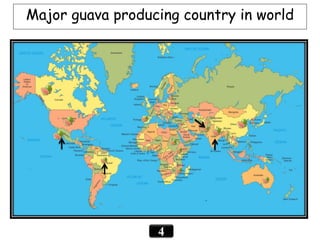
Major guava producing country in world
5
Major guava growing states in India
6
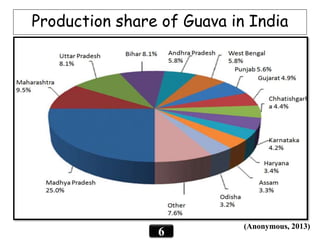
Production share of Guava in India
(Anonymous, 2013)
Country wise share of export of guava
from India
7 (Anonymous, 2013)
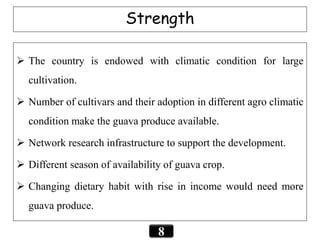
Strength
 The country is endowed with climatic condition for large
cultivation.
 Number of cultivars and their adoption in different agro climatic
condition make the guava produce available.
 Network research infrastructure to support the development.
 Different season of availability of guava crop.
 Changing dietary habit with rise in income would need more
guava produce.
8
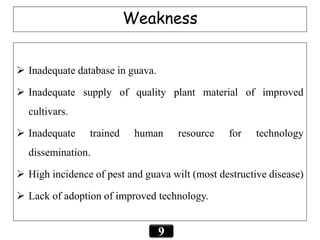
Weakness
9
 Inadequate database in guava.
 Inadequate supply of quality plant material of improved
cultivars.
 Inadequate trained human resource for technology
dissemination.
 High incidence of pest and guava wilt (most destructive disease)
 Lack of adoption of improved technology.
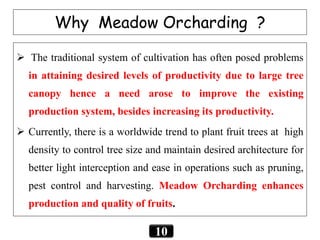
Why Meadow Orcharding ?
 The traditional system of cultivation has often posed problems
in attaining desired levels of productivity due to large tree
canopy hence a need arose to improve the existing
production system, besides increasing its productivity.
 Currently, there is a worldwide trend to plant fruit trees at high
density to control tree size and maintain desired architecture for
better light interception and ease in operations such as pruning,
pest control and harvesting. Meadow Orcharding enhances
production and quality of fruits.
10
Non intensive, age old planting system, trees planted at wide
spacing, accommodating about 100-250 plants/ha.
Less input and care intensive, holds popularity among
growers.
Output from orchard during early 5-10 years is less.
Pruning done at minimal level, orchard raised so as to
favour maximum development of trees.
.
Trees acquire commercial production potential after 7-10
year of planting.
1) Low density planting:
Different types of planting
11
Highly minimized distance covering 250-500 plants/ha.
Lead in output reliable growers to produce amenable fruit
crops like pomegranate, citrus, guava, papaya, banana, etc.
Proper pruning undertaken to manage tree in desirable shape.
More care intensive, labour requirement is more, obtained
yield is also more.
2) Medium density planting
Different types of planting
12
Very condensing planting with 500-5000 plants/ha.
Required heavy pruning. Yield as well as expenses per unit
area is high.
Ultra-high density:– 2,000-5,000 plants/ha.
Medium high density:– 500-1,000 plants/ha.
Optimum high density:– 1,000-2,000 plants/ha.
3) High density planting
Different types of planting
13
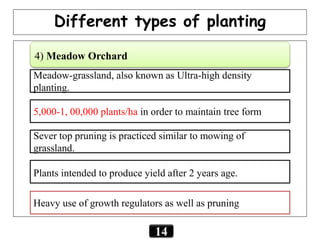
Meadow-grassland, also known as Ultra-high density
planting.
Heavy use of growth regulators as well as pruning
Plants intended to produce yield after 2 years age.
5,000-1, 00,000 plants/ha in order to maintain tree form
Sever top pruning is practiced similar to mowing of
grassland.
4) Meadow Orchard
Different types of planting
14
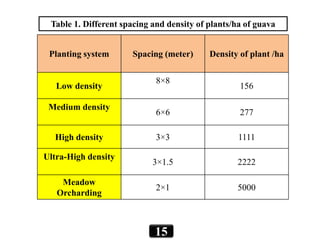
Planting system Spacing (meter) Density of plant /ha
Low density
8×8
156
Medium density
6×6 277
High density 3×3 1111
Ultra-High density
3×1.5 2222
Meadow
Orcharding
2×1 5000
Table 1. Different spacing and density of plants/ha of guava
15
16CISH, Lucknow
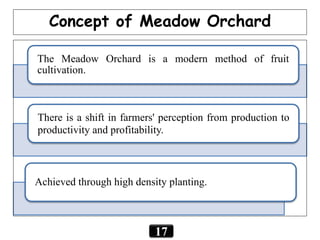
The Meadow Orchard is a modern method of fruit
cultivation.
There is a shift in farmers' perception from production to
productivity and profitability.
Achieved through high density planting.
Concept of Meadow Orchard
17
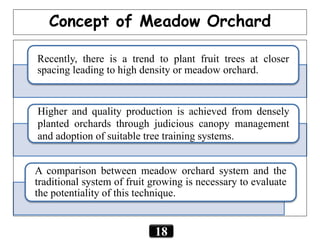
Recently, there is a trend to plant fruit trees at closer
spacing leading to high density or meadow orchard.
Higher and quality production is achieved from densely
planted orchards through judicious canopy management
and adoption of suitable tree training systems.
A comparison between meadow orchard system and the
traditional system of fruit growing is necessary to evaluate
the potentiality of this technique.
Concept of Meadow Orchard
18
Attributes Traditional system Meadow system
Bearing After two years From first year
Production
Average yield is 12-20 t
ha-1 Average yield is 40-60 t ha-1
Management
Difficult to manage due to
large tree size
Easy to manage due to small tree
size
Labour
requirement
Requires more labour Requires less labour
Production cost
Higher cost of production Lower cost of production
Quality
Large canopy, poor
sunlight penetration and
poor quality fruits
Small canopy better air and
sunlight penetration ,minimum
disease incidence and high
quality fruit with good colour
development.
19
Table 2. Comparison between traditional system and meadow orchard
system of guava
Singh (2010)CISH, Lucknow
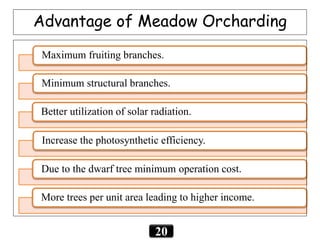
Maximum fruiting branches.
Minimum structural branches.
Better utilization of solar radiation.
Increase the photosynthetic efficiency.
Due to the dwarf tree minimum operation cost.
More trees per unit area leading to higher income.
Advantage of Meadow Orcharding
20
Component for meadow orchard system
21 Singh (2013)CISH, Lucknow
 Dwarf
 Suitable to
market
 Varieties
 Root stock
 Plant utilize
maximum
light
 Suitable to
guava
 well fertile
 Near to
source
 Water
 INM
 IPM
 True to type
 Healthy
 Free from
disease &
pest
 Plant
trained for
making
dwarf
canopy
22
Establishing Meadow Orchard
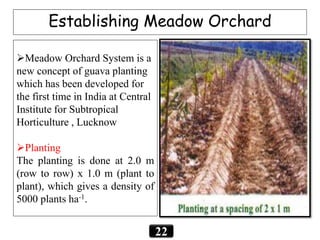
Meadow Orchard System is a
new concept of guava planting
which has been developed for
the first time in India at Central
Institute for Subtropical
Horticulture , Lucknow
Planting
The planting is done at 2.0 m
(row to row) x 1.0 m (plant to
plant), which gives a density of
5000 plants ha-1.
23
First pruning
 The tree are pruned and trained three time in a year to allow
maximum production of quality fruit during the first year.
 A single trunk tree with no interfering branches up to 30-40 cm
from the ground level is desirable to make dwarf tree architecture
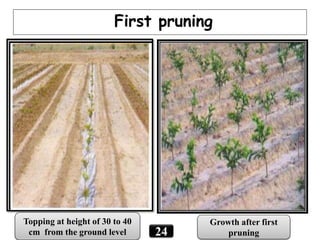
 After a period of 1-2 month of planting all the tree are topped at a
uniform height of 30-40 cm from the ground level initiation of
new growth below the cut and no side shoot or branch should
remain after topping.
 This is done to make a single trunk straight up to 40 cm height.
24
First pruning
Growth after first
pruning
Topping at height of 30 to 40
cm from the ground level
25
Second pruning
 After 15-20 days of topping new shoot emerge. In general, 3-4
shoot are retained from below the cut point after topping .
 As shoot mature generally after a period of 3-4 month, they are
reduced by 50 percent of their total length so that new shoot
emerge below the cut Point.
 This is done to attain the desirable tree canopy architecture and
strong frame work.
26
Second pruning
CISH, Lucknow
27
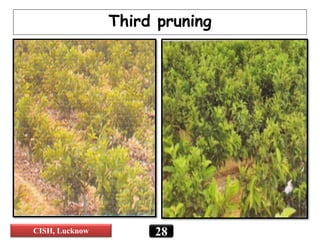
Third pruning
 The emerged shoot are allow to grow for 3-4 month before they
are again pruned by 50 per cent. After pruning, new shoot emerge
on which flowering take place.
It is emphasized that shoot pruning is done thrice a year. This
leads to desired canopy development. Though fruiting starts in the
same year.
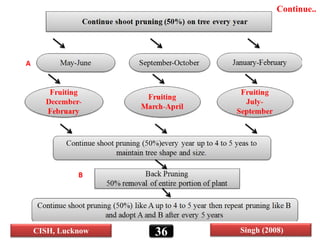
Pruning is continued so that plants remain dwarf. After a year,
pruning operation is done especially in May-June, September-
October and January-February.
28
Third pruning
CISH, Lucknow
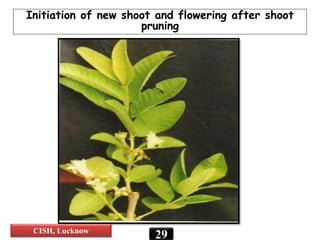
Initiation of new shoot and flowering after shoot
pruning
29CISH, Lucknow
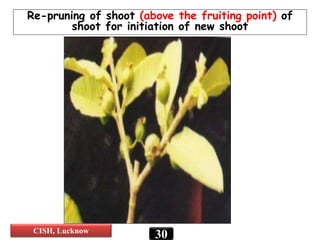
Re-pruning of shoot (above the fruiting point) of
shoot for initiation of new shoot
30CISH, Lucknow
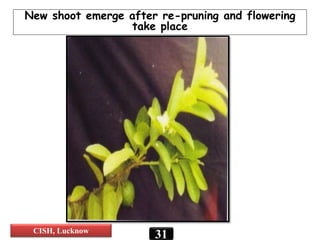
New shoot emerge after re-pruning and flowering
take place
31CISH, Lucknow
Pruned tree is heavily Fruiting
32CISH, Lucknow
33
Overview of meadow orchard
CISH, Lucknow
34
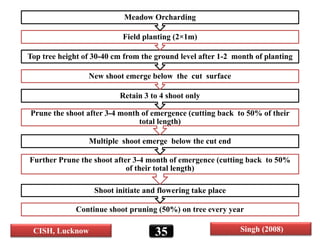
Continue shoot pruning (50%) on tree every year
Shoot initiate and flowering take place
Further Prune the shoot after 3-4 month of emergence (cutting back to 50%
of their total length)
Multiple shoot emerge below the cut end
Prune the shoot after 3-4 month of emergence (cutting back to 50% of their
total length)
Retain 3 to 4 shoot only
New shoot emerge below the cut surface
Top tree height of 30-40 cm from the ground level after 1-2 month of planting
Field planting (2×1m)
Meadow Orcharding
35 Singh (2008)CISH, Lucknow
36 Singh (2008)CISH, Lucknow
Continue..
37
Back pruning 50 per cent
removal of entire plantCISH, Lucknow
38
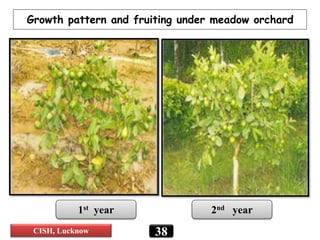
Growth pattern and fruiting under meadow orchard
1st year 2nd year
CISH, Lucknow
39
Growth pattern and fruiting under meadow orchard
3rd year 4th year
CISH, Lucknow
40
41
Varieties
No of new
shoot
Flowering
(%)
Fruit set
(%)
Yield
(kg/plant)
Sardar 18.5 86.4 54.3 7.23
Sweta 17.0 44.0 49.1 8.14
CISH-G-5 15.0 51.4 49.7 8.39
CISH-G-6 14.4 57.8 51.0 7.11
Lalit 13.6 72.4 48.7 8.51
Allahabad Safeda 13.4 64.4 48.4 7.16
Hybrid seedling 10.6 37.6 54.4 4.20
CD(0.05) 2.33 3.10 3.14 1.3
42
Table 3. Influence of topping hedging on no of new shoot, flowering, fruit set
and yield of different varieties of guava under meadow orchard.
Singh (2011)CISH, Lucknow
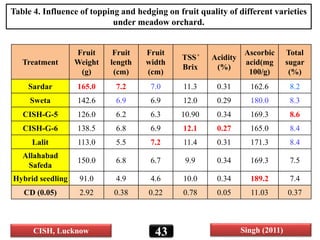
Treatment
Fruit
Weight
(g)
Fruit
length
(cm)
Fruit
width
(cm)
TSS ̊
Brix
Acidity
(%)
Ascorbic
acid(mg
100/g)
Total
sugar
(%)
Sardar 165.0 7.2 7.0 11.3 0.31 162.6 8.2
Sweta 142.6 6.9 6.9 12.0 0.29 180.0 8.3
CISH-G-5 126.0 6.2 6.3 10.90 0.34 169.3 8.6
CISH-G-6 138.5 6.8 6.9 12.1 0.27 165.0 8.4
Lalit 113.0 5.5 7.2 11.4 0.31 171.3 8.4
Allahabad
Safeda
150.0 6.8 6.7 9.9 0.34 169.3 7.5
Hybrid seedling 91.0 4.9 4.6 10.0 0.34 189.2 7.4
CD (0.05) 2.92 0.38 0.22 0.78 0.05 11.03 0.37
43
Table 4. Influence of topping and hedging on fruit quality of different varieties
under meadow orchard.
Singh (2011)CISH, Lucknow
44CISH, Lucknow
45
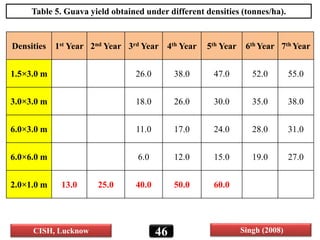
Densities 1st Year 2nd Year 3rd Year 4th Year 5th Year 6th Year 7th Year
1.5×3.0 m 26.0 38.0 47.0 52.0 55.0
3.0×3.0 m 18.0 26.0 30.0 35.0 38.0
6.0×3.0 m 11.0 17.0 24.0 28.0 31.0
6.0×6.0 m 6.0 12.0 15.0 19.0 27.0
2.0×1.0 m 13.0 25.0 40.0 50.0 60.0
46 Singh (2008)
Table 5. Guava yield obtained under different densities (tonnes/ha).
CISH, Lucknow
47
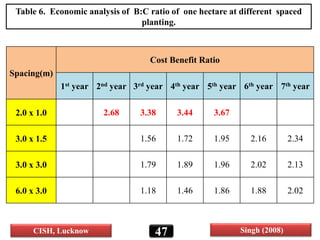
Spacing(m)
Cost Benefit Ratio
1st year 2nd year 3rd year 4th year 5th year 6th year 7th year
2.0 x 1.0 2.68 3.38 3.44 3.67
3.0 x 1.5 1.56 1.72 1.95 2.16 2.34
3.0 x 3.0 1.79 1.89 1.96 2.02 2.13
6.0 x 3.0 1.18 1.46 1.86 1.88 2.02
CISH, Lucknow Singh (2008)
Table 6. Economic analysis of B:C ratio of one hectare at different spaced
planting.
47
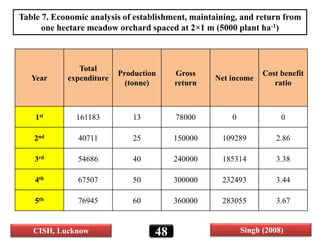
Year
Total
expenditure
Production
(tonne)
Gross
return
Net income
Cost benefit
ratio
1st 161183 13 78000 0 0
2nd 40711 25 150000 109289 2.86
3rd 54686 40 240000 185314 3.38
4th 67507 50 300000 232493 3.44
5th 76945 60 360000 283055 3.67
Table 7. Economic analysis of establishment, maintaining, and return from
one hectare meadow orchard spaced at 2×1 m (5000 plant ha-1)
CISH, Lucknow Singh (2008)48
49
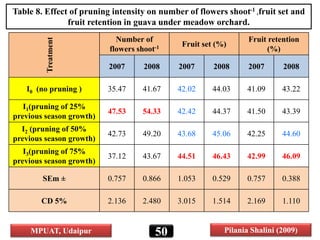
Treatment
Number of
flowers shoot-1 Fruit set (%)
Fruit retention
(%)
2007 2008 2007 2008 2007 2008
I0 (no pruning ) 35.47 41.67 42.02 44.03 41.09 43.22
I1(pruning of 25%
previous season growth)
47.53 54.33 42.42 44.37 41.50 43.39
I2 (pruning of 50%
previous season growth)
42.73 49.20 43.68 45.06 42.25 44.60
I3(pruning of 75%
previous season growth)
37.12 43.67 44.51 46.43 42.99 46.09
SEm ± 0.757 0.866 1.053 0.529 0.757 0.388
CD 5% 2.136 2.480 3.015 1.514 2.169 1.110
Table 8. Effect of pruning intensity on number of flowers shoot-1 ,fruit set and
fruit retention in guava under meadow orchard.
50MPUAT, Udaipur Pilania Shalini (2009)
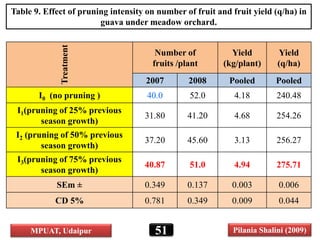
Table 9. Effect of pruning intensity on number of fruit and fruit yield (q/ha) in
guava under meadow orchard.
Treatment
Number of
fruits /plant
Yield
(kg/plant)
Yield
(q/ha)
2007 2008 Pooled Pooled
I0 (no pruning ) 40.0 52.0 4.18 240.48
I1(pruning of 25% previous
season growth)
31.80 41.20 4.68 254.26
I2 (pruning of 50% previous
season growth)
37.20 45.60 3.13 256.27
I3(pruning of 75% previous
season growth)
40.87 51.0 4.94 275.71
SEm ± 0.349 0.137 0.003 0.006
CD 5% 0.781 0.349 0.009 0.044
51MPUAT, Udaipur Pilania Shalini (2009)
Treatment
Fruit
diameter
(polar)
(cm)
Average
fruit
weight
(g)
Ascorbic
acid (mg
100 g-1
pulp)
Total sugar (%)
Pooled Pooled Pooled 2007 2008
I0 (no pruning ) 4.45 101.36 214.83 10.68 14.827
I1(pruning of 25% previous
season growth)
4.57 106.15 218.01 10.78 14.95
I2 (pruning of 50% previous
season growth)
4.86 121.83 222.20 11.27 15.63
I3(pruning of 75% previous
season growth)
4.93 127.79 227.48 11.03 15.30
SEm ± 0.010 0.746 0.769 0.0124 0.0172
CD 5% 0.029 2.120 2.166 0.036 0.049
Table 10. Effect of pruning intensity on fruit diameter, average fruit weight,
ascorbic acid and total sugar in guava under meadow orchard.
52MPUAT, Udaipur Pilania Shalini (2009)
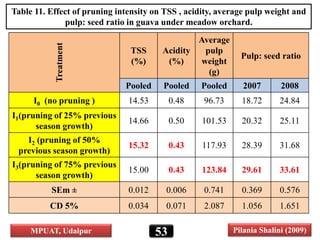
Table 11. Effect of pruning intensity on TSS , acidity, average pulp weight and
pulp: seed ratio in guava under meadow orchard.
Treatment
TSS
(%)
Acidity
(%)
Average
pulp
weight
(g)
Pulp: seed ratio
Pooled Pooled Pooled 2007 2008
I0 (no pruning ) 14.53 0.48 96.73 18.72 24.84
I1(pruning of 25% previous
season growth)
14.66 0.50 101.53 20.32 25.11
I2 (pruning of 50%
previous season growth)
15.32 0.43 117.93 28.39 31.68
I3(pruning of 75% previous
season growth)
15.00 0.43 123.84 29.61 33.61
SEm ± 0.012 0.006 0.741 0.369 0.576
CD 5% 0.034 0.071 2.087 1.056 1.651
53MPUAT, Udaipur Pilania Shalini (2009)
54
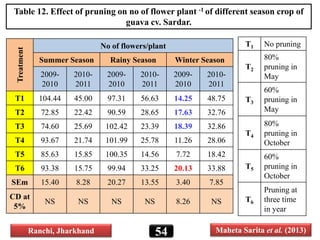
Treatment
No of flowers/plant
Summer Season Rainy Season Winter Season
2009-
2010
2010-
2011
2009-
2010
2010-
2011
2009-
2010
2010-
2011
T1 104.44 45.00 97.31 56.63 14.25 48.75
T2 72.85 22.42 90.59 28.65 17.63 32.76
T3 74.60 25.69 102.42 23.39 18.39 32.86
T4 93.67 21.74 101.99 25.78 11.26 28.06
T5 85.63 15.85 100.35 14.56 7.72 18.42
T6 93.38 15.75 99.94 33.25 20.13 33.88
SEm 15.40 8.28 20.27 13.55 3.40 7.85
CD at
5%
NS NS NS NS 8.26 NS
Ranchi, Jharkhand Maheta Sarita et al. (2013)
Table 12. Effect of pruning on no of flower plant -1 of different season crop of
guava cv. Sardar.
T1 No pruning
T2
80%
pruning in
May
T3
60%
pruning in
May
T4
80%
pruning in
October
T5
60%
pruning in
October
T6
Pruning at
three time
in year
54
Treatment
Yield (t/ha)
Summer
Season
Rainy
Season
Winter
Season
Total yield
2009-
2010
2010-
2011
2009-
2010
2010-
2011
2009-
2010
2010-
2011
2009-
2010
2010-
2011
T1 1.76 2.92 13.58 3.29 6.92 20.06 25.76 28.26
T2 1.56 5.01 12.71 2.91 10.12 22.56 24.39 30.48
T3 1.34 4.09 9.21 3.07 10.29 20.58 20.83 27.73
T4 1.69 5.60 17.56 4.61 6.48 12.11 25.73 22.32
T5 1.37 3.55 16.86 3.18 5.62 9.25 23.85 15.98
T6 3.73 9.07 16.48 4.92 5.03 23.26 34.88 37.24
SEm 0.61 1.26 1.26 0.90 0.46 1.26 2.53 1.82
CD
at
5%
1.49 3.06 3.95 NS 1.13 3.06 6.14 4.43
Table 13. Effect of pruning on yield of different season crop of
guava cv. Sardar.
T1 No pruning
T2
80% pruning
in May
T3
60% pruning
in May
T4
80% pruning
in October
T5
60% pruning
in October
T6
Pruning at
three time in
year
55Ranchi, Jharkhand Maheta Sarita et al. (2013)
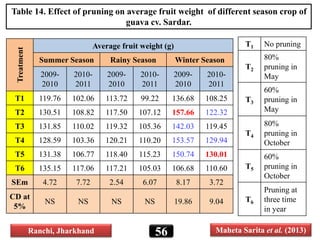
Treatment
Average fruit weight (g)
Summer Season Rainy Season Winter Season
2009-
2010
2010-
2011
2009-
2010
2010-
2011
2009-
2010
2010-
2011
T1 119.76 102.06 113.72 99.22 136.68 108.25
T2 130.51 108.82 117.50 107.12 157.66 122.32
T3 131.85 110.02 119.32 105.36 142.03 119.45
T4 128.59 103.36 120.21 110.20 153.57 129.94
T5 131.38 106.77 118.40 115.23 150.74 130.01
T6 135.15 117.06 117.21 105.03 106.68 110.60
SEm 4.72 7.72 2.54 6.07 8.17 3.72
CD at
5%
NS NS NS NS 19.86 9.04
Table 14. Effect of pruning on average fruit weight of different season crop of
guava cv. Sardar.
T1 No pruning
T2
80%
pruning in
May
T3
60%
pruning in
May
T4
80%
pruning in
October
T5
60%
pruning in
October
T6
Pruning at
three time
in year
56Ranchi, Jharkhand Maheta Sarita et al. (2013)
57
58
Varieties
No of new
shoots
% Flowering
% Fruit
Set
Yield (kg/plant)
Sardar 13.5 90.5 56.3 7.38
Sweta 18.4 50.3 54.2 8.46
CISH-G-5 16.3 52.0 49.1 8.53
CISH-G-6 14.4 57.8 51.0 7.34
Lalit 11.7 73.0 50.4 8.60
Allahabad Safeda 13.6 73.2 44.4 7.66
Hybrid seedling 12.5 46.4 54.3 6.14
CD(0.05) 2.33 3.10 3.14 1.3
58
Table 15. Influence of topping, hedging with black plastic mulch on flowering
and yield of different varieties of guava under meadow orchard.
Singh (2011)CISH, Lucknow
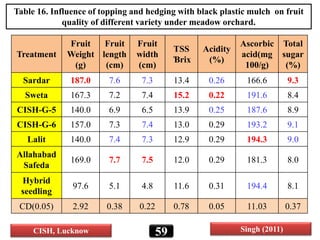
Treatment
Fruit
Weight
(g)
Fruit
length
(cm)
Fruit
width
(cm)
TSS
̊Brix
Acidity
(%)
Ascorbic
acid(mg
100/g)
Total
sugar
(%)
Sardar 187.0 7.6 7.3 13.4 0.26 166.6 9.3
Sweta 167.3 7.2 7.4 15.2 0.22 191.6 8.4
CISH-G-5 140.0 6.9 6.5 13.9 0.25 187.6 8.9
CISH-G-6 157.0 7.3 7.4 13.0 0.29 193.2 9.1
Lalit 140.0 7.4 7.3 12.9 0.29 194.3 9.0
Allahabad
Safeda
169.0 7.7 7.5 12.0 0.29 181.3 8.0
Hybrid
seedling
97.6 5.1 4.8 11.6 0.31 194.4 8.1
CD(0.05) 2.92 0.38 0.22 0.78 0.05 11.03 0.37
Table 16. Influence of topping and hedging with black plastic mulch on fruit
quality of different variety under meadow orchard.
59 Singh (2011)CISH, Lucknow
Treatment
No. of new
shoot
Flowering
shoot (%)
Fruit set(%) Yield (t/ha)
Black mulch 13.1 78.0 63.0 63.5
Banana leaf
mulch
13.1 77.5 62.7 62.5
Paddy straw 13.5 73.5 63.9 62.0
Grass mulch 13.2 72.6 63.0 62.0
Control
(No-mulch)
12.7 70.6 61.1 60.0
CD (0.05) 2.94 4.09 1.79 2.23
60 Singh (2009)
Table 17. Flowering, fruit set and yield in relation to different mulch under
meadow orchard.
CISH, Lucknow
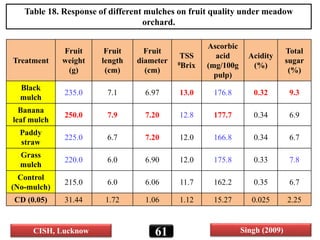
Treatment
Fruit
weight
(g)
Fruit
length
(cm)
Fruit
diameter
(cm)
TSS
0Brix
Ascorbic
acid
(mg/100g
pulp)
Acidity
(%)
Total
sugar
(%)
Black
mulch
235.0 7.1 6.97 13.0 176.8 0.32 9.3
Banana
leaf mulch
250.0 7.9 7.20 12.8 177.7 0.34 6.9
Paddy
straw
225.0 6.7 7.20 12.0 166.8 0.34 6.7
Grass
mulch
220.0 6.0 6.90 12.0 175.8 0.33 7.8
Control
(No-mulch)
215.0 6.0 6.06 11.7 162.2 0.35 6.7
CD (0.05) 31.44 1.72 1.06 1.12 15.27 0.025 2.25
Singh (2009)
Table 18. Response of different mulches on fruit quality under meadow
orchard.
CISH, Lucknow 61
Conclusion
62
 India is the largest producer of guava in the world but the
productivity is very less as compared to developed countries
because of the absence of improved production and protection
technologies.
 Meadow orchard planting system is one of the improved
technologies with use of improved cultivars, cultural practices
like canopy management and mulching leads to revolutionize
the guava industry by enhancing productivity coupled with
reduction of production cost along with best quality fruits.
 Thus, it is clear that farmers should have to adopt this
technology for improving its productivity.
Meadow orchrad in_guava

Meadow orchrad in_guava

  • 2.
  • 3.
    INTRODUCTION  Guava isan important fruit crop in tropical and subtropical regions of the country due to the hardy nature of its tree and prolific bearing even in marginal lands.  Its cultivation requires little care and inputs. But, of late, this crop has exhibited a paradigm shift in the production system, from subsistence farming to commercial production. 3
  • 4.
    4 Major guava producingcountry in world
  • 5.
    5 Major guava growingstates in India
  • 6.
    6 Production share ofGuava in India (Anonymous, 2013)
  • 7.
    Country wise shareof export of guava from India 7 (Anonymous, 2013)
  • 8.
    Strength  The countryis endowed with climatic condition for large cultivation.  Number of cultivars and their adoption in different agro climatic condition make the guava produce available.  Network research infrastructure to support the development.  Different season of availability of guava crop.  Changing dietary habit with rise in income would need more guava produce. 8
  • 9.
    Weakness 9  Inadequate databasein guava.  Inadequate supply of quality plant material of improved cultivars.  Inadequate trained human resource for technology dissemination.  High incidence of pest and guava wilt (most destructive disease)  Lack of adoption of improved technology.
  • 10.
    Why Meadow Orcharding?  The traditional system of cultivation has often posed problems in attaining desired levels of productivity due to large tree canopy hence a need arose to improve the existing production system, besides increasing its productivity.  Currently, there is a worldwide trend to plant fruit trees at high density to control tree size and maintain desired architecture for better light interception and ease in operations such as pruning, pest control and harvesting. Meadow Orcharding enhances production and quality of fruits. 10
  • 11.
    Non intensive, ageold planting system, trees planted at wide spacing, accommodating about 100-250 plants/ha. Less input and care intensive, holds popularity among growers. Output from orchard during early 5-10 years is less. Pruning done at minimal level, orchard raised so as to favour maximum development of trees. . Trees acquire commercial production potential after 7-10 year of planting. 1) Low density planting: Different types of planting 11
  • 12.
    Highly minimized distancecovering 250-500 plants/ha. Lead in output reliable growers to produce amenable fruit crops like pomegranate, citrus, guava, papaya, banana, etc. Proper pruning undertaken to manage tree in desirable shape. More care intensive, labour requirement is more, obtained yield is also more. 2) Medium density planting Different types of planting 12
  • 13.
    Very condensing plantingwith 500-5000 plants/ha. Required heavy pruning. Yield as well as expenses per unit area is high. Ultra-high density:– 2,000-5,000 plants/ha. Medium high density:– 500-1,000 plants/ha. Optimum high density:– 1,000-2,000 plants/ha. 3) High density planting Different types of planting 13
  • 14.
    Meadow-grassland, also knownas Ultra-high density planting. Heavy use of growth regulators as well as pruning Plants intended to produce yield after 2 years age. 5,000-1, 00,000 plants/ha in order to maintain tree form Sever top pruning is practiced similar to mowing of grassland. 4) Meadow Orchard Different types of planting 14
  • 15.
    Planting system Spacing(meter) Density of plant /ha Low density 8×8 156 Medium density 6×6 277 High density 3×3 1111 Ultra-High density 3×1.5 2222 Meadow Orcharding 2×1 5000 Table 1. Different spacing and density of plants/ha of guava 15
  • 16.
  • 17.
    The Meadow Orchardis a modern method of fruit cultivation. There is a shift in farmers' perception from production to productivity and profitability. Achieved through high density planting. Concept of Meadow Orchard 17
  • 18.
    Recently, there isa trend to plant fruit trees at closer spacing leading to high density or meadow orchard. Higher and quality production is achieved from densely planted orchards through judicious canopy management and adoption of suitable tree training systems. A comparison between meadow orchard system and the traditional system of fruit growing is necessary to evaluate the potentiality of this technique. Concept of Meadow Orchard 18
  • 19.
    Attributes Traditional systemMeadow system Bearing After two years From first year Production Average yield is 12-20 t ha-1 Average yield is 40-60 t ha-1 Management Difficult to manage due to large tree size Easy to manage due to small tree size Labour requirement Requires more labour Requires less labour Production cost Higher cost of production Lower cost of production Quality Large canopy, poor sunlight penetration and poor quality fruits Small canopy better air and sunlight penetration ,minimum disease incidence and high quality fruit with good colour development. 19 Table 2. Comparison between traditional system and meadow orchard system of guava Singh (2010)CISH, Lucknow
  • 20.
    Maximum fruiting branches. Minimumstructural branches. Better utilization of solar radiation. Increase the photosynthetic efficiency. Due to the dwarf tree minimum operation cost. More trees per unit area leading to higher income. Advantage of Meadow Orcharding 20
  • 21.
    Component for meadoworchard system 21 Singh (2013)CISH, Lucknow  Dwarf  Suitable to market  Varieties  Root stock  Plant utilize maximum light  Suitable to guava  well fertile  Near to source  Water  INM  IPM  True to type  Healthy  Free from disease & pest  Plant trained for making dwarf canopy
  • 22.
    22 Establishing Meadow Orchard MeadowOrchard System is a new concept of guava planting which has been developed for the first time in India at Central Institute for Subtropical Horticulture , Lucknow Planting The planting is done at 2.0 m (row to row) x 1.0 m (plant to plant), which gives a density of 5000 plants ha-1.
  • 23.
    23 First pruning  Thetree are pruned and trained three time in a year to allow maximum production of quality fruit during the first year.  A single trunk tree with no interfering branches up to 30-40 cm from the ground level is desirable to make dwarf tree architecture  After a period of 1-2 month of planting all the tree are topped at a uniform height of 30-40 cm from the ground level initiation of new growth below the cut and no side shoot or branch should remain after topping.  This is done to make a single trunk straight up to 40 cm height.
  • 24.
    24 First pruning Growth afterfirst pruning Topping at height of 30 to 40 cm from the ground level
  • 25.
    25 Second pruning  After15-20 days of topping new shoot emerge. In general, 3-4 shoot are retained from below the cut point after topping .  As shoot mature generally after a period of 3-4 month, they are reduced by 50 percent of their total length so that new shoot emerge below the cut Point.  This is done to attain the desirable tree canopy architecture and strong frame work.
  • 26.
  • 27.
    27 Third pruning  Theemerged shoot are allow to grow for 3-4 month before they are again pruned by 50 per cent. After pruning, new shoot emerge on which flowering take place. It is emphasized that shoot pruning is done thrice a year. This leads to desired canopy development. Though fruiting starts in the same year. Pruning is continued so that plants remain dwarf. After a year, pruning operation is done especially in May-June, September- October and January-February.
  • 28.
  • 29.
    Initiation of newshoot and flowering after shoot pruning 29CISH, Lucknow
  • 30.
    Re-pruning of shoot(above the fruiting point) of shoot for initiation of new shoot 30CISH, Lucknow
  • 31.
    New shoot emergeafter re-pruning and flowering take place 31CISH, Lucknow
  • 32.
    Pruned tree isheavily Fruiting 32CISH, Lucknow
  • 33.
    33 Overview of meadoworchard CISH, Lucknow
  • 34.
  • 35.
    Continue shoot pruning(50%) on tree every year Shoot initiate and flowering take place Further Prune the shoot after 3-4 month of emergence (cutting back to 50% of their total length) Multiple shoot emerge below the cut end Prune the shoot after 3-4 month of emergence (cutting back to 50% of their total length) Retain 3 to 4 shoot only New shoot emerge below the cut surface Top tree height of 30-40 cm from the ground level after 1-2 month of planting Field planting (2×1m) Meadow Orcharding 35 Singh (2008)CISH, Lucknow
  • 36.
    36 Singh (2008)CISH,Lucknow Continue..
  • 37.
    37 Back pruning 50per cent removal of entire plantCISH, Lucknow
  • 38.
    38 Growth pattern andfruiting under meadow orchard 1st year 2nd year CISH, Lucknow
  • 39.
    39 Growth pattern andfruiting under meadow orchard 3rd year 4th year CISH, Lucknow
  • 40.
  • 41.
  • 42.
    Varieties No of new shoot Flowering (%) Fruitset (%) Yield (kg/plant) Sardar 18.5 86.4 54.3 7.23 Sweta 17.0 44.0 49.1 8.14 CISH-G-5 15.0 51.4 49.7 8.39 CISH-G-6 14.4 57.8 51.0 7.11 Lalit 13.6 72.4 48.7 8.51 Allahabad Safeda 13.4 64.4 48.4 7.16 Hybrid seedling 10.6 37.6 54.4 4.20 CD(0.05) 2.33 3.10 3.14 1.3 42 Table 3. Influence of topping hedging on no of new shoot, flowering, fruit set and yield of different varieties of guava under meadow orchard. Singh (2011)CISH, Lucknow
  • 43.
    Treatment Fruit Weight (g) Fruit length (cm) Fruit width (cm) TSS ̊ Brix Acidity (%) Ascorbic acid(mg 100/g) Total sugar (%) Sardar 165.07.2 7.0 11.3 0.31 162.6 8.2 Sweta 142.6 6.9 6.9 12.0 0.29 180.0 8.3 CISH-G-5 126.0 6.2 6.3 10.90 0.34 169.3 8.6 CISH-G-6 138.5 6.8 6.9 12.1 0.27 165.0 8.4 Lalit 113.0 5.5 7.2 11.4 0.31 171.3 8.4 Allahabad Safeda 150.0 6.8 6.7 9.9 0.34 169.3 7.5 Hybrid seedling 91.0 4.9 4.6 10.0 0.34 189.2 7.4 CD (0.05) 2.92 0.38 0.22 0.78 0.05 11.03 0.37 43 Table 4. Influence of topping and hedging on fruit quality of different varieties under meadow orchard. Singh (2011)CISH, Lucknow
  • 44.
  • 45.
  • 46.
    Densities 1st Year2nd Year 3rd Year 4th Year 5th Year 6th Year 7th Year 1.5×3.0 m 26.0 38.0 47.0 52.0 55.0 3.0×3.0 m 18.0 26.0 30.0 35.0 38.0 6.0×3.0 m 11.0 17.0 24.0 28.0 31.0 6.0×6.0 m 6.0 12.0 15.0 19.0 27.0 2.0×1.0 m 13.0 25.0 40.0 50.0 60.0 46 Singh (2008) Table 5. Guava yield obtained under different densities (tonnes/ha). CISH, Lucknow
  • 47.
    47 Spacing(m) Cost Benefit Ratio 1styear 2nd year 3rd year 4th year 5th year 6th year 7th year 2.0 x 1.0 2.68 3.38 3.44 3.67 3.0 x 1.5 1.56 1.72 1.95 2.16 2.34 3.0 x 3.0 1.79 1.89 1.96 2.02 2.13 6.0 x 3.0 1.18 1.46 1.86 1.88 2.02 CISH, Lucknow Singh (2008) Table 6. Economic analysis of B:C ratio of one hectare at different spaced planting. 47
  • 48.
    Year Total expenditure Production (tonne) Gross return Net income Cost benefit ratio 1st161183 13 78000 0 0 2nd 40711 25 150000 109289 2.86 3rd 54686 40 240000 185314 3.38 4th 67507 50 300000 232493 3.44 5th 76945 60 360000 283055 3.67 Table 7. Economic analysis of establishment, maintaining, and return from one hectare meadow orchard spaced at 2×1 m (5000 plant ha-1) CISH, Lucknow Singh (2008)48
  • 49.
  • 50.
    Treatment Number of flowers shoot-1Fruit set (%) Fruit retention (%) 2007 2008 2007 2008 2007 2008 I0 (no pruning ) 35.47 41.67 42.02 44.03 41.09 43.22 I1(pruning of 25% previous season growth) 47.53 54.33 42.42 44.37 41.50 43.39 I2 (pruning of 50% previous season growth) 42.73 49.20 43.68 45.06 42.25 44.60 I3(pruning of 75% previous season growth) 37.12 43.67 44.51 46.43 42.99 46.09 SEm ± 0.757 0.866 1.053 0.529 0.757 0.388 CD 5% 2.136 2.480 3.015 1.514 2.169 1.110 Table 8. Effect of pruning intensity on number of flowers shoot-1 ,fruit set and fruit retention in guava under meadow orchard. 50MPUAT, Udaipur Pilania Shalini (2009)
  • 51.
    Table 9. Effectof pruning intensity on number of fruit and fruit yield (q/ha) in guava under meadow orchard. Treatment Number of fruits /plant Yield (kg/plant) Yield (q/ha) 2007 2008 Pooled Pooled I0 (no pruning ) 40.0 52.0 4.18 240.48 I1(pruning of 25% previous season growth) 31.80 41.20 4.68 254.26 I2 (pruning of 50% previous season growth) 37.20 45.60 3.13 256.27 I3(pruning of 75% previous season growth) 40.87 51.0 4.94 275.71 SEm ± 0.349 0.137 0.003 0.006 CD 5% 0.781 0.349 0.009 0.044 51MPUAT, Udaipur Pilania Shalini (2009)
  • 52.
    Treatment Fruit diameter (polar) (cm) Average fruit weight (g) Ascorbic acid (mg 100 g-1 pulp) Totalsugar (%) Pooled Pooled Pooled 2007 2008 I0 (no pruning ) 4.45 101.36 214.83 10.68 14.827 I1(pruning of 25% previous season growth) 4.57 106.15 218.01 10.78 14.95 I2 (pruning of 50% previous season growth) 4.86 121.83 222.20 11.27 15.63 I3(pruning of 75% previous season growth) 4.93 127.79 227.48 11.03 15.30 SEm ± 0.010 0.746 0.769 0.0124 0.0172 CD 5% 0.029 2.120 2.166 0.036 0.049 Table 10. Effect of pruning intensity on fruit diameter, average fruit weight, ascorbic acid and total sugar in guava under meadow orchard. 52MPUAT, Udaipur Pilania Shalini (2009)
  • 53.
    Table 11. Effectof pruning intensity on TSS , acidity, average pulp weight and pulp: seed ratio in guava under meadow orchard. Treatment TSS (%) Acidity (%) Average pulp weight (g) Pulp: seed ratio Pooled Pooled Pooled 2007 2008 I0 (no pruning ) 14.53 0.48 96.73 18.72 24.84 I1(pruning of 25% previous season growth) 14.66 0.50 101.53 20.32 25.11 I2 (pruning of 50% previous season growth) 15.32 0.43 117.93 28.39 31.68 I3(pruning of 75% previous season growth) 15.00 0.43 123.84 29.61 33.61 SEm ± 0.012 0.006 0.741 0.369 0.576 CD 5% 0.034 0.071 2.087 1.056 1.651 53MPUAT, Udaipur Pilania Shalini (2009)
  • 54.
    54 Treatment No of flowers/plant SummerSeason Rainy Season Winter Season 2009- 2010 2010- 2011 2009- 2010 2010- 2011 2009- 2010 2010- 2011 T1 104.44 45.00 97.31 56.63 14.25 48.75 T2 72.85 22.42 90.59 28.65 17.63 32.76 T3 74.60 25.69 102.42 23.39 18.39 32.86 T4 93.67 21.74 101.99 25.78 11.26 28.06 T5 85.63 15.85 100.35 14.56 7.72 18.42 T6 93.38 15.75 99.94 33.25 20.13 33.88 SEm 15.40 8.28 20.27 13.55 3.40 7.85 CD at 5% NS NS NS NS 8.26 NS Ranchi, Jharkhand Maheta Sarita et al. (2013) Table 12. Effect of pruning on no of flower plant -1 of different season crop of guava cv. Sardar. T1 No pruning T2 80% pruning in May T3 60% pruning in May T4 80% pruning in October T5 60% pruning in October T6 Pruning at three time in year 54
  • 55.
    Treatment Yield (t/ha) Summer Season Rainy Season Winter Season Total yield 2009- 2010 2010- 2011 2009- 2010 2010- 2011 2009- 2010 2010- 2011 2009- 2010 2010- 2011 T11.76 2.92 13.58 3.29 6.92 20.06 25.76 28.26 T2 1.56 5.01 12.71 2.91 10.12 22.56 24.39 30.48 T3 1.34 4.09 9.21 3.07 10.29 20.58 20.83 27.73 T4 1.69 5.60 17.56 4.61 6.48 12.11 25.73 22.32 T5 1.37 3.55 16.86 3.18 5.62 9.25 23.85 15.98 T6 3.73 9.07 16.48 4.92 5.03 23.26 34.88 37.24 SEm 0.61 1.26 1.26 0.90 0.46 1.26 2.53 1.82 CD at 5% 1.49 3.06 3.95 NS 1.13 3.06 6.14 4.43 Table 13. Effect of pruning on yield of different season crop of guava cv. Sardar. T1 No pruning T2 80% pruning in May T3 60% pruning in May T4 80% pruning in October T5 60% pruning in October T6 Pruning at three time in year 55Ranchi, Jharkhand Maheta Sarita et al. (2013)
  • 56.
    Treatment Average fruit weight(g) Summer Season Rainy Season Winter Season 2009- 2010 2010- 2011 2009- 2010 2010- 2011 2009- 2010 2010- 2011 T1 119.76 102.06 113.72 99.22 136.68 108.25 T2 130.51 108.82 117.50 107.12 157.66 122.32 T3 131.85 110.02 119.32 105.36 142.03 119.45 T4 128.59 103.36 120.21 110.20 153.57 129.94 T5 131.38 106.77 118.40 115.23 150.74 130.01 T6 135.15 117.06 117.21 105.03 106.68 110.60 SEm 4.72 7.72 2.54 6.07 8.17 3.72 CD at 5% NS NS NS NS 19.86 9.04 Table 14. Effect of pruning on average fruit weight of different season crop of guava cv. Sardar. T1 No pruning T2 80% pruning in May T3 60% pruning in May T4 80% pruning in October T5 60% pruning in October T6 Pruning at three time in year 56Ranchi, Jharkhand Maheta Sarita et al. (2013)
  • 57.
  • 58.
    58 Varieties No of new shoots %Flowering % Fruit Set Yield (kg/plant) Sardar 13.5 90.5 56.3 7.38 Sweta 18.4 50.3 54.2 8.46 CISH-G-5 16.3 52.0 49.1 8.53 CISH-G-6 14.4 57.8 51.0 7.34 Lalit 11.7 73.0 50.4 8.60 Allahabad Safeda 13.6 73.2 44.4 7.66 Hybrid seedling 12.5 46.4 54.3 6.14 CD(0.05) 2.33 3.10 3.14 1.3 58 Table 15. Influence of topping, hedging with black plastic mulch on flowering and yield of different varieties of guava under meadow orchard. Singh (2011)CISH, Lucknow
  • 59.
    Treatment Fruit Weight (g) Fruit length (cm) Fruit width (cm) TSS ̊Brix Acidity (%) Ascorbic acid(mg 100/g) Total sugar (%) Sardar 187.0 7.67.3 13.4 0.26 166.6 9.3 Sweta 167.3 7.2 7.4 15.2 0.22 191.6 8.4 CISH-G-5 140.0 6.9 6.5 13.9 0.25 187.6 8.9 CISH-G-6 157.0 7.3 7.4 13.0 0.29 193.2 9.1 Lalit 140.0 7.4 7.3 12.9 0.29 194.3 9.0 Allahabad Safeda 169.0 7.7 7.5 12.0 0.29 181.3 8.0 Hybrid seedling 97.6 5.1 4.8 11.6 0.31 194.4 8.1 CD(0.05) 2.92 0.38 0.22 0.78 0.05 11.03 0.37 Table 16. Influence of topping and hedging with black plastic mulch on fruit quality of different variety under meadow orchard. 59 Singh (2011)CISH, Lucknow
  • 60.
    Treatment No. of new shoot Flowering shoot(%) Fruit set(%) Yield (t/ha) Black mulch 13.1 78.0 63.0 63.5 Banana leaf mulch 13.1 77.5 62.7 62.5 Paddy straw 13.5 73.5 63.9 62.0 Grass mulch 13.2 72.6 63.0 62.0 Control (No-mulch) 12.7 70.6 61.1 60.0 CD (0.05) 2.94 4.09 1.79 2.23 60 Singh (2009) Table 17. Flowering, fruit set and yield in relation to different mulch under meadow orchard. CISH, Lucknow
  • 61.
    Treatment Fruit weight (g) Fruit length (cm) Fruit diameter (cm) TSS 0Brix Ascorbic acid (mg/100g pulp) Acidity (%) Total sugar (%) Black mulch 235.0 7.1 6.9713.0 176.8 0.32 9.3 Banana leaf mulch 250.0 7.9 7.20 12.8 177.7 0.34 6.9 Paddy straw 225.0 6.7 7.20 12.0 166.8 0.34 6.7 Grass mulch 220.0 6.0 6.90 12.0 175.8 0.33 7.8 Control (No-mulch) 215.0 6.0 6.06 11.7 162.2 0.35 6.7 CD (0.05) 31.44 1.72 1.06 1.12 15.27 0.025 2.25 Singh (2009) Table 18. Response of different mulches on fruit quality under meadow orchard. CISH, Lucknow 61
  • 62.
    Conclusion 62  India isthe largest producer of guava in the world but the productivity is very less as compared to developed countries because of the absence of improved production and protection technologies.  Meadow orchard planting system is one of the improved technologies with use of improved cultivars, cultural practices like canopy management and mulching leads to revolutionize the guava industry by enhancing productivity coupled with reduction of production cost along with best quality fruits.  Thus, it is clear that farmers should have to adopt this technology for improving its productivity.

Editor's Notes

  • #11 Change tile “why meadow orchards