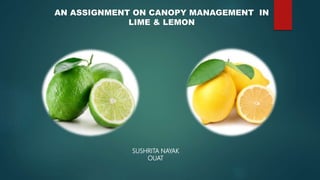
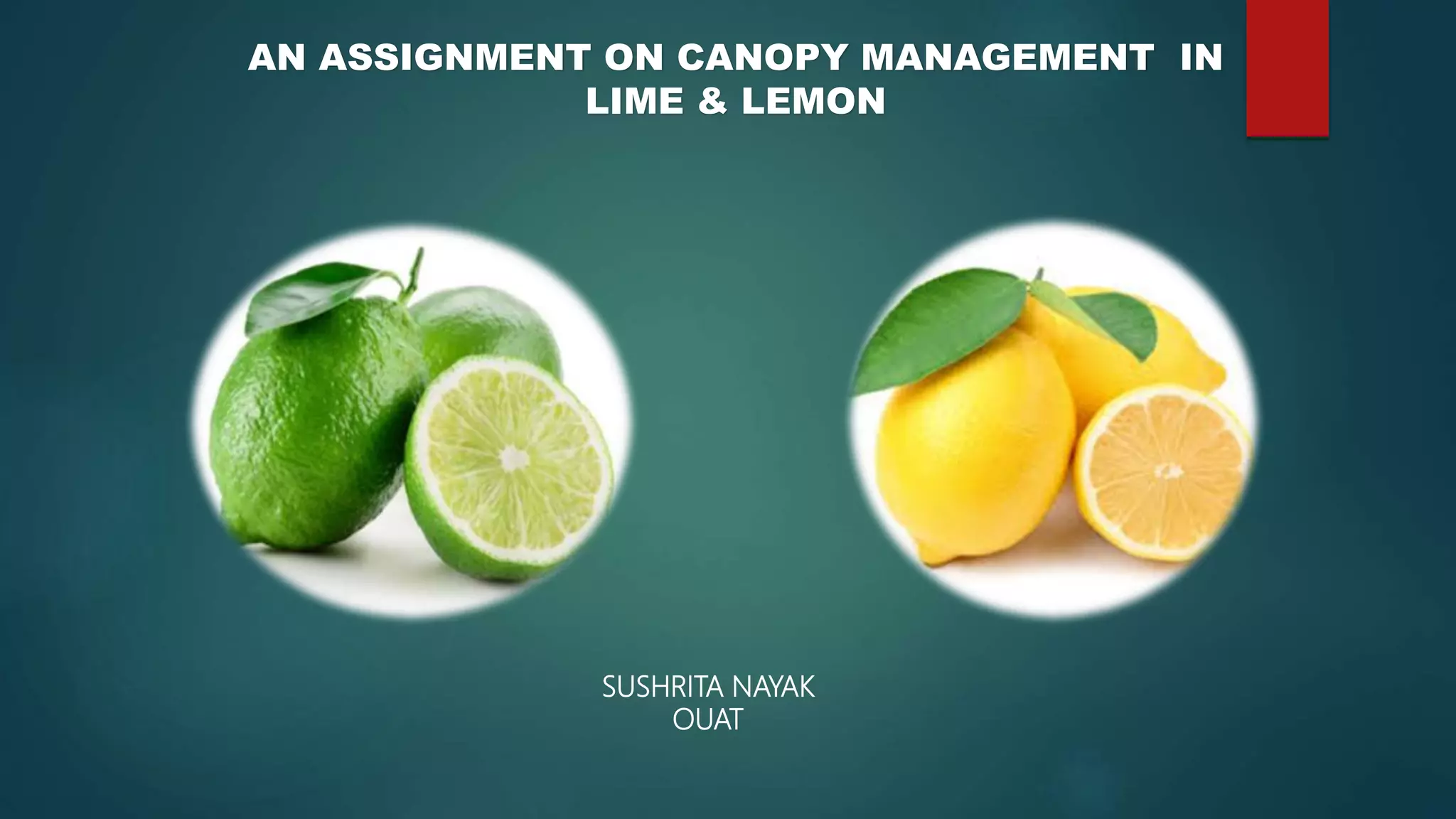
AN ASSIGNMENT ON CANOPY MANAGEMENT IN
LIME & LEMON
SUSHRITA NAYAK
OUAT
INTRODUCTION
 Citrus trees lime &lemon are a perennial crop. As long as they remain healthy, they can flower and
fruit for years on end, sometimes for as long as twenty or thirty years. However, if the trees are not
maintained at a proper size, the height and canopy shape of mature trees in a citrus orchard will
not be uniform and the branches will be too crowded.
 In a crowded orchard, diseases and pests can spread quickly. Fruit quality tends to be poor, and
trees may not bear fruit every year. A proper training and pruning program is essential for the
maintenance of a healthy, productive citrus orchard.
SHOOT GROWTH AND BEARING HABITS
OF CITRUS TREES(LIME AND LEMON)
 General Characteristics of Growth
 All cultivated citrus species are evergreen trees, with one exception (trifoliate orange: Poncirus trifoliata Raf.). Neglected trees
tend to have overgrown tops and produce crowded shoots. In a few years, the canopy becomes very dense and grows into a
dome. Branches in the interior may die from lack of sunlight. The tree will bear fruit only on the surface of the canopy and will
become progressively less productive.
 Flushes
 In tropical and subtropical areas, new shoot growth occurs in spring, summer, autumn, and sometimes even in winter. The
spring and summer shoots are the most important ones. They should develop properly, and not be too vigorous.
 Bearing Habits
 In a mature citrus tree, the bearing wood develops mainly from the spring and summer shoots. The spring shoots which
sprout from the bearing woods are the most productive ones. Single flowers or inflorescences may develop from the shoot
apex or axillary buds.
 Tree Form and Training System
 Citrus trees can grow tall. They should be trained into a suitable shape, with an open center. There are several advantages if
growers follow such a system. The trees are easy to manage, including spraying and harvesting the fruit. There is rapid growth
of the canopy in young trees, which also bear fruit early. The trees are easy to prune, and the bearing canopy covers a large
surface area.
CANOPY MANAGEMENT
 Manipulation of tree vigor and maximum utilization of sunlight, results in increased
productivity and quality.
 Basic principles of canopy management are:
 Maximum utilization of light
 Avoidance of built up of microclimate congenial for the diseases and pests.
 Helps in convenience in carrying out cultivation operations. Also the inter space can be
utilized for raising annuals as intercrops.
CITRUS CANOPY MANAGEMENT
STRGIEATES:
 These are based on understanding of knowledge of tree phenology and natural growth habit,
recognition of fruiting habits of “strong” and “weak” bearing branch units tree physiology, floral
biology, environmental physiology, effects of canopy illumination, branch sap flow patterns, and
of effects on these of climate, weather, topography, altitude and local pest and disease cycles.
 Secondly, Canopy Management Strategy were derived with an understanding of effects on tree
physiology of specific pruning and regrowth management practices.
 Thirdly, cost-effective methods were developed of optimizing growth, form and function of non-
bearing trees, trees in full production, and old trees declining due to age and/or shading.
CANOPY MANAGEMENT PROCEDURES
 1. Induction of complexity in young trees.
 2. Maintenance of complexity in bearing trees.
 3. Reduction of complexity of large, old trees declining due to the effects of age
and/or shading.
Training Young Trees
 Young trees are trained by removing immediately any broken, dead or diseased branch.
 The height above soil level of the tree’s lowest limb is set at between 45 to 65 cm above soil level,
and the young tree’s trunk is kept clear of all growth below this point.
 Growers also must select the 3 to 6 well-spaced and oriented branches that will be left to form the
limbs of the mature tree.
 Finally, trees should be skirted at a convenient height to avoid damage by herbicide applications and
to facilitate ant and/or snail control.
 Young trees can be trained at any time of the year and might require two to three passes over the
same trees.
CANOPY MANAGEMENT OF BEARING
TREES
1. Skirting and Light Hedging: As soon after harvest as possible, skirt trees at such height
at which fruit at maturity is no less than 400 mm above the soil surface, and no lower than 300
mm for trees planted on berms or ridges. Commercial experience shows that correctly skirted
trees appear to “reallocate” flowering and fruiting to remaining parts of the canopy. For best
results, cut wood no thicker than 10 to 12 mm diameter. This usually achieves adequate control of
tree spread, renewal of strong bearing wood and production of vegetative re-growth not
excessively vigorous. Hedging at an angle of 20o to the vertical allows light to reach tree skirts
Commercial experiences with hedging show trees should be hedged as lightly as possible.
2. Canopy Structure Improvement: After skirting, spray channels into tree canopies
and thin out tree “tops and shoulders” by removing, at their points of origin, wood of the
following types: dead, diseased or broken branches; crossover branches; rubbing branches, water-
shoots growing up the centre of the tree and sharp branch stubs left from previous cutting. Spend
about two to three minutes per tree on this step: typically, one would each year make four to 6
saw-cuts of wood of 25 to 50 mm diameter.
3. “Pruning” to Remove Weak Bearing Branch Units (WBBU): With high value varieties, or where crop
regulation (reduction of flower number) is required ,pruners may make “window cuts” by removing
inferior bearing wood. Pruners are taught to recognize this type of inferior fruiting wood, and to
remove such wood. This includes WBBU called “hangers” (old, unproductive, long, thin, spindly, much-
branched, growth with smallish, yellow leaves, arising from the underside of their supporting
branches); branches bearing leafless, “white” bloom. In addition, pruners thin out branches in
congested (dark) areas of canopy and shorten “long” flushes to one-third of their length, during which
time 12 to 15 secateurs cuts are made, intersecting wood of 8-15 mm diameter.
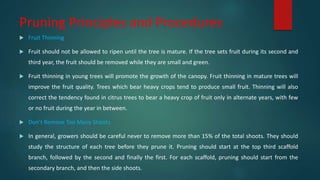
4. Rejuvenation Pruning of Old Trees: As trees age, their canopies become too tall and broad to
conveniently manage. Their productivity also declines through the effects of age and/or shading. In old
trees both canopy physical dimensions (height, spread, length) and complexity may be reduced through
rejuvenation pruning. In general, the same sorts of cuts are made as those used on mature trees,
although heavier pruning of older, thicker branches will be needed to rejuvenate them. Try not to over-
prune in any one year: it is a work in progress, and trees may be pruned every year. Growers are
advised to take two to three years to reduce canopy size and complexity.
Old Tree before Pruning. The Tree Form after Pruning
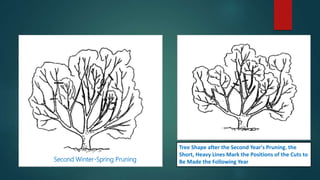
Second Winter-Spring Pruning
Tree Shape after the Second Year's Pruning. the
Short, Heavy Lines Mark the Positions of the Cuts to
Be Made the Following Year
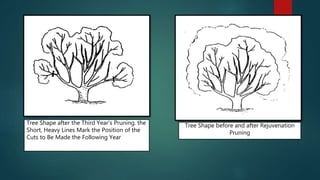
Tree Shape after the Third Year's Pruning. the
Short, Heavy Lines Mark the Position of the
Cuts to Be Made the Following Year
Tree Shape before and after Rejuvenation
Pruning
Pruning Principles and Procedures
 Fruit Thinning
 Fruit should not be allowed to ripen until the tree is mature. If the tree sets fruit during its second and
third year, the fruit should be removed while they are small and green.
 Fruit thinning in young trees will promote the growth of the canopy. Fruit thinning in mature trees will
improve the fruit quality. Trees which bear heavy crops tend to produce small fruit. Thinning will also
correct the tendency found in citrus trees to bear a heavy crop of fruit only in alternate years, with few
or no fruit during the year in between.
 Don't Remove Too Many Shoots
 In general, growers should be careful never to remove more than 15% of the total shoots. They should
study the structure of each tree before they prune it. Pruning should start at the top third scaffold
branch, followed by the second and finally the first. For each scaffold, pruning should start from the
secondary branch, and then the side shoots.
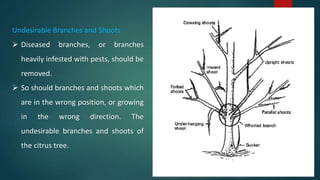
Undesirable Branches and Shoots
 Diseased branches, or branches
heavily infested with pests, should be
removed.
 So should branches and shoots which
are in the wrong position, or growing
in the wrong direction. The
undesirable branches and shoots of
the citrus tree.
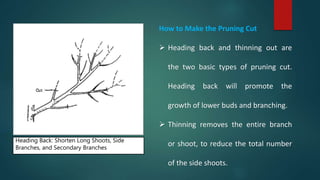
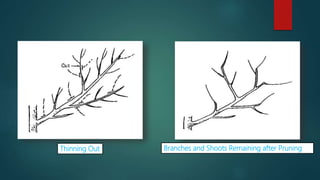
How to Make the Pruning Cut
 Heading back and thinning out are
the two basic types of pruning cut.
Heading back will promote the
growth of lower buds and branching.
 Thinning removes the entire branch
or shoot, to reduce the total number
of the side shoots.
Heading Back: Shorten Long Shoots, Side
Branches, and Secondary Branches
Thinning Out Branches and Shoots Remaining after Pruning
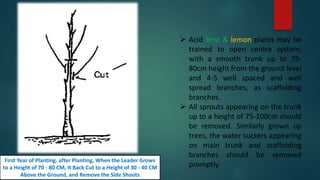
 Acid lime & lemon plants may be
trained to open centre system,
with a smooth trunk up to 75-
80cm height from the ground level
and 4-5 well spaced and well
spread branches, as scaffolding
branches.
 All sprouts appearing on the trunk
up to a height of 75-100cm should
be removed. Similarly grown up
trees, the water suckers appearing
on main trunk and scaffolding
branches should be removed
promptly.
First Year of Planting. after Planting, When the Leader Grows
to a Height of 70 - 80 CM, It Back Cut to a Height of 30 - 40 CM
Above the Ground, and Remove the Side Shoots
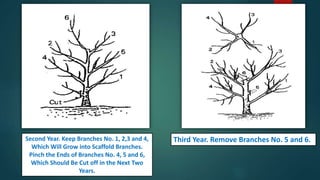
Second Year. Keep Branches No. 1, 2,3 and 4,
Which Will Grow into Scaffold Branches.
Pinch the Ends of Branches No. 4, 5 and 6,
Which Should Be Cut off in the Next Two
Years.
Third Year. Remove Branches No. 5 and 6.
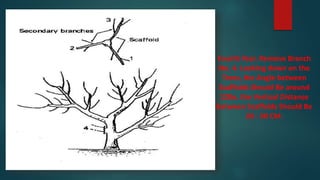
Fourth Year. Remove Branch
No. 4. Looking down on the
Trees, the Angle between
Scaffolds Should Be around
120o. the Vertical Distance
between Scaffolds Should Be
20 - 30 CM.
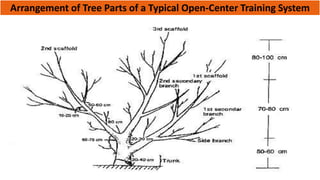
Arrangement of Tree Parts of a Typical Open-Center Training System
IRRIGATION AND FERTILIZATION
 Any significant reduction (i.e. >15%) of the mature tree canopy by pruning requires concomitant
changes to the applied amount of especially nitrogenous and potassic fertilizer's, and usually also to
irrigation.
 In this way, excessive vigor of regrowth is reduced.
 Improved fruit set may reduce the number and intensity of subsequent leaf flushes and facilitate
pest and disease management.
 The aim is to balance vigour. Flushes need to be vigorous enough to form strong Branch Bearing Unit.
 Lowering leaf nitrate levels reportedly reduces pest and disease infections.
 Finally, growers might also consider silicon applications, which reportedly increase plant resistance
to biotic and abiotic stresses, decrease susceptibility to pest and disease outbreaks, and perhaps
also exhibit anti-feedant properties.
Canopy managemnt in lime and lemone

Canopy managemnt in lime and lemone

  • 1.
    AN ASSIGNMENT ONCANOPY MANAGEMENT IN LIME & LEMON SUSHRITA NAYAK OUAT
  • 2.
    INTRODUCTION  Citrus treeslime &lemon are a perennial crop. As long as they remain healthy, they can flower and fruit for years on end, sometimes for as long as twenty or thirty years. However, if the trees are not maintained at a proper size, the height and canopy shape of mature trees in a citrus orchard will not be uniform and the branches will be too crowded.  In a crowded orchard, diseases and pests can spread quickly. Fruit quality tends to be poor, and trees may not bear fruit every year. A proper training and pruning program is essential for the maintenance of a healthy, productive citrus orchard.
  • 3.
    SHOOT GROWTH ANDBEARING HABITS OF CITRUS TREES(LIME AND LEMON)  General Characteristics of Growth  All cultivated citrus species are evergreen trees, with one exception (trifoliate orange: Poncirus trifoliata Raf.). Neglected trees tend to have overgrown tops and produce crowded shoots. In a few years, the canopy becomes very dense and grows into a dome. Branches in the interior may die from lack of sunlight. The tree will bear fruit only on the surface of the canopy and will become progressively less productive.  Flushes  In tropical and subtropical areas, new shoot growth occurs in spring, summer, autumn, and sometimes even in winter. The spring and summer shoots are the most important ones. They should develop properly, and not be too vigorous.  Bearing Habits  In a mature citrus tree, the bearing wood develops mainly from the spring and summer shoots. The spring shoots which sprout from the bearing woods are the most productive ones. Single flowers or inflorescences may develop from the shoot apex or axillary buds.  Tree Form and Training System  Citrus trees can grow tall. They should be trained into a suitable shape, with an open center. There are several advantages if growers follow such a system. The trees are easy to manage, including spraying and harvesting the fruit. There is rapid growth of the canopy in young trees, which also bear fruit early. The trees are easy to prune, and the bearing canopy covers a large surface area.
  • 4.
    CANOPY MANAGEMENT  Manipulationof tree vigor and maximum utilization of sunlight, results in increased productivity and quality.  Basic principles of canopy management are:  Maximum utilization of light  Avoidance of built up of microclimate congenial for the diseases and pests.  Helps in convenience in carrying out cultivation operations. Also the inter space can be utilized for raising annuals as intercrops.
  • 5.
    CITRUS CANOPY MANAGEMENT STRGIEATES: These are based on understanding of knowledge of tree phenology and natural growth habit, recognition of fruiting habits of “strong” and “weak” bearing branch units tree physiology, floral biology, environmental physiology, effects of canopy illumination, branch sap flow patterns, and of effects on these of climate, weather, topography, altitude and local pest and disease cycles.  Secondly, Canopy Management Strategy were derived with an understanding of effects on tree physiology of specific pruning and regrowth management practices.  Thirdly, cost-effective methods were developed of optimizing growth, form and function of non- bearing trees, trees in full production, and old trees declining due to age and/or shading.
  • 6.
    CANOPY MANAGEMENT PROCEDURES 1. Induction of complexity in young trees.  2. Maintenance of complexity in bearing trees.  3. Reduction of complexity of large, old trees declining due to the effects of age and/or shading.
  • 7.
    Training Young Trees Young trees are trained by removing immediately any broken, dead or diseased branch.  The height above soil level of the tree’s lowest limb is set at between 45 to 65 cm above soil level, and the young tree’s trunk is kept clear of all growth below this point.  Growers also must select the 3 to 6 well-spaced and oriented branches that will be left to form the limbs of the mature tree.  Finally, trees should be skirted at a convenient height to avoid damage by herbicide applications and to facilitate ant and/or snail control.  Young trees can be trained at any time of the year and might require two to three passes over the same trees.
  • 8.
    CANOPY MANAGEMENT OFBEARING TREES 1. Skirting and Light Hedging: As soon after harvest as possible, skirt trees at such height at which fruit at maturity is no less than 400 mm above the soil surface, and no lower than 300 mm for trees planted on berms or ridges. Commercial experience shows that correctly skirted trees appear to “reallocate” flowering and fruiting to remaining parts of the canopy. For best results, cut wood no thicker than 10 to 12 mm diameter. This usually achieves adequate control of tree spread, renewal of strong bearing wood and production of vegetative re-growth not excessively vigorous. Hedging at an angle of 20o to the vertical allows light to reach tree skirts Commercial experiences with hedging show trees should be hedged as lightly as possible. 2. Canopy Structure Improvement: After skirting, spray channels into tree canopies and thin out tree “tops and shoulders” by removing, at their points of origin, wood of the following types: dead, diseased or broken branches; crossover branches; rubbing branches, water- shoots growing up the centre of the tree and sharp branch stubs left from previous cutting. Spend about two to three minutes per tree on this step: typically, one would each year make four to 6 saw-cuts of wood of 25 to 50 mm diameter.
  • 9.
    3. “Pruning” toRemove Weak Bearing Branch Units (WBBU): With high value varieties, or where crop regulation (reduction of flower number) is required ,pruners may make “window cuts” by removing inferior bearing wood. Pruners are taught to recognize this type of inferior fruiting wood, and to remove such wood. This includes WBBU called “hangers” (old, unproductive, long, thin, spindly, much- branched, growth with smallish, yellow leaves, arising from the underside of their supporting branches); branches bearing leafless, “white” bloom. In addition, pruners thin out branches in congested (dark) areas of canopy and shorten “long” flushes to one-third of their length, during which time 12 to 15 secateurs cuts are made, intersecting wood of 8-15 mm diameter. 4. Rejuvenation Pruning of Old Trees: As trees age, their canopies become too tall and broad to conveniently manage. Their productivity also declines through the effects of age and/or shading. In old trees both canopy physical dimensions (height, spread, length) and complexity may be reduced through rejuvenation pruning. In general, the same sorts of cuts are made as those used on mature trees, although heavier pruning of older, thicker branches will be needed to rejuvenate them. Try not to over- prune in any one year: it is a work in progress, and trees may be pruned every year. Growers are advised to take two to three years to reduce canopy size and complexity.
  • 10.
    Old Tree beforePruning. The Tree Form after Pruning
  • 11.
    Second Winter-Spring Pruning TreeShape after the Second Year's Pruning. the Short, Heavy Lines Mark the Positions of the Cuts to Be Made the Following Year
  • 12.
    Tree Shape afterthe Third Year's Pruning. the Short, Heavy Lines Mark the Position of the Cuts to Be Made the Following Year Tree Shape before and after Rejuvenation Pruning
  • 13.
    Pruning Principles andProcedures  Fruit Thinning  Fruit should not be allowed to ripen until the tree is mature. If the tree sets fruit during its second and third year, the fruit should be removed while they are small and green.  Fruit thinning in young trees will promote the growth of the canopy. Fruit thinning in mature trees will improve the fruit quality. Trees which bear heavy crops tend to produce small fruit. Thinning will also correct the tendency found in citrus trees to bear a heavy crop of fruit only in alternate years, with few or no fruit during the year in between.  Don't Remove Too Many Shoots  In general, growers should be careful never to remove more than 15% of the total shoots. They should study the structure of each tree before they prune it. Pruning should start at the top third scaffold branch, followed by the second and finally the first. For each scaffold, pruning should start from the secondary branch, and then the side shoots.
  • 14.
    Undesirable Branches andShoots  Diseased branches, or branches heavily infested with pests, should be removed.  So should branches and shoots which are in the wrong position, or growing in the wrong direction. The undesirable branches and shoots of the citrus tree.
  • 15.
    How to Makethe Pruning Cut  Heading back and thinning out are the two basic types of pruning cut. Heading back will promote the growth of lower buds and branching.  Thinning removes the entire branch or shoot, to reduce the total number of the side shoots. Heading Back: Shorten Long Shoots, Side Branches, and Secondary Branches
  • 16.
    Thinning Out Branchesand Shoots Remaining after Pruning
  • 17.
     Acid lime& lemon plants may be trained to open centre system, with a smooth trunk up to 75- 80cm height from the ground level and 4-5 well spaced and well spread branches, as scaffolding branches.  All sprouts appearing on the trunk up to a height of 75-100cm should be removed. Similarly grown up trees, the water suckers appearing on main trunk and scaffolding branches should be removed promptly. First Year of Planting. after Planting, When the Leader Grows to a Height of 70 - 80 CM, It Back Cut to a Height of 30 - 40 CM Above the Ground, and Remove the Side Shoots
  • 18.
    Second Year. KeepBranches No. 1, 2,3 and 4, Which Will Grow into Scaffold Branches. Pinch the Ends of Branches No. 4, 5 and 6, Which Should Be Cut off in the Next Two Years. Third Year. Remove Branches No. 5 and 6.
  • 19.
    Fourth Year. RemoveBranch No. 4. Looking down on the Trees, the Angle between Scaffolds Should Be around 120o. the Vertical Distance between Scaffolds Should Be 20 - 30 CM.
  • 20.
    Arrangement of TreeParts of a Typical Open-Center Training System
  • 21.
    IRRIGATION AND FERTILIZATION Any significant reduction (i.e. >15%) of the mature tree canopy by pruning requires concomitant changes to the applied amount of especially nitrogenous and potassic fertilizer's, and usually also to irrigation.  In this way, excessive vigor of regrowth is reduced.  Improved fruit set may reduce the number and intensity of subsequent leaf flushes and facilitate pest and disease management.  The aim is to balance vigour. Flushes need to be vigorous enough to form strong Branch Bearing Unit.  Lowering leaf nitrate levels reportedly reduces pest and disease infections.  Finally, growers might also consider silicon applications, which reportedly increase plant resistance to biotic and abiotic stresses, decrease susceptibility to pest and disease outbreaks, and perhaps also exhibit anti-feedant properties.