TREE
PRUNING
BY SHIVANGI GUPTA
OVERVIEW
 Decision Tree
 Why Tree Pruning?
 Types of Tree pruning
 Reduced Error pruning
 Comparision
 References
INTRODUCTION
 Decision trees are made to classify the item
set.
 While classifying we meet with 2 problems
1. Underfitting .
2. Overfitting .
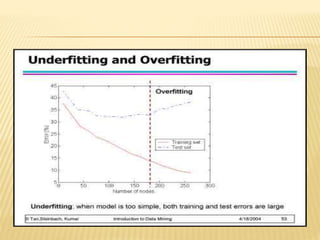
 Underfitting problem arises when both the
“training errors and test errors are large”
 This happens when the developed model is
made very simple.
 Overfitting problem arises when
“training errors are small but test errors are
large”
OVERFITTING
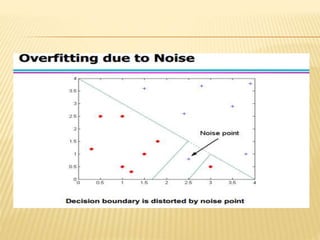
 Overfitting results in decision trees that are more
complex than necessary.
 Training error no longer provides a good estimate
of how well the tree will perform on previously
unseen records.
 Need new ways for estimating errors.
How to address overfitting ?
“Tree Pruning”
WHAT IS PRUNING?
 The process of adjusting Decision Tree to minimize
“misclassification error” is called pruning .
 Pruning can be done in 2 ways
1. Prepruning.
2.Postpruning.
PREPRUNING
 Prepruning is the halting of subtree construction at
some node after checking some measures.
 These measures can be Information gain, Gini
index,etc.
 If partitioning the tuple at a node would result in a
split that falls below a prespecified threshold, then
pruning is done.
 Early stopping- Pre-pruning may stop the growth
process prematurely.
POSTPRUNING
 Grow decision tree to its entirety.
 Trim the nodes of the decision tree in a
bottom-up fashion.Postpruning is done by
replacing the node with leaf.
 If error improves after trimming, replace sub-
tree by a leaf node.
REDUCED ERROR PRUNING
 The idea is to hold out some of the available instances—the
“pruning set” after the tree is built.
 Prune the tree until the classification error on these independent
instances starts to increase.
 These pruning set are not used for building the decision tree,
they provide a less biased estimate of its error rate on future
instances than the training data.
 Reduced error pruning is done in bottom up fashion.
 Criteria:
If error of parent is lesser than its child then prune the tree else
not .
i.e if Parent (error)< Child(error) then “Prune”
else don’t Prune
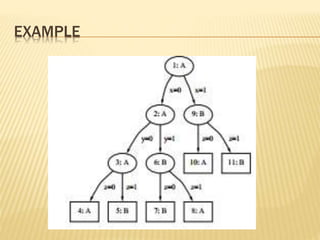
EXAMPLE
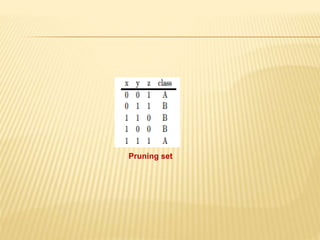
Pruning set
STEPS
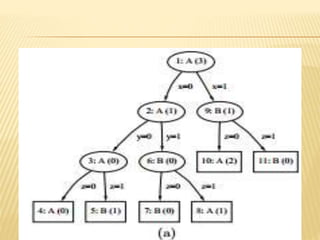
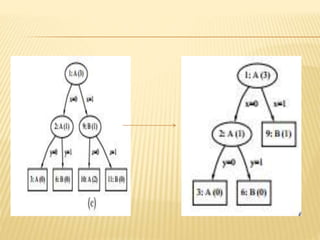
 In each tree, the number of instances in the pruning data
that are misclassified by the individual nodes are given in
parentheses.
 Assuming that the tree is traversed left-to-right.
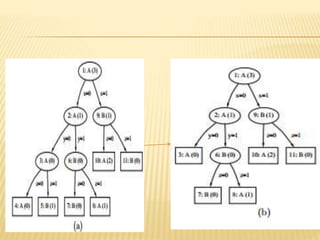
 The pruning procedure first considers for removal the
subtree attached to node 3.
 Because the subtree’s error on the pruning data (1 error)
exceeds the error of node 3 itself (0errors), node 3 is
converted to a leaf.
 Next, node 6 is replaced by a leaf for the same reason
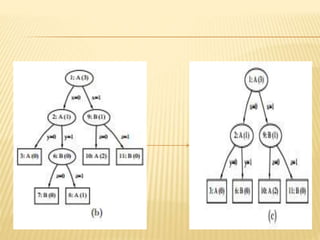
 Having processed both of its successors, the pruning
procedure then considers node 2 for deletion.
However, because the subtree attached to node 2
makes fewer mistakes (0 errors) than node 2 itself (1
error), the subtree remains in place.
 Next, the subtree extending from node 9 is
considered for pruning, resulting in a leaf
 In the last step, node 1 is considered for pruning,
leaving the tree unchanged.
COMPARISION
 Prepruning is faster than post pruning since it don’t need to
wait for complete construction of decision tree.
 But still Post-pruning is preferable to pre-pruning because of
“interaction effect”.
 These are the efects which arise after interaction of several
attributes.
 Prepruning suppresses growth by evaluating each attribute
individually, and so might overlook effects that are due to the
interaction of several attributes and stop too early. Post-
pruning, on the other hand, avoids this problem because
interaction effects are visible in the fully grown tree.

Tree pruning

  • 1.
  • 2.
    OVERVIEW  Decision Tree Why Tree Pruning?  Types of Tree pruning  Reduced Error pruning  Comparision  References
  • 3.
    INTRODUCTION  Decision treesare made to classify the item set.  While classifying we meet with 2 problems 1. Underfitting . 2. Overfitting .
  • 4.
     Underfitting problemarises when both the “training errors and test errors are large”  This happens when the developed model is made very simple.  Overfitting problem arises when “training errors are small but test errors are large”
  • 6.
    OVERFITTING  Overfitting resultsin decision trees that are more complex than necessary.  Training error no longer provides a good estimate of how well the tree will perform on previously unseen records.  Need new ways for estimating errors.
  • 8.
    How to addressoverfitting ? “Tree Pruning”
  • 9.
    WHAT IS PRUNING? The process of adjusting Decision Tree to minimize “misclassification error” is called pruning .  Pruning can be done in 2 ways 1. Prepruning. 2.Postpruning.
  • 10.
    PREPRUNING  Prepruning isthe halting of subtree construction at some node after checking some measures.  These measures can be Information gain, Gini index,etc.  If partitioning the tuple at a node would result in a split that falls below a prespecified threshold, then pruning is done.  Early stopping- Pre-pruning may stop the growth process prematurely.
  • 11.
    POSTPRUNING  Grow decisiontree to its entirety.  Trim the nodes of the decision tree in a bottom-up fashion.Postpruning is done by replacing the node with leaf.  If error improves after trimming, replace sub- tree by a leaf node.
  • 12.
    REDUCED ERROR PRUNING The idea is to hold out some of the available instances—the “pruning set” after the tree is built.  Prune the tree until the classification error on these independent instances starts to increase.  These pruning set are not used for building the decision tree, they provide a less biased estimate of its error rate on future instances than the training data.  Reduced error pruning is done in bottom up fashion.  Criteria: If error of parent is lesser than its child then prune the tree else not . i.e if Parent (error)< Child(error) then “Prune” else don’t Prune
  • 13.
  • 14.
  • 15.
    STEPS  In eachtree, the number of instances in the pruning data that are misclassified by the individual nodes are given in parentheses.  Assuming that the tree is traversed left-to-right.  The pruning procedure first considers for removal the subtree attached to node 3.  Because the subtree’s error on the pruning data (1 error) exceeds the error of node 3 itself (0errors), node 3 is converted to a leaf.  Next, node 6 is replaced by a leaf for the same reason
  • 16.
     Having processedboth of its successors, the pruning procedure then considers node 2 for deletion. However, because the subtree attached to node 2 makes fewer mistakes (0 errors) than node 2 itself (1 error), the subtree remains in place.  Next, the subtree extending from node 9 is considered for pruning, resulting in a leaf  In the last step, node 1 is considered for pruning, leaving the tree unchanged.
  • 21.
    COMPARISION  Prepruning isfaster than post pruning since it don’t need to wait for complete construction of decision tree.  But still Post-pruning is preferable to pre-pruning because of “interaction effect”.  These are the efects which arise after interaction of several attributes.  Prepruning suppresses growth by evaluating each attribute individually, and so might overlook effects that are due to the interaction of several attributes and stop too early. Post- pruning, on the other hand, avoids this problem because interaction effects are visible in the fully grown tree.