SPECIAL HORTICULTURAL PRACTICES
✓Ofthe many factors influencing floral initiation, carbohydrates-
nitrogen ratio appears to be the one factor that could be controlled.
✓The accumulation of carbohydrates can be brought about by more
rapid manufacture and less immediate utilization.
✓In vegetatively weak plants, favorable conditions for carbohydrate
accumulation will have to be created by provision of desired
temperature, light, water and nutrient change
✓While in vigorous plants this change is to be induced by the reduction
of water and nutrient supply.
✓Pruning, root pruning, ringing, girdling, notching, bending, smudging
are some of the specialized horticultural practices followed for
regulation of fruiting.
2.
1. PRUNING
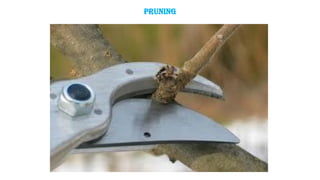
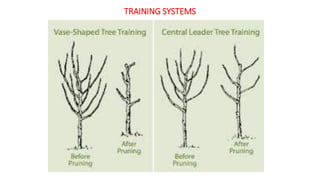
✓Pruning maybe defined as, an art and science of cutting away of
portion of plant, to improve its shape, to influence its growth, flowering
& fruitfulness and to improve the quality of the product.
✓It is done to divert a part of plant energy, from one part to another part
of plant.
Effect of Pruning
✓In young trees flowering will be delayed
✓In old trees there will be new vigorous vegetative growth which bears
fruit
✓It reduces bearing surface, as a result tree remain dwarf, which is
compensated by accommodating more number of dwarf trees
✓Improvement in size, colour and quality of fruits
Principles of Pruning:
✓Youngtrees are pruned to train it, to acquire a desired shape.
✓In old trees light heading back is done, to stimulate the flowering
✓In bearing trees light pruning is done, to stimulate fresh growth.
✓All the diseased, weak, dead or shading branches must be
removed.
Systems of Pruning:
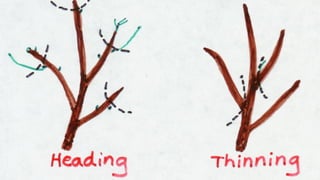
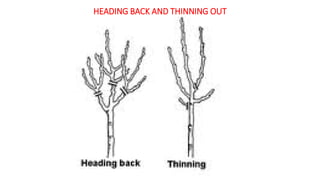
a. Heading back: Only tops of branches are headed back or cut off
(light pruning).
b. Thinning out: Complete removal of a branches or a part from
its origin.
c. Dehorning: Cutting away the thick major branches
d. Bulk pruning: Heavy pruning all over the tree.
2. TRAINING:
✓It meansdeveloping a desired shape.
✓Training is start from nursery stage of plant.
✓Some fruit crops like grape vines, ber, fig, guava etc require training.
Principles of Training:
✓Formation of the main frame work must be strong.
✓The branches must be suitabaly spaced apart and the tree must be
balanced on all the sides.
✓Careful training of main branches is very essential.
✓If two branches are growing at the same point try to train them to grow
at a wider angle.
✓Narrow angle is always weak.
8.
System of Training:
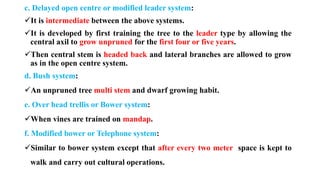
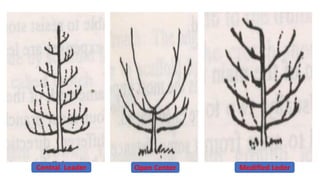
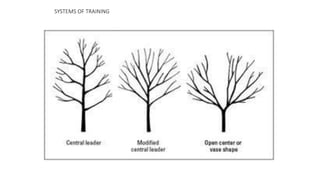
a.Central leader system:
✓In this system the central leader branches are allowed to
grow indefinitely so that it will grow more rapidly and
vigorously than the side branches and tree became tall.
✓Such tree bears more fruits near the top.
✓The lower branches are less vigorous and less fruitful.
b. Open centre or vase system:
✓The main stem is allowed to grow only up to a certain height
about 1.5 to 1.8 m and then it cut for development of lateral
branches.
✓It allows full sunshine to reach each branch.
……….
9.
c. Delayed opencentre or modified leader system:
✓It is intermediate between the above systems.
✓It is developed by first training the tree to the leader type by allowing the
central axil to grow unpruned for the first four or five years.
✓Then central stem is headed back and lateral branches are allowed to grow
as in the open centre system.
d. Bush system:
✓An unpruned tree multi stem and dwarf growing habit.
e. Over head trellis or Bower system:
✓When vines are trained on mandap.
f. Modified bower or Telephone system:
✓Similar to bower system except that after every two meter space is kept to
walk and carry out cultural operations.
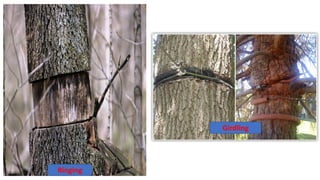
3. Ringing andGirdling:
✓Ringing consists of removing a ring of bark about 1 to 2 cm wide
around the trunk or branches,
✓while Girdling is a milder treatment to draw a knife around the
branch so as to cut through the bark but not the wood.
✓A wire tied very firmly round the stem also serves the same
purpose.
✓Ringing or girdling will increase the concentration of
carbohydrates above the ring.
✓It will also reduce the nitrogen supply
✓Ringing is done in vigorous mango tree.
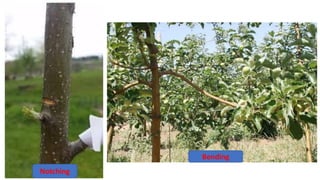
4. Notching:
✓It issimilar to ringing except that in notching only bark about 0.2
to 0.5 cm thick and 1.5 to 2.5 cm in length is removed just above
or close to a dormant bud in slantwise.
✓The bud selected should be large, plampy and healthy which is
produced on a perfect mature wood and has undergone dormancy.
✓Generally 3 to 4 buds in the middle portion of the selected shoot
are best to operate on.
✓The season for notching the fig is August-September.
16.
5. Bending:
✓Bending abranch downward, sometimes checks growth and
causes accumulation of starch in the branch with greater
flowering.
✓In case of bending the effect of apical dominance of the growing
shoot is removed.
✓This is usually practiced in local guava variety in Maharashtra.
6. Smudging:
✓Smudging isa practice of smoking the tree, by burning brush
wood (small branches) on the ground and allowing smoke to pass
through the center of the crown of the tree.
✓The smoking is discontinued as soon as the terminal buds begin to
swell.
✓Practice of smoking to the trees like mango, commonly employed
in the Philippines to produce off-season crop.
19.
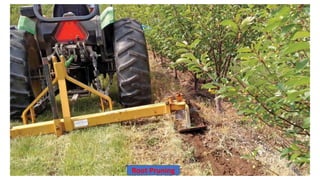
7. Root pruning:
✓Rootpruning results in less carbohydrate utilization of the top
growth, there is a little more utilization of carbohydrate for root
functions, which results in fruit bud differentiation.
✓The plant became dwarf.
✓The root pruning is done two months before the bloom required.
✓The main roots are exposed to the sun and the fibrous roots are cut,
so water is withheld.
✓The trees are allowed to go dry until their leaves wither and fall
down.
✓The time taken for leaf fall is 3-4 weeks.
……….
20.
✓After that theexposed roots are covered with a mixture of soil and
manure.
✓The trees are then immediately irrigated.
✓The trees on which root pruning is practiced quite frequently are
short lived and are liable to be week and unhealthy.
✓Root pruning is generally included in bahar treatments given to
fruit trees like sweet orange, mandarin, guava, pomegranate, lime
etc.
8. Bahar treatment:
✓Thispractice is followed with fruit trees like sweet orange, mandarin,
grape fruit, guava, pomegranate ber, lime etc. in the state of Maharashtra,
M.P. and Gujarat etc.
✓As there is no distinct winter (very cold winter) these fruit trees are in
continuous vegetative growth resulting in indistinct flowering season.
✓About 1 to 1½ months prior to the expected flowering irrigation is
withheld.
✓There are three flowering season namely
i. Mrig bahar: Flowering in June-July
ii. Hasta bahar: Flowering in Oct-Nov
iii. Ambe bahar: flowering in Dec-Feb
……….
23.
✓The orchard isploughed both ways and the roots are exposed by
removing the upper 10-15 cm of soil within a radius of 60-90 cm
around the trunk.
✓The dead and decayed fibrous roots are removed in the area
exposed.
✓The leaves start turning yellow, shrivel and fall.
✓The exposed roots are re-covered with original soil and necessary
manures are added.
✓Trees are irrigated lightly.