NANOTECHNOLOGY: ITS
APPLICATION IN CROP
IMPROVEMENT
VISHNUTEJ
ELLUR
PG13AGR5065
• There is increasing potential for
 Suitable techniques and sensors for precision agriculture,
natural resource management,
 Early detection of pathogens
 contaminants in food products,
 Smart delivery systems for agrochemicals like fertilizers and
pesticides,
 Smart systems integration for food processing, packaging and
other areas like monitoring agricultural and food system
security
INTRODUCTION
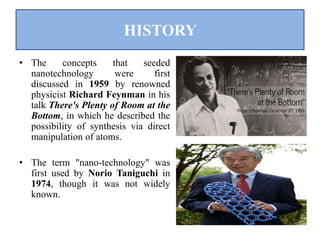
• The concepts that seeded
nanotechnology were first
discussed in 1959 by renowned
physicist Richard Feynman in his
talk There's Plenty of Room at the
Bottom, in which he described the
possibility of synthesis via direct
manipulation of atoms.
• The term "nano-technology" was
first used by Norio Taniguchi in
1974, though it was not widely
known.
HISTORY
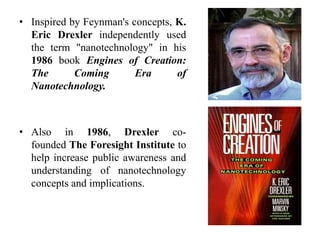
• Inspired by Feynman's concepts, K.
Eric Drexler independently used
the term "nanotechnology" in his
1986 book Engines of Creation:
The Coming Era of
Nanotechnology.
• Also in 1986, Drexler co-
founded The Foresight Institute to
help increase public awareness and
understanding of nanotechnology
concepts and implications.
• Nanotechnology is the Design, Fabrication and Utilization of
materials, devices and systems through control of matter on
the nanometer length scale and exploitation of novel
phenomena and properties (physical, chemical, biological) at
that length scale. It is now more properly labeled as
"molecular nanotechnology" (MNT) or "nano-scale
engineering”
• The word “nano” comes from the Greek for “dwarf”
• Technology: visualize, characterize, produce and manipulate
matter of the size of 1 – 100 nm
DEFINITION
HOW BIG IS NANOTECHNOLOGY?
• A nanometer is a thousandth of a thousandth of a thousandth
of a meter (10-9m)
• One nanometer is about 60,000 times smaller than a human
hair in diameter or the size of a virus
Comparison...!!!!!!!
• Thickness of paper -1,00,000 nm
• Leukocycte - 10,000 nm
• RBC -2,000 to 5,000 nm
• Bacteria -1000 – 10,000 nm
• Wavelength of light - 400 – 700 nm
• Virus - 75 – 100 nm
• Nano scale - 1 to 100 nm
• Protien - 5 – 50 nm
• DNA - ~ 2 nm width
• Atom - ~ 0.1nm
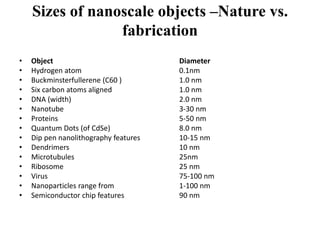
Sizes of nanoscale objects –Nature vs.
fabrication
• Object Diameter
• Hydrogen atom 0.1nm
• Buckminsterfullerene (C60 ) 1.0 nm
• Six carbon atoms aligned 1.0 nm
• DNA (width) 2.0 nm
• Nanotube 3-30 nm
• Proteins 5-50 nm
• Quantum Dots (of CdSe) 8.0 nm
• Dip pen nanolithography features 10-15 nm
• Dendrimers 10 nm
• Microtubules 25nm
• Ribosome 25 nm
• Virus 75-100 nm
• Nanoparticles range from 1-100 nm
• Semiconductor chip features 90 nm
WHAT IS UNIQUE ABOUT
NANOTECHNOLOGY?
 Small size (High surface to volume ratio), therefore requires
self assemblers
 Significantly higher hardness, breaking strength and toughness
at low temperatures and super plasticity at high temperatures
 Additional electronic states, high chemical selectivity of
surface sites and significantly increased surface energy
 New entry ways (high mobility in human body, plants and
environment)
Current research in Nanotechnology
• Nanomaterials
• Functional approaches
• Biomimetic approaches
– Bionanotechnology is the use of biomolecules for
applications in nanotechnology, including use of viruses
and lipid assemblies. Nanocellulose is a potential bulk-
scale application
Applications of Nanotechnology in
Agriculture
• Crop improvement
• Nanobiotechnology
• Analysis of gene expression and Regulation
• Soil management
• Plant disease diagnostics
• Efficient pesticides and fertilizers
• Water management
• Bioprocessing
• Post Harvest Technology
• Monitoring the identity and quality of agricultural produce
• Precision agriculture
Nanobiotechnology
• Bionanotechnology, nanobiotechnology & nanobiology are
terms that refer to the intersection of nanotechnology and
biology.
• The subject is one that has only emerged very recently
• Concepts that are enhanced through nanobiology
include: nanodevices, nanoparticles, and nanoscale phenomena
that occurs within the discipline of nanotechnology
• However, as with nanotechnology and biotechnology,
bionanotechnology does have many potential ethical
issues associated with it.
• The most important objectives that are frequently found in
nanobiology involve applying nanotools to relevant
medical/biological problems and refining these applications.
Nanotechnology for Crop Improvement
DNA in Nano World
• The DNA molecule has appealing features for use in
nanotechnology: its
– minuscule size,
– with a diameter of about 2 nanometers,
– its short structural repeat (helical pitch) of about 3.4–3.6
nm, its ‘stiffness’, with a persistence length (a measure of
stiffness) of round 50 nm.
There are two basic types of nanotechnological
construction:
• ‘top-down’ systems are where microscopic
manipulations of small numbers of atoms or
molecules fashion elegant patterns,
• while in ‘bottom-up’ constructions, many
molecules self-assemble in parallel steps, as a
function of their molecular recognition
properties.
Nanofabricated Gel-free Systems and
High Throughput DNA Sequencing
• Advancing toward the ability to sequence DNA in
nanofabricated gel-free systems, which would allow for
significantly more rapid DNA sequencing
• Coupled with powerful approaches such as association genetic
analysis, DNA sequencing data of the crop germplasm, gene
can potentially provide highly useful information about
molecular markers associated with agronomically and
economically important traits
Atomically Modified Seeds
• In March 2004, ETC Group reported on a nanotech research
initiative in Thailand that aims to atomically modify the
characteristics of local rice varieties
• Researchers “drilled” a hole through the membrane of a rice
cell in order to insert a nitrogen atom that would stimulate the
rearrangement of the rice’s DNA. So far, researchers have
been able to alter the colour of a local rice variety from purple
to green
Hormone and Antibiotics Delivery in
plants
• Controlled release involves the
combination of a biocompatible
material or device with a drug to be
delivered in a way that it can be
delivered to and released at diseased
sites in a designed manner.
• Drug-delivery systems may rescue
potential drug candidates by
increasing solubility and stability by
the application of coating of
polymer drug conjugates, polymeric
micelles, polymeric nanospheres and
nanocapsules, and polyplexes.
Using Nanosensors on Crops and
Nanoparticles in Fertilisers
• Tiny sensors offer the possibility of monitoring pathogens on
crops and livestock as well as measuring crop productivity. In
addition, nanoparticles could increase the efficiency of
fertilisers.
• However, the Swiss insurance company SwissRe warned in a
report in 2004 that they could also increase the ability of
potentially toxic substances, such as fertilisers, to penetrate
deep layers of the soil and travel over greater distances.
Nanocides: Pesticides via Encapsulation
• Pesticides containing nano-scale active ingredients are already
on the market,
• “Nanoparticles Comprising a Crop Protection Agent,” that
involves an active ingredient whose ideal particle size is
between 10 and 150 nm.
• The advantage of the nano-formulation is that the pesticide
dissolves more easily in water (to simplify application to
crops); it is more stable and the killingcapacity of the chemical
(herbicide, insecticide or fungicide) is optimized.
Soil Binder - Using Chemical Reactions
at the Nanoscale to Bind Soil Together
• In 2003, ETC Group reported on a nanotech-based soil binder
called SoilSet developed by Sequoia Pacific Research of Utah
(USA). SoilSet is a quick-setting mulch which relies on
chemical reactions on the nanoscale to bind the soil together.
• to prevent erosion following forest fires, as well as on smaller
areas of forest burns
Disease diagnosis:
• Sample Retrieval:
Develop retrieval nanosystems for sampling specific
components (from air, plant and animal organisms, water, and
soil).
• Pathogen Detection:
Develop methods of near real time pathogen detection and
location reporting using a systems approach, integrating
nanotechnology microelectromechanical systems (MEMS),
wireless communication, chip design, and molecular biology
for applications in agricultural security (economic, agricultural
terrorism, agricultural forensics) and food safety
Nanotechnology and Indian Initiatives
Present area of activities in the field of
Nanotechnology in India
The priority
The priority areas identified in
Agriculture are:
• Detecting contamination in raw agriculture products
• Development of nano tubes devices to diagnoses diseases in
agriculture crops.
• To detect carcinogenic pathogens and bio sensors for improved
and contamination free agriculture products.
• Use of nano particles with bio compatible Chitosan
National Challenge Program on
Nanobiotechnology and Food and
Health Security
• To meet the Millennium Development Goal of UN25
• To prioritize the area of research and to measure the research
outlay and scientific and social outcome
• To coordinate the research between ICAR, CSIR, ICMR, DST
and DBT organizations.
• DST has invested approx. $20million for the period 2004-
2009.
Future trends
• The question that whether the coming age of Nanotechnology
is the Next technological revolution everyone talking about is
still to be answered?
• There is great optimism among scientists, politicians and
policy makers who anticipate significant job creation.
• Opportunities for developing new materials and methods that
will enhance our ability to develop faster, more reliable and
more sensitive analytical systems.
• Overall the scenario presents us with the view that
nanotechnology is here to stay!
Nanotechnology

Nanotechnology

  • 1.
    NANOTECHNOLOGY: ITS APPLICATION INCROP IMPROVEMENT VISHNUTEJ ELLUR PG13AGR5065
  • 2.
    • There isincreasing potential for  Suitable techniques and sensors for precision agriculture, natural resource management,  Early detection of pathogens  contaminants in food products,  Smart delivery systems for agrochemicals like fertilizers and pesticides,  Smart systems integration for food processing, packaging and other areas like monitoring agricultural and food system security INTRODUCTION
  • 3.
    • The conceptsthat seeded nanotechnology were first discussed in 1959 by renowned physicist Richard Feynman in his talk There's Plenty of Room at the Bottom, in which he described the possibility of synthesis via direct manipulation of atoms. • The term "nano-technology" was first used by Norio Taniguchi in 1974, though it was not widely known. HISTORY
  • 4.
    • Inspired byFeynman's concepts, K. Eric Drexler independently used the term "nanotechnology" in his 1986 book Engines of Creation: The Coming Era of Nanotechnology. • Also in 1986, Drexler co- founded The Foresight Institute to help increase public awareness and understanding of nanotechnology concepts and implications.
  • 5.
    • Nanotechnology isthe Design, Fabrication and Utilization of materials, devices and systems through control of matter on the nanometer length scale and exploitation of novel phenomena and properties (physical, chemical, biological) at that length scale. It is now more properly labeled as "molecular nanotechnology" (MNT) or "nano-scale engineering” • The word “nano” comes from the Greek for “dwarf” • Technology: visualize, characterize, produce and manipulate matter of the size of 1 – 100 nm DEFINITION
  • 6.
    HOW BIG ISNANOTECHNOLOGY? • A nanometer is a thousandth of a thousandth of a thousandth of a meter (10-9m) • One nanometer is about 60,000 times smaller than a human hair in diameter or the size of a virus
  • 7.
    Comparison...!!!!!!! • Thickness ofpaper -1,00,000 nm • Leukocycte - 10,000 nm • RBC -2,000 to 5,000 nm • Bacteria -1000 – 10,000 nm • Wavelength of light - 400 – 700 nm • Virus - 75 – 100 nm • Nano scale - 1 to 100 nm • Protien - 5 – 50 nm • DNA - ~ 2 nm width • Atom - ~ 0.1nm
  • 8.
    Sizes of nanoscaleobjects –Nature vs. fabrication • Object Diameter • Hydrogen atom 0.1nm • Buckminsterfullerene (C60 ) 1.0 nm • Six carbon atoms aligned 1.0 nm • DNA (width) 2.0 nm • Nanotube 3-30 nm • Proteins 5-50 nm • Quantum Dots (of CdSe) 8.0 nm • Dip pen nanolithography features 10-15 nm • Dendrimers 10 nm • Microtubules 25nm • Ribosome 25 nm • Virus 75-100 nm • Nanoparticles range from 1-100 nm • Semiconductor chip features 90 nm
  • 11.
    WHAT IS UNIQUEABOUT NANOTECHNOLOGY?  Small size (High surface to volume ratio), therefore requires self assemblers  Significantly higher hardness, breaking strength and toughness at low temperatures and super plasticity at high temperatures  Additional electronic states, high chemical selectivity of surface sites and significantly increased surface energy  New entry ways (high mobility in human body, plants and environment)
  • 13.
    Current research inNanotechnology • Nanomaterials • Functional approaches • Biomimetic approaches – Bionanotechnology is the use of biomolecules for applications in nanotechnology, including use of viruses and lipid assemblies. Nanocellulose is a potential bulk- scale application
  • 14.
    Applications of Nanotechnologyin Agriculture • Crop improvement • Nanobiotechnology • Analysis of gene expression and Regulation • Soil management • Plant disease diagnostics • Efficient pesticides and fertilizers • Water management • Bioprocessing • Post Harvest Technology • Monitoring the identity and quality of agricultural produce • Precision agriculture
  • 15.
    Nanobiotechnology • Bionanotechnology, nanobiotechnology& nanobiology are terms that refer to the intersection of nanotechnology and biology. • The subject is one that has only emerged very recently • Concepts that are enhanced through nanobiology include: nanodevices, nanoparticles, and nanoscale phenomena that occurs within the discipline of nanotechnology • However, as with nanotechnology and biotechnology, bionanotechnology does have many potential ethical issues associated with it. • The most important objectives that are frequently found in nanobiology involve applying nanotools to relevant medical/biological problems and refining these applications.
  • 16.
    Nanotechnology for CropImprovement DNA in Nano World • The DNA molecule has appealing features for use in nanotechnology: its – minuscule size, – with a diameter of about 2 nanometers, – its short structural repeat (helical pitch) of about 3.4–3.6 nm, its ‘stiffness’, with a persistence length (a measure of stiffness) of round 50 nm.
  • 17.
    There are twobasic types of nanotechnological construction: • ‘top-down’ systems are where microscopic manipulations of small numbers of atoms or molecules fashion elegant patterns, • while in ‘bottom-up’ constructions, many molecules self-assemble in parallel steps, as a function of their molecular recognition properties.
  • 18.
    Nanofabricated Gel-free Systemsand High Throughput DNA Sequencing • Advancing toward the ability to sequence DNA in nanofabricated gel-free systems, which would allow for significantly more rapid DNA sequencing • Coupled with powerful approaches such as association genetic analysis, DNA sequencing data of the crop germplasm, gene can potentially provide highly useful information about molecular markers associated with agronomically and economically important traits
  • 19.
    Atomically Modified Seeds •In March 2004, ETC Group reported on a nanotech research initiative in Thailand that aims to atomically modify the characteristics of local rice varieties • Researchers “drilled” a hole through the membrane of a rice cell in order to insert a nitrogen atom that would stimulate the rearrangement of the rice’s DNA. So far, researchers have been able to alter the colour of a local rice variety from purple to green
  • 20.
    Hormone and AntibioticsDelivery in plants • Controlled release involves the combination of a biocompatible material or device with a drug to be delivered in a way that it can be delivered to and released at diseased sites in a designed manner. • Drug-delivery systems may rescue potential drug candidates by increasing solubility and stability by the application of coating of polymer drug conjugates, polymeric micelles, polymeric nanospheres and nanocapsules, and polyplexes.
  • 21.
    Using Nanosensors onCrops and Nanoparticles in Fertilisers • Tiny sensors offer the possibility of monitoring pathogens on crops and livestock as well as measuring crop productivity. In addition, nanoparticles could increase the efficiency of fertilisers. • However, the Swiss insurance company SwissRe warned in a report in 2004 that they could also increase the ability of potentially toxic substances, such as fertilisers, to penetrate deep layers of the soil and travel over greater distances.
  • 22.
    Nanocides: Pesticides viaEncapsulation • Pesticides containing nano-scale active ingredients are already on the market, • “Nanoparticles Comprising a Crop Protection Agent,” that involves an active ingredient whose ideal particle size is between 10 and 150 nm. • The advantage of the nano-formulation is that the pesticide dissolves more easily in water (to simplify application to crops); it is more stable and the killingcapacity of the chemical (herbicide, insecticide or fungicide) is optimized.
  • 23.
    Soil Binder -Using Chemical Reactions at the Nanoscale to Bind Soil Together • In 2003, ETC Group reported on a nanotech-based soil binder called SoilSet developed by Sequoia Pacific Research of Utah (USA). SoilSet is a quick-setting mulch which relies on chemical reactions on the nanoscale to bind the soil together. • to prevent erosion following forest fires, as well as on smaller areas of forest burns
  • 24.
    Disease diagnosis: • SampleRetrieval: Develop retrieval nanosystems for sampling specific components (from air, plant and animal organisms, water, and soil). • Pathogen Detection: Develop methods of near real time pathogen detection and location reporting using a systems approach, integrating nanotechnology microelectromechanical systems (MEMS), wireless communication, chip design, and molecular biology for applications in agricultural security (economic, agricultural terrorism, agricultural forensics) and food safety
  • 25.
  • 27.
    Present area ofactivities in the field of Nanotechnology in India The priority
  • 28.
    The priority areasidentified in Agriculture are: • Detecting contamination in raw agriculture products • Development of nano tubes devices to diagnoses diseases in agriculture crops. • To detect carcinogenic pathogens and bio sensors for improved and contamination free agriculture products. • Use of nano particles with bio compatible Chitosan
  • 29.
    National Challenge Programon Nanobiotechnology and Food and Health Security • To meet the Millennium Development Goal of UN25 • To prioritize the area of research and to measure the research outlay and scientific and social outcome • To coordinate the research between ICAR, CSIR, ICMR, DST and DBT organizations. • DST has invested approx. $20million for the period 2004- 2009.
  • 30.
    Future trends • Thequestion that whether the coming age of Nanotechnology is the Next technological revolution everyone talking about is still to be answered? • There is great optimism among scientists, politicians and policy makers who anticipate significant job creation. • Opportunities for developing new materials and methods that will enhance our ability to develop faster, more reliable and more sensitive analytical systems. • Overall the scenario presents us with the view that nanotechnology is here to stay!