Osmometry- a laboratory technique
to find the molecular weight of an
unknown compound by determining
the osmotic strength of a solution.
Osmometer- an instrument that can
find the osmotic strength of a solution or
colloid using data from a
semipermeable membrane, freezing
point depression or vapor pressure.
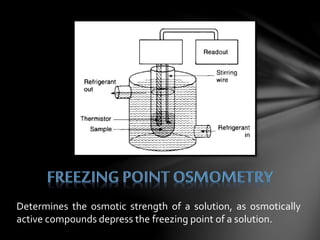
Determines the osmotic strength of a solution, as osmotically
active compounds depress the freezing point of a solution.
1. The sample in a small tube is lowered
into a chamber with cold refrigerant
circulating from a cooling point.
2. A thermistor is immersed in the sample.
3. To measure temperature, a wire is used
to gently stir the sample until it is cooled
to several degrees below its freezing
point. It is possible to cool water to as
low as -40°C and still have liquid water,
provided no crystals or particulate
matter is present—supercooled
solution.
4. Freezing can also be started by
“seeding” a supercooled solution
with crystals.
5. When the supercooled solution start
to freeze as a result of the rapid
stirring, a slush is formed and the
solution actually warms to its freezing
point temperature.
6. The slush will remain at the freezing
point temperature until the sample
freezes solid and drops below its
freezing point.
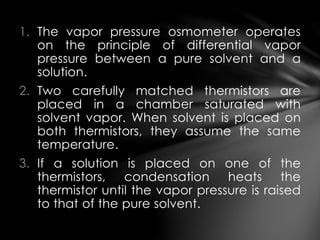
Determines the concentration of osmotically
active particles that reduce the vapor
pressure of a solution.
1. The vapor pressure osmometer operates
on the principle of differential vapor
pressure between a pure solvent and a
solution.
2. Two carefully matched thermistors are
placed in a chamber saturated with
solvent vapor. When solvent is placed on
both thermistors, they assume the same
temperature.
3. If a solution is placed on one of the
thermistors, condensation heats the
thermistor until the vapor pressure is raised
to that of the pure solvent.
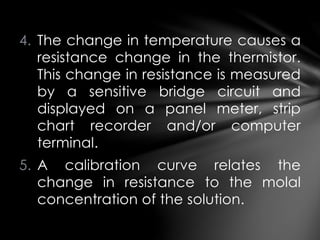
4. The change in temperature causes a
resistance change in the thermistor.
This change in resistance is measured
by a sensitive bridge circuit and
displayed on a panel meter, strip
chart recorder and/or computer
terminal.
5. A calibration curve relates the
change in resistance to the molal
concentration of the solution.
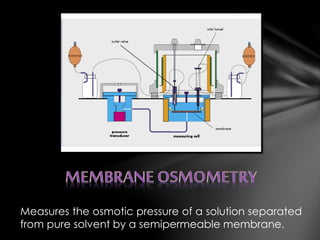
Measures the osmotic pressure of a solution separated
from pure solvent by a semipermeable membrane.
1. The solvent is separated from the polymer
solution by a semipermeable membrane which is
tightly held between the two chambers.
2.The solvent chamber is filled with solvent and
closed to the atmosphere except for the solvent
passage through the membrane while the solute
chamber is left open to the atmosphere.
3. The chemical potential of the solvent is much
higher than that of the solute, therefore there is
a tendency for flow to occur from the solvent
through the membrane to the polymer solution.
4. Because the solvent is permitted through the
membrane a change in concentration causes
the solvent to diffuse to the solute side of the
chamber. As this occurs, the pressure of the
solvent decreases until the pressure
difference across the membrane just
counteracts the chemical potential difference
caused by the solute.
5.This pressure reduction required to
equilibrate the chemical potential on both
sides of the membrane is regarded as the
osmotic pressure.
 Osmotic pressure is the minimum pressure which
needs to be applied to a solution to prevent the
inward flow of water across a semipermeable
membrane.
 Refrigerant- a compound that can readily
absorb heat at one temperature.
 Thermistor- a device for determining temperature;
also may be used for control of temperature.
 Slush- an equilibrium of liquid and ice crystals
 Freezing point- a temperature at which a liquid
solidifies.
 Freezing-point depression- describes the process
in which adding a solute to a solvent decreases
the freezing point of the solvent.
Definition of Terms
 Vapor pressure- defined as the pressure exerted
by a vapor in thermodynamic equilibrium with
its condensed phases (solid or liquid) at a given
temperature in a closed system.
 Condensation- the change of water from its
gaseous form (water vapor) into liquid water
 Pure solvent- a substance or liquid that is able
to dissolve another substance within itself.
 Molal concentration- also called as molality—
defined as the number of moles of solute
dissolved per kilogram of solvent (mol/kg = m).
Definition ofTerms

Osmometry report.pdf

  • 2.
    Osmometry- a laboratorytechnique to find the molecular weight of an unknown compound by determining the osmotic strength of a solution. Osmometer- an instrument that can find the osmotic strength of a solution or colloid using data from a semipermeable membrane, freezing point depression or vapor pressure.
  • 3.
    Determines the osmoticstrength of a solution, as osmotically active compounds depress the freezing point of a solution.
  • 4.
    1. The samplein a small tube is lowered into a chamber with cold refrigerant circulating from a cooling point. 2. A thermistor is immersed in the sample. 3. To measure temperature, a wire is used to gently stir the sample until it is cooled to several degrees below its freezing point. It is possible to cool water to as low as -40°C and still have liquid water, provided no crystals or particulate matter is present—supercooled solution.
  • 5.
    4. Freezing canalso be started by “seeding” a supercooled solution with crystals. 5. When the supercooled solution start to freeze as a result of the rapid stirring, a slush is formed and the solution actually warms to its freezing point temperature. 6. The slush will remain at the freezing point temperature until the sample freezes solid and drops below its freezing point.
  • 6.
    Determines the concentrationof osmotically active particles that reduce the vapor pressure of a solution.
  • 7.
    1. The vaporpressure osmometer operates on the principle of differential vapor pressure between a pure solvent and a solution. 2. Two carefully matched thermistors are placed in a chamber saturated with solvent vapor. When solvent is placed on both thermistors, they assume the same temperature. 3. If a solution is placed on one of the thermistors, condensation heats the thermistor until the vapor pressure is raised to that of the pure solvent.
  • 8.
    4. The changein temperature causes a resistance change in the thermistor. This change in resistance is measured by a sensitive bridge circuit and displayed on a panel meter, strip chart recorder and/or computer terminal. 5. A calibration curve relates the change in resistance to the molal concentration of the solution.
  • 9.
    Measures the osmoticpressure of a solution separated from pure solvent by a semipermeable membrane.
  • 10.
    1. The solventis separated from the polymer solution by a semipermeable membrane which is tightly held between the two chambers. 2.The solvent chamber is filled with solvent and closed to the atmosphere except for the solvent passage through the membrane while the solute chamber is left open to the atmosphere. 3. The chemical potential of the solvent is much higher than that of the solute, therefore there is a tendency for flow to occur from the solvent through the membrane to the polymer solution.
  • 11.
    4. Because thesolvent is permitted through the membrane a change in concentration causes the solvent to diffuse to the solute side of the chamber. As this occurs, the pressure of the solvent decreases until the pressure difference across the membrane just counteracts the chemical potential difference caused by the solute. 5.This pressure reduction required to equilibrate the chemical potential on both sides of the membrane is regarded as the osmotic pressure.
  • 12.
     Osmotic pressureis the minimum pressure which needs to be applied to a solution to prevent the inward flow of water across a semipermeable membrane.  Refrigerant- a compound that can readily absorb heat at one temperature.  Thermistor- a device for determining temperature; also may be used for control of temperature.  Slush- an equilibrium of liquid and ice crystals  Freezing point- a temperature at which a liquid solidifies.  Freezing-point depression- describes the process in which adding a solute to a solvent decreases the freezing point of the solvent. Definition of Terms
  • 13.
     Vapor pressure-defined as the pressure exerted by a vapor in thermodynamic equilibrium with its condensed phases (solid or liquid) at a given temperature in a closed system.  Condensation- the change of water from its gaseous form (water vapor) into liquid water  Pure solvent- a substance or liquid that is able to dissolve another substance within itself.  Molal concentration- also called as molality— defined as the number of moles of solute dissolved per kilogram of solvent (mol/kg = m). Definition ofTerms