Dr. D.V.S. REVATH VYAS
PG 1ST YEAR
DEPT OF ORAL MEDICINE
AND RADIOLOGY
-INTRODUCTION
-CALCIUM REGULATION IN BODY
-CALCIUM METABOLISM
-FACTORS REGULATING CALCIUM METABOLISM
-TOOTH MINERALISATION
CONTENTS
CONTENTS
-PHOSPHOROUS REGULATION IN BODY
-PHOSPHOROUS METABOLISM
-FACTORS REGULATING PHOSPHOROUS
METABOLISM
-APPLIED ASPECTS
The rigidity of skeleton which provides support and protection
for soft tissues, muscle contraction , the hardness and fitness
of the teeth, the stability of the cell membranes, as activator
of many hormones and last but not the least the heart beat it
self, is dependent on CALCIUM. With its myriads of functions
and complex mechanisms of control, calcium in both ionized and
unionized form is arguably one of the most important body
components.
INTRODUCTION
CALCIUM
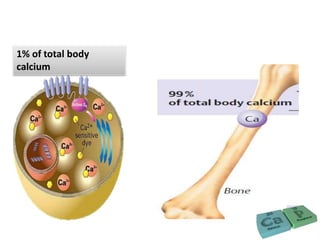
1% of total body
calcium
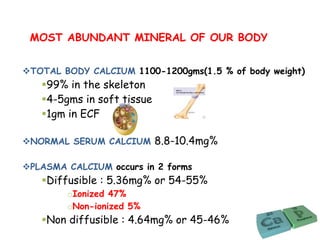
TOTAL BODY CALCIUM 1100-1200gms(1.5 % of body weight)
99% in the skeleton
4-5gms in soft tissue
1gm in ECF
NORMAL SERUM CALCIUM 8.8-10.4mg%
PLASMA CALCIUM occurs in 2 forms
Diffusible : 5.36mg% or 54-55%
oIonized 47%
oNon-ionized 5%
Non diffusible : 4.64mg% or 45-46%
MOST ABUNDANT MINERAL OF OUR BODY
ESTIMATION OF CALCIUM CONCENTRATION
• Ionized Ca concentration can be estimated from routine
laboratory tests, usually with reasonable accuracy
eg: plasma Ca is often low - Hypoalbuminemia
plasma Ca increases - Multiple myeloma
• Measured total plasma Ca decreases or increases by about 0.8
mg/dL (0.20 mmol/L) for every 1-g/dL decrease or increase in
albumin
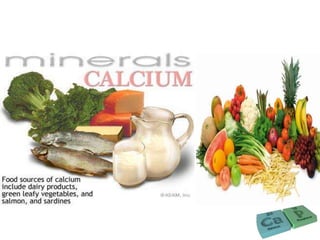
8-ounce glass of milk = 300mg of calcium
2 ounces of Swiss cheese = 530mg of calcium
6 ounces of yogurt = 300 mg of calcium
2 ounces of sardines with bones = 240mg of calcium
6 ounces of cooked turnip greens = 220mg of calcium
3 ounces of almonds = 210mg of calcium
“Avoid foods causing calcium loss.. For example excess salt
and caffeine”
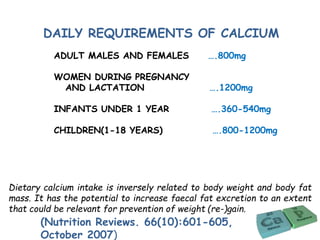
ADULT MALES AND FEMALES ….800mg
WOMEN DURING PREGNANCY
AND LACTATION ….1200mg
INFANTS UNDER 1 YEAR ….360-540mg
CHILDREN(1-18 YEARS) ….800-1200mg
DAILY REQUIREMENTS OF CALCIUM
.
Dietary calcium intake is inversely related to body weight and body fat
mass. It has the potential to increase faecal fat excretion to an extent
that could be relevant for prevention of weight (re-)gain.
(Nutrition Reviews. 66(10):601-605,
October 2007)
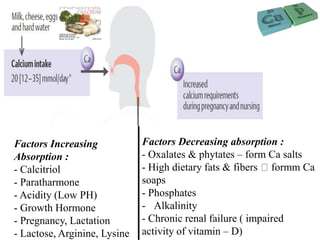
Factors Increasing
Absorption :
- Calcitriol
- Paratharmone
- Acidity (Low PH)
- Growth Hormone
- Pregnancy, Lactation
- Lactose, Arginine, Lysine
Factors Decreasing absorption :
- Oxalates & phytates – form Ca salts
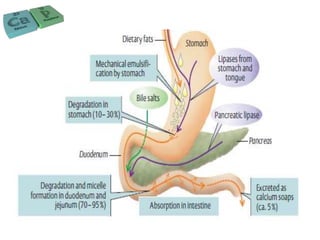
- High dietary fats & fibers formm Ca
soaps
- Phosphates
- Alkalinity
- Chronic renal failure ( impaired
activity of vitamin – D)
CALCIUM REGULATION IN THE BODY
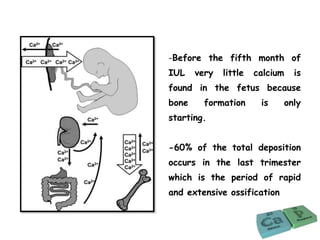
-Before the fifth month of
IUL very little calcium is
found in the fetus because
bone formation is only
starting.
-60% of the total deposition
occurs in the last trimester
which is the period of rapid
and extensive ossification
-One year old baby contains about 100 g of calcium, a gain of
70 g over the total calcium content at birth.
-The adult human weighing 70 kg contains about 1.2 to 1.4 kg
of calcium that is 1.5% of the body weight, 99% of which is
present in bones and teeth.
 Mature fetus contains about 30 g of calcium which constitutes
about 3 to 4% of maternal calcium
 Much greater drainage occurs after birth during lactation
TYPES OF CALCIUM
Calcium in plasma
3 forms:
Ionized (50%)
Nonionozed (8-10%)
Calcium bound to plasma protein (40-42%)
Calcium in bones:
2 forms:
Rapidly exchangeable calcium
Slowly exchangeable calcium
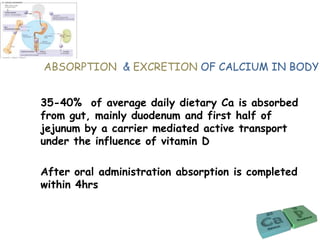
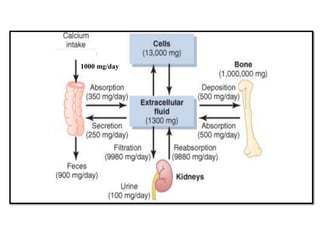
ABSORPTION & EXCRETION OF CALCIUM IN BODY
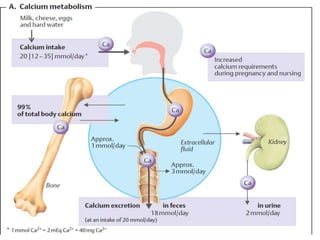
35-40% of average daily dietary Ca is absorbed
from gut, mainly duodenum and first half of
jejunum by a carrier mediated active transport
under the influence of vitamin D
After oral administration absorption is completed
within 4hrs
1000 mg/day
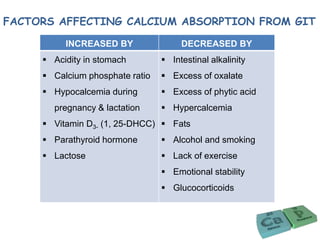
INCREASED BY DECREASED BY
 Acidity in stomach
 Calcium phosphate ratio
 Hypocalcemia during
pregnancy & lactation
 Vitamin D3- (1, 25-DHCC)
 Parathyroid hormone
 Lactose
 Intestinal alkalinity
 Excess of oxalate
 Excess of phytic acid
 Hypercalcemia
 Fats
 Alcohol and smoking
 Lack of exercise
 Emotional stability
 Glucocorticoids
FACTORS AFFECTING CALCIUM ABSORPTION FROM GIT
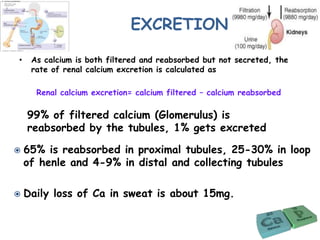
EXCRETION
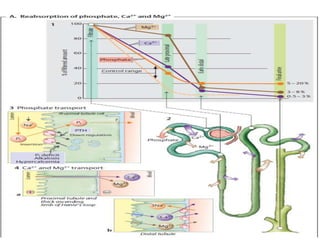
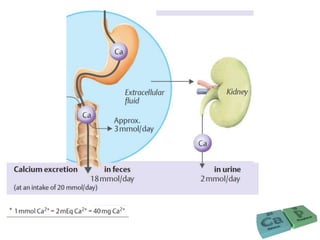
• As calcium is both filtered and reabsorbed but not secreted, the
rate of renal calcium excretion is calculated as
Renal calcium excretion= calcium filtered – calcium reabsorbed
99% of filtered calcium (Glomerulus) is
reabsorbed by the tubules, 1% gets excreted
 65% is reabsorbed in proximal tubules, 25-30% in loop
of henle and 4-9% in distal and collecting tubules
 Daily loss of Ca in sweat is about 15mg.
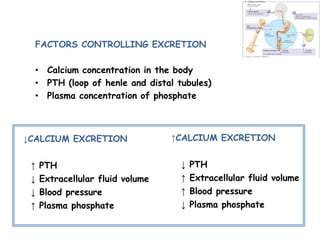
FACTORS CONTROLLING EXCRETION
• Calcium concentration in the body
• PTH (loop of henle and distal tubules)
• Plasma concentration of phosphate
↓CALCIUM EXCRETION
↑ PTH
↓ Extracellular fluid volume
↓ Blood pressure
↑ Plasma phosphate
↑CALCIUM EXCRETION
↓ PTH
↑ Extracellular fluid volume
↑ Blood pressure
↓ Plasma phosphate
HORMONES INFLUENCING CALCIUM ABSORPTION
• GROWTH HORMONE
• “PROLACTIN (Prolactin has been shown to stimulate
intestinal calcium absorption, increase bone turnover, and
reduce renal calcium excretion)”
Canadian Journal of Physiology & Pharmacology. 85(6):569-581, June 2007)
• GLUCOCORTICOIDS
FUNCTIONS OF CALCIUM
• Bone and teeth formation
• Neuronal activity
• Muscle activity
• Cardiac activity
• Cell division and growth
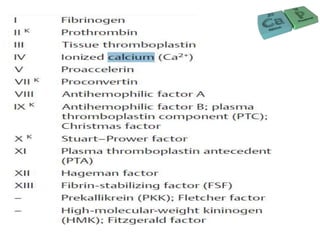
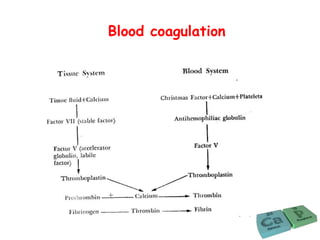
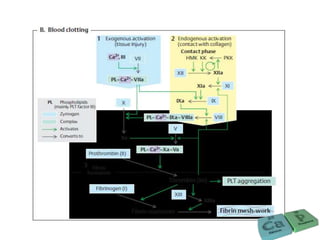
• Blood coagulation
• Excitability of nerves and muscles
• Maintains integrity of cell membrane
Constituent of bone and teeth
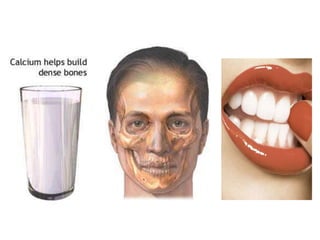
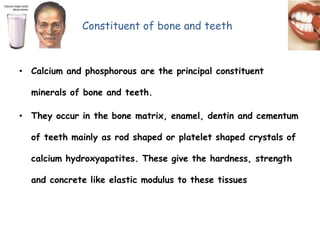
• Calcium and phosphorous are the principal constituent
minerals of bone and teeth.
• They occur in the bone matrix, enamel, dentin and cementum
of teeth mainly as rod shaped or platelet shaped crystals of
calcium hydroxyapatites. These give the hardness, strength
and concrete like elastic modulus to these tissues
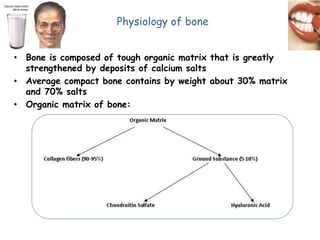
Physiology of bone
• Bone is composed of tough organic matrix that is greatly
strengthened by deposits of calcium salts
• Average compact bone contains by weight about 30% matrix
and 70% salts
• Organic matrix of bone:
BONE SALTS
 The crystalline salts deposited in the organic matrix of bone are
composed principally of calcium and phosphate.
 The major crystalline salt is known as hydroxyapatite
[Ca10(PO4)6(OH)2].
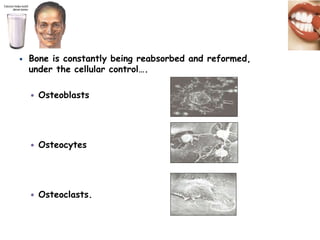
 Bone is constantly being reabsorbed and reformed,
under the cellular control….
 Osteoblasts
 Osteocytes
 Osteoclasts.
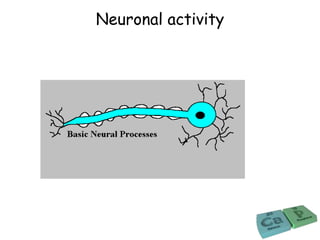
Neuronal activity
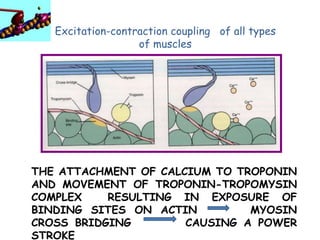
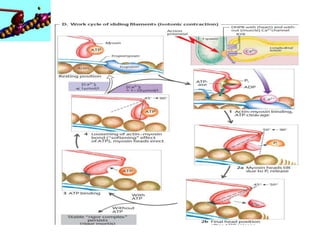
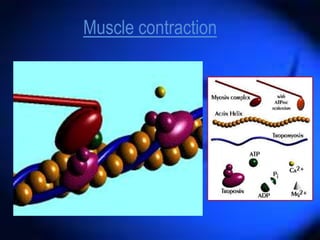
Excitation-contraction coupling of all types
of muscles
THE ATTACHMENT OF CALCIUM TO TROPONIN
AND MOVEMENT OF TROPONIN-TROPOMYSIN
COMPLEX RESULTING IN EXPOSURE OF
BINDING SITES ON ACTIN MYOSIN
CROSS BRIDGING CAUSING A POWER
STROKE
Muscle contraction
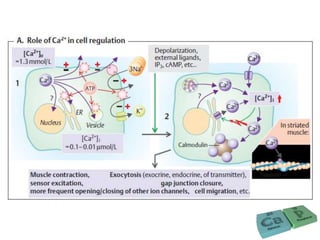
Membrane permeability
• Ca2+ reduces membrane permeability to ions and water,
probably by binding with calmodulin of cell membranes and
consequently changing the conformation and hydration of
membrane proteins.
Blood coagulation
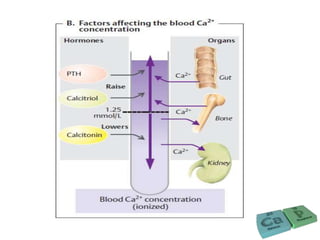
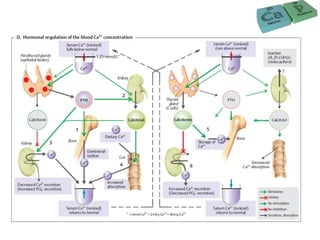
factors REGULATING CALCIUM METABOLISM
Vitamin D
Calcitonin
Parathyroid hormone
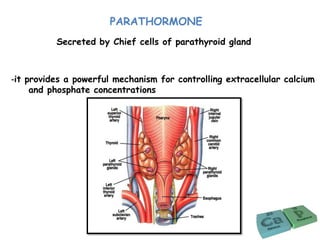
PARATHORMONE
-it provides a powerful mechanism for controlling extracellular calcium
and phosphate concentrations
Secreted by Chief cells of parathyroid gland
On blood calcium level:
1. Increases bone resorption/absorbtion
2. Increases renal Ca ++ absorption in distal tubules
3. Increases absorption of intestinal Ca++
On blood phosphate level:
1. Stimulates resorption of phosphate from bone
2. Increases urinary excretion
3. Increases absorption of phosphate from GIT through calcitriol
ACTIONS OF PTH
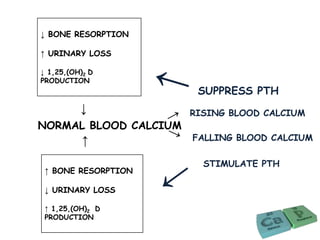
↓ BONE RESORPTION
↑ URINARY LOSS
↓ 1,25,(OH)2 D
PRODUCTION
↓
NORMAL BLOOD CALCIUM
↑
↑ BONE RESORPTION
↓ URINARY LOSS
↑ 1,25,(OH)2 D
PRODUCTION
SUPPRESS PTH
RISING BLOOD CALCIUM
FALLING BLOOD CALCIUM
STIMULATE PTH
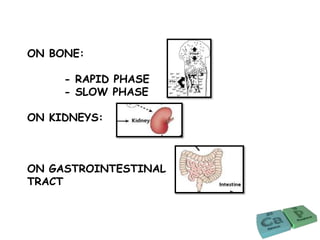
ON BONE:
- RAPID PHASE
- SLOW PHASE
ON KIDNEYS:
ON GASTROINTESTINAL
TRACT
Role of PTH in the activation of VITAMIN D
VITAMIN D IS A HORMONE BY CLASSIC CRITERIA: MADE
IN ONE PLACE (OR SEQUENTIALLY SEVERAL PLACES!),
AND ACTING IN OTHER
DAILY DIETARY ALLOWANCE RECOMMENDED:
- From infancy till puberty is 10 mcg of cholecalciferol (400
IU of vitamin D)
- In young adulthood, its 7.5 mcg
- After 25 yrs, 5 mcg required
Pregnancy and lactation 10 mcg
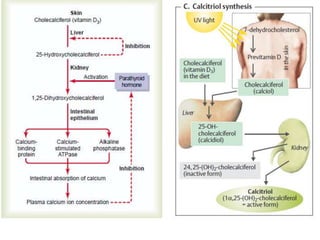
ACTIVATION Of VITAMIN D
BONE
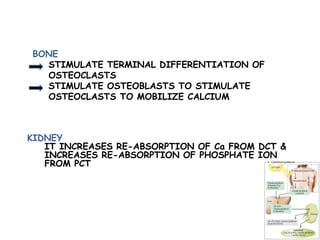
STIMULATE TERMINAL DIFFERENTIATION OF
OSTEOCLASTS
STIMULATE OSTEOBLASTS TO STIMULATE
OSTEOCLASTS TO MOBILIZE CALCIUM
KIDNEY
IT INCREASES RE-ABSORPTION OF Ca FROM DCT &
INCREASES RE-ABSORPTION OF PHOSPHATE ION
FROM PCT
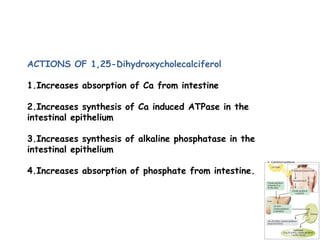
ACTIONS OF 1,25-Dihydroxycholecalciferol
1.Increases absorption of Ca from intestine
2.Increases synthesis of Ca induced ATPase in the
intestinal epithelium
3.Increases synthesis of alkaline phosphatase in the
intestinal epithelium
4.Increases absorption of phosphate from intestine.
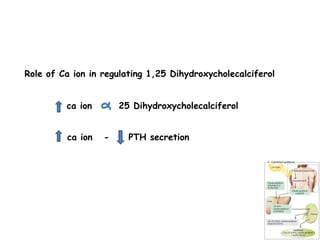
Role of Ca ion in regulating 1,25 Dihydroxycholecalciferol
ca ion 25 Dihydroxycholecalciferol
ca ion - PTH secretion
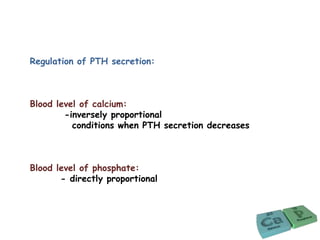
Regulation of PTH secretion:
Blood level of calcium:
-inversely proportional
conditions when PTH secretion decreases
Blood level of phosphate:
- directly proportional
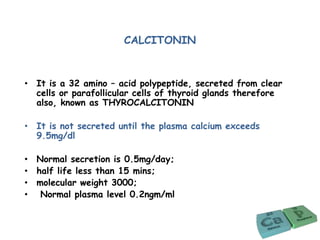
CALCITONIN
• It is a 32 amino – acid polypeptide, secreted from clear
cells or parafollicular cells of thyroid glands therefore
also, known as THYROCALCITONIN
• It is not secreted until the plasma calcium exceeds
9.5mg/dl
• Normal secretion is 0.5mg/day;
• half life less than 15 mins;
• molecular weight 3000;
• Normal plasma level 0.2ngm/ml
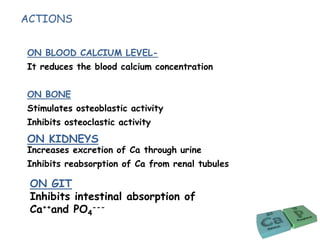
ACTIONS
ON BLOOD CALCIUM LEVEL-
It reduces the blood calcium concentration
ON BONE
Stimulates osteoblastic activity
Inhibits osteoclastic activity
Increases excretion of Ca through urine
Inhibits reabsorption of Ca from renal tubules
ON GIT
Inhibits intestinal absorption of
Ca++and PO4
---
ON KIDNEYS
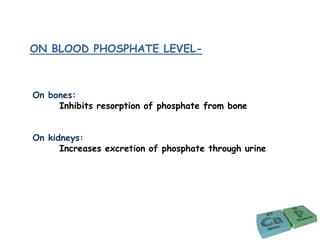
ON BLOOD PHOSPHATE LEVEL-
On bones:
Inhibits resorption of phosphate from bone
On kidneys:
Increases excretion of phosphate through urine
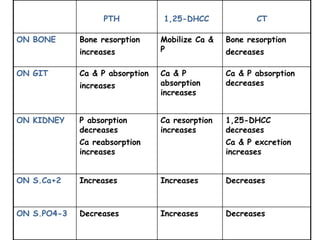
PTH 1,25-DHCC CT
ON BONE Bone resorption
increases
Mobilize Ca &
P
Bone resorption
decreases
ON GIT Ca & P absorption
increases
Ca & P
absorption
increases
Ca & P absorption
decreases
ON KIDNEY P absorption
decreases
Ca reabsorption
increases
Ca resorption
increases
1,25-DHCC
decreases
Ca & P excretion
increases
ON S.Ca+2 Increases Increases Decreases
ON S.PO4-3 Decreases Increases Decreases
Applied physiology –
Disorders of parathyroid glands ( two types )
1. HYPOPARATHYROIDISM
-causes: Parathyroidectomy
Thyroidectomy
Deficiency of receptor for PTH
1. HYPERPARATHYROIDISM
Primary hyperparathyroidism
Secondary hyperparathyroidism
Tertiary hyperparathyroidism
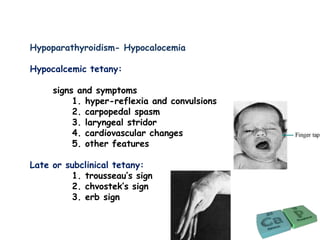
Hypoparathyroidism- Hypocalocemia
Hypocalcemic tetany:
signs and symptoms
1. hyper-reflexia and convulsions
2. carpopedal spasm
3. laryngeal stridor
4. cardiovascular changes
5. other features
Late or subclinical tetany:
1. trousseau’s sign
2. chvostek’s sign
3. erb sign
Hyperparathyroidism- hypercalcemia
signs and symptoms:
1. depression of the nervous system
2. sluggishness of reflex activities
3. reduced ST segment and QT interval in ECG
4. lack of appetite
5. constipation
Parathyroid function tests:
Measurement of blood Ca level
Chvostek’s sign and trousseau’s sign for hypoparathyroidism
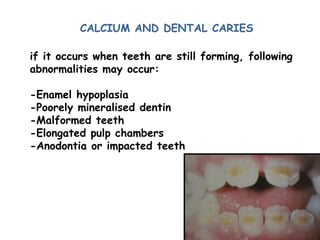
CALCIUM AND DENTAL CARIES
if it occurs when teeth are still forming, following
abnormalities may occur:
-Enamel hypoplasia
-Poorely mineralised dentin
-Malformed teeth
-Elongated pulp chambers
-Anodontia or impacted teeth
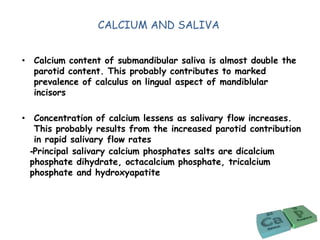
CALCIUM AND SALIVA
• Calcium content of submandibular saliva is almost double the
parotid content. This probably contributes to marked
prevalence of calculus on lingual aspect of mandiblular
incisors
• Concentration of calcium lessens as salivary flow increases.
This probably results from the increased parotid contribution
in rapid salivary flow rates
-Principal salivary calcium phosphates salts are dicalcium
phosphate dihydrate, octacalcium phosphate, tricalcium
phosphate and hydroxyapatite
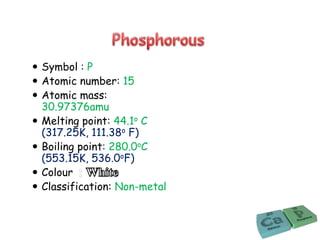
 Symbol : P
 Atomic number: 15
 Atomic mass:
30.97376amu
 Melting point: 44.1o C
(317.25K, 111.38o F)
 Boiling point: 280.0oC
(553.15K, 536.0oF)
 Colour
 Classification: Non-metal
• Key element in all the known forms of life
• Plays a major role in biological molecules such as RNA and DNA
• Main structural component of all the cellular membranes
• Living cells also utilize phosphate to transport cellular energy via
ATP
• Average person contains little less than 1 kg of phosphorous,
about 3quater present in bones and teeth in form of apatite
crystal
 It is found in ATP, cAMP, 2, 3-DPG (diphosphoglyceric
acid)
 Total body phosphate is 500-600gms,
 80-85% is in skeleton
 Remaining is in intracellular phosphate pool.
 Serum inorganic phosphate level:
 In adults: 2.5-4mg%
 In children: 5-6mg%
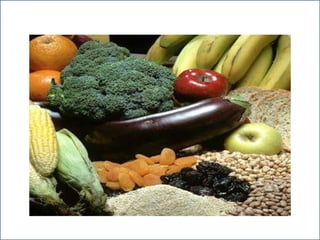
Sources of Phosphorus
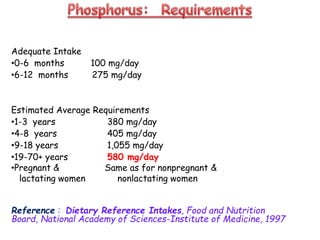
Adequate Intake
•0-6 months 100 mg/day
•6-12 months 275 mg/day
Estimated Average Requirements
•1-3 years 380 mg/day
•4-8 years 405 mg/day
•9-18 years 1,055 mg/day
•19-70+ years 580 mg/day
•Pregnant & Same as for nonpregnant &
lactating women nonlactating women
Reference : Dietary Reference Intakes, Food and Nutrition
Board, National Academy of Sciences-Institute of Medicine, 1997
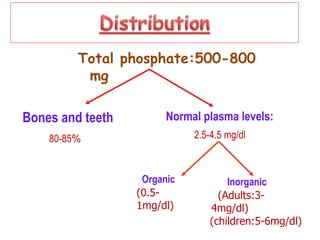
Total phosphate:500-800
mg
Bones and teeth
80-85%
Inorganic
(0.5-
1mg/dl)
(Adults:3-
4mg/dl)
(children:5-6mg/dl)
Normal plasma levels:
2.5-4.5 mg/dl
Organic
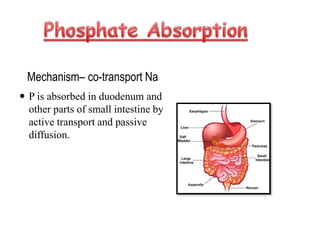
Mechanism– co-transport Na
 P is absorbed in duodenum and
other parts of small intestine by
active transport and passive
diffusion.
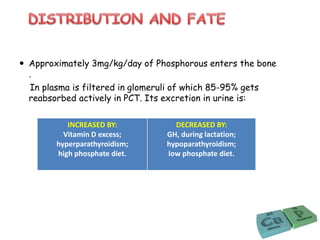
 Approximately 3mg/kg/day of Phosphorous enters the bone
.
In plasma is filtered in glomeruli of which 85-95% gets
reabsorbed actively in PCT. Its excretion in urine is:
INCREASED BY:
Vitamin D excess;
hyperparathyroidism;
high phosphate diet.
DECREASED BY:
GH, during lactation;
hypoparathyroidism;
low phosphate diet.
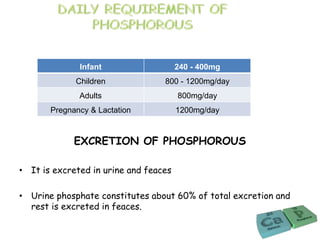
EXCRETION OF PHOSPHOROUS
• It is excreted in urine and feaces
• Urine phosphate constitutes about 60% of total excretion and
rest is excreted in feaces.
Infant 240 - 400mg
Children 800 - 1200mg/day
Adults 800mg/day
Pregnancy & Lactation 1200mg/day
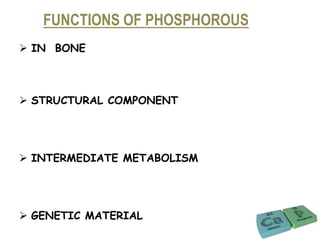
 IN BONE
 STRUCTURAL COMPONENT
 INTERMEDIATE METABOLISM
 GENETIC MATERIAL
FUNCTIONS OF PHOSPHOROUS
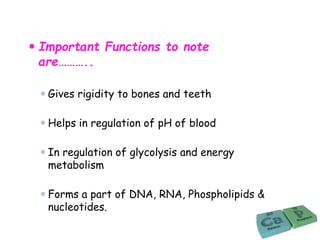
 Important Functions to note
are………..
 Gives rigidity to bones and teeth
 Helps in regulation of pH of blood
 In regulation of glycolysis and energy
metabolism
 Forms a part of DNA, RNA, Phospholipids &
nucleotides.
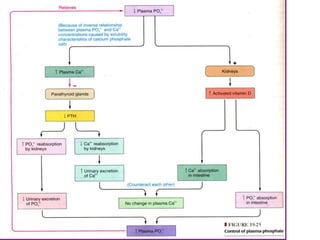
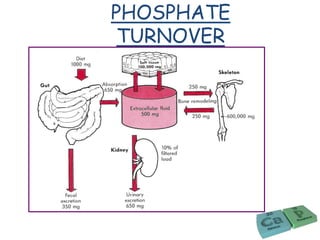
PHOSPHATE
TURNOVER
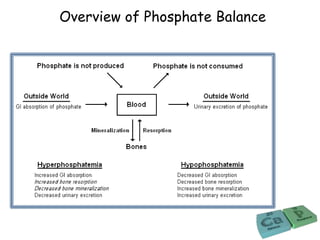
Overview of Phosphate Balance
Conditions arising from
disruption / irregularities
of phosphate metabolism
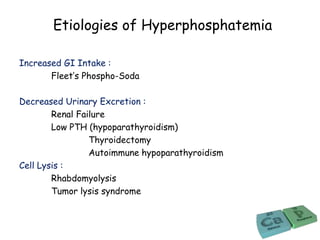
Etiologies of Hyperphosphatemia
Increased GI Intake :
Fleet’s Phospho-Soda
Decreased Urinary Excretion :
Renal Failure
Low PTH (hypoparathyroidism)
Thyroidectomy
Autoimmune hypoparathyroidism
Cell Lysis :
Rhabdomyolysis
Tumor lysis syndrome
Etiologies of Hypophosphatemia
Decreased GI Absorption
Decreased dietary intake
Diarrhea / Malabsorption
Phosphate binders (calcium acetate, Al & Mg
containing antacids)
Decreased Bone Resorption / Increased Bone Mineralization
Vitamin D deficiency / low calcitriol
Hungry bones syndrome
Osteoblastic metastases
Increased Urinary Excretion
Elevated PTH (as in primary hyperparathyroidism)
Vitamin D deficiency / low calcitriol
Fanconi’s syndrome
Internal Redistribution (due to acute stimulation of
glycolysis)
Refeeding syndrome (seen in starvation, anorexia, and
alcoholism)
During treatment for Diabetic keto acidosis
Etiologies of Hypophosphatemia
Applied physiology
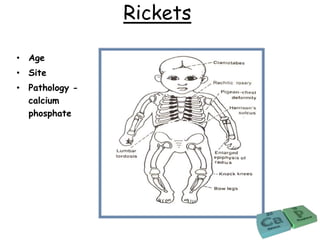
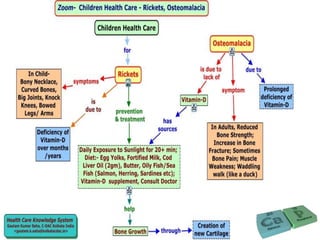
Rickets
• Age
• Site
• Pathology -
calcium
phosphate
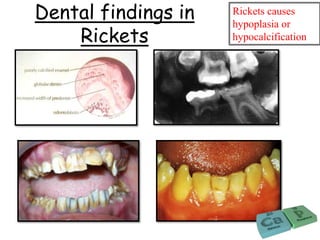
Dental findings in
Rickets
Rickets causes
hypoplasia or
hypocalcification
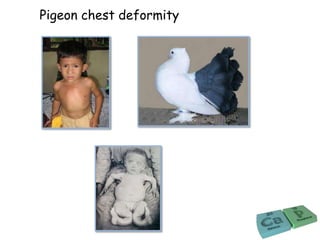
Pigeon chest deformity
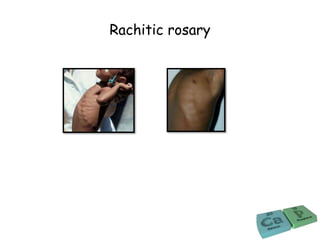
Rachitic rosary
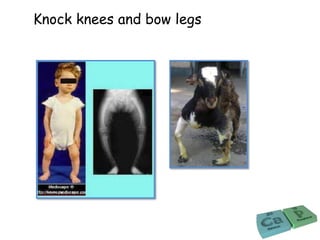
Knock knees and bow legs
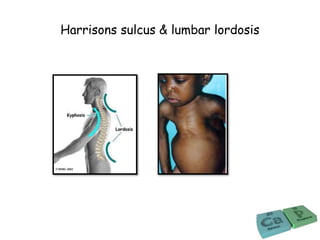
Harrisons sulcus & lumbar lordosis
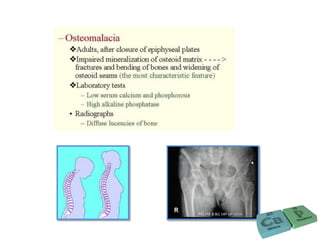
OSTEOMALACIA OR ADULT
RICKETS
• The amount of mineral accretion in bone per unit bone matrix is
deficient due to inadequate absorption of Ca and decreased
amount of phosphorous owing to deficiency of vitamin D&C in
diet.
• Disease is limited to females, usually after multiple pregnancies
&lactation but symptoms tend to clear up after lactation is
completed.
• The bones especially pelvic girdle, ribs & femur become soft,
painful & deformed.
PSEUDOHYPOPARATHYROIDISM
 The patients have normal parathyroid glands, but they fail to
respond to parathyroid hormone or PTH injections
 Autosomal dominant
 Symptoms and signs
 Hypocalcemia
 Hyperphosphatemia
 Characteristic physical appearance: short stature, round face,
short thick neck, obesity, shortening of the metacarpals
 Resistance to parathyroid hormone
 Symptoms begin in children of about 8 years
 Tetany and seizures
 Hypoplasia of dentin or enamel and delay or absence of
eruption occurs in 50% of people with the disorder
 Rx: Vitamin D and calcium
Adequate amount of phosphorous in diet
PSEUDOHYPOPARATHYROIDISM
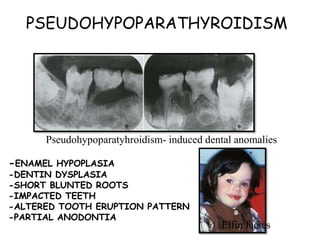
Pseudohypoparatyhroidism- induced dental anomalies
-ENAMEL HYPOPLASIA
-DENTIN DYSPLASIA
-SHORT BLUNTED ROOTS
-IMPACTED TEETH
-ALTERED TOOTH ERUPTION PATTERN
-PARTIAL ANODONTIA
Elfin facies
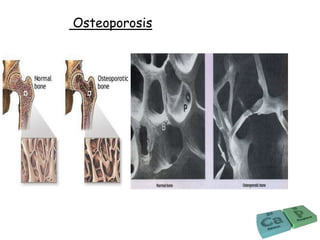
Osteoporosis
Osteoporosis
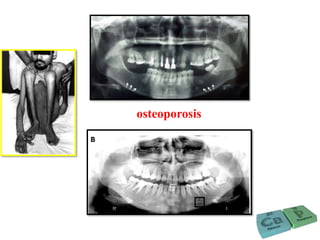
osteoporosis
PRIMARY HYPERPARATHYROIDISM
• Women (especially postmenopausal) are more commonly affected
than men (Scutellari et al, 1996).
• Causes
– SPORADIC ADENOMA(s) MOST COMMON CAUSE
– MULTIPLE ENDOCRINE NEOPLASIA TYPE 1 (MEN-1):
PARATHYROID TUMORS (AND PITUITARY AND
PANCREAS)
– MEN-2a: PARATHYROID TUMORS, MEDULLARY THYROID
CANCER (OR HYPERPLASIA), AND PHEOCHROMOCYTOMA
– FAMILIAL HYPERPARATHYROIDISM: 1o HPT WITHOUT
THE OTHER TUMORS SEEN IN MEN-1 OR MEN-2a
– FAMILIAL BENIGN HYPOCALCIURIC HYPERCALCEMIA
Characterized by:
• ↑ serum Ca2+
• ↓ serum phosphate
• ↑ urinary phosphate excretion (phosphaturic effect of PTH)
• ↓ urinary Ca2+ excretion (caused by ↑ Ca2+ reabsorption)
• ↑ urinary (nephrogenous) cAMP
• ↑ bone resorption
• Osteoblastic activity increases in an attempt to make for
the resorbed bone. They secrete large quantities of alkaline
phosphatase
Clinical features
“Painful Bones, Renal Stones, Abdominal Groans,
Psychiatric Moans”
• Pain Due To # Of Bones
• Renal Stones (Nephrolithiasis) With Pain And Obstructive Uropathy
• GI Disturbances -Constipation, Pancreatitis, Nausea, Peptic Ulcrs
• CNS Alterations Including Depression, Lethargy And Seizures
• Neuromuscular Abnormality Including Weakness And Hypotonia
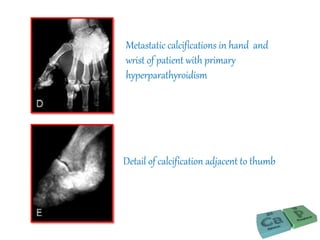
• Metastatic calcifications seen in subcutaneous soft tissues,
sclera, dura and region around joints
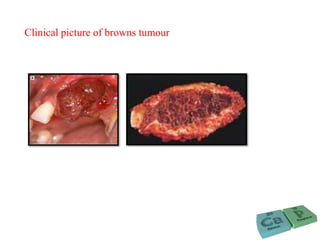
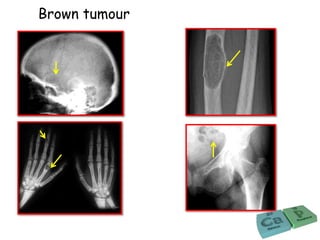
• Brown tumor
• Affect mandible, clavicles, ribs and pelvis
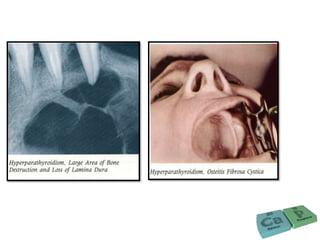
• Osteitis fibrosa cystica- develops from central degeneration
and fibrosis of long standing brown tumor
Clinical picture of browns tumour
Brown tumour
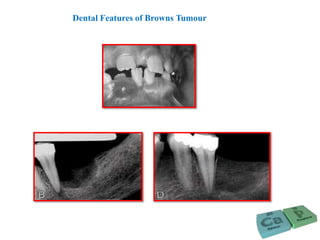
Dental Features of Browns Tumour
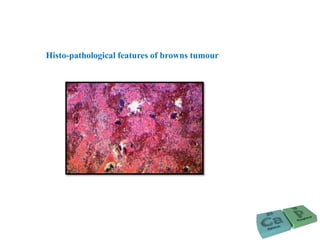
Histo-pathological features of browns tumour
Radiological features
• First radiological sign is subperiosteal resorption of
phalanges of index and middle fingers
• Unilocular or multilocular cystic radiolucencies in bone
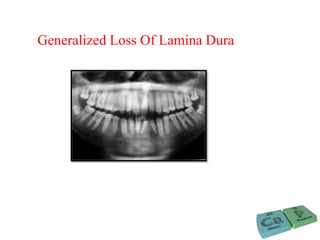
• Generalized Attenuation or loss of lamina dura surrounding
the teeth
• Decrease in trabecular density and blurring of normal
trabecular pattern, giving ‘ground glass’ appearance
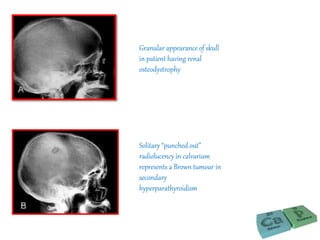
Granular appearance of skull
in patient having renal
osteodystrophy
Solitary “punched out”
radiolucency in calvarium
represents a Brown tumour in
secondary
hyperparathyroidism
Generalized Loss Of Lamina Dura
Metastatic calcifications in hand and
wrist of patient with primary
hyperparathyroidism
Detail of calcification adjacent to thumb
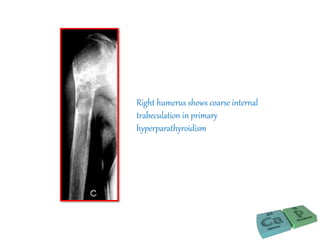
Right humerus shows coarse internal
trabeculation in primary
hyperparathyroidism
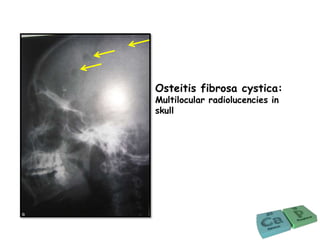
Osteitis fibrosa cystica:
Multilocular radiolucencies in
skull
Treatment:
• Hyperplastic parathyroid tissue or
functional tumor is removed surgically
to reduce PTH levels to normal
SECONDARY HYPERPARATHYROIDISM
• Secondary hyperparathyroidism results in excess secretion of
parathyroid hormone due to parathyroid hyperplasia
compensating for a metabolic disorder that has resulted in
retention of phosphate or depletion of the serum calcium
level
(Ganibegovic, 2000).
• Renal osteodystrophy refers to skeletal changes that result
from chronic renal failure
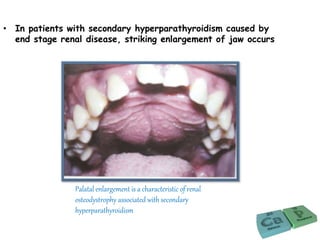
• In patients with secondary hyperparathyroidism caused by
end stage renal disease, striking enlargement of jaw occurs
Palatal enlargement is a characteristic of renal
osteodystrophy associated with secondary
hyperparathyroidism
• Bone lesions in digits, clavicle
• Mottling of skull, erosion of the distal clavicle, rib fractures
and necrosis of femoral head.
• Children show osteomalacia
Treatment
• Restriction of dietary phosphate
• Use of phosphate binding agents (calcium carbonate or calcium
acetate)
• Use of calcimimetic agents like cinacalcet
(Nephrol Dial Transplant (2002) 17: 204-207)
• Treatment with an active vitamin D metabolite
• Synthetic salmon calcitonin can be used
• Renal transplant: An ideal treatment
REFERENCES
–Textbook of medical physiology
by Guyton & Hall; 10th Edition
–The physiology & biochemistry of
the mouth by G Neil Jenkins; 4th
Edition
–Textbook of physiology by Prof.
A. K. Jain
–Textbook of Endodontics - Ingle
Thank you…

Calcium and phosphate METABOLISM

  • 2.
    Dr. D.V.S. REVATHVYAS PG 1ST YEAR DEPT OF ORAL MEDICINE AND RADIOLOGY
  • 3.
    -INTRODUCTION -CALCIUM REGULATION INBODY -CALCIUM METABOLISM -FACTORS REGULATING CALCIUM METABOLISM -TOOTH MINERALISATION CONTENTS
  • 4.
    CONTENTS -PHOSPHOROUS REGULATION INBODY -PHOSPHOROUS METABOLISM -FACTORS REGULATING PHOSPHOROUS METABOLISM -APPLIED ASPECTS
  • 7.
    The rigidity ofskeleton which provides support and protection for soft tissues, muscle contraction , the hardness and fitness of the teeth, the stability of the cell membranes, as activator of many hormones and last but not the least the heart beat it self, is dependent on CALCIUM. With its myriads of functions and complex mechanisms of control, calcium in both ionized and unionized form is arguably one of the most important body components. INTRODUCTION
  • 8.
  • 9.
    1% of totalbody calcium
  • 10.
    TOTAL BODY CALCIUM1100-1200gms(1.5 % of body weight) 99% in the skeleton 4-5gms in soft tissue 1gm in ECF NORMAL SERUM CALCIUM 8.8-10.4mg% PLASMA CALCIUM occurs in 2 forms Diffusible : 5.36mg% or 54-55% oIonized 47% oNon-ionized 5% Non diffusible : 4.64mg% or 45-46% MOST ABUNDANT MINERAL OF OUR BODY
  • 11.
    ESTIMATION OF CALCIUMCONCENTRATION • Ionized Ca concentration can be estimated from routine laboratory tests, usually with reasonable accuracy eg: plasma Ca is often low - Hypoalbuminemia plasma Ca increases - Multiple myeloma • Measured total plasma Ca decreases or increases by about 0.8 mg/dL (0.20 mmol/L) for every 1-g/dL decrease or increase in albumin
  • 13.
    8-ounce glass ofmilk = 300mg of calcium 2 ounces of Swiss cheese = 530mg of calcium 6 ounces of yogurt = 300 mg of calcium 2 ounces of sardines with bones = 240mg of calcium 6 ounces of cooked turnip greens = 220mg of calcium 3 ounces of almonds = 210mg of calcium “Avoid foods causing calcium loss.. For example excess salt and caffeine”
  • 14.
    ADULT MALES ANDFEMALES ….800mg WOMEN DURING PREGNANCY AND LACTATION ….1200mg INFANTS UNDER 1 YEAR ….360-540mg CHILDREN(1-18 YEARS) ….800-1200mg DAILY REQUIREMENTS OF CALCIUM . Dietary calcium intake is inversely related to body weight and body fat mass. It has the potential to increase faecal fat excretion to an extent that could be relevant for prevention of weight (re-)gain. (Nutrition Reviews. 66(10):601-605, October 2007)
  • 15.
    Factors Increasing Absorption : -Calcitriol - Paratharmone - Acidity (Low PH) - Growth Hormone - Pregnancy, Lactation - Lactose, Arginine, Lysine Factors Decreasing absorption : - Oxalates & phytates – form Ca salts - High dietary fats & fibers formm Ca soaps - Phosphates - Alkalinity - Chronic renal failure ( impaired activity of vitamin – D)
  • 16.
  • 19.
    -Before the fifthmonth of IUL very little calcium is found in the fetus because bone formation is only starting. -60% of the total deposition occurs in the last trimester which is the period of rapid and extensive ossification
  • 20.
    -One year oldbaby contains about 100 g of calcium, a gain of 70 g over the total calcium content at birth. -The adult human weighing 70 kg contains about 1.2 to 1.4 kg of calcium that is 1.5% of the body weight, 99% of which is present in bones and teeth.  Mature fetus contains about 30 g of calcium which constitutes about 3 to 4% of maternal calcium  Much greater drainage occurs after birth during lactation
  • 21.
    TYPES OF CALCIUM Calciumin plasma 3 forms: Ionized (50%) Nonionozed (8-10%) Calcium bound to plasma protein (40-42%) Calcium in bones: 2 forms: Rapidly exchangeable calcium Slowly exchangeable calcium
  • 22.
    ABSORPTION & EXCRETIONOF CALCIUM IN BODY 35-40% of average daily dietary Ca is absorbed from gut, mainly duodenum and first half of jejunum by a carrier mediated active transport under the influence of vitamin D After oral administration absorption is completed within 4hrs
  • 23.
  • 24.
    INCREASED BY DECREASEDBY  Acidity in stomach  Calcium phosphate ratio  Hypocalcemia during pregnancy & lactation  Vitamin D3- (1, 25-DHCC)  Parathyroid hormone  Lactose  Intestinal alkalinity  Excess of oxalate  Excess of phytic acid  Hypercalcemia  Fats  Alcohol and smoking  Lack of exercise  Emotional stability  Glucocorticoids FACTORS AFFECTING CALCIUM ABSORPTION FROM GIT
  • 25.
    EXCRETION • As calciumis both filtered and reabsorbed but not secreted, the rate of renal calcium excretion is calculated as Renal calcium excretion= calcium filtered – calcium reabsorbed 99% of filtered calcium (Glomerulus) is reabsorbed by the tubules, 1% gets excreted  65% is reabsorbed in proximal tubules, 25-30% in loop of henle and 4-9% in distal and collecting tubules  Daily loss of Ca in sweat is about 15mg.
  • 29.
    FACTORS CONTROLLING EXCRETION •Calcium concentration in the body • PTH (loop of henle and distal tubules) • Plasma concentration of phosphate ↓CALCIUM EXCRETION ↑ PTH ↓ Extracellular fluid volume ↓ Blood pressure ↑ Plasma phosphate ↑CALCIUM EXCRETION ↓ PTH ↑ Extracellular fluid volume ↑ Blood pressure ↓ Plasma phosphate
  • 30.
    HORMONES INFLUENCING CALCIUMABSORPTION • GROWTH HORMONE • “PROLACTIN (Prolactin has been shown to stimulate intestinal calcium absorption, increase bone turnover, and reduce renal calcium excretion)” Canadian Journal of Physiology & Pharmacology. 85(6):569-581, June 2007) • GLUCOCORTICOIDS
  • 31.
    FUNCTIONS OF CALCIUM •Bone and teeth formation • Neuronal activity • Muscle activity • Cardiac activity • Cell division and growth • Blood coagulation • Excitability of nerves and muscles • Maintains integrity of cell membrane
  • 33.
    Constituent of boneand teeth • Calcium and phosphorous are the principal constituent minerals of bone and teeth. • They occur in the bone matrix, enamel, dentin and cementum of teeth mainly as rod shaped or platelet shaped crystals of calcium hydroxyapatites. These give the hardness, strength and concrete like elastic modulus to these tissues
  • 34.
    Physiology of bone •Bone is composed of tough organic matrix that is greatly strengthened by deposits of calcium salts • Average compact bone contains by weight about 30% matrix and 70% salts • Organic matrix of bone:
  • 35.
    BONE SALTS  Thecrystalline salts deposited in the organic matrix of bone are composed principally of calcium and phosphate.  The major crystalline salt is known as hydroxyapatite [Ca10(PO4)6(OH)2].
  • 36.
     Bone isconstantly being reabsorbed and reformed, under the cellular control….  Osteoblasts  Osteocytes  Osteoclasts.
  • 37.
  • 38.
    Excitation-contraction coupling ofall types of muscles THE ATTACHMENT OF CALCIUM TO TROPONIN AND MOVEMENT OF TROPONIN-TROPOMYSIN COMPLEX RESULTING IN EXPOSURE OF BINDING SITES ON ACTIN MYOSIN CROSS BRIDGING CAUSING A POWER STROKE
  • 40.
  • 41.
    Membrane permeability • Ca2+reduces membrane permeability to ions and water, probably by binding with calmodulin of cell membranes and consequently changing the conformation and hydration of membrane proteins.
  • 46.
  • 51.
    factors REGULATING CALCIUMMETABOLISM Vitamin D Calcitonin Parathyroid hormone
  • 52.
    PARATHORMONE -it provides apowerful mechanism for controlling extracellular calcium and phosphate concentrations Secreted by Chief cells of parathyroid gland
  • 53.
    On blood calciumlevel: 1. Increases bone resorption/absorbtion 2. Increases renal Ca ++ absorption in distal tubules 3. Increases absorption of intestinal Ca++ On blood phosphate level: 1. Stimulates resorption of phosphate from bone 2. Increases urinary excretion 3. Increases absorption of phosphate from GIT through calcitriol ACTIONS OF PTH
  • 54.
    ↓ BONE RESORPTION ↑URINARY LOSS ↓ 1,25,(OH)2 D PRODUCTION ↓ NORMAL BLOOD CALCIUM ↑ ↑ BONE RESORPTION ↓ URINARY LOSS ↑ 1,25,(OH)2 D PRODUCTION SUPPRESS PTH RISING BLOOD CALCIUM FALLING BLOOD CALCIUM STIMULATE PTH
  • 55.
    ON BONE: - RAPIDPHASE - SLOW PHASE ON KIDNEYS: ON GASTROINTESTINAL TRACT
  • 56.
    Role of PTHin the activation of VITAMIN D VITAMIN D IS A HORMONE BY CLASSIC CRITERIA: MADE IN ONE PLACE (OR SEQUENTIALLY SEVERAL PLACES!), AND ACTING IN OTHER DAILY DIETARY ALLOWANCE RECOMMENDED: - From infancy till puberty is 10 mcg of cholecalciferol (400 IU of vitamin D) - In young adulthood, its 7.5 mcg - After 25 yrs, 5 mcg required Pregnancy and lactation 10 mcg
  • 57.
  • 59.
    BONE STIMULATE TERMINAL DIFFERENTIATIONOF OSTEOCLASTS STIMULATE OSTEOBLASTS TO STIMULATE OSTEOCLASTS TO MOBILIZE CALCIUM KIDNEY IT INCREASES RE-ABSORPTION OF Ca FROM DCT & INCREASES RE-ABSORPTION OF PHOSPHATE ION FROM PCT
  • 60.
    ACTIONS OF 1,25-Dihydroxycholecalciferol 1.Increasesabsorption of Ca from intestine 2.Increases synthesis of Ca induced ATPase in the intestinal epithelium 3.Increases synthesis of alkaline phosphatase in the intestinal epithelium 4.Increases absorption of phosphate from intestine.
  • 61.
    Role of Caion in regulating 1,25 Dihydroxycholecalciferol ca ion 25 Dihydroxycholecalciferol ca ion - PTH secretion
  • 62.
    Regulation of PTHsecretion: Blood level of calcium: -inversely proportional conditions when PTH secretion decreases Blood level of phosphate: - directly proportional
  • 63.
    CALCITONIN • It isa 32 amino – acid polypeptide, secreted from clear cells or parafollicular cells of thyroid glands therefore also, known as THYROCALCITONIN • It is not secreted until the plasma calcium exceeds 9.5mg/dl • Normal secretion is 0.5mg/day; • half life less than 15 mins; • molecular weight 3000; • Normal plasma level 0.2ngm/ml
  • 64.
    ACTIONS ON BLOOD CALCIUMLEVEL- It reduces the blood calcium concentration ON BONE Stimulates osteoblastic activity Inhibits osteoclastic activity Increases excretion of Ca through urine Inhibits reabsorption of Ca from renal tubules ON GIT Inhibits intestinal absorption of Ca++and PO4 --- ON KIDNEYS
  • 65.
    ON BLOOD PHOSPHATELEVEL- On bones: Inhibits resorption of phosphate from bone On kidneys: Increases excretion of phosphate through urine
  • 66.
    PTH 1,25-DHCC CT ONBONE Bone resorption increases Mobilize Ca & P Bone resorption decreases ON GIT Ca & P absorption increases Ca & P absorption increases Ca & P absorption decreases ON KIDNEY P absorption decreases Ca reabsorption increases Ca resorption increases 1,25-DHCC decreases Ca & P excretion increases ON S.Ca+2 Increases Increases Decreases ON S.PO4-3 Decreases Increases Decreases
  • 67.
    Applied physiology – Disordersof parathyroid glands ( two types ) 1. HYPOPARATHYROIDISM -causes: Parathyroidectomy Thyroidectomy Deficiency of receptor for PTH 1. HYPERPARATHYROIDISM Primary hyperparathyroidism Secondary hyperparathyroidism Tertiary hyperparathyroidism
  • 68.
    Hypoparathyroidism- Hypocalocemia Hypocalcemic tetany: signsand symptoms 1. hyper-reflexia and convulsions 2. carpopedal spasm 3. laryngeal stridor 4. cardiovascular changes 5. other features Late or subclinical tetany: 1. trousseau’s sign 2. chvostek’s sign 3. erb sign
  • 69.
    Hyperparathyroidism- hypercalcemia signs andsymptoms: 1. depression of the nervous system 2. sluggishness of reflex activities 3. reduced ST segment and QT interval in ECG 4. lack of appetite 5. constipation Parathyroid function tests: Measurement of blood Ca level Chvostek’s sign and trousseau’s sign for hypoparathyroidism
  • 70.
    CALCIUM AND DENTALCARIES if it occurs when teeth are still forming, following abnormalities may occur: -Enamel hypoplasia -Poorely mineralised dentin -Malformed teeth -Elongated pulp chambers -Anodontia or impacted teeth
  • 71.
    CALCIUM AND SALIVA •Calcium content of submandibular saliva is almost double the parotid content. This probably contributes to marked prevalence of calculus on lingual aspect of mandiblular incisors • Concentration of calcium lessens as salivary flow increases. This probably results from the increased parotid contribution in rapid salivary flow rates -Principal salivary calcium phosphates salts are dicalcium phosphate dihydrate, octacalcium phosphate, tricalcium phosphate and hydroxyapatite
  • 72.
     Symbol :P  Atomic number: 15  Atomic mass: 30.97376amu  Melting point: 44.1o C (317.25K, 111.38o F)  Boiling point: 280.0oC (553.15K, 536.0oF)  Colour  Classification: Non-metal
  • 73.
    • Key elementin all the known forms of life • Plays a major role in biological molecules such as RNA and DNA • Main structural component of all the cellular membranes • Living cells also utilize phosphate to transport cellular energy via ATP • Average person contains little less than 1 kg of phosphorous, about 3quater present in bones and teeth in form of apatite crystal
  • 74.
     It isfound in ATP, cAMP, 2, 3-DPG (diphosphoglyceric acid)  Total body phosphate is 500-600gms,  80-85% is in skeleton  Remaining is in intracellular phosphate pool.  Serum inorganic phosphate level:  In adults: 2.5-4mg%  In children: 5-6mg%
  • 75.
  • 76.
    Adequate Intake •0-6 months100 mg/day •6-12 months 275 mg/day Estimated Average Requirements •1-3 years 380 mg/day •4-8 years 405 mg/day •9-18 years 1,055 mg/day •19-70+ years 580 mg/day •Pregnant & Same as for nonpregnant & lactating women nonlactating women Reference : Dietary Reference Intakes, Food and Nutrition Board, National Academy of Sciences-Institute of Medicine, 1997
  • 77.
    Total phosphate:500-800 mg Bones andteeth 80-85% Inorganic (0.5- 1mg/dl) (Adults:3- 4mg/dl) (children:5-6mg/dl) Normal plasma levels: 2.5-4.5 mg/dl Organic
  • 78.
    Mechanism– co-transport Na P is absorbed in duodenum and other parts of small intestine by active transport and passive diffusion.
  • 79.
     Approximately 3mg/kg/dayof Phosphorous enters the bone . In plasma is filtered in glomeruli of which 85-95% gets reabsorbed actively in PCT. Its excretion in urine is: INCREASED BY: Vitamin D excess; hyperparathyroidism; high phosphate diet. DECREASED BY: GH, during lactation; hypoparathyroidism; low phosphate diet.
  • 80.
    EXCRETION OF PHOSPHOROUS •It is excreted in urine and feaces • Urine phosphate constitutes about 60% of total excretion and rest is excreted in feaces. Infant 240 - 400mg Children 800 - 1200mg/day Adults 800mg/day Pregnancy & Lactation 1200mg/day
  • 81.
     IN BONE STRUCTURAL COMPONENT  INTERMEDIATE METABOLISM  GENETIC MATERIAL FUNCTIONS OF PHOSPHOROUS
  • 82.
     Important Functionsto note are………..  Gives rigidity to bones and teeth  Helps in regulation of pH of blood  In regulation of glycolysis and energy metabolism  Forms a part of DNA, RNA, Phospholipids & nucleotides.
  • 84.
  • 85.
  • 86.
    Conditions arising from disruption/ irregularities of phosphate metabolism
  • 87.
    Etiologies of Hyperphosphatemia IncreasedGI Intake : Fleet’s Phospho-Soda Decreased Urinary Excretion : Renal Failure Low PTH (hypoparathyroidism) Thyroidectomy Autoimmune hypoparathyroidism Cell Lysis : Rhabdomyolysis Tumor lysis syndrome
  • 88.
    Etiologies of Hypophosphatemia DecreasedGI Absorption Decreased dietary intake Diarrhea / Malabsorption Phosphate binders (calcium acetate, Al & Mg containing antacids) Decreased Bone Resorption / Increased Bone Mineralization Vitamin D deficiency / low calcitriol Hungry bones syndrome Osteoblastic metastases
  • 89.
    Increased Urinary Excretion ElevatedPTH (as in primary hyperparathyroidism) Vitamin D deficiency / low calcitriol Fanconi’s syndrome Internal Redistribution (due to acute stimulation of glycolysis) Refeeding syndrome (seen in starvation, anorexia, and alcoholism) During treatment for Diabetic keto acidosis Etiologies of Hypophosphatemia
  • 90.
  • 91.
    Rickets • Age • Site •Pathology - calcium phosphate
  • 92.
    Dental findings in Rickets Ricketscauses hypoplasia or hypocalcification
  • 93.
  • 94.
  • 95.
  • 96.
    Harrisons sulcus &lumbar lordosis
  • 97.
    OSTEOMALACIA OR ADULT RICKETS •The amount of mineral accretion in bone per unit bone matrix is deficient due to inadequate absorption of Ca and decreased amount of phosphorous owing to deficiency of vitamin D&C in diet. • Disease is limited to females, usually after multiple pregnancies &lactation but symptoms tend to clear up after lactation is completed. • The bones especially pelvic girdle, ribs & femur become soft, painful & deformed.
  • 100.
    PSEUDOHYPOPARATHYROIDISM  The patientshave normal parathyroid glands, but they fail to respond to parathyroid hormone or PTH injections  Autosomal dominant  Symptoms and signs  Hypocalcemia  Hyperphosphatemia  Characteristic physical appearance: short stature, round face, short thick neck, obesity, shortening of the metacarpals  Resistance to parathyroid hormone
  • 101.
     Symptoms beginin children of about 8 years  Tetany and seizures  Hypoplasia of dentin or enamel and delay or absence of eruption occurs in 50% of people with the disorder  Rx: Vitamin D and calcium Adequate amount of phosphorous in diet
  • 102.
    PSEUDOHYPOPARATHYROIDISM Pseudohypoparatyhroidism- induced dentalanomalies -ENAMEL HYPOPLASIA -DENTIN DYSPLASIA -SHORT BLUNTED ROOTS -IMPACTED TEETH -ALTERED TOOTH ERUPTION PATTERN -PARTIAL ANODONTIA Elfin facies
  • 103.
  • 104.
  • 105.
  • 106.
    PRIMARY HYPERPARATHYROIDISM • Women(especially postmenopausal) are more commonly affected than men (Scutellari et al, 1996). • Causes – SPORADIC ADENOMA(s) MOST COMMON CAUSE – MULTIPLE ENDOCRINE NEOPLASIA TYPE 1 (MEN-1): PARATHYROID TUMORS (AND PITUITARY AND PANCREAS) – MEN-2a: PARATHYROID TUMORS, MEDULLARY THYROID CANCER (OR HYPERPLASIA), AND PHEOCHROMOCYTOMA – FAMILIAL HYPERPARATHYROIDISM: 1o HPT WITHOUT THE OTHER TUMORS SEEN IN MEN-1 OR MEN-2a – FAMILIAL BENIGN HYPOCALCIURIC HYPERCALCEMIA
  • 107.
    Characterized by: • ↑serum Ca2+ • ↓ serum phosphate • ↑ urinary phosphate excretion (phosphaturic effect of PTH) • ↓ urinary Ca2+ excretion (caused by ↑ Ca2+ reabsorption) • ↑ urinary (nephrogenous) cAMP • ↑ bone resorption • Osteoblastic activity increases in an attempt to make for the resorbed bone. They secrete large quantities of alkaline phosphatase
  • 108.
    Clinical features “Painful Bones,Renal Stones, Abdominal Groans, Psychiatric Moans” • Pain Due To # Of Bones • Renal Stones (Nephrolithiasis) With Pain And Obstructive Uropathy • GI Disturbances -Constipation, Pancreatitis, Nausea, Peptic Ulcrs • CNS Alterations Including Depression, Lethargy And Seizures • Neuromuscular Abnormality Including Weakness And Hypotonia
  • 109.
    • Metastatic calcificationsseen in subcutaneous soft tissues, sclera, dura and region around joints • Brown tumor • Affect mandible, clavicles, ribs and pelvis • Osteitis fibrosa cystica- develops from central degeneration and fibrosis of long standing brown tumor
  • 110.
    Clinical picture ofbrowns tumour
  • 111.
  • 112.
    Dental Features ofBrowns Tumour
  • 113.
  • 114.
    Radiological features • Firstradiological sign is subperiosteal resorption of phalanges of index and middle fingers • Unilocular or multilocular cystic radiolucencies in bone • Generalized Attenuation or loss of lamina dura surrounding the teeth • Decrease in trabecular density and blurring of normal trabecular pattern, giving ‘ground glass’ appearance
  • 115.
    Granular appearance ofskull in patient having renal osteodystrophy Solitary “punched out” radiolucency in calvarium represents a Brown tumour in secondary hyperparathyroidism
  • 116.
  • 117.
    Metastatic calcifications inhand and wrist of patient with primary hyperparathyroidism Detail of calcification adjacent to thumb
  • 118.
    Right humerus showscoarse internal trabeculation in primary hyperparathyroidism
  • 120.
  • 121.
    Treatment: • Hyperplastic parathyroidtissue or functional tumor is removed surgically to reduce PTH levels to normal
  • 122.
    SECONDARY HYPERPARATHYROIDISM • Secondaryhyperparathyroidism results in excess secretion of parathyroid hormone due to parathyroid hyperplasia compensating for a metabolic disorder that has resulted in retention of phosphate or depletion of the serum calcium level (Ganibegovic, 2000). • Renal osteodystrophy refers to skeletal changes that result from chronic renal failure
  • 123.
    • In patientswith secondary hyperparathyroidism caused by end stage renal disease, striking enlargement of jaw occurs Palatal enlargement is a characteristic of renal osteodystrophy associated with secondary hyperparathyroidism
  • 124.
    • Bone lesionsin digits, clavicle • Mottling of skull, erosion of the distal clavicle, rib fractures and necrosis of femoral head. • Children show osteomalacia
  • 125.
    Treatment • Restriction ofdietary phosphate • Use of phosphate binding agents (calcium carbonate or calcium acetate) • Use of calcimimetic agents like cinacalcet (Nephrol Dial Transplant (2002) 17: 204-207) • Treatment with an active vitamin D metabolite • Synthetic salmon calcitonin can be used • Renal transplant: An ideal treatment
  • 126.
    REFERENCES –Textbook of medicalphysiology by Guyton & Hall; 10th Edition –The physiology & biochemistry of the mouth by G Neil Jenkins; 4th Edition –Textbook of physiology by Prof. A. K. Jain –Textbook of Endodontics - Ingle
  • 127.