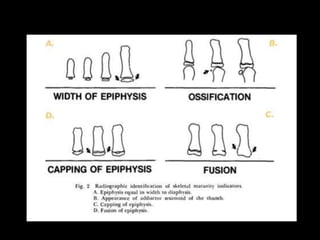
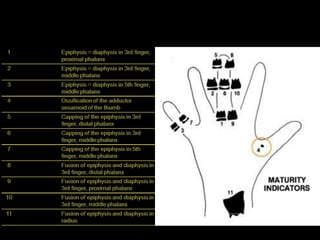
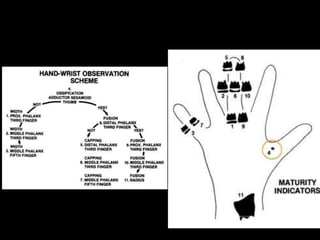
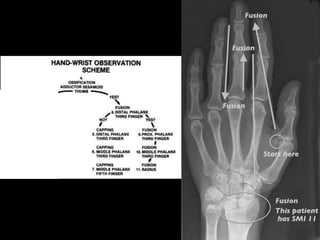
Forensic Odontology
By,
Dr. Revath Vyas
PG III yr
Part – 1 contents
• Introduction
• History
• Personal identification
• Age estimation
• Dental
• skeletal
• Sex determination
• Dental
• skeletal
• Mass disaster Management
Part – 2 contents
• Bite marks
• Cheiloscopy
• Rugoscopy
• Ameloglyphics
• Dental Jurispedence
• Ethics in Dentistry
• Forensic Radiology
FORENSIC
ODONTOLOGY - 1
• ‘‘What a nightmare!. . . bodies as of negroes –
blackened; heads carbonised; shrunk and reduced
to nothing , but only the teeth remained.”
-Dr. Oscar Amoedo
(The father of Forensic Dentistry)
FORENSIC DENTISTRY
or
FORENSIC ODONTOLOGY
Definition:
Forensic – Forum means ‘Court of Law’
Odontology – Study of teeth
• Branch of forensic sciences which deals with collecting,
preserving, recording and interpretation of dental evidence
at the interest of court of law to offer law enforcement.
• Forensic Dentistry, or Forensic Odontology, is the
application of dental and paradental knowledge to the
solution of legal issues in civil and in criminal matters
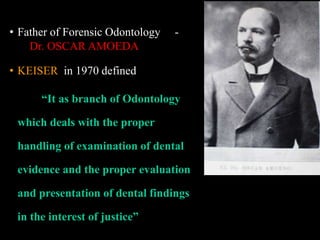
• Father of Forensic Odontology -
Dr. OSCAR AMOEDA
• KEISER in 1970 defined
“It as branch of Odontology
which deals with the proper
handling of examination of dental
evidence and the proper evaluation
and presentation of dental findings
in the interest of justice”
HISTORY OF FORENSIC DENTISTRY
• History of forensic dentistry dates back 4500 years
• One of the first dental identification was recorded in 2500 BC, then 2
molars were linked together by gold wire were found by Junker in a
tomb located at Giza
• At the time of Nero, in 66 AD, As the story goes, Nero’s mother
Agrippina had ordered her soldiers kill Lollia Paulina, with
instructions to bring back her head as proof that she was dead.
Agrippina, unable to positively identify the head, examined the front
teeth and on finding the discolored front tooth confirmed the identity
of the victim
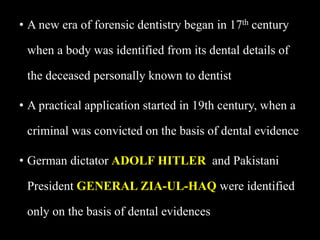
• A new era of forensic dentistry began in 17th century
when a body was identified from its dental details of
the deceased personally known to dentist
• A practical application started in 19th century, when a
criminal was convicted on the basis of dental evidence
• German dictator ADOLF HITLER and Pakistani
President GENERAL ZIA-UL-HAQ were identified
only on the basis of dental evidences
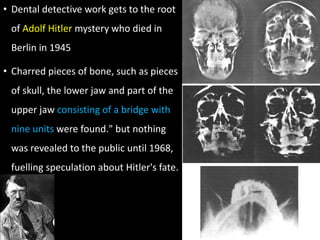
• Dental detective work gets to the root
of Adolf Hitler mystery who died in
Berlin in 1945
• Charred pieces of bone, such as pieces
of skull, the lower jaw and part of the
upper jaw consisting of a bridge with
nine units were found." but nothing
was revealed to the public until 1968,
fuelling speculation about Hitler's fate.
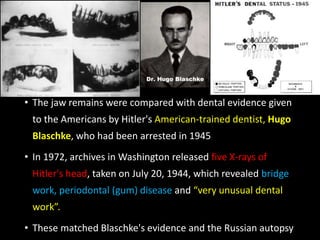
• The jaw remains were compared with dental evidence given
to the Americans by Hitler's American-trained dentist, Hugo
Blaschke, who had been arrested in 1945
• In 1972, archives in Washington released five X-rays of
Hitler's head, taken on July 20, 1944, which revealed bridge
work, periodontal (gum) disease and “very unusual dental
work”.
• These matched Blaschke's evidence and the Russian autopsy
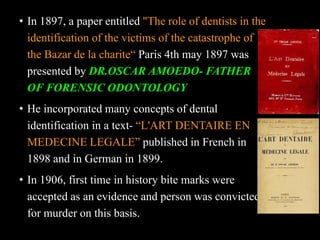
• In 1897, a paper entitled "The role of dentists in the
identification of the victims of the catastrophe of
the Bazar de la charite“ Paris 4th may 1897 was
presented by DR.OSCAR AMOEDO- FATHER
OF FORENSIC ODONTOLOGY
• He incorporated many concepts of dental
identification in a text- “L'ART DENTAIRE EN
MEDECINE LEGALE” published in French in
1898 and in German in 1899.
• In 1906, first time in history bite marks were
accepted as an evidence and person was convicted
for murder on this basis.
Involves
• Identification of the living or the deceased
• Bite mark identification, analysis and comparison
• Lip print identification, analysis and comparison
• Rugae print identification, analysis and comparison
• Patterned injury identification, analysis, comparison
• Identification of dental specimens at crime scene or elsewhere
• Evaluation of oro-facial trauma
• Malpractice and negligence claims
The subject is divided into three major fields of activity- civil,
criminal and research
CIVIL:
1. Malpractice and all aspects which may eventually lead to
criminal charges in the form of fraud.
2. Neglect, where damages may be sought
3. Identification of individual remains where death is not due to
suspicious circumstances- whether fragmentary or complete. It
includes each assessments
4. Identification of a living person- loss of memory.
5. Major or mass disasters- the identification of victims of an
aircraft or train disasters or fire in a public building
CRIMINAL
1. The identification of persons from their teeth -
living/dead person.
2. Bite marks - food stuff (Layton 1966), on the assailant,
on the victim- self inflicted/inflicted by another
RESEARCH
1. Academic training and courses
2. Post graduate tuition
Role of Forensic Odontology:
1) Routine identification
- unknown human remains in various stages of decomposition.
- Analyze the dentition of the deceased. Record all the
restorations, anomalies, missing teeth
- Radiographic and photographic records of the dental arches.
- Compared with antemortem records & radiographs for
positive identification
- Assessment requires ageing, sex and socioeconomic status –
Skeletal structures, dental eruption patterns, restorative
material in teeth, status of periodontium, serology, cytology of
pulp, saliva & mucosa.
2) Mass Disasters:-
Identification of people in mass disasters.
3) Bitemark evidence:-
Identification, examination & evaluation of bite marks –
sexual assaults, child abuse, personal defense situations.
4) Child abuse:-
Battered child, sexual & non sexual abuse
5) Civil Litigation:-
Examination of patients sustaining trauma due to
accident, assault, negligence or malpractice – supported
with radiographs, photographs etc.
6) Age Estimation:
Estimation of both the living and the
deceased.
7) Sex Determination:-
Determining the gender of unidentified
individuals.
8) Other methods of Identification:-
Cheiloscopy (Study of lip prints)
Rugoscopy (Study of palatal rugae patterns)
Sialochemistry (Detection of Chemicals in
Saliva)
PERSONAL IDENTIFICATION
• Identity :- The characteristics by which a person may
be recognized.
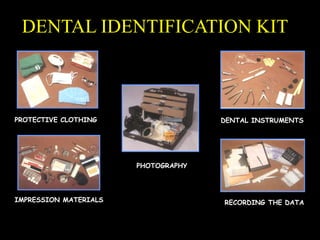
DENTAL IDENTIFICATION KIT
PROTECTIVE CLOTHING DENTAL INSTRUMENTS
RECORDING THE DATAIMPRESSION MATERIALS
PHOTOGRAPHY
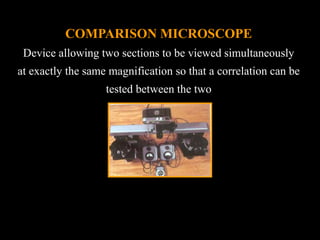
COMPARISON MICROSCOPE
Device allowing two sections to be viewed simultaneously
at exactly the same magnification so that a correlation can be
tested between the two
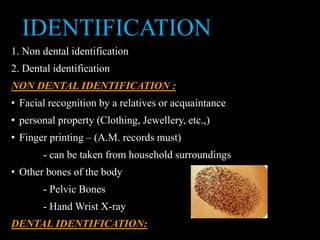
IDENTIFICATION
1. Non dental identification
2. Dental identification
NON DENTAL IDENTIFICATION :
• Facial recognition by a relatives or acquaintance
• personal property (Clothing, Jewellery, etc.,)
• Finger printing – (A.M. records must)
- can be taken from household surroundings
• Other bones of the body
- Pelvic Bones
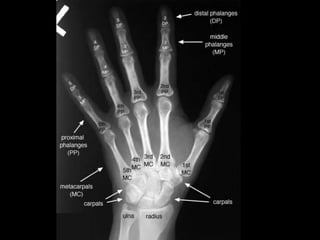
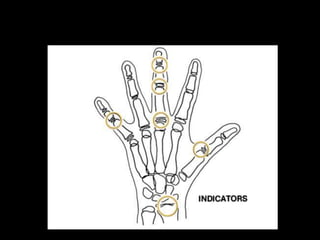
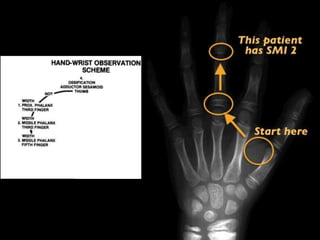
- Hand Wrist X-ray
DENTAL IDENTIFICATION:
Teeth in identification
1. Resistant to post-mortem destruction (physical,
chemical, thermal and decomposition)
2. Developmental and function characteristics of teeth
3. To be contained in small area of the body so that even
when body is crushed or fragmented, sufficient portion
of the area containing material remains intact
4. Be a part of body that is readily accessible for
examination
5. Various degree of dental pathology
6. Varieties of dental restorations
7. Identical twins are not necessarily identical
dentally
8. Bleeding and congestion of pulp in suffocation
9. Blood group can be determined from teeth by special
tests
Three Main forms of Dental Identification
1. Comparative identification
- most frequently performed examination
- to establish the remains of a decedent and a person
represented by ante mortem records are of the same
individual.
2. Reconstructive identification [Dental profiling or
Post-mortem Dental profile]
- elicit race, gender, age & occupation of the dead
individual
- undertaken when ante-mortem records are not
available.
3. Identification in mass disasters
- identification of victims in mass disasters
I. Comparative Dental Identification
- Conventional method of identification
- includes four steps
A) Oral Autopsy
B) Obtaining Dental Records
C) Comparing post and ante-mortem dental records
D) Writing a report & drawing conclusions.
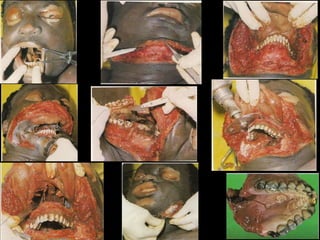
A. ORAL AUTOPSY
– dissection to expose the organs, to determine the cause of death
– oral examination – essential part
– Forensic dentist should have knowledge about rigor mortis
[stiffening & rigidity], livor mortis [purple discoloration on the
skin in the dependent parts], decomposition & postmortem
artifacts
– For jaw separation, use of mouth gags or intra oral myotomy is
essential.
– Teeth to be reinforced with cyanoacrylate cement, polyvinyl
acetate or clear acrylic spray
– Thorough examination of soft tissue injuries, fractures &
foreign bodies
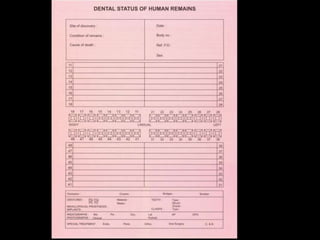
– information be entered on to the standard ‘Interpol Post-
Mortem form’ – Color coded in Pink.
B. OBTAINING DENTAL RECORDS
[Ante-mortem records]
– Contains information of treatment & dental status
during his/her life.
– Obtained from treating dentist, specialist or hospital
records – in the form of dental charts, radiographs, casts
& / or photographs
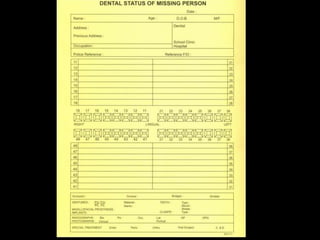
– Transcribed onto the standard ‘Interpol ante-mortem
form’ – color coded in Yellow.
C. COMPARING POST – AND ANTE-MORTEM
DENTAL RECORDS
– Compared by written notes, Study casts, radiographs,
Photographs etc.,
– Criteria for comparison are
a Tooth characteristics [number, eruption status,
position]
b. Personal characteristics
[crown morphology - occlusal ridges, cusps,
Root morphology - branching pattern, furcation,
fusion]
c. Complexity factors – tubercles, pits, additional
ridges, grooves, fissures &
d. Acquired features – hypoplasia, trauma, function,
personal habits, restorations
– Individual with multiple dental treatment & unusual
features – better identified.
– Dental record considered a legal document
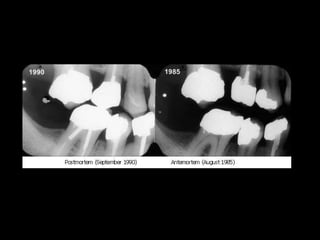
– Radiographic identification is often conclusive.
The Post-mortem Records
- Made using diagrammatic charts, tape recordings,
radiographs, photographs & / or models.
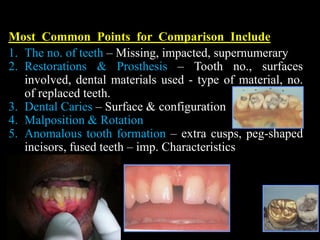
Most Common Points for Comparison Include
1. The no. of teeth – Missing, impacted, supernumerary
2. Restorations & Prosthesis – Tooth no., surfaces
involved, dental materials used - type of material, no.
of replaced teeth.
3. Dental Caries – Surface & configuration
4. Malposition & Rotation
5. Anomalous tooth formation – extra cusps, peg-shaped
incisors, fused teeth – imp. Characteristics
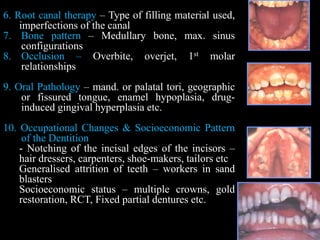
6. Root canal therapy – Type of filling material used,
imperfections of the canal
7. Bone pattern – Medullary bone, max. sinus
configurations
8. Occlusion – Overbite, overjet, 1st molar
relationships
9. Oral Pathology – mand. or palatal tori, geographic
or fissured tongue, enamel hypoplasia, drug-
induced gingival hyperplasia etc.
10. Occupational Changes & Socioeconomic Pattern
of the Dentition
- Notching of the incisal edges of the incisors –
hair dressers, carpenters, shoe-makers, tailors etc
Generalised attrition of teeth – workers in sand
blasters
Socioeconomic status – multiple crowns, gold
restoration, RCT, Fixed partial dentures etc.
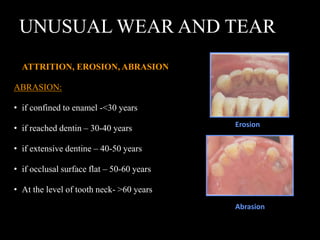
UNUSUAL WEAR AND TEAR
ATTRITION, EROSION, ABRASION
ABRASION:
• if confined to enamel -<30 years
• if reached dentin – 30-40 years
• if extensive dentine – 40-50 years
• if occlusal surface flat – 50-60 years
• At the level of tooth neck- >60 years
Erosion
Abrasion
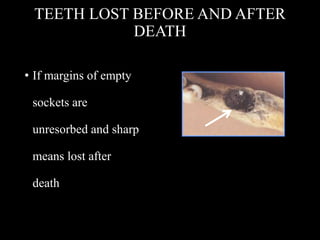
TEETH LOST BEFORE AND AFTER
DEATH
• If margins of empty
sockets are
unresorbed and sharp
means lost after
death
D. WRITING A REPORT AND DRAWING
CONCLUSIONS
- Establishing identity is addressed to the legal authorities
- detailed report & factual conclusion must be clearly
stated.
Range of Conclusions
1. Confirms identification
- Ante – and Post-mortem data match each other
- Identity is proven ‘beyond reasonable doubt’
- includes radiographic support.
2. Probable identification
- Data is consistent
- Lack of quality of ante- & Post-mortem information
- no radiographic support
3. Possible identification
- Explainable differences exist between the ante –
and post-mortem data.
4. Insufficient Information
- available information is minimal
5. Excludes identification
- Ante-and Post-mortem data are inconsistent
- Data contains unexplainable differences
- Indicates a mismatch
II. DENTAL PROFILING
[RECONSTRUCTIVE IDENTIFICATION (OR)
POST – MORTEM DENTAL PROILE]
It includes the decedent’s
A. ETHNIC ORIGIN [Race determination]
B. GENDER [Sex determination]
C. AGE [Age estimation]
A. IDENTIFYING ETHNIC ORIGIN FROM TEETH
[RACE DETERMINATION]
Human species has been categorized into three races
– Caucasoid, Mongoloid & Negroid
Skull Face Nasal apertures
CAUCASIANS (White) Rounded Small Narrow & Elongated
MONGOLOIDS (Yellow) Square Large, Flattened Rounded
NEGROID
(Black Africans)
Narrow,
Elongated
Maxilla &
Mandible
Prognathic
Broad
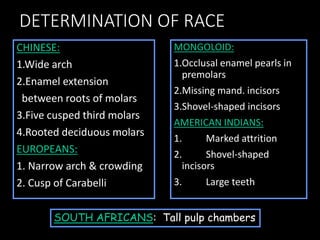
DETERMINATION OF RACE
CHINESE:
1.Wide arch
2.Enamel extension
between roots of molars
3.Five cusped third molars
4.Rooted deciduous molars
EUROPEANS:
1. Narrow arch & crowding
2. Cusp of Carabelli
MONGOLOID:
1.Occlusal enamel pearls in
premolars
2.Missing mand. incisors
3.Shovel-shaped incisors
AMERICAN INDIANS:
1. Marked attrition
2. Shovel-shaped
incisors
3. Large teeth
SOUTH AFRICANS: Tall pulp chambers
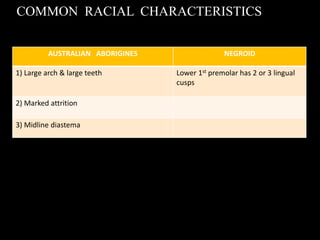
COMMON RACIAL CHARACTERISTICS
AUSTRALIAN ABORIGINES NEGROID
1) Large arch & large teeth Lower 1st premolar has 2 or 3 lingual
cusps
2) Marked attrition
3) Midline diastema
IDENTIFICATION OF INDIVIDUAL’S ETHNIC
ORIGIN BASED PURELY ON DENTITION
Dental features - Combination of hereditary & environmental factors
Dental features are broadly categorized as
a) Metric [ Tooth size ] – Measurements
b) Non Metric [ Tooth Shape ]
- Presence or absence of a particular feature eg:- Cusp of carabelli
A. METRIC FEATURES:-
Influenced by local environmental factors eg:- missing lat.
Incisors causes compensatory increase in central incisors, Lack of
space result in compression of third molars.
B. NON METRIC FEATURES:-
- heritable, more dependable
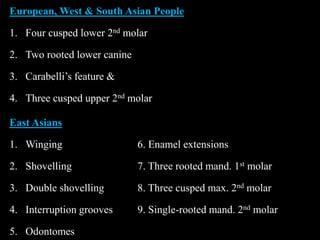
European, West & South Asian People
1. Four cusped lower 2nd molar
2. Two rooted lower canine
3. Carabelli’s feature &
4. Three cusped upper 2nd molar
East Asians
1. Winging 6. Enamel extensions
2. Shovelling 7. Three rooted mand. 1st molar
3. Double shovelling 8. Three cusped max. 2nd molar
4. Interruption grooves 9. Single-rooted mand. 2nd molar
5. Odontomes
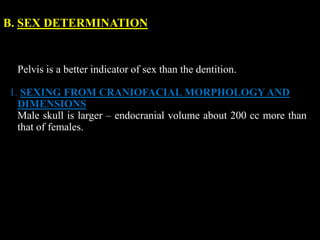
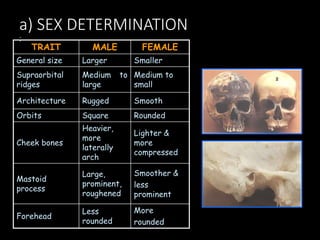
B. SEX DETERMINATION
Pelvis is a better indicator of sex than the dentition.
1. SEXING FROM CRANIOFACIAL MORPHOLOGYAND
DIMENSIONS
Male skull is larger – endocranial volume about 200 cc more than
that of females.
a) SEX DETERMINATION
TRAIT MALE FEMALE
General size Larger Smaller
Supraorbital
ridges
Medium to
large
Medium to
small
Architecture Rugged Smooth
Orbits Square Rounded
Cheek bones
Heavier,
more
laterally
arch
Lighter &
more
compressed
Mastoid
process
Large,
prominent,
roughened
Smoother &
less
prominent
Forehead
Less
rounded
More
rounded
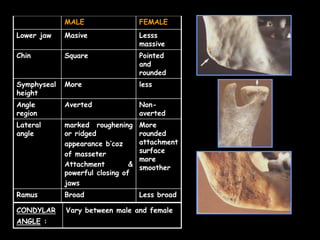
:
MALE FEMALE
Lower jaw Masive Lesss
massive
Chin Square Pointed
and
rounded
Symphyseal
height
More less
Angle
region
Averted Non-
averted
Lateral
angle
marked roughening
or ridged
appearance b’coz
of masseter
Attachment &
powerful closing of
jaws
More
rounded
attachment
surface
more
smoother
Ramus Broad Less broad
CONDYLAR
ANGLE :
Vary between male and female
2. SEX DIFFERENCES IN TOOTH SIZE
Generally teeth are smaller in females
Teeth – used for differentiating sex by measuring mesiodistal & buccolingual
dimensions
Canines – show max. sex difference
Mand. Canines show greatest dimensional difference, being larger in males
Dental Index
In addition to tooth size, tooth proportions have been suggested for differentiating
the sexes.
Aitchison presented the ‘Incisor Index’ [Ii] calculated by the formula
Ii = MDI2 MDI2 is the max. MD diameter of Max. LI
MDI1 MDI1 is the max. MD diameter of Max. CI
Ii is higher in males
Standard Mandibular Canine Index Proposed by Rao & Assoc.
Mean mandibular canine index in female + S.D
+
Mean mandibular canine index in males – S.D
2
100
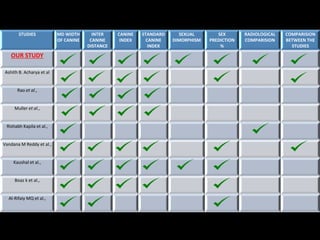
STUDIES MD WIDTH
OF CANINE
INTER
CANINE
DISTANCE
CANINE
INDEX
STANDARD
CANINE
INDEX
SEXUAL
DIMORPHISM
SEX
PREDICTION
%
RADIOLOGICAL
COMPARISION
COMPARISION
BETWEEN THE
STUDIES
OUR STUDY
Ashith B. Acharya et al
Rao et al.,
Muller et al.,
Rishabh Kapila et al.,
Vandana M Reddy et al.,
Kaushal et al.,
Boaz k et al.,
Al-Rifaiy MQ et al.,
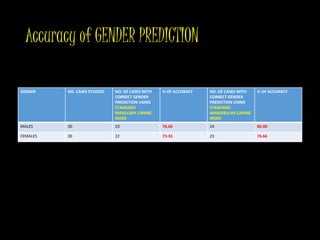
Accuracy of GENDER PREDICTION
GENDER NO. CASES STUDIED NO. OF CASES WITH
CORRECT GENDER
PREDICTION USING
STANDARD
MAXILLARY CANINE
INDEX
% OF ACCURACY NO. OF CASES WITH
CORRECT GENDER
PREDICTION USING
STANDARD
MANDIBULAR CANINE
INDEX
% OF ACCURACY
MALES 30 23 76.66 24 80.00
FEMALES 30 22 73.33 23 76.66
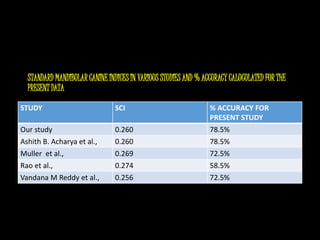
STANDARD MANDIBULAR CANINE INDICES IN VARIOUS STUDIES AND % ACCURACY CALUCULATED FOR THE
PRESENT DATA
STUDY SCI % ACCURACY FOR
PRESENT STUDY
Our study 0.260 78.5%
Ashith B. Acharya et al., 0.260 78.5%
Muller et al., 0.269 72.5%
Rao et al., 0.274 58.5%
Vandana M Reddy et al., 0.256 72.5%
3. TOOTH MORPHOLOGY AND SEXING
According to scott & Turner II, ‘Distal Accessory ridge’ – a nonmetric
feature on the canine – most sexually dimorphic crown trait.
Males shows significantly higher frequency & more pronounced expression
than females.
4. SEX DETERMINATION BY DNA ANALYSIS
a. From pulp tissue:- Y chromosome analysis from dental pulp of male can be
done even after 1yr. Of death
b. From enamel protein [Amelogenin]:-
Amelogenin[AMEL] – Major matrix proteins secreted by the ameloblasts
of the enamel
AMELgene located on X & Y – chromosomes in humans
c. From Buccal Mucosa:- Barr bodies & x-chromosomes of female
detected from buccal mucosal epithelium.
AGE ESTIMATION
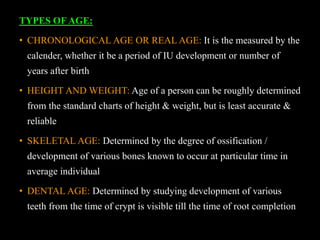
TYPES OF AGE:
• CHRONOLOGICAL AGE OR REAL AGE: It is the measured by the
calender, whether it be a period of IU development or number of
years after birth
• HEIGHT AND WEIGHT: Age of a person can be roughly determined
from the standard charts of height & weight, but is least accurate &
reliable
• SKELETAL AGE: Determined by the degree of ossification /
development of various bones known to occur at particular time in
average individual
• DENTAL AGE: Determined by studying development of various
teeth from the time of crypt is visible till the time of root completion
SKELETAL AGE
DETERMINATION
Age Changes in Craniofacial Bones
Neonatal : Edentulous jaws, orbit size relatively
large
I year : Fusion of midline symphysis of
mandible
Metopic sutures of two halves of
frontal bone fuse
Lat. Sphenoidal synchondrose fuse
Fontanelles : Post & ant. Lateral fuse by 3 months.
Ant. Fontanelle by 1 ½ yr (18 MONTHS).
3 years : Condylar portion of occipital bone
fuses with squama
5 years : Condylar position of occipital bone
fuses with basoocciput.
SPHENOOCCIPITAL SYNCHONDROSIS
[between basal part of occipital bone & adj. body of
sphenoid] – Major skull cartilage centre, fuses by 18-
21 years – most useful skeletal ageing factor.
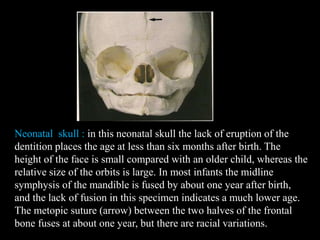
Neonatal skull : in this neonatal skull the lack of eruption of the
dentition places the age at less than six months after birth. The
height of the face is small compared with an older child, whereas the
relative size of the orbits is large. In most infants the midline
symphysis of the mandible is fused by about one year after birth,
and the lack of fusion in this specimen indicates a much lower age.
The metopic suture (arrow) between the two halves of the frontal
bone fuses at about one year, but there are racial variations.
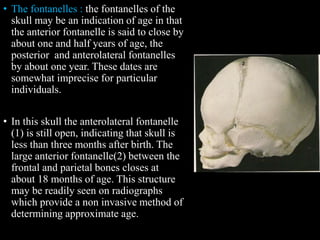
• The fontanelles : the fontanelles of the
skull may be an indication of age in that
the anterior fontanelle is said to close by
about one and half years of age, the
posterior and anterolateral fontanelles
by about one year. These dates are
somewhat imprecise for particular
individuals.
• In this skull the anterolateral fontanelle
(1) is still open, indicating that skull is
less than three months after birth. The
large anterior fontanelle(2) between the
frontal and parietal bones closes at
about 18 months of age. This structure
may be readily seen on radiographs
which provide a non invasive method of
determining approximate age.
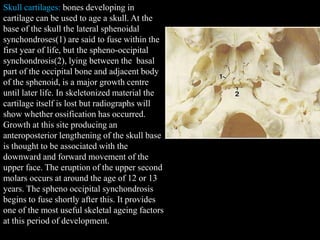
Skull cartilages: bones developing in
cartilage can be used to age a skull. At the
base of the skull the lateral sphenoidal
synchondroses(1) are said to fuse within the
first year of life, but the spheno-occipital
synchondrosis(2), lying between the basal
part of the occipital bone and adjacent body
of the sphenoid, is a major growth centre
until later life. In skeletonized material the
cartilage itself is lost but radiographs will
show whether ossification has occurred.
Growth at this site producing an
anteroposterior lengthening of the skull base
is thought to be associated with the
downward and forward movement of the
upper face. The eruption of the upper second
molars occurs at around the age of 12 or 13
years. The spheno occipital synchondrosis
begins to fuse shortly after this. It provides
one of the most useful skeletal ageing factors
at this period of development.
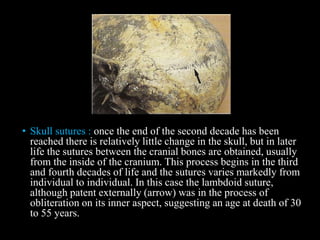
• Skull sutures : once the end of the second decade has been
reached there is relatively little change in the skull, but in later
life the sutures between the cranial bones are obtained, usually
from the inside of the cranium. This process begins in the third
and fourth decades of life and the sutures varies markedly from
individual to individual. In this case the lambdoid suture,
although patent externally (arrow) was in the process of
obliteration on its inner aspect, suggesting an age at death of 30
to 55 years.
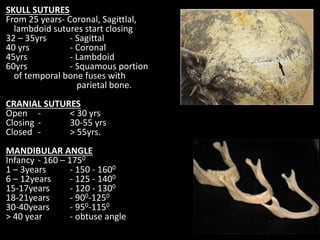
SKULL SUTURES
From 25 years- Coronal, Sagittlal,
lambdoid sutures start closing
32 – 35yrs - Sagittal
40 yrs - Coronal
45yrs - Lambdoid
60yrs - Squamous portion
of temporal bone fuses with
parietal bone.
CRANIAL SUTURES
Open - < 30 yrs
Closing - 30-55 yrs
Closed - > 55yrs.
MANDIBULAR ANGLE
Infancy - 160 – 1750
1 – 3years - 150 - 1600
6 – 12years - 125 - 1400
15-17years - 120 - 1300
18-21years - 900-1250
30-40years - 950-1150
> 40 year - obtuse angle
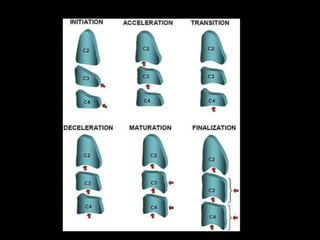
• Evaluation of Cervical Vertebrae Maturity on Lateral
Cephalogram
CVMI were evaluated by classifying C2, C3, and C4
into six groups depending on their maturation patterns
on the lateral cephalogram using the classification of
Hassel and Farman.
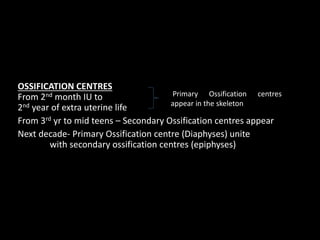
OSSIFICATION CENTRES
From 2nd month IU to
2nd year of extra uterine life
From 3rd yr to mid teens – Secondary Ossification centres appear
Next decade- Primary Ossification centre (Diaphyses) unite
with secondary ossification centres (epiphyses)
Primary Ossification centres
appear in the skeleton
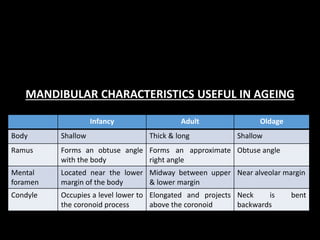
Infancy Adult Oldage
Body Shallow Thick & long Shallow
Ramus Forms an obtuse angle
with the body
Forms an approximate
right angle
Obtuse angle
Mental
foramen
Located near the lower
margin of the body
Midway between upper
& lower margin
Near alveolar margin
Condyle Occupies a level lower to
the coronoid process
Elongated and projects
above the coronoid
Neck is bent
backwards
MANDIBULAR CHARACTERISTICS USEFUL IN AGEING
DENTAL AGE ESTIMATION
Important Subspeciality of forensic sciences
Also has application in living individuals
Dental Age Estimation Methods
a. Morphologic / visual Examination
b. Radiographic Examination
c. Histological Examination and
d. Biochemical Examination
Age estimation using the dentition may be grouped into
three phases
a. Ageing in prenatal, neonatal & early Post natal
b. Age estimation in children and adolescents
c. Age estimation in adults
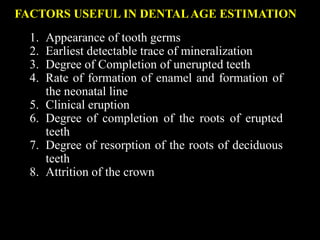
FACTORS USEFUL IN DENTALAGE ESTIMATION
1. Appearance of tooth germs
2. Earliest detectable trace of mineralization
3. Degree of Completion of unerupted teeth
4. Rate of formation of enamel and formation of
the neonatal line
5. Clinical eruption
6. Degree of completion of the roots of erupted
teeth
7. Degree of resorption of the roots of deciduous
teeth
8. Attrition of the crown
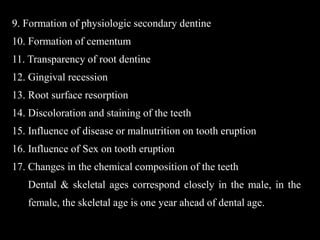
9. Formation of physiologic secondary dentine
10. Formation of cementum
11. Transparency of root dentine
12. Gingival recession
13. Root surface resorption
14. Discoloration and staining of the teeth
15. Influence of disease or malnutrition on tooth eruption
16. Influence of Sex on tooth eruption
17. Changes in the chemical composition of the teeth
Dental & skeletal ages correspond closely in the male, in the
female, the skeletal age is one year ahead of dental age.
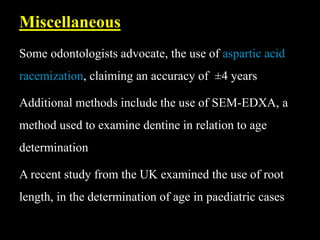
Some odontologists advocate, the use of aspartic acid
racemization, claiming an accuracy of ±4 years
Additional methods include the use of SEM-EDXA, a
method used to examine dentine in relation to age
determination
A recent study from the UK examined the use of root
length, in the determination of age in paediatric cases
Miscellaneous
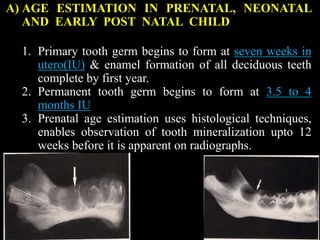
A) AGE ESTIMATION IN PRENATAL, NEONATAL
AND EARLY POST NATAL CHILD
1. Primary tooth germ begins to form at seven weeks in
utero(IU) & enamel formation of all deciduous teeth
complete by first year.
2. Permanent tooth germ begins to form at 3.5 to 4
months IU
3. Prenatal age estimation uses histological techniques,
enables observation of tooth mineralization upto 12
weeks before it is apparent on radiographs.
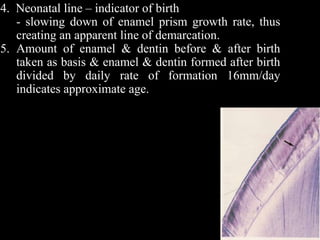
4. Neonatal line – indicator of birth
- slowing down of enamel prism growth rate, thus
creating an apparent line of demarcation.
5. Amount of enamel & dentin before & after birth
taken as basis & enamel & dentin formed after birth
divided by daily rate of formation 16mm/day
indicates approximate age.
B. AGE ESTIMATION IN CHILDREN AND ADOLESCENTS
1. Tooth emergence or Eruption
2. Tooth calcification
1. ERUPTION:- Convenient clinical method
visual assessment of teeth & compared with radiographs & charts.
Main drawback is emergence patterns are under the influence of
intraoral environment [infection, arch space, premature tooth loss]
2. CALCIFICATION:- better alternative, since,
a. Calcification can be observed for a period of several years from
radiographs
b. not altered by local factors
c. assess age at periods when no emergence takes place [2.5 – 6yrs
& more than 12yrs]
Methods for estimating age in Children and adolescents
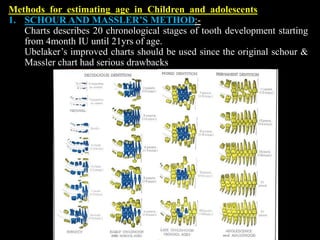
1. SCHOUR AND MASSLER’S METHOD:-
Charts describes 20 chronological stages of tooth development starting
from 4month IU until 21yrs of age.
Ubelaker’s improved charts should be used since the original schour &
Massler chart had serious drawbacks
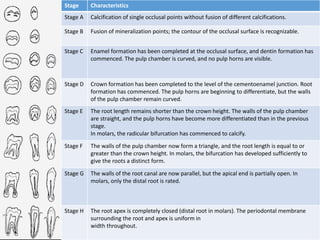
2. DEMIRJIAN’S METHOD:-
- made up of scoring system
- development of seven mand.teeth was divided
into eight stages each [A to H].
- each tooth is assigned a maturity score that
corresponds to its developmental stage.
- maturity score for each tooth is added and a total
maturity score obtained
- Total maturity score is plotted on a chronologic
‘age conversion table’ [Separate for both sexes
Stage Characteristics
Stage A Calcification of single occlusal points without fusion of different calcifications.
Stage B Fusion of mineralization points; the contour of the occlusal surface is recognizable.
Stage C Enamel formation has been completed at the occlusal surface, and dentin formation has
commenced. The pulp chamber is curved, and no pulp horns are visible.
Stage D Crown formation has been completed to the level of the cementoenamel junction. Root
formation has commenced. The pulp horns are beginning to differentiate, but the walls
of the pulp chamber remain curved.
Stage E The root length remains shorter than the crown height. The walls of the pulp chamber
are straight, and the pulp horns have become more differentiated than in the previous
stage.
In molars, the radicular bifurcation has commenced to calcify.
Stage F The walls of the pulp chamber now form a triangle, and the root length is equal to or
greater than the crown height. In molars, the bifurcation has developed sufficiently to
give the roots a distinct form.
Stage G The walls of the root canal are now parallel, but the apical end is partially open. In
molars, only the distal root is rated.
Stage H The root apex is completely closed (distal root in molars). The periodontal membrane
surrounding the root and apex is uniform in
width throughout.
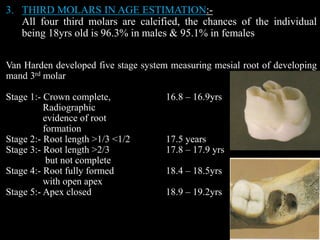
3. THIRD MOLARS IN AGE ESTIMATION:-
All four third molars are calcified, the chances of the individual
being 18yrs old is 96.3% in males & 95.1% in females
Van Harden developed five stage system measuring mesial root of developing
mand 3rd molar
Stage 1:- Crown complete, 16.8 – 16.9yrs
Radiographic
evidence of root
formation
Stage 2:- Root length >1/3 <1/2 17.5 years
Stage 3:- Root length >2/3 17.8 – 17.9 yrs
but not complete
Stage 4:- Root fully formed 18.4 – 18.5yrs
with open apex
Stage 5:- Apex closed 18.9 – 19.2yrs
C) AGE ESTIMATION IN ADULTS
Most of the methods in adults use various regressive changes of hard and soft
tissues of the teeth. Less accurate compared with estimation <20yrs.
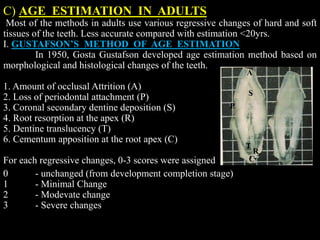
I. GUSTAFSON’S METHOD OF AGE ESTIMATION
In 1950, Gosta Gustafson developed age estimation method based on
morphological and histological changes of the teeth.
1. Amount of occlusal Attrition (A)
2. Loss of periodontal attachment (P)
3. Coronal secondary dentine deposition (S)
4. Root resorption at the apex (R)
5. Dentine translucency (T)
6. Cementum apposition at the root apex (C)
For each regressive changes, 0-3 scores were assigned
0 - unchanged (from development completion stage)
1 - Minimal Change
2 - Modevate change
3 - Severe changes
A
P
S
R
T
C
The points awarded to each feature are added
(e.g. A3 + S2 + P2 + C1 + R2 + T1 =X)
↑ in total score (X) → ↑ in age
Age was estimated using the formula
Age = 11.43 + 4.56 X with an average error of 3.6yrs.
Maples and Rice Corrected the above formula
as Age = 13.45 + 4.26 X
According to Johanson
Instead of four grades (0-3), he proposed seven grades (0, 0.5, 1, 1.5,
2, 2.5 & 3). Using these grades
Age = 11.02 + (5.14A) + (2.3S) +(4.14P) + (3.71C) + (5.57R) + (8.98T) was
suggested
II) DENTINE TRANSLUCENCY
Bang & Ramm – first to use dentine translucency for age estimation
Root dentine starts translucent during 3rd decade of life, begins at
the apex & advances coronally.
Solheim suggested translucency length (in mm) or area
(mm2) measured on intact or sectioned teeth.
Two equations were given
Age = B0 + B1 + B2 X2 for zones of translucency ≤ 9mm
Age = B0 + B1 X for zones of translucency
>9mm
Where B0 is regression constant, B1 & B2 are regression
coefficients, X is the translucency length.
Disadvantages:-
1. Irregular junction of translucent & non translucent
zones.
2. Under estimation of age in old age groups due to
slowing down of dentinal sclerosis, restricting further ↑
in translucency
III) AGE ESTIMATION FROM INCREMENTAL
LINE OF CEMENTUM
Kagerer & Grupe suggested age estimation from
acellular cementum incremental lines.
Mineralized unstained cross-sections of teeth
[preferably mand. CI & 3rd molars] are used.
Disadvantage:-
Necessity to extract and / or section the teeth
possible in the dead but not in living individuals.
IV. RADIOGRAPHIC METHOD OF KVAAL AND ASSOCIATES
Developed a method that used Pulp size measurement of Six teeth (Max CI
& LI, 2nd PM, Mand CI, LI, canine & 1st PM) on periapical radiographs.
Pulp - Root length (P)
Pulp - tooth length (R)
Tooth - Root length (T)
Pulp - root width at CEJ (A)
Pulp - root width at mid root level (C)
Pulp - root width at midpoint between level C & A (B),
Mean value of width ratios B and C (W)
Mean value of length ratios P and R (L)
Mean values of all ratios excluding T (M)
Regression formula,
Age = 129.8 – 316.4 (M) – 66.8 (W-L)
V. AMINOACID RACEMISATION
Aspartic acid gets converted from L-Aspartic acid to D- Aspartic acid
with increasing age.
Constant change in the ratio of L-and D Aspartic acid at different ages.
Recemization rate of aspartic acid is high in root dentine – teeth are
valuable source for ageing
-accurate, with age estimates with in + / - 3 yrs of actual age.
VI. OTHER METHODS
Age estimation from changes in tooth color
Martin–de las Heras & co workers proposed the use of spectro radio metry
for dentine color Measurements.
Dentinal colors white, cream & yellow – 12 – 37yrs
Dentinal colors dark yellow & brown – 55 – 64yrs.
Kvaal & Solheim suggested the use of dentine & cementum fluorescence
for age estimation
↑ deepening of tooth color - ↑ fluorescence intensity - ↑ in age.
Identification in Mass disasters
• Disasters: refers to natural calamities such as
earthquakes, floods and tsunami and accidental or
man-made events such as airplane crashes or
terrorist attacks-that result in multiple human
fatalities. Such incidents require identification of the
postmortem remains due to severe mutilation.
• The process of dental identification involves
examining and comparing hundreds, sometimes
thousands, of ante and postmortem data.
• Human remains in such events may be highly
fragmented and, hence, only part of the body may
be recovered. The bodies may be incinerated or
commingled, i.e. parts of two bodies are mixed with
each other.
• Forensic dentists are usually part of a team of
identification specialists that include anthropologists
and fingerprint experts, to name a few.
• Each team has its own section where postmortem
identification is carried out.
• According to Clark, almost 50% of identifications in
disasters are from dental evidence. Therefore, most
disaster identifications have an odontology section.
• Vale and Noguchi suggest the division of the dental
section into three sub sections-postmortem unit,
antemortem unit and comparison and identification unit.
• Clark states that dental examination is usually done
after most other procedures such as photography,
fingerprinting and medical autopsy.
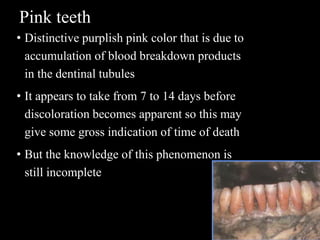
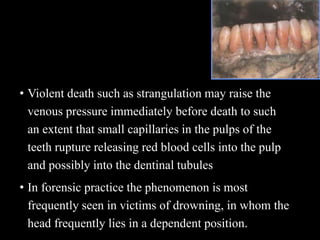
Pink teeth
• Distinctive purplish pink color that is due to
accumulation of blood breakdown products
in the dentinal tubules
• It appears to take from 7 to 14 days before
discoloration becomes apparent so this may
give some gross indication of time of death
• But the knowledge of this phenomenon is
still incomplete
• Violent death such as strangulation may raise the
venous pressure immediately before death to such
an extent that small capillaries in the pulps of the
teeth rupture releasing red blood cells into the pulp
and possibly into the dentinal tubules
• In forensic practice the phenomenon is most
frequently seen in victims of drowning, in whom the
head frequently lies in a dependent position.
IDENTIFICATION FROM DENTAL DNA
Teeth - Excellent source of DNA
PCR (Polymerase chain reaction)
– amplifies highly degraded DNA
compared with ante-mortem sample of the decedent (hair from a hair brush,
epithelial cells from a tooth brush or a biopsy specimen)
Major Advantage:
– DNA Pattern may be compared to a parent or a sibling, if ante-mortem
sample is unavailable.
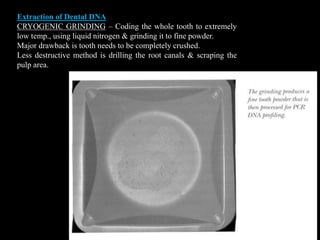
Extraction of Dental DNA
CRYOGENIC GRINDING – Coding the whole tooth to extremely
low temp., using liquid nitrogen & grinding it to fine powder.
Major drawback is tooth needs to be completely crushed.
Less destructive method is drilling the root canals & scraping the
pulp area.
Types of DNA
1. Genomic or Nuclear DNA – Commonly used
2. Mitochondrial DNA (mt DNA) – substituted if
nuclear DNA is unavailable
- inherited from mother
- high no. of mt. DNA in each cell
By
Dr. Revath Vyas
Pg III Yr
Forensic Odontology II
• CONTENTS
• Bite marks
• Rugoscopy
• Cheiloscopy
• Child abuse
• Use of radiology in forensic dentistry
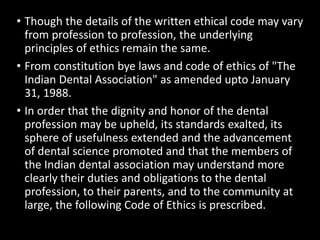
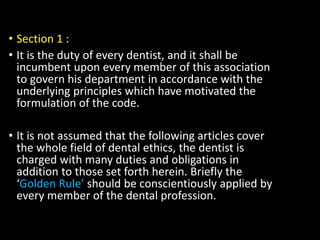
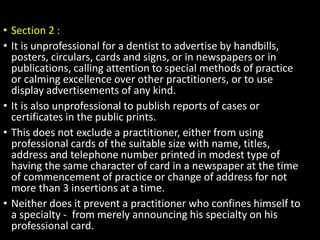
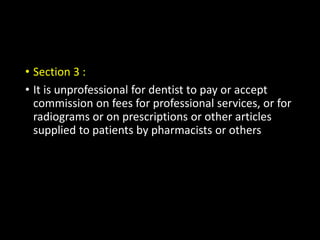
• Ethics in dentistry
• Dental jurisprudence
Bite marks
• McDonald et al (1981) States that bite mark injuries are a form of
"patterned injury" which means that the configuration is caused
by a particular object.
• Sometimes bitemarks are called as "toolmarks".
• Bite marks is defined as "a mark caused by the teeth either alone
or in combination with other mouth parts.“ (MacDonald)
• Bite marks may be caused by humans or animals; they may be on
tissue, food items or on objects.
• Biting is considered to be a primitive type of assault and results
when teeth are employed as a weapon in an act of dominance or
desperation.
• As a result, bite marks are usually associated with sex crimes,
violent fights and child abuse.
• Bite marks have even been recovered from scenes of theft.
• Hence, matching the bite mark to a suspect's dentition may enable
the investigating officers to implicate the suspect in a crime.
• Sweet and Pretty consider the size, shape and pattern of the incisal
or biting edges of upper and lower anterior teeth to be specific to
an individual.
• Rawson and associates have mathematically calculated that biting
edges (incisal edges) of the twelve anterior teeth can be arranged
in 1.36 X 1026 different combinations.
• a bite mark may accurately depict the 'unique' pattern of a biter's
teeth.
• Human bite marks is one among the most violent crimes tried in
the criminal courts.
• Bites have been found in cases of homicide, attempted suicide,
sexual assault and child abuse.
• Bites can occur on both the victim and the suspect: teeth are used
as weapon by the aggressor and in self defence by the victim.
• Although they are only a small portion of most forensic dentists
case load, bite marks represent the most challenging aspect of the
discipline.
• Definitions of Marks in Forensic Dentistry (Jakobsen)
• Tooth mark - Mark left by a tooth
• Arch mark - Mark produced by four or five adjacent teeth in
the same arch.
• Bite mark- Tooth marks produced by antagonistic teeth
Anatomic location
1. Bite marks are found on almost all areas of the body.
2. It is common to find more than one bite mark on a victim,
often in different anatomical locations.
3. Bite marks occurred primarily in sex-related crimes,
child abuse cases and cases involving physical altercations
of various types.
4. Female victims are most commonly bitten on the breasts, arms
and legs in descending order of frequency, and males most
frequently bitten on the arms, back and hands.
5. Patterns of distribution of bite marks are discernable and variable
and are based in part by the type of crime involved, the age and
sex of the victim, whether the bite mark is on the victim or the
attacker and the sex and age of the perpetrator.
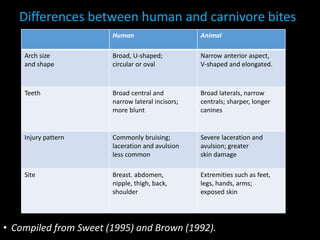
Differences between human and carnivore bites
• Compiled from Sweet (1995) and Brown (1992).
Human Animal
Arch size
and shape
Broad, U-shaped;
circular or oval
Narrow anterior aspect,
V-shaped and elongated.
Teeth Broad central and
narrow lateral incisors;
more blunt
Broad laterals, narrow
centrals; sharper, longer
canines
Injury pattern Commonly bruising;
laceration and avulsion
less common
Severe laceration and
avulsion; greater
skin damage
Site Breast. abdomen,
nipple, thigh, back,
shoulder
Extremities such as feet,
legs, hands, arms;
exposed skin
Classification of bite marks• Cameron and Sims Classification.
based on the type of agent producing the bite mark and the
material exhibiting it.
Agents
• Human
• Animal
Materials
• Skin, body tissue
• Foodstuff
• Other materials.
• MacDonald's Classification.
• suggested an etiologic classification.
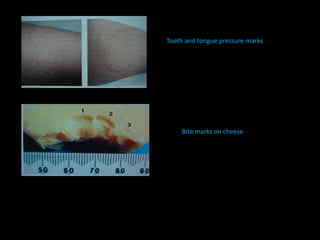
• Tooth pressure marks. Marks produced on tissue as a result of
"direct application of pressure by teeth". These are generally
produced by the incisal or occlusal surfaces of teeth.
• Tongue pressure marks: When sufficient amount of tissue is taken
into the mouth, the tongue presses it against rigid areas such as the
lingual surfaces of teeth and palatal Rugae. The marks thus left on
the skin are referred to as 'suckling,' since there is a combination of
sucking and tongue thrusting involved.
• Tooth scrape marks: These are marks caused due to scraping of
teeth across the bitten material. They are usually caused by anterior
teeth, and present as scratches or superficial abrasions.
Tooth and tongue pressure marks
Bite marks on cheese
• Description of some types of bite marks:
• Sexually Oriented bites: Sexually oriented bites appear to have
been inflicted slowly and deliberately with suction applied to the
tissue by tongue and lips.
• The resultant injury exhibits central or peripheral "suck marks"
and marks of- anterior teeth with good definition.
• The amount of distortion may indicate whether the person being
bitten was active or passive when the bite mark was being
inflicted.
• Child abuse cases: In the child abuse cases either aggressive
(anger bite marks) or sexually oriented type of bite marks are
seen.
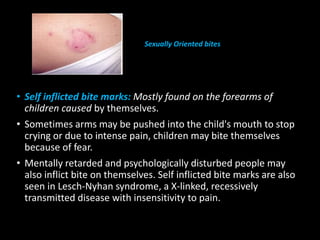
• Self inflicted bite marks: Mostly found on the forearms of
children caused by themselves.
• Sometimes arms may be pushed into the child's mouth to stop
crying or due to intense pain, children may bite themselves
because of fear.
• Mentally retarded and psychologically disturbed people may
also inflict bite on themselves. Self inflicted bite marks are also
seen in Lesch-Nyhan syndrome, a X-linked, recessively
transmitted disease with insensitivity to pain.
Sexually Oriented bites
• Factors influencing the bite marks:
• Type of tissue: In the case of skin, if it is loose or with excessive
fat bites commonly produce bruising leading to poor definition.
• Whereas in areas of fibrous tissue or with high muscle content
tend to bruise less, so that the definition of bite mark is good.
• Age: Infants and old individuals bruise more than other age
groups.
• Sex: Females tend to bruise more than males. Once produced
bitemarks will be evident for longer period of time in females
compared to males.
• Medical status: People having bleeding disturbances, under
anticoagulant therapy and certain skin diseases bruise more.
• Time: The time elapsed between actual biting and when the
impression is made is vital. Depression produced in the skin
due to bitemarks will recover within 10-20 minutes leaving
swelling and discoloration. After death skin tends to contract,
harden and decompose
• Enzyme histochemistry:
• According to Rae Kallio, the appearance of various enzymes
from the time of injury are as follows:
• ATP-ase : 1 hour after injury.
• Esterase : 1 hour after injury.
• Acid phosphatase : 4 hours after injury.
• Alkaline phosphatase : 8 hours after injury.
• Bite mark cases have to be dealt step by step in the
following way:
• Description of bite marks.
• Collection of evidence from the victim.
• Collection of evidence from the suspect.
• Bite marks comparison.
I. Description of bite marks:
Both in the living and deceased victims the following vital
information should be recorded.
A. Demographics:
Name, age, sex, race, case number, date of examination, and name
of the examiners should be recorded.
B. Location of the bite mark:
Describe the anatomic location, indicate the contour of the surface
as flat, curved or irregular and state the tissue characters
Skin - fixed or mobile.
Underlying tissue - bone, cartilage, muscle or fat.
C. Shape of the bite marks:
Indicate whether it is round, ovoid, crescent or irregular in shape.
D. Color of the mark:
E. Size of the mark:
Both vertical and horizontal dimensions should be recorded in metric
system.
F. Type of injury:
Type of tissue injury due to bite mark may be,
Petechial hemorrhage
Contusion
Abrasion
Laceration
Incision
Avulsion
or an Artefact.
II. Data collection from the victim:
Bite mark evidence should be gathered from the victim after obtaining
authorization from the authorities. Determine whether the bite mark
has been affected by washing, contamination, embalming,
decomposition etc.
Steps in the examination of the victim:
A. Visual Examination. Visually examine the bite mark and document the
following:
• • Type of injury
• • Contour, texture, and elasticity of the bite site
• • Physical appearance (color and size), orientation, and location of the
bite mark
• • Differences between upper and lower arches, and between individual
teeth.
• If the victim is dead, visual examination must be done before an
autopsy.
B. Photographs of the bite marks should be made immediately.
• provide a permanent record of the appearance of bite marks.
• No time should be lost in obtaining photographs, as the injury
rapidly changes appearance due to healing.
It is advisable to have photographs from two views:
• Orientation photographs -These photographs depict the location of
the bite mark on the body.
• Close-up photographs -These photographs should be taken with a
rigid reference scale that is placed in the same plane as the injury.
The entire scale and bite mark must be visible in the photograph.
C. Salivary swabbing:
The amount of saliva deposited with a bite mark is about 0.3 ml and
distributed over a wide area of 20 cm. Practical points helpful in the
collection of salivary swabbing are described below.
One square centimeter piece of Rizla type of cigarette paper held in
forceps is used after wetting it with fresh water or distilled water
(contamination with fingers will give false positive result).
• The whole bite mark and the adjacent area should be swabbed.
• Air dry the paper by placing it on a clear microscopic slide.
• After drying swabs are packed and send to the laboratory.
• A control sample is prepared using same method as described above-but
without swabbing with saliva.
• Instead of using paper, a cotton piece can also be used for saliva swabbing.
• Saliva obtained from swabbing is used to determine the blood group
antigens.
• Identification of the saliva is done by demonstrating it's amylase activity in
hydrolyzing a starch substrate.
• The presence of blood group antigens can be determined by absorption-
elution or absorption-inhibition group testing.
• In the case of sexual assault, oral swabs should also be taken for semen.
• Mouth washes (with water) can be used to obtain test sample for
spermatozoa.
D. Impression of bite marks:
• If the bite marks have penetrated the skin, an
impression of the marks should be made.
• A rubber base material such as vinyl polysiloxans with
dimensional stability should be used.
• Two methods are commonly used to make
impressions.
• Method-1:
• Cover the bite area with 5mm thick light bodied material.
• Place a wire gauze over the set material.
• Inject additional material over it.
• After removal of the impression indicate the direction of head
with marker on the back of the impression.
• Method-2:
• A special tray is constructed using cold cure or orthopedic cast
material confining to the shape of anatomic part in which bite
mark is present.
• Impression is made using rubber base material.
• Master casts must be poured with type-IV stone and duplicate
casts should also be made. Either visible light cure or epoxyresin
clear material may be used to make stable rigid model.
Bite print recording:
• Similar to the methods used to lift finger prints from crime
scenes, fingerprint lifting tape can be used to lift the "non-
perforating" bite marks after brushing the bite mark with
finger print lifting powder.
Tissue samples:
• In the case of dead victims with bite marks, bite marks can be
excised along with the underlying tissues after fixing an acrylic
stent around the bite mark to avoid shrinkage of the tissue.
Store the specimen in 4% formalin.
The videotape documentation:
• The videotape documentation demonstrated the three
dimensionally of the bite in motion.
III. Examination of the suspect:
• Following details should be noted from the suspect after obtaining
necessary consent.
• History of dental treatments after or just before the bite mark has
to be noted.
A. Photographs:
• Full face, profile photographs, frontal, occlusal and lateral views of
the dental arches should be taken.
B. Examination:
• TMJ . status, facial asymmetry, muscle tone, maximum opening of
mouth, deviation while opening and closing movements have to be
recorded under extra oral examination.
• Tongue movements, periodontal status should be noted. Special
attention should be given to the arrangement of dentition.
C. Saliva swabbing should be performed as described
before.
D. Upper and lower dental models should be
prepared.
• Sample bites should be made whenever possible,
simulating the type of bite under study.
• This may be recorded in wax sheet or in impression
compound.
IV. Evaluation of evidence:
• American Board of Forensic Odontology (ABFO) has
provided a scoring system which gives scores for
gross features, tooth position and intradental
features for evaluating the evidence collected from
bite marks.
• While evaluating the bite mark firstly the cause of
the mark has to be determined, since bite marks
may be caused by nonhumans or humans.
• Following two factors will help to differentiate bite
marks caused by nonhuman from human.
1. Teeth size, shape and arrangement in the anterior portion
of the arch:
Human incisor teeth produce rectangular marks whereas
canine teeth produce triangular marks in cross section.
• Animal bites inflicted by dogs or cats puncture the skin and
the cross sectional size of the tooth is small and circular.
2. Size of the dental arch:
• Width of the adult arches from canine to canine is 2.5-4 cm.
Children's arches are smaller than the adults whereas dog's
and cat's arches are smaller than children.
• METHODS OF ANALYSIS OF BITE MARKS:
• Odontometric triangle method:
• In this objective method a triangle is made on the tracing
of bite marks and teeth models by marking three points,
two on the outer most convex point of canines and one in
the centre of the upper central incisors.
• Three angles of the triangles are measured and
compared.
• A clinico-anthropological study carried out by Manohar
Singh et al by comparing bitemark width, bizygomatic
and bigonial width concluded that from a given bitemark
impression the facial dimensions of a person who is
responsible for the mark can be determined
Comparison techniques:
• They use life size 1:1 photographs and models of teeth.
• In assisted comparison method, specialized techniques such as
microscopic methods, radiographs or experimental bite marks are
used.
• Comparison techniques can be classified as direct and indirect
methods.
Direct method:
• Model from the suspect can be directly placed over the photograph
of the bite mark to demonstrate concordant points. Video tape can
be used to show slippage of teeth producing distorted images and to
study dynamics of the bite marks.
• Indirect method:
• Indirect method involve preparation of transparent overlay of
occlusal or incisal surfaces of the teeth which are then placed over
the marks on the photographs.
• Over lays may be produced by tracing the occlusal surface of teeth
by placing cellulose acetate paper over the model, Xeroxing the
model on the transparent sheet, use of reverse negatives which
preserves the anatomic details, recording bite in a wax sheet or
sprinkling radio-opaque powders into the teeth impression, then
producing a radiograph.
• CT scan can be used to produce overlays of the dentition at
varying depths.
• This is considered to be an accurate method of overlay
production.
Special methods in bite mark analysis:
• Vectron: Vectron is used to measure distances between
fixed points and angles.
• Stereometric graphic analysis: This can be used to
produce contour map of the suspect's dentition.
• Experimental marks: Experimental bite marks may be
produced on the pig skin, bakers dough or rubber for
analysis.
• Result: In comparing a particular bite mark, it is
important to respond affirmatively, negatively or stating
that the evidence is in sufficient for a firm conclusion.
Bite marks in inanimate objects:
• bite marks found in a variety of inanimate objects such as
wooden cabinets, pipe stems, mouth pieces of musical
instruments and more commonly in the food stuffs, such
as cheese, chocolate, apples, chewing gums etc have been
reported.
• Terminologies such as three dimensional bite, tentative
bite, complete bite, sliding bite are used to describe bite
marks in food.
• To overcome this confusion Webster classified them into
three types.
• Type I: Bites that are found in materials such as chocolate,
which fracture readily with a limited depth of penetration.
Bites of this type will record the most prominent incisal
edges of the upper and lower anterior teeth upto a depth
of 1-2 mm.
• Type II: Bites in this type consist of those where a good grip of the
material is obtained by the teeth and then the bitten piece is removed
by fracturing it from the main material
• eg., apple. This type of bite shows a record of the outline of labial
aspect of upper and lower incisors and tooth scrape marks tend to
record those elements of teeth which are most prominent anteriorly.
• Type III: Bites of this type are produced by biting through the material
such as cheese.
• It has an advantage that it indicates relative positions of upper and
lower incisors in centric occlusion from the extensive scrape marks.
• Since the bite marks in food substances may produce exact
mesiodistal dimension of teeth, records should be made as soon as
possible.
• Saliva swabbing can be taken from the bite mark for blood group
analysis.
• Preservation:
• Storage of the food materials with bite mark can be done by
placing them in air tight bags and then in refrigerator or by
using preserving solutions (made up of equal parts of glacial
acetic acid, formalin and alcohol).
• Long term preservation can be done by taking photographs
and by preparing models.
• Analysis of bite marks in inanimate objects are not very much
different from that which is used to analyze marks in the skin.
• The scientific basis of bite mark analysis is rooted in the
premise of the individuality of the human dentition, the belief
that no two humans have identical dentitions in regard to the
size, shape, and alignment of the teeth.
• Bitemark analysis is similar to fingerprint or DNA analyses,
with one major exception. Fingerprint and DNA analyses can
be expressed quantitatively as a numerical probability based
on research database.
CONCLUSIONS OF BITE MARK ANALYSIS
• Following comparison, any bite mark analysis has three likely outcomes.
These conclusions are suggested along the lines of those given by Levine.
• Positive identification:
• Positive identification indicates that there are characteristic matches
between the bite mark pattern and the pattern of the suspect's teeth.
• Possible identification:
• This implies that although the suspect's teeth could have made the bite
mark, there are no characteristic matches to be absolutely certain.
• Excludes identification:
• When features on the bitemark indicate that the suspect's teeth could
definitely not have caused them, it represents a Negative or exclusion.
THE PALATAL RUGAE IN IDENTIFICATION
[RUGOSCOPY]
Useful method in edentulous individuals
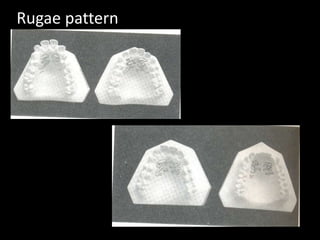
Rugae pattern – unique to an individual.
• The rugae pattern on the deceased's maxilla or maxillary
denture may be compared to old dentures that may be
recovered from the decedent's residence or plaster
models that may be available with the treating dentist.
• Palatal rugae are ridges on the anterior part of the palatal
mucosa on each side of the mid-palatine raphae, behind
the incisive papilla.
• These asymmetric and irregular ridges are well protected
by the lips, cheek, tongue, buccal pad of fat and teeth in
incidents of fire and high-impact trauma.
Classification of Palatal rugae
Ly’sells Classification
a) Primary Rugae (>5mm)
b) Secondary Rugae (3-5mm)
c) Fragmentary Rugae (2-3mm)
Thomas & Kotze Classification
1. Branched
2. unified
3. cross linked
4. Annular and
5. Papillary
Analysis of Rugae Patterns
Thomas & Vanwyk – Manually traced rugae patterns on to
clear acetate & superimposed on photographs of plaster models
Limson & Julian – ‘RUG FP – ID Match’
- Computer software program – same principle as employed
in finger print analysis.
Rugae pattern
Lip Prints
• The wrinkles and grooves visible on the lips have
been named by Tsuchihashi as 'sulci labiorum
rubrorum'.
• The imprint produced by these grooves is termed
'lip print', the examination of which is referred to
as 'cheiloscopy'.
• These grooves are heritable and are supposed to
be individualistic. Lip prints, therefore, can
constitute material evidence left at a crime
scene, much like fingerprints.
• Cheiloscopy [Examination of lip prints]
• Cheiloscopy is a forensic investigation technique
that deals with identification of humans based on
lips traces.
• Lip prints have to be obtained within 24 hours of
time of death to prevent erroneous data that would
result from post mortem alterations of lip.
• Lip print pattern depends on whether mouth is
opened or closed.
• In closed mouth position lip exhibits well defined
grooves, where as in open position the groves are
relatively ill defined and difficult to interpret
Classification of lip prints
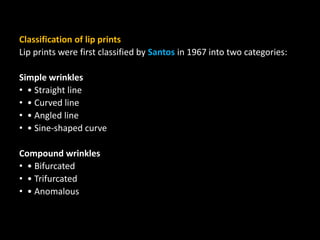
Lip prints were first classified by Santos in 1967 into two categories:
Simple wrinkles
• • Straight line
• • Curved line
• • Angled line
• • Sine-shaped curve
Compound wrinkles
• • Bifurcated
• • Trifurcated
• • Anomalous
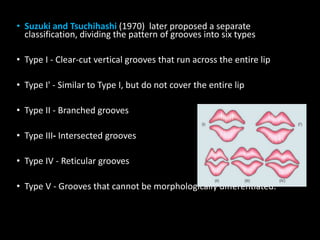
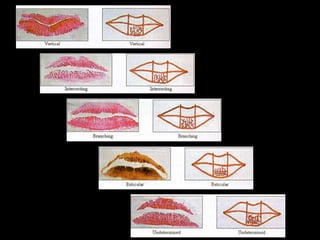
• Suzuki and Tsuchihashi (1970) later proposed a separate
classification, dividing the pattern of grooves into six types
• Type I - Clear-cut vertical grooves that run across the entire lip
• Type I' - Similar to Type I, but do not cover the entire lip
• Type II - Branched grooves
• Type III- Intersected grooves
• Type IV - Reticular grooves
• Type V - Grooves that cannot be morphologically differentiated.
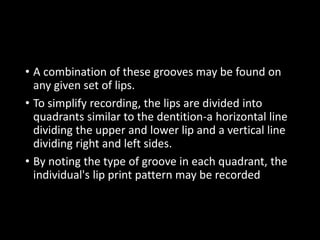
• A combination of these grooves may be found on
any given set of lips.
• To simplify recording, the lips are divided into
quadrants similar to the dentition-a horizontal line
dividing the upper and lower lip and a vertical line
dividing right and left sides.
• By noting the type of groove in each quadrant, the
individual's lip print pattern may be recorded
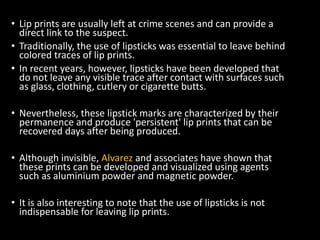
• Lip prints are usually left at crime scenes and can provide a
direct link to the suspect.
• Traditionally, the use of lipsticks was essential to leave behind
colored traces of lip prints.
• In recent years, however, lipsticks have been developed that
do not leave any visible trace after contact with surfaces such
as glass, clothing, cutlery or cigarette butts.
• Nevertheless, these lipstick marks are characterized by their
permanence and produce 'persistent' lip prints that can be
recovered days after being produced.
• Although invisible, Alvarez and associates have shown that
these prints can be developed and visualized using agents
such as aluminium powder and magnetic powder.
• It is also interesting to note that the use of lipsticks is not
indispensable for leaving lip prints.
• Ball states that the vermilion border has minor
salivary glands and the edges of the lips have
sebaceous glands with sweat glands in between.
• The secretions of oil and moisture from these
enable development of 'latent' lip prints in most
crime scenes, analogous to latent fingerprints,
where close contact between the victim and
culprit has occurred.
Disadvantage of Lip Print Investigation:
• Major trauma to the lips can result in scarring.
• Surgical treatment rendered to correct any abnormality also affects
the size and shape of the lips, thereby altering the pattern and
morphology of the grooves.
• The prints produced may differ in appearance depending on the
pressure applied and its direction.
• Hence, lip prints caused by one individual may be mistakenly
identified as those from another.
• Therefore, ball concludes that this sub-specialty of forensic
odontology requires further study
• First, to comprehensively establish the uniqueness of lip grooves;
second, to develop standard protocols for collecting and analysing lip
prints, without which it will fail the rigors of court interrogation.
Child abuse
• Child abuse may be defined as any act of commission or omission that
endangers or impairs a child's physical or emotional health and
development.
• Such acts include physical, sexual, or emotional abuse, as well as physical
neglect, inadequate supervision, and emotional deprivation
• It is important to realize that all members of the dental team have
unique opportunity-and a legal obligation to assist in the struggle against
child abuse.
• This special opportunity exists because a high proportion of abused
children suffer injuries to the face and head, including the oral and
perioral regions.
• These injuries may be observed during the course of dental treatment
and in some cases even before the child is seated in the dental chair.
• Child abuse is second only to SIDS(Sudden Infant Death
Syndrome) as the leading cause of death in children
under one year of age.
• In older children it is second only to accidents
• Our mission involves:
• (i) Knowing the signs of child abuse and neglect.
• (ii) Fulfilling the legal and moral obligation to prevent
further abuse by documenting the injuries by
photographs or other means and reporting the matter to
the police or social welfare agency.
• Dr. Kempe in 1961 coined the term "battered child
syndrome" to describe the children with multiple
unexplained bruises, fractures and head injuries.
• Child abuse can be defined as an non accidental
trauma or abuse inflicted on a child under eighteen
years of age while under the care of responsible
person.
• Preschool children are more prone to be abused.
Premature babies and babies with special needs
due to congenital diseases etc., are abused more
than normal babies.
• Most of the abusers (offenders) are the family
members or relatives of the children
• DETECTING CHILD ABUSE IN THE DENTAL OFFICE
When a child presents for examination, particularly if
there is an injury involved, the history may alert the
dental team to the possibility of child abuse.
Indeed, the history may be the single most important
source of information, Because legal proceedings
could follow, the history should be recorded in
detail.
• The possibility of child abuse or neglect should be considered
whenever the history reveals the following:
- The present injury is one of a series of injuries that the child has
experienced.
- The family offers an explanation that is not compatible with the nature
of the injury.
- There has been an extraordinary delay in seeking care for the injury.
- The family does not want to discuss the circumstances of the injury.
- While the above finding are by no means conclusive, they should cause
the examiner to look further for possible signs of abuse and to consider
this among the possibilities to be confirmed or eliminated.
• GENERAL PHYSICAL FINDINGS
Before examining the mouth, alert members of the dental team may
note general physical findings that are consistent with child abuse or
neglect:
• The child's nutritional state is poor and growth is subnormal.
• Extraoral injuries are noted. They may be in various stages of healing,
indicating the possibility of repeated trauma
• Bruises may change from reddish-blue or purple to green, yellow, then
brown over a period of 10 to 14+ days.
• There may be bruises or abrasions that reflect the shape of the
offending object, e.g. belt buckle, strap hand.
•
Cigarette burns or friction burns may be noted, e.g. from ligatures
of wrists, gag on mouth.
• There may be bitemarks, bald patches (where hair has been
pulled out), injuries on extremities or on the face, eyes, ears or
around the mouth.
FINDINGS ON DENTAL EXAMINATION
• Examination of dental injuries includes thorough visual
observation, radiographic studies, manipulation of the jaws, pulp
vitality tests, and percussion.
• Transillumination may also be helpful
Oral findings in Physical abuse:
• Craniofacial, head, face, and neck injuries occur in more than
half of the cases of child abuse.
• A careful and thorough intraoral and perioral examination is
necessary in all cases of suspected abuse and neglect.
• In addition, all suspected victims of abuse or neglect,
including children in state custody or foster care, should be
examined carefully not only for signs of oral trauma but also
for caries, gingivitis, and other oral health problems.
• Some authorities believe that the oral cavity may be a
central focus for physical abuse because of its
significance in communication and nutrition.
• Oral injuries may be inflicted with instruments such as
eating utensils or a bottle during forced feedings, hands,
fingers, or scalding liquids or caustic substances.
• The abuse may result in: contusions, burns, or
lacerations of the tongue, lips, buccal mucosa, palate
(soft and hard), gingivae, alveolar mucosa, or frenum;
fractured, displaced, or avulsed teeth; or facial bone and
jaw fractures.
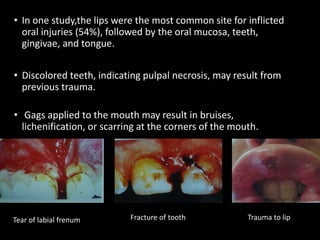
• In one study,the lips were the most common site for inflicted
oral injuries (54%), followed by the oral mucosa, teeth,
gingivae, and tongue.
• Discolored teeth, indicating pulpal necrosis, may result from
previous trauma.
• Gags applied to the mouth may result in bruises,
lichenification, or scarring at the corners of the mouth.
•
Tear of labial frenum Trauma to lipFracture of tooth
• Oral findings in Sexual abuse:
• Although the oral cavity is a frequent site of sexual abuse in
children, visible oral injuries or infections are rare.
• Oral and perioral gonorrhea in prepubertal children,
diagnosed with appropriate culture techniques and
confirmatory testing, is pathognomonic of sexual abuse but
rare among prepubertal girls evaluated for sexual abuse.
• Pharyngeal gonorrhea is frequently asymptomatic.
• When oral-genital contact is confirmed by history or
examination findings, universal testing for sexually
transmitted diseases within the oral cavity is controversial;
the clinician should consider risk factors
• Human papilloma virus infections may be sexually transmitted
through oral-genital contact, vertically transmitted from mother to
infant during birth, or horizontally transmitted through nonsexual
contact from a child or caregiver’s hand to the genitals or mouth.
• Unexplained injury or petechiae of the palate, particularly at the
junction of the hard and soft palate, may be evidence of forced oral
sex. As with all suspected child abuse or neglect, when sexual abuse
is suspected or diagnosed in a child, the case must be reported to
child protective services and/or law enforcement agencies for
investigation.
• Children who present acutely with a recent history of sexual abuse
may require specialized forensic testing for semen and other foreign
materials resulting from assault. If a victim provides a history for
oral-penile contact, the buccal mucosa and tongue can be swabbed
with a sterile cotton-tipped applicator, then the swab can be air-
dried and packaged appropriately for laboratory analysis.
• ASSOCIATED FACIAL LESIONS
• Becker et al found that in their series of facial injuries in abused children,
66%of the injuries were contusions and ecchymoses, 28%were abrasions
and lacerations, 3%were burns, 2%were fractures, and 1%were bites.
• Knowledge of the color changes associated with bruising may be
important in determining when the injury occurred, and in determining
whether other injuries occurred during the same event or at different
times.
• Kessler and Hyden point out that after the injury occurs, the area is
usually tender and swollen, but the bruise may not be visible as a
contusion or ecchymosis for 24 to 72 hours.
• A reddish-blue or purple color may change to green in 5 to 7 days, then
to yellow in 7 to 10 days, then to brown in 10 to 14 + days, before
clearing 2 to 4 weeks.
• Injuries to the face may include trauma to the eyes, ears, and nose, as
well as to the oral cavity.
• Blunt force trauma to the eye may cause periorbital bruises (black
eyes), acute hyphema (blood in the anterior chamber of the eye),
retinal and subconjunctival hemorrhage, ruptured globe, dislocated
lens, optic atrophy, traumatic cataract, and detached retina.
• Direct trauma to the nose may cause deviated septum due to cartilage
injury or hematoma formation. Such trauma may also cause nasal
fractures, with accompanying bilateral ecchymosis.
• Injuries to the ear may be associated with twisting and bruising, while
repeated blows may eventually result in a “cauliflower ear".
• Blows to the ear can also rupture the tympanic membrane or cause
hemorrhage and hematoma formation.
• Bruises from hand slapping are not uncommon.
• In such cases the bruise may reproduce the outline of the hand in
startling detail. As noted earlier, other cutaneous injuries may also take
the shape of the object used to inflict the injury, such as a belt buckle
or looped electric cord.
• BITE MARKS IN CHILD ABUSE
• Acute or healed bite marks may indicate abuse.
• Dentists trained as forensic odontologists can assist physicians in
the detection and evaluation of bite marks related to physical
and sexual abuse.
• Bite marks should be suspected when ecchymoses, abrasions, or
lacerations are found in an elliptical or ovoid pattern.
• Bite marks may have a central area of ecchymoses (contusions)
caused by 2 possible phenomena: positive pressure from the
closing of the teeth with disruption of small vessels or negative
pressure caused by suction and tongue thrusting.
• Bites produced by dogs and other carnivorous animals tend to
tear flesh, whereas human bites compress flesh and can cause
abrasions, contusions, and lacerations but rarely avulsions of
tissue.
• An intercanine distance (ie, the linear distance between the cen-
tral point of the cuspid tips) measuring more than 3.0 cm is
suspicious of an adult human bite.
• The pattern, size, contour, and color of the bite
mark should be evaluated by a forensic
odontologist or a forensic pathologist if an
odontologist is not available.
• If neither specialist is available, a physician or
dentist experienced in the patterns of child abuse
injuries should observe and document the bite
mark characteristics photographically with an
identification tag and scale marker (eg, ruler) in
the photograph
• DOCUMENTING AND REPORTING CHILD ABUSE
• When one suspects child abuse, it is important to document the
findings thoroughly.
• This record of the evidence is crucial for whatever legal proceeding
may follow. Documentation may involve written notes,
photographs, and radiographs.
• In some cases videotapes or audiotapes may be helpful. It is
important that critical photographs of injuries include a ruler or
scale held adjacent to the injury and on the same plane as the
injured surface.
• The report can be made to the local police agency or welfare
department. To a local agency or for other supportive information.
• In addition to criminal liability for failure to report, the practitioner
could also face a civil lawsuit, if there is subsequent injury to the
child
• Dental neglect
• Dental neglect, as defined by the American Academy of
Paediatric Dentistry, is the “will ful failure of parent or
guardian to seek and follow through with treatment
necessary to ensure a level of oral health essential for
adequate function and freedom from pain and
infection.”
• Dental caries, periodontal diseases, and other oral
conditions, if left untreated, can lead to pain, infection,
and loss of function.
• These undesirable outcomes can adversely affect
learning, communication, nutrition, and other activities
necessary for normal growth and development
• Failure to seek or obtain proper dental care may result
from factors such as family isolation, lack of finances,
parental ignorance, or lack of perceived value of oral
health.
• The physician or dentist should be certain that the care-
givers understand the explanation of the disease and its
implications and, when barriers to the needed care
exist, attempt to assist the families in finding financial
aid, transportation, or public facilities for needed
services.
• Parents should be reassured that appropriate analgesic
and anesthetic procedures will be used to ensure the
child’s comfort during dental procedures.
• If, despite these efforts, the parents fail to obtain
therapy, the case should be reported to the appropriate
child protective services agency.
Use of Radiology in Forensic Dentistry
• Radiographs being non destructive method play a
vital role in forensic dentistry to uncover the hidden
facts which can't be seen by means of physical
examination.
• They have helped to solve difficult cases in the
forensic science.
Uses:
Identification of Victims:
• Radiographs are helpful to determine age of an individual by
assessing the stage of eruption of teeth.
• Skull radiographs can be used in identification by
superimposing on antemortem radiographs or photographs.
• Since frontal sinuses are known for greatest normal
variations among individuals they are used for this purpose.
• Racial variations in the configuration of frontal sinuses are
also seen.
• Yoshino et al have classified frontal sinuses based on size,
bilateral asymmetry, superiority of side, outline of upper
borders, presence of partial septa and supra orbital cells and
reported a criminal case in which frontal sinus was used to
identify a person.
Comparison of frontal sinuses between ante-mortem (AM) and post-mortem (PM)
skull films showing duplication of distinctive pattern of air cells, margins, and
septae
Uses of dental radiographs in identification:
• Dental radiographs may be compared from ante and
postmortem records for congenital and acquired
abnormalities such as malformed tooth, caries,
restorations, root canal fillings etc.
• Law et al have injected radioopaque Substances into
the sockets of skeletonized remains to reconstruct the
root canal morphology to compare with antemortem
radiographs.
• A new method using digital subtraction image analysis
of bitewing radiographs provided reliable registration
for positive identity when certain criteria were used.
• Age of the extraction socket can be determined from
the appearance of the socket in the radiograph.
First evidence of healing Fuzziness of lamina dura due to
resorption.
Early stages after extraction Granular appearance of the socket
due to new bone formation.
Later stages Normal trabecular bone pattern.
Evidence in the identification of suspect:
• Cases have been reported where suspects were
identified because of fractured tooth parts of
victims in the body of the suspects or fractured
tooth of suspect in the victim as in the bite mark
cases.
• Deliberate alterations in the shape of the teeth in
suspects can be identified with radiographs in bite
mark cases.
To determine the cause of death:
• Radiographs may provide evidence of bullets or
foreign bodies in the soft tissues following fire arm
incidents and explosions.
• After air crash accidents the cause of crash may be
elucidated by the presence radio opaque objects in
the soft tissues.
• This is due to Contamination with molten aircraft
metal producing irregular shaped radio-opacity.
To find faulty charting of teeth:
• Sometimes while charting postmortem data teeth
may be wrongly numbered especially in cases where
adjacent tooth migrate into the extraction space.
• This can be corrected using radiographs.
Basic principle used for postmortem radiograph:
• When a radiograph of postmortem remains is
performed to compare with antemortem
radiograph "identical projection" must be achieved
with similar magnification, exposure factors and
angulation so as to reproduce the antemortem
radiograph like image.
• This job is carried out by using various angles of
projection and by varying technical factors.
Similarities In Antemortem And
Post Mortem Radiographs
• General considerations:
• Radiographs should be taken before and after head and
neck autopsy .
• Whenever possible radiographs should be made at the
scene of accident or crime.
• They should be properly labelled with identification
number, site and date of examination for future
reference.
• All intra and extra oral projections including panoramic
radiographs have to be taken as and when it is needed
depending on the case and type of remains.
• Intra oral radiographs
• Intra oral radiographs are difficult to perform
particularly when there is restricted mouth
opening.
• It may be necessary to remove soft tissues from the
floor of the mouth or cheeks to insert the film.
• A miniature intra oral x-ray source may be used.
• Resected maxilla may be split through the midpalatal
suture.
• The posterior mandible and maxilla are placed on
occlusal film to produce an "enlarged bite-wing film".
• Whenever fragmented remains consisting of teeth,
restorations, bone pieces, appliances are recovered
they have to separated.
• TECHNICAL FACTORS
• Sources of x-ray:
• Intraoral source: Radioactive Iodine 125 can be used to
expose the radiograph.
• It emits 27.4 kev x-rays.
• It is expensive and has a short half life of 60 days.
• Advantage of this source is that it eliminates the need
for jaw resection for the purpose of taking radiographs
as it can be introduced into the oral cavity with trocar
and cannula.
• Extra oral source: Extra oral source of x-rays are provided
from dental or medical x-ray machines.
• Film Holder:
• Films are held in position with hemostats, tapes or gauze
stuffed in the mouth or using modeling clay.
• ExposureFactors:
• Exposure time depends on the density of the object. Density
increases with soft tissues and skull recovered from the
water, but decreases due to fire.
• Usually exposure time should be reduced to one half to two
thirds of normal exposure for remains with soft tissue.
• Skeletonized remains need only one half of the normal
exposure.
• To differentiate tooth and filling MA should be reduced
with increased exposure time.
• Generally films should be repeated with varying KVP,
mA and exposure time.
• Films:
• Slower films are used in forensic cases to enhance the
details.
• Double film packets eliminate the need for duplication.
• For extra oral radiographs slow films and intensifying
screens should be used.
• Processing:
• Best results can be obtained with manual
processing using "visual method“ to adjust and
reproduce films resembling antemortem films.
• All the radiographs should be duplicated and filed
for future reference.
• Improving the bad quality radiographs:
• There are few methods which can be utilized to
improve too dark or too light radiographs.
• Chemical Methods: Dark radiographs may be lightened
by chemically removing some of the silver that forms the
image and light films may be intensified by binding
another visible substance to the silver.
• Duplication Method: While duplicating a film by
increasing or decreasing light exposure, radiographs can
be made light or dark as required.
• Photographic Method: Changing transmitted light
intensity from a view box, altering exposure time or lens
opening or using different speed photographic films
radiographs can be photographed to overcome poor
quality.
• Electronic Imaging Techniques: Computerized digital
image processing and manipulation can enhance
observer's ability to detect from defective radiographs.
Ethics in Dentistry
• The word ethics comes from the Greek ‘ethos’ originally
meaning character or conduct.
• It is typically used interchangeably with the word moral
which is derived from the Latin word ‘mores’, which means
customs or habits.
• Together these two terms refer to conduct, character, and
motivations involved in moral acts.
• Thus, ethics are not imposed by a profession or by law, but by
moral obligation.
• Ethics are an unwritten code of conduct that encompass both
professional conduct and judgment.
• Though the details of the written ethical code may vary
from profession to profession, the underlying
principles of ethics remain the same.
• From constitution bye laws and code of ethics of "The
Indian Dental Association" as amended upto January
31, 1988.
• In order that the dignity and honor of the dental
profession may be upheld, its standards exalted, its
sphere of usefulness extended and the advancement
of dental science promoted and that the members of
the Indian dental association may understand more
clearly their duties and obligations to the dental
profession, to their parents, and to the community at
large, the following Code of Ethics is prescribed.
• Section 1 :
• It is the duty of every dentist, and it shall be
incumbent upon every member of this association
to govern his department in accordance with the
underlying principles which have motivated the
formulation of the code.
• It is not assumed that the following articles cover
the whole field of dental ethics, the dentist is
charged with many duties and obligations in
addition to those set forth herein. Briefly the
‘Golden Rule’ should be conscientiously applied by
every member of the dental profession.
• Section 2 :
• It is unprofessional for a dentist to advertise by handbills,
posters, circulars, cards and signs, or in newspapers or in
publications, calling attention to special methods of practice
or calming excellence over other practitioners, or to use
display advertisements of any kind.
• It is also unprofessional to publish reports of cases or
certificates in the public prints.
• This does not exclude a practitioner, either from using
professional cards of the suitable size with name, titles,
address and telephone number printed in modest type of
having the same character of card in a newspaper at the time
of commencement of practice or change of address for not
more than 3 insertions at a time.
• Neither does it prevent a practitioner who confines himself to
a specialty - from merely announcing his specialty on his
professional card.
• Section 3 :
• It is unprofessional for dentist to pay or accept
commission on fees for professional services, or for
radiograms or on prescriptions or other articles
supplied to patients by pharmacists or others
• Section 4:
• One dentist should not disparage the services of
another to a patient.
• Criticism of operations which are apparently defective
may be unjust through lack of knowledge of the
conditions under which they were performed.
• But the welfare of the patient is paramount to every
other consideration and should be conserved to the
utmost of the practitioner’s ability.
• If he finds indisputable evidence that a patient is
suffering from previous faulty treatment, it is his duty
to institute correct treatment at once, doing it with as
little comment as possible and in such manner as to
avoid reflection on his predecessor
• Section 5 :
• If a dentist is consulted in an emergency by the
patient of another practitioner who is temporarily
absent from his office or by a patient who is away
from home, the duty of the dentist so consulted is
to relieve the patient of any immediate disability by
temporary service only and then refer the patient
back to the regular dentist.
• Section 6 :
• When a dentist is called in consultation by a fellow
practitioner, he should hold the discussions in the
consultation as confidential and under no
circumstances should he accept charge of the case
without the request of the dentist who has been
attending it.
• Section 7 :
• It is unethical for dentist to connive at or aid in
illegal practice by others.
• It is their duty to expose such persons without fear
or favor.
• Dentist shall call to the attention of the committee
of ethics of IDA, illegal, corrupt or dishonest
conduct on the part of any member of the dental
profession.
• Section 8 :
• It is un ethical for dentists to give testimonials
directly or indirectly, concerning the supposed
virtue of secret therapeutic agent or medicines or
to promise radical cures by employing secret
methods of treatment.
• Section 9 :
• The dentist should be morally, mentally and
physically clean.
• He should be honest in all his dealings with his
fellow men as comports with the honor and dignity
of cultured and professional gentlemen.
Dental jurisprudence
• Dental jurisprudence refers to the science that applies the
principles and practice of the various fields of dentistry to
the elucidation of doubtful questions in a court of justice.
• Code of ethics laid down by IDA –
• Consent in dental practice :
• Patient has right to get sufficient information regarding his
diseases, treatment available for the disease, probable
outcome of the treatment and alternative treatment, if
available, so as to make an intelligent decision on whether
to accept or reject medical or dental care.
• It is important to obtain consent of the patient. Failure to
do so may result in prosecution for assault to the person
and the patient may be entitled to damage
• Types of consent:
• There are two types of consent, one is implied
consent and the other is informed consent.
• Implied consent:
• By being seated in the dental chair with their
mouth opened, a patient implies that they are for
the dental treatment. Now this form of consent is
used only for examination and minor treatments
in children, if a child's mother has made an
appointment for her child but can't accompany
him or her to the clinic.
• Express or informed consent:
• Informed consent must be obtained before any
procedure other than examination either orally or
in writing. Before embarking on treatment the
dentist should fully inform the patient regarding the
following.
• Treatment plans along with alternative treatments.
• Probable costs of treatment.
• Probable outcome of therapy.
• Anesthesia.
• Possible pitfalls and difficulties of treatments.
• Possible postoperative problems.
• If extensive work is necessary and before
administration of general anesthetic always get a
written consent. If written consent has not been
obtained, a note should be made in the record that
informed consent has been given orally and that
the material risks of the procedures have been
explained to the patient.
• Blanket type of consent form is not recommended
because patient can't give permission for a
procedure of which he has no knowledge.
• Special problems:
• In the case of patients below eighteen years it is
wise to get informed consent from parents and
patients.
• When the patient can't give consent as in the case
of mentally disordered patients, a dentist is
permitted to treat him or her provided it is in the
patient's interest.
• Consent for research purpose:
• Patients who are invited to take part in a research
programme approved by the local ethics committee
must be given full explanation regarding the
objective of the study and possible side effects.
• Patients should not be put under pressure to
participate.
• Malpractice And Negligence
• Dentist is considered negligent when the duties to
the patient are not provided by him.
• In such cases there is an absence of care consisting
of either doing something that should not have
been done (commission) or not doing something
that should have been done (omission).
• In other words dentist failed to use his degree of
skill, care and judgement that a reasonable or
prudent dentist would have used.
• Malpractice is a broader term referring to the failure
to exercise skill, knowledge or care with resultant
injury to the patient.
• Respondent superior:
• Respondent superior ("let the master answer") is
an established principle which means that dentist is
legally responsible for wrongs committed by his
employees.
• Common malpractice problems encountered in
dentistry:
• Failure to diagnose:
• Due to failure to take adequate history, failure to
examine thoroughly or investigate properly.
• Improper diagnosis:
• Failure to refer:
• Dentists should not attempt to do services beyond their limits
• Failure to inform:
• Patient must be informed about the disease and treatments
provided to it.
• Dentists should also inform the patients about complications
during treatment
• Eg : broken instruments in the root canals or root tips left in
situ.
• Failure to maintain records.
• Complications due to treatment.
• Death in dental clinic due to negligence
• To avoid malpractice dentists should
maintain complete treatment records, obtain
consent from the patient in writing, provide
above average dental care.
• He should improve his skills and knowledge
by attending continuing education courses.
• Dentist as an Expert Witness:
• Expert witness is an advisor to the court and may give
opinions, draw inferences or interpret facts about which the
judge has 'special knowledge.
• A dentist may be required to testify in malpractice cases,
other criminal and civil cases. In principle he should act only
as an advisor to the court and should remember that he is
not an advocate of either side.
• Before testifying in the court, expert should go through the
records regarding the case, prepare notes keeping in mind
that the opposing attorney has right to see them and make
them public. All the court exhibits should be simple and
straight forward which can be understood by the judges.
• Always simple and clear language should be used. The
expert should be ready to answer defence attorney's
questions such as probability of error, references to the
opinion given by the expert.
• CONCLUSION
• The roles of any forensic scientist are to collect, preserve and
interpret trace evidence, then to relay the results to the judicial
authority in a form of a report.
• Forensic Odontology is the forensic science that is concerned with
dental evidence.
• Dental practitioners should be aware of the forensic application of
dentistry.
• Dental records that are used to provide patients with optimal dental
service could also be very beneficial to legal authorities during an
identification process.
• Therefore, all forms of dental treatments should be recorded and
kept properly.
• Dental clinicians, as other healthcare workers, are at
the forefront in detecting signs of violence appearing
on their patients.
• They should be aware of the criteria of abusive
injuries, and the reporting mechanisms to ensure a
correct response by the concerned authorities.
• Though forensic odontology has achieved giant strides
in recent times, various techniques utilized in forensic
odontology are abided by limitations.
• These limitations are to be kept in mind when
answering queries in the court of law while
prosecuting an accused, because an improper
conclusion can alter and shatter the dreams and lives
of alleged accused too.
• Reference :
• A colour atlas of forensic dentistry – Whittaker and
MacDonald
• Text book of forensic Odontology – KMK Masthan
• Shafer’s textbook of oral pathology - 6th edn
• Text book of forensic Odontology – Pramod K Dayal
forensic odontology by Dr. Revath Vyas Devulapalli

forensic odontology by Dr. Revath Vyas Devulapalli

  • 1.
  • 2.
    Part – 1contents • Introduction • History • Personal identification • Age estimation • Dental • skeletal • Sex determination • Dental • skeletal • Mass disaster Management
  • 3.
    Part – 2contents • Bite marks • Cheiloscopy • Rugoscopy • Ameloglyphics • Dental Jurispedence • Ethics in Dentistry • Forensic Radiology
  • 4.
  • 5.
    • ‘‘What anightmare!. . . bodies as of negroes – blackened; heads carbonised; shrunk and reduced to nothing , but only the teeth remained.” -Dr. Oscar Amoedo (The father of Forensic Dentistry)
  • 6.
    FORENSIC DENTISTRY or FORENSIC ODONTOLOGY Definition: Forensic– Forum means ‘Court of Law’ Odontology – Study of teeth • Branch of forensic sciences which deals with collecting, preserving, recording and interpretation of dental evidence at the interest of court of law to offer law enforcement. • Forensic Dentistry, or Forensic Odontology, is the application of dental and paradental knowledge to the solution of legal issues in civil and in criminal matters
  • 7.
    • Father ofForensic Odontology - Dr. OSCAR AMOEDA • KEISER in 1970 defined “It as branch of Odontology which deals with the proper handling of examination of dental evidence and the proper evaluation and presentation of dental findings in the interest of justice”
  • 8.
    HISTORY OF FORENSICDENTISTRY • History of forensic dentistry dates back 4500 years • One of the first dental identification was recorded in 2500 BC, then 2 molars were linked together by gold wire were found by Junker in a tomb located at Giza • At the time of Nero, in 66 AD, As the story goes, Nero’s mother Agrippina had ordered her soldiers kill Lollia Paulina, with instructions to bring back her head as proof that she was dead. Agrippina, unable to positively identify the head, examined the front teeth and on finding the discolored front tooth confirmed the identity of the victim
  • 9.
    • A newera of forensic dentistry began in 17th century when a body was identified from its dental details of the deceased personally known to dentist • A practical application started in 19th century, when a criminal was convicted on the basis of dental evidence • German dictator ADOLF HITLER and Pakistani President GENERAL ZIA-UL-HAQ were identified only on the basis of dental evidences
  • 10.
    • Dental detectivework gets to the root of Adolf Hitler mystery who died in Berlin in 1945 • Charred pieces of bone, such as pieces of skull, the lower jaw and part of the upper jaw consisting of a bridge with nine units were found." but nothing was revealed to the public until 1968, fuelling speculation about Hitler's fate.
  • 11.
    • The jawremains were compared with dental evidence given to the Americans by Hitler's American-trained dentist, Hugo Blaschke, who had been arrested in 1945 • In 1972, archives in Washington released five X-rays of Hitler's head, taken on July 20, 1944, which revealed bridge work, periodontal (gum) disease and “very unusual dental work”. • These matched Blaschke's evidence and the Russian autopsy
  • 12.
    • In 1897,a paper entitled "The role of dentists in the identification of the victims of the catastrophe of the Bazar de la charite“ Paris 4th may 1897 was presented by DR.OSCAR AMOEDO- FATHER OF FORENSIC ODONTOLOGY • He incorporated many concepts of dental identification in a text- “L'ART DENTAIRE EN MEDECINE LEGALE” published in French in 1898 and in German in 1899. • In 1906, first time in history bite marks were accepted as an evidence and person was convicted for murder on this basis.
  • 13.
    Involves • Identification ofthe living or the deceased • Bite mark identification, analysis and comparison • Lip print identification, analysis and comparison • Rugae print identification, analysis and comparison • Patterned injury identification, analysis, comparison • Identification of dental specimens at crime scene or elsewhere • Evaluation of oro-facial trauma • Malpractice and negligence claims
  • 14.
    The subject isdivided into three major fields of activity- civil, criminal and research CIVIL: 1. Malpractice and all aspects which may eventually lead to criminal charges in the form of fraud. 2. Neglect, where damages may be sought 3. Identification of individual remains where death is not due to suspicious circumstances- whether fragmentary or complete. It includes each assessments 4. Identification of a living person- loss of memory. 5. Major or mass disasters- the identification of victims of an aircraft or train disasters or fire in a public building
  • 15.
    CRIMINAL 1. The identificationof persons from their teeth - living/dead person. 2. Bite marks - food stuff (Layton 1966), on the assailant, on the victim- self inflicted/inflicted by another RESEARCH 1. Academic training and courses 2. Post graduate tuition
  • 16.
    Role of ForensicOdontology: 1) Routine identification - unknown human remains in various stages of decomposition. - Analyze the dentition of the deceased. Record all the restorations, anomalies, missing teeth - Radiographic and photographic records of the dental arches. - Compared with antemortem records & radiographs for positive identification - Assessment requires ageing, sex and socioeconomic status – Skeletal structures, dental eruption patterns, restorative material in teeth, status of periodontium, serology, cytology of pulp, saliva & mucosa.
  • 17.
    2) Mass Disasters:- Identificationof people in mass disasters. 3) Bitemark evidence:- Identification, examination & evaluation of bite marks – sexual assaults, child abuse, personal defense situations. 4) Child abuse:- Battered child, sexual & non sexual abuse 5) Civil Litigation:- Examination of patients sustaining trauma due to accident, assault, negligence or malpractice – supported with radiographs, photographs etc.
  • 18.
    6) Age Estimation: Estimationof both the living and the deceased. 7) Sex Determination:- Determining the gender of unidentified individuals. 8) Other methods of Identification:- Cheiloscopy (Study of lip prints) Rugoscopy (Study of palatal rugae patterns) Sialochemistry (Detection of Chemicals in Saliva)
  • 19.
    PERSONAL IDENTIFICATION • Identity:- The characteristics by which a person may be recognized.
  • 20.
    DENTAL IDENTIFICATION KIT PROTECTIVECLOTHING DENTAL INSTRUMENTS RECORDING THE DATAIMPRESSION MATERIALS PHOTOGRAPHY
  • 21.
    COMPARISON MICROSCOPE Device allowingtwo sections to be viewed simultaneously at exactly the same magnification so that a correlation can be tested between the two
  • 22.
    IDENTIFICATION 1. Non dentalidentification 2. Dental identification NON DENTAL IDENTIFICATION : • Facial recognition by a relatives or acquaintance • personal property (Clothing, Jewellery, etc.,) • Finger printing – (A.M. records must) - can be taken from household surroundings • Other bones of the body - Pelvic Bones - Hand Wrist X-ray DENTAL IDENTIFICATION:
  • 23.
    Teeth in identification 1.Resistant to post-mortem destruction (physical, chemical, thermal and decomposition) 2. Developmental and function characteristics of teeth 3. To be contained in small area of the body so that even when body is crushed or fragmented, sufficient portion of the area containing material remains intact 4. Be a part of body that is readily accessible for examination
  • 24.
    5. Various degreeof dental pathology 6. Varieties of dental restorations 7. Identical twins are not necessarily identical dentally 8. Bleeding and congestion of pulp in suffocation 9. Blood group can be determined from teeth by special tests
  • 25.
    Three Main formsof Dental Identification 1. Comparative identification - most frequently performed examination - to establish the remains of a decedent and a person represented by ante mortem records are of the same individual. 2. Reconstructive identification [Dental profiling or Post-mortem Dental profile] - elicit race, gender, age & occupation of the dead individual - undertaken when ante-mortem records are not available. 3. Identification in mass disasters - identification of victims in mass disasters
  • 26.
    I. Comparative DentalIdentification - Conventional method of identification - includes four steps A) Oral Autopsy B) Obtaining Dental Records C) Comparing post and ante-mortem dental records D) Writing a report & drawing conclusions.
  • 27.
    A. ORAL AUTOPSY –dissection to expose the organs, to determine the cause of death – oral examination – essential part – Forensic dentist should have knowledge about rigor mortis [stiffening & rigidity], livor mortis [purple discoloration on the skin in the dependent parts], decomposition & postmortem artifacts – For jaw separation, use of mouth gags or intra oral myotomy is essential. – Teeth to be reinforced with cyanoacrylate cement, polyvinyl acetate or clear acrylic spray – Thorough examination of soft tissue injuries, fractures & foreign bodies – information be entered on to the standard ‘Interpol Post- Mortem form’ – Color coded in Pink.
  • 30.
    B. OBTAINING DENTALRECORDS [Ante-mortem records] – Contains information of treatment & dental status during his/her life. – Obtained from treating dentist, specialist or hospital records – in the form of dental charts, radiographs, casts & / or photographs – Transcribed onto the standard ‘Interpol ante-mortem form’ – color coded in Yellow.
  • 32.
    C. COMPARING POST– AND ANTE-MORTEM DENTAL RECORDS – Compared by written notes, Study casts, radiographs, Photographs etc., – Criteria for comparison are a Tooth characteristics [number, eruption status, position] b. Personal characteristics [crown morphology - occlusal ridges, cusps, Root morphology - branching pattern, furcation, fusion] c. Complexity factors – tubercles, pits, additional ridges, grooves, fissures & d. Acquired features – hypoplasia, trauma, function, personal habits, restorations
  • 33.
    – Individual withmultiple dental treatment & unusual features – better identified. – Dental record considered a legal document – Radiographic identification is often conclusive. The Post-mortem Records - Made using diagrammatic charts, tape recordings, radiographs, photographs & / or models.
  • 34.
    Most Common Pointsfor Comparison Include 1. The no. of teeth – Missing, impacted, supernumerary 2. Restorations & Prosthesis – Tooth no., surfaces involved, dental materials used - type of material, no. of replaced teeth. 3. Dental Caries – Surface & configuration 4. Malposition & Rotation 5. Anomalous tooth formation – extra cusps, peg-shaped incisors, fused teeth – imp. Characteristics
  • 35.
    6. Root canaltherapy – Type of filling material used, imperfections of the canal 7. Bone pattern – Medullary bone, max. sinus configurations 8. Occlusion – Overbite, overjet, 1st molar relationships 9. Oral Pathology – mand. or palatal tori, geographic or fissured tongue, enamel hypoplasia, drug- induced gingival hyperplasia etc. 10. Occupational Changes & Socioeconomic Pattern of the Dentition - Notching of the incisal edges of the incisors – hair dressers, carpenters, shoe-makers, tailors etc Generalised attrition of teeth – workers in sand blasters Socioeconomic status – multiple crowns, gold restoration, RCT, Fixed partial dentures etc.
  • 36.
    UNUSUAL WEAR ANDTEAR ATTRITION, EROSION, ABRASION ABRASION: • if confined to enamel -<30 years • if reached dentin – 30-40 years • if extensive dentine – 40-50 years • if occlusal surface flat – 50-60 years • At the level of tooth neck- >60 years Erosion Abrasion
  • 38.
    TEETH LOST BEFOREAND AFTER DEATH • If margins of empty sockets are unresorbed and sharp means lost after death
  • 39.
    D. WRITING AREPORT AND DRAWING CONCLUSIONS - Establishing identity is addressed to the legal authorities - detailed report & factual conclusion must be clearly stated. Range of Conclusions 1. Confirms identification - Ante – and Post-mortem data match each other - Identity is proven ‘beyond reasonable doubt’ - includes radiographic support. 2. Probable identification - Data is consistent - Lack of quality of ante- & Post-mortem information - no radiographic support
  • 40.
    3. Possible identification -Explainable differences exist between the ante – and post-mortem data. 4. Insufficient Information - available information is minimal 5. Excludes identification - Ante-and Post-mortem data are inconsistent - Data contains unexplainable differences - Indicates a mismatch
  • 41.
    II. DENTAL PROFILING [RECONSTRUCTIVEIDENTIFICATION (OR) POST – MORTEM DENTAL PROILE] It includes the decedent’s A. ETHNIC ORIGIN [Race determination] B. GENDER [Sex determination] C. AGE [Age estimation]
  • 42.
    A. IDENTIFYING ETHNICORIGIN FROM TEETH [RACE DETERMINATION] Human species has been categorized into three races – Caucasoid, Mongoloid & Negroid Skull Face Nasal apertures CAUCASIANS (White) Rounded Small Narrow & Elongated MONGOLOIDS (Yellow) Square Large, Flattened Rounded NEGROID (Black Africans) Narrow, Elongated Maxilla & Mandible Prognathic Broad
  • 43.
    DETERMINATION OF RACE CHINESE: 1.Widearch 2.Enamel extension between roots of molars 3.Five cusped third molars 4.Rooted deciduous molars EUROPEANS: 1. Narrow arch & crowding 2. Cusp of Carabelli MONGOLOID: 1.Occlusal enamel pearls in premolars 2.Missing mand. incisors 3.Shovel-shaped incisors AMERICAN INDIANS: 1. Marked attrition 2. Shovel-shaped incisors 3. Large teeth SOUTH AFRICANS: Tall pulp chambers
  • 44.
    COMMON RACIAL CHARACTERISTICS AUSTRALIANABORIGINES NEGROID 1) Large arch & large teeth Lower 1st premolar has 2 or 3 lingual cusps 2) Marked attrition 3) Midline diastema
  • 45.
    IDENTIFICATION OF INDIVIDUAL’SETHNIC ORIGIN BASED PURELY ON DENTITION Dental features - Combination of hereditary & environmental factors Dental features are broadly categorized as a) Metric [ Tooth size ] – Measurements b) Non Metric [ Tooth Shape ] - Presence or absence of a particular feature eg:- Cusp of carabelli A. METRIC FEATURES:- Influenced by local environmental factors eg:- missing lat. Incisors causes compensatory increase in central incisors, Lack of space result in compression of third molars.
  • 46.
    B. NON METRICFEATURES:- - heritable, more dependable
  • 47.
    European, West &South Asian People 1. Four cusped lower 2nd molar 2. Two rooted lower canine 3. Carabelli’s feature & 4. Three cusped upper 2nd molar East Asians 1. Winging 6. Enamel extensions 2. Shovelling 7. Three rooted mand. 1st molar 3. Double shovelling 8. Three cusped max. 2nd molar 4. Interruption grooves 9. Single-rooted mand. 2nd molar 5. Odontomes
  • 48.
    B. SEX DETERMINATION Pelvisis a better indicator of sex than the dentition. 1. SEXING FROM CRANIOFACIAL MORPHOLOGYAND DIMENSIONS Male skull is larger – endocranial volume about 200 cc more than that of females.
  • 49.
    a) SEX DETERMINATION TRAITMALE FEMALE General size Larger Smaller Supraorbital ridges Medium to large Medium to small Architecture Rugged Smooth Orbits Square Rounded Cheek bones Heavier, more laterally arch Lighter & more compressed Mastoid process Large, prominent, roughened Smoother & less prominent Forehead Less rounded More rounded :
  • 50.
    MALE FEMALE Lower jawMasive Lesss massive Chin Square Pointed and rounded Symphyseal height More less Angle region Averted Non- averted Lateral angle marked roughening or ridged appearance b’coz of masseter Attachment & powerful closing of jaws More rounded attachment surface more smoother Ramus Broad Less broad CONDYLAR ANGLE : Vary between male and female
  • 51.
    2. SEX DIFFERENCESIN TOOTH SIZE Generally teeth are smaller in females Teeth – used for differentiating sex by measuring mesiodistal & buccolingual dimensions Canines – show max. sex difference Mand. Canines show greatest dimensional difference, being larger in males Dental Index In addition to tooth size, tooth proportions have been suggested for differentiating the sexes. Aitchison presented the ‘Incisor Index’ [Ii] calculated by the formula Ii = MDI2 MDI2 is the max. MD diameter of Max. LI MDI1 MDI1 is the max. MD diameter of Max. CI Ii is higher in males Standard Mandibular Canine Index Proposed by Rao & Assoc. Mean mandibular canine index in female + S.D + Mean mandibular canine index in males – S.D 2 100
  • 52.
    STUDIES MD WIDTH OFCANINE INTER CANINE DISTANCE CANINE INDEX STANDARD CANINE INDEX SEXUAL DIMORPHISM SEX PREDICTION % RADIOLOGICAL COMPARISION COMPARISION BETWEEN THE STUDIES OUR STUDY Ashith B. Acharya et al Rao et al., Muller et al., Rishabh Kapila et al., Vandana M Reddy et al., Kaushal et al., Boaz k et al., Al-Rifaiy MQ et al.,
  • 53.
    Accuracy of GENDERPREDICTION GENDER NO. CASES STUDIED NO. OF CASES WITH CORRECT GENDER PREDICTION USING STANDARD MAXILLARY CANINE INDEX % OF ACCURACY NO. OF CASES WITH CORRECT GENDER PREDICTION USING STANDARD MANDIBULAR CANINE INDEX % OF ACCURACY MALES 30 23 76.66 24 80.00 FEMALES 30 22 73.33 23 76.66
  • 54.
    STANDARD MANDIBULAR CANINEINDICES IN VARIOUS STUDIES AND % ACCURACY CALUCULATED FOR THE PRESENT DATA STUDY SCI % ACCURACY FOR PRESENT STUDY Our study 0.260 78.5% Ashith B. Acharya et al., 0.260 78.5% Muller et al., 0.269 72.5% Rao et al., 0.274 58.5% Vandana M Reddy et al., 0.256 72.5%
  • 55.
    3. TOOTH MORPHOLOGYAND SEXING According to scott & Turner II, ‘Distal Accessory ridge’ – a nonmetric feature on the canine – most sexually dimorphic crown trait. Males shows significantly higher frequency & more pronounced expression than females. 4. SEX DETERMINATION BY DNA ANALYSIS a. From pulp tissue:- Y chromosome analysis from dental pulp of male can be done even after 1yr. Of death b. From enamel protein [Amelogenin]:- Amelogenin[AMEL] – Major matrix proteins secreted by the ameloblasts of the enamel AMELgene located on X & Y – chromosomes in humans c. From Buccal Mucosa:- Barr bodies & x-chromosomes of female detected from buccal mucosal epithelium.
  • 56.
  • 57.
    TYPES OF AGE: •CHRONOLOGICAL AGE OR REAL AGE: It is the measured by the calender, whether it be a period of IU development or number of years after birth • HEIGHT AND WEIGHT: Age of a person can be roughly determined from the standard charts of height & weight, but is least accurate & reliable • SKELETAL AGE: Determined by the degree of ossification / development of various bones known to occur at particular time in average individual • DENTAL AGE: Determined by studying development of various teeth from the time of crypt is visible till the time of root completion
  • 58.
    SKELETAL AGE DETERMINATION Age Changesin Craniofacial Bones Neonatal : Edentulous jaws, orbit size relatively large I year : Fusion of midline symphysis of mandible Metopic sutures of two halves of frontal bone fuse Lat. Sphenoidal synchondrose fuse Fontanelles : Post & ant. Lateral fuse by 3 months. Ant. Fontanelle by 1 ½ yr (18 MONTHS). 3 years : Condylar portion of occipital bone fuses with squama 5 years : Condylar position of occipital bone fuses with basoocciput. SPHENOOCCIPITAL SYNCHONDROSIS [between basal part of occipital bone & adj. body of sphenoid] – Major skull cartilage centre, fuses by 18- 21 years – most useful skeletal ageing factor.
  • 59.
    Neonatal skull :in this neonatal skull the lack of eruption of the dentition places the age at less than six months after birth. The height of the face is small compared with an older child, whereas the relative size of the orbits is large. In most infants the midline symphysis of the mandible is fused by about one year after birth, and the lack of fusion in this specimen indicates a much lower age. The metopic suture (arrow) between the two halves of the frontal bone fuses at about one year, but there are racial variations.
  • 60.
    • The fontanelles: the fontanelles of the skull may be an indication of age in that the anterior fontanelle is said to close by about one and half years of age, the posterior and anterolateral fontanelles by about one year. These dates are somewhat imprecise for particular individuals. • In this skull the anterolateral fontanelle (1) is still open, indicating that skull is less than three months after birth. The large anterior fontanelle(2) between the frontal and parietal bones closes at about 18 months of age. This structure may be readily seen on radiographs which provide a non invasive method of determining approximate age.
  • 61.
    Skull cartilages: bonesdeveloping in cartilage can be used to age a skull. At the base of the skull the lateral sphenoidal synchondroses(1) are said to fuse within the first year of life, but the spheno-occipital synchondrosis(2), lying between the basal part of the occipital bone and adjacent body of the sphenoid, is a major growth centre until later life. In skeletonized material the cartilage itself is lost but radiographs will show whether ossification has occurred. Growth at this site producing an anteroposterior lengthening of the skull base is thought to be associated with the downward and forward movement of the upper face. The eruption of the upper second molars occurs at around the age of 12 or 13 years. The spheno occipital synchondrosis begins to fuse shortly after this. It provides one of the most useful skeletal ageing factors at this period of development.
  • 62.
    • Skull sutures: once the end of the second decade has been reached there is relatively little change in the skull, but in later life the sutures between the cranial bones are obtained, usually from the inside of the cranium. This process begins in the third and fourth decades of life and the sutures varies markedly from individual to individual. In this case the lambdoid suture, although patent externally (arrow) was in the process of obliteration on its inner aspect, suggesting an age at death of 30 to 55 years.
  • 63.
    SKULL SUTURES From 25years- Coronal, Sagittlal, lambdoid sutures start closing 32 – 35yrs - Sagittal 40 yrs - Coronal 45yrs - Lambdoid 60yrs - Squamous portion of temporal bone fuses with parietal bone. CRANIAL SUTURES Open - < 30 yrs Closing - 30-55 yrs Closed - > 55yrs. MANDIBULAR ANGLE Infancy - 160 – 1750 1 – 3years - 150 - 1600 6 – 12years - 125 - 1400 15-17years - 120 - 1300 18-21years - 900-1250 30-40years - 950-1150 > 40 year - obtuse angle
  • 64.
    • Evaluation ofCervical Vertebrae Maturity on Lateral Cephalogram CVMI were evaluated by classifying C2, C3, and C4 into six groups depending on their maturation patterns on the lateral cephalogram using the classification of Hassel and Farman.
  • 73.
    OSSIFICATION CENTRES From 2ndmonth IU to 2nd year of extra uterine life From 3rd yr to mid teens – Secondary Ossification centres appear Next decade- Primary Ossification centre (Diaphyses) unite with secondary ossification centres (epiphyses) Primary Ossification centres appear in the skeleton
  • 74.
    Infancy Adult Oldage BodyShallow Thick & long Shallow Ramus Forms an obtuse angle with the body Forms an approximate right angle Obtuse angle Mental foramen Located near the lower margin of the body Midway between upper & lower margin Near alveolar margin Condyle Occupies a level lower to the coronoid process Elongated and projects above the coronoid Neck is bent backwards MANDIBULAR CHARACTERISTICS USEFUL IN AGEING
  • 75.
    DENTAL AGE ESTIMATION ImportantSubspeciality of forensic sciences Also has application in living individuals Dental Age Estimation Methods a. Morphologic / visual Examination b. Radiographic Examination c. Histological Examination and d. Biochemical Examination Age estimation using the dentition may be grouped into three phases a. Ageing in prenatal, neonatal & early Post natal b. Age estimation in children and adolescents c. Age estimation in adults
  • 76.
    FACTORS USEFUL INDENTALAGE ESTIMATION 1. Appearance of tooth germs 2. Earliest detectable trace of mineralization 3. Degree of Completion of unerupted teeth 4. Rate of formation of enamel and formation of the neonatal line 5. Clinical eruption 6. Degree of completion of the roots of erupted teeth 7. Degree of resorption of the roots of deciduous teeth 8. Attrition of the crown
  • 77.
    9. Formation ofphysiologic secondary dentine 10. Formation of cementum 11. Transparency of root dentine 12. Gingival recession 13. Root surface resorption 14. Discoloration and staining of the teeth 15. Influence of disease or malnutrition on tooth eruption 16. Influence of Sex on tooth eruption 17. Changes in the chemical composition of the teeth Dental & skeletal ages correspond closely in the male, in the female, the skeletal age is one year ahead of dental age.
  • 78.
    Some odontologists advocate,the use of aspartic acid racemization, claiming an accuracy of ±4 years Additional methods include the use of SEM-EDXA, a method used to examine dentine in relation to age determination A recent study from the UK examined the use of root length, in the determination of age in paediatric cases Miscellaneous
  • 79.
    A) AGE ESTIMATIONIN PRENATAL, NEONATAL AND EARLY POST NATAL CHILD 1. Primary tooth germ begins to form at seven weeks in utero(IU) & enamel formation of all deciduous teeth complete by first year. 2. Permanent tooth germ begins to form at 3.5 to 4 months IU 3. Prenatal age estimation uses histological techniques, enables observation of tooth mineralization upto 12 weeks before it is apparent on radiographs.
  • 80.
    4. Neonatal line– indicator of birth - slowing down of enamel prism growth rate, thus creating an apparent line of demarcation. 5. Amount of enamel & dentin before & after birth taken as basis & enamel & dentin formed after birth divided by daily rate of formation 16mm/day indicates approximate age.
  • 81.
    B. AGE ESTIMATIONIN CHILDREN AND ADOLESCENTS 1. Tooth emergence or Eruption 2. Tooth calcification 1. ERUPTION:- Convenient clinical method visual assessment of teeth & compared with radiographs & charts. Main drawback is emergence patterns are under the influence of intraoral environment [infection, arch space, premature tooth loss] 2. CALCIFICATION:- better alternative, since, a. Calcification can be observed for a period of several years from radiographs b. not altered by local factors c. assess age at periods when no emergence takes place [2.5 – 6yrs & more than 12yrs]
  • 82.
    Methods for estimatingage in Children and adolescents 1. SCHOUR AND MASSLER’S METHOD:- Charts describes 20 chronological stages of tooth development starting from 4month IU until 21yrs of age. Ubelaker’s improved charts should be used since the original schour & Massler chart had serious drawbacks
  • 83.
    2. DEMIRJIAN’S METHOD:- -made up of scoring system - development of seven mand.teeth was divided into eight stages each [A to H]. - each tooth is assigned a maturity score that corresponds to its developmental stage. - maturity score for each tooth is added and a total maturity score obtained - Total maturity score is plotted on a chronologic ‘age conversion table’ [Separate for both sexes
  • 84.
    Stage Characteristics Stage ACalcification of single occlusal points without fusion of different calcifications. Stage B Fusion of mineralization points; the contour of the occlusal surface is recognizable. Stage C Enamel formation has been completed at the occlusal surface, and dentin formation has commenced. The pulp chamber is curved, and no pulp horns are visible. Stage D Crown formation has been completed to the level of the cementoenamel junction. Root formation has commenced. The pulp horns are beginning to differentiate, but the walls of the pulp chamber remain curved. Stage E The root length remains shorter than the crown height. The walls of the pulp chamber are straight, and the pulp horns have become more differentiated than in the previous stage. In molars, the radicular bifurcation has commenced to calcify. Stage F The walls of the pulp chamber now form a triangle, and the root length is equal to or greater than the crown height. In molars, the bifurcation has developed sufficiently to give the roots a distinct form. Stage G The walls of the root canal are now parallel, but the apical end is partially open. In molars, only the distal root is rated. Stage H The root apex is completely closed (distal root in molars). The periodontal membrane surrounding the root and apex is uniform in width throughout.
  • 85.
    3. THIRD MOLARSIN AGE ESTIMATION:- All four third molars are calcified, the chances of the individual being 18yrs old is 96.3% in males & 95.1% in females Van Harden developed five stage system measuring mesial root of developing mand 3rd molar Stage 1:- Crown complete, 16.8 – 16.9yrs Radiographic evidence of root formation Stage 2:- Root length >1/3 <1/2 17.5 years Stage 3:- Root length >2/3 17.8 – 17.9 yrs but not complete Stage 4:- Root fully formed 18.4 – 18.5yrs with open apex Stage 5:- Apex closed 18.9 – 19.2yrs
  • 86.
    C) AGE ESTIMATIONIN ADULTS Most of the methods in adults use various regressive changes of hard and soft tissues of the teeth. Less accurate compared with estimation <20yrs. I. GUSTAFSON’S METHOD OF AGE ESTIMATION In 1950, Gosta Gustafson developed age estimation method based on morphological and histological changes of the teeth. 1. Amount of occlusal Attrition (A) 2. Loss of periodontal attachment (P) 3. Coronal secondary dentine deposition (S) 4. Root resorption at the apex (R) 5. Dentine translucency (T) 6. Cementum apposition at the root apex (C) For each regressive changes, 0-3 scores were assigned 0 - unchanged (from development completion stage) 1 - Minimal Change 2 - Modevate change 3 - Severe changes A P S R T C
  • 87.
    The points awardedto each feature are added (e.g. A3 + S2 + P2 + C1 + R2 + T1 =X) ↑ in total score (X) → ↑ in age Age was estimated using the formula Age = 11.43 + 4.56 X with an average error of 3.6yrs. Maples and Rice Corrected the above formula as Age = 13.45 + 4.26 X According to Johanson Instead of four grades (0-3), he proposed seven grades (0, 0.5, 1, 1.5, 2, 2.5 & 3). Using these grades Age = 11.02 + (5.14A) + (2.3S) +(4.14P) + (3.71C) + (5.57R) + (8.98T) was suggested II) DENTINE TRANSLUCENCY Bang & Ramm – first to use dentine translucency for age estimation Root dentine starts translucent during 3rd decade of life, begins at the apex & advances coronally.
  • 88.
    Solheim suggested translucencylength (in mm) or area (mm2) measured on intact or sectioned teeth. Two equations were given Age = B0 + B1 + B2 X2 for zones of translucency ≤ 9mm Age = B0 + B1 X for zones of translucency >9mm Where B0 is regression constant, B1 & B2 are regression coefficients, X is the translucency length. Disadvantages:- 1. Irregular junction of translucent & non translucent zones. 2. Under estimation of age in old age groups due to slowing down of dentinal sclerosis, restricting further ↑ in translucency III) AGE ESTIMATION FROM INCREMENTAL LINE OF CEMENTUM Kagerer & Grupe suggested age estimation from acellular cementum incremental lines. Mineralized unstained cross-sections of teeth [preferably mand. CI & 3rd molars] are used.
  • 89.
    Disadvantage:- Necessity to extractand / or section the teeth possible in the dead but not in living individuals. IV. RADIOGRAPHIC METHOD OF KVAAL AND ASSOCIATES Developed a method that used Pulp size measurement of Six teeth (Max CI & LI, 2nd PM, Mand CI, LI, canine & 1st PM) on periapical radiographs. Pulp - Root length (P) Pulp - tooth length (R) Tooth - Root length (T) Pulp - root width at CEJ (A) Pulp - root width at mid root level (C) Pulp - root width at midpoint between level C & A (B), Mean value of width ratios B and C (W) Mean value of length ratios P and R (L) Mean values of all ratios excluding T (M) Regression formula, Age = 129.8 – 316.4 (M) – 66.8 (W-L)
  • 90.
    V. AMINOACID RACEMISATION Asparticacid gets converted from L-Aspartic acid to D- Aspartic acid with increasing age. Constant change in the ratio of L-and D Aspartic acid at different ages. Recemization rate of aspartic acid is high in root dentine – teeth are valuable source for ageing -accurate, with age estimates with in + / - 3 yrs of actual age. VI. OTHER METHODS Age estimation from changes in tooth color Martin–de las Heras & co workers proposed the use of spectro radio metry for dentine color Measurements. Dentinal colors white, cream & yellow – 12 – 37yrs Dentinal colors dark yellow & brown – 55 – 64yrs. Kvaal & Solheim suggested the use of dentine & cementum fluorescence for age estimation ↑ deepening of tooth color - ↑ fluorescence intensity - ↑ in age.
  • 91.
    Identification in Massdisasters • Disasters: refers to natural calamities such as earthquakes, floods and tsunami and accidental or man-made events such as airplane crashes or terrorist attacks-that result in multiple human fatalities. Such incidents require identification of the postmortem remains due to severe mutilation.
  • 92.
    • The processof dental identification involves examining and comparing hundreds, sometimes thousands, of ante and postmortem data. • Human remains in such events may be highly fragmented and, hence, only part of the body may be recovered. The bodies may be incinerated or commingled, i.e. parts of two bodies are mixed with each other.
  • 93.
    • Forensic dentistsare usually part of a team of identification specialists that include anthropologists and fingerprint experts, to name a few. • Each team has its own section where postmortem identification is carried out. • According to Clark, almost 50% of identifications in disasters are from dental evidence. Therefore, most disaster identifications have an odontology section. • Vale and Noguchi suggest the division of the dental section into three sub sections-postmortem unit, antemortem unit and comparison and identification unit. • Clark states that dental examination is usually done after most other procedures such as photography, fingerprinting and medical autopsy.
  • 94.
    Pink teeth • Distinctivepurplish pink color that is due to accumulation of blood breakdown products in the dentinal tubules • It appears to take from 7 to 14 days before discoloration becomes apparent so this may give some gross indication of time of death • But the knowledge of this phenomenon is still incomplete
  • 95.
    • Violent deathsuch as strangulation may raise the venous pressure immediately before death to such an extent that small capillaries in the pulps of the teeth rupture releasing red blood cells into the pulp and possibly into the dentinal tubules • In forensic practice the phenomenon is most frequently seen in victims of drowning, in whom the head frequently lies in a dependent position.
  • 96.
    IDENTIFICATION FROM DENTALDNA Teeth - Excellent source of DNA PCR (Polymerase chain reaction) – amplifies highly degraded DNA compared with ante-mortem sample of the decedent (hair from a hair brush, epithelial cells from a tooth brush or a biopsy specimen) Major Advantage: – DNA Pattern may be compared to a parent or a sibling, if ante-mortem sample is unavailable.
  • 97.
    Extraction of DentalDNA CRYOGENIC GRINDING – Coding the whole tooth to extremely low temp., using liquid nitrogen & grinding it to fine powder. Major drawback is tooth needs to be completely crushed. Less destructive method is drilling the root canals & scraping the pulp area.
  • 98.
    Types of DNA 1.Genomic or Nuclear DNA – Commonly used 2. Mitochondrial DNA (mt DNA) – substituted if nuclear DNA is unavailable - inherited from mother - high no. of mt. DNA in each cell
  • 100.
    By Dr. Revath Vyas PgIII Yr Forensic Odontology II
  • 101.
    • CONTENTS • Bitemarks • Rugoscopy • Cheiloscopy • Child abuse • Use of radiology in forensic dentistry • Ethics in dentistry • Dental jurisprudence
  • 102.
    Bite marks • McDonaldet al (1981) States that bite mark injuries are a form of "patterned injury" which means that the configuration is caused by a particular object. • Sometimes bitemarks are called as "toolmarks". • Bite marks is defined as "a mark caused by the teeth either alone or in combination with other mouth parts.“ (MacDonald) • Bite marks may be caused by humans or animals; they may be on tissue, food items or on objects. • Biting is considered to be a primitive type of assault and results when teeth are employed as a weapon in an act of dominance or desperation.
  • 103.
    • As aresult, bite marks are usually associated with sex crimes, violent fights and child abuse. • Bite marks have even been recovered from scenes of theft. • Hence, matching the bite mark to a suspect's dentition may enable the investigating officers to implicate the suspect in a crime. • Sweet and Pretty consider the size, shape and pattern of the incisal or biting edges of upper and lower anterior teeth to be specific to an individual. • Rawson and associates have mathematically calculated that biting edges (incisal edges) of the twelve anterior teeth can be arranged in 1.36 X 1026 different combinations. • a bite mark may accurately depict the 'unique' pattern of a biter's teeth.
  • 104.
    • Human bitemarks is one among the most violent crimes tried in the criminal courts. • Bites have been found in cases of homicide, attempted suicide, sexual assault and child abuse. • Bites can occur on both the victim and the suspect: teeth are used as weapon by the aggressor and in self defence by the victim. • Although they are only a small portion of most forensic dentists case load, bite marks represent the most challenging aspect of the discipline.
  • 105.
    • Definitions ofMarks in Forensic Dentistry (Jakobsen) • Tooth mark - Mark left by a tooth • Arch mark - Mark produced by four or five adjacent teeth in the same arch. • Bite mark- Tooth marks produced by antagonistic teeth
  • 106.
    Anatomic location 1. Bitemarks are found on almost all areas of the body. 2. It is common to find more than one bite mark on a victim, often in different anatomical locations. 3. Bite marks occurred primarily in sex-related crimes, child abuse cases and cases involving physical altercations of various types. 4. Female victims are most commonly bitten on the breasts, arms and legs in descending order of frequency, and males most frequently bitten on the arms, back and hands. 5. Patterns of distribution of bite marks are discernable and variable and are based in part by the type of crime involved, the age and sex of the victim, whether the bite mark is on the victim or the attacker and the sex and age of the perpetrator.
  • 107.
    Differences between humanand carnivore bites • Compiled from Sweet (1995) and Brown (1992). Human Animal Arch size and shape Broad, U-shaped; circular or oval Narrow anterior aspect, V-shaped and elongated. Teeth Broad central and narrow lateral incisors; more blunt Broad laterals, narrow centrals; sharper, longer canines Injury pattern Commonly bruising; laceration and avulsion less common Severe laceration and avulsion; greater skin damage Site Breast. abdomen, nipple, thigh, back, shoulder Extremities such as feet, legs, hands, arms; exposed skin
  • 108.
    Classification of bitemarks• Cameron and Sims Classification. based on the type of agent producing the bite mark and the material exhibiting it. Agents • Human • Animal Materials • Skin, body tissue • Foodstuff • Other materials.
  • 109.
    • MacDonald's Classification. •suggested an etiologic classification. • Tooth pressure marks. Marks produced on tissue as a result of "direct application of pressure by teeth". These are generally produced by the incisal or occlusal surfaces of teeth. • Tongue pressure marks: When sufficient amount of tissue is taken into the mouth, the tongue presses it against rigid areas such as the lingual surfaces of teeth and palatal Rugae. The marks thus left on the skin are referred to as 'suckling,' since there is a combination of sucking and tongue thrusting involved. • Tooth scrape marks: These are marks caused due to scraping of teeth across the bitten material. They are usually caused by anterior teeth, and present as scratches or superficial abrasions.
  • 110.
    Tooth and tonguepressure marks Bite marks on cheese
  • 111.
    • Description ofsome types of bite marks: • Sexually Oriented bites: Sexually oriented bites appear to have been inflicted slowly and deliberately with suction applied to the tissue by tongue and lips. • The resultant injury exhibits central or peripheral "suck marks" and marks of- anterior teeth with good definition. • The amount of distortion may indicate whether the person being bitten was active or passive when the bite mark was being inflicted. • Child abuse cases: In the child abuse cases either aggressive (anger bite marks) or sexually oriented type of bite marks are seen.
  • 112.
    • Self inflictedbite marks: Mostly found on the forearms of children caused by themselves. • Sometimes arms may be pushed into the child's mouth to stop crying or due to intense pain, children may bite themselves because of fear. • Mentally retarded and psychologically disturbed people may also inflict bite on themselves. Self inflicted bite marks are also seen in Lesch-Nyhan syndrome, a X-linked, recessively transmitted disease with insensitivity to pain. Sexually Oriented bites
  • 113.
    • Factors influencingthe bite marks: • Type of tissue: In the case of skin, if it is loose or with excessive fat bites commonly produce bruising leading to poor definition. • Whereas in areas of fibrous tissue or with high muscle content tend to bruise less, so that the definition of bite mark is good. • Age: Infants and old individuals bruise more than other age groups. • Sex: Females tend to bruise more than males. Once produced bitemarks will be evident for longer period of time in females compared to males.
  • 114.
    • Medical status:People having bleeding disturbances, under anticoagulant therapy and certain skin diseases bruise more. • Time: The time elapsed between actual biting and when the impression is made is vital. Depression produced in the skin due to bitemarks will recover within 10-20 minutes leaving swelling and discoloration. After death skin tends to contract, harden and decompose
  • 115.
    • Enzyme histochemistry: •According to Rae Kallio, the appearance of various enzymes from the time of injury are as follows: • ATP-ase : 1 hour after injury. • Esterase : 1 hour after injury. • Acid phosphatase : 4 hours after injury. • Alkaline phosphatase : 8 hours after injury.
  • 116.
    • Bite markcases have to be dealt step by step in the following way: • Description of bite marks. • Collection of evidence from the victim. • Collection of evidence from the suspect. • Bite marks comparison.
  • 117.
    I. Description ofbite marks: Both in the living and deceased victims the following vital information should be recorded. A. Demographics: Name, age, sex, race, case number, date of examination, and name of the examiners should be recorded. B. Location of the bite mark: Describe the anatomic location, indicate the contour of the surface as flat, curved or irregular and state the tissue characters Skin - fixed or mobile. Underlying tissue - bone, cartilage, muscle or fat. C. Shape of the bite marks: Indicate whether it is round, ovoid, crescent or irregular in shape.
  • 118.
    D. Color ofthe mark: E. Size of the mark: Both vertical and horizontal dimensions should be recorded in metric system. F. Type of injury: Type of tissue injury due to bite mark may be, Petechial hemorrhage Contusion Abrasion Laceration Incision Avulsion or an Artefact.
  • 119.
    II. Data collectionfrom the victim: Bite mark evidence should be gathered from the victim after obtaining authorization from the authorities. Determine whether the bite mark has been affected by washing, contamination, embalming, decomposition etc. Steps in the examination of the victim: A. Visual Examination. Visually examine the bite mark and document the following: • • Type of injury • • Contour, texture, and elasticity of the bite site • • Physical appearance (color and size), orientation, and location of the bite mark • • Differences between upper and lower arches, and between individual teeth. • If the victim is dead, visual examination must be done before an autopsy.
  • 120.
    B. Photographs ofthe bite marks should be made immediately. • provide a permanent record of the appearance of bite marks. • No time should be lost in obtaining photographs, as the injury rapidly changes appearance due to healing. It is advisable to have photographs from two views: • Orientation photographs -These photographs depict the location of the bite mark on the body. • Close-up photographs -These photographs should be taken with a rigid reference scale that is placed in the same plane as the injury. The entire scale and bite mark must be visible in the photograph.
  • 121.
    C. Salivary swabbing: Theamount of saliva deposited with a bite mark is about 0.3 ml and distributed over a wide area of 20 cm. Practical points helpful in the collection of salivary swabbing are described below. One square centimeter piece of Rizla type of cigarette paper held in forceps is used after wetting it with fresh water or distilled water (contamination with fingers will give false positive result). • The whole bite mark and the adjacent area should be swabbed. • Air dry the paper by placing it on a clear microscopic slide. • After drying swabs are packed and send to the laboratory.
  • 122.
    • A controlsample is prepared using same method as described above-but without swabbing with saliva. • Instead of using paper, a cotton piece can also be used for saliva swabbing. • Saliva obtained from swabbing is used to determine the blood group antigens. • Identification of the saliva is done by demonstrating it's amylase activity in hydrolyzing a starch substrate. • The presence of blood group antigens can be determined by absorption- elution or absorption-inhibition group testing. • In the case of sexual assault, oral swabs should also be taken for semen. • Mouth washes (with water) can be used to obtain test sample for spermatozoa.
  • 123.
    D. Impression ofbite marks: • If the bite marks have penetrated the skin, an impression of the marks should be made. • A rubber base material such as vinyl polysiloxans with dimensional stability should be used. • Two methods are commonly used to make impressions.
  • 124.
    • Method-1: • Coverthe bite area with 5mm thick light bodied material. • Place a wire gauze over the set material. • Inject additional material over it. • After removal of the impression indicate the direction of head with marker on the back of the impression. • Method-2: • A special tray is constructed using cold cure or orthopedic cast material confining to the shape of anatomic part in which bite mark is present. • Impression is made using rubber base material. • Master casts must be poured with type-IV stone and duplicate casts should also be made. Either visible light cure or epoxyresin clear material may be used to make stable rigid model.
  • 125.
    Bite print recording: •Similar to the methods used to lift finger prints from crime scenes, fingerprint lifting tape can be used to lift the "non- perforating" bite marks after brushing the bite mark with finger print lifting powder. Tissue samples: • In the case of dead victims with bite marks, bite marks can be excised along with the underlying tissues after fixing an acrylic stent around the bite mark to avoid shrinkage of the tissue. Store the specimen in 4% formalin. The videotape documentation: • The videotape documentation demonstrated the three dimensionally of the bite in motion.
  • 126.
    III. Examination ofthe suspect: • Following details should be noted from the suspect after obtaining necessary consent. • History of dental treatments after or just before the bite mark has to be noted. A. Photographs: • Full face, profile photographs, frontal, occlusal and lateral views of the dental arches should be taken. B. Examination: • TMJ . status, facial asymmetry, muscle tone, maximum opening of mouth, deviation while opening and closing movements have to be recorded under extra oral examination. • Tongue movements, periodontal status should be noted. Special attention should be given to the arrangement of dentition.
  • 127.
    C. Saliva swabbingshould be performed as described before. D. Upper and lower dental models should be prepared. • Sample bites should be made whenever possible, simulating the type of bite under study. • This may be recorded in wax sheet or in impression compound.
  • 128.
    IV. Evaluation ofevidence: • American Board of Forensic Odontology (ABFO) has provided a scoring system which gives scores for gross features, tooth position and intradental features for evaluating the evidence collected from bite marks. • While evaluating the bite mark firstly the cause of the mark has to be determined, since bite marks may be caused by nonhumans or humans. • Following two factors will help to differentiate bite marks caused by nonhuman from human.
  • 129.
    1. Teeth size,shape and arrangement in the anterior portion of the arch: Human incisor teeth produce rectangular marks whereas canine teeth produce triangular marks in cross section. • Animal bites inflicted by dogs or cats puncture the skin and the cross sectional size of the tooth is small and circular. 2. Size of the dental arch: • Width of the adult arches from canine to canine is 2.5-4 cm. Children's arches are smaller than the adults whereas dog's and cat's arches are smaller than children.
  • 130.
    • METHODS OFANALYSIS OF BITE MARKS: • Odontometric triangle method: • In this objective method a triangle is made on the tracing of bite marks and teeth models by marking three points, two on the outer most convex point of canines and one in the centre of the upper central incisors. • Three angles of the triangles are measured and compared. • A clinico-anthropological study carried out by Manohar Singh et al by comparing bitemark width, bizygomatic and bigonial width concluded that from a given bitemark impression the facial dimensions of a person who is responsible for the mark can be determined
  • 131.
    Comparison techniques: • Theyuse life size 1:1 photographs and models of teeth. • In assisted comparison method, specialized techniques such as microscopic methods, radiographs or experimental bite marks are used. • Comparison techniques can be classified as direct and indirect methods. Direct method: • Model from the suspect can be directly placed over the photograph of the bite mark to demonstrate concordant points. Video tape can be used to show slippage of teeth producing distorted images and to study dynamics of the bite marks.
  • 132.
    • Indirect method: •Indirect method involve preparation of transparent overlay of occlusal or incisal surfaces of the teeth which are then placed over the marks on the photographs. • Over lays may be produced by tracing the occlusal surface of teeth by placing cellulose acetate paper over the model, Xeroxing the model on the transparent sheet, use of reverse negatives which preserves the anatomic details, recording bite in a wax sheet or sprinkling radio-opaque powders into the teeth impression, then producing a radiograph. • CT scan can be used to produce overlays of the dentition at varying depths. • This is considered to be an accurate method of overlay production.
  • 133.
    Special methods inbite mark analysis: • Vectron: Vectron is used to measure distances between fixed points and angles. • Stereometric graphic analysis: This can be used to produce contour map of the suspect's dentition. • Experimental marks: Experimental bite marks may be produced on the pig skin, bakers dough or rubber for analysis. • Result: In comparing a particular bite mark, it is important to respond affirmatively, negatively or stating that the evidence is in sufficient for a firm conclusion.
  • 134.
    Bite marks ininanimate objects: • bite marks found in a variety of inanimate objects such as wooden cabinets, pipe stems, mouth pieces of musical instruments and more commonly in the food stuffs, such as cheese, chocolate, apples, chewing gums etc have been reported. • Terminologies such as three dimensional bite, tentative bite, complete bite, sliding bite are used to describe bite marks in food. • To overcome this confusion Webster classified them into three types. • Type I: Bites that are found in materials such as chocolate, which fracture readily with a limited depth of penetration. Bites of this type will record the most prominent incisal edges of the upper and lower anterior teeth upto a depth of 1-2 mm.
  • 135.
    • Type II:Bites in this type consist of those where a good grip of the material is obtained by the teeth and then the bitten piece is removed by fracturing it from the main material • eg., apple. This type of bite shows a record of the outline of labial aspect of upper and lower incisors and tooth scrape marks tend to record those elements of teeth which are most prominent anteriorly. • Type III: Bites of this type are produced by biting through the material such as cheese. • It has an advantage that it indicates relative positions of upper and lower incisors in centric occlusion from the extensive scrape marks. • Since the bite marks in food substances may produce exact mesiodistal dimension of teeth, records should be made as soon as possible. • Saliva swabbing can be taken from the bite mark for blood group analysis.
  • 136.
    • Preservation: • Storageof the food materials with bite mark can be done by placing them in air tight bags and then in refrigerator or by using preserving solutions (made up of equal parts of glacial acetic acid, formalin and alcohol). • Long term preservation can be done by taking photographs and by preparing models. • Analysis of bite marks in inanimate objects are not very much different from that which is used to analyze marks in the skin. • The scientific basis of bite mark analysis is rooted in the premise of the individuality of the human dentition, the belief that no two humans have identical dentitions in regard to the size, shape, and alignment of the teeth. • Bitemark analysis is similar to fingerprint or DNA analyses, with one major exception. Fingerprint and DNA analyses can be expressed quantitatively as a numerical probability based on research database.
  • 137.
    CONCLUSIONS OF BITEMARK ANALYSIS • Following comparison, any bite mark analysis has three likely outcomes. These conclusions are suggested along the lines of those given by Levine. • Positive identification: • Positive identification indicates that there are characteristic matches between the bite mark pattern and the pattern of the suspect's teeth. • Possible identification: • This implies that although the suspect's teeth could have made the bite mark, there are no characteristic matches to be absolutely certain. • Excludes identification: • When features on the bitemark indicate that the suspect's teeth could definitely not have caused them, it represents a Negative or exclusion.
  • 138.
    THE PALATAL RUGAEIN IDENTIFICATION [RUGOSCOPY] Useful method in edentulous individuals Rugae pattern – unique to an individual. • The rugae pattern on the deceased's maxilla or maxillary denture may be compared to old dentures that may be recovered from the decedent's residence or plaster models that may be available with the treating dentist. • Palatal rugae are ridges on the anterior part of the palatal mucosa on each side of the mid-palatine raphae, behind the incisive papilla. • These asymmetric and irregular ridges are well protected by the lips, cheek, tongue, buccal pad of fat and teeth in incidents of fire and high-impact trauma.
  • 139.
    Classification of Palatalrugae Ly’sells Classification a) Primary Rugae (>5mm) b) Secondary Rugae (3-5mm) c) Fragmentary Rugae (2-3mm) Thomas & Kotze Classification 1. Branched 2. unified 3. cross linked 4. Annular and 5. Papillary Analysis of Rugae Patterns Thomas & Vanwyk – Manually traced rugae patterns on to clear acetate & superimposed on photographs of plaster models Limson & Julian – ‘RUG FP – ID Match’ - Computer software program – same principle as employed in finger print analysis.
  • 140.
  • 141.
    Lip Prints • Thewrinkles and grooves visible on the lips have been named by Tsuchihashi as 'sulci labiorum rubrorum'. • The imprint produced by these grooves is termed 'lip print', the examination of which is referred to as 'cheiloscopy'. • These grooves are heritable and are supposed to be individualistic. Lip prints, therefore, can constitute material evidence left at a crime scene, much like fingerprints.
  • 142.
    • Cheiloscopy [Examinationof lip prints] • Cheiloscopy is a forensic investigation technique that deals with identification of humans based on lips traces. • Lip prints have to be obtained within 24 hours of time of death to prevent erroneous data that would result from post mortem alterations of lip. • Lip print pattern depends on whether mouth is opened or closed. • In closed mouth position lip exhibits well defined grooves, where as in open position the groves are relatively ill defined and difficult to interpret
  • 143.
    Classification of lipprints Lip prints were first classified by Santos in 1967 into two categories: Simple wrinkles • • Straight line • • Curved line • • Angled line • • Sine-shaped curve Compound wrinkles • • Bifurcated • • Trifurcated • • Anomalous
  • 144.
    • Suzuki andTsuchihashi (1970) later proposed a separate classification, dividing the pattern of grooves into six types • Type I - Clear-cut vertical grooves that run across the entire lip • Type I' - Similar to Type I, but do not cover the entire lip • Type II - Branched grooves • Type III- Intersected grooves • Type IV - Reticular grooves • Type V - Grooves that cannot be morphologically differentiated.
  • 146.
    • A combinationof these grooves may be found on any given set of lips. • To simplify recording, the lips are divided into quadrants similar to the dentition-a horizontal line dividing the upper and lower lip and a vertical line dividing right and left sides. • By noting the type of groove in each quadrant, the individual's lip print pattern may be recorded
  • 147.
    • Lip printsare usually left at crime scenes and can provide a direct link to the suspect. • Traditionally, the use of lipsticks was essential to leave behind colored traces of lip prints. • In recent years, however, lipsticks have been developed that do not leave any visible trace after contact with surfaces such as glass, clothing, cutlery or cigarette butts. • Nevertheless, these lipstick marks are characterized by their permanence and produce 'persistent' lip prints that can be recovered days after being produced. • Although invisible, Alvarez and associates have shown that these prints can be developed and visualized using agents such as aluminium powder and magnetic powder. • It is also interesting to note that the use of lipsticks is not indispensable for leaving lip prints.
  • 148.
    • Ball statesthat the vermilion border has minor salivary glands and the edges of the lips have sebaceous glands with sweat glands in between. • The secretions of oil and moisture from these enable development of 'latent' lip prints in most crime scenes, analogous to latent fingerprints, where close contact between the victim and culprit has occurred.
  • 149.
    Disadvantage of LipPrint Investigation: • Major trauma to the lips can result in scarring. • Surgical treatment rendered to correct any abnormality also affects the size and shape of the lips, thereby altering the pattern and morphology of the grooves. • The prints produced may differ in appearance depending on the pressure applied and its direction. • Hence, lip prints caused by one individual may be mistakenly identified as those from another. • Therefore, ball concludes that this sub-specialty of forensic odontology requires further study • First, to comprehensively establish the uniqueness of lip grooves; second, to develop standard protocols for collecting and analysing lip prints, without which it will fail the rigors of court interrogation.
  • 150.
    Child abuse • Childabuse may be defined as any act of commission or omission that endangers or impairs a child's physical or emotional health and development. • Such acts include physical, sexual, or emotional abuse, as well as physical neglect, inadequate supervision, and emotional deprivation • It is important to realize that all members of the dental team have unique opportunity-and a legal obligation to assist in the struggle against child abuse. • This special opportunity exists because a high proportion of abused children suffer injuries to the face and head, including the oral and perioral regions. • These injuries may be observed during the course of dental treatment and in some cases even before the child is seated in the dental chair.
  • 151.
    • Child abuseis second only to SIDS(Sudden Infant Death Syndrome) as the leading cause of death in children under one year of age. • In older children it is second only to accidents • Our mission involves: • (i) Knowing the signs of child abuse and neglect. • (ii) Fulfilling the legal and moral obligation to prevent further abuse by documenting the injuries by photographs or other means and reporting the matter to the police or social welfare agency.
  • 152.
    • Dr. Kempein 1961 coined the term "battered child syndrome" to describe the children with multiple unexplained bruises, fractures and head injuries. • Child abuse can be defined as an non accidental trauma or abuse inflicted on a child under eighteen years of age while under the care of responsible person. • Preschool children are more prone to be abused. Premature babies and babies with special needs due to congenital diseases etc., are abused more than normal babies. • Most of the abusers (offenders) are the family members or relatives of the children
  • 153.
    • DETECTING CHILDABUSE IN THE DENTAL OFFICE When a child presents for examination, particularly if there is an injury involved, the history may alert the dental team to the possibility of child abuse. Indeed, the history may be the single most important source of information, Because legal proceedings could follow, the history should be recorded in detail.
  • 154.
    • The possibilityof child abuse or neglect should be considered whenever the history reveals the following: - The present injury is one of a series of injuries that the child has experienced. - The family offers an explanation that is not compatible with the nature of the injury. - There has been an extraordinary delay in seeking care for the injury. - The family does not want to discuss the circumstances of the injury. - While the above finding are by no means conclusive, they should cause the examiner to look further for possible signs of abuse and to consider this among the possibilities to be confirmed or eliminated.
  • 155.
    • GENERAL PHYSICALFINDINGS Before examining the mouth, alert members of the dental team may note general physical findings that are consistent with child abuse or neglect: • The child's nutritional state is poor and growth is subnormal. • Extraoral injuries are noted. They may be in various stages of healing, indicating the possibility of repeated trauma • Bruises may change from reddish-blue or purple to green, yellow, then brown over a period of 10 to 14+ days. • There may be bruises or abrasions that reflect the shape of the offending object, e.g. belt buckle, strap hand. •
  • 156.
    Cigarette burns orfriction burns may be noted, e.g. from ligatures of wrists, gag on mouth. • There may be bitemarks, bald patches (where hair has been pulled out), injuries on extremities or on the face, eyes, ears or around the mouth. FINDINGS ON DENTAL EXAMINATION • Examination of dental injuries includes thorough visual observation, radiographic studies, manipulation of the jaws, pulp vitality tests, and percussion. • Transillumination may also be helpful
  • 157.
    Oral findings inPhysical abuse: • Craniofacial, head, face, and neck injuries occur in more than half of the cases of child abuse. • A careful and thorough intraoral and perioral examination is necessary in all cases of suspected abuse and neglect. • In addition, all suspected victims of abuse or neglect, including children in state custody or foster care, should be examined carefully not only for signs of oral trauma but also for caries, gingivitis, and other oral health problems.
  • 158.
    • Some authoritiesbelieve that the oral cavity may be a central focus for physical abuse because of its significance in communication and nutrition. • Oral injuries may be inflicted with instruments such as eating utensils or a bottle during forced feedings, hands, fingers, or scalding liquids or caustic substances. • The abuse may result in: contusions, burns, or lacerations of the tongue, lips, buccal mucosa, palate (soft and hard), gingivae, alveolar mucosa, or frenum; fractured, displaced, or avulsed teeth; or facial bone and jaw fractures.
  • 159.
    • In onestudy,the lips were the most common site for inflicted oral injuries (54%), followed by the oral mucosa, teeth, gingivae, and tongue. • Discolored teeth, indicating pulpal necrosis, may result from previous trauma. • Gags applied to the mouth may result in bruises, lichenification, or scarring at the corners of the mouth. • Tear of labial frenum Trauma to lipFracture of tooth
  • 160.
    • Oral findingsin Sexual abuse: • Although the oral cavity is a frequent site of sexual abuse in children, visible oral injuries or infections are rare. • Oral and perioral gonorrhea in prepubertal children, diagnosed with appropriate culture techniques and confirmatory testing, is pathognomonic of sexual abuse but rare among prepubertal girls evaluated for sexual abuse. • Pharyngeal gonorrhea is frequently asymptomatic. • When oral-genital contact is confirmed by history or examination findings, universal testing for sexually transmitted diseases within the oral cavity is controversial; the clinician should consider risk factors
  • 161.
    • Human papillomavirus infections may be sexually transmitted through oral-genital contact, vertically transmitted from mother to infant during birth, or horizontally transmitted through nonsexual contact from a child or caregiver’s hand to the genitals or mouth. • Unexplained injury or petechiae of the palate, particularly at the junction of the hard and soft palate, may be evidence of forced oral sex. As with all suspected child abuse or neglect, when sexual abuse is suspected or diagnosed in a child, the case must be reported to child protective services and/or law enforcement agencies for investigation. • Children who present acutely with a recent history of sexual abuse may require specialized forensic testing for semen and other foreign materials resulting from assault. If a victim provides a history for oral-penile contact, the buccal mucosa and tongue can be swabbed with a sterile cotton-tipped applicator, then the swab can be air- dried and packaged appropriately for laboratory analysis.
  • 162.
    • ASSOCIATED FACIALLESIONS • Becker et al found that in their series of facial injuries in abused children, 66%of the injuries were contusions and ecchymoses, 28%were abrasions and lacerations, 3%were burns, 2%were fractures, and 1%were bites. • Knowledge of the color changes associated with bruising may be important in determining when the injury occurred, and in determining whether other injuries occurred during the same event or at different times. • Kessler and Hyden point out that after the injury occurs, the area is usually tender and swollen, but the bruise may not be visible as a contusion or ecchymosis for 24 to 72 hours. • A reddish-blue or purple color may change to green in 5 to 7 days, then to yellow in 7 to 10 days, then to brown in 10 to 14 + days, before clearing 2 to 4 weeks.
  • 163.
    • Injuries tothe face may include trauma to the eyes, ears, and nose, as well as to the oral cavity. • Blunt force trauma to the eye may cause periorbital bruises (black eyes), acute hyphema (blood in the anterior chamber of the eye), retinal and subconjunctival hemorrhage, ruptured globe, dislocated lens, optic atrophy, traumatic cataract, and detached retina. • Direct trauma to the nose may cause deviated septum due to cartilage injury or hematoma formation. Such trauma may also cause nasal fractures, with accompanying bilateral ecchymosis. • Injuries to the ear may be associated with twisting and bruising, while repeated blows may eventually result in a “cauliflower ear". • Blows to the ear can also rupture the tympanic membrane or cause hemorrhage and hematoma formation. • Bruises from hand slapping are not uncommon. • In such cases the bruise may reproduce the outline of the hand in startling detail. As noted earlier, other cutaneous injuries may also take the shape of the object used to inflict the injury, such as a belt buckle or looped electric cord.
  • 164.
    • BITE MARKSIN CHILD ABUSE • Acute or healed bite marks may indicate abuse. • Dentists trained as forensic odontologists can assist physicians in the detection and evaluation of bite marks related to physical and sexual abuse. • Bite marks should be suspected when ecchymoses, abrasions, or lacerations are found in an elliptical or ovoid pattern. • Bite marks may have a central area of ecchymoses (contusions) caused by 2 possible phenomena: positive pressure from the closing of the teeth with disruption of small vessels or negative pressure caused by suction and tongue thrusting. • Bites produced by dogs and other carnivorous animals tend to tear flesh, whereas human bites compress flesh and can cause abrasions, contusions, and lacerations but rarely avulsions of tissue. • An intercanine distance (ie, the linear distance between the cen- tral point of the cuspid tips) measuring more than 3.0 cm is suspicious of an adult human bite.
  • 165.
    • The pattern,size, contour, and color of the bite mark should be evaluated by a forensic odontologist or a forensic pathologist if an odontologist is not available. • If neither specialist is available, a physician or dentist experienced in the patterns of child abuse injuries should observe and document the bite mark characteristics photographically with an identification tag and scale marker (eg, ruler) in the photograph
  • 166.
    • DOCUMENTING ANDREPORTING CHILD ABUSE • When one suspects child abuse, it is important to document the findings thoroughly. • This record of the evidence is crucial for whatever legal proceeding may follow. Documentation may involve written notes, photographs, and radiographs. • In some cases videotapes or audiotapes may be helpful. It is important that critical photographs of injuries include a ruler or scale held adjacent to the injury and on the same plane as the injured surface. • The report can be made to the local police agency or welfare department. To a local agency or for other supportive information. • In addition to criminal liability for failure to report, the practitioner could also face a civil lawsuit, if there is subsequent injury to the child
  • 167.
    • Dental neglect •Dental neglect, as defined by the American Academy of Paediatric Dentistry, is the “will ful failure of parent or guardian to seek and follow through with treatment necessary to ensure a level of oral health essential for adequate function and freedom from pain and infection.” • Dental caries, periodontal diseases, and other oral conditions, if left untreated, can lead to pain, infection, and loss of function. • These undesirable outcomes can adversely affect learning, communication, nutrition, and other activities necessary for normal growth and development
  • 168.
    • Failure toseek or obtain proper dental care may result from factors such as family isolation, lack of finances, parental ignorance, or lack of perceived value of oral health. • The physician or dentist should be certain that the care- givers understand the explanation of the disease and its implications and, when barriers to the needed care exist, attempt to assist the families in finding financial aid, transportation, or public facilities for needed services. • Parents should be reassured that appropriate analgesic and anesthetic procedures will be used to ensure the child’s comfort during dental procedures. • If, despite these efforts, the parents fail to obtain therapy, the case should be reported to the appropriate child protective services agency.
  • 169.
    Use of Radiologyin Forensic Dentistry • Radiographs being non destructive method play a vital role in forensic dentistry to uncover the hidden facts which can't be seen by means of physical examination. • They have helped to solve difficult cases in the forensic science.
  • 170.
    Uses: Identification of Victims: •Radiographs are helpful to determine age of an individual by assessing the stage of eruption of teeth. • Skull radiographs can be used in identification by superimposing on antemortem radiographs or photographs. • Since frontal sinuses are known for greatest normal variations among individuals they are used for this purpose. • Racial variations in the configuration of frontal sinuses are also seen. • Yoshino et al have classified frontal sinuses based on size, bilateral asymmetry, superiority of side, outline of upper borders, presence of partial septa and supra orbital cells and reported a criminal case in which frontal sinus was used to identify a person.
  • 171.
    Comparison of frontalsinuses between ante-mortem (AM) and post-mortem (PM) skull films showing duplication of distinctive pattern of air cells, margins, and septae
  • 172.
    Uses of dentalradiographs in identification: • Dental radiographs may be compared from ante and postmortem records for congenital and acquired abnormalities such as malformed tooth, caries, restorations, root canal fillings etc. • Law et al have injected radioopaque Substances into the sockets of skeletonized remains to reconstruct the root canal morphology to compare with antemortem radiographs. • A new method using digital subtraction image analysis of bitewing radiographs provided reliable registration for positive identity when certain criteria were used.
  • 173.
    • Age ofthe extraction socket can be determined from the appearance of the socket in the radiograph. First evidence of healing Fuzziness of lamina dura due to resorption. Early stages after extraction Granular appearance of the socket due to new bone formation. Later stages Normal trabecular bone pattern.
  • 174.
    Evidence in theidentification of suspect: • Cases have been reported where suspects were identified because of fractured tooth parts of victims in the body of the suspects or fractured tooth of suspect in the victim as in the bite mark cases. • Deliberate alterations in the shape of the teeth in suspects can be identified with radiographs in bite mark cases.
  • 175.
    To determine thecause of death: • Radiographs may provide evidence of bullets or foreign bodies in the soft tissues following fire arm incidents and explosions. • After air crash accidents the cause of crash may be elucidated by the presence radio opaque objects in the soft tissues. • This is due to Contamination with molten aircraft metal producing irregular shaped radio-opacity.
  • 176.
    To find faultycharting of teeth: • Sometimes while charting postmortem data teeth may be wrongly numbered especially in cases where adjacent tooth migrate into the extraction space. • This can be corrected using radiographs.
  • 177.
    Basic principle usedfor postmortem radiograph: • When a radiograph of postmortem remains is performed to compare with antemortem radiograph "identical projection" must be achieved with similar magnification, exposure factors and angulation so as to reproduce the antemortem radiograph like image. • This job is carried out by using various angles of projection and by varying technical factors.
  • 178.
    Similarities In AntemortemAnd Post Mortem Radiographs
  • 179.
    • General considerations: •Radiographs should be taken before and after head and neck autopsy . • Whenever possible radiographs should be made at the scene of accident or crime. • They should be properly labelled with identification number, site and date of examination for future reference. • All intra and extra oral projections including panoramic radiographs have to be taken as and when it is needed depending on the case and type of remains.
  • 180.
    • Intra oralradiographs • Intra oral radiographs are difficult to perform particularly when there is restricted mouth opening. • It may be necessary to remove soft tissues from the floor of the mouth or cheeks to insert the film. • A miniature intra oral x-ray source may be used.
  • 181.
    • Resected maxillamay be split through the midpalatal suture. • The posterior mandible and maxilla are placed on occlusal film to produce an "enlarged bite-wing film". • Whenever fragmented remains consisting of teeth, restorations, bone pieces, appliances are recovered they have to separated.
  • 182.
    • TECHNICAL FACTORS •Sources of x-ray: • Intraoral source: Radioactive Iodine 125 can be used to expose the radiograph. • It emits 27.4 kev x-rays. • It is expensive and has a short half life of 60 days. • Advantage of this source is that it eliminates the need for jaw resection for the purpose of taking radiographs as it can be introduced into the oral cavity with trocar and cannula.
  • 183.
    • Extra oralsource: Extra oral source of x-rays are provided from dental or medical x-ray machines. • Film Holder: • Films are held in position with hemostats, tapes or gauze stuffed in the mouth or using modeling clay. • ExposureFactors: • Exposure time depends on the density of the object. Density increases with soft tissues and skull recovered from the water, but decreases due to fire. • Usually exposure time should be reduced to one half to two thirds of normal exposure for remains with soft tissue. • Skeletonized remains need only one half of the normal exposure.
  • 184.
    • To differentiatetooth and filling MA should be reduced with increased exposure time. • Generally films should be repeated with varying KVP, mA and exposure time. • Films: • Slower films are used in forensic cases to enhance the details. • Double film packets eliminate the need for duplication. • For extra oral radiographs slow films and intensifying screens should be used.
  • 185.
    • Processing: • Bestresults can be obtained with manual processing using "visual method“ to adjust and reproduce films resembling antemortem films. • All the radiographs should be duplicated and filed for future reference. • Improving the bad quality radiographs: • There are few methods which can be utilized to improve too dark or too light radiographs.
  • 186.
    • Chemical Methods:Dark radiographs may be lightened by chemically removing some of the silver that forms the image and light films may be intensified by binding another visible substance to the silver. • Duplication Method: While duplicating a film by increasing or decreasing light exposure, radiographs can be made light or dark as required. • Photographic Method: Changing transmitted light intensity from a view box, altering exposure time or lens opening or using different speed photographic films radiographs can be photographed to overcome poor quality. • Electronic Imaging Techniques: Computerized digital image processing and manipulation can enhance observer's ability to detect from defective radiographs.
  • 187.
    Ethics in Dentistry •The word ethics comes from the Greek ‘ethos’ originally meaning character or conduct. • It is typically used interchangeably with the word moral which is derived from the Latin word ‘mores’, which means customs or habits. • Together these two terms refer to conduct, character, and motivations involved in moral acts. • Thus, ethics are not imposed by a profession or by law, but by moral obligation. • Ethics are an unwritten code of conduct that encompass both professional conduct and judgment.
  • 188.
    • Though thedetails of the written ethical code may vary from profession to profession, the underlying principles of ethics remain the same. • From constitution bye laws and code of ethics of "The Indian Dental Association" as amended upto January 31, 1988. • In order that the dignity and honor of the dental profession may be upheld, its standards exalted, its sphere of usefulness extended and the advancement of dental science promoted and that the members of the Indian dental association may understand more clearly their duties and obligations to the dental profession, to their parents, and to the community at large, the following Code of Ethics is prescribed.
  • 189.
    • Section 1: • It is the duty of every dentist, and it shall be incumbent upon every member of this association to govern his department in accordance with the underlying principles which have motivated the formulation of the code. • It is not assumed that the following articles cover the whole field of dental ethics, the dentist is charged with many duties and obligations in addition to those set forth herein. Briefly the ‘Golden Rule’ should be conscientiously applied by every member of the dental profession.
  • 190.
    • Section 2: • It is unprofessional for a dentist to advertise by handbills, posters, circulars, cards and signs, or in newspapers or in publications, calling attention to special methods of practice or calming excellence over other practitioners, or to use display advertisements of any kind. • It is also unprofessional to publish reports of cases or certificates in the public prints. • This does not exclude a practitioner, either from using professional cards of the suitable size with name, titles, address and telephone number printed in modest type of having the same character of card in a newspaper at the time of commencement of practice or change of address for not more than 3 insertions at a time. • Neither does it prevent a practitioner who confines himself to a specialty - from merely announcing his specialty on his professional card.
  • 191.
    • Section 3: • It is unprofessional for dentist to pay or accept commission on fees for professional services, or for radiograms or on prescriptions or other articles supplied to patients by pharmacists or others
  • 192.
    • Section 4: •One dentist should not disparage the services of another to a patient. • Criticism of operations which are apparently defective may be unjust through lack of knowledge of the conditions under which they were performed. • But the welfare of the patient is paramount to every other consideration and should be conserved to the utmost of the practitioner’s ability. • If he finds indisputable evidence that a patient is suffering from previous faulty treatment, it is his duty to institute correct treatment at once, doing it with as little comment as possible and in such manner as to avoid reflection on his predecessor
  • 193.
    • Section 5: • If a dentist is consulted in an emergency by the patient of another practitioner who is temporarily absent from his office or by a patient who is away from home, the duty of the dentist so consulted is to relieve the patient of any immediate disability by temporary service only and then refer the patient back to the regular dentist.
  • 194.
    • Section 6: • When a dentist is called in consultation by a fellow practitioner, he should hold the discussions in the consultation as confidential and under no circumstances should he accept charge of the case without the request of the dentist who has been attending it.
  • 195.
    • Section 7: • It is unethical for dentist to connive at or aid in illegal practice by others. • It is their duty to expose such persons without fear or favor. • Dentist shall call to the attention of the committee of ethics of IDA, illegal, corrupt or dishonest conduct on the part of any member of the dental profession.
  • 196.
    • Section 8: • It is un ethical for dentists to give testimonials directly or indirectly, concerning the supposed virtue of secret therapeutic agent or medicines or to promise radical cures by employing secret methods of treatment.
  • 197.
    • Section 9: • The dentist should be morally, mentally and physically clean. • He should be honest in all his dealings with his fellow men as comports with the honor and dignity of cultured and professional gentlemen.
  • 198.
    Dental jurisprudence • Dentaljurisprudence refers to the science that applies the principles and practice of the various fields of dentistry to the elucidation of doubtful questions in a court of justice. • Code of ethics laid down by IDA – • Consent in dental practice : • Patient has right to get sufficient information regarding his diseases, treatment available for the disease, probable outcome of the treatment and alternative treatment, if available, so as to make an intelligent decision on whether to accept or reject medical or dental care. • It is important to obtain consent of the patient. Failure to do so may result in prosecution for assault to the person and the patient may be entitled to damage
  • 199.
    • Types ofconsent: • There are two types of consent, one is implied consent and the other is informed consent. • Implied consent: • By being seated in the dental chair with their mouth opened, a patient implies that they are for the dental treatment. Now this form of consent is used only for examination and minor treatments in children, if a child's mother has made an appointment for her child but can't accompany him or her to the clinic.
  • 200.
    • Express orinformed consent: • Informed consent must be obtained before any procedure other than examination either orally or in writing. Before embarking on treatment the dentist should fully inform the patient regarding the following. • Treatment plans along with alternative treatments. • Probable costs of treatment. • Probable outcome of therapy. • Anesthesia. • Possible pitfalls and difficulties of treatments. • Possible postoperative problems.
  • 201.
    • If extensivework is necessary and before administration of general anesthetic always get a written consent. If written consent has not been obtained, a note should be made in the record that informed consent has been given orally and that the material risks of the procedures have been explained to the patient. • Blanket type of consent form is not recommended because patient can't give permission for a procedure of which he has no knowledge.
  • 202.
    • Special problems: •In the case of patients below eighteen years it is wise to get informed consent from parents and patients. • When the patient can't give consent as in the case of mentally disordered patients, a dentist is permitted to treat him or her provided it is in the patient's interest.
  • 203.
    • Consent forresearch purpose: • Patients who are invited to take part in a research programme approved by the local ethics committee must be given full explanation regarding the objective of the study and possible side effects. • Patients should not be put under pressure to participate.
  • 204.
    • Malpractice AndNegligence • Dentist is considered negligent when the duties to the patient are not provided by him. • In such cases there is an absence of care consisting of either doing something that should not have been done (commission) or not doing something that should have been done (omission). • In other words dentist failed to use his degree of skill, care and judgement that a reasonable or prudent dentist would have used. • Malpractice is a broader term referring to the failure to exercise skill, knowledge or care with resultant injury to the patient.
  • 205.
    • Respondent superior: •Respondent superior ("let the master answer") is an established principle which means that dentist is legally responsible for wrongs committed by his employees. • Common malpractice problems encountered in dentistry: • Failure to diagnose: • Due to failure to take adequate history, failure to examine thoroughly or investigate properly.
  • 206.
    • Improper diagnosis: •Failure to refer: • Dentists should not attempt to do services beyond their limits • Failure to inform: • Patient must be informed about the disease and treatments provided to it. • Dentists should also inform the patients about complications during treatment • Eg : broken instruments in the root canals or root tips left in situ. • Failure to maintain records. • Complications due to treatment. • Death in dental clinic due to negligence
  • 207.
    • To avoidmalpractice dentists should maintain complete treatment records, obtain consent from the patient in writing, provide above average dental care. • He should improve his skills and knowledge by attending continuing education courses.
  • 208.
    • Dentist asan Expert Witness: • Expert witness is an advisor to the court and may give opinions, draw inferences or interpret facts about which the judge has 'special knowledge. • A dentist may be required to testify in malpractice cases, other criminal and civil cases. In principle he should act only as an advisor to the court and should remember that he is not an advocate of either side. • Before testifying in the court, expert should go through the records regarding the case, prepare notes keeping in mind that the opposing attorney has right to see them and make them public. All the court exhibits should be simple and straight forward which can be understood by the judges. • Always simple and clear language should be used. The expert should be ready to answer defence attorney's questions such as probability of error, references to the opinion given by the expert.
  • 209.
    • CONCLUSION • Theroles of any forensic scientist are to collect, preserve and interpret trace evidence, then to relay the results to the judicial authority in a form of a report. • Forensic Odontology is the forensic science that is concerned with dental evidence. • Dental practitioners should be aware of the forensic application of dentistry. • Dental records that are used to provide patients with optimal dental service could also be very beneficial to legal authorities during an identification process. • Therefore, all forms of dental treatments should be recorded and kept properly.
  • 210.
    • Dental clinicians,as other healthcare workers, are at the forefront in detecting signs of violence appearing on their patients. • They should be aware of the criteria of abusive injuries, and the reporting mechanisms to ensure a correct response by the concerned authorities. • Though forensic odontology has achieved giant strides in recent times, various techniques utilized in forensic odontology are abided by limitations. • These limitations are to be kept in mind when answering queries in the court of law while prosecuting an accused, because an improper conclusion can alter and shatter the dreams and lives of alleged accused too.
  • 211.
    • Reference : •A colour atlas of forensic dentistry – Whittaker and MacDonald • Text book of forensic Odontology – KMK Masthan • Shafer’s textbook of oral pathology - 6th edn • Text book of forensic Odontology – Pramod K Dayal

Editor's Notes

  • #6 Bazar de la Charité fire, which occurred on May 4, 1897 in Rue Jean-Goujon, Paris. One hundred and twenty six members of the Parisian aristocracy perished after an ether-oxygen film projector ignited a rapidly destructive fire. 96 individuals were identified by jewellery and other personal belongings. 30 others were identified using dental findings
  • #53 14. Limitations of the mandibular canine index in sex assessment Ashith B. Acharya, Sneedha Mainali, Journal of Forensic and Legal Medicine 16 (2009) 67–69 15. Rao NG, Rao NN, Pai ML, Kotian MS. Mandibular canine index: A clue for establishing sex identity. Forensic Sci Int 1989;42:249-54. 16. Muller M, Lupipegurier L, Quatrehomme G, Bolla M. Odontometrical method useful in determining gender and dental alignment. Forensic Sci Int 2001;121:194-7. 17. Sexual Dimorphism in Human Mandibular Canines: A Radiomorphometric Study in South Indian Population Rishabh Kapila, K.S. Nagesh, Asha R. Iyengar, Sushma Mehkr JODDD, Vol. 5, No. 2 Spring 2011, 51-54 18. Mandibular canine index as a sex determinant: A study on the population of western Uttar Pradesh, Vandana M Reddy, Susmita Saxena, Puja Bansal, JOMFP: Vol. 12 Issue 2 Jul - Dec 2008, 56-59 19. Kaushal S, Patnaik VVG, Agnihotri G. Mandibular canines in sex determination. J Anat Soc India 2003;52:119-24. 20. Boaz K, Gupta C. Dimorphism in human maxillary and mandibular canine in establishment of gender. J 12. Muller M, Lupipegurier L, Quatrehomme G, Balla M. forencis Dent Sc: 2009; 1:42-4. 21. Al-Rifaiy MQ, Abdullah MA, Ashraf I, Khan N. Dimorphism of mandibular and maxillary canine teeth in establishing sex identity. Saudi Dent J 1997;9:17-20.
  • #107 According to various studies conducted to describe anatomical locations of the bite marks, the sex and age of victims sustaining these injuries, and the types of crime in which these injuries featured. Common observation includes
  • #120 Color and black-and-white photographs from different angles may be taken