Calcium metabolism and its regulation
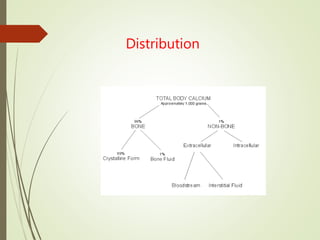
Distribution
Different Forms of Calcium
Most of the calcium in the body exists as the mineral
hydroxyapatite, Ca10(PO4)6(OH)2.
 Calcium in the plasma:
45% in ionized form (the physiologically active form)
45% bound to proteins (predominantly albumin)
10% complexed with anions (citrate, sulfate, phosphate)
 Both total calcium and ionized calcium measurements are
available in many laboratories
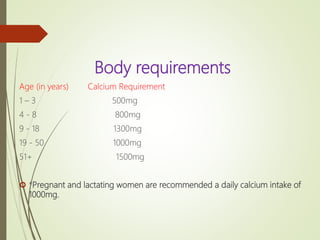
Body requirements
Age (in years) Calcium Requirement
1 – 3 500mg
4 - 8 800mg
9 - 18 1300mg
19 - 50 1000mg
51+ 1500mg
 *Pregnant and lactating women are recommended a daily calcium intake of
1000mg.
source
 Calcium is found in milk and dairy products,
 Green leafy vegetables,
 seafood,
 almonds,
 blackstrap molasses,
 broccoli,
 enriched soy and rice milk products, figs,
 soybeans and tofu.
Absorption of Ca
 Absorption is taking place from the first and second part of duodenum against
concentration gradients
 Absorption required a carrier protein , helped by Ca-dependent ATPase
 Increased absorption-
- calcitriol , active form of Vit-D
- PTH
- acidic pH
- Lys and Arg
 Inhibiting absorption -
- phytic acid
- oxalates
- phosphate
- Mg
- caffeine
Biological functions of Calcium
 Bone and teeth mineralization
 Regulate neuromuscular excitability
 Blood coagulation
 Secretory processes
 Membrane integrity
 Plasma membrane transport
 Enzyme reactions
 Release of hormones and neurotransmitters
 Intracellular second messenger
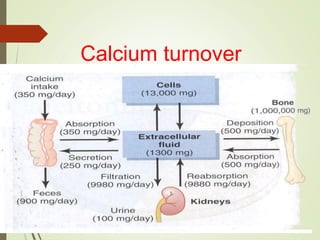
Calcium turnover
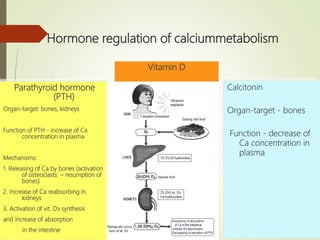
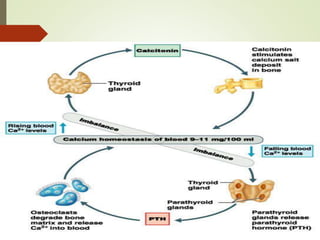
Hormone regulation of calciummetabolism
Parathyroid hormone
(PTH)
Organ-target: bones, kidneys
Function of PTH - increase of Ca
concentration in plasma
Mechanisms:
1. Releasing of Са by bones (activation
of osteoclasts – resumption of
bones)
2. Increase of Са reabsorbing in
kidneys
3. Activation of vit. Dз synthesis
and increase of absorption
in the intestine
Vitamin D
Calcitonin
Organ-target - bones
Function - decrease of
Ca concentration in
plasma
Vitamin D3
 Dietary cholesterol is converted into 7-dehydrocholesterol and transported to
skin
 UV sunlight (290-320nm) penetrates the skin to break provitamine ( 7-
dehydrocholesterol ) to previtamine and it is then converted to Cholecalciferol
by the process of isomerisation
 In the liver, cholecalciferol undergoes 25-hydroxylation to yield 25(OH) Vit-D (
calcidiol)
 In the kidney , calcidiol undergoes further 1α-hydroxylation to produce 1,25 –
dihydroxy Vit-D (Calcitriol). Its production in the kidney is catalyzed by 1α -
hydroxylase .
 1α -hydroxylase activity is increased by :
 Decreased serum Ca2+
 Increased PTH level
 Decreased serum phosphate
 Action of 1,25-dihydroxycholecalcififerol(Calcitriol)
Vitamin D3 and Calcium Control
 Vitamin D3 (Cholecalciferol)
 Converted to precursor in liver
 Initially stored
 Converted to 25-Hydroxycholecalciferol
 Feedback control limits concentration
 Converted to active form in kidney
 1,25-Dihydroxycholecalciferol
 Under the feedback control of parathyroid hormone (PTH)
 The main action of 1,25-(OH)2-D is to stimulate absorption of
Ca2+ from the intestine.
 1,25-(OH)2-D induces the production of calcium binding proteins
which sequester Ca2+, buffer high Ca2+ concentrations that arise
during initial absorption and allow Ca2+ to be absorbed against
a high Ca2+ gradient
Vitamin D3 and Calcium Control
Vitamin D3 promotes intestinal calcium absorption
 Vitamin D3 acts via steroid hormone like receptor to increase transcriptional
and translational activity
 One gene product is calcium-binding protein (CaBP)
 CaBP facilitates calcium uptake by intestinal cells
 Estrogen, prolactin and growth hormone also stimulate 1α -
hydroxylase thus increasing Ca absorption
during pregnancy, lactation and growth
Vitamin D3 Actions on Bones
 Another important target for 1,25-(OH)2-D3 is the bone.
 Osteoblasts, but not osteoclasts have vitamin D3 receptors.
 1,25-(OH)2-D3 acts on osteoblasts which produce a paracrine
signal that activates osteoclasts to resorb Ca++ from the bone
matrix.
 1,25-(OH)2-D3 also stimulates osteocytic osteolysis.
 In its absence, excess osteoid accumulates from lack of 1,25-
(OH)2-D3 repression of osteoblastic collagen synthesis.
 Inadequate supply of vitamin D3 results in rickets, a disease of
bone deformation
):
 It is synthesised as pre-pro-PTH(115aa) and is
cleaved to pro-PTH(90aa) with cleavage before
secretion of PTH(84aa).
Intact PTH T1/2 3-4 mins
Normal levels 1.3 – 6.8 pmol/L
Secreted from the chief cells of the parathyroid glands.
 Function:
Increase renal phosphate excretion , and increases plasma calcium by:
 Increasing osteoclastic resorption of bone (occurring rapidly).
 Increasing intestinal absorption of calcium (a slower response).
 Increasing synthesis of 1,25-(OH)2D3 (stimulating GIT absorption).
 Increasing renal tubular reabsorption of calcium
Parathyroid hormone (PTH
PTH action
The overall action of PTH is to increase plasma Ca++
levels and decrease plasma phosphate levels.
PTH acts directly on the bones to stimulate Ca++
resorption and kidney to stimulate Ca++ reabsorption
in the distal tubule of the kidney and to inhibit
reabosorptioin of phosphate (thereby stimulating its
excretion).
PTH also acts indirectly on intestine by stimulating
1,25-(OH)2-D synthesis.
PTH indirectly increases Calcium absorption from GIT
Regulation of PTH
 The dominant regulator of PTH is plasma Ca2+.
 Secretion of PTH is inversely related to [Ca2+].
 Maximum secretion of PTH occurs at plasma Ca2+ below 3.5 mg/dL.
 At Ca2+ above 5.5 mg/dL, PTH secretion is maximally inhibited.
 PTH secretion responds to small alterations in plasma Ca2+ within seconds.
 A unique calcium receptor within the parathyroid cell plasma membrane senses
changes in the extracellular fluid concentration of Ca2+.
 This is a typical G-protein coupled receptor that activates phospholipase C and
adenylate cyclase—result is increase in intracellular Ca2+ via generation of
inositol phosphates and decrease in cAMP which prevents exocytosis of PTH
from secretory granules.
 When Ca2+ falls, cAMP rises and PTH is secreted.
 1,25-(OH)2-D inhibits PTH gene expression, providing another level of feedback
control of PTH.
 Despite close connection between Ca2+ and PO4, no direct control of PTH is
exerted by phosphate levels.
Calcitonin
 This is produced from the C-cells of the thyroid.
 Ploypeptide(32 aa) , MW 35KD , T1/2 10 mins
 The major stimulus of calcitonin secretion is a rise in plasma Ca++ levels
 Calcitonin is a physiological antagonist to PTH with regard to Ca++ homeostasis
 The target cell for calcitonin is the osteoclast.
 Calcitonin acts via increased cAMP concentrations to inhibit osteoclast motility
and cell shape and inactivates them.
 The major effect of calcitonin administration is a rapid fall in Ca2+ caused by
inhibition of bone resorption.
Calcium regulation

Calcium regulation

  • 1.
    Calcium metabolism andits regulation
  • 2.
  • 3.
    Different Forms ofCalcium Most of the calcium in the body exists as the mineral hydroxyapatite, Ca10(PO4)6(OH)2.  Calcium in the plasma: 45% in ionized form (the physiologically active form) 45% bound to proteins (predominantly albumin) 10% complexed with anions (citrate, sulfate, phosphate)  Both total calcium and ionized calcium measurements are available in many laboratories
  • 4.
    Body requirements Age (inyears) Calcium Requirement 1 – 3 500mg 4 - 8 800mg 9 - 18 1300mg 19 - 50 1000mg 51+ 1500mg  *Pregnant and lactating women are recommended a daily calcium intake of 1000mg.
  • 5.
    source  Calcium isfound in milk and dairy products,  Green leafy vegetables,  seafood,  almonds,  blackstrap molasses,  broccoli,  enriched soy and rice milk products, figs,  soybeans and tofu.
  • 6.
    Absorption of Ca Absorption is taking place from the first and second part of duodenum against concentration gradients  Absorption required a carrier protein , helped by Ca-dependent ATPase  Increased absorption- - calcitriol , active form of Vit-D - PTH - acidic pH - Lys and Arg  Inhibiting absorption - - phytic acid - oxalates - phosphate - Mg - caffeine
  • 7.
    Biological functions ofCalcium  Bone and teeth mineralization  Regulate neuromuscular excitability  Blood coagulation  Secretory processes  Membrane integrity  Plasma membrane transport  Enzyme reactions  Release of hormones and neurotransmitters  Intracellular second messenger
  • 8.
  • 9.
    Hormone regulation ofcalciummetabolism Parathyroid hormone (PTH) Organ-target: bones, kidneys Function of PTH - increase of Ca concentration in plasma Mechanisms: 1. Releasing of Са by bones (activation of osteoclasts – resumption of bones) 2. Increase of Са reabsorbing in kidneys 3. Activation of vit. Dз synthesis and increase of absorption in the intestine Vitamin D Calcitonin Organ-target - bones Function - decrease of Ca concentration in plasma
  • 10.
    Vitamin D3  Dietarycholesterol is converted into 7-dehydrocholesterol and transported to skin  UV sunlight (290-320nm) penetrates the skin to break provitamine ( 7- dehydrocholesterol ) to previtamine and it is then converted to Cholecalciferol by the process of isomerisation  In the liver, cholecalciferol undergoes 25-hydroxylation to yield 25(OH) Vit-D ( calcidiol)  In the kidney , calcidiol undergoes further 1α-hydroxylation to produce 1,25 – dihydroxy Vit-D (Calcitriol). Its production in the kidney is catalyzed by 1α - hydroxylase .  1α -hydroxylase activity is increased by :  Decreased serum Ca2+  Increased PTH level  Decreased serum phosphate  Action of 1,25-dihydroxycholecalcififerol(Calcitriol)
  • 11.
    Vitamin D3 andCalcium Control  Vitamin D3 (Cholecalciferol)  Converted to precursor in liver  Initially stored  Converted to 25-Hydroxycholecalciferol  Feedback control limits concentration  Converted to active form in kidney  1,25-Dihydroxycholecalciferol  Under the feedback control of parathyroid hormone (PTH)  The main action of 1,25-(OH)2-D is to stimulate absorption of Ca2+ from the intestine.  1,25-(OH)2-D induces the production of calcium binding proteins which sequester Ca2+, buffer high Ca2+ concentrations that arise during initial absorption and allow Ca2+ to be absorbed against a high Ca2+ gradient
  • 12.
    Vitamin D3 andCalcium Control
  • 13.
    Vitamin D3 promotesintestinal calcium absorption  Vitamin D3 acts via steroid hormone like receptor to increase transcriptional and translational activity  One gene product is calcium-binding protein (CaBP)  CaBP facilitates calcium uptake by intestinal cells  Estrogen, prolactin and growth hormone also stimulate 1α - hydroxylase thus increasing Ca absorption during pregnancy, lactation and growth
  • 14.
    Vitamin D3 Actionson Bones  Another important target for 1,25-(OH)2-D3 is the bone.  Osteoblasts, but not osteoclasts have vitamin D3 receptors.  1,25-(OH)2-D3 acts on osteoblasts which produce a paracrine signal that activates osteoclasts to resorb Ca++ from the bone matrix.  1,25-(OH)2-D3 also stimulates osteocytic osteolysis.  In its absence, excess osteoid accumulates from lack of 1,25- (OH)2-D3 repression of osteoblastic collagen synthesis.  Inadequate supply of vitamin D3 results in rickets, a disease of bone deformation
  • 15.
    ):  It issynthesised as pre-pro-PTH(115aa) and is cleaved to pro-PTH(90aa) with cleavage before secretion of PTH(84aa). Intact PTH T1/2 3-4 mins Normal levels 1.3 – 6.8 pmol/L Secreted from the chief cells of the parathyroid glands.  Function: Increase renal phosphate excretion , and increases plasma calcium by:  Increasing osteoclastic resorption of bone (occurring rapidly).  Increasing intestinal absorption of calcium (a slower response).  Increasing synthesis of 1,25-(OH)2D3 (stimulating GIT absorption).  Increasing renal tubular reabsorption of calcium Parathyroid hormone (PTH
  • 16.
    PTH action The overallaction of PTH is to increase plasma Ca++ levels and decrease plasma phosphate levels. PTH acts directly on the bones to stimulate Ca++ resorption and kidney to stimulate Ca++ reabsorption in the distal tubule of the kidney and to inhibit reabosorptioin of phosphate (thereby stimulating its excretion). PTH also acts indirectly on intestine by stimulating 1,25-(OH)2-D synthesis. PTH indirectly increases Calcium absorption from GIT
  • 17.
    Regulation of PTH The dominant regulator of PTH is plasma Ca2+.  Secretion of PTH is inversely related to [Ca2+].  Maximum secretion of PTH occurs at plasma Ca2+ below 3.5 mg/dL.  At Ca2+ above 5.5 mg/dL, PTH secretion is maximally inhibited.  PTH secretion responds to small alterations in plasma Ca2+ within seconds.  A unique calcium receptor within the parathyroid cell plasma membrane senses changes in the extracellular fluid concentration of Ca2+.  This is a typical G-protein coupled receptor that activates phospholipase C and adenylate cyclase—result is increase in intracellular Ca2+ via generation of inositol phosphates and decrease in cAMP which prevents exocytosis of PTH from secretory granules.  When Ca2+ falls, cAMP rises and PTH is secreted.  1,25-(OH)2-D inhibits PTH gene expression, providing another level of feedback control of PTH.  Despite close connection between Ca2+ and PO4, no direct control of PTH is exerted by phosphate levels.
  • 18.
    Calcitonin  This isproduced from the C-cells of the thyroid.  Ploypeptide(32 aa) , MW 35KD , T1/2 10 mins  The major stimulus of calcitonin secretion is a rise in plasma Ca++ levels  Calcitonin is a physiological antagonist to PTH with regard to Ca++ homeostasis  The target cell for calcitonin is the osteoclast.  Calcitonin acts via increased cAMP concentrations to inhibit osteoclast motility and cell shape and inactivates them.  The major effect of calcitonin administration is a rapid fall in Ca2+ caused by inhibition of bone resorption.