PANAROMIC RADIOGRAPHY
By
Dr. Revath Vyas
MDS III year
CONTENTS
• Introduction
• Synonyms
• Historical Development
• Basic concept of tomography
• Practical application of working principle
• Focal Trough
• Equipment and Patient positioning
• Establishing exposure factors
• Panoramic films, intensifying screens and Cassette
• Normal Anatomy
• Real and Ghost images
• Advantages
• Disadvantages
• Common errors made in Panoramic Radiographs
• Interpretation
• Conclusion
• References 2/60
SYNONYMS
• Panoramic Imaging
• Pantomography
• Orthopantomograph
• Rotational Panoramic Radiography
• Dental Panoramic tomography
/60
• The value of any diagnostic procedure depends on the
amount and validity of the information that can be
derived from it.
• The importance of intra oral radiograph in dental
diagnosis is well documented. However, the intra oral
radiograph is some what limited in the structures it
covers.
• Panoramic radiographs do not replace the conventional
dental film but when used as a supplemental
diagnostic technique, it gives a good outcome due to
its increased overall coverage of the dental arches and
associated structures, reduced radiation dosage to the
patient and simplicity of operation
Introduction
Panorama – “an unobstructed wide angle view of a region” 3/60
Historical background
The first attempts to image the whole jaw was made with
intraoral radiation sources at the beginning of 19th century in
1922.
Dr Host Beger of Germany
 Uses a small x-ray tube that
can be introduced into the
patient’s mouth-patient, source &
film are stationary.
Koch and Sterzel of Essen Germany (panoramix).
Siemens corp. Erlangen, Germany (staters-x)
Philips Medical systems, Inc, Holland (shot oralix)
4/60
1933 - Dr. H. Numata of Japan was the first to propose extraoral
technique - He used intraoral curved films with the source rotating.
1948 - Dr. Yrjoveli Paotero used a long curved film inserted
lingual to the teeth with the patient rotating -
PARABOLOGRAPHY
1949 - Film extra orally – film and patient moved while source
was stationary - PANTOMOGRAPHY
1950 – Robert J Nelson used Paotero’s parabolographic technique,
used an intraoral film,with the source moving for posterior projections
and patient+film stationary and vise versa for anteriors
1959 – Patero modified this technique with
extraoral films – called it as Orthopantomography
and the first orthopantomograph of clinical
importance approved in 1960
First Orthopantomograph machine became available
in 1961
Comercially available Orthopantomograph machines
are manufactured by Palomex ( Siemens Corp.
Germany).
Orthopantomo N-70 (Hilda Electric co) and
Panoramax (Asahi Roentgen Co.)
5/60
Working principle
• Employs scanography (slit beam) & tomography
• Tomography: A term derived from greek words tomos meaning “slice or
section” and graphia meaning “picture”
6/60
7/60
Practical application of the working principle
ABCD move past the film with the same velocity in
opposite direction – hence are sharply recorded on the
film.
8/60
To obtain optimal image definition, it is crucial that the speed of
the film passing the collimator slit is maintained equal to the
speed at which the xray beam sweeps through the objects of
interest.
9/60
• Stationary rotation centre
Centers of Rotation
• Single rotation centre
• Double rotation centre
10/60
3. Triple center of rotation – Panoram ; Panora
4. Multiple centers of rotation – Ellipso pantomograph
11/60
/60
VERTICAL PROJECTION
/60
HORIZONTAL PROJECTION
/60
Focal trough
• It is an imaginary three- dimensional curved zone in which structures
are clearly demonstrated on a panoramic radiograph
12/60
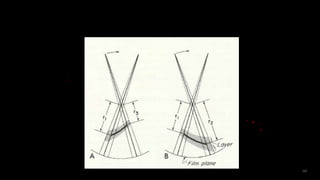
Form And Thickness Of Image Layer
• A constant film speed in relation to the beam places
the center of the image layer at a defined distance
from the rotation center.
• The distance from the rotation center of the beam to
the center of the image layer may be called the
effective projection radius. The thickness of the image
layer is dependent on the length of this radius.
• The longer the radius thicker the image layer, and is
inversely proportional to the width of the beam.
13/60
/60
/60
Number of OPG units available which vary depending on
• Number of rotation centers
• Size and shape of the focal trough
• Type of films used
Equipment
14/60
• Units that follow the principle
of stationary x ray source with
rotating object and receptor.
• Eg : Tomax panaromic unit
Koch and Sterzel of Essen
Germany (panoramix).
Siemens corp. Erlangen, Germany
(staters-x)
Philips Medical systems, Inc,
Holland (shot oralix)
15/60
• Orthopantomograph 10 E
unit
• Patient in the sitting position.
• Panellipse unit
• Patient in the standing
position.
16/60
PC1000
Panoramic
Corporation
PROLIN
E 2002
Planmeca
ROTOGRAP
H
Villa Sistemi
Medicali
PANTO
S
Bluex
ARCOGR
APH
Imago
PANOURA
ULTRA &
12
Yoshida
ORTHOR
ALIX
SD
Gendex
GX-PAN
Gendex
OP5
Siemens
OP10
Siemens
ORTHO
PHOS
PLUS
Sirona
ORTHOPH
OS 3
Sirona
AVANTEX
BMT
PANELIPS
E
I & II
GE
17/60
EQUIPMENT
• Panoramic x-ray tube head
• Head positioner
• Cephalometric component
• Exposure controls
• Cassettes
• Films
Planmecca pro EC
18/60
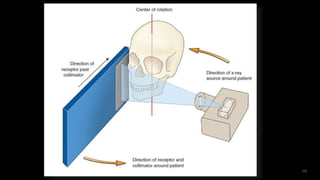
• The panoramic x-ray tube head is very similar to an intra
oral x-ray tube head each has a filament used to produce
electrons and a target used to produce x-rays.
• Collimator used in the panoramic tube head differs from
the collimator used in intra oral x-ray tube head. Collimator
used in panoramic x-ray machine is a lead plate with an
opening in the shape of a narrow vertical slit through which
x-ray beam emerges as a narrow band. Beam passes
through the patients and then exposes the film through
another vertical slit in the cassette carrier. Narrow x-ray
beam emerging from the collimater minimizes patient
exposure to x-radiation.
19/60
/60
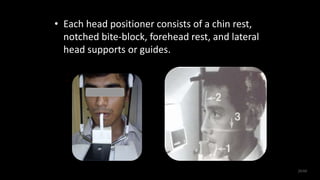
• Each head positioner consists of a chin rest,
notched bite-block, forehead rest, and lateral
head supports or guides.
20/60
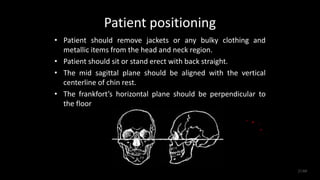
Patient positioning
• Patient should remove jackets or any bulky clothing and
metallic items from the head and neck region.
• Patient should sit or stand erect with back straight.
• The mid sagittal plane should be aligned with the vertical
centerline of chin rest.
• The frankfort’s horizontal plane should be perpendicular to
the floor
21/60
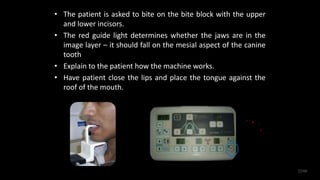
• The patient is asked to bite on the bite block with the upper
and lower incisors.
• The red guide light determines whether the jaws are in the
image layer – it should fall on the mesial aspect of the canine
tooth
• Explain to the patient how the machine works.
• Have patient close the lips and place the tongue against the
roof of the mouth.
22/60
23/60
Exposure parameters
• Kvp - 72 ; mA - 8 ; Exposure time 18 sec
Dose to the patient - 0.103mR
• Kvp - 80 ; mA 15 ; Exposure time 15 sec
Dose to the patient - 0.116mR
• In case of full mouth examination with 14
intraoral films
Dose to the patient 0.712mR
24/60
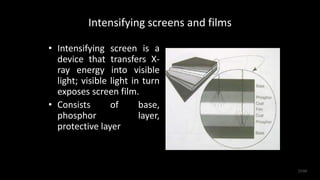
Intensifying screens and films
• Intensifying screen is a
device that transfers X-
ray energy into visible
light; visible light in turn
exposes screen film.
• Consists of base,
phosphor layer,
protective layer
25/60
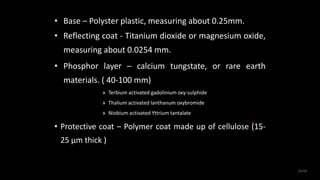
• Base – Polyster plastic, measuring about 0.25mm.
• Reflecting coat - Titanium dioxide or magnesium oxide,
measuring about 0.0254 mm.
• Phosphor layer – calcium tungstate, or rare earth
materials. ( 40-100 mm)
» Terbium activated gadolinium oxy-sulphide
» Thalium activated lanthanum oxybromide
» Niobium activated Yttrium tantalate
• Protective coat – Polymer coat made up of cellulose (15-
25 µm thick )
26/60
• Film screen combinations :
• S
Emulsions sensitive to blue light – standard silver halide
emulsions
Sensitive to green light – Orthochromatic emulsions
Sensitive to red light – panchromatic emusions
Sensitive to UV light – modified silver halide emulsions
27/60
• Cassettes :
– Cassette is a device that is used to hold the extra oral film and
intensifying screens.
– Cassettes may be rigid or flexible curved or straight.
– All the cassettes must be light tight to avoid film from
exposure
30/60
/60
/60
/60
/60
Image
Real
Ghost
Single Double
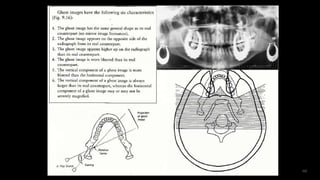
Ghost Image : Objects with high attenuations
may in certain instances be observed in two
positions in panoramic radiograph only one of
these images is intended and the other is usually
rejected to as a ghost image.
31/60
/60
Ghost image in recognized by:
Unsharpness which is in horizontal dimension;
Always projected at a higher position in the radiograph than
its real counterpart (because beam is directed from below)
Image is always reversed.
Ghost images are formed of more radiodense objects because
it is formed by objects that are out of focus and are usually
obscured , hence more radiolucent objects fail to project in the
radiograph as images.
32/60
Normal Anatomy
• Real Or Actual Shadows:
These include:
– Teeth
– Mandible
– Maxilla, including floor, anterior and posterior walls of the antrum
– Hard palate
– Zygomatic arches and zygoma
– Styloid processes
– Hyoid bone
– Nasal septum and conchae
– Orbital rim
– Base of skull
31/60
• Important Soft Tissue Shadows:
1. Tongue
2. Soft Palate and uvula
3. Lip Line
4. Ear lobes
Nose
Nasolabial folds
• Air Shadows:
1. Palatoglossal air space
2. Nasopharyngeal
3. Glossopharyngeal
• Ghost or Artefactual Shadows:
– Cervical vertebrae
– Body, angle and ramus of the contra lateral side of the mandible
– Palate.
32/60
Ext.
Auditory
meatus
Mandibular
condyle
Articular eminence
Coronoid
process
Zygomatic
bone
Ptregomaxillary Fissure
Inf. orbital rimFloor of Max. sinus
Ant. wall of Max. sinus
Hard palate
Nasal fossa
Inf. Orbital canal and foramen
Zyg.
process of
Max.
Panoramic Innominate line (Infra
temporal surface of Zyg. bone
Lat. ptreg.
plate
Glenoid
fossa
Inf. border of Man.
C- Spine
Mental foramen Hyoid bone
Inf. Alveolar canal
Ext. oblique ridge
33/60
Inf. nasal concha
Inferior nasal meatus
Dorsal surface of
the tongue
Post. Wall of
the pharynx
Soft palate
Lower lipUpper lip
© Ra’ed Al-Sadhan, 1999
Middle meatus
Ghost image of opposite Mandible.
34/60
/60
Common errors
• Errors in preparing the patient for film exposure
• Errors in film exposure and processing.
• Errors in handling the film.
37/60
Errors in preparing the patient for exposure
• Errors caused when metallic objects are not
removed
38/60
/60
/60
Improper positioning of the patient
When the lips are not closed - lip shadow is seen.
When the chin is tipped too high - the maxillary teeth roots are superimposed,
- the maxillary incisors appear blurred,
- flattening of occlusal plane ( reverse smile line)
39/60
When chin is placed downward
When the chin is tipped too high - the mandibular incisors appear blurred,
- the apices of the lower incisors are out of focus
and blurred
- one/both condyles may cut off from the radiograph
- increased curvature of the occlusal plane
(exaggerated smile line)
40/60
When patient is positioned too far forward –
anterior to the focal trough
-The anterior teeth appear blurred, narrower and out of focus.
- Spine is superimposed on the ramus area
41/60
When patient is positioned too far backward –
posterior to the focal trough
-The anterior teeth appear blurred, broader and out of focus.
- Ghost image of the mandibular spine is more prominent.
42/60
When patient’s head is tilted
-One side condyle appears larger than the other side.
- The side tilted towards the xray tube is enlarged.
43/60
When the patient’s spine is not straight
It appears as a radio-opaque artifact in the centre of the film
superimposed on the anterior region
44/60
Other Artifacts and Errors
46/60
/60
/60
/60
/60
/60
/60
/60
/60
/60
/60
/60
/60
IINTERPRETATION
/60
Interpretation
Zone 1 : The teeth and the surrounding bone
Zone 2 : Nose&sinus
Zone 3: The inferior cortex of the mandibular body.
- Principles and practice of panoramic radiology by langland langlais & Morris
47/60
Zone 4: The condyles are centered in this zone.
Zone 5: Ramus and Spine
Zone 6: The hyoid bone.
- Principles and practice of panoramic radiology by langland langlais & Morris
48/60
• The Orthopantomograph should be viewed as if
looking at the patient i.e. with the image of the
patient’s left side on the operators right.
• Should be viewed on a view box with sufficient
light.
• A thorough knowledge of the normal anatomical
landmarks and the superimposed structures is
mandatory.
• The potential artifacts associated with the patient
and machine movement, patient positioning and
unusual patient anatomy have to be identified
and understood.
- Oral Radiology, Principles and interpretation; White & Pharoah (6th Edition)
49/60
INTERPRETATION
• Assess the periphery and corners of the image
• Examine the outer cortices of the mandible
• Examine the cortices of the maxilla
• Examine the zygomatic bones and arches
• Assess the internal density of the maxillary sinuses
• Assess the structures of the nasal cavity and the palates
• Examine bone the pattern of the maxilla and mandible
• Alveolar processes and teeth
/60
S Perschbacher. Interpretation of panoramic radiographs.
Australian Dental Journal 2012; 57:(1 Suppl): 40–45
Condylar process and temporomandibular
joint
Coronoid process Ramus
Body and angle followed by mandibular
dentition and supporting alveolus
Mandible
51/60
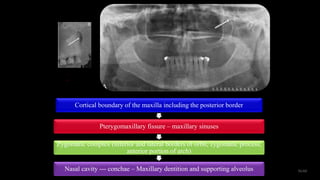
Midfacial region
Cortical boundary of the maxilla including the
posterior border
Pterygomaxillary fissure – maxillary sinuses
Zygomatic complex (inferior and lateral borders of
orbit, zygomatic process, anterior portion of arch)
Nasal cavity --- conchae – Maxillary dentition and
supporting alveolus
54/60
56/60
Cortical boundary of the maxilla including the posterior border
Pterygomaxillary fissure – maxillary sinuses
Zygomatic complex (inferior and lateral borders of orbit, zygomatic process,
anterior portion of arch)
Nasal cavity --- conchae – Maxillary dentition and supporting alveolus
Advancements
A new panoramic radiography system, in which a large
number of vertical strip images can be acquired with a
semiconductor detector used to reconstruct high-quality
images using the concept of tomosynthesis.
It uses SCAN-300FPC detector
with 20 frames/degree of
rotation.
Development of a new dental panoramic radiographic
system based on a tomosynthesis method .
Dentomaxillofacial Radiology (2010)
Cone beam computed tomography
57/60
Conclusion
• Panoramic radiographs have proved to be good adjuvant
radiographs to conventional intraoral radiographs mainly because
they produce a single tomographic image of facial structures that
include both maxilla and mandible and their supporting structures..
• The diagnostic value of these films is increased considerably if
clinicians are aware of their limitations and apply a systematic
approach to its interpretation.
58/60
References
• Principles of dental imaging –
Langland Langlais & Morris
• Oral radiology , Principles and Interpretation –
White & Pharoah ( 4th , 5th & 6th edition)
• Essentials if Dental Radiology –
Eric Whaites (3rd Edition )
• Textbook of Oral Radiology – Anil Govindrao Ghom.
• Textbook of Dental and Maxillofacial Radiology –
Freny R Karjodhkar ( 2nd edition )
59/60

Panaromic radiography

  • 1.
  • 2.
    CONTENTS • Introduction • Synonyms •Historical Development • Basic concept of tomography • Practical application of working principle • Focal Trough • Equipment and Patient positioning • Establishing exposure factors • Panoramic films, intensifying screens and Cassette • Normal Anatomy • Real and Ghost images • Advantages • Disadvantages • Common errors made in Panoramic Radiographs • Interpretation • Conclusion • References 2/60
  • 3.
    SYNONYMS • Panoramic Imaging •Pantomography • Orthopantomograph • Rotational Panoramic Radiography • Dental Panoramic tomography /60
  • 4.
    • The valueof any diagnostic procedure depends on the amount and validity of the information that can be derived from it. • The importance of intra oral radiograph in dental diagnosis is well documented. However, the intra oral radiograph is some what limited in the structures it covers. • Panoramic radiographs do not replace the conventional dental film but when used as a supplemental diagnostic technique, it gives a good outcome due to its increased overall coverage of the dental arches and associated structures, reduced radiation dosage to the patient and simplicity of operation Introduction Panorama – “an unobstructed wide angle view of a region” 3/60
  • 5.
    Historical background The firstattempts to image the whole jaw was made with intraoral radiation sources at the beginning of 19th century in 1922. Dr Host Beger of Germany  Uses a small x-ray tube that can be introduced into the patient’s mouth-patient, source & film are stationary. Koch and Sterzel of Essen Germany (panoramix). Siemens corp. Erlangen, Germany (staters-x) Philips Medical systems, Inc, Holland (shot oralix) 4/60
  • 6.
    1933 - Dr.H. Numata of Japan was the first to propose extraoral technique - He used intraoral curved films with the source rotating. 1948 - Dr. Yrjoveli Paotero used a long curved film inserted lingual to the teeth with the patient rotating - PARABOLOGRAPHY 1949 - Film extra orally – film and patient moved while source was stationary - PANTOMOGRAPHY 1950 – Robert J Nelson used Paotero’s parabolographic technique, used an intraoral film,with the source moving for posterior projections and patient+film stationary and vise versa for anteriors 1959 – Patero modified this technique with extraoral films – called it as Orthopantomography and the first orthopantomograph of clinical importance approved in 1960 First Orthopantomograph machine became available in 1961 Comercially available Orthopantomograph machines are manufactured by Palomex ( Siemens Corp. Germany). Orthopantomo N-70 (Hilda Electric co) and Panoramax (Asahi Roentgen Co.) 5/60
  • 7.
    Working principle • Employsscanography (slit beam) & tomography • Tomography: A term derived from greek words tomos meaning “slice or section” and graphia meaning “picture” 6/60
  • 8.
  • 9.
    Practical application ofthe working principle ABCD move past the film with the same velocity in opposite direction – hence are sharply recorded on the film. 8/60
  • 10.
    To obtain optimalimage definition, it is crucial that the speed of the film passing the collimator slit is maintained equal to the speed at which the xray beam sweeps through the objects of interest. 9/60
  • 11.
    • Stationary rotationcentre Centers of Rotation • Single rotation centre • Double rotation centre 10/60
  • 12.
    3. Triple centerof rotation – Panoram ; Panora 4. Multiple centers of rotation – Ellipso pantomograph 11/60
  • 13.
  • 14.
  • 15.
  • 16.
    Focal trough • Itis an imaginary three- dimensional curved zone in which structures are clearly demonstrated on a panoramic radiograph 12/60
  • 17.
    Form And ThicknessOf Image Layer • A constant film speed in relation to the beam places the center of the image layer at a defined distance from the rotation center. • The distance from the rotation center of the beam to the center of the image layer may be called the effective projection radius. The thickness of the image layer is dependent on the length of this radius. • The longer the radius thicker the image layer, and is inversely proportional to the width of the beam. 13/60
  • 18.
  • 19.
  • 20.
    Number of OPGunits available which vary depending on • Number of rotation centers • Size and shape of the focal trough • Type of films used Equipment 14/60
  • 21.
    • Units thatfollow the principle of stationary x ray source with rotating object and receptor. • Eg : Tomax panaromic unit Koch and Sterzel of Essen Germany (panoramix). Siemens corp. Erlangen, Germany (staters-x) Philips Medical systems, Inc, Holland (shot oralix) 15/60
  • 22.
    • Orthopantomograph 10E unit • Patient in the sitting position. • Panellipse unit • Patient in the standing position. 16/60
  • 23.
    PC1000 Panoramic Corporation PROLIN E 2002 Planmeca ROTOGRAP H Villa Sistemi Medicali PANTO S Bluex ARCOGR APH Imago PANOURA ULTRA& 12 Yoshida ORTHOR ALIX SD Gendex GX-PAN Gendex OP5 Siemens OP10 Siemens ORTHO PHOS PLUS Sirona ORTHOPH OS 3 Sirona AVANTEX BMT PANELIPS E I & II GE 17/60
  • 24.
    EQUIPMENT • Panoramic x-raytube head • Head positioner • Cephalometric component • Exposure controls • Cassettes • Films Planmecca pro EC 18/60
  • 25.
    • The panoramicx-ray tube head is very similar to an intra oral x-ray tube head each has a filament used to produce electrons and a target used to produce x-rays. • Collimator used in the panoramic tube head differs from the collimator used in intra oral x-ray tube head. Collimator used in panoramic x-ray machine is a lead plate with an opening in the shape of a narrow vertical slit through which x-ray beam emerges as a narrow band. Beam passes through the patients and then exposes the film through another vertical slit in the cassette carrier. Narrow x-ray beam emerging from the collimater minimizes patient exposure to x-radiation. 19/60
  • 26.
  • 27.
    • Each headpositioner consists of a chin rest, notched bite-block, forehead rest, and lateral head supports or guides. 20/60
  • 28.
    Patient positioning • Patientshould remove jackets or any bulky clothing and metallic items from the head and neck region. • Patient should sit or stand erect with back straight. • The mid sagittal plane should be aligned with the vertical centerline of chin rest. • The frankfort’s horizontal plane should be perpendicular to the floor 21/60
  • 29.
    • The patientis asked to bite on the bite block with the upper and lower incisors. • The red guide light determines whether the jaws are in the image layer – it should fall on the mesial aspect of the canine tooth • Explain to the patient how the machine works. • Have patient close the lips and place the tongue against the roof of the mouth. 22/60
  • 30.
  • 31.
    Exposure parameters • Kvp- 72 ; mA - 8 ; Exposure time 18 sec Dose to the patient - 0.103mR • Kvp - 80 ; mA 15 ; Exposure time 15 sec Dose to the patient - 0.116mR • In case of full mouth examination with 14 intraoral films Dose to the patient 0.712mR 24/60
  • 32.
    Intensifying screens andfilms • Intensifying screen is a device that transfers X- ray energy into visible light; visible light in turn exposes screen film. • Consists of base, phosphor layer, protective layer 25/60
  • 33.
    • Base –Polyster plastic, measuring about 0.25mm. • Reflecting coat - Titanium dioxide or magnesium oxide, measuring about 0.0254 mm. • Phosphor layer – calcium tungstate, or rare earth materials. ( 40-100 mm) » Terbium activated gadolinium oxy-sulphide » Thalium activated lanthanum oxybromide » Niobium activated Yttrium tantalate • Protective coat – Polymer coat made up of cellulose (15- 25 µm thick ) 26/60
  • 34.
    • Film screencombinations : • S Emulsions sensitive to blue light – standard silver halide emulsions Sensitive to green light – Orthochromatic emulsions Sensitive to red light – panchromatic emusions Sensitive to UV light – modified silver halide emulsions 27/60
  • 35.
    • Cassettes : –Cassette is a device that is used to hold the extra oral film and intensifying screens. – Cassettes may be rigid or flexible curved or straight. – All the cassettes must be light tight to avoid film from exposure 30/60
  • 36.
  • 37.
  • 38.
  • 39.
  • 40.
    Image Real Ghost Single Double Ghost Image: Objects with high attenuations may in certain instances be observed in two positions in panoramic radiograph only one of these images is intended and the other is usually rejected to as a ghost image. 31/60
  • 41.
  • 42.
    Ghost image inrecognized by: Unsharpness which is in horizontal dimension; Always projected at a higher position in the radiograph than its real counterpart (because beam is directed from below) Image is always reversed. Ghost images are formed of more radiodense objects because it is formed by objects that are out of focus and are usually obscured , hence more radiolucent objects fail to project in the radiograph as images. 32/60
  • 43.
    Normal Anatomy • RealOr Actual Shadows: These include: – Teeth – Mandible – Maxilla, including floor, anterior and posterior walls of the antrum – Hard palate – Zygomatic arches and zygoma – Styloid processes – Hyoid bone – Nasal septum and conchae – Orbital rim – Base of skull 31/60
  • 44.
    • Important SoftTissue Shadows: 1. Tongue 2. Soft Palate and uvula 3. Lip Line 4. Ear lobes Nose Nasolabial folds • Air Shadows: 1. Palatoglossal air space 2. Nasopharyngeal 3. Glossopharyngeal • Ghost or Artefactual Shadows: – Cervical vertebrae – Body, angle and ramus of the contra lateral side of the mandible – Palate. 32/60
  • 45.
    Ext. Auditory meatus Mandibular condyle Articular eminence Coronoid process Zygomatic bone Ptregomaxillary Fissure Inf.orbital rimFloor of Max. sinus Ant. wall of Max. sinus Hard palate Nasal fossa Inf. Orbital canal and foramen Zyg. process of Max. Panoramic Innominate line (Infra temporal surface of Zyg. bone Lat. ptreg. plate Glenoid fossa Inf. border of Man. C- Spine Mental foramen Hyoid bone Inf. Alveolar canal Ext. oblique ridge 33/60
  • 46.
    Inf. nasal concha Inferiornasal meatus Dorsal surface of the tongue Post. Wall of the pharynx Soft palate Lower lipUpper lip © Ra’ed Al-Sadhan, 1999 Middle meatus Ghost image of opposite Mandible. 34/60
  • 47.
  • 48.
    Common errors • Errorsin preparing the patient for film exposure • Errors in film exposure and processing. • Errors in handling the film. 37/60
  • 49.
    Errors in preparingthe patient for exposure • Errors caused when metallic objects are not removed 38/60
  • 50.
  • 51.
  • 52.
    Improper positioning ofthe patient When the lips are not closed - lip shadow is seen. When the chin is tipped too high - the maxillary teeth roots are superimposed, - the maxillary incisors appear blurred, - flattening of occlusal plane ( reverse smile line) 39/60
  • 53.
    When chin isplaced downward When the chin is tipped too high - the mandibular incisors appear blurred, - the apices of the lower incisors are out of focus and blurred - one/both condyles may cut off from the radiograph - increased curvature of the occlusal plane (exaggerated smile line) 40/60
  • 54.
    When patient ispositioned too far forward – anterior to the focal trough -The anterior teeth appear blurred, narrower and out of focus. - Spine is superimposed on the ramus area 41/60
  • 55.
    When patient ispositioned too far backward – posterior to the focal trough -The anterior teeth appear blurred, broader and out of focus. - Ghost image of the mandibular spine is more prominent. 42/60
  • 56.
    When patient’s headis tilted -One side condyle appears larger than the other side. - The side tilted towards the xray tube is enlarged. 43/60
  • 57.
    When the patient’sspine is not straight It appears as a radio-opaque artifact in the centre of the film superimposed on the anterior region 44/60
  • 58.
    Other Artifacts andErrors 46/60
  • 59.
  • 60.
  • 61.
  • 62.
  • 63.
  • 64.
  • 65.
  • 66.
  • 67.
  • 68.
  • 69.
  • 70.
  • 71.
  • 72.
    Interpretation Zone 1 :The teeth and the surrounding bone Zone 2 : Nose&sinus Zone 3: The inferior cortex of the mandibular body. - Principles and practice of panoramic radiology by langland langlais & Morris 47/60
  • 73.
    Zone 4: Thecondyles are centered in this zone. Zone 5: Ramus and Spine Zone 6: The hyoid bone. - Principles and practice of panoramic radiology by langland langlais & Morris 48/60
  • 74.
    • The Orthopantomographshould be viewed as if looking at the patient i.e. with the image of the patient’s left side on the operators right. • Should be viewed on a view box with sufficient light. • A thorough knowledge of the normal anatomical landmarks and the superimposed structures is mandatory. • The potential artifacts associated with the patient and machine movement, patient positioning and unusual patient anatomy have to be identified and understood. - Oral Radiology, Principles and interpretation; White & Pharoah (6th Edition) 49/60
  • 75.
    INTERPRETATION • Assess theperiphery and corners of the image • Examine the outer cortices of the mandible • Examine the cortices of the maxilla • Examine the zygomatic bones and arches • Assess the internal density of the maxillary sinuses • Assess the structures of the nasal cavity and the palates • Examine bone the pattern of the maxilla and mandible • Alveolar processes and teeth /60 S Perschbacher. Interpretation of panoramic radiographs. Australian Dental Journal 2012; 57:(1 Suppl): 40–45
  • 76.
    Condylar process andtemporomandibular joint Coronoid process Ramus Body and angle followed by mandibular dentition and supporting alveolus Mandible 51/60
  • 77.
    Midfacial region Cortical boundaryof the maxilla including the posterior border Pterygomaxillary fissure – maxillary sinuses Zygomatic complex (inferior and lateral borders of orbit, zygomatic process, anterior portion of arch) Nasal cavity --- conchae – Maxillary dentition and supporting alveolus 54/60
  • 78.
    56/60 Cortical boundary ofthe maxilla including the posterior border Pterygomaxillary fissure – maxillary sinuses Zygomatic complex (inferior and lateral borders of orbit, zygomatic process, anterior portion of arch) Nasal cavity --- conchae – Maxillary dentition and supporting alveolus
  • 79.
    Advancements A new panoramicradiography system, in which a large number of vertical strip images can be acquired with a semiconductor detector used to reconstruct high-quality images using the concept of tomosynthesis. It uses SCAN-300FPC detector with 20 frames/degree of rotation. Development of a new dental panoramic radiographic system based on a tomosynthesis method . Dentomaxillofacial Radiology (2010) Cone beam computed tomography 57/60
  • 80.
    Conclusion • Panoramic radiographshave proved to be good adjuvant radiographs to conventional intraoral radiographs mainly because they produce a single tomographic image of facial structures that include both maxilla and mandible and their supporting structures.. • The diagnostic value of these films is increased considerably if clinicians are aware of their limitations and apply a systematic approach to its interpretation. 58/60
  • 81.
    References • Principles ofdental imaging – Langland Langlais & Morris • Oral radiology , Principles and Interpretation – White & Pharoah ( 4th , 5th & 6th edition) • Essentials if Dental Radiology – Eric Whaites (3rd Edition ) • Textbook of Oral Radiology – Anil Govindrao Ghom. • Textbook of Dental and Maxillofacial Radiology – Freny R Karjodhkar ( 2nd edition ) 59/60

Editor's Notes

  • #15 The panoramic radiograph is unique in that the foci of the projection in the vertical and horizontal dimensions are not the same, in the horizontal dimension it is the rotation center of the beam that constitutes, the functional focus, whereas in the vertical dimension it is the x-ray source.  
  • #19 1. The image layer is directly related to the distance from the center of rotation to the central plane of the image, which is called the "effective projection radius." The width of the layer depends on the length of the radius (Fig. 9.5). The longer the radius, the thicker the layer. 2. The layer thickness is inversely proportional to the width of the long, narrow slit beam. The narrower the x-ray beam, the wider the image layer. The image layer is directly related to the distance from the center of rotation to the central plane of the image, which is called the "effective projection radius." The width of the layer depends on the length of the radius. The longer the radius, the thicker the layer.
  • #20 Deceleration shifts the position of the layer successively towards the rotation center. Acceleration shifts the position of the image layer successively away from the rotation center of the beam.
  • #32 0.013 msv;
  • #61 Lead apron artifact, use poncho style apron
  • #63 Fixer and developer stains
  • #64 Over exposure, under exposure
  • #65 Film not starting in house; resulting in panoramic cone cut
  • #66 Linear defect on intensifying screen. Distinguished from scratches…
  • #67 Multiple Tiny defects on screen and crimp marks
  • #68 Static electricity: dry air, improper handling,
  • #69 Scratch marks
  • #70 Damaged Plastic intensifying screen resulting in light leak
  • #71 Reversed film
  • #72 Double exposure and unexposed film.
  • #73 Pt movement, wavy outline of mandible
  • #78 The following steps are an example of an approach to analysing the complex projection of the anatomic structures on a panoramic radiograph: