7 LATTICE SYSTEM
POLAR MOLECULAR SOLIDS
Polar molecular solids are composed of molecules held
together by dipole-dipole forces. These solids consist of
polar molecules, meaning they have a partial positive charge
on one side and a partial negative charge on the other.
Have higher melting and boiling points than non-polar
molecular solids.
Typically soft and can be easily deformed.
Often soluble in polar solvents like water.
Do not conduct electricity because molecules are neutral
overall.
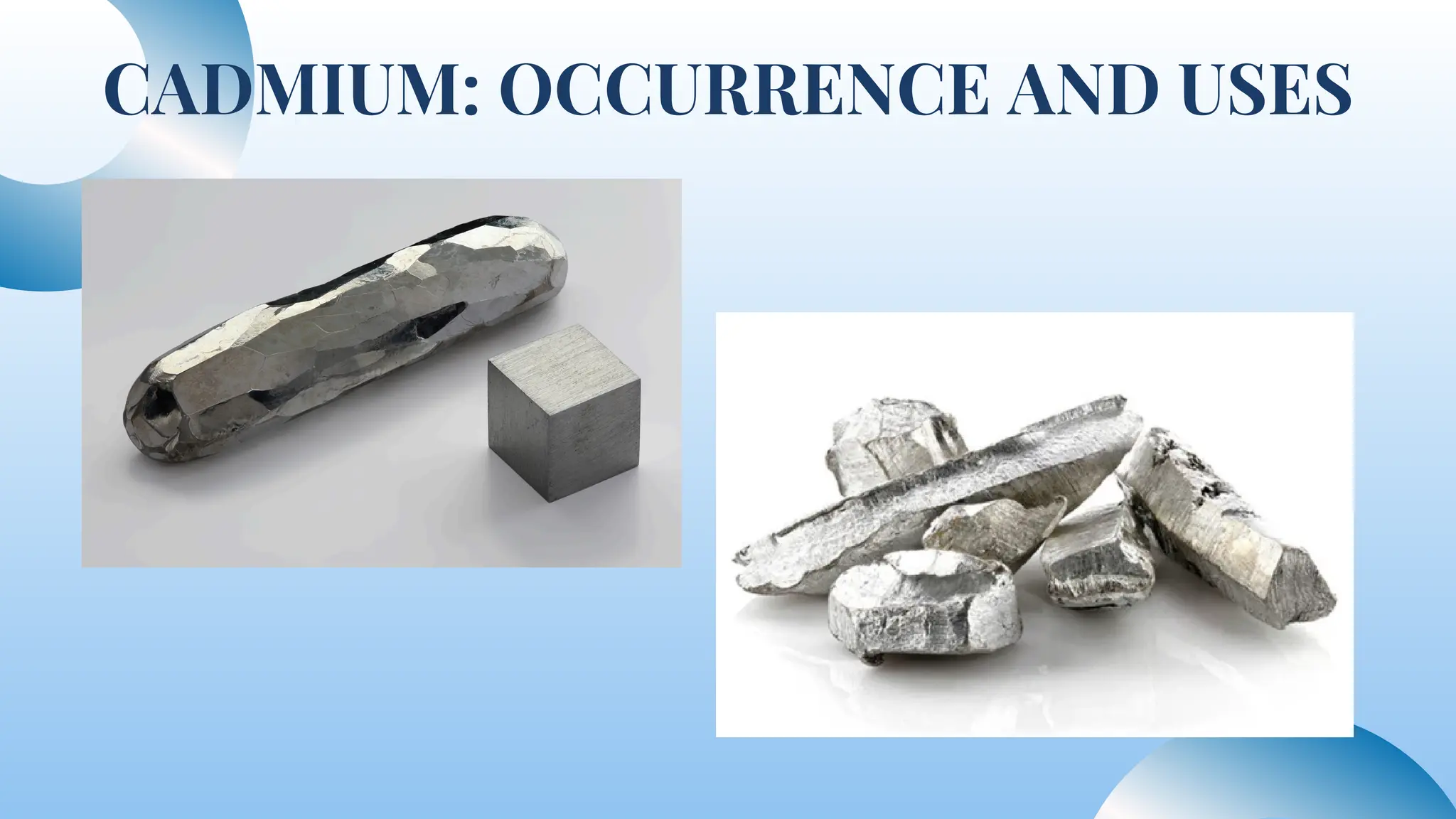
CADMIUM: OCCURRENCE AND USES
Occurrence
Found naturally in the Earth’s crust,
often alongside zinc ores like sphalerite
(ZnS).
Present in trace amounts in soil, rocks,
and coal.
Released into the environment through
volcanic activity and mining.
CADMIUM: OCCURRENCE AND USES
Uses
Electroplating: Coats metals to protect them from
corrosion.
Nickel-cadmium batteries: Rechargeable batteries
commonly used in electronics.
Pigments: Used in red, yellow, and orange paints and
plastics.
Stabilizers: Helps stabilize plastics, especially in
PVC.
Nuclear reactors: Used to absorb neutrons and
control reactions.
The study of solid-state physics began with the discovery of x-ray
diffraction by crystals, revealing their periodic atomic structure.
Crystalline solids are particularly important because their
electronic properties depend on the regular atomic order, which
affects the behavior of short-wavelength electrons. Noncrystalline
materials, such as glasses, are more relevant for optical
properties, as light waves with longer wavelengths respond to an
average atomic order. X-ray diffraction, first observed in 1912,
confirmed the periodicity of crystals, which are built from
identical atomic units, and helped develop quantum theory. This
foundational work expanded into condensed matter physics,
encompassing both crystalline and noncrystalline solids.
PERIODIC ARRAY OF SYSTEMS
Solids are one of the three
fundamental states of matter.
Definite shape
Definite volume
High density
High Melting and boiling
points
Incompressibility factor
Atoms are in vibratory
motion
SOLIDS
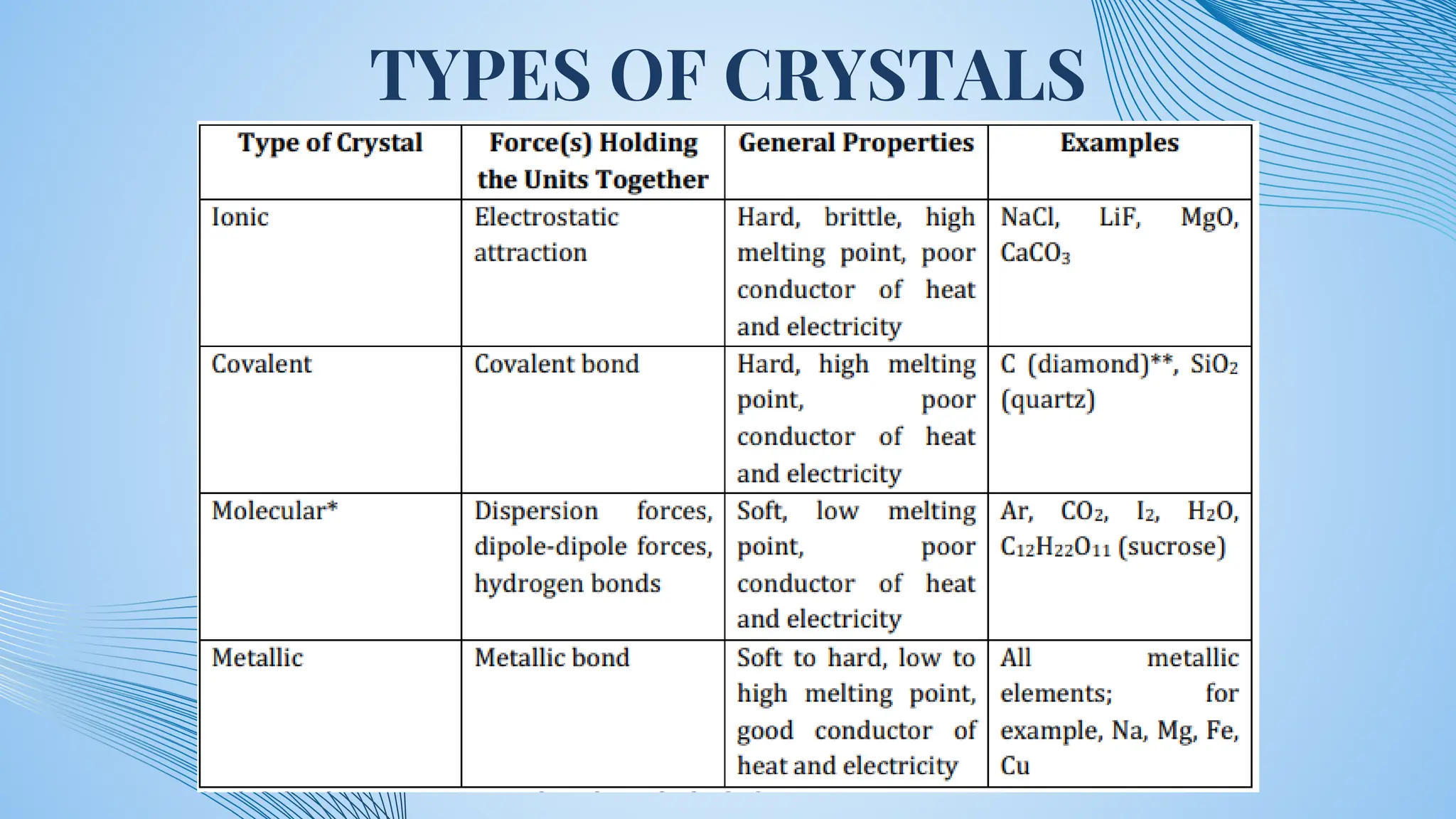
TYPES OF CRYSTALS
IONIC CRYSTAL
Salt Crystal
COVALENT CRYSTAL
Diamond
METALLIC CRYSTAL
Magnetite (Iron Crystals)
MOLECULAR CRYSTAL
Sugar Crystal
Ice
MOLECULAR SOLIDS
Molecular solids consist of molecules which are
held together by weak Vander waals forces of
attraction.
The crystal in which the molecules with no
charge are the lattice points which are held
together by weak force of attraction.
3 TYPES OF MOLECULAR SOLIDS
In these types of solids the atoms or molecules are
held by weak dispersion forces or London forces.
The solids are soft and non conductors of
electricity.
They have low melting points.
For example H2,C12 and 12
NON POLAR MOLECULAR SOLIDS
3 TYPES OF MOLECULAR SOLIDS
POLAR MOLECULAR SOLIDS
In these types of solids the molecules are held
together by relatively stronger dipole-dipole
interactions .
These are soft and non conductors of electricity.
The melting points are comparitively higher than
non polar solids.
For example solid s02 NH3
3 TYPES OF MOLECULAR SOLIDS
HYDROGEN BONDED MOLECULAR SOLIDS
The molecules of such solids contain polar covalent
bonds between H and F, O or N atoms.
Strong hydrogen bonds bind molecules of these
solids .
For example H20(ice)
WHAT IS METAL?
A metal is a material that is typically hard,
opaque, shiny, and has good electrical and
thermal conductivity.
FACTS ABOUT METALS
The first metal to be discovered was Gold,
followed by Copper and then Silver.
There are 95 metals discovered out of 118
elements in the periodic table.
Some Metals are uncombined in nature but the
majority of metals are found combined in their
ores. An ore is a rock which contains minerals
including the many important elements
including metals.
PROPERTIES OF METALS
Generally solids at room temperature
Good conductors of heat and electricity
High melting and boiling points
Shiny in appearance
Malleable and ductile
Malleable: Able to be hammered or pressed
into shape without breaking or cracking.
Ductile: Able to be drawn out into a thin wire.
CLASSIFICATION OF METALS
FERROUS METAL
The metals in which iron is the principal
element is known as Ferrous Metal. These are
directly attracted by magnets.
Eg: Cast iron, wrought iron, steel etc.
CLASSIFICATION OF METALS
NON-FERROUS METAL
The metals which does not contain iron is
called Non-Ferrous Metals.
Eg: Copper, Aluminium, Tin, Lead
USES OF METALS
Iron is used in making machinery, buildings,
car, motorcycle, ships, bridge, etc.
Copper is used in making electric wires,
statue, etc.
Aluminium is used in making kitchen utensils,
electric wire, etc.
Gold is used in making ornaments.
Silver is used in making ornaments.
USES OF METALS
https://www.google.com/url?sa=i&url=https%3A%2F%2Fwww.mechdaily.com%2Ftypes-of-
metals%2F&psig=AOvVaw0bbljQW82DxiBMPTKNtbU5&ust=1729821520045000&source=images&cd=vfe&opi=89978449&ved=0CBcQjhxqFwoTCPjci9Swp4kDFQAAAAAdAAAAABAE
ADVANTAGES DISADVANTAGES
Many are good at conducting heat
and electricity
They are not sustainable and cannot be
replaced
They can be moulded and formed to
different shapes
Some metals are impacted by the
environment and can corrode or rust
They have variety of different
mechanical properties
Some metals need to undergo numerous
processes before they can be used to
create manufactured goods
ADVANTAGES AND
DISADVANTAGES OF METALS
TOXIC METALS
1. CADMIUM
Occurrence : coal burning, waste
incineration, and the use of phosphate
fertilizers. cigarette smoke, food
consumption, drinking water, and incidental
ingestion of soil
Uses: pigmenting agents, resistant coating on
metal, photography, nickel-Cd batteries
CADMIUM: OCCURRENCE AND USES
TOXIC METALS
1. CADMIUM
Mechanism of Toxicity:
The liver is the primary target in acute Cd
exposure.
Oxidative stress or lipid peroxidation of cell
membrane
Cd does not form stable DNA adducts but
stimulates cell proliferation and inhibits DNA
repair
TOXIC METALS
2. LEAD
Occurrence and Uses:
batteries and in sheathing electric cables,
protective shielding from X rays and
radiation from nuclear reactors, pigments
in paint, “antiknock” agent in gasoline,
until it was banned as an environmental
pollutant in the United States in the 1970s.
TOXIC METALS
2. LEAD
Mechanism of Toxicity:
Principal targets for Pb intoxication are the
bone marrow and blood-forming pathways, GI
tract, CNS, and neuromuscular system.
Pb increases intracellular levels of Ca in brain
capillaries, neurons, hepatocytes, and arteries
that trigger smooth muscle contraction, thereby
inducing hypertension.
TOXIC METALS
3. MERCURY
Occurrence and Uses:
earth’s crust and the leaching of sediment.
Used in thermometers, barometers, velectrical
apparatus, paints
both organic and inorganic Hg undergoes
environmental transformation.
Conversion of inorganic Hg to methyl Hg results
in its release from sediment at a relatively fast rate
and leads to its wider distribution
TOXIC METALS
3. MERCURY
Mechanism of Toxicity:
high-affinity binding of divalent mercuric ions to
thiol or SH groups of proteins.
Inactivation of various enzymes, structural proteins,
and alterations of cell membrane permeability.
Increased oxidative stress, disruption of
microtubule formation, interference with protein
synthesis, DNA replication, and Ca homeostasis
TOXIC METALS
4. IRON
Fe forms ferrous and ferric compounds.
The ferrous and ferric ions combine with
cyanides to form complex cyanide
compounds.
Occurrence and Uses:
pigment in paint (blue and red color)
TOXIC METALS
4. IRON
Mechanism of Toxicity:
usually occurs after about a few days of 20 to 60
mg/kg of continuous administration
chronic Fe overload affects the liver, heart, and
pancreatic beta cells.
amplify oxidant damage via the Fenton reaction.
accumulation within the cellular lysosomal
compartment sensitizes lysosomes to damage and
rupture
TOXIC METALS
5. ZINC
Zn is used extensively as a protective coating or
galvanizer for iron and steel.
Zn oxide has antiseptic and astringent properties.
Rodenticides, herbicides, pigments, and wood
preservatives; and as solubilizing agents.
Zn deficiency results in dermatitis, growth
retardation, impaired immune function, and
congenital malformations
TOXIC METALS
5. ZINC
Mechanism of Toxicity:
it enters cells via channels that are
shared by Fe and Ca. This pathway may
be a prerequisite for cell injury.
BASIC CONCEPTS OF CRYSTAL STRUCTURE - CHEMISTRY

BASIC CONCEPTS OF CRYSTAL STRUCTURE - CHEMISTRY

  • 3.
  • 5.
    POLAR MOLECULAR SOLIDS Polarmolecular solids are composed of molecules held together by dipole-dipole forces. These solids consist of polar molecules, meaning they have a partial positive charge on one side and a partial negative charge on the other. Have higher melting and boiling points than non-polar molecular solids. Typically soft and can be easily deformed. Often soluble in polar solvents like water. Do not conduct electricity because molecules are neutral overall.
  • 6.
    CADMIUM: OCCURRENCE ANDUSES Occurrence Found naturally in the Earth’s crust, often alongside zinc ores like sphalerite (ZnS). Present in trace amounts in soil, rocks, and coal. Released into the environment through volcanic activity and mining.
  • 7.
    CADMIUM: OCCURRENCE ANDUSES Uses Electroplating: Coats metals to protect them from corrosion. Nickel-cadmium batteries: Rechargeable batteries commonly used in electronics. Pigments: Used in red, yellow, and orange paints and plastics. Stabilizers: Helps stabilize plastics, especially in PVC. Nuclear reactors: Used to absorb neutrons and control reactions.
  • 8.
    The study ofsolid-state physics began with the discovery of x-ray diffraction by crystals, revealing their periodic atomic structure. Crystalline solids are particularly important because their electronic properties depend on the regular atomic order, which affects the behavior of short-wavelength electrons. Noncrystalline materials, such as glasses, are more relevant for optical properties, as light waves with longer wavelengths respond to an average atomic order. X-ray diffraction, first observed in 1912, confirmed the periodicity of crystals, which are built from identical atomic units, and helped develop quantum theory. This foundational work expanded into condensed matter physics, encompassing both crystalline and noncrystalline solids. PERIODIC ARRAY OF SYSTEMS
  • 9.
    Solids are oneof the three fundamental states of matter. Definite shape Definite volume High density High Melting and boiling points Incompressibility factor Atoms are in vibratory motion SOLIDS
  • 10.
  • 11.
    IONIC CRYSTAL Salt Crystal COVALENTCRYSTAL Diamond METALLIC CRYSTAL Magnetite (Iron Crystals) MOLECULAR CRYSTAL Sugar Crystal Ice
  • 12.
    MOLECULAR SOLIDS Molecular solidsconsist of molecules which are held together by weak Vander waals forces of attraction. The crystal in which the molecules with no charge are the lattice points which are held together by weak force of attraction.
  • 13.
    3 TYPES OFMOLECULAR SOLIDS In these types of solids the atoms or molecules are held by weak dispersion forces or London forces. The solids are soft and non conductors of electricity. They have low melting points. For example H2,C12 and 12 NON POLAR MOLECULAR SOLIDS
  • 14.
    3 TYPES OFMOLECULAR SOLIDS POLAR MOLECULAR SOLIDS In these types of solids the molecules are held together by relatively stronger dipole-dipole interactions . These are soft and non conductors of electricity. The melting points are comparitively higher than non polar solids. For example solid s02 NH3
  • 15.
    3 TYPES OFMOLECULAR SOLIDS HYDROGEN BONDED MOLECULAR SOLIDS The molecules of such solids contain polar covalent bonds between H and F, O or N atoms. Strong hydrogen bonds bind molecules of these solids . For example H20(ice)
  • 17.
    WHAT IS METAL? Ametal is a material that is typically hard, opaque, shiny, and has good electrical and thermal conductivity.
  • 18.
    FACTS ABOUT METALS Thefirst metal to be discovered was Gold, followed by Copper and then Silver. There are 95 metals discovered out of 118 elements in the periodic table. Some Metals are uncombined in nature but the majority of metals are found combined in their ores. An ore is a rock which contains minerals including the many important elements including metals.
  • 19.
    PROPERTIES OF METALS Generallysolids at room temperature Good conductors of heat and electricity High melting and boiling points Shiny in appearance Malleable and ductile Malleable: Able to be hammered or pressed into shape without breaking or cracking. Ductile: Able to be drawn out into a thin wire.
  • 20.
    CLASSIFICATION OF METALS FERROUSMETAL The metals in which iron is the principal element is known as Ferrous Metal. These are directly attracted by magnets. Eg: Cast iron, wrought iron, steel etc.
  • 21.
    CLASSIFICATION OF METALS NON-FERROUSMETAL The metals which does not contain iron is called Non-Ferrous Metals. Eg: Copper, Aluminium, Tin, Lead
  • 22.
    USES OF METALS Ironis used in making machinery, buildings, car, motorcycle, ships, bridge, etc. Copper is used in making electric wires, statue, etc. Aluminium is used in making kitchen utensils, electric wire, etc. Gold is used in making ornaments. Silver is used in making ornaments.
  • 23.
  • 24.
    ADVANTAGES DISADVANTAGES Many aregood at conducting heat and electricity They are not sustainable and cannot be replaced They can be moulded and formed to different shapes Some metals are impacted by the environment and can corrode or rust They have variety of different mechanical properties Some metals need to undergo numerous processes before they can be used to create manufactured goods ADVANTAGES AND DISADVANTAGES OF METALS
  • 25.
    TOXIC METALS 1. CADMIUM Occurrence: coal burning, waste incineration, and the use of phosphate fertilizers. cigarette smoke, food consumption, drinking water, and incidental ingestion of soil Uses: pigmenting agents, resistant coating on metal, photography, nickel-Cd batteries
  • 26.
  • 27.
    TOXIC METALS 1. CADMIUM Mechanismof Toxicity: The liver is the primary target in acute Cd exposure. Oxidative stress or lipid peroxidation of cell membrane Cd does not form stable DNA adducts but stimulates cell proliferation and inhibits DNA repair
  • 28.
    TOXIC METALS 2. LEAD Occurrenceand Uses: batteries and in sheathing electric cables, protective shielding from X rays and radiation from nuclear reactors, pigments in paint, “antiknock” agent in gasoline, until it was banned as an environmental pollutant in the United States in the 1970s.
  • 29.
    TOXIC METALS 2. LEAD Mechanismof Toxicity: Principal targets for Pb intoxication are the bone marrow and blood-forming pathways, GI tract, CNS, and neuromuscular system. Pb increases intracellular levels of Ca in brain capillaries, neurons, hepatocytes, and arteries that trigger smooth muscle contraction, thereby inducing hypertension.
  • 30.
    TOXIC METALS 3. MERCURY Occurrenceand Uses: earth’s crust and the leaching of sediment. Used in thermometers, barometers, velectrical apparatus, paints both organic and inorganic Hg undergoes environmental transformation. Conversion of inorganic Hg to methyl Hg results in its release from sediment at a relatively fast rate and leads to its wider distribution
  • 31.
    TOXIC METALS 3. MERCURY Mechanismof Toxicity: high-affinity binding of divalent mercuric ions to thiol or SH groups of proteins. Inactivation of various enzymes, structural proteins, and alterations of cell membrane permeability. Increased oxidative stress, disruption of microtubule formation, interference with protein synthesis, DNA replication, and Ca homeostasis
  • 32.
    TOXIC METALS 4. IRON Feforms ferrous and ferric compounds. The ferrous and ferric ions combine with cyanides to form complex cyanide compounds. Occurrence and Uses: pigment in paint (blue and red color)
  • 33.
    TOXIC METALS 4. IRON Mechanismof Toxicity: usually occurs after about a few days of 20 to 60 mg/kg of continuous administration chronic Fe overload affects the liver, heart, and pancreatic beta cells. amplify oxidant damage via the Fenton reaction. accumulation within the cellular lysosomal compartment sensitizes lysosomes to damage and rupture
  • 34.
    TOXIC METALS 5. ZINC Znis used extensively as a protective coating or galvanizer for iron and steel. Zn oxide has antiseptic and astringent properties. Rodenticides, herbicides, pigments, and wood preservatives; and as solubilizing agents. Zn deficiency results in dermatitis, growth retardation, impaired immune function, and congenital malformations
  • 35.
    TOXIC METALS 5. ZINC Mechanismof Toxicity: it enters cells via channels that are shared by Fe and Ca. This pathway may be a prerequisite for cell injury.