Loading Complete!
Group 10
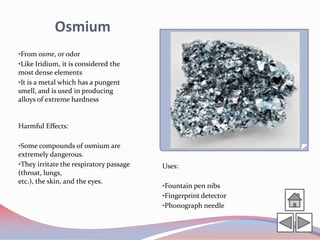
Osmium
•From osme, or odor
•Like Iridium, it is considered the
most dense elements
•It is a metal which has a pungent
smell, and is used in producing
alloys of extreme hardness


Harmful Effects:

•Some compounds of osmium are
extremely dangerous.
•They irritate the respiratory passage   Uses:
(throat, lungs,
etc.), the skin, and the eyes.
                                         •Fountain pen nibs
                                         •Fingerprint detector
                                         •Phonograph needle
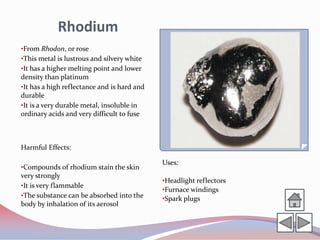
Rhodium
•From Rhodon, or rose
•This metal is lustrous and silvery white
•It has a higher melting point and lower
density than platinum
•It has a high reflectance and is hard and
durable
•It is a very durable metal, insoluble in
ordinary acids and very difficult to fuse


Harmful Effects:

                                             Uses:
•Compounds of rhodium stain the skin
very strongly
                                             •Headlight reflectors
•It is very flammable
                                             •Furnace windings
•The substance can be absorbed into the      •Spark plugs
body by inhalation of its aerosol
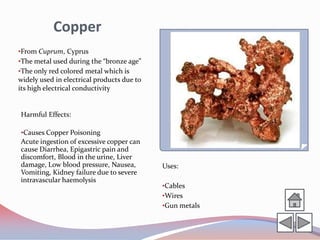
Copper
•From Cuprum, Cyprus
•The metal used during the “bronze age”
•The only red colored metal which is
widely used in electrical products due to
its high electrical conductivity


Harmful Effects:

•Causes Copper Poisoning
Acute ingestion of excessive copper can
cause Diarrhea, Epigastric pain and
discomfort, Blood in the urine, Liver
damage, Low blood pressure, Nausea,         Uses:
Vomiting, Kidney failure due to severe
intravascular haemolysis
                                            •Cables
                                            •Wires
                                            •Gun metals
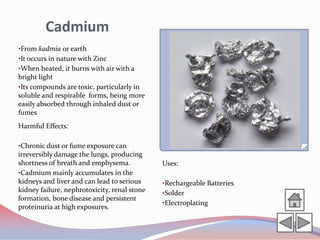
Cadmium
•From kadmia or earth
•It occurs in nature with Zinc
•When heated, it burns with air with a
bright light
•Its compounds are toxic, particularly in
soluble and respirable forms, being more
easily absorbed through inhaled dust or
fumes
Harmful Effects:

•Chronic dust or fume exposure can
irreversibly damage the lungs, producing
shortness of breath and emphysema.            Uses:
•Cadmium mainly accumulates in the
kidneys and liver and can lead to serious     •Rechargeable Batteries
kidney failure, nephrotoxicity, renal stone   •Solder
formation, bone disease and persistent
                                              •Electroplating
proteinuria at high exposures.
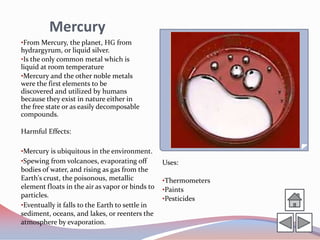
Mercury
•From Mercury, the planet, HG from
hydrargyrum, or liquid silver.
•Is the only common metal which is
liquid at room temperature
•Mercury and the other noble metals
were the first elements to be
discovered and utilized by humans
because they exist in nature either in
the free state or as easily decomposable
compounds.

Harmful Effects:

•Mercury is ubiquitous in the environment.
•Spewing from volcanoes, evaporating off         Uses:
bodies of water, and rising as gas from the
Earth's crust, the poisonous, metallic           •Thermometers
element floats in the air as vapor or binds to   •Paints
particles.                                       •Pesticides
•Eventually it falls to the Earth to settle in
sediment, oceans, and lakes, or reenters the
atmosphere by evaporation.
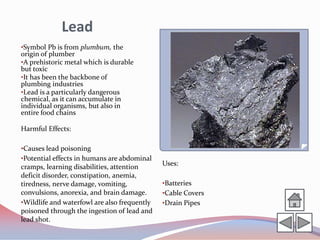
Lead
•Symbol Pb is from plumbum, the
origin of plumber
•A prehistoric metal which is durable
but toxic
•It has been the backbone of
plumbing industries
•Lead is a particularly dangerous
chemical, as it can accumulate in
individual organisms, but also in
entire food chains

Harmful Effects:

•Causes lead poisoning
•Potential effects in humans are abdominal
cramps, learning disabilities, attention      Uses:
deficit disorder, constipation, anemia,
tiredness, nerve damage, vomiting,            •Batteries
convulsions, anorexia, and brain damage.      •Cable Covers
•Wildlife and waterfowl are also frequently   •Drain Pipes
poisoned through the ingestion of lead and
lead shot.
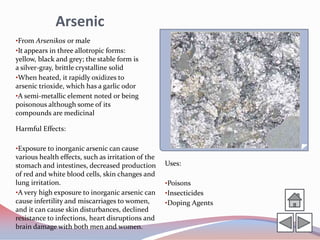
Arsenic
•From Arsenikos or male
•It appears in three allotropic forms:
yellow, black and grey; the stable form is
a silver-gray, brittle crystalline solid
•When heated, it rapidly oxidizes to
arsenic trioxide, which has a garlic odor
•A semi-metallic element noted or being
poisonous although some of its
compounds are medicinal

Harmful Effects:

•Exposure to inorganic arsenic can cause
various health effects, such as irritation of the
stomach and intestines, decreased production        Uses:
of red and white blood cells, skin changes and
lung irritation.                                    •Poisons
•A very high exposure to inorganic arsenic can      •Insecticides
cause infertility and miscarriages to women,        •Doping Agents
and it can cause skin disturbances, declined
resistance to infections, heart disruptions and
brain damage with both men and women.
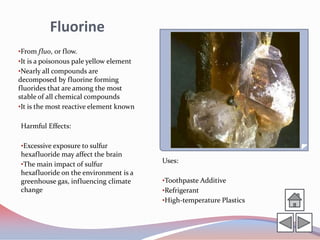
Fluorine
•From fluo, or flow.
•It is a poisonous pale yellow element
•Nearly all compounds are
decomposed by fluorine forming
fluorides that are among the most
stable of all chemical compounds
•It is the most reactive element known

Harmful Effects:

•Excessive exposure to sulfur
hexafluoride may affect the brain
•The main impact of sulfur
                                         Uses:
hexafluoride on the environment is a
greenhouse gas, influencing climate      •Toothpaste Additive
change                                   •Refrigerant
                                         •High-temperature Plastics
Bromine
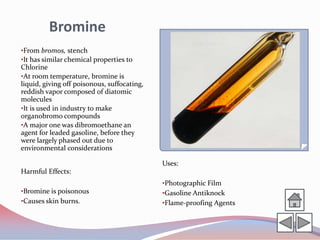
•From bromos, stench
•It has similar chemical properties to
Chlorine
•At room temperature, bromine is
liquid, giving off poisonous, suffocating,
reddish vapor composed of diatomic
molecules
•It is used in industry to make
organobromo compounds
•A major one was dibromoethane an
agent for leaded gasoline, before they
were largely phased out due to
environmental considerations

                                             Uses:
Harmful Effects:
                                             •Photographic Film
•Bromine is poisonous                        •Gasoline Antiknock
•Causes skin burns.                          •Flame-proofing Agents
Tin
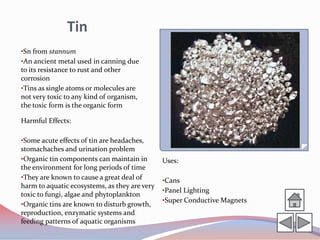
•Sn from stannum
•An ancient metal used in canning due
to its resistance to rust and other
corrosion
•Tins as single atoms or molecules are
not very toxic to any kind of organism,
the toxic form is the organic form

Harmful Effects:

•Some acute effects of tin are headaches,
stomachaches and urination problem
•Organic tin components can maintain in        Uses:
the environment for long periods of time
•They are known to cause a great deal of       •Cans
harm to aquatic ecosystems, as they are very
                                               •Panel Lighting
toxic to fungi, algae and phytoplankton
                                               •Super Conductive Magnets
•Organic tins are known to disturb growth,
reproduction, enzymatic systems and
feeding patterns of aquatic organisms
Link:
http://www.slideshare.net/nicekarlasison/chemistry-
petagroup-10-of-saint-claire#

Group 10 chemistry peta

  • 1.
  • 2.
  • 3.
    Osmium •From osme, orodor •Like Iridium, it is considered the most dense elements •It is a metal which has a pungent smell, and is used in producing alloys of extreme hardness Harmful Effects: •Some compounds of osmium are extremely dangerous. •They irritate the respiratory passage Uses: (throat, lungs, etc.), the skin, and the eyes. •Fountain pen nibs •Fingerprint detector •Phonograph needle
  • 4.
    Rhodium •From Rhodon, orrose •This metal is lustrous and silvery white •It has a higher melting point and lower density than platinum •It has a high reflectance and is hard and durable •It is a very durable metal, insoluble in ordinary acids and very difficult to fuse Harmful Effects: Uses: •Compounds of rhodium stain the skin very strongly •Headlight reflectors •It is very flammable •Furnace windings •The substance can be absorbed into the •Spark plugs body by inhalation of its aerosol
  • 5.
    Copper •From Cuprum, Cyprus •Themetal used during the “bronze age” •The only red colored metal which is widely used in electrical products due to its high electrical conductivity Harmful Effects: •Causes Copper Poisoning Acute ingestion of excessive copper can cause Diarrhea, Epigastric pain and discomfort, Blood in the urine, Liver damage, Low blood pressure, Nausea, Uses: Vomiting, Kidney failure due to severe intravascular haemolysis •Cables •Wires •Gun metals
  • 6.
    Cadmium •From kadmia orearth •It occurs in nature with Zinc •When heated, it burns with air with a bright light •Its compounds are toxic, particularly in soluble and respirable forms, being more easily absorbed through inhaled dust or fumes Harmful Effects: •Chronic dust or fume exposure can irreversibly damage the lungs, producing shortness of breath and emphysema. Uses: •Cadmium mainly accumulates in the kidneys and liver and can lead to serious •Rechargeable Batteries kidney failure, nephrotoxicity, renal stone •Solder formation, bone disease and persistent •Electroplating proteinuria at high exposures.
  • 7.
    Mercury •From Mercury, theplanet, HG from hydrargyrum, or liquid silver. •Is the only common metal which is liquid at room temperature •Mercury and the other noble metals were the first elements to be discovered and utilized by humans because they exist in nature either in the free state or as easily decomposable compounds. Harmful Effects: •Mercury is ubiquitous in the environment. •Spewing from volcanoes, evaporating off Uses: bodies of water, and rising as gas from the Earth's crust, the poisonous, metallic •Thermometers element floats in the air as vapor or binds to •Paints particles. •Pesticides •Eventually it falls to the Earth to settle in sediment, oceans, and lakes, or reenters the atmosphere by evaporation.
  • 8.
    Lead •Symbol Pb isfrom plumbum, the origin of plumber •A prehistoric metal which is durable but toxic •It has been the backbone of plumbing industries •Lead is a particularly dangerous chemical, as it can accumulate in individual organisms, but also in entire food chains Harmful Effects: •Causes lead poisoning •Potential effects in humans are abdominal cramps, learning disabilities, attention Uses: deficit disorder, constipation, anemia, tiredness, nerve damage, vomiting, •Batteries convulsions, anorexia, and brain damage. •Cable Covers •Wildlife and waterfowl are also frequently •Drain Pipes poisoned through the ingestion of lead and lead shot.
  • 9.
    Arsenic •From Arsenikos ormale •It appears in three allotropic forms: yellow, black and grey; the stable form is a silver-gray, brittle crystalline solid •When heated, it rapidly oxidizes to arsenic trioxide, which has a garlic odor •A semi-metallic element noted or being poisonous although some of its compounds are medicinal Harmful Effects: •Exposure to inorganic arsenic can cause various health effects, such as irritation of the stomach and intestines, decreased production Uses: of red and white blood cells, skin changes and lung irritation. •Poisons •A very high exposure to inorganic arsenic can •Insecticides cause infertility and miscarriages to women, •Doping Agents and it can cause skin disturbances, declined resistance to infections, heart disruptions and brain damage with both men and women.
  • 10.
    Fluorine •From fluo, orflow. •It is a poisonous pale yellow element •Nearly all compounds are decomposed by fluorine forming fluorides that are among the most stable of all chemical compounds •It is the most reactive element known Harmful Effects: •Excessive exposure to sulfur hexafluoride may affect the brain •The main impact of sulfur Uses: hexafluoride on the environment is a greenhouse gas, influencing climate •Toothpaste Additive change •Refrigerant •High-temperature Plastics
  • 11.
    Bromine •From bromos, stench •Ithas similar chemical properties to Chlorine •At room temperature, bromine is liquid, giving off poisonous, suffocating, reddish vapor composed of diatomic molecules •It is used in industry to make organobromo compounds •A major one was dibromoethane an agent for leaded gasoline, before they were largely phased out due to environmental considerations Uses: Harmful Effects: •Photographic Film •Bromine is poisonous •Gasoline Antiknock •Causes skin burns. •Flame-proofing Agents
  • 12.
    Tin •Sn from stannum •Anancient metal used in canning due to its resistance to rust and other corrosion •Tins as single atoms or molecules are not very toxic to any kind of organism, the toxic form is the organic form Harmful Effects: •Some acute effects of tin are headaches, stomachaches and urination problem •Organic tin components can maintain in Uses: the environment for long periods of time •They are known to cause a great deal of •Cans harm to aquatic ecosystems, as they are very •Panel Lighting toxic to fungi, algae and phytoplankton •Super Conductive Magnets •Organic tins are known to disturb growth, reproduction, enzymatic systems and feeding patterns of aquatic organisms
  • 13.