Lecture 6 - Integration
C2 Foundation Mathematics (Standard Track)
Dr Linda Stringer Dr Simon Craik
l.stringer@uea.ac.uk s.craik@uea.ac.uk
INTO City/UEA London
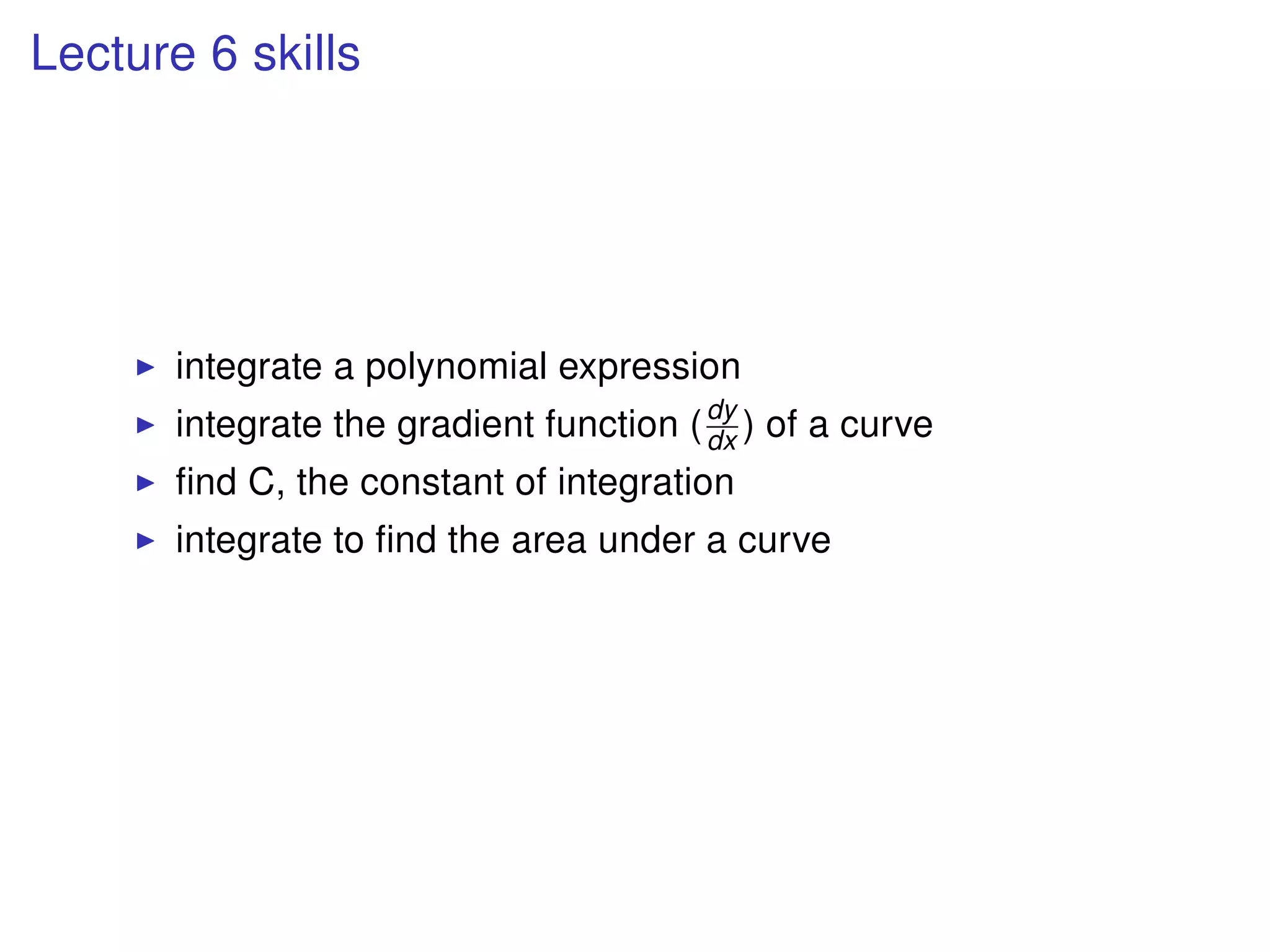
Lecture 6 skills
integrate a polynomial expression
integrate the gradient function (dy
dx ) of a curve
find C, the constant of integration
integrate to find the area under a curve
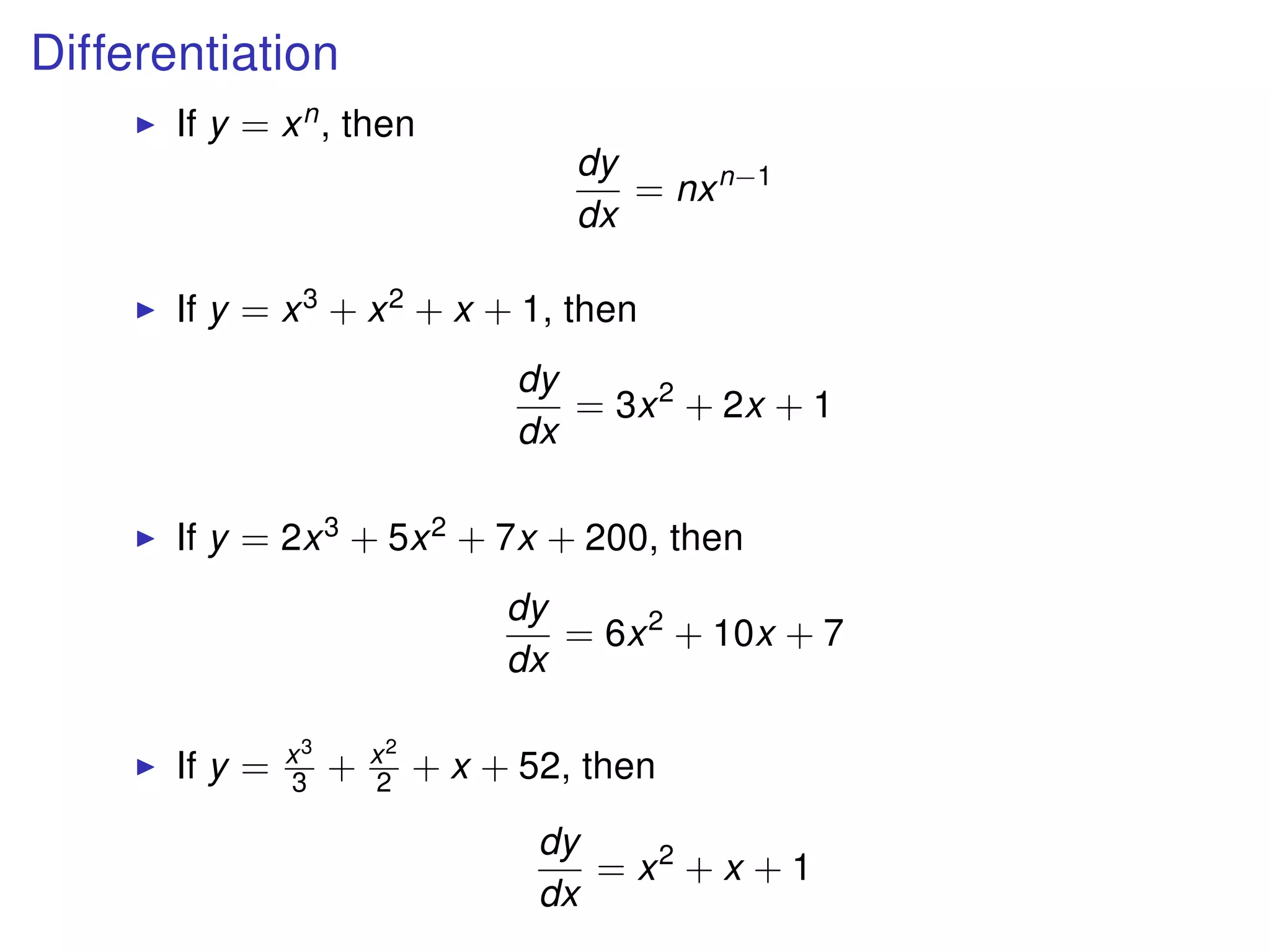
Differentiation
If y = xn, then
dy
dx
= nxn−1
If y = x3 + x2 + x + 1, then
dy
dx
= 3x2
+ 2x + 1
If y = 2x3 + 5x2 + 7x + 200, then
dy
dx
= 6x2
+ 10x + 7
If y = x3
3 + x2
2 + x + 52, then
dy
dx
= x2
+ x + 1
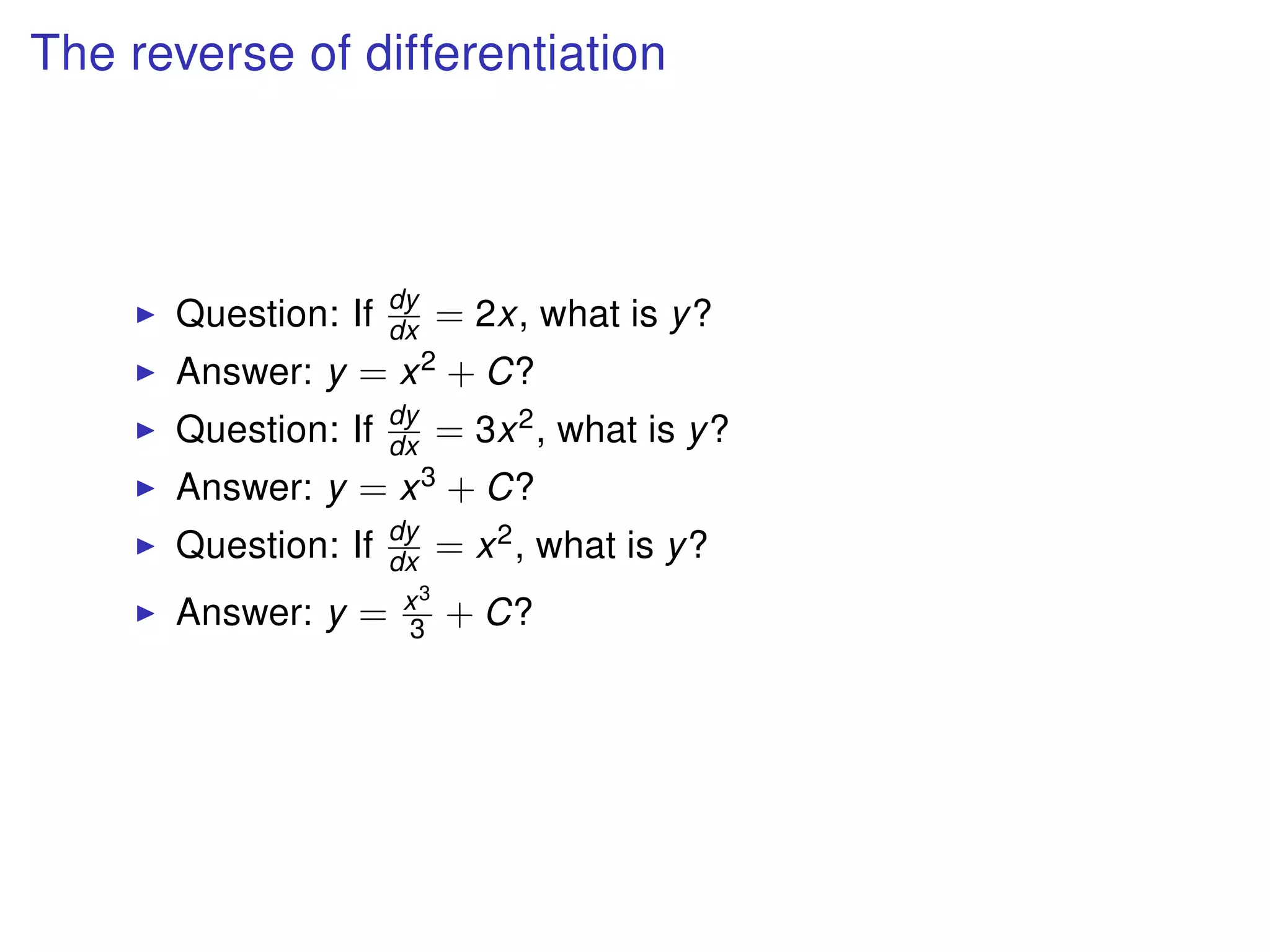
The reverse of differentiation
Question: If dy
dx = 2x, what is y?
Answer: y = x2 + C?
Question: If dy
dx = 3x2, what is y?
Answer: y = x3 + C?
Question: If dy
dx = x2, what is y?
Answer: y = x3
3 + C?
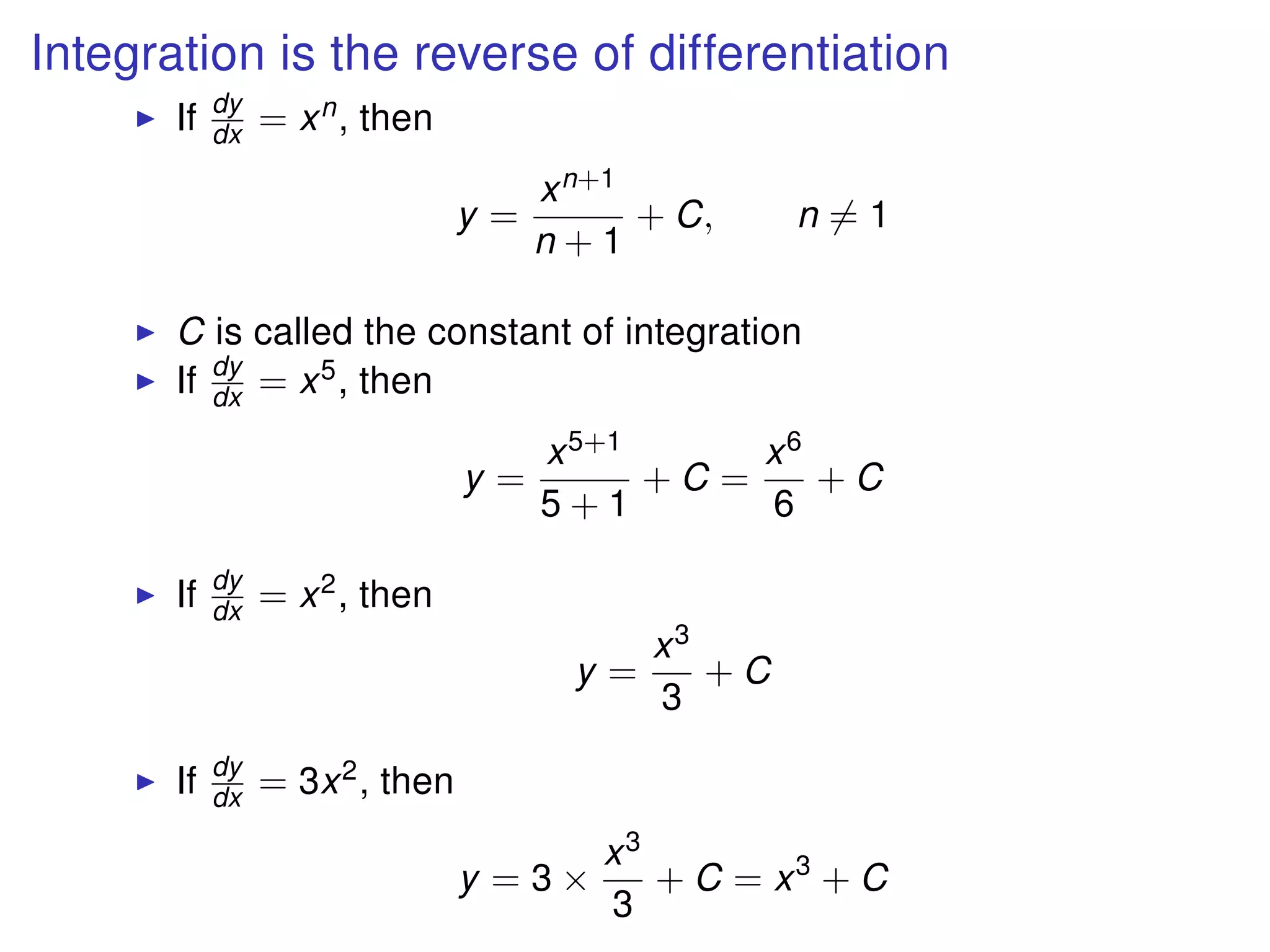
Integration is the reverse of differentiation
If dy
dx = xn, then
y =
xn+1
n + 1
+ C, n = 1
C is called the constant of integration
If dy
dx = x5, then
y =
x5+1
5 + 1
+ C =
x6
6
+ C
If dy
dx = x2, then
y =
x3
3
+ C
If dy
dx = 3x2, then
y = 3 ×
x3
3
+ C = x3
+ C
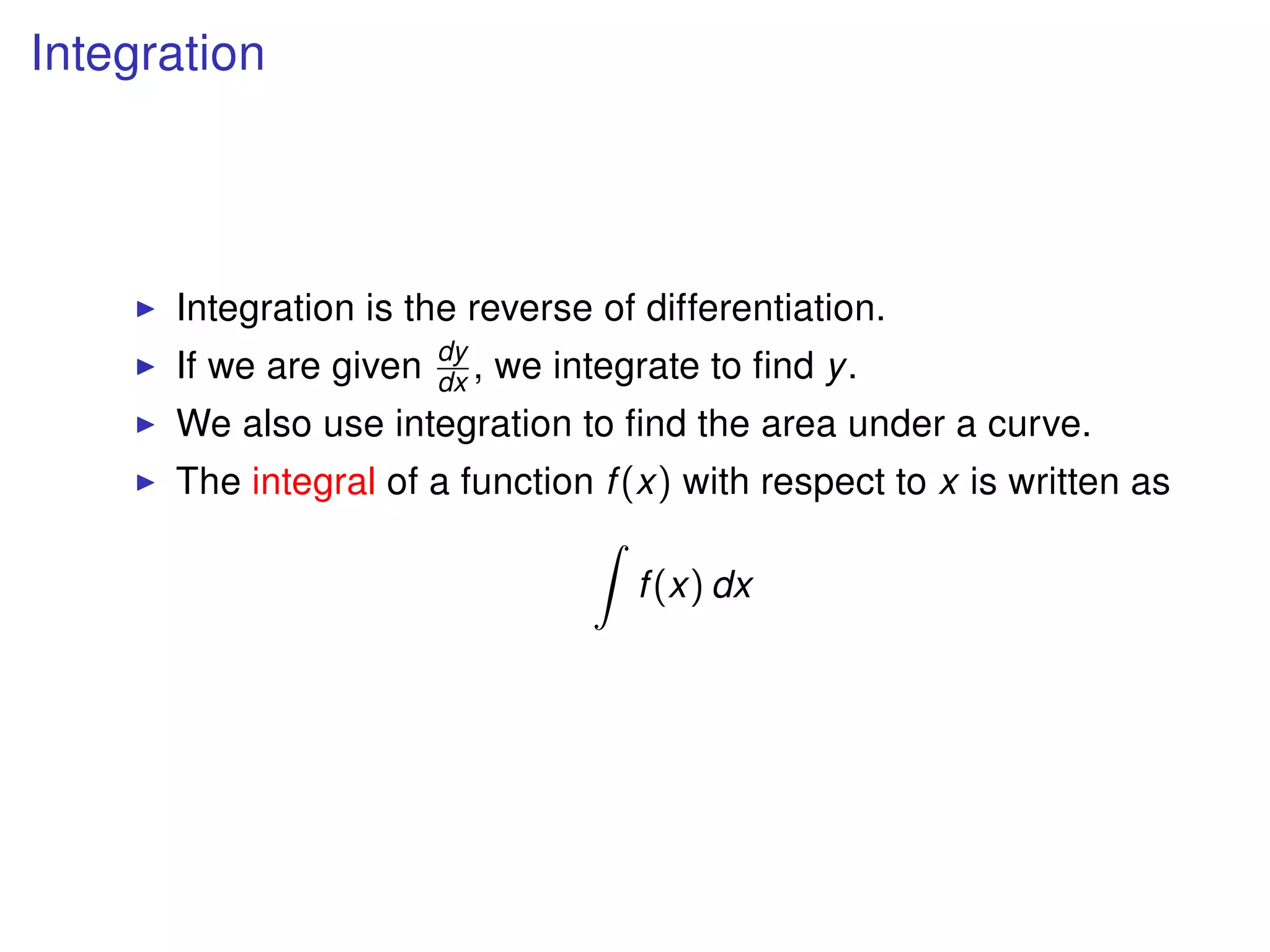
Integration
Integration is the reverse of differentiation.
If we are given dy
dx , we integrate to find y.
We also use integration to find the area under a curve.
The integral of a function f(x) with respect to x is written as
f(x) dx
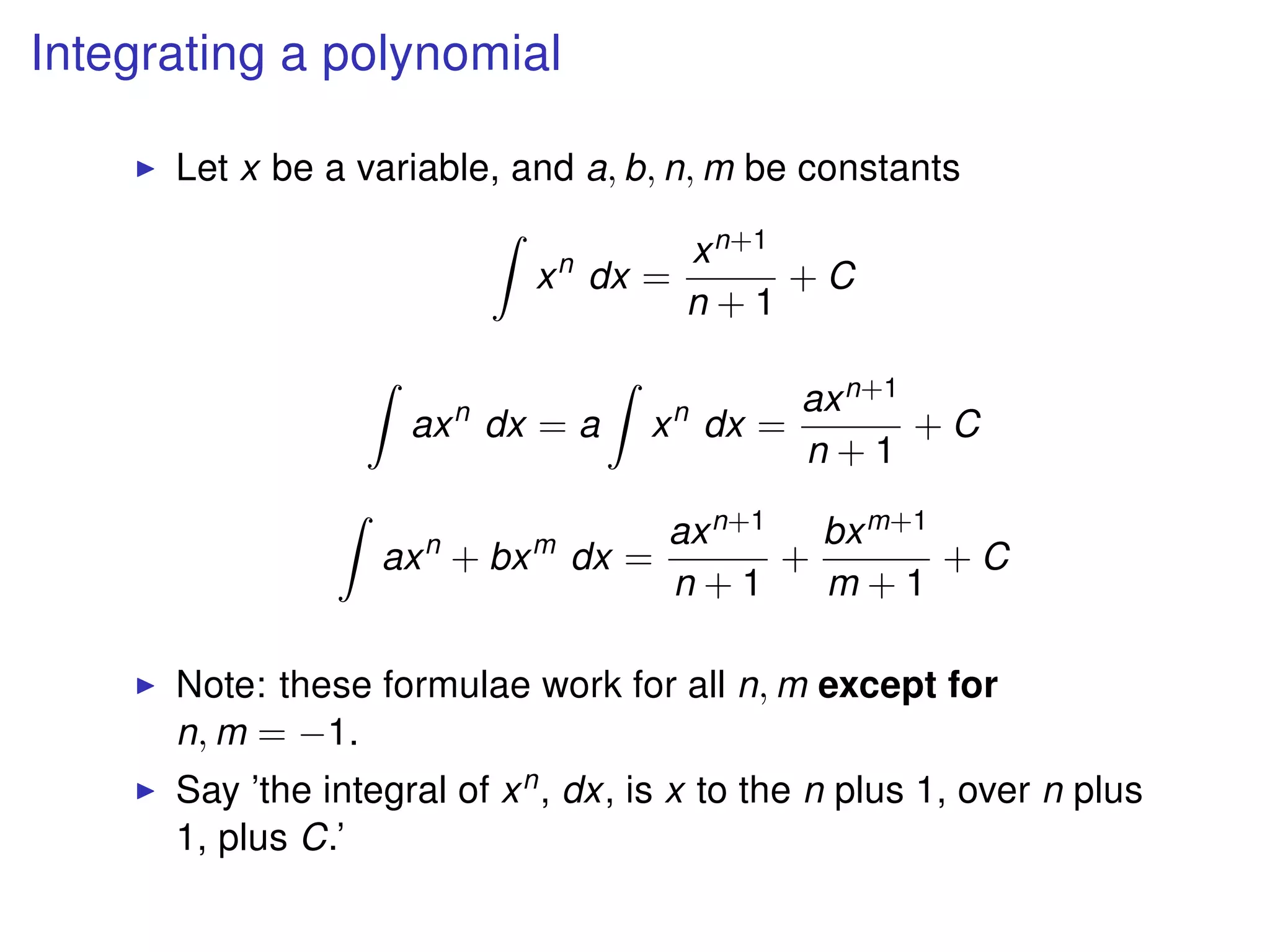
Integrating a polynomial
Let x be a variable, and a, b, n, m be constants
xn
dx =
xn+1
n + 1
+ C
axn
dx = a xn
dx =
axn+1
n + 1
+ C
axn
+ bxm
dx =
axn+1
n + 1
+
bxm+1
m + 1
+ C
Note: these formulae work for all n, m except for
n, m = −1.
Say ’the integral of xn, dx, is x to the n plus 1, over n plus
1, plus C.’
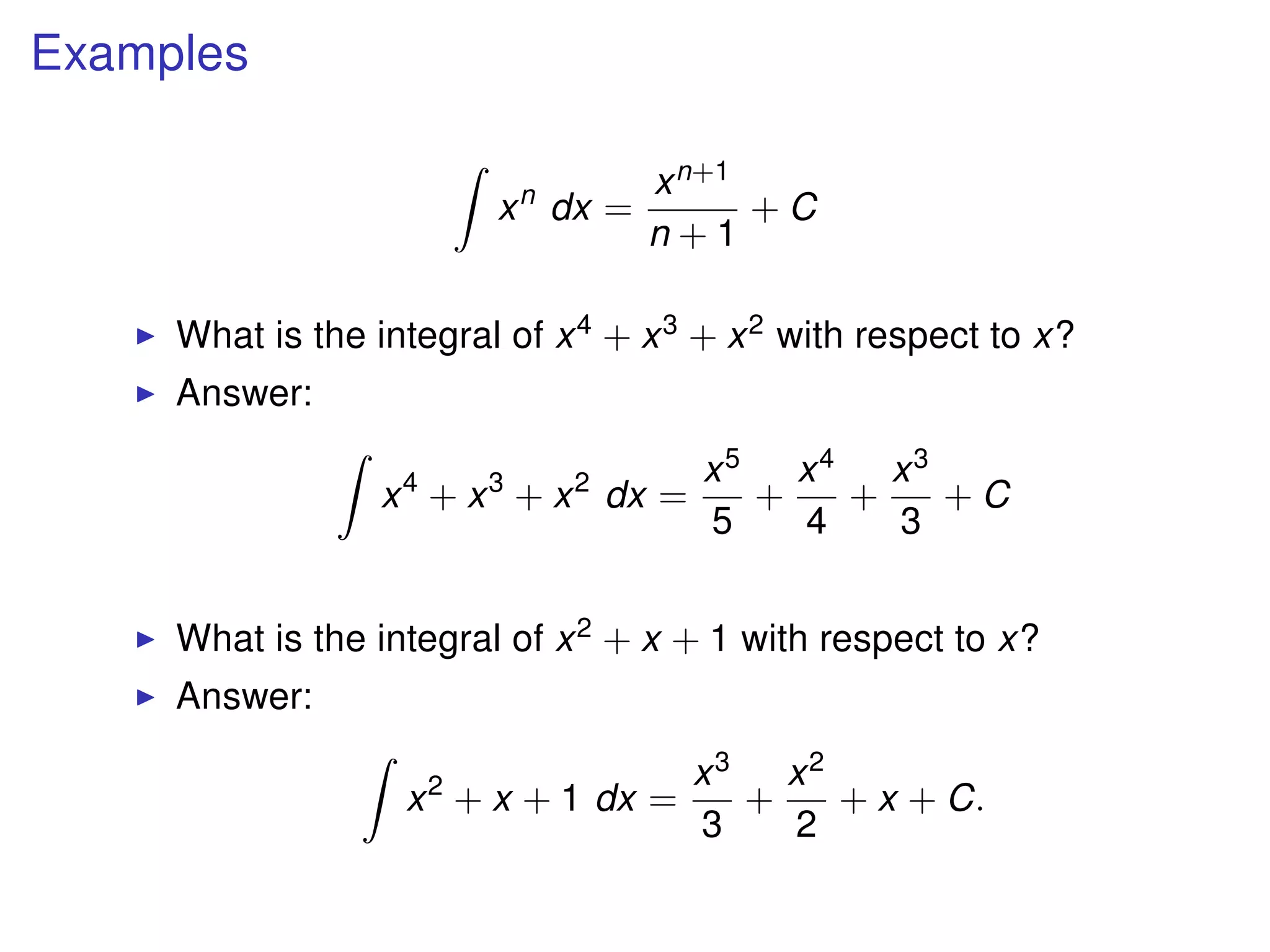
Examples
xn
dx =
xn+1
n + 1
+ C
What is the integral of x4 + x3 + x2 with respect to x?
Answer:
x4
+ x3
+ x2
dx =
x5
5
+
x4
4
+
x3
3
+ C
What is the integral of x2 + x + 1 with respect to x?
Answer:
x2
+ x + 1 dx =
x3
3
+
x2
2
+ x + C.
Examples
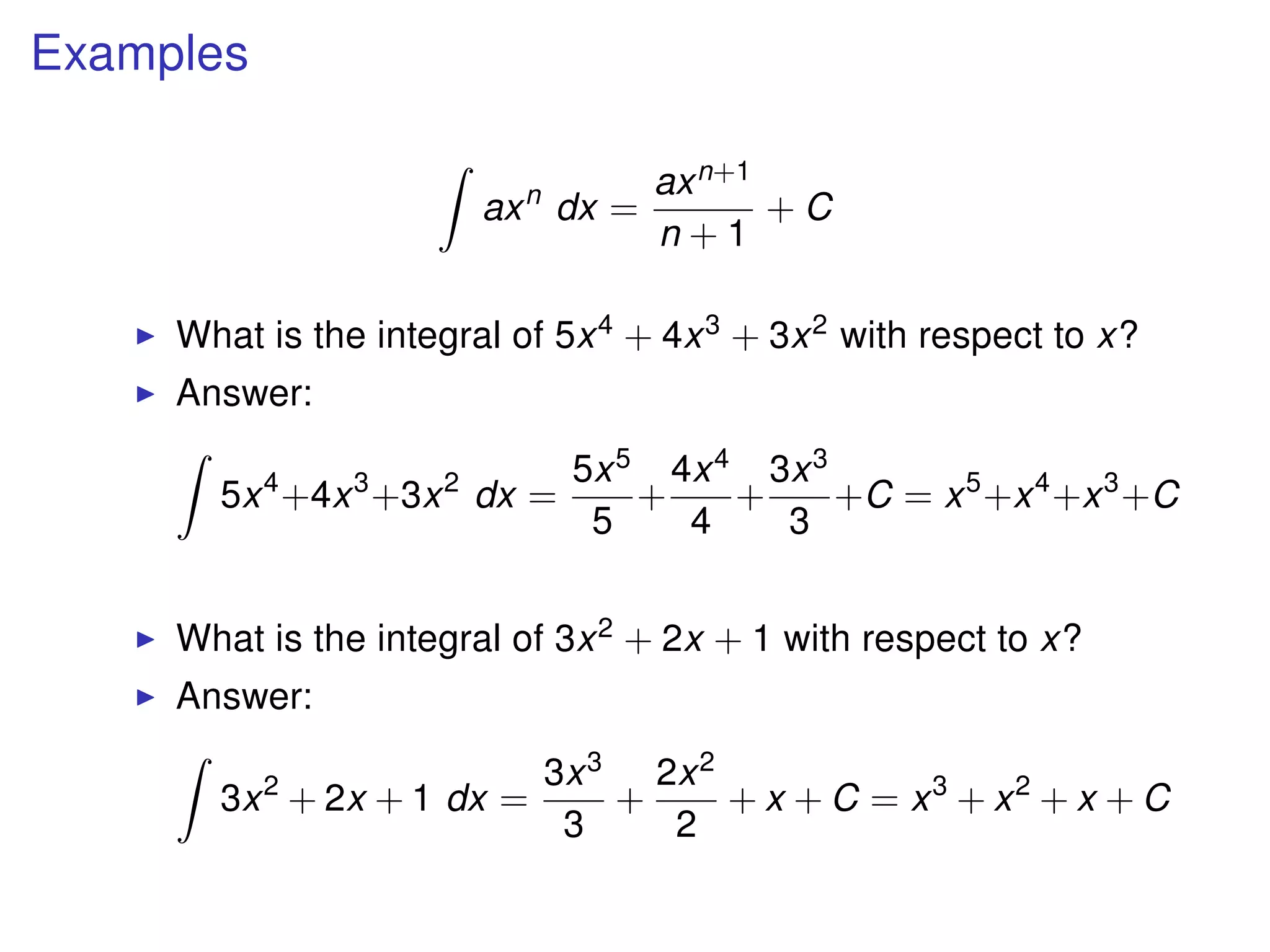
axn
dx =
axn+1
n + 1
+ C
What is the integral of 5x4 + 4x3 + 3x2 with respect to x?
Answer:
5x4
+4x3
+3x2
dx =
5x5
5
+
4x4
4
+
3x3
3
+C = x5
+x4
+x3
+C
What is the integral of 3x2 + 2x + 1 with respect to x?
Answer:
3x2
+ 2x + 1 dx =
3x3
3
+
2x2
2
+ x + C = x3
+ x2
+ x + C
Examples
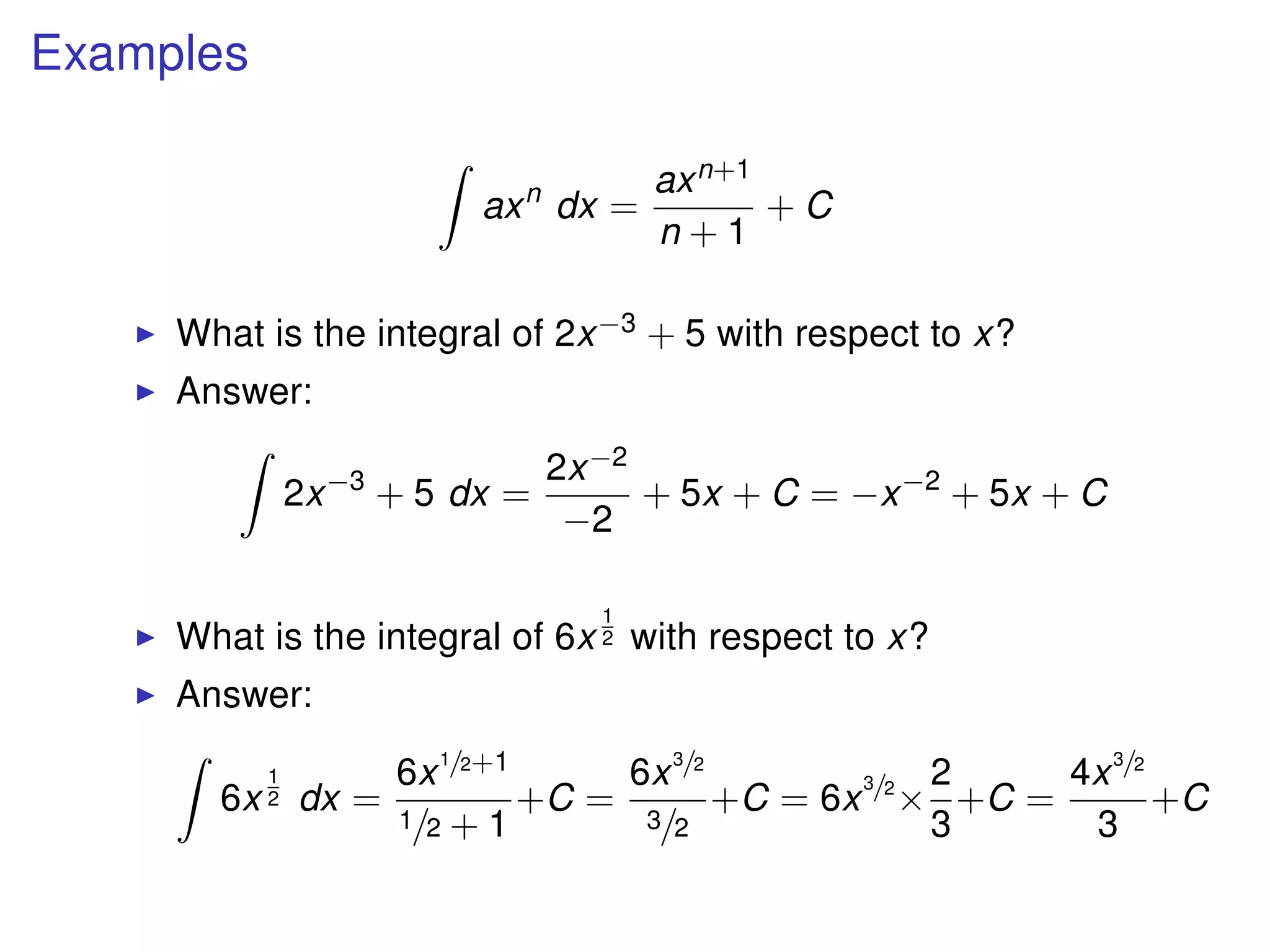
axn
dx =
axn+1
n + 1
+ C
What is the integral of 2x−3 + 5 with respect to x?
Answer:
2x−3
+ 5 dx =
2x−2
−2
+ 5x + C = −x−2
+ 5x + C
What is the integral of 6x
1
2 with respect to x?
Answer:
6x
1
2 dx =
6x1/2+1
1/2 + 1
+C =
6x3/2
3/2
+C = 6x
3/2
×
2
3
+C =
4x3/2
3
+C
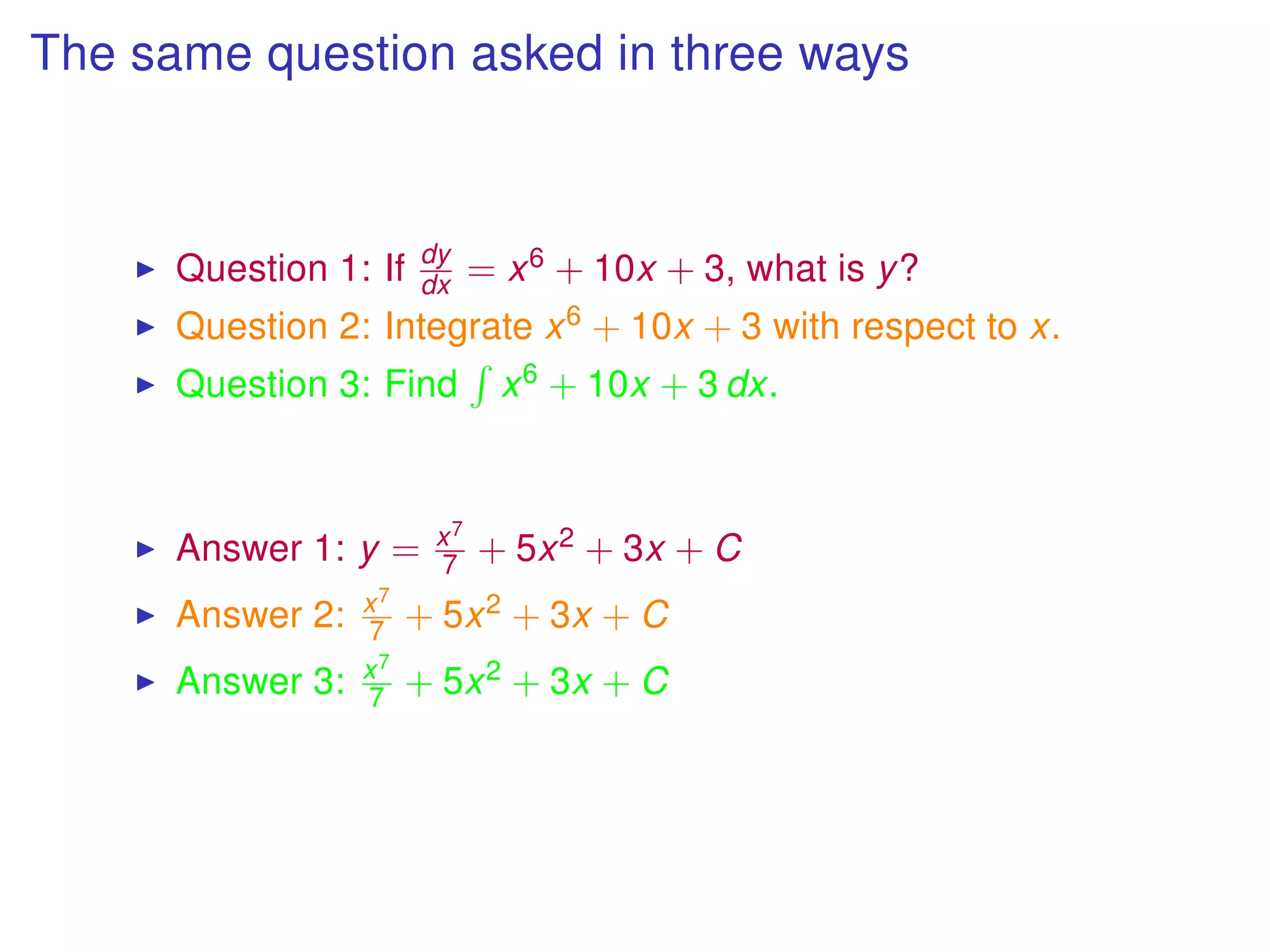
The same question asked in three ways
Question 1: If dy
dx = x6 + 10x + 3, what is y?
Question 2: Integrate x6 + 10x + 3 with respect to x.
Question 3: Find x6 + 10x + 3 dx.
Answer 1: y = x7
7 + 5x2 + 3x + C
Answer 2: x7
7 + 5x2 + 3x + C
Answer 3: x7
7 + 5x2 + 3x + C
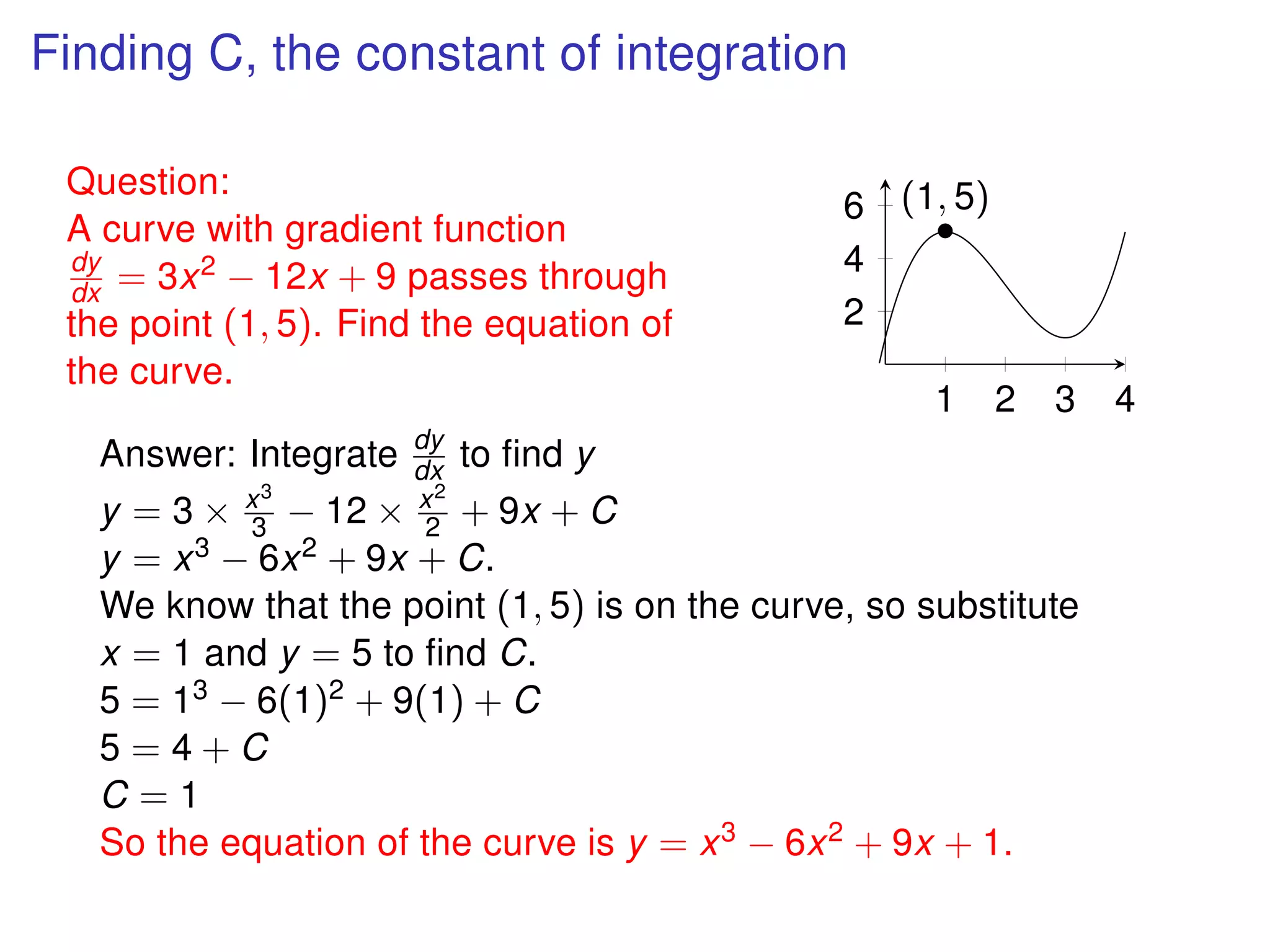
Finding C, the constant of integration
Question:
A curve with gradient function
dy
dx = 3x2 − 12x + 9 passes through
the point (1, 5). Find the equation of
the curve.
1 2 3 4
2
4
6
•
(1, 5)
Answer: Integrate dy
dx to find y
y = 3 × x3
3 − 12 × x2
2 + 9x + C
y = x3 − 6x2 + 9x + C.
We know that the point (1, 5) is on the curve, so substitute
x = 1 and y = 5 to find C.
5 = 13 − 6(1)2 + 9(1) + C
5 = 4 + C
C = 1
So the equation of the curve is y = x3 − 6x2 + 9x + 1.
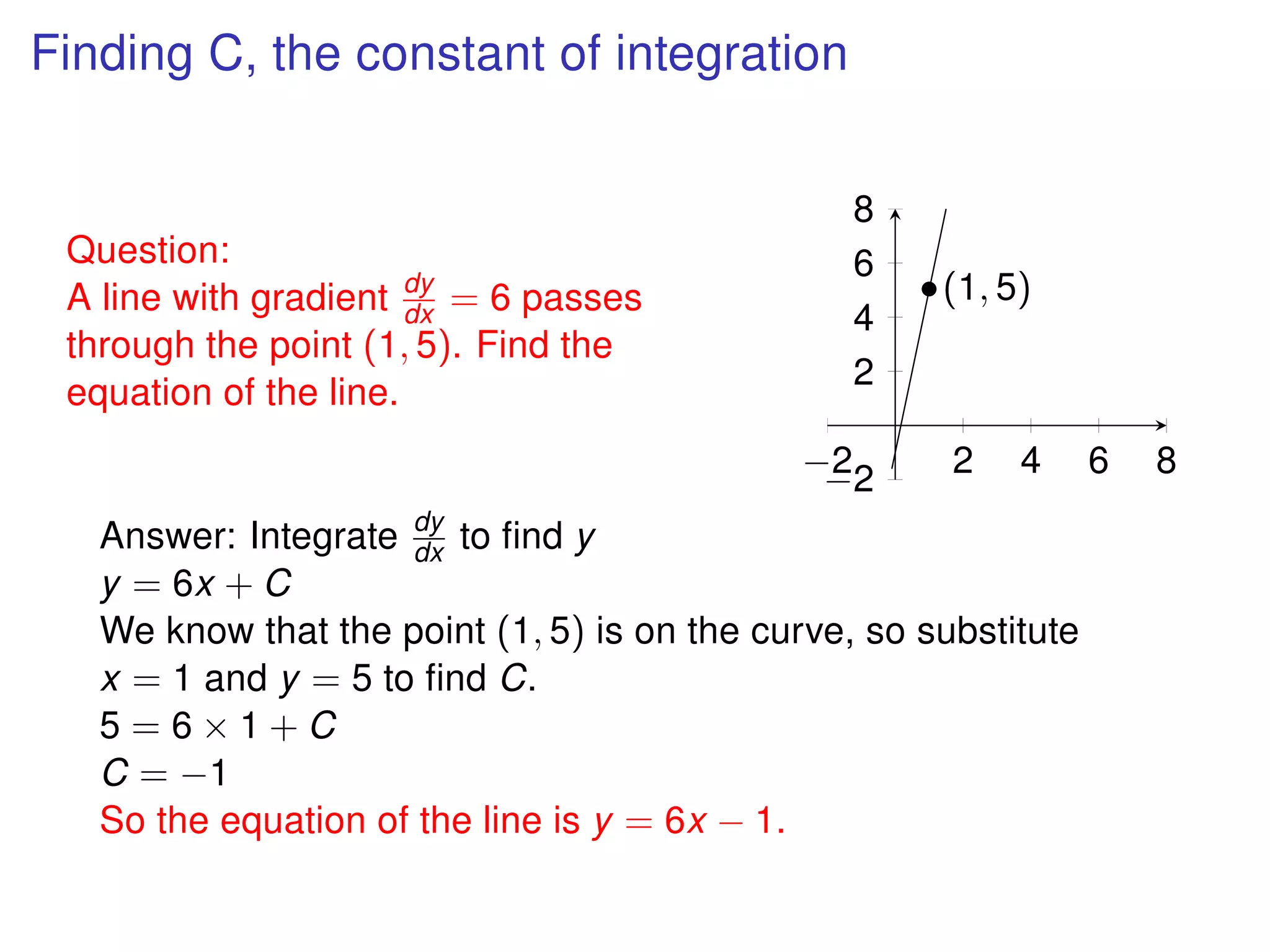
Finding C, the constant of integration
Question:
A line with gradient dy
dx = 6 passes
through the point (1, 5). Find the
equation of the line.
−2 2 4 6 8−2
2
4
6
8
•(1, 5)
Answer: Integrate dy
dx to find y
y = 6x + C
We know that the point (1, 5) is on the curve, so substitute
x = 1 and y = 5 to find C.
5 = 6 × 1 + C
C = −1
So the equation of the line is y = 6x − 1.
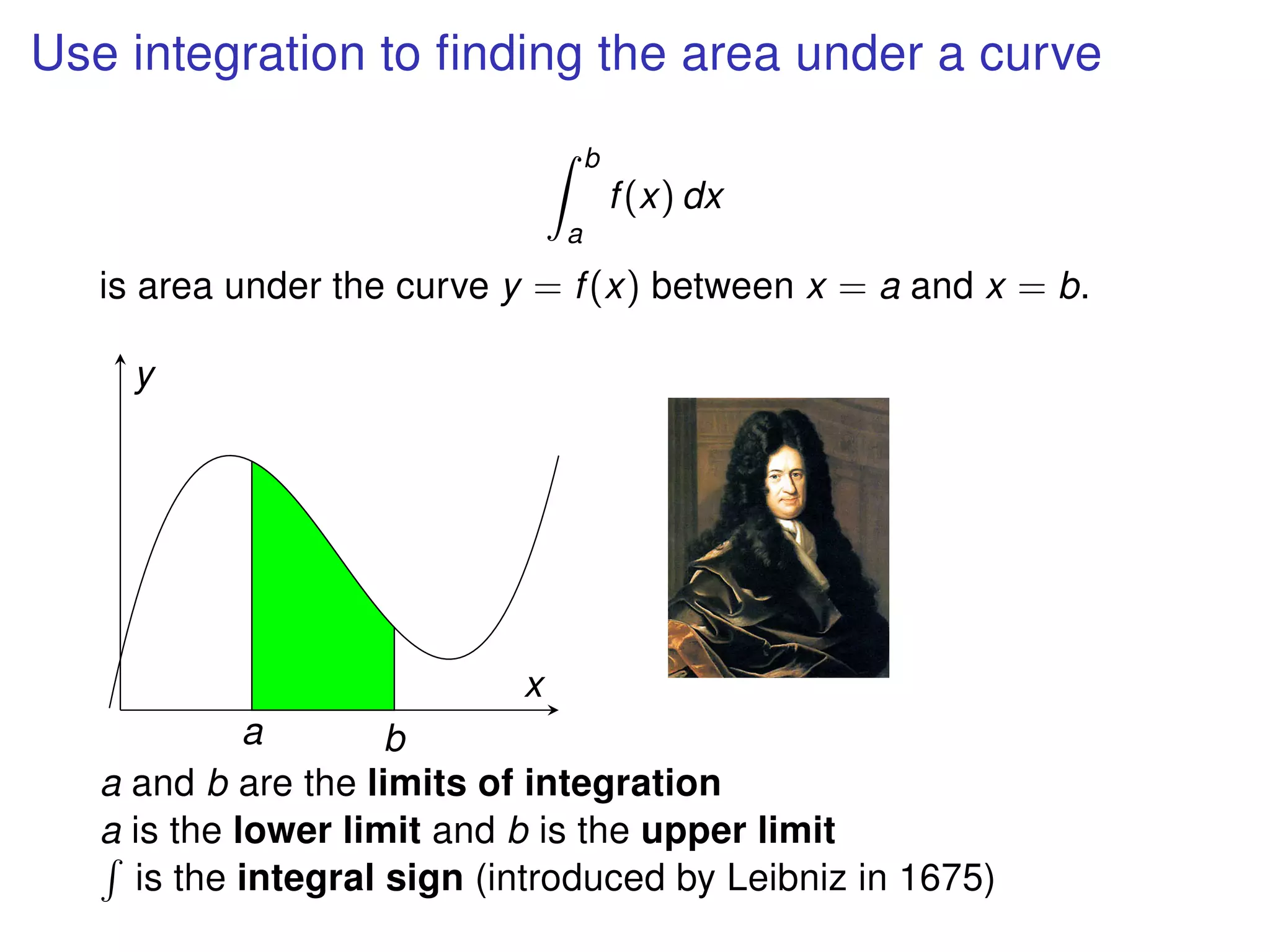
Use integration to finding the area under a curve
b
a
f(x) dx
is area under the curve y = f(x) between x = a and x = b.
a b
x
y
a and b are the limits of integration
a is the lower limit and b is the upper limit
is the integral sign (introduced by Leibniz in 1675)
The Fundamental Theorem of Calculus Part II
If f(x) dx = F(x), then
b
a
f(x) dx = [F(x)]b
a = [F(b)] − [F(a)]
Example
Question:
What is the area under the
curve y = 3x3 + 2 between
x = 0 and x = 2?
−1 1 2
10
20
30
Answer:
2
0 3x3 + 2 dx = [3x4
4 + 2x]2
0
= [3×(2)4
4 + 2 × 2] − [3×04
4 + 2 × 0]
= [12 + 4] − [0 + 0]
= [16] − [0] = 16
Example 2
Question:
What is the area under the
curve y = 6x2 + 2x−3 between
x = −2 and x = −1?
−2 −1
10
20
Answer:
−1
−2 6x2 + 2x−3 dx = [2x3 − x−2]−1
−2
= [2(−1)3 − (−1)−2] − [2(−2)3 − (−2)−2]
= [−2 − 1] − [−16 − 1
4 ]
= [−3] − [−64−1
4 ]
= 53
4 = 131
4 = 13.25
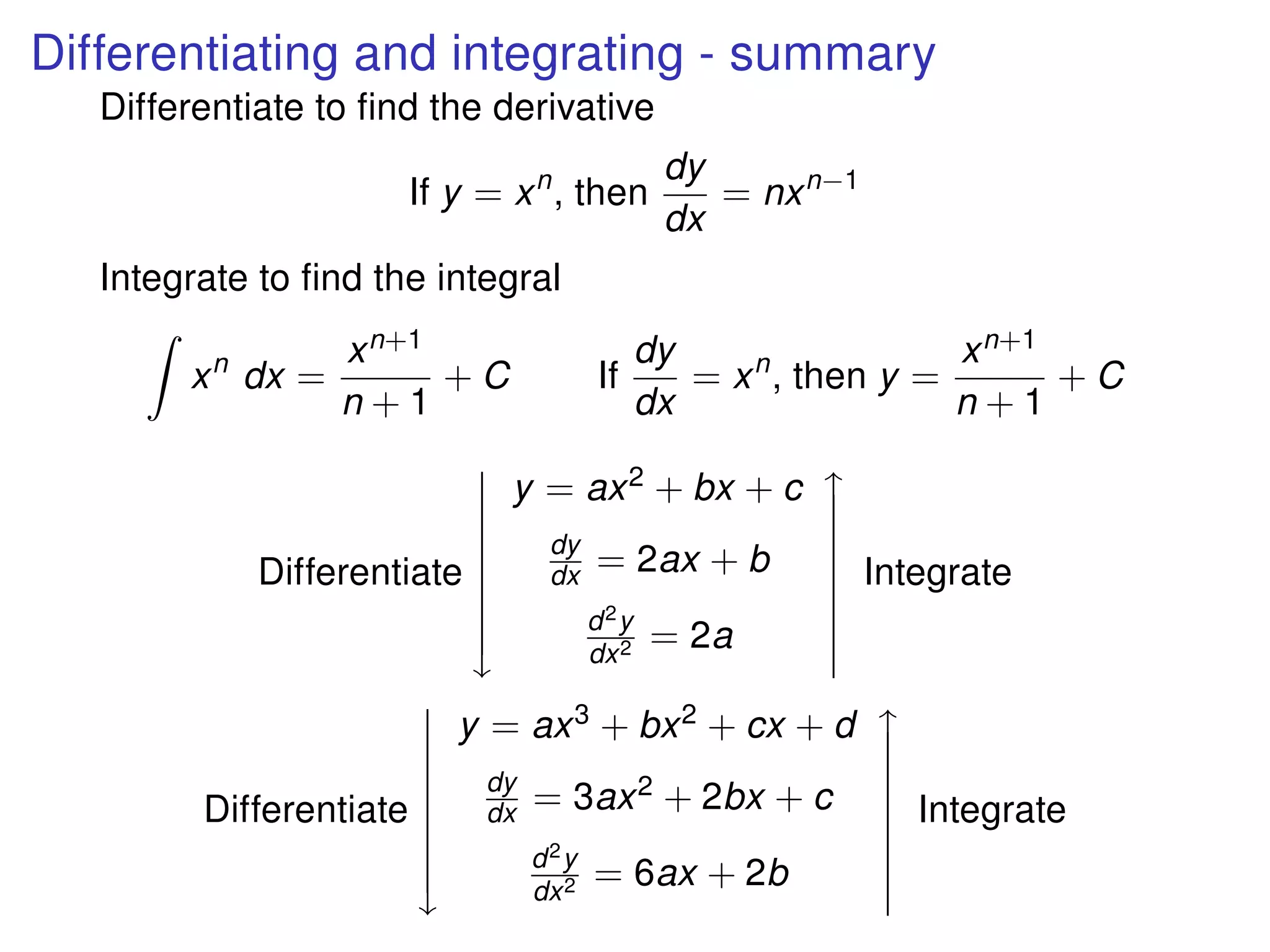
Differentiating and integrating - summary
Differentiate to find the derivative
If y = xn
, then
dy
dx
= nxn−1
Integrate to find the integral
xn
dx =
xn+1
n + 1
+ C If
dy
dx
= xn
, then y =
xn+1
n + 1
+ C
Differentiate








y = ax2 + bx + c
dy
dx = 2ax + b
d2y
dx2 = 2a








Integrate
Differentiate








y = ax3 + bx2 + cx + d
dy
dx = 3ax2 + 2bx + c
d2y
dx2 = 6ax + 2b








Integrate

C2 st lecture 6 handout

  • 1.
    Lecture 6 -Integration C2 Foundation Mathematics (Standard Track) Dr Linda Stringer Dr Simon Craik l.stringer@uea.ac.uk s.craik@uea.ac.uk INTO City/UEA London
  • 2.
    Lecture 6 skills integratea polynomial expression integrate the gradient function (dy dx ) of a curve find C, the constant of integration integrate to find the area under a curve
  • 3.
    Differentiation If y =xn, then dy dx = nxn−1 If y = x3 + x2 + x + 1, then dy dx = 3x2 + 2x + 1 If y = 2x3 + 5x2 + 7x + 200, then dy dx = 6x2 + 10x + 7 If y = x3 3 + x2 2 + x + 52, then dy dx = x2 + x + 1
  • 4.
    The reverse ofdifferentiation Question: If dy dx = 2x, what is y? Answer: y = x2 + C? Question: If dy dx = 3x2, what is y? Answer: y = x3 + C? Question: If dy dx = x2, what is y? Answer: y = x3 3 + C?
  • 5.
    Integration is thereverse of differentiation If dy dx = xn, then y = xn+1 n + 1 + C, n = 1 C is called the constant of integration If dy dx = x5, then y = x5+1 5 + 1 + C = x6 6 + C If dy dx = x2, then y = x3 3 + C If dy dx = 3x2, then y = 3 × x3 3 + C = x3 + C
  • 6.
    Integration Integration is thereverse of differentiation. If we are given dy dx , we integrate to find y. We also use integration to find the area under a curve. The integral of a function f(x) with respect to x is written as f(x) dx
  • 7.
    Integrating a polynomial Letx be a variable, and a, b, n, m be constants xn dx = xn+1 n + 1 + C axn dx = a xn dx = axn+1 n + 1 + C axn + bxm dx = axn+1 n + 1 + bxm+1 m + 1 + C Note: these formulae work for all n, m except for n, m = −1. Say ’the integral of xn, dx, is x to the n plus 1, over n plus 1, plus C.’
  • 8.
    Examples xn dx = xn+1 n +1 + C What is the integral of x4 + x3 + x2 with respect to x? Answer: x4 + x3 + x2 dx = x5 5 + x4 4 + x3 3 + C What is the integral of x2 + x + 1 with respect to x? Answer: x2 + x + 1 dx = x3 3 + x2 2 + x + C.
  • 9.
    Examples axn dx = axn+1 n +1 + C What is the integral of 5x4 + 4x3 + 3x2 with respect to x? Answer: 5x4 +4x3 +3x2 dx = 5x5 5 + 4x4 4 + 3x3 3 +C = x5 +x4 +x3 +C What is the integral of 3x2 + 2x + 1 with respect to x? Answer: 3x2 + 2x + 1 dx = 3x3 3 + 2x2 2 + x + C = x3 + x2 + x + C
  • 10.
    Examples axn dx = axn+1 n +1 + C What is the integral of 2x−3 + 5 with respect to x? Answer: 2x−3 + 5 dx = 2x−2 −2 + 5x + C = −x−2 + 5x + C What is the integral of 6x 1 2 with respect to x? Answer: 6x 1 2 dx = 6x1/2+1 1/2 + 1 +C = 6x3/2 3/2 +C = 6x 3/2 × 2 3 +C = 4x3/2 3 +C
  • 11.
    The same questionasked in three ways Question 1: If dy dx = x6 + 10x + 3, what is y? Question 2: Integrate x6 + 10x + 3 with respect to x. Question 3: Find x6 + 10x + 3 dx. Answer 1: y = x7 7 + 5x2 + 3x + C Answer 2: x7 7 + 5x2 + 3x + C Answer 3: x7 7 + 5x2 + 3x + C
  • 12.
    Finding C, theconstant of integration Question: A curve with gradient function dy dx = 3x2 − 12x + 9 passes through the point (1, 5). Find the equation of the curve. 1 2 3 4 2 4 6 • (1, 5) Answer: Integrate dy dx to find y y = 3 × x3 3 − 12 × x2 2 + 9x + C y = x3 − 6x2 + 9x + C. We know that the point (1, 5) is on the curve, so substitute x = 1 and y = 5 to find C. 5 = 13 − 6(1)2 + 9(1) + C 5 = 4 + C C = 1 So the equation of the curve is y = x3 − 6x2 + 9x + 1.
  • 13.
    Finding C, theconstant of integration Question: A line with gradient dy dx = 6 passes through the point (1, 5). Find the equation of the line. −2 2 4 6 8−2 2 4 6 8 •(1, 5) Answer: Integrate dy dx to find y y = 6x + C We know that the point (1, 5) is on the curve, so substitute x = 1 and y = 5 to find C. 5 = 6 × 1 + C C = −1 So the equation of the line is y = 6x − 1.
  • 14.
    Use integration tofinding the area under a curve b a f(x) dx is area under the curve y = f(x) between x = a and x = b. a b x y a and b are the limits of integration a is the lower limit and b is the upper limit is the integral sign (introduced by Leibniz in 1675)
  • 15.
    The Fundamental Theoremof Calculus Part II If f(x) dx = F(x), then b a f(x) dx = [F(x)]b a = [F(b)] − [F(a)]
  • 16.
    Example Question: What is thearea under the curve y = 3x3 + 2 between x = 0 and x = 2? −1 1 2 10 20 30 Answer: 2 0 3x3 + 2 dx = [3x4 4 + 2x]2 0 = [3×(2)4 4 + 2 × 2] − [3×04 4 + 2 × 0] = [12 + 4] − [0 + 0] = [16] − [0] = 16
  • 17.
    Example 2 Question: What isthe area under the curve y = 6x2 + 2x−3 between x = −2 and x = −1? −2 −1 10 20 Answer: −1 −2 6x2 + 2x−3 dx = [2x3 − x−2]−1 −2 = [2(−1)3 − (−1)−2] − [2(−2)3 − (−2)−2] = [−2 − 1] − [−16 − 1 4 ] = [−3] − [−64−1 4 ] = 53 4 = 131 4 = 13.25
  • 18.
    Differentiating and integrating- summary Differentiate to find the derivative If y = xn , then dy dx = nxn−1 Integrate to find the integral xn dx = xn+1 n + 1 + C If dy dx = xn , then y = xn+1 n + 1 + C Differentiate         y = ax2 + bx + c dy dx = 2ax + b d2y dx2 = 2a         Integrate Differentiate         y = ax3 + bx2 + cx + d dy dx = 3ax2 + 2bx + c d2y dx2 = 6ax + 2b         Integrate