Lecture 10:
Terrorism and terrorists
What is terrorism?
• Terrorism is a controversial term
• All definitions agree that terrorism involves acts of
violence
• Terrorism differs from criminal violence because it
aims to achieve political change
• Terrorists claim to fight for a just cause, but opponents
of that cause regard them as ordinary criminals
• Whether we describe something as terrorism depends
on our view of the legitimacy of the cause
Who is a terrorist?
• States reserve for themselves
the power to define who is a
terrorist
• In the 1980s, the USA regarded
the Afghan Mujahideen as
‘freedom fighters’ when they
resisted the Soviet invasion
• Two decades later, the USA
accused a new generation of
Afghans of being terrorists for
resisting western invasion
State violence:
the first terrorists
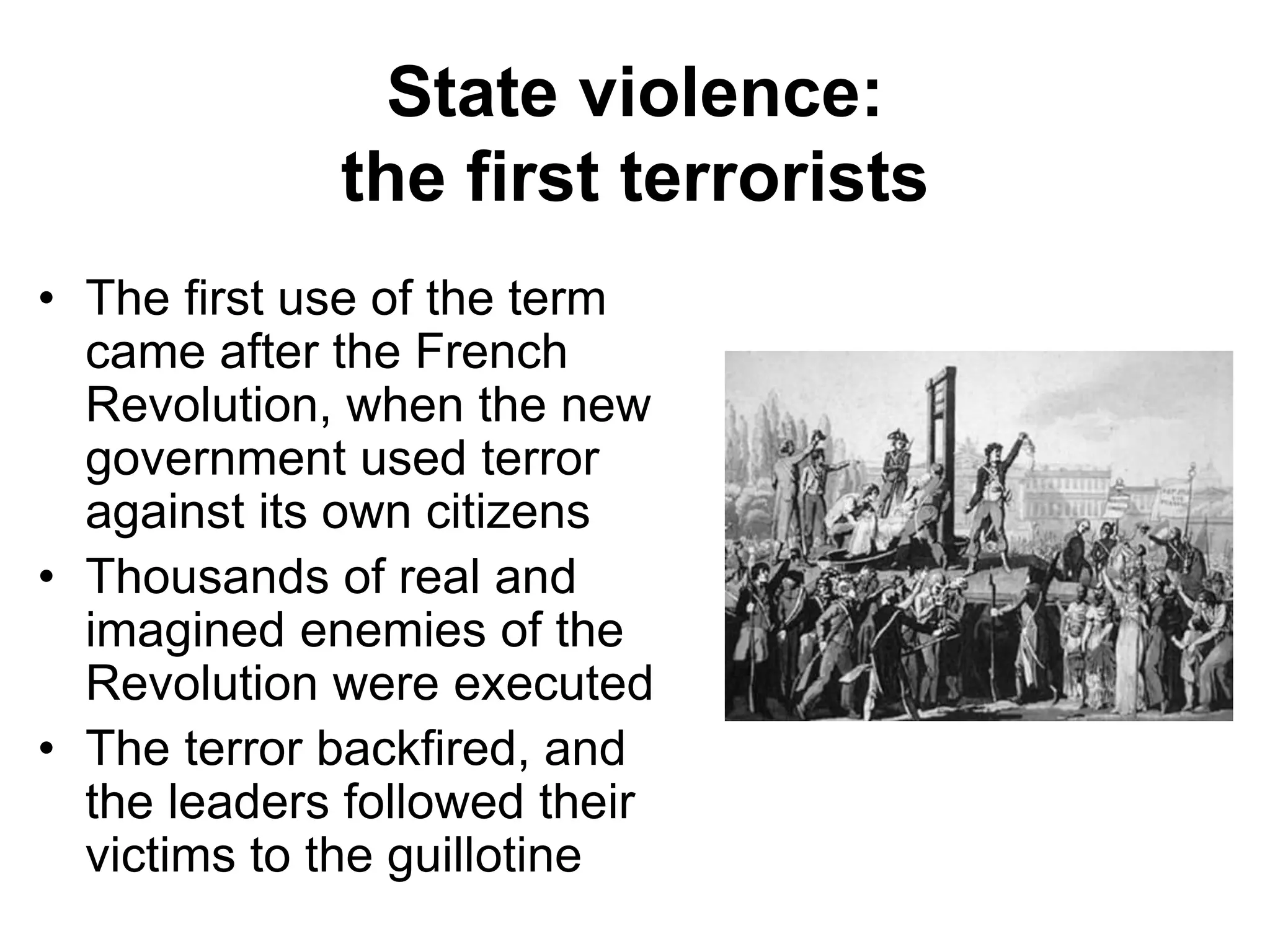
• The first use of the term
came after the French
Revolution, when the new
government used terror
against its own citizens
• Thousands of real and
imagined enemies of the
Revolution were executed
• The terror backfired, and
the leaders followed their
victims to the guillotine
Is state violence terrorism?
• State violence is not normally regarded as
terrorism now
• In Realist IR theory, states have a monopoly
on the use of force
• Thus only sub-state groups are regarded as
terrorists
• These groups and their supporters would not
accept that distinction
State-sponsored terrorism
• One factor not covered
by the Realist concept of
state force is state
support for terrorist
groups in other countries
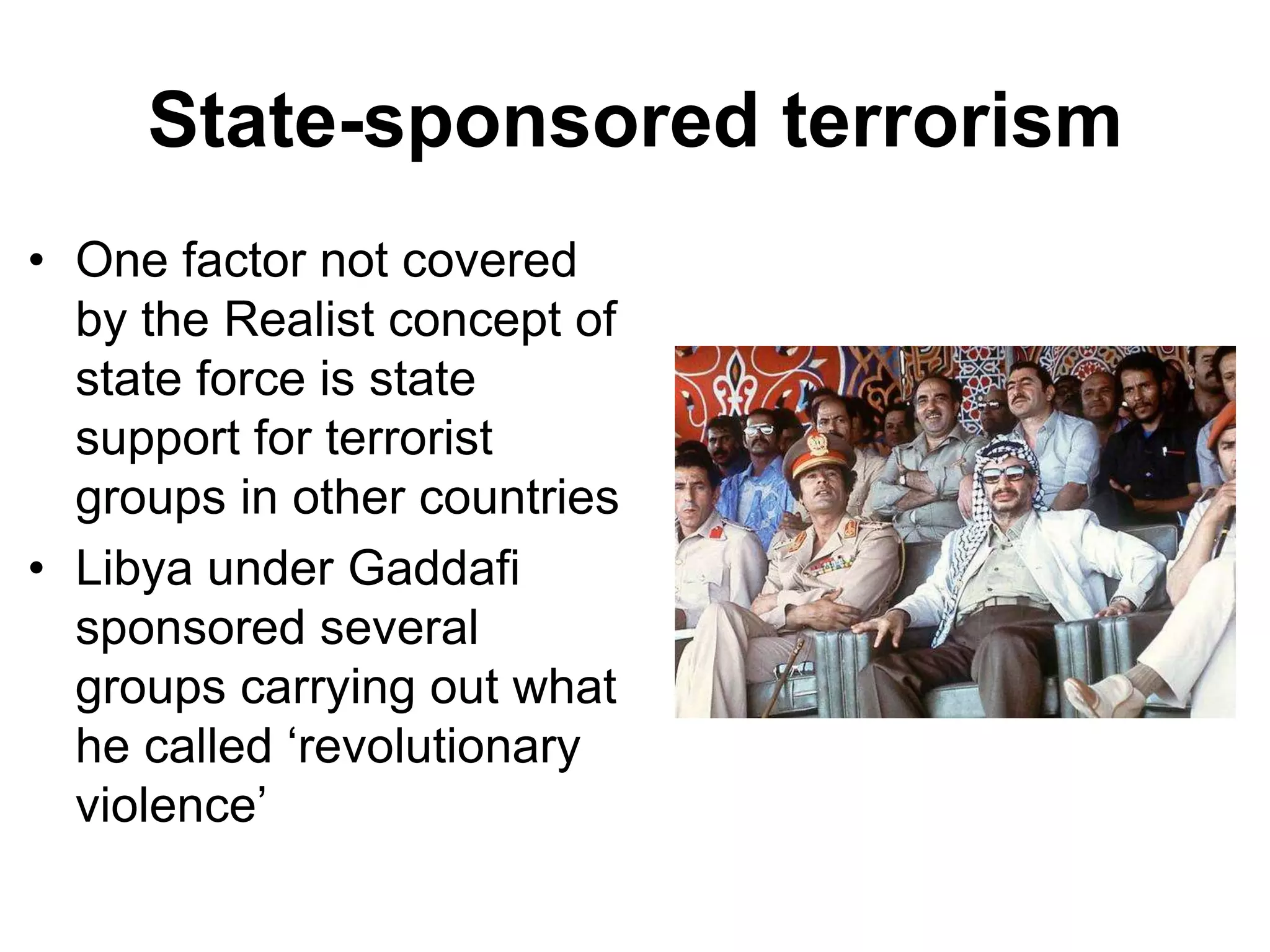
• Libya under Gaddafi
sponsored several
groups carrying out what
he called ‘revolutionary
violence’
Terrorism in International Relations
• Terrorist groups are
not regarded as a
legitimate actor in IR,
as they operate
outside the law
• Even so, it is clear
that terrorist groups
have been able to
exert influence on
international and
domestic politics
Terrorism as a struggle
• Terrorism is the weakest form of armed struggle
• Terrorist groups lack the means to engage in
direct confrontation with governments
• Terrorists therefore pick soft or limited targets
• Most terrorist groups enjoy limited popular support
– they are too radical
• Terrorists usually seek to provoke a
disproportionate response from governments
• This strategy can be counterproductive, as
terrorists can lose support
Types of terrorism
• In terms of political aims, terrorist groups can
be conveniently divided into four types:
• a) left-wing
• b) right-wing
• c) ethno-nationalist or separatist
• d) religious or ‘sacred’
• These distinctions can overlap – some ethno-
nationalist groups could be Marxist or inspired
by Marxist ideas
Left-wing terrorism
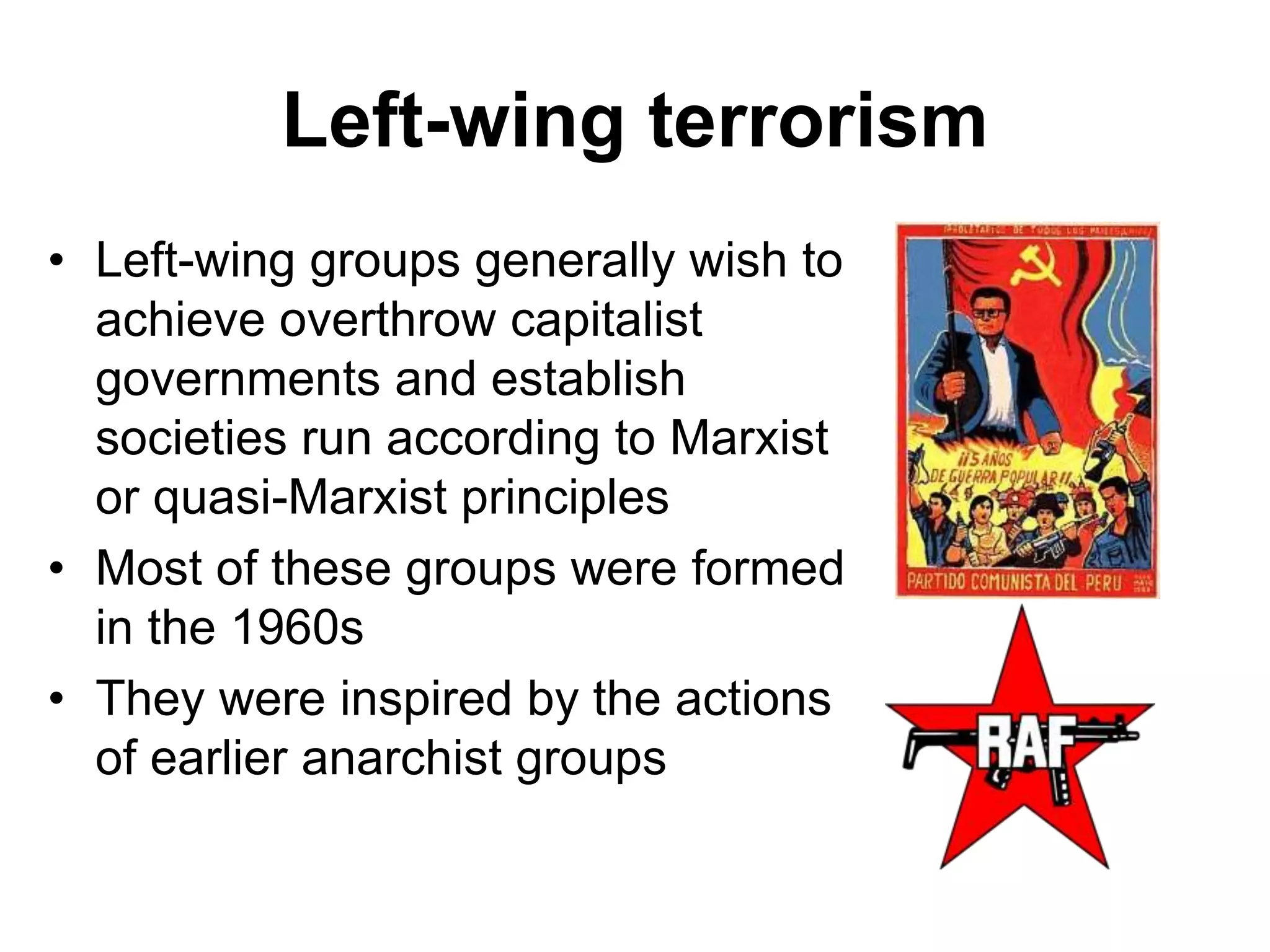
• Left-wing groups generally wish to
achieve overthrow capitalist
governments and establish
societies run according to Marxist
or quasi-Marxist principles
• Most of these groups were formed
in the 1960s
• They were inspired by the actions
of earlier anarchist groups
Early left-wing groups
• Long before the creation of
the Soviet Union and modern
communism, several early
terrorist groups pursued
broadly left-wing ideals
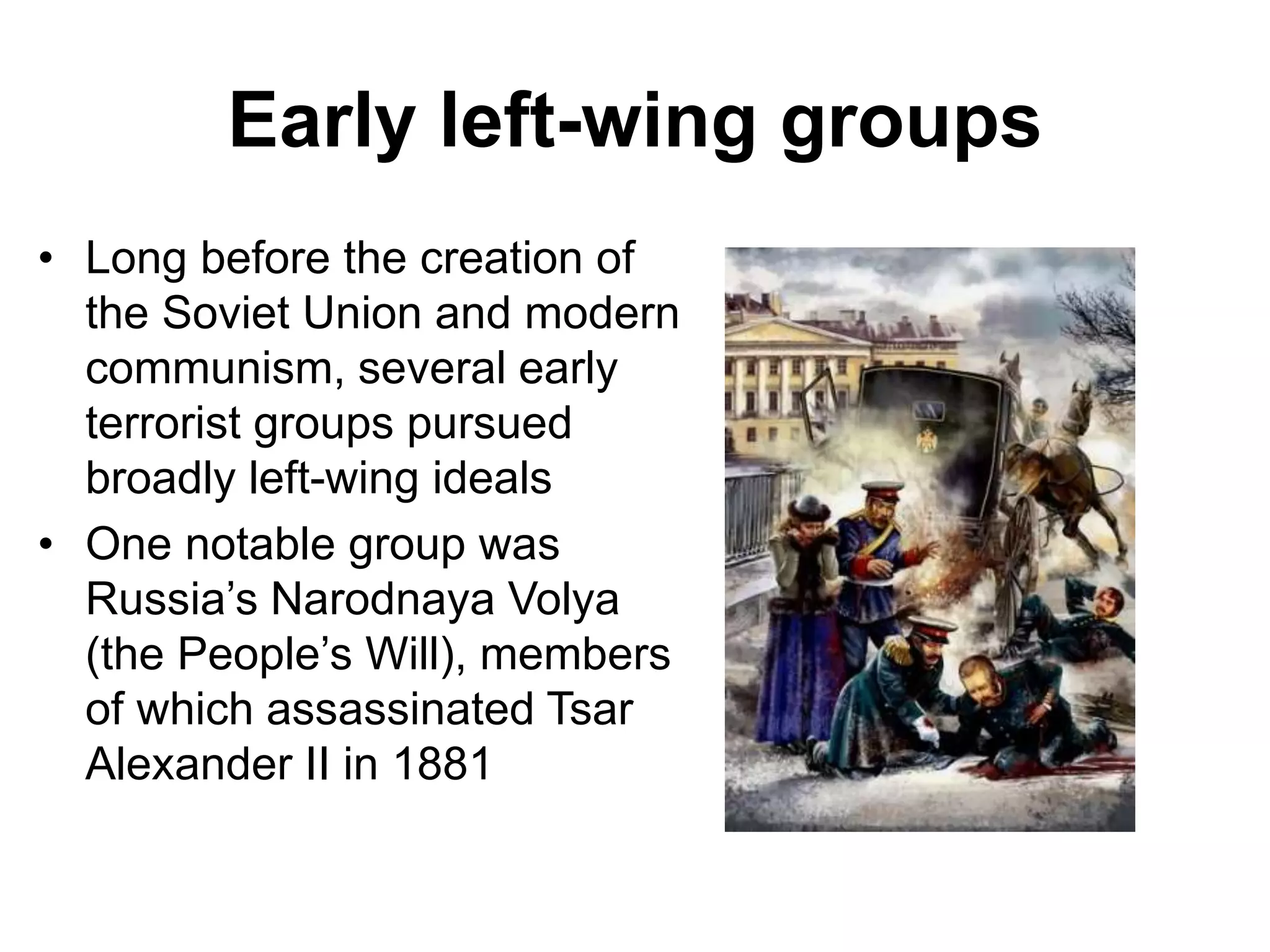
• One notable group was
Russia’s Narodnaya Volya
(the People’s Will), members
of which assassinated Tsar
Alexander II in 1881
Right-wing terrorism
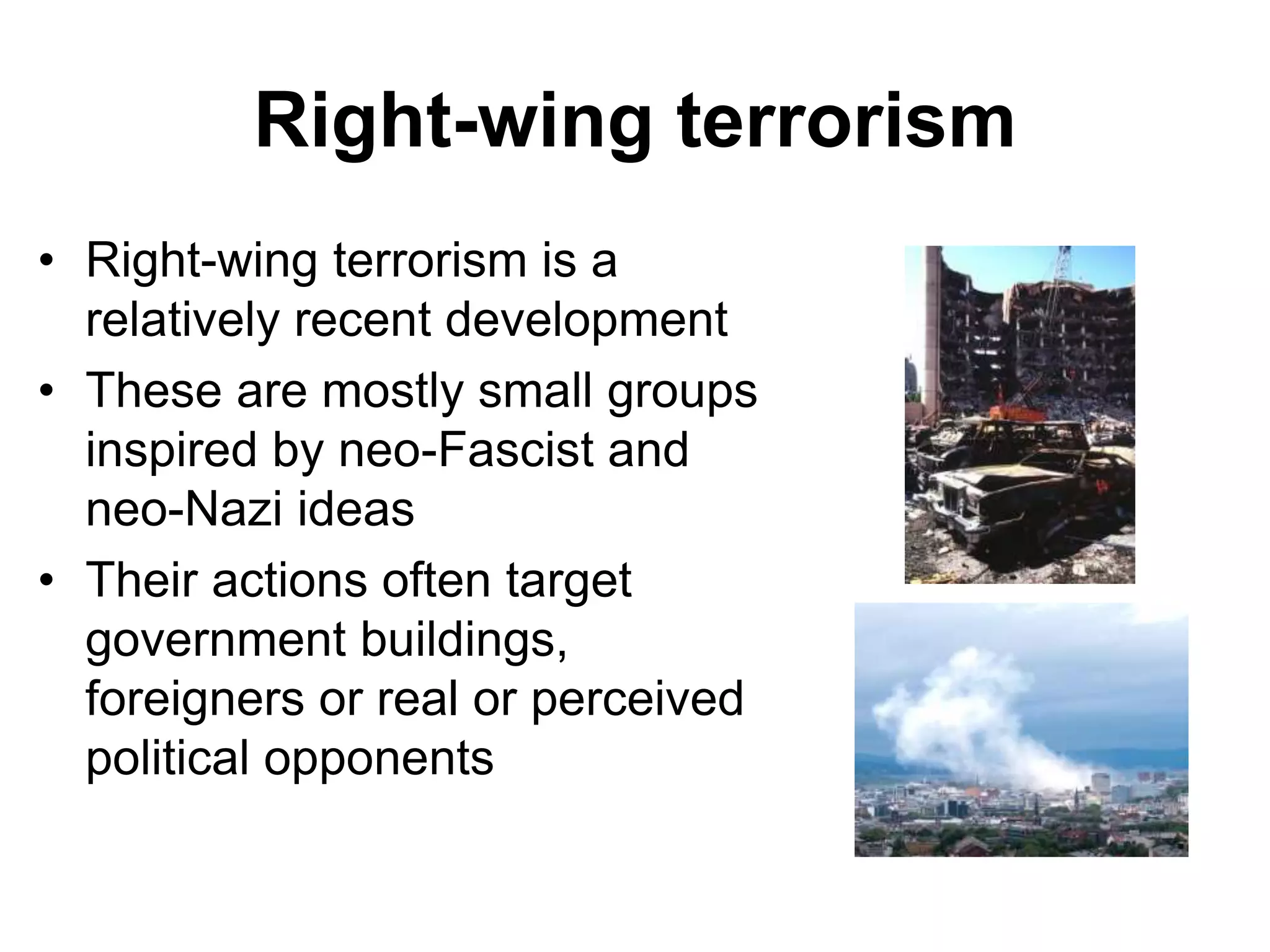
• Right-wing terrorism is a
relatively recent development
• These are mostly small groups
inspired by neo-Fascist and
neo-Nazi ideas
• Their actions often target
government buildings,
foreigners or real or perceived
political opponents
Ethno-nationalists
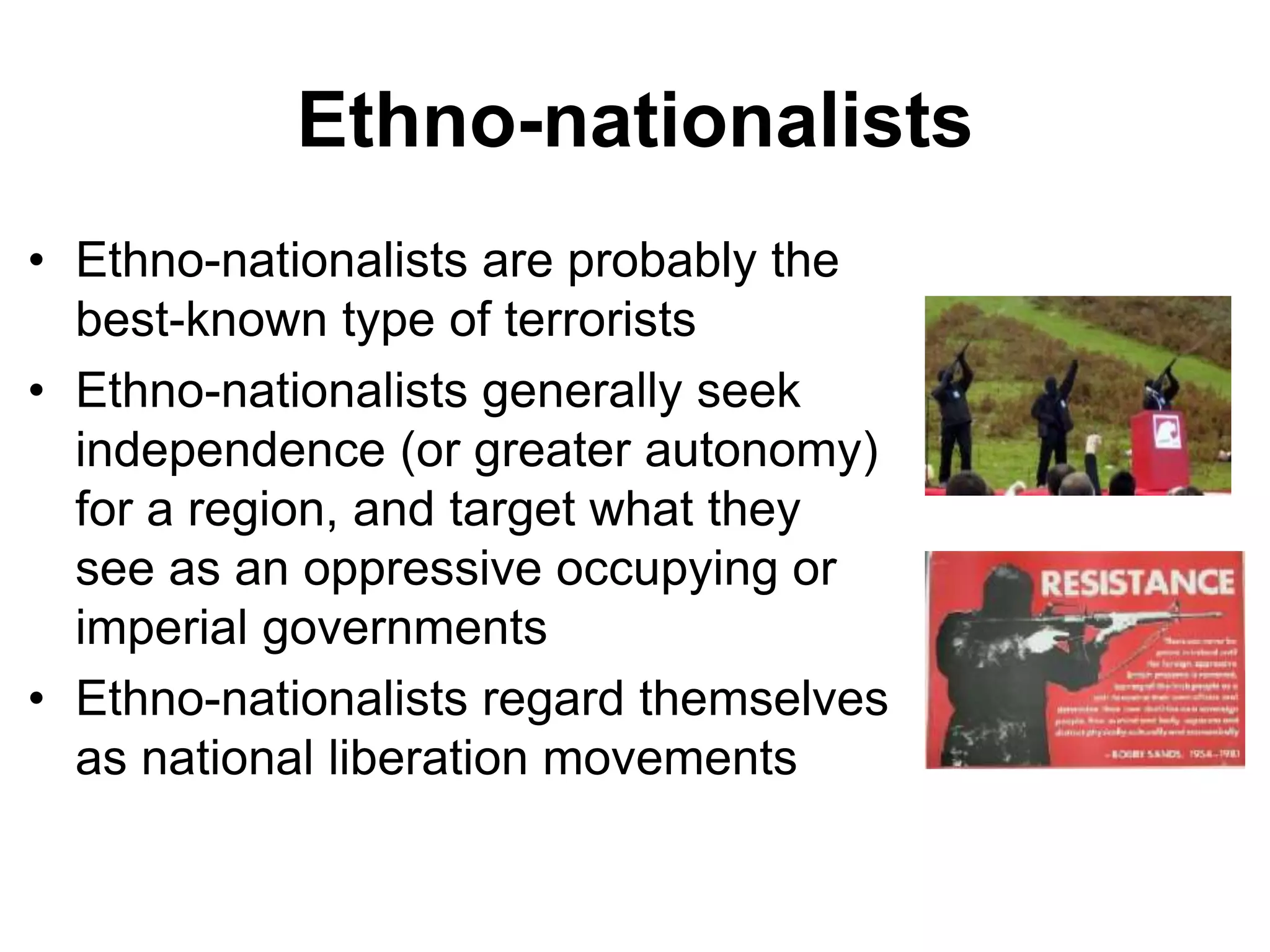
• Ethno-nationalists are probably the
best-known type of terrorists
• Ethno-nationalists generally seek
independence (or greater autonomy)
for a region, and target what they
see as an oppressive occupying or
imperial governments
• Ethno-nationalists regard themselves
as national liberation movements
Early ethno-nationalist groups
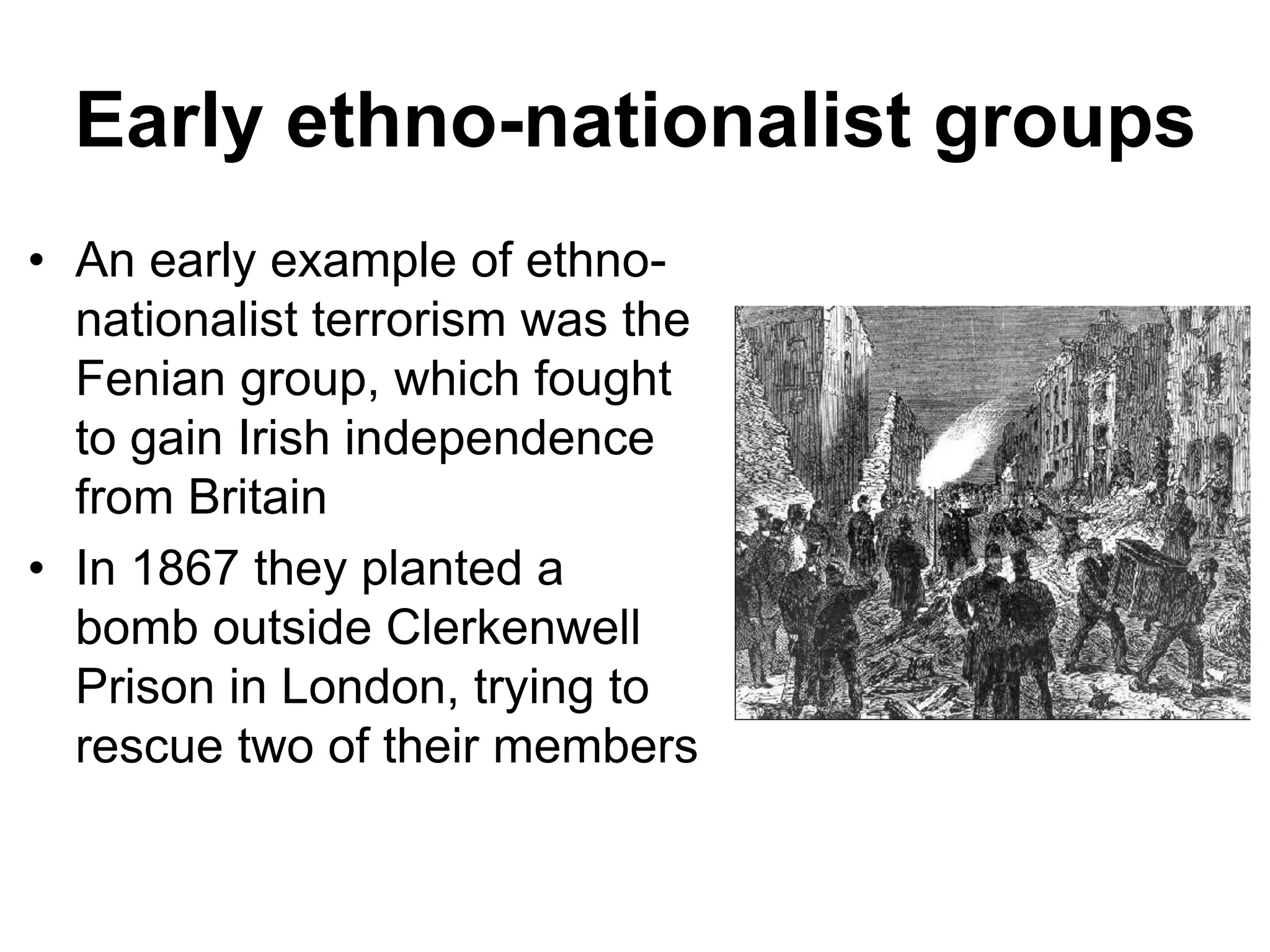
• An early example of ethno-
nationalist terrorism was the
Fenian group, which fought
to gain Irish independence
from Britain
• In 1867 they planted a
bomb outside Clerkenwell
Prison in London, trying to
rescue two of their members
Later ethno-nationalist groups
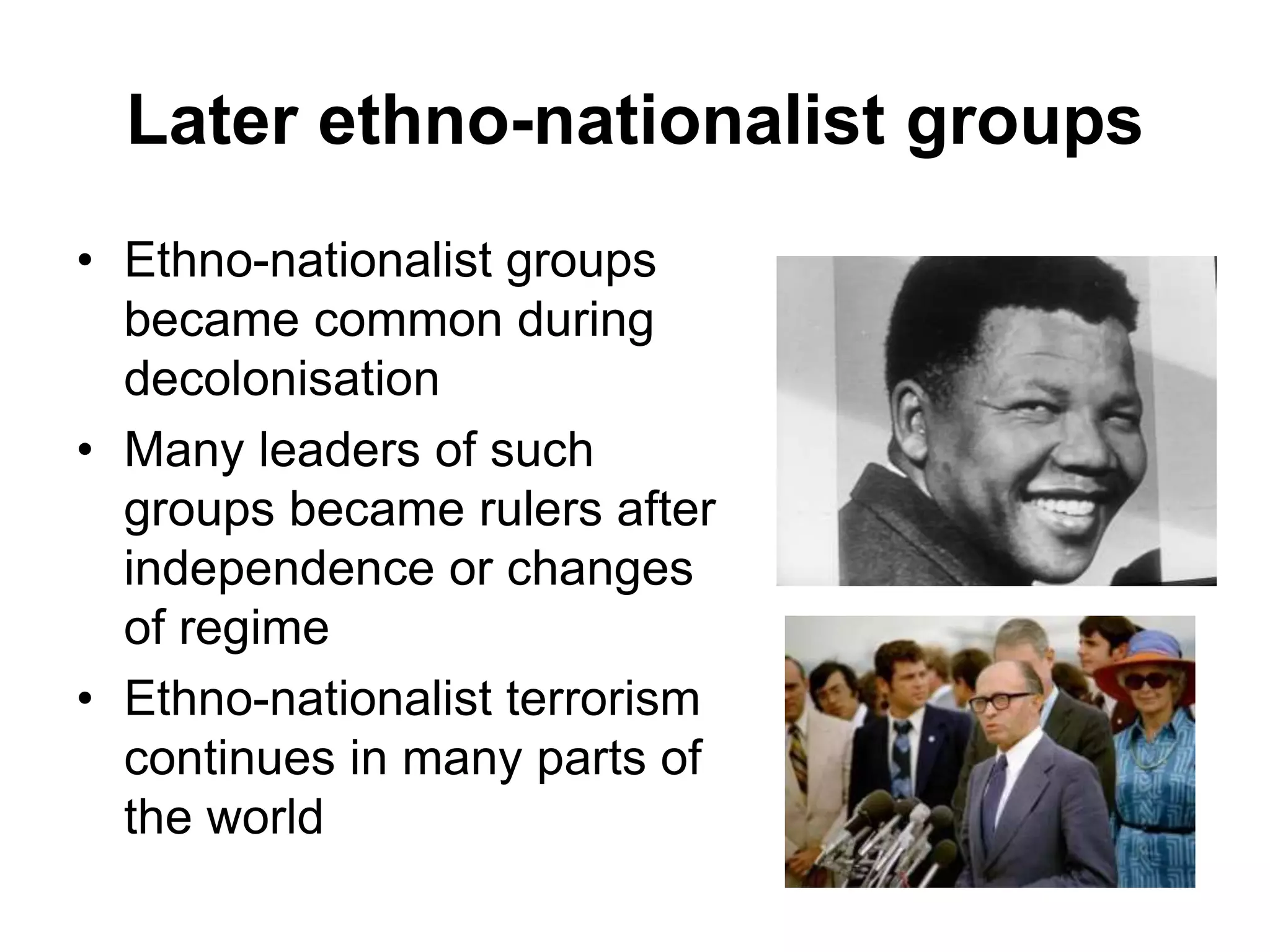
• Ethno-nationalist groups
became common during
decolonisation
• Many leaders of such
groups became rulers after
independence or changes
of regime
• Ethno-nationalist terrorism
continues in many parts of
the world
Religious or ‘sacred’ terrorism
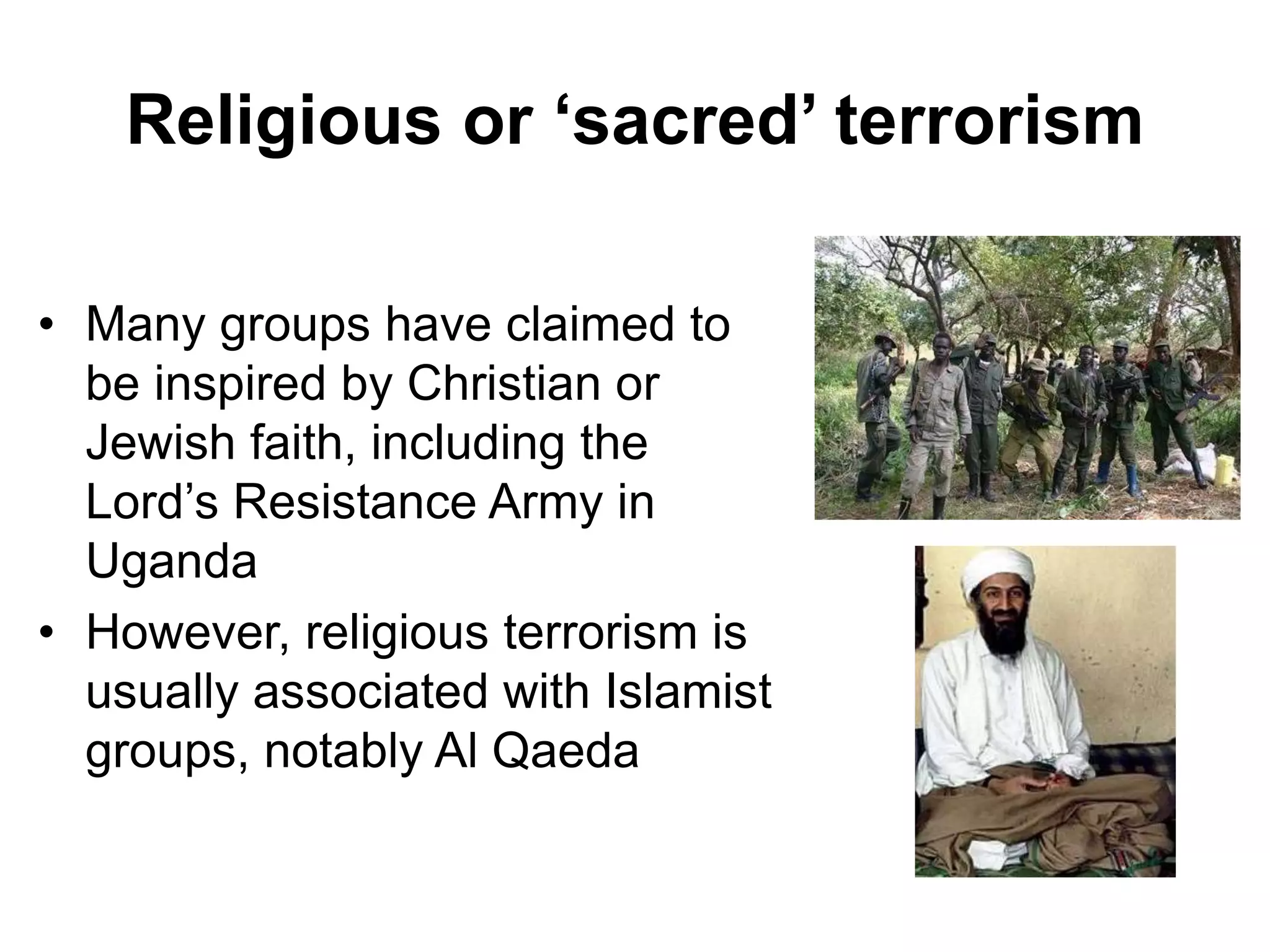
• Many groups have claimed to
be inspired by Christian or
Jewish faith, including the
Lord’s Resistance Army in
Uganda
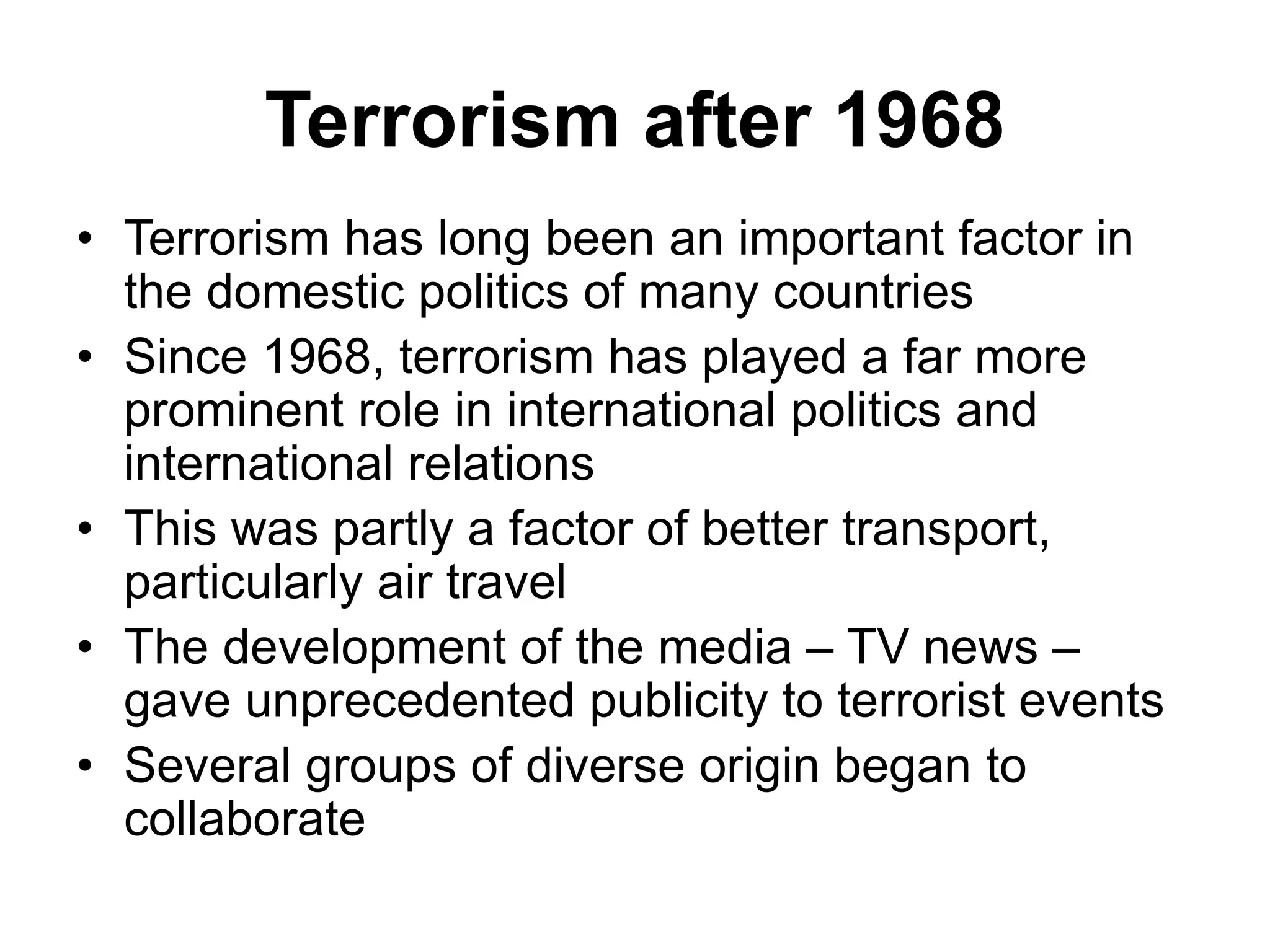
• However, religious terrorism is
usually associated with Islamist
groups, notably Al Qaeda
Terrorism after 1968
• Terrorism has long been an important factor in
the domestic politics of many countries
• Since 1968, terrorism has played a far more
prominent role in international politics and
international relations
• This was partly a factor of better transport,
particularly air travel
• The development of the media – TV news –
gave unprecedented publicity to terrorist events
• Several groups of diverse origin began to
collaborate
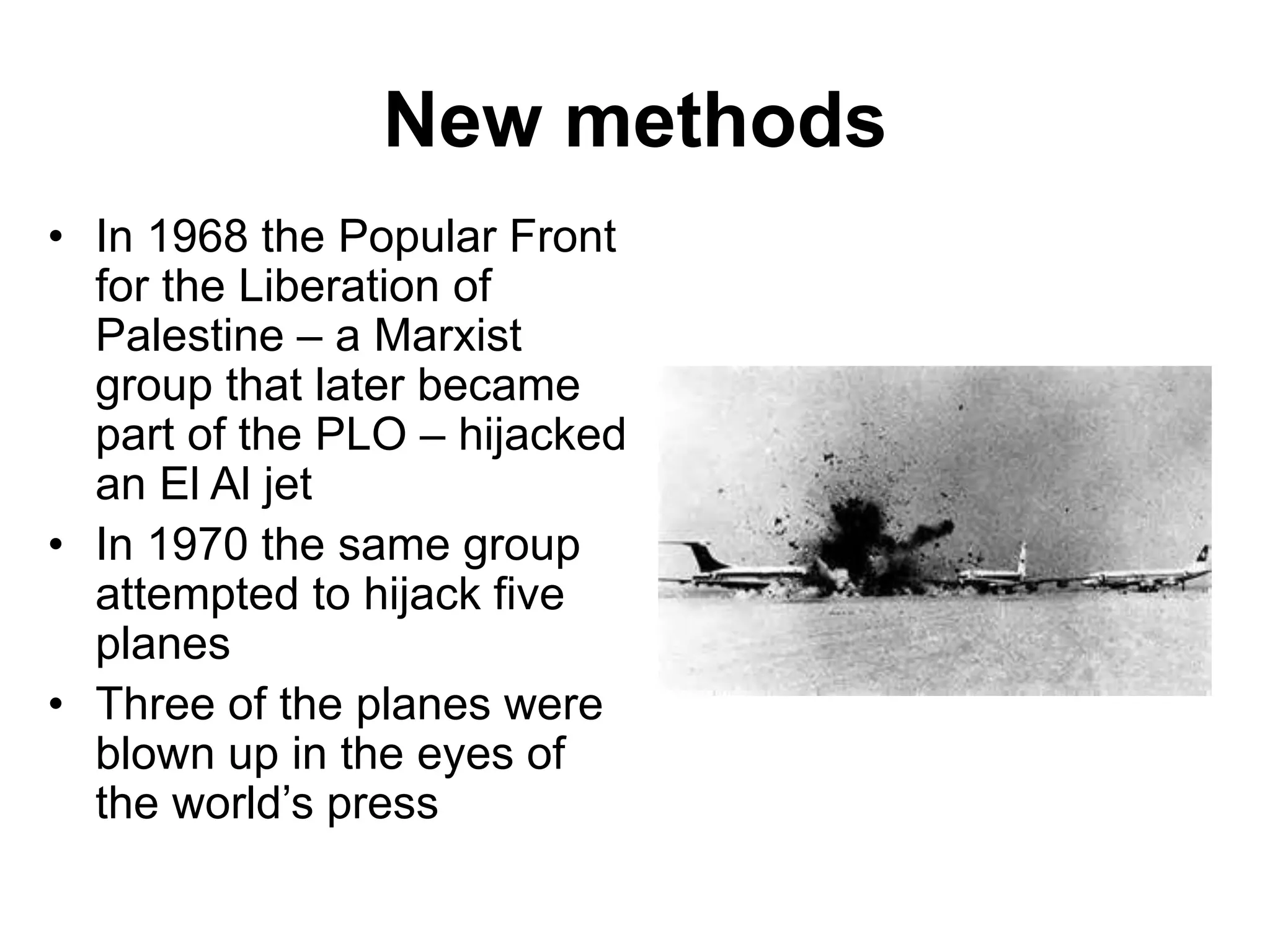
New methods
• In 1968 the Popular Front
for the Liberation of
Palestine – a Marxist
group that later became
part of the PLO – hijacked
an El Al jet
• In 1970 the same group
attempted to hijack five
planes
• Three of the planes were
blown up in the eyes of
the world’s press
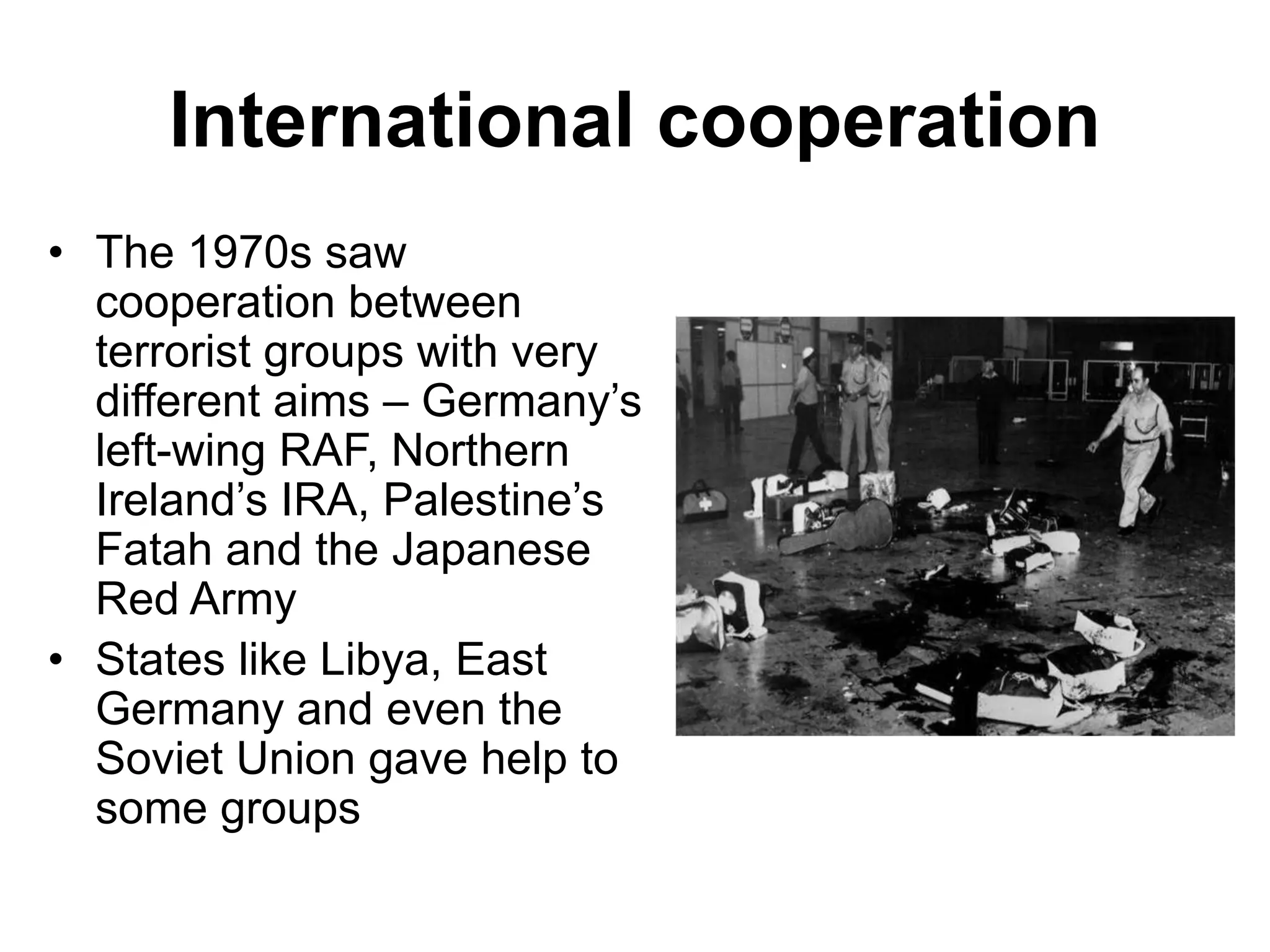
International cooperation
• The 1970s saw
cooperation between
terrorist groups with very
different aims – Germany’s
left-wing RAF, Northern
Ireland’s IRA, Palestine’s
Fatah and the Japanese
Red Army
• States like Libya, East
Germany and even the
Soviet Union gave help to
some groups
Terrorism and globalisation
• The changes associated with globalisation – the
growing interconnectedness of the world – have
created new opportunities for terrorist groups
• Better transport means increased mobility
• The Internet and mobile phone technologies
allow better communication, organisation and
publicity
• They also make it possible to coordinate attacks
from anywhere in the world
The rise of Al Qaeda
• What is new about Al Qaeda?
• It represents the newest form of terrorism, the
so-called ‘sacred’ terrorism
• Motivated by its own interpretation of Islam, it
promises its operatives rewards in the afterlife
• It works as a brand, rather than as a tightly
structured organisation
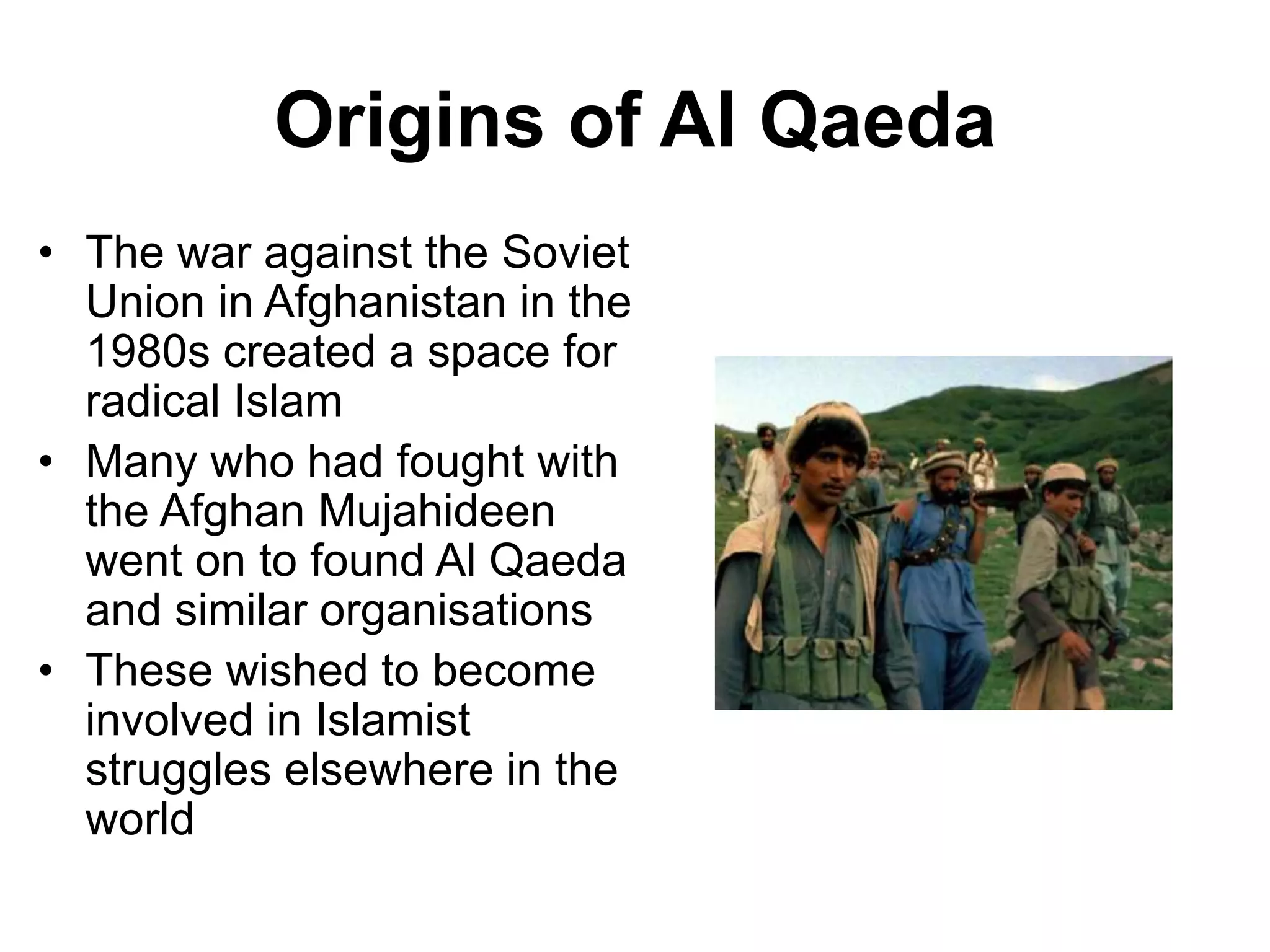
Origins of Al Qaeda
• The war against the Soviet
Union in Afghanistan in the
1980s created a space for
radical Islam
• Many who had fought with
the Afghan Mujahideen
went on to found Al Qaeda
and similar organisations
• These wished to become
involved in Islamist
struggles elsewhere in the
world
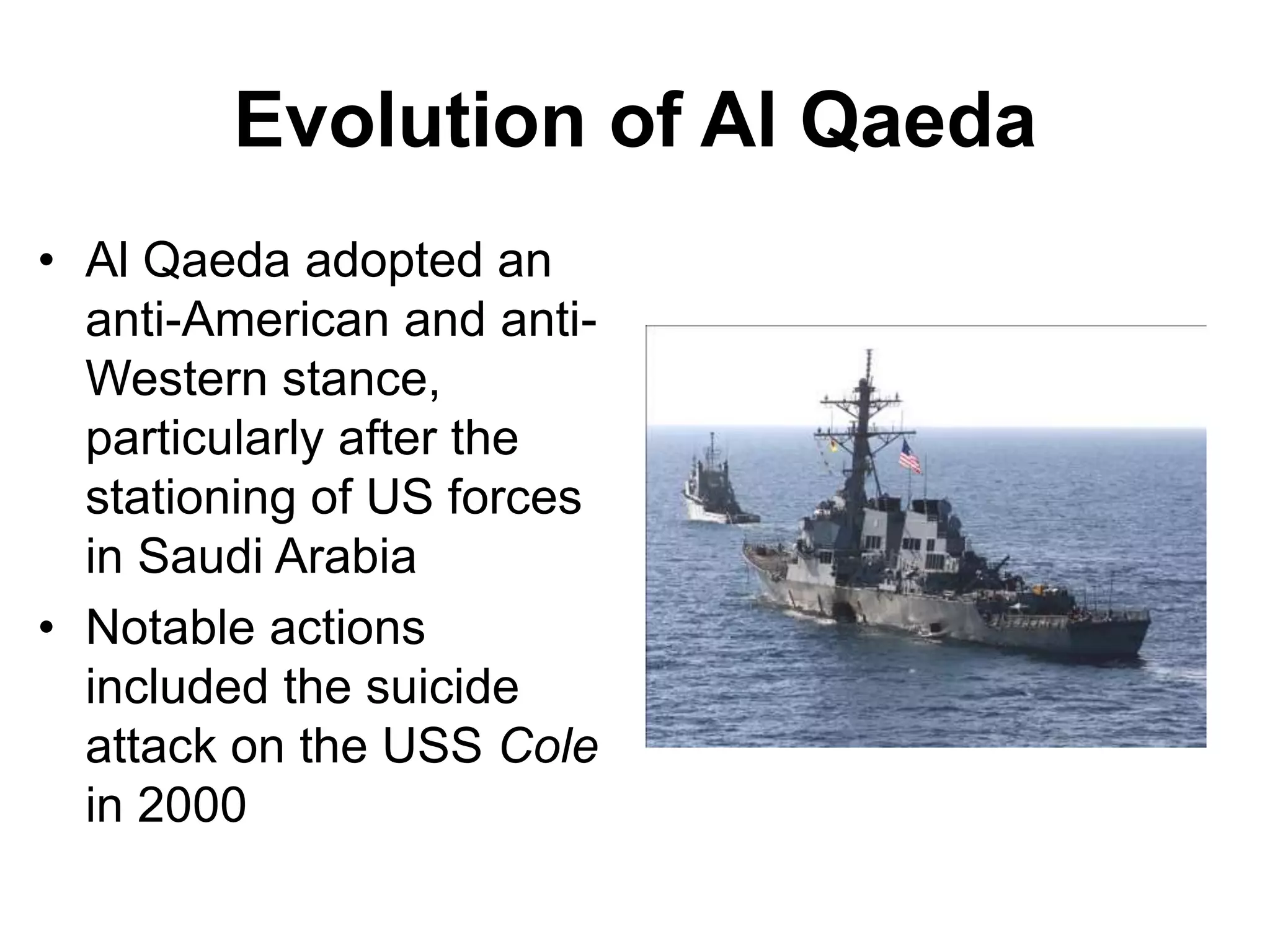
Evolution of Al Qaeda
• Al Qaeda adopted an
anti-American and anti-
Western stance,
particularly after the
stationing of US forces
in Saudi Arabia
• Notable actions
included the suicide
attack on the USS Cole
in 2000
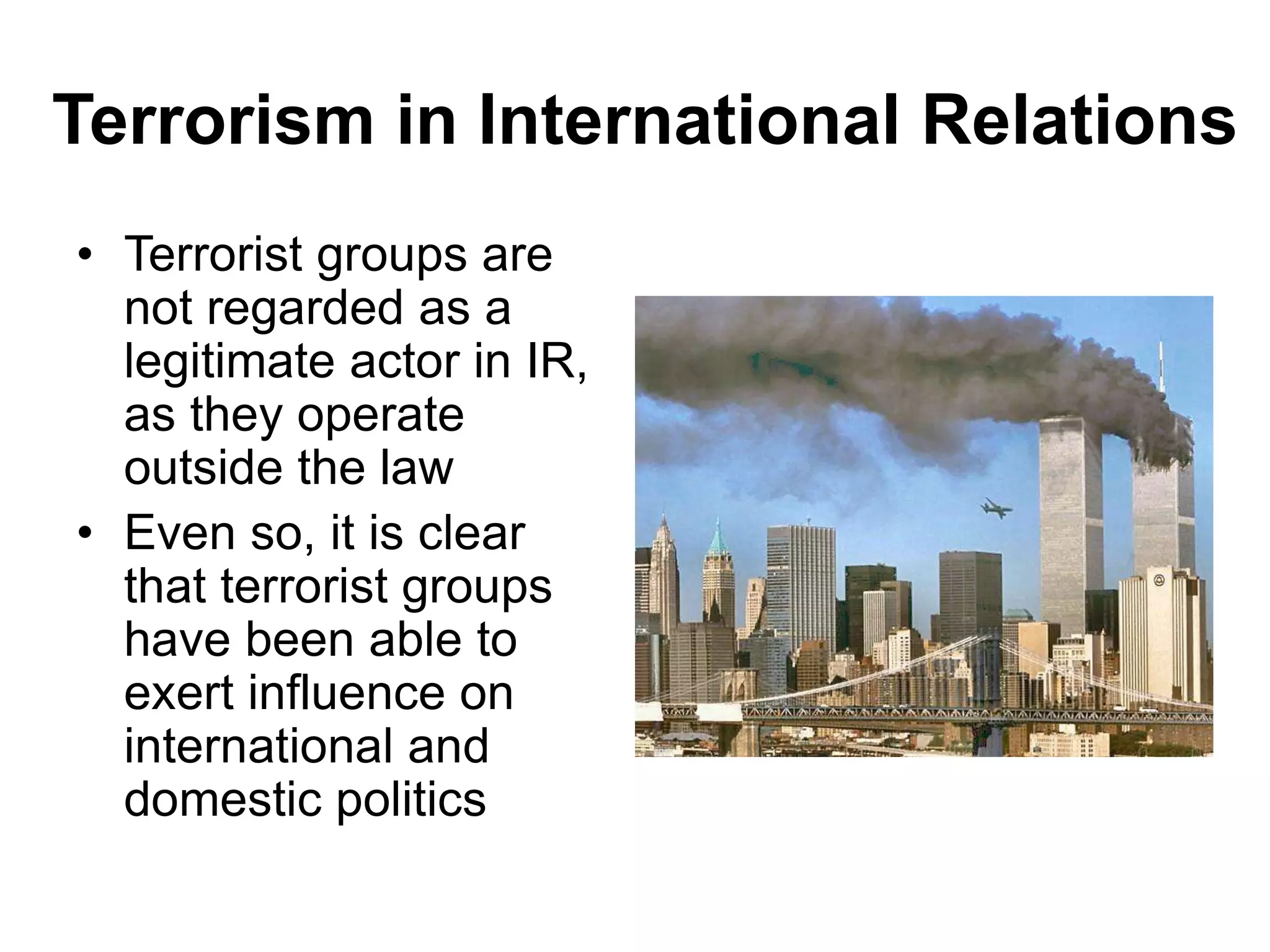
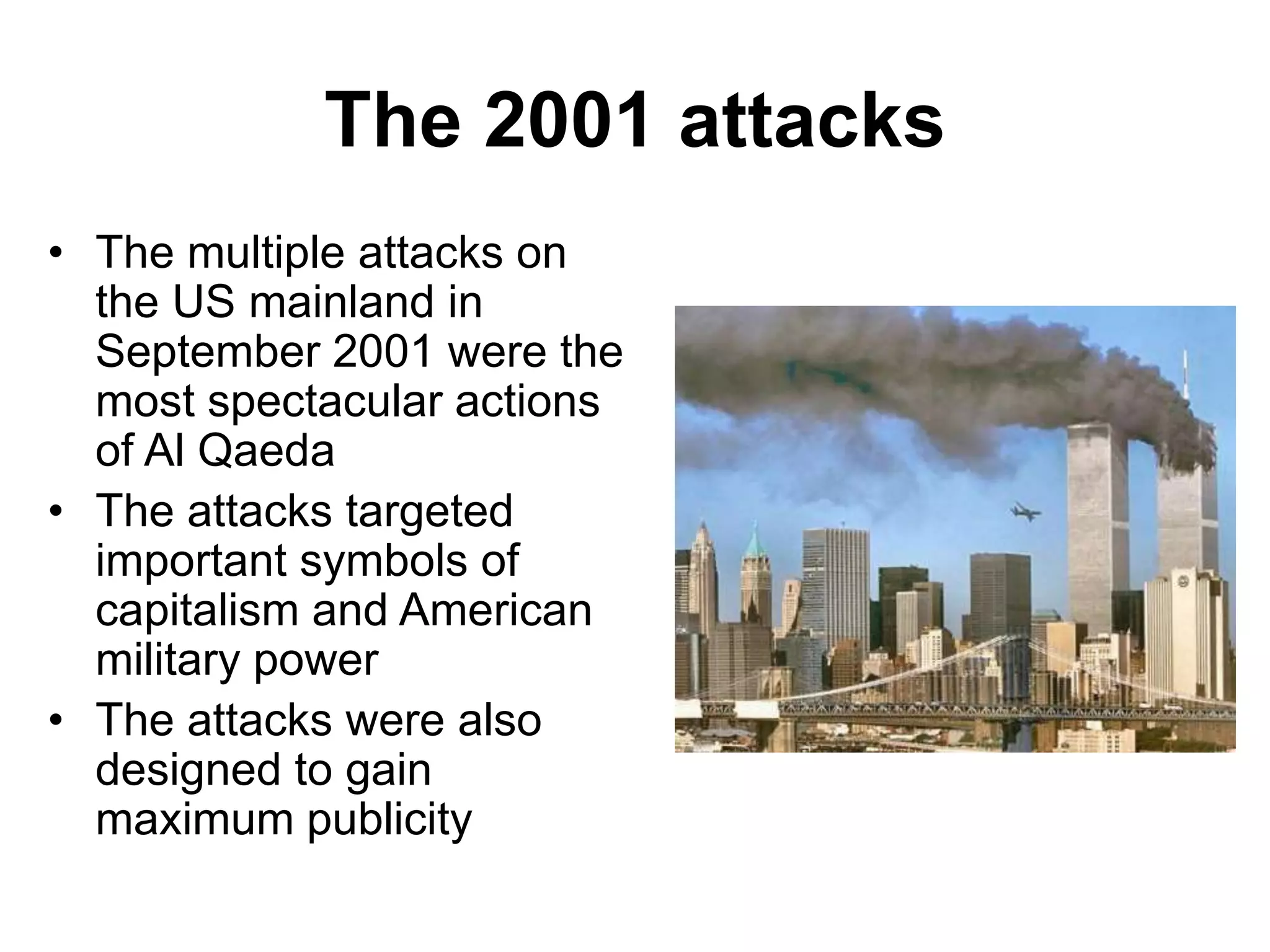
The 2001 attacks
• The multiple attacks on
the US mainland in
September 2001 were the
most spectacular actions
of Al Qaeda
• The attacks targeted
important symbols of
capitalism and American
military power
• The attacks were also
designed to gain
maximum publicity
What has terrorism achieved?
• Most terrorist groups have
achieved very little
• It is very difficult to undermine
state power, unless there is strong
popular support for the cause (not
necessarily the methods)
• Some former terrorists entered the
political process and achieved all
or some of their aims, usually
national independence or
autonomy
• These groups (Sinn Féin, the
PLO) usually had concrete aims
that could be negotiated
• Most left- and right-wing groups
achieved nothing
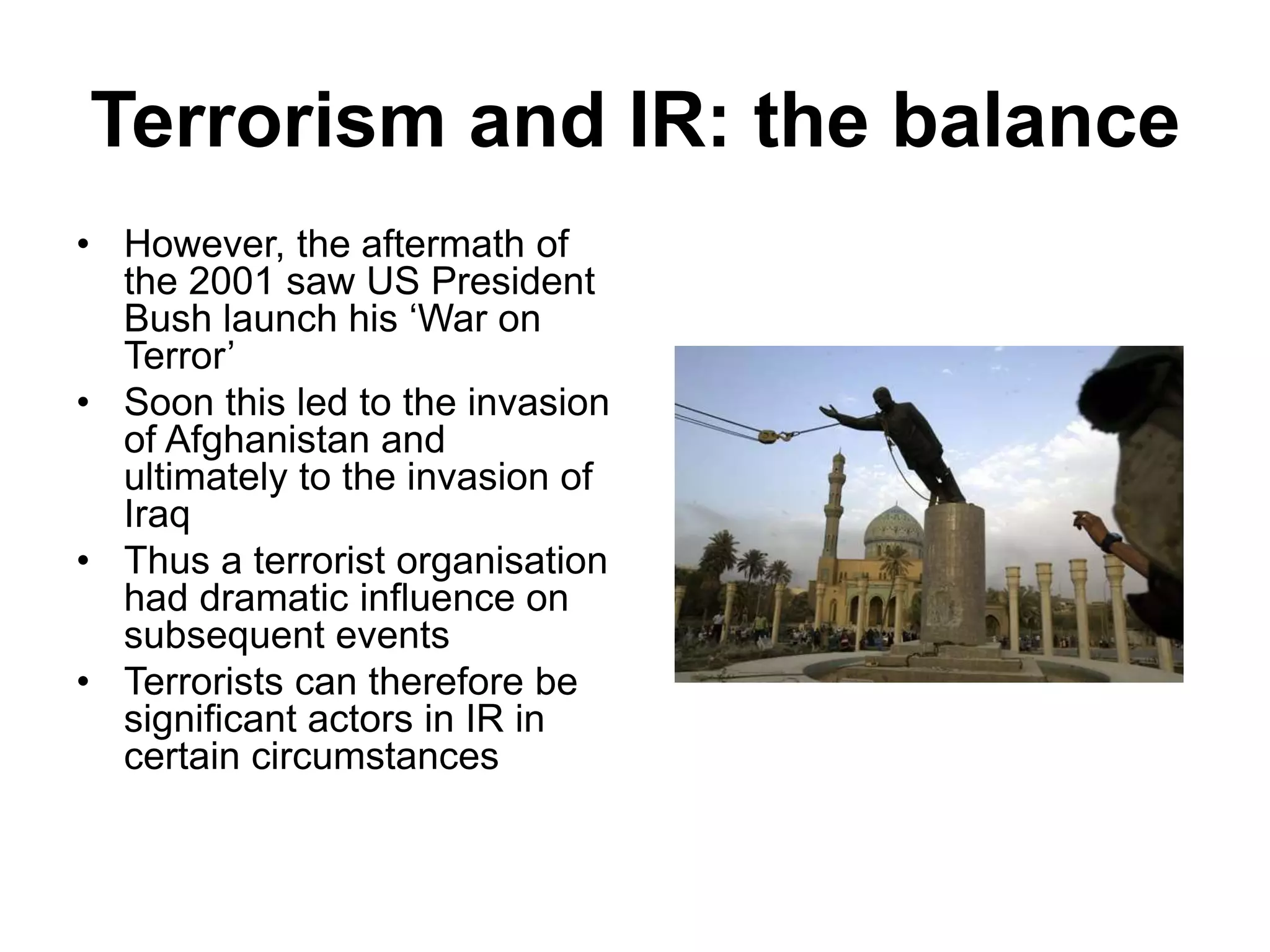
Terrorism and IR: the balance
• However, the aftermath of
the 2001 saw US President
Bush launch his ‘War on
Terror’
• Soon this led to the invasion
of Afghanistan and
ultimately to the invasion of
Iraq
• Thus a terrorist organisation
had dramatic influence on
subsequent events
• Terrorists can therefore be
significant actors in IR in
certain circumstances

10 terrorism

  • 1.
  • 2.
    What is terrorism? •Terrorism is a controversial term • All definitions agree that terrorism involves acts of violence • Terrorism differs from criminal violence because it aims to achieve political change • Terrorists claim to fight for a just cause, but opponents of that cause regard them as ordinary criminals • Whether we describe something as terrorism depends on our view of the legitimacy of the cause
  • 3.
    Who is aterrorist? • States reserve for themselves the power to define who is a terrorist • In the 1980s, the USA regarded the Afghan Mujahideen as ‘freedom fighters’ when they resisted the Soviet invasion • Two decades later, the USA accused a new generation of Afghans of being terrorists for resisting western invasion
  • 4.
    State violence: the firstterrorists • The first use of the term came after the French Revolution, when the new government used terror against its own citizens • Thousands of real and imagined enemies of the Revolution were executed • The terror backfired, and the leaders followed their victims to the guillotine
  • 5.
    Is state violenceterrorism? • State violence is not normally regarded as terrorism now • In Realist IR theory, states have a monopoly on the use of force • Thus only sub-state groups are regarded as terrorists • These groups and their supporters would not accept that distinction
  • 6.
    State-sponsored terrorism • Onefactor not covered by the Realist concept of state force is state support for terrorist groups in other countries • Libya under Gaddafi sponsored several groups carrying out what he called ‘revolutionary violence’
  • 7.
    Terrorism in InternationalRelations • Terrorist groups are not regarded as a legitimate actor in IR, as they operate outside the law • Even so, it is clear that terrorist groups have been able to exert influence on international and domestic politics
  • 8.
    Terrorism as astruggle • Terrorism is the weakest form of armed struggle • Terrorist groups lack the means to engage in direct confrontation with governments • Terrorists therefore pick soft or limited targets • Most terrorist groups enjoy limited popular support – they are too radical • Terrorists usually seek to provoke a disproportionate response from governments • This strategy can be counterproductive, as terrorists can lose support
  • 9.
    Types of terrorism •In terms of political aims, terrorist groups can be conveniently divided into four types: • a) left-wing • b) right-wing • c) ethno-nationalist or separatist • d) religious or ‘sacred’ • These distinctions can overlap – some ethno- nationalist groups could be Marxist or inspired by Marxist ideas
  • 10.
    Left-wing terrorism • Left-winggroups generally wish to achieve overthrow capitalist governments and establish societies run according to Marxist or quasi-Marxist principles • Most of these groups were formed in the 1960s • They were inspired by the actions of earlier anarchist groups
  • 11.
    Early left-wing groups •Long before the creation of the Soviet Union and modern communism, several early terrorist groups pursued broadly left-wing ideals • One notable group was Russia’s Narodnaya Volya (the People’s Will), members of which assassinated Tsar Alexander II in 1881
  • 12.
    Right-wing terrorism • Right-wingterrorism is a relatively recent development • These are mostly small groups inspired by neo-Fascist and neo-Nazi ideas • Their actions often target government buildings, foreigners or real or perceived political opponents
  • 13.
    Ethno-nationalists • Ethno-nationalists areprobably the best-known type of terrorists • Ethno-nationalists generally seek independence (or greater autonomy) for a region, and target what they see as an oppressive occupying or imperial governments • Ethno-nationalists regard themselves as national liberation movements
  • 14.
    Early ethno-nationalist groups •An early example of ethno- nationalist terrorism was the Fenian group, which fought to gain Irish independence from Britain • In 1867 they planted a bomb outside Clerkenwell Prison in London, trying to rescue two of their members
  • 15.
    Later ethno-nationalist groups •Ethno-nationalist groups became common during decolonisation • Many leaders of such groups became rulers after independence or changes of regime • Ethno-nationalist terrorism continues in many parts of the world
  • 16.
    Religious or ‘sacred’terrorism • Many groups have claimed to be inspired by Christian or Jewish faith, including the Lord’s Resistance Army in Uganda • However, religious terrorism is usually associated with Islamist groups, notably Al Qaeda
  • 17.
    Terrorism after 1968 •Terrorism has long been an important factor in the domestic politics of many countries • Since 1968, terrorism has played a far more prominent role in international politics and international relations • This was partly a factor of better transport, particularly air travel • The development of the media – TV news – gave unprecedented publicity to terrorist events • Several groups of diverse origin began to collaborate
  • 18.
    New methods • In1968 the Popular Front for the Liberation of Palestine – a Marxist group that later became part of the PLO – hijacked an El Al jet • In 1970 the same group attempted to hijack five planes • Three of the planes were blown up in the eyes of the world’s press
  • 19.
    International cooperation • The1970s saw cooperation between terrorist groups with very different aims – Germany’s left-wing RAF, Northern Ireland’s IRA, Palestine’s Fatah and the Japanese Red Army • States like Libya, East Germany and even the Soviet Union gave help to some groups
  • 20.
    Terrorism and globalisation •The changes associated with globalisation – the growing interconnectedness of the world – have created new opportunities for terrorist groups • Better transport means increased mobility • The Internet and mobile phone technologies allow better communication, organisation and publicity • They also make it possible to coordinate attacks from anywhere in the world
  • 21.
    The rise ofAl Qaeda • What is new about Al Qaeda? • It represents the newest form of terrorism, the so-called ‘sacred’ terrorism • Motivated by its own interpretation of Islam, it promises its operatives rewards in the afterlife • It works as a brand, rather than as a tightly structured organisation
  • 22.
    Origins of AlQaeda • The war against the Soviet Union in Afghanistan in the 1980s created a space for radical Islam • Many who had fought with the Afghan Mujahideen went on to found Al Qaeda and similar organisations • These wished to become involved in Islamist struggles elsewhere in the world
  • 23.
    Evolution of AlQaeda • Al Qaeda adopted an anti-American and anti- Western stance, particularly after the stationing of US forces in Saudi Arabia • Notable actions included the suicide attack on the USS Cole in 2000
  • 24.
    The 2001 attacks •The multiple attacks on the US mainland in September 2001 were the most spectacular actions of Al Qaeda • The attacks targeted important symbols of capitalism and American military power • The attacks were also designed to gain maximum publicity
  • 25.
    What has terrorismachieved? • Most terrorist groups have achieved very little • It is very difficult to undermine state power, unless there is strong popular support for the cause (not necessarily the methods) • Some former terrorists entered the political process and achieved all or some of their aims, usually national independence or autonomy • These groups (Sinn Féin, the PLO) usually had concrete aims that could be negotiated • Most left- and right-wing groups achieved nothing
  • 26.
    Terrorism and IR:the balance • However, the aftermath of the 2001 saw US President Bush launch his ‘War on Terror’ • Soon this led to the invasion of Afghanistan and ultimately to the invasion of Iraq • Thus a terrorist organisation had dramatic influence on subsequent events • Terrorists can therefore be significant actors in IR in certain circumstances