aieEE–Past papersMATHEMATICS- UNSOLVED PAPER - 2004
SECTION – ASingle Correct Answer TypeThere are five parts in this question. Four choices are given for each part and one of them is correct.  Indicate  you choice of  the correct  answer for  each part in  your answer-book by  writing  the letter (a), (b), (c) or (d)  whichever  is appropriate
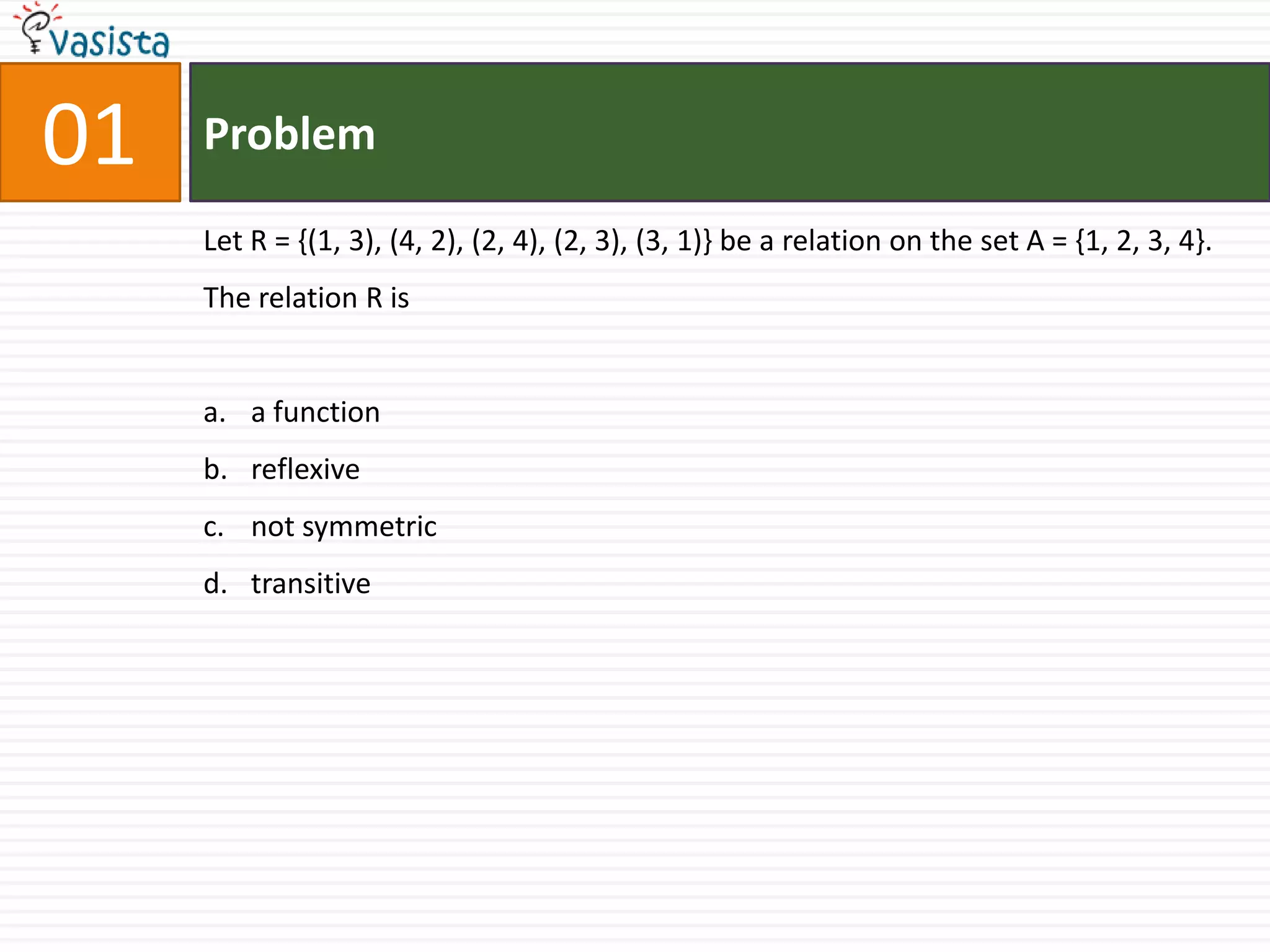
01ProblemLet R = {(1, 3), (4, 2), (2, 4), (2, 3), (3, 1)} be a relation on the set A = {1, 2, 3, 4}. The relation R isa functionreflexivenot symmetric transitive
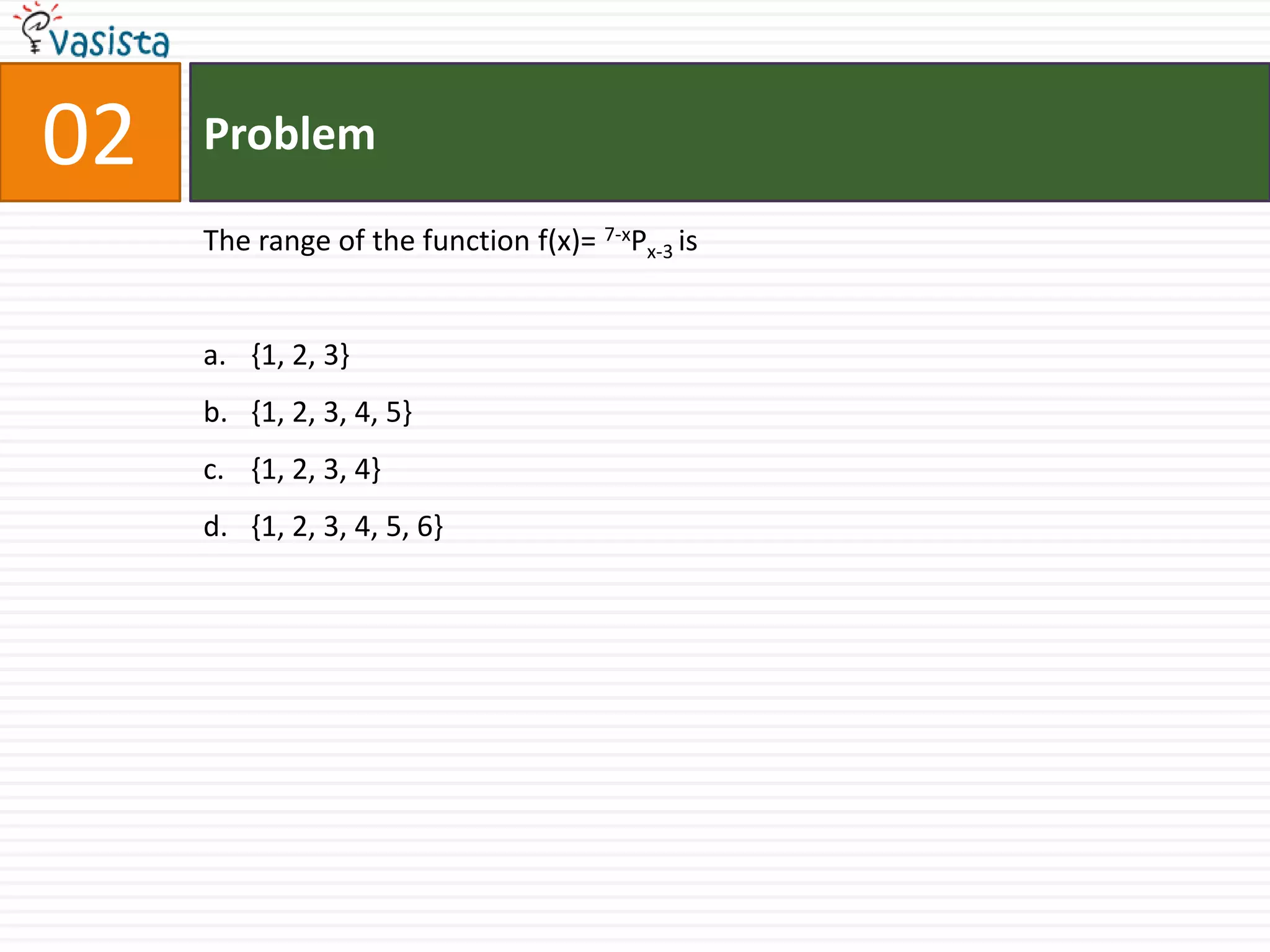
Problem02The range of the function f(x)= 7-xPx-3 is{1, 2, 3}{1, 2, 3, 4, 5}{1, 2, 3, 4} {1, 2, 3, 4, 5, 6}
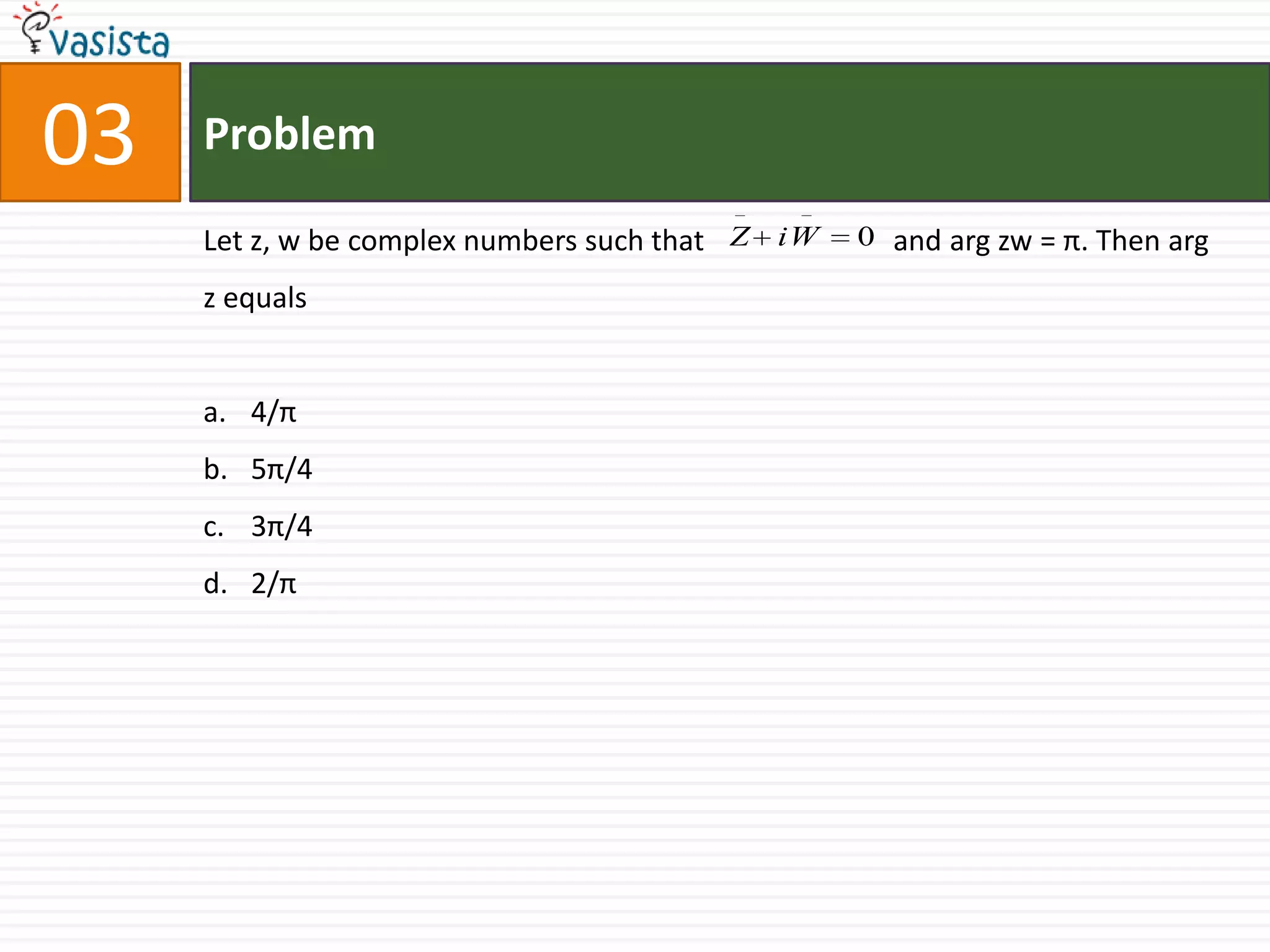
Problem03Let z, w be complex numbers such that                          and argzw = π. Then arg z equals4/π5π/43π/42/π
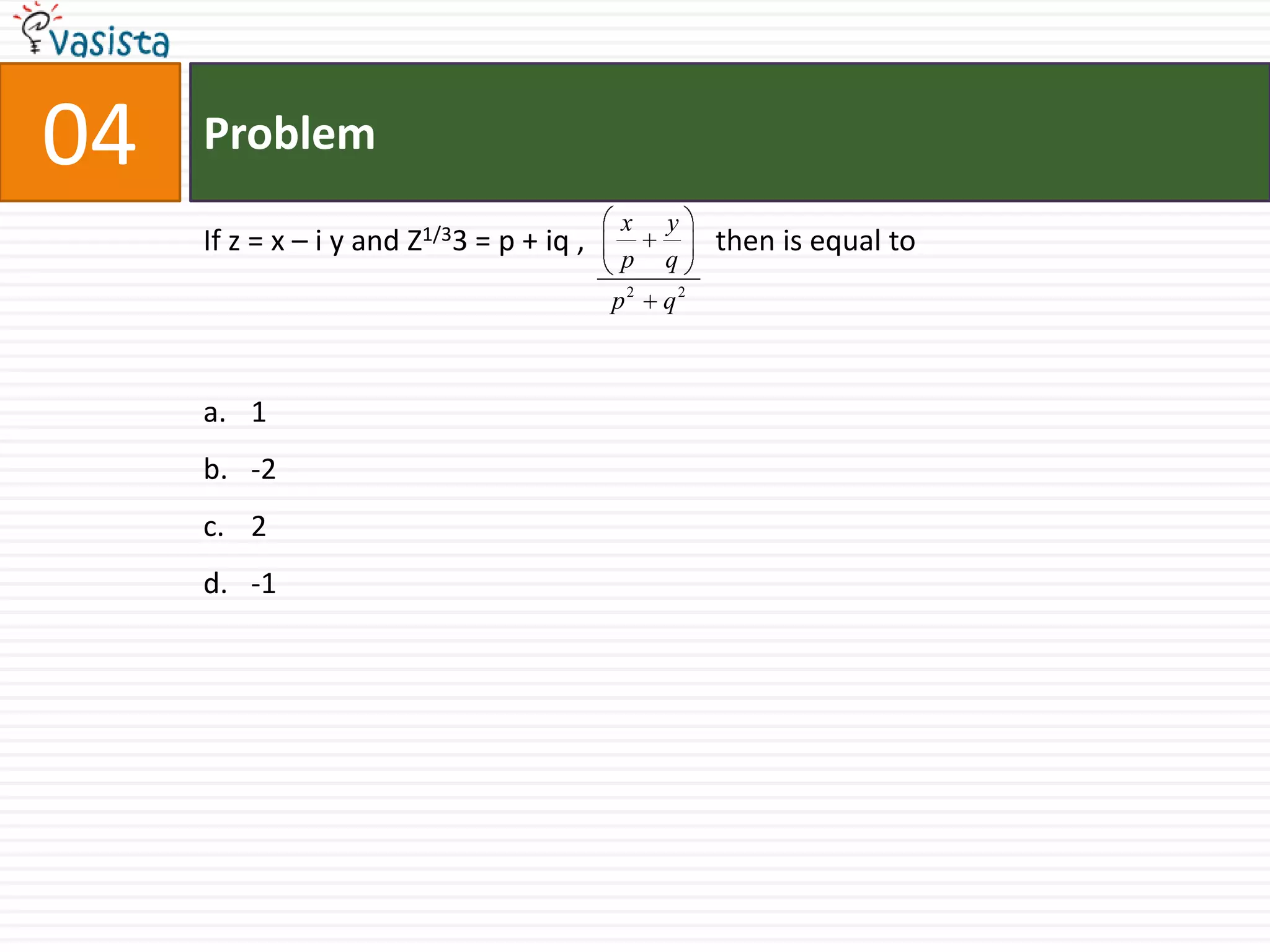
Problem04If z = x – i y and Z1/33 = p + iq ,                  then is equal to1-22 -1
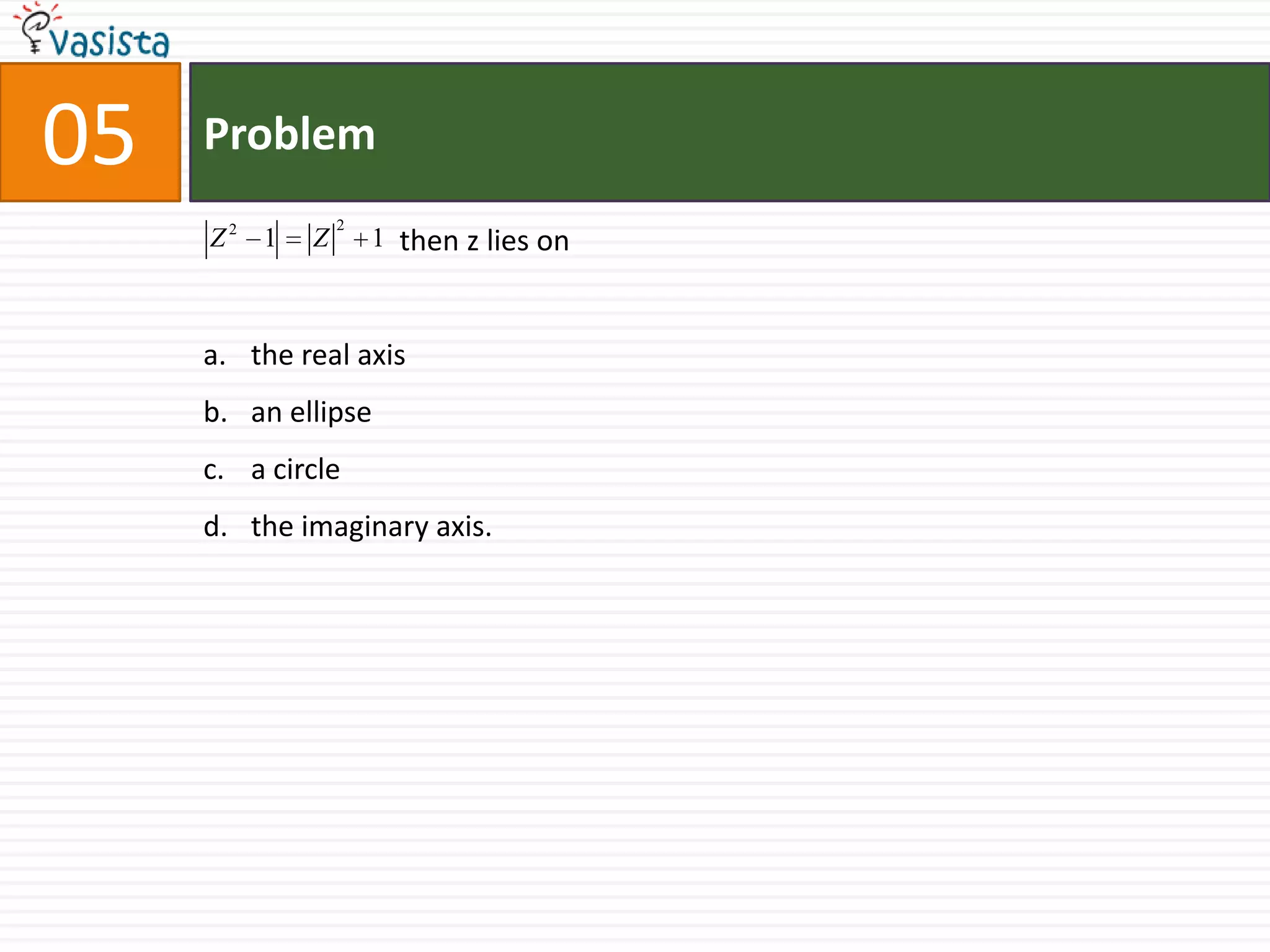
Problem05                           then z lies onthe real axisan ellipsea circle the imaginary axis.
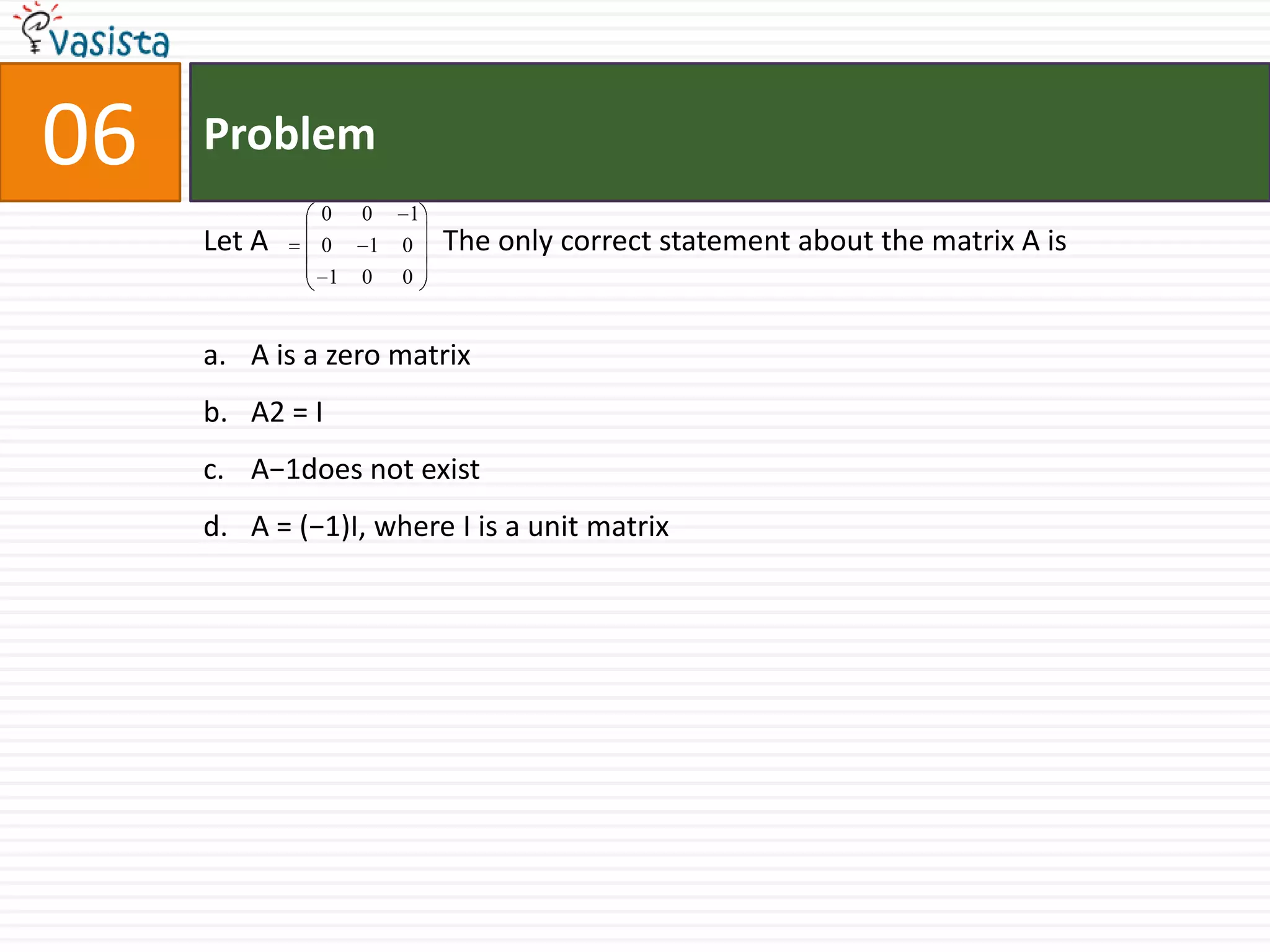
Problem06Let A                        The only correct statement about the matrix A isA is a zero matrix A2 = IA−1does not exist A = (−1)I, where I is a unit matrix
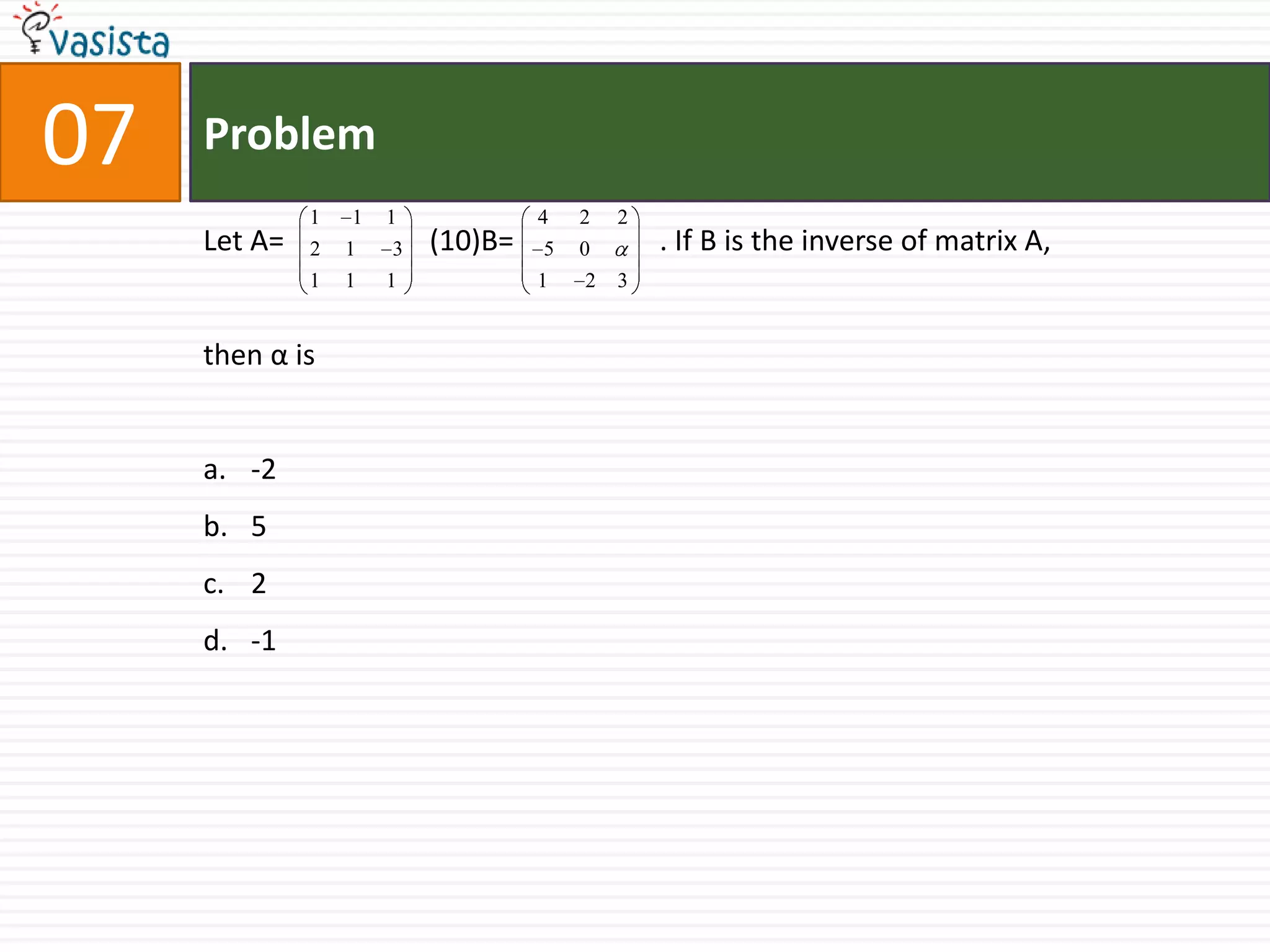
Problem07Let A=                    (10)B=                    . If B is the inverse of matrix A, then α is-2 52-1
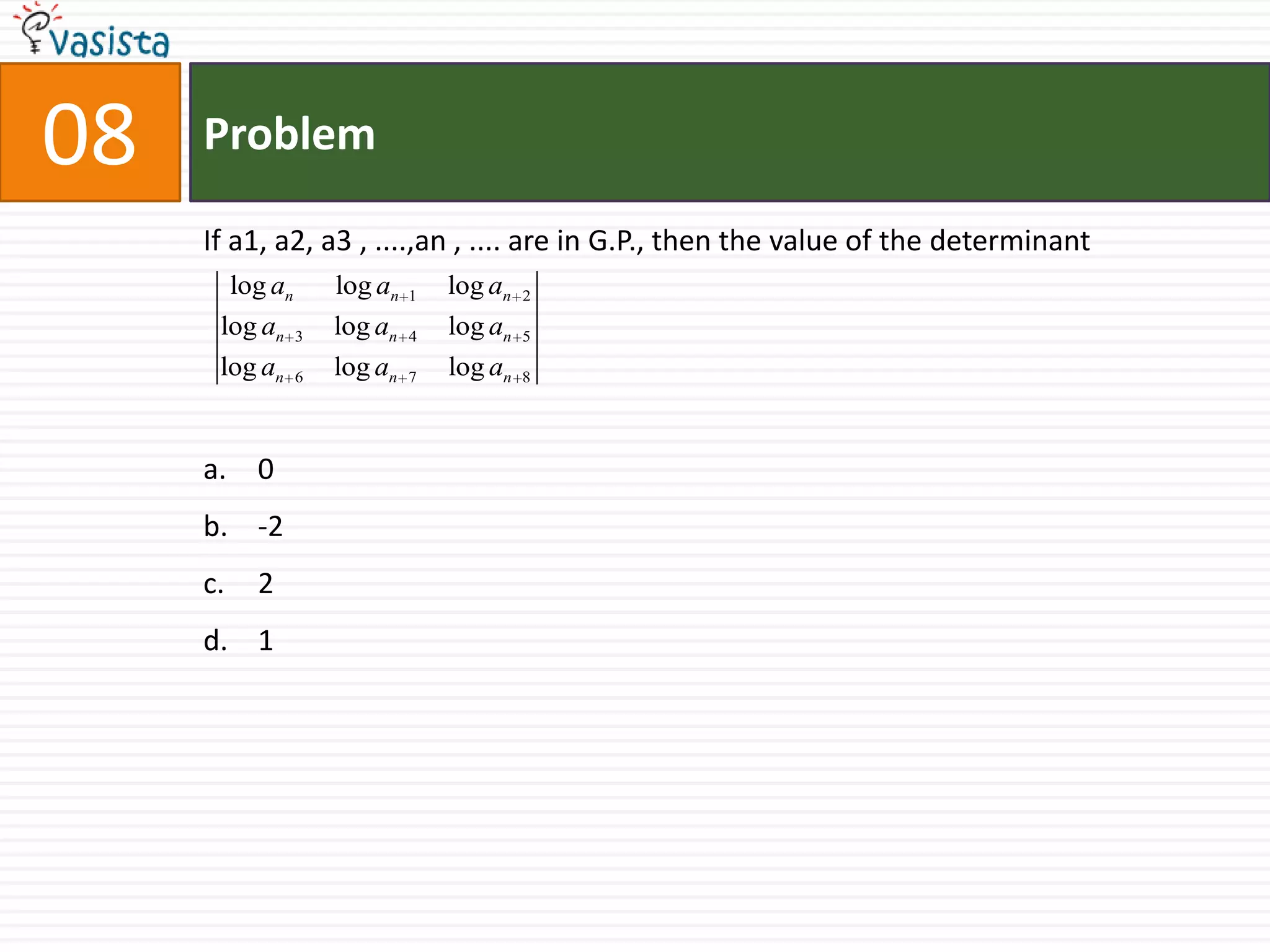
Problem08If a1, a2, a3 , ....,an , .... are in G.P., then the value of the determinant 0  -2 2  1
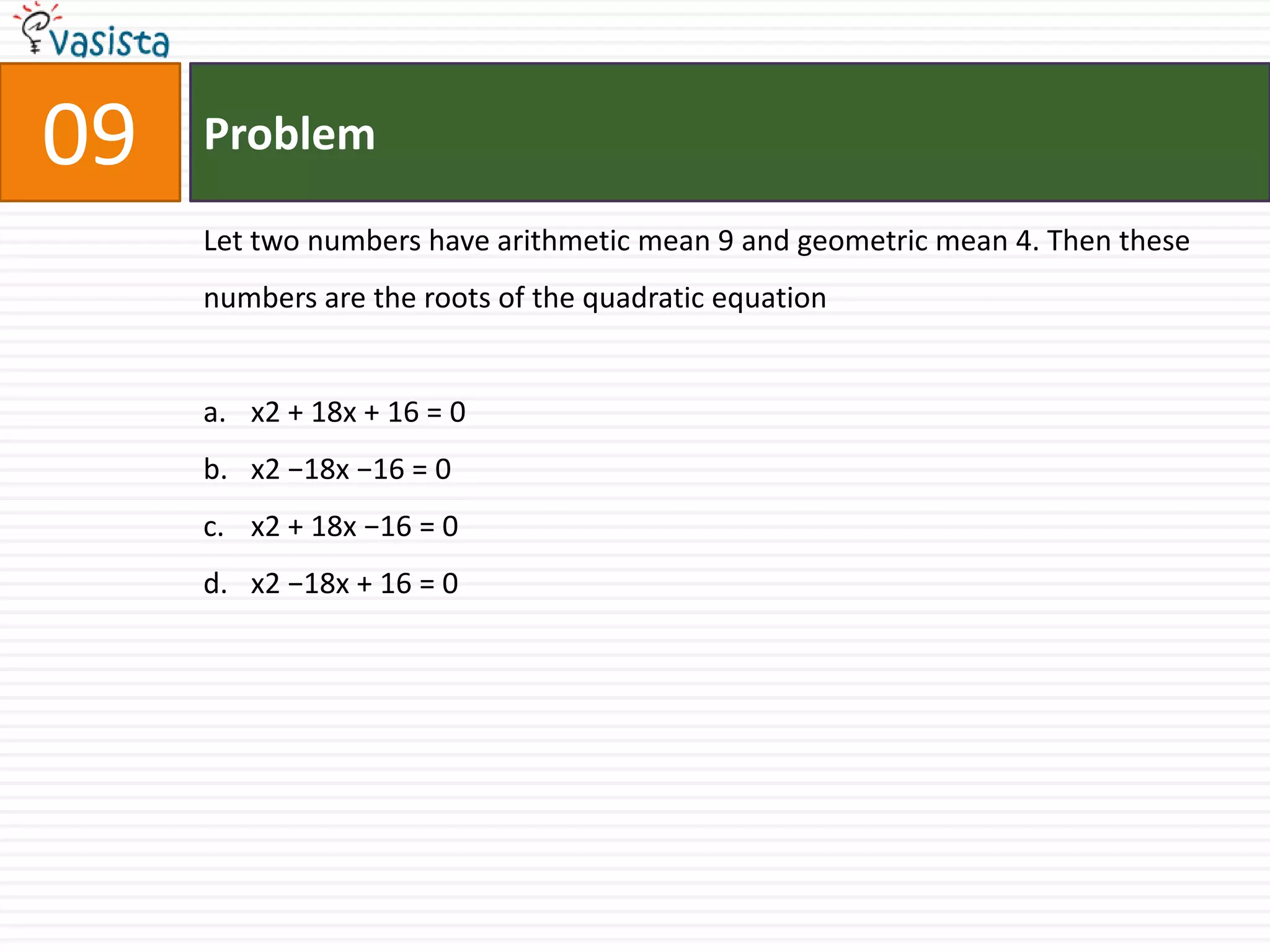
Problem09Let two numbers have arithmetic mean 9 and geometric mean 4. Then these numbers are the roots of the quadratic equationx2 + 18x + 16 = 0 x2 −18x −16 = 0x2 + 18x −16 = 0 x2 −18x + 16 = 0
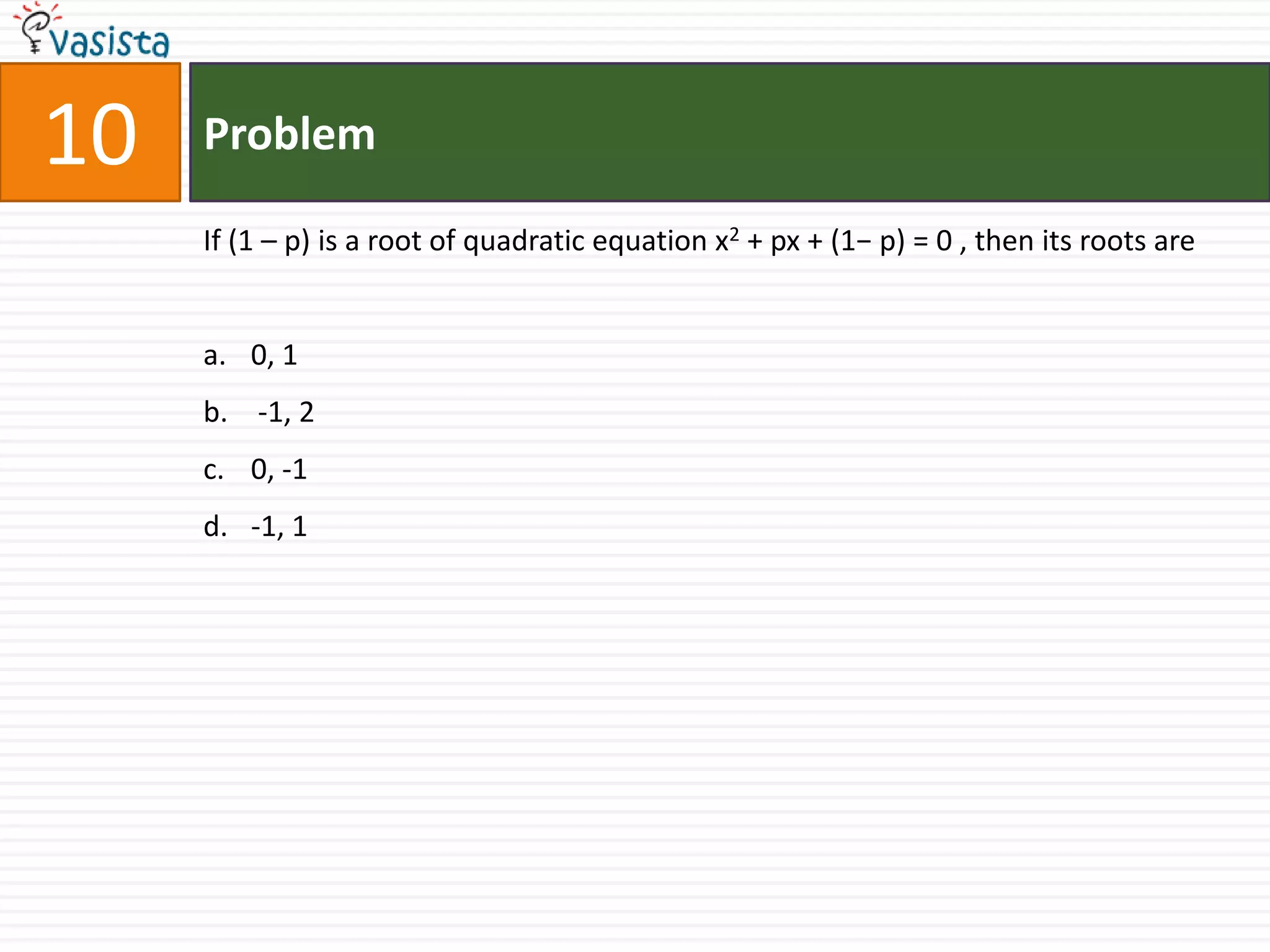
Problem10If (1 – p) is a root of quadratic equation x2 + px + (1− p) = 0 , then its roots are0, 1  -1, 20, -1 -1, 1
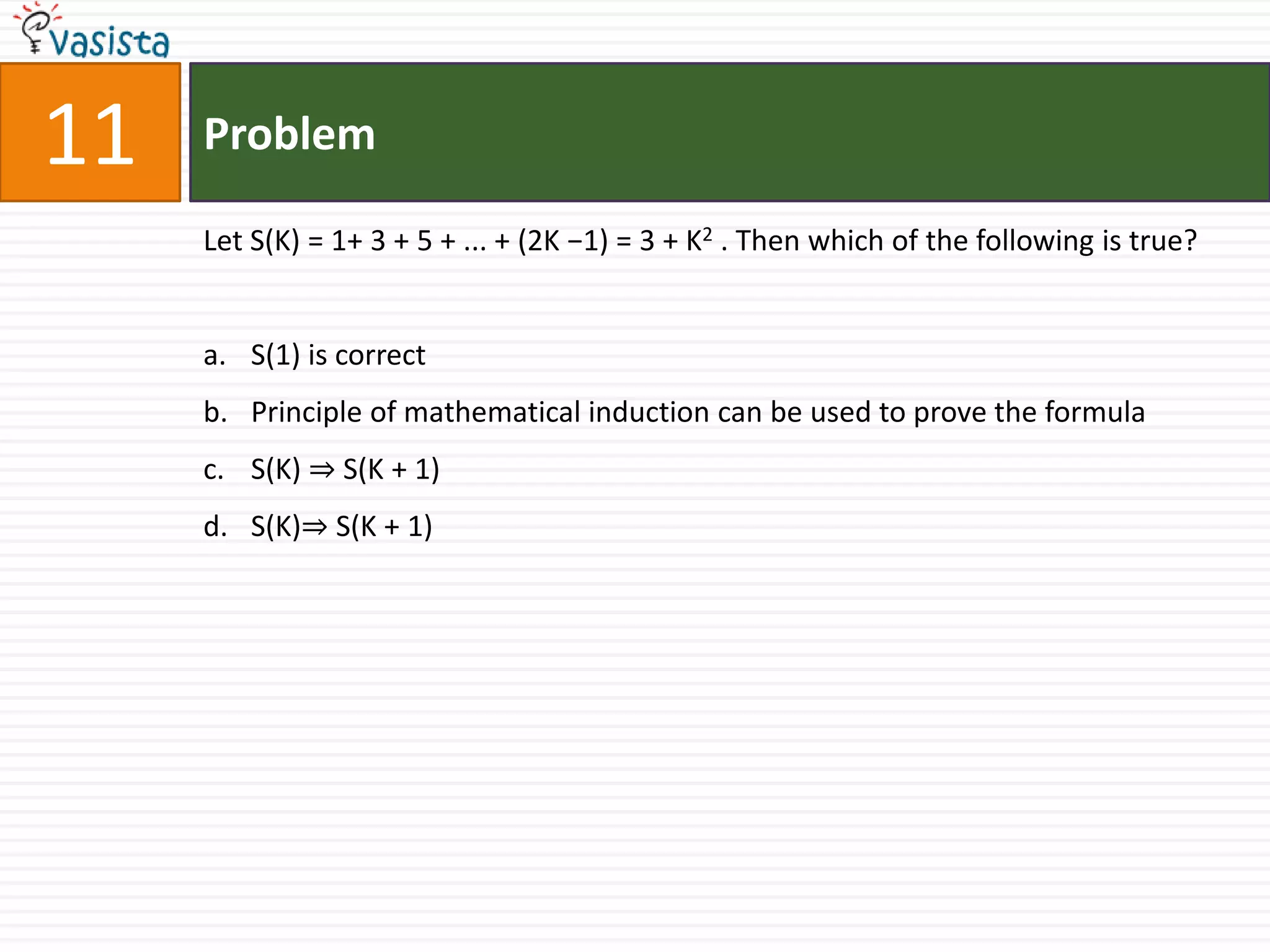
Problem11Let S(K) = 1+ 3 + 5 + ... + (2K −1) = 3 + K2 . Then which of the following is true?S(1) is correctPrinciple of mathematical induction can be used to prove the formulaS(K) ⇒ S(K + 1)S(K)⇒ S(K + 1)
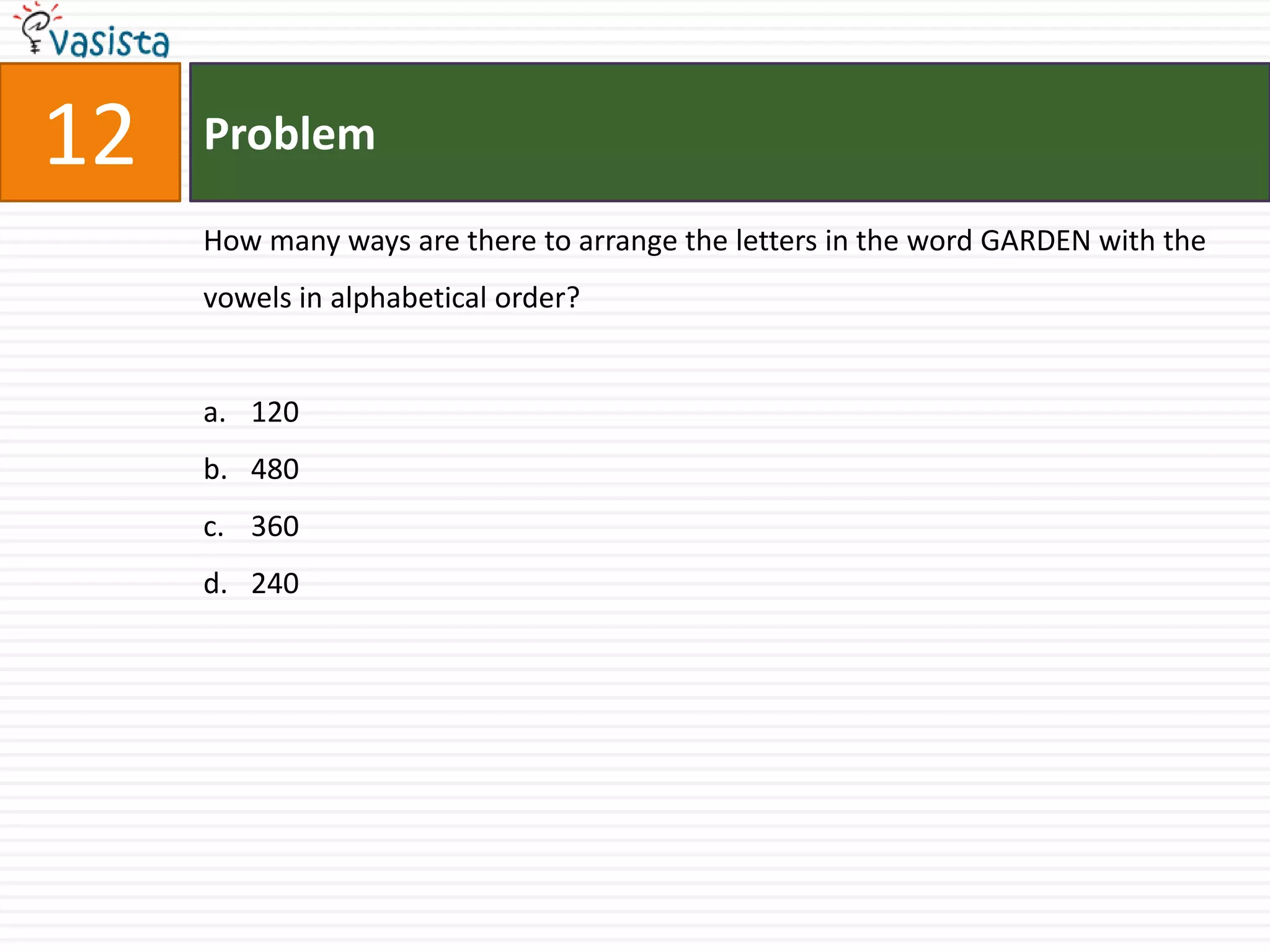
Problem12How many ways are there to arrange the letters in the word GARDEN with the vowels in alphabetical order?120 480360240
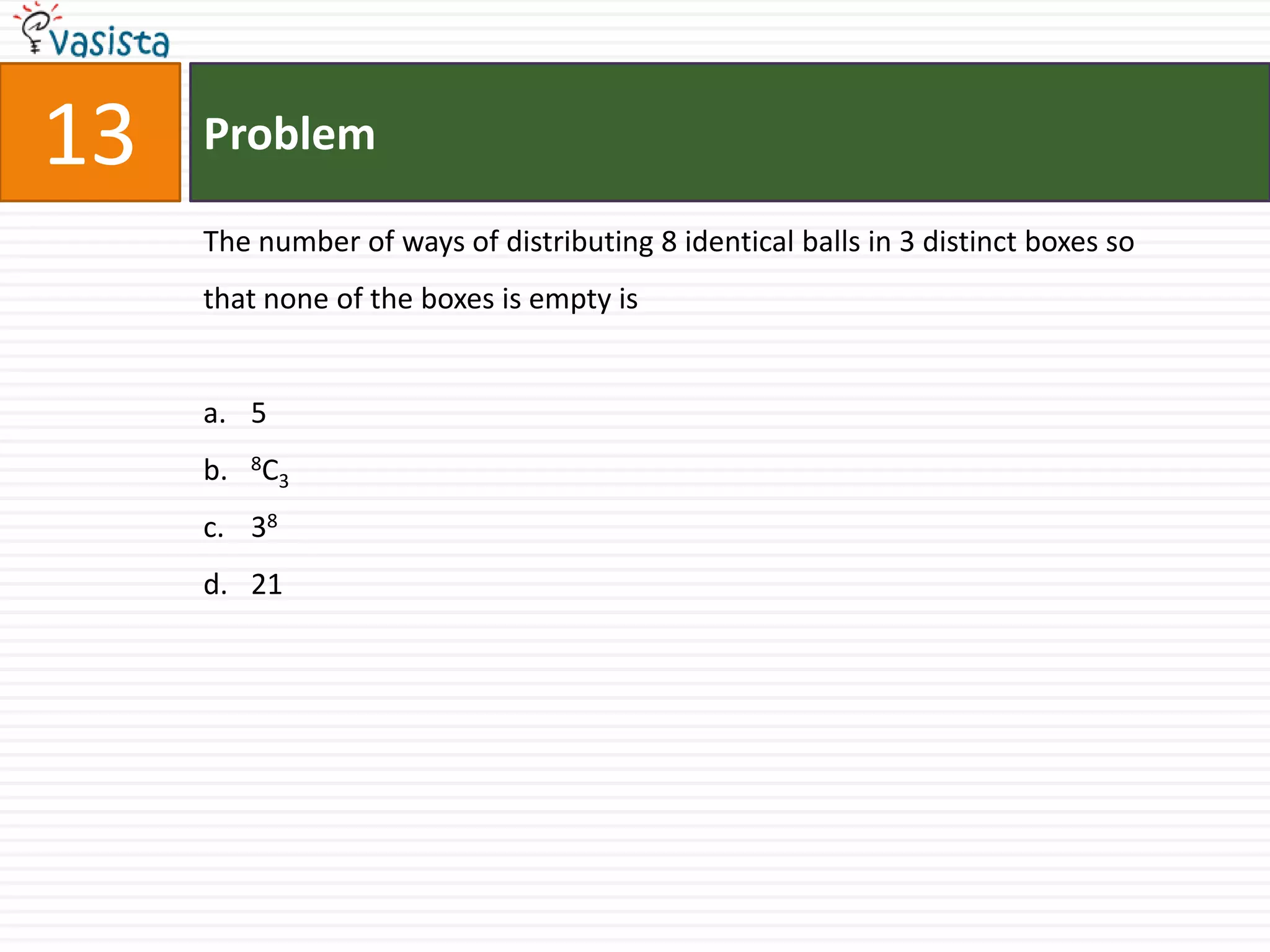
Problem13The number of ways of distributing 8 identical balls in 3 distinct boxes so that none of the boxes is empty is5 8C33821
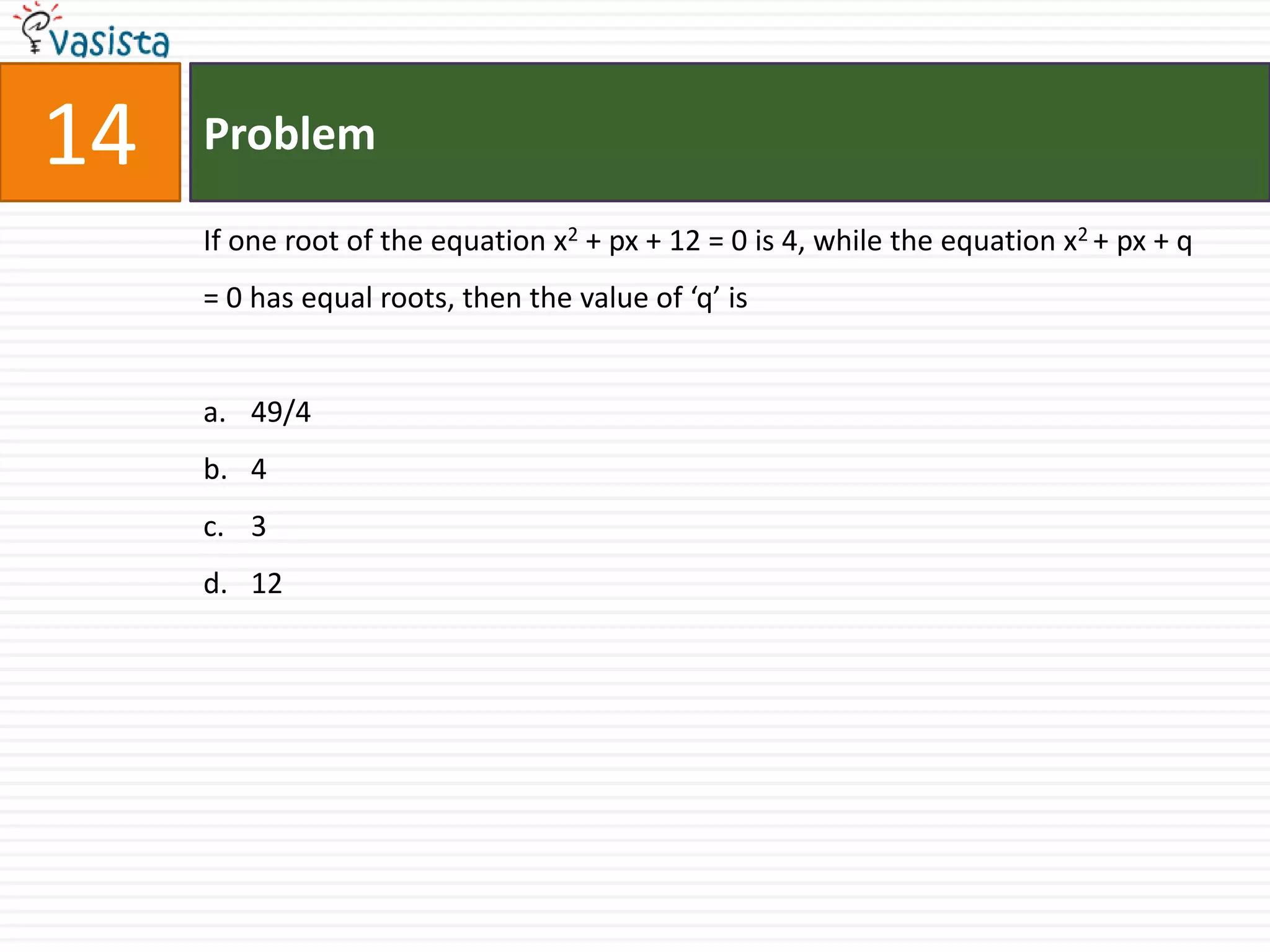
Problem14If one root of the equation x2 + px + 12 = 0 is 4, while the equation x2 + px + q = 0 has equal roots, then the value of ‘q’ is49/443 12
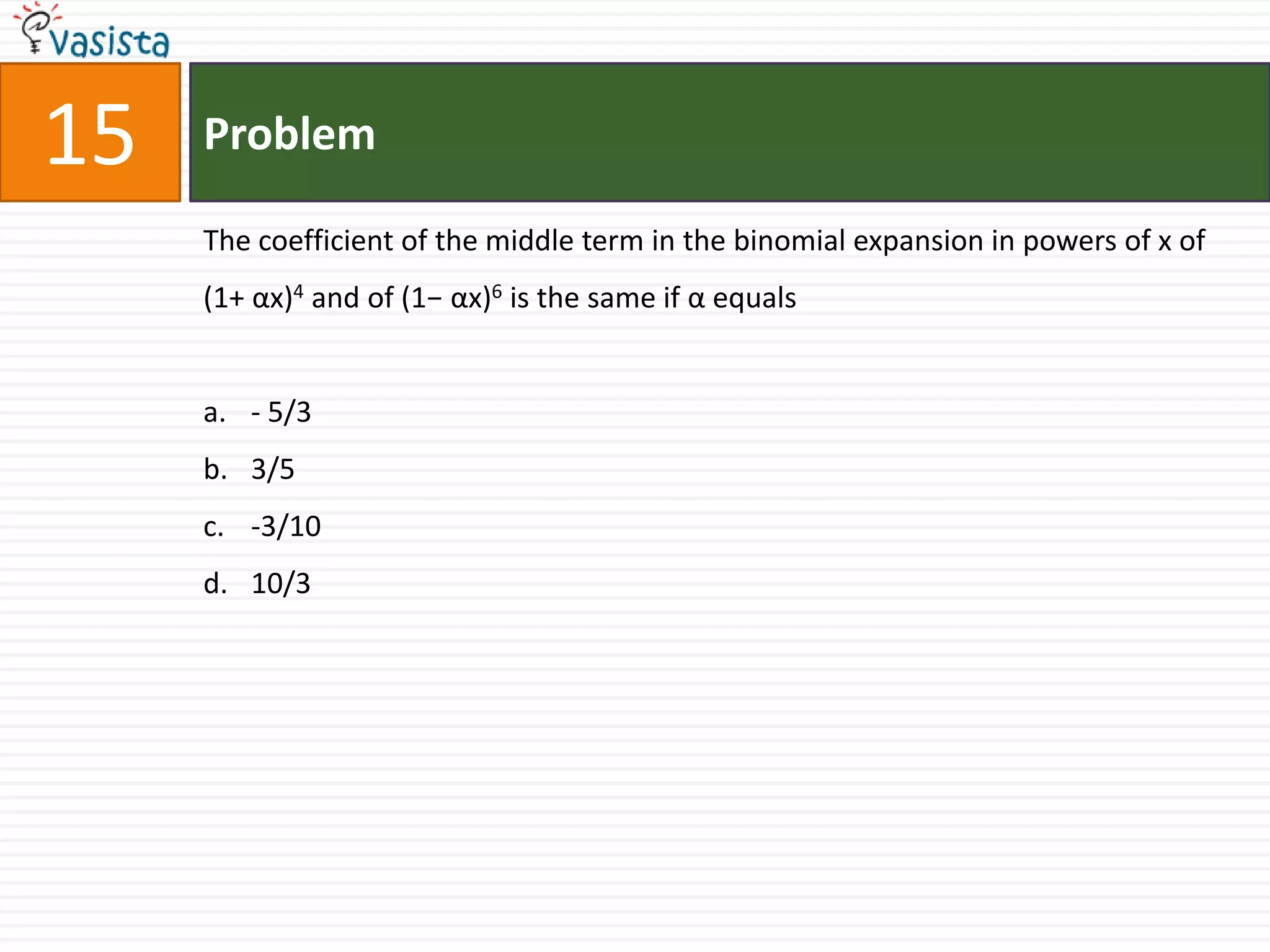
Problem15The coefficient of the middle term in the binomial expansion in powers of x of (1+ αx)4 and of (1− αx)6 is the same if α equals- 5/33/5-3/1010/3
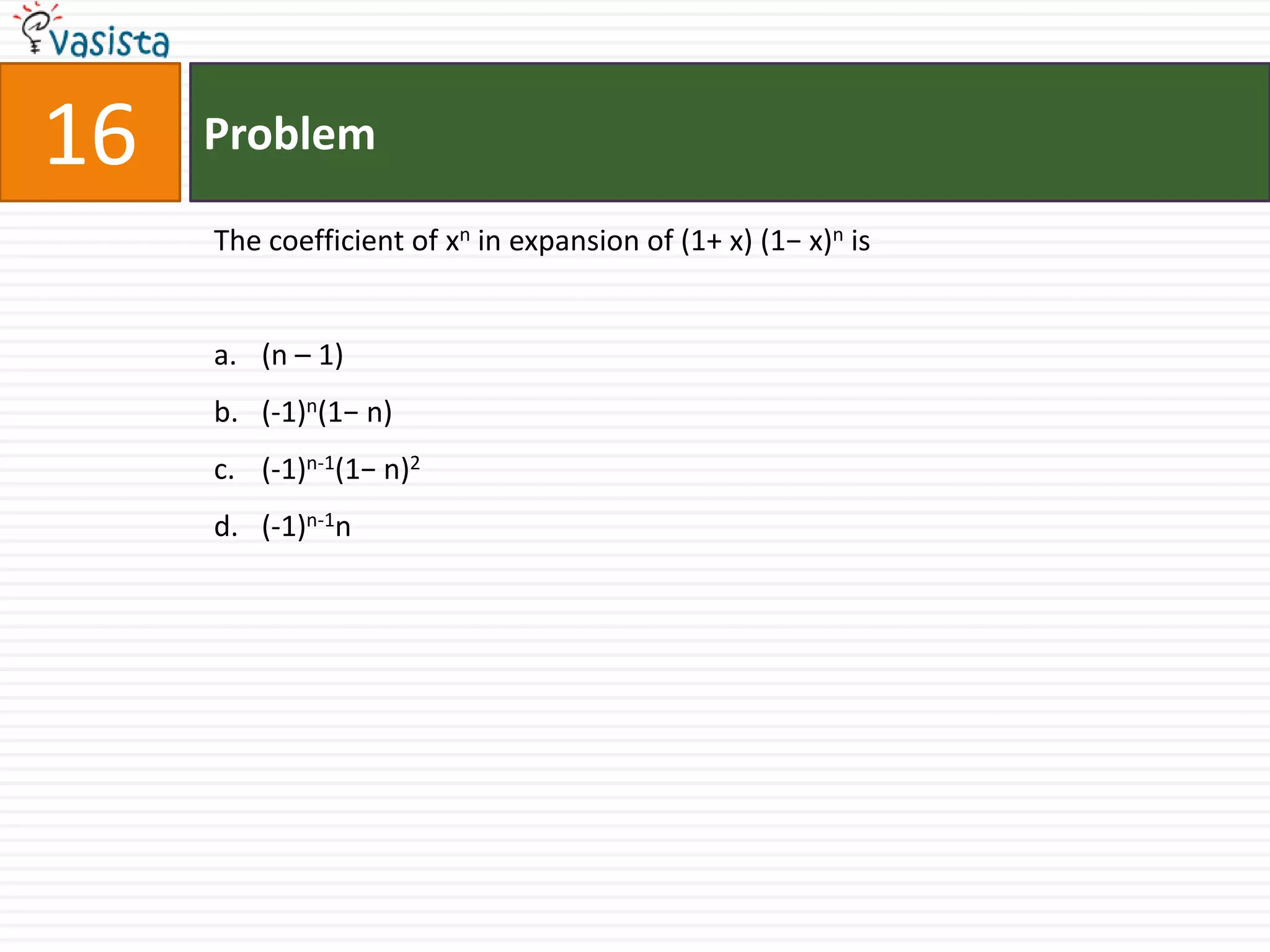
Problem16The coefficient of xn in expansion of (1+ x) (1− x)n is(n – 1) (-1)n(1− n)	(-1)n-1(1− n)2(-1)n-1n
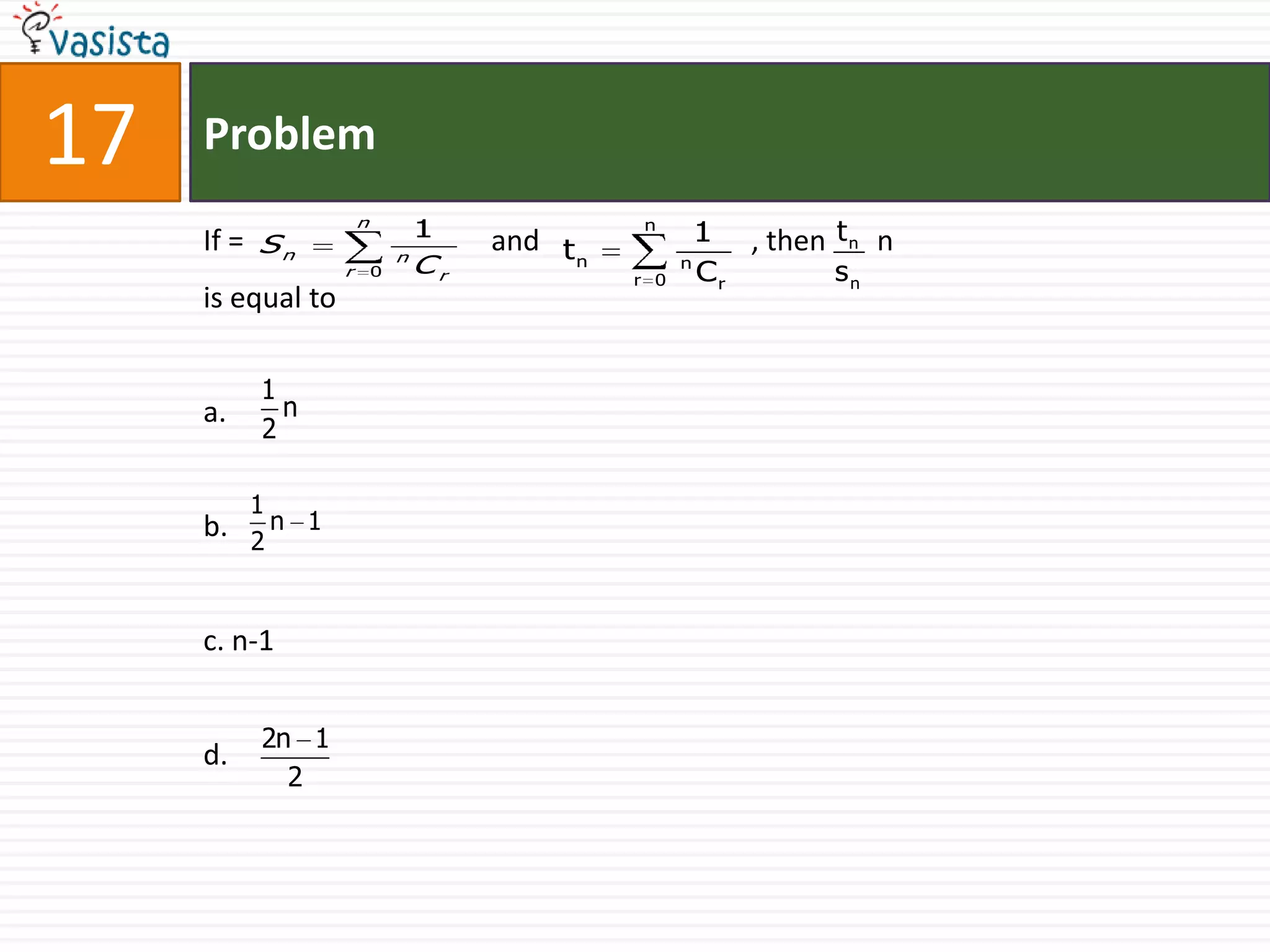
Problem17If = and                             , then       nis equal toa.b.c. n-1d.
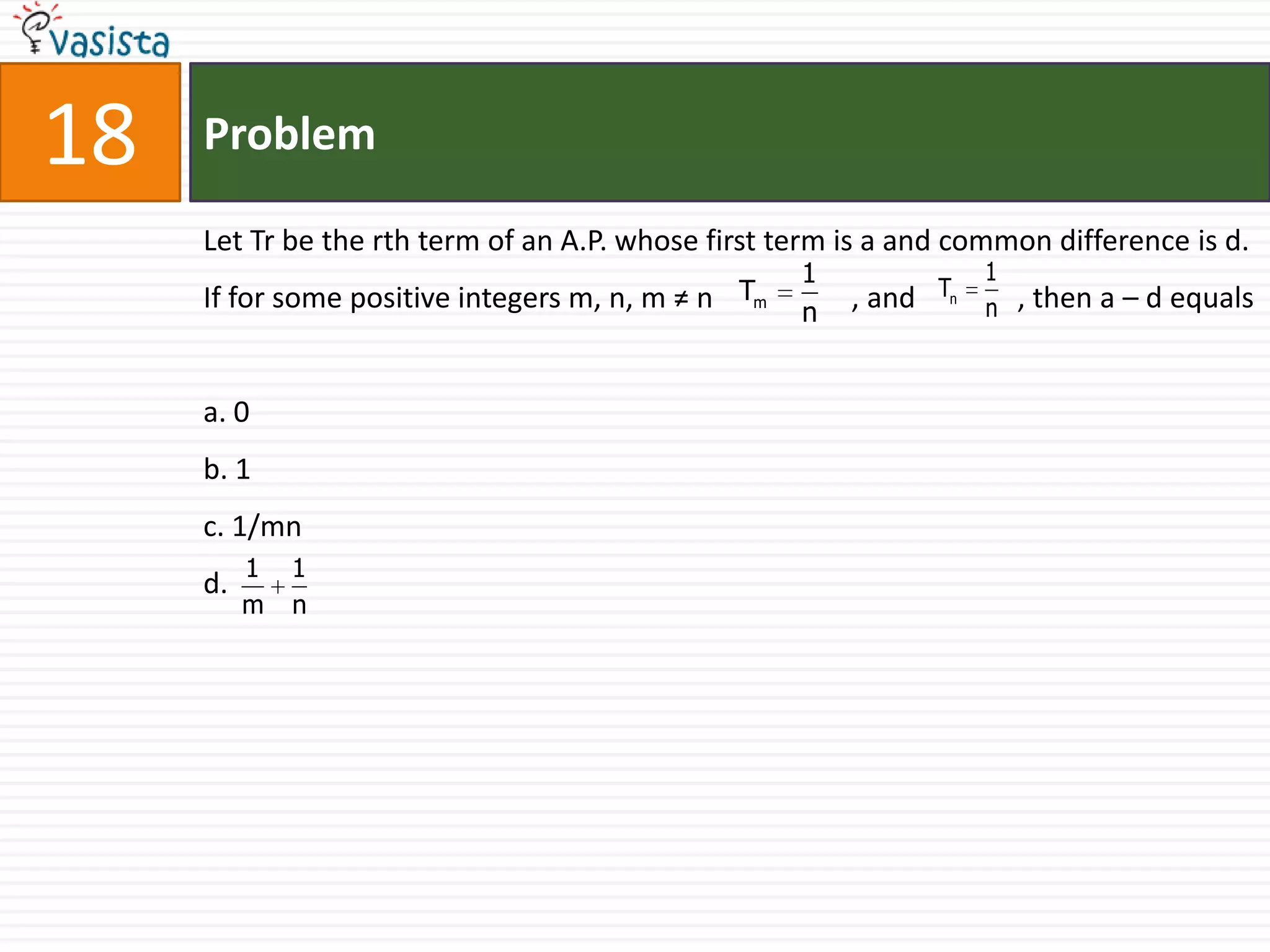
Problem18Let Tr be the rth term of an A.P. whose first term is a and common difference is d. If for some positive integers m, n, m ≠ n                   , and              , then a – d equalsa. 0b. 1c. 1/mnd.
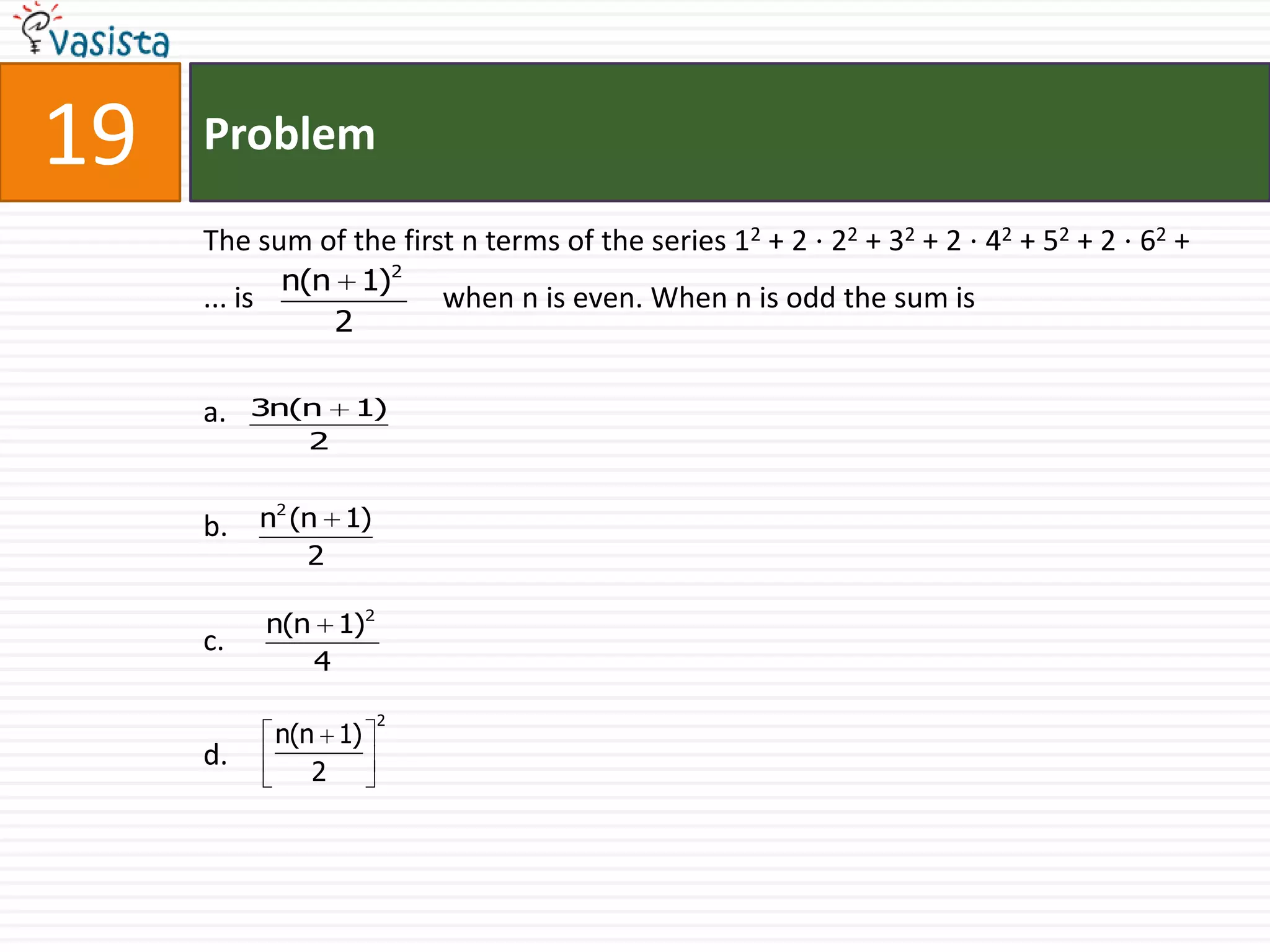
Problem19The sum of the first n terms of the series 12 + 2 ⋅ 22 + 32 + 2 ⋅ 42 + 52 + 2 ⋅ 62 +                ... iswhen n is even. When n is odd the sum isa.b.c.d.
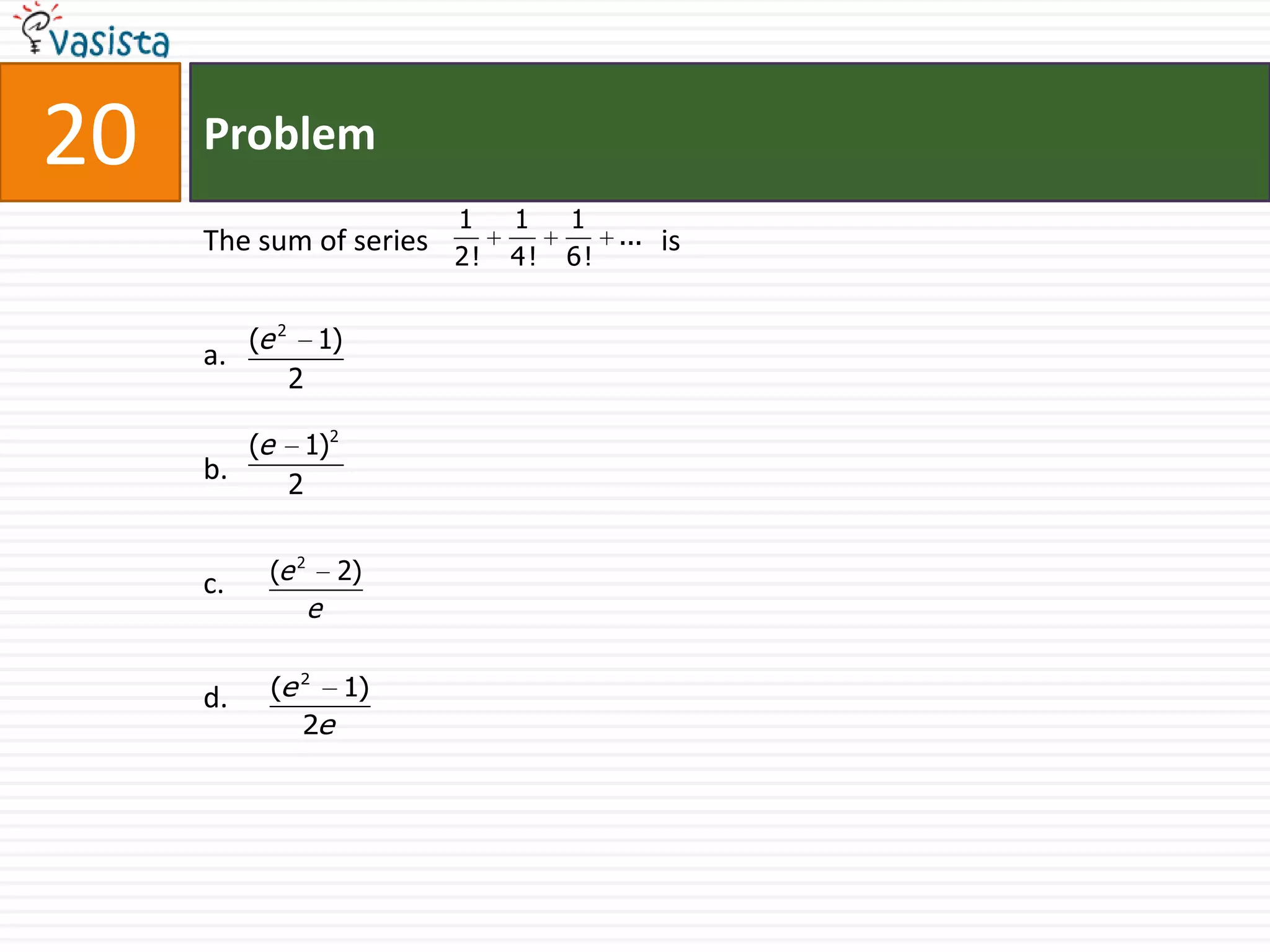
Problem20The sum of series                                isa.b.c.d.
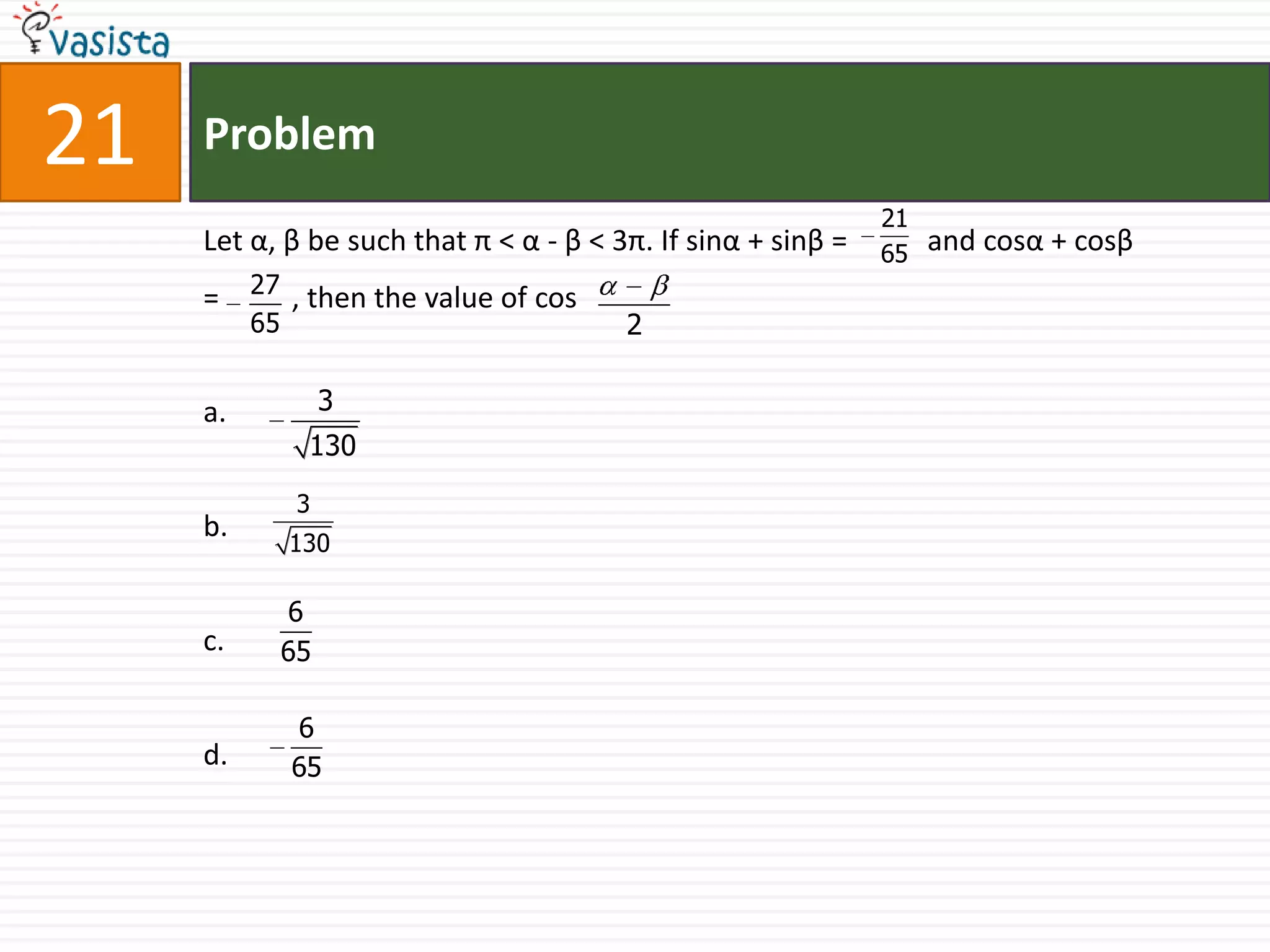
Problem21Let α, β be such that π < α - β < 3π. If sinα + sinβ =           and cosα + cosβ =          , then the value of cosa.b.c.d.
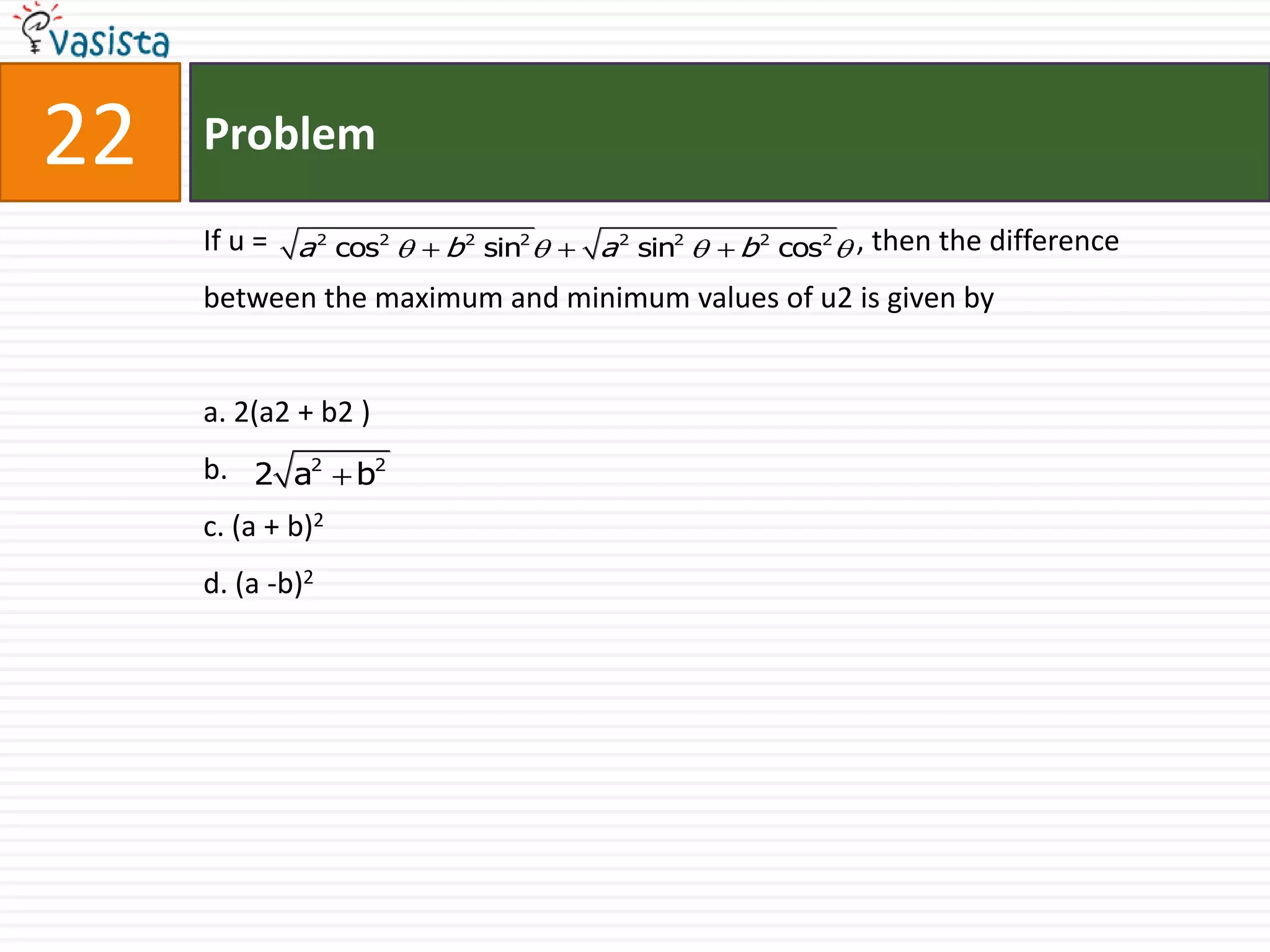
Problem22If u =                                                                                 , then the difference between the maximum and minimum values of u2 is given bya. 2(a2 + b2 ) b. c. (a + b)2d. (a -b)2
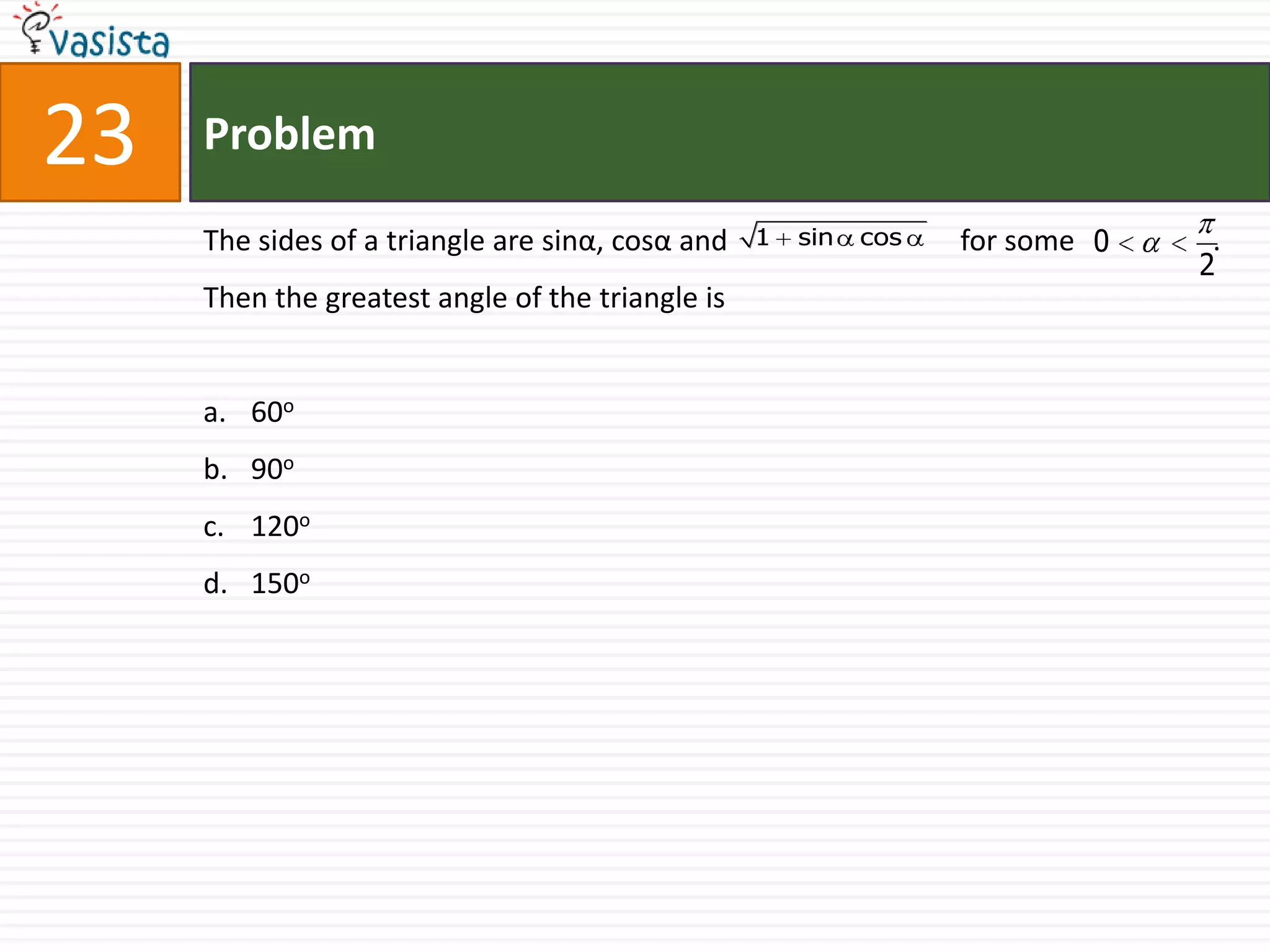
Problem23The sides of a triangle are sinα, cosα and                             for some                   . Then the greatest angle of the triangle is60o90o120o 150o
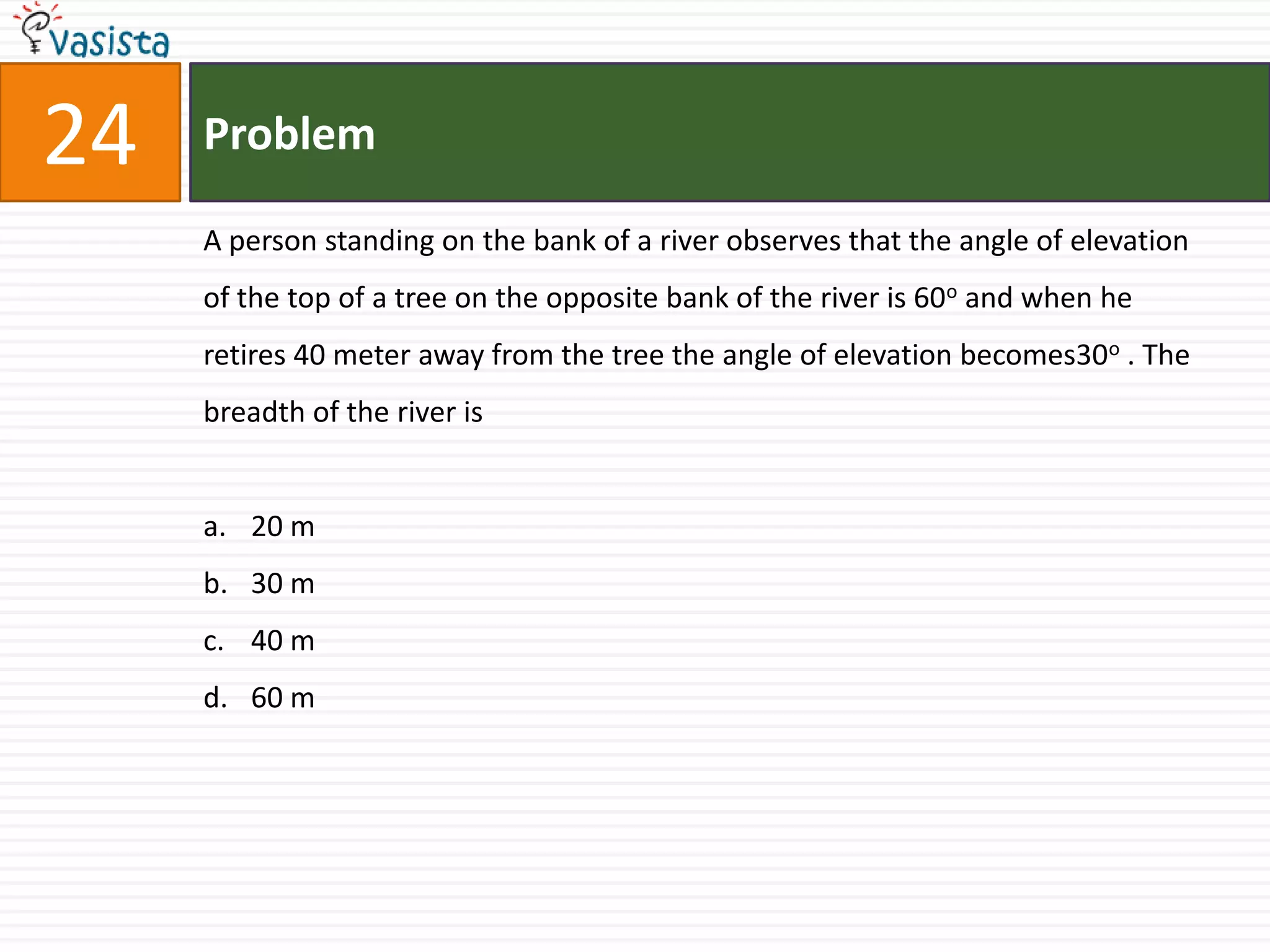
Problem24A person standing on the bank of a river observes that the angle of elevation of the top of a tree on the opposite bank of the river is 60o and when he retires 40 meter away from the tree the angle of elevation becomes30o . The breadth of the river is20 m 30 m40 m 60 m
Problem25If f :R -> S, defined by f(x) = sin x − √3 cos x + 1, is onto, then the interval of S is[0, 3] [-1, 1][0, 1] [-1, 3]
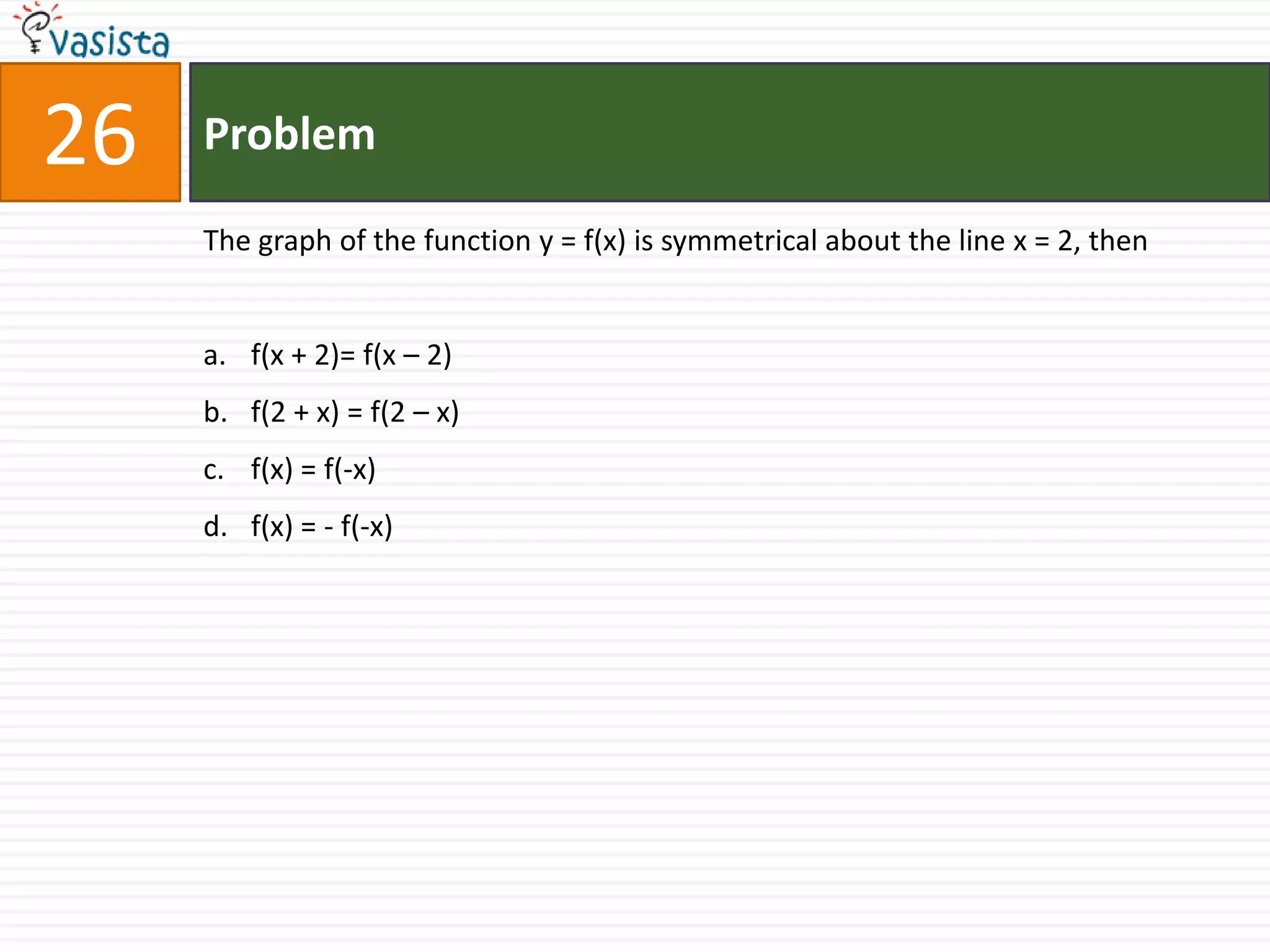
Problem26The graph of the function y = f(x) is symmetrical about the line x = 2, thenf(x + 2)= f(x – 2) f(2 + x) = f(2 – x)f(x) = f(-x) f(x) = - f(-x)
Problem27The domain of the function                         is[2, 3] [2, 3)[1, 2] [1, 2)
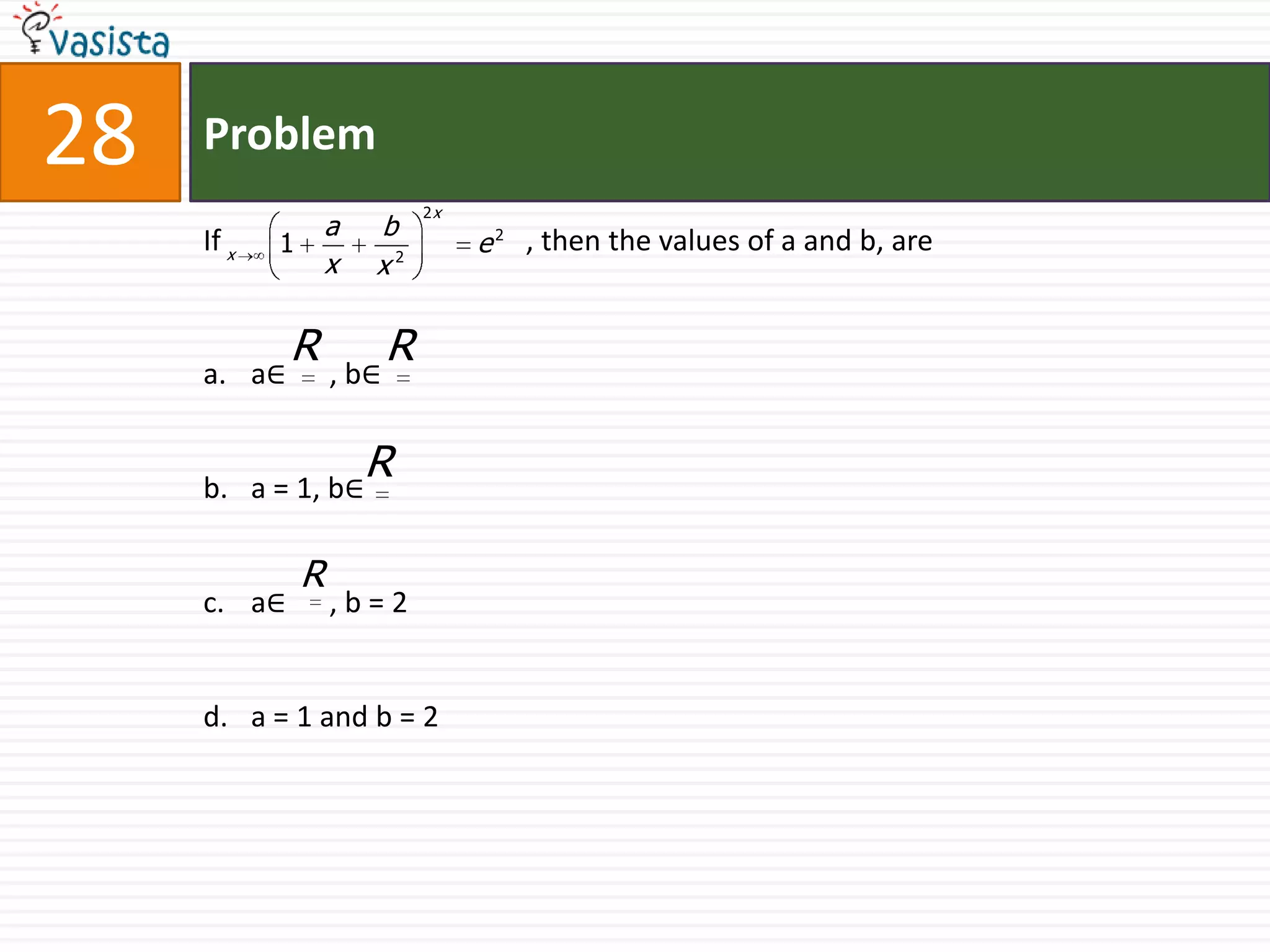
Problem28If                                          , then the values of a and b, area∈      , b∈a = 1, b∈a∈      , b = 2 a = 1 and b = 2
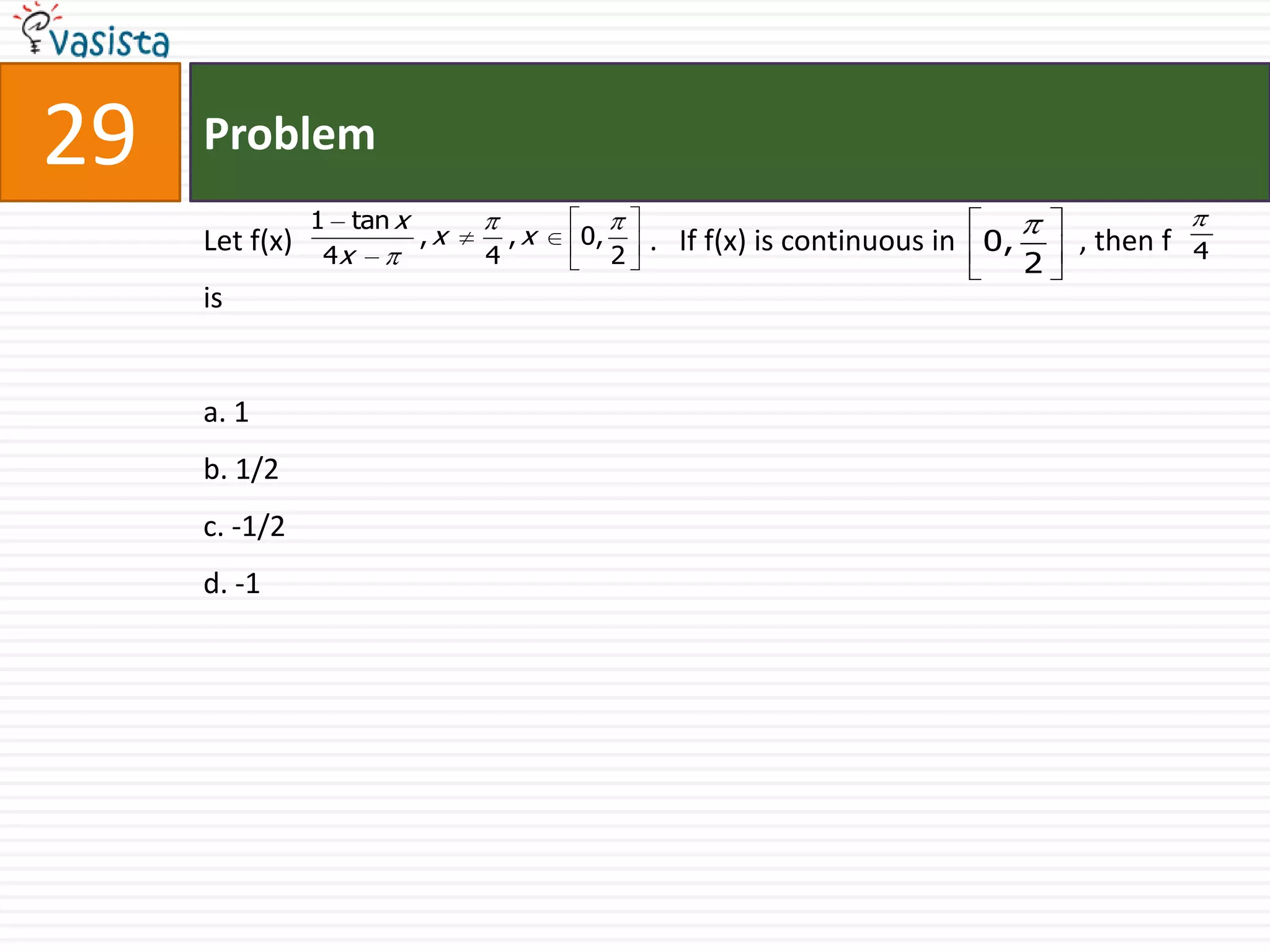
Problem29Let f(x) .   If f(x) is continuous in                 , then f         isa. 1 b. 1/2c. -1/2d. -1
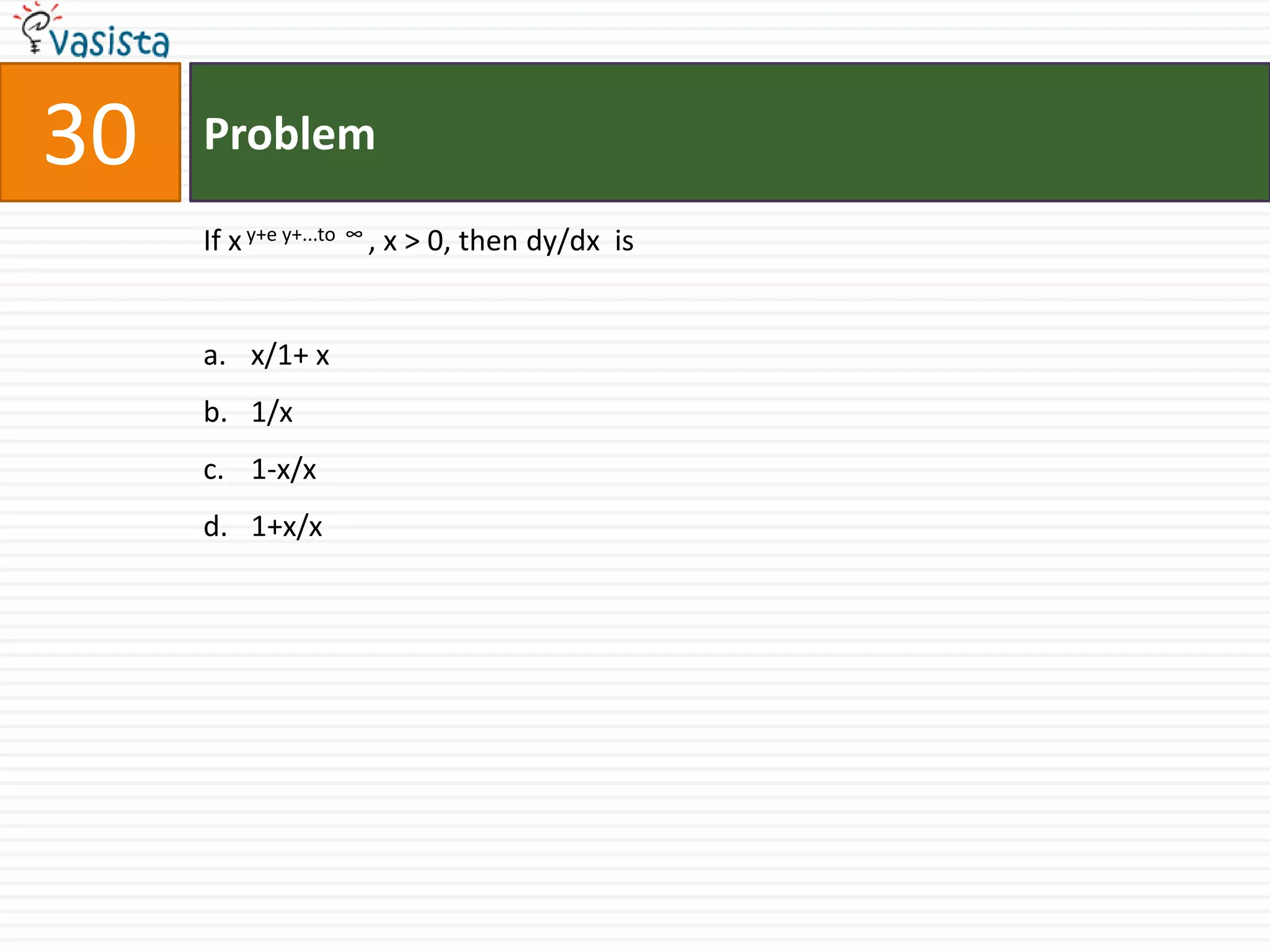
Problem30If xy+e y+...to  ∞ , x > 0, then dy/dx  isx/1+ x1/x1-x/x1+x/x
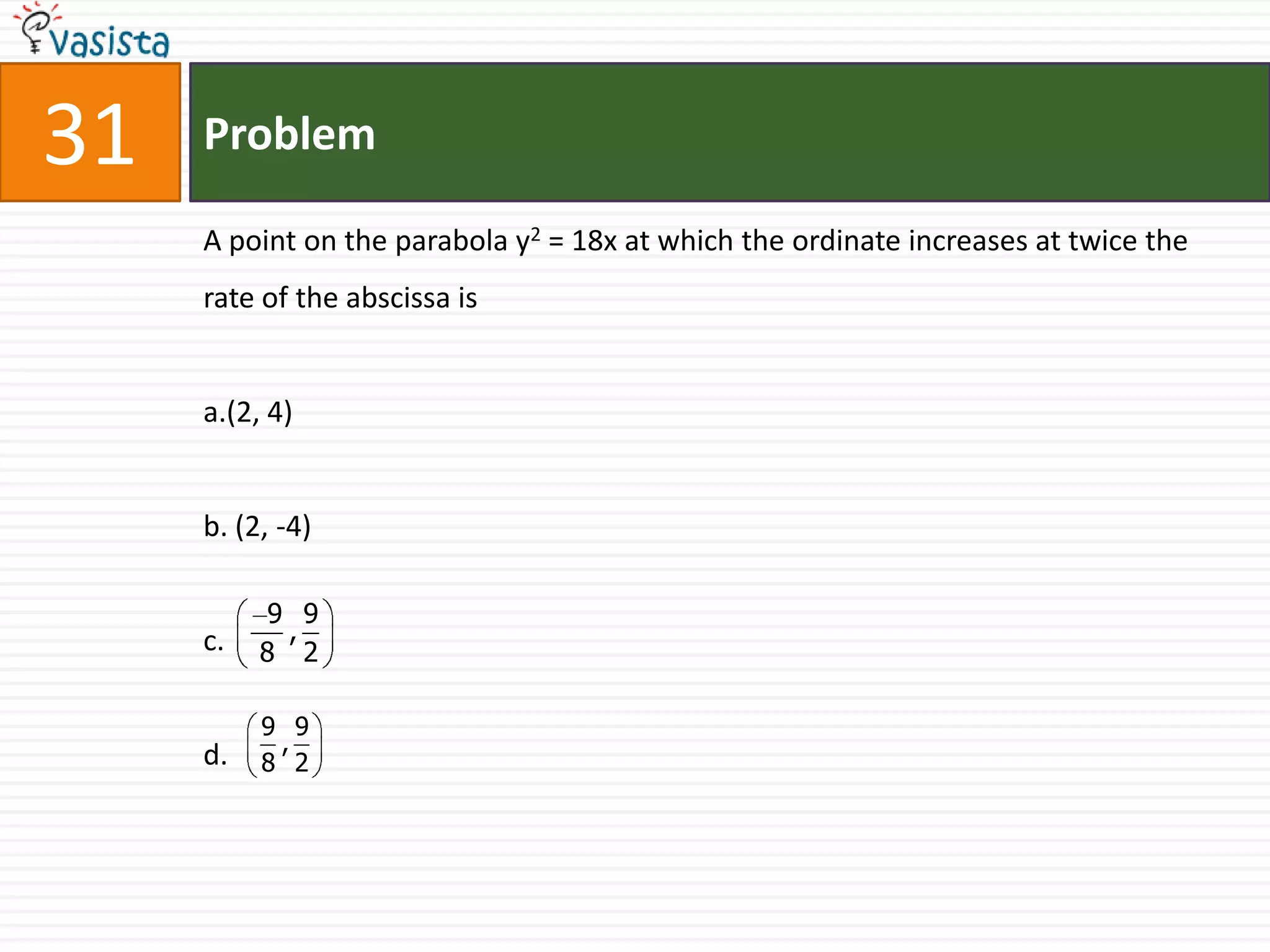
Problem31A point on the parabola y2 = 18x at which the ordinate increases at twice the rate of the abscissa isa.(2, 4) b. (2, -4)c.d.
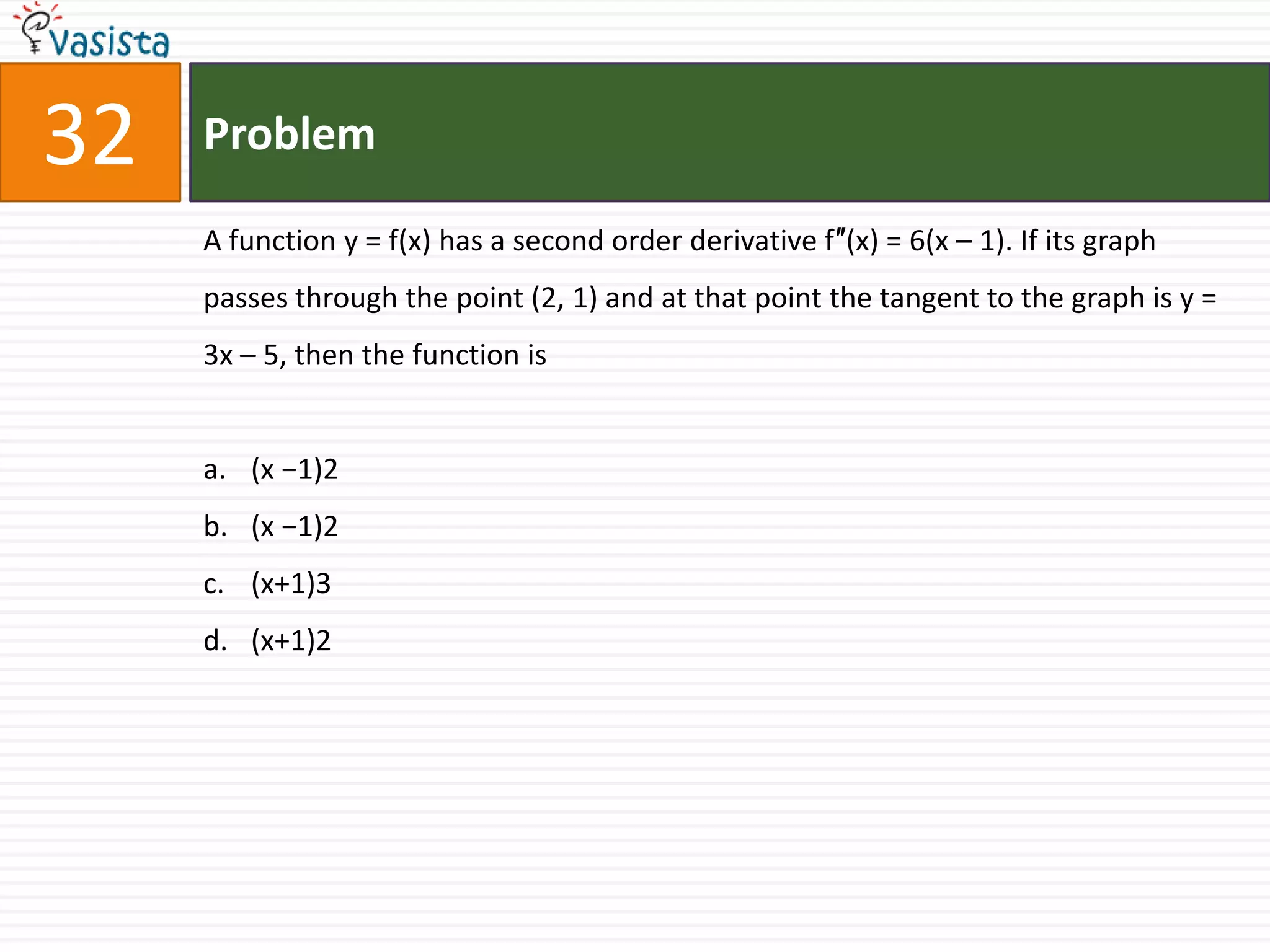
Problem32A function y = f(x) has a second order derivative f″(x) = 6(x – 1). If its graph passes through the point (2, 1) and at that point the tangent to the graph is y = 3x – 5, then the function is(x −1)2 (x −1)2(x+1)3 (x+1)2
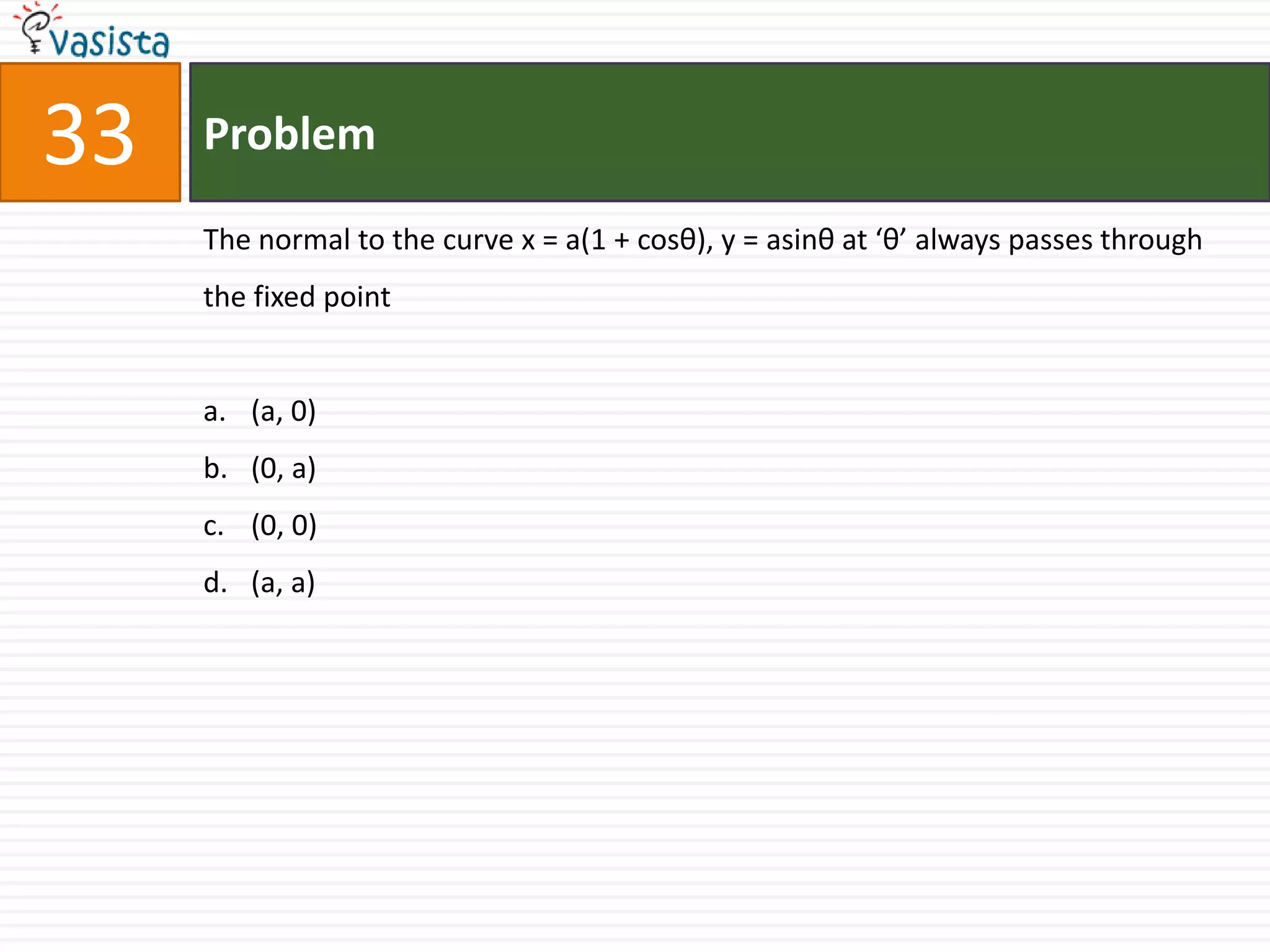
Problem33The normal to the curve x = a(1 + cosθ), y = asinθ at ‘θ’ always passes through the fixed point(a, 0) (0, a)(0, 0) (a, a)
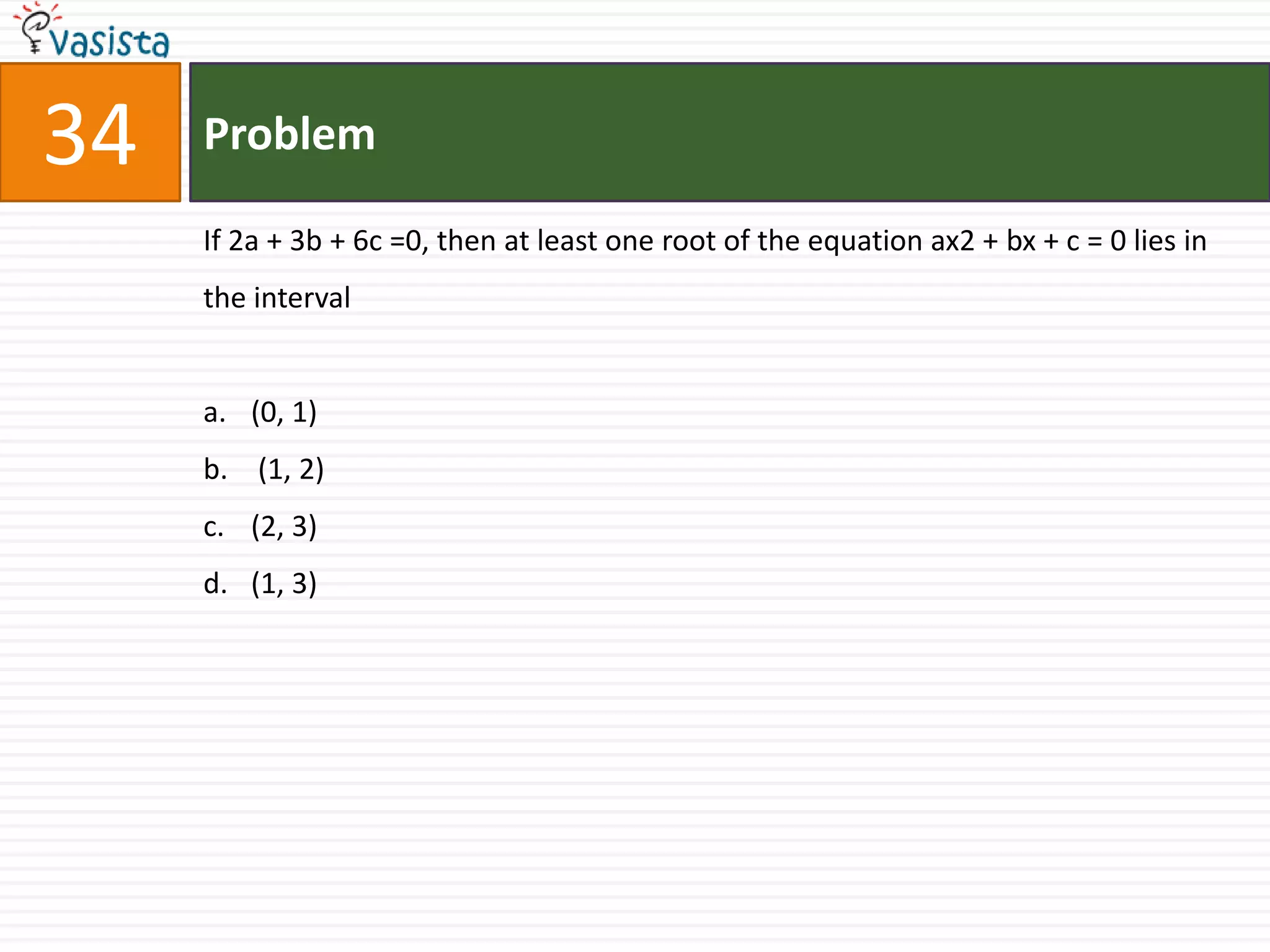
Problem34If 2a + 3b + 6c =0, then at least one root of the equation ax2 + bx + c = 0 lies in the interval(0, 1)  (1, 2)(2, 3) (1, 3)
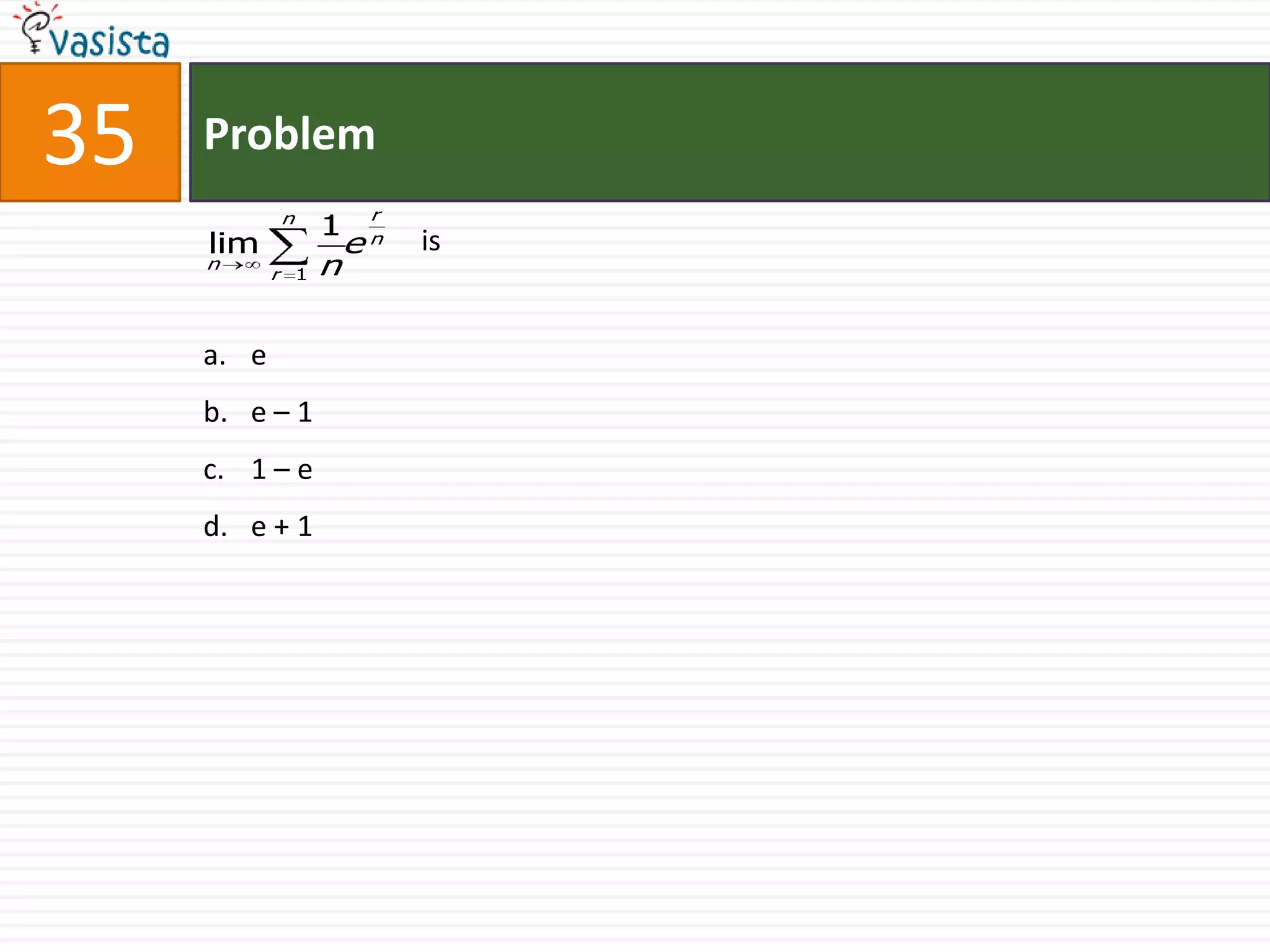
Problem35                              ise e – 11 – e e + 1
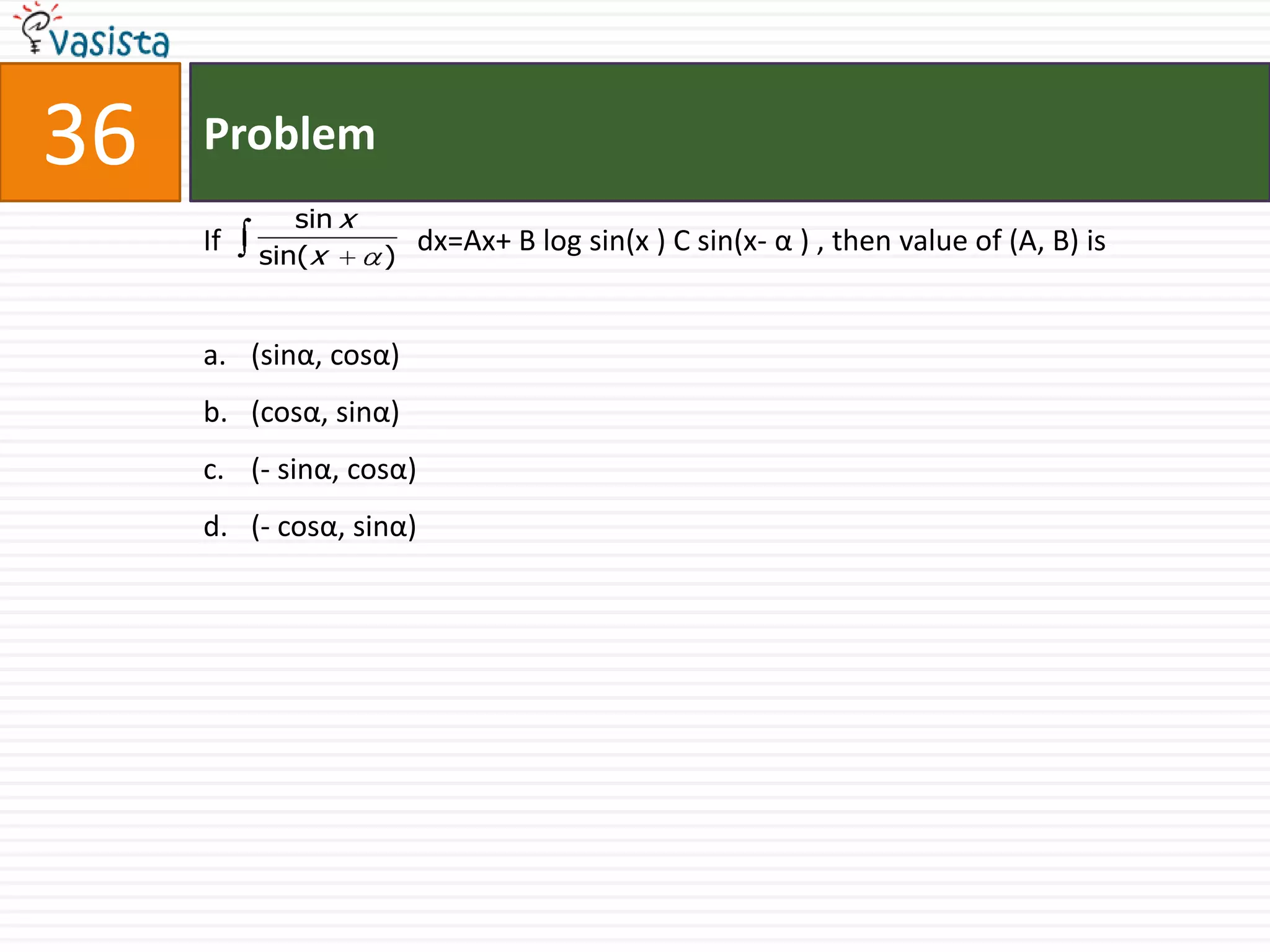
Problem36If                           dx=Ax+ B log sin(x ) C sin(x- α ) , then value of (A, B) is(sinα, cosα) (cosα, sinα)(- sinα, cosα)(- cosα, sinα)
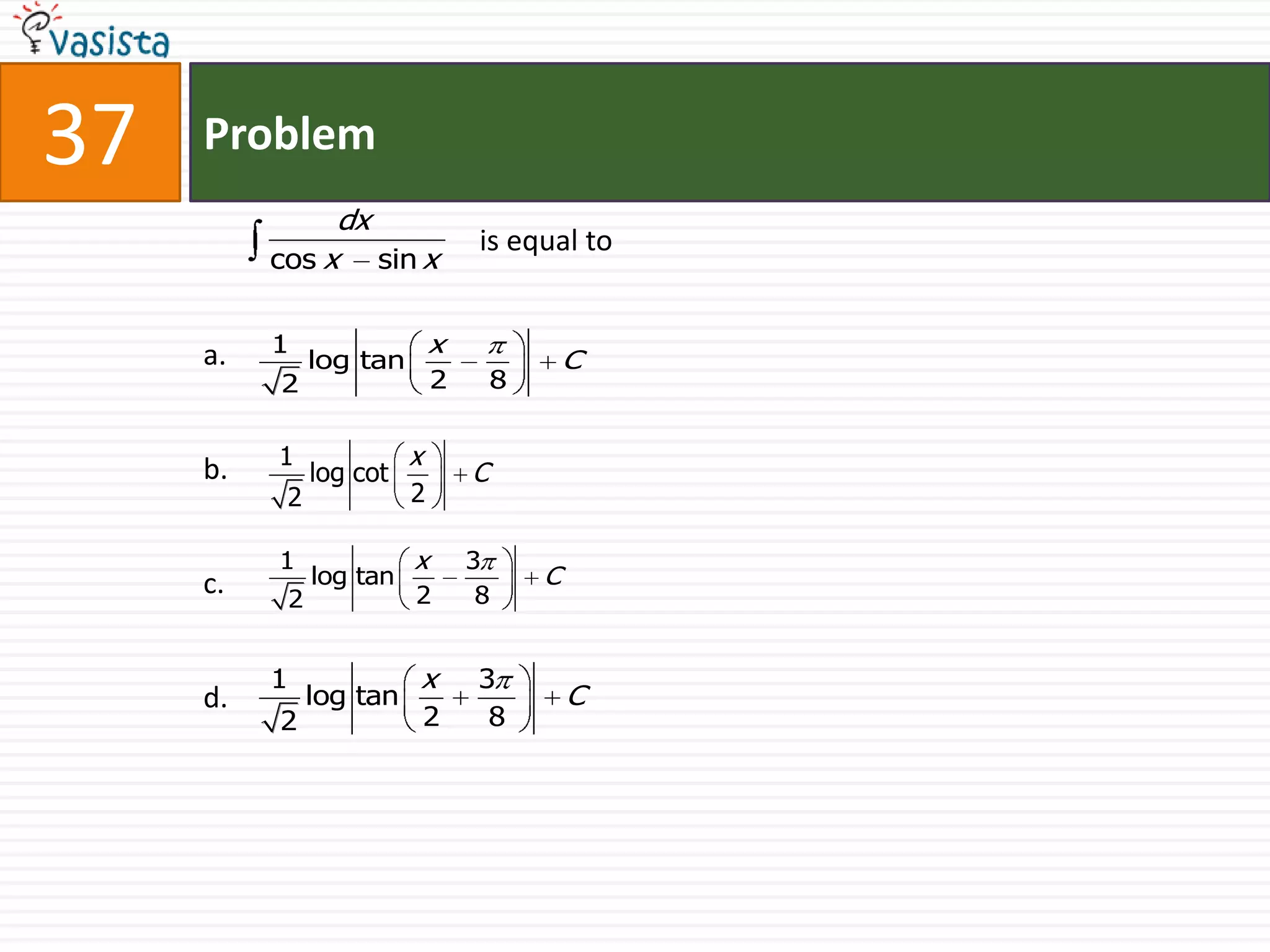
Problem37is equal toa.b.c.d.
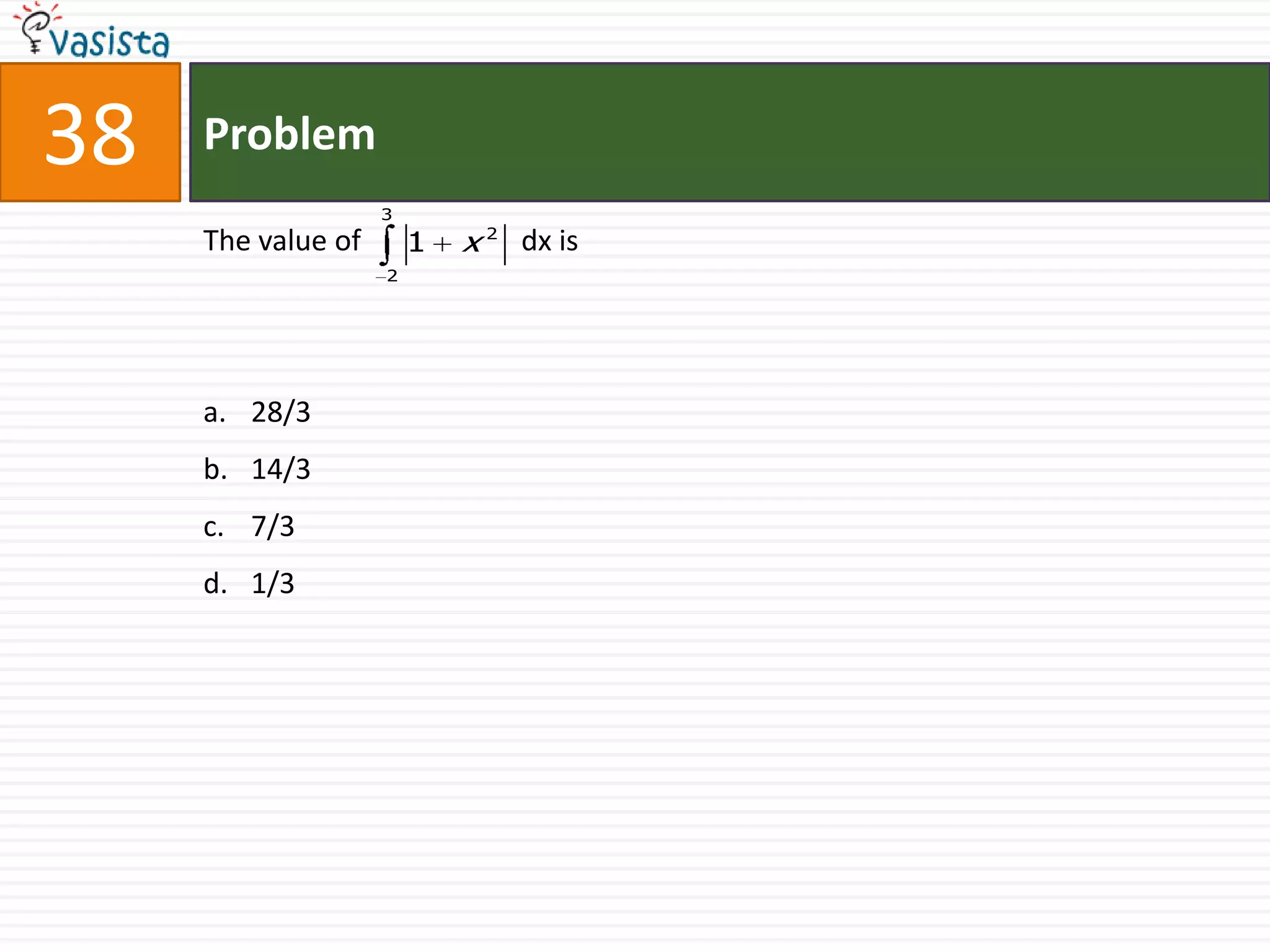
Problem38The value of                      dx is28/314/37/31/3
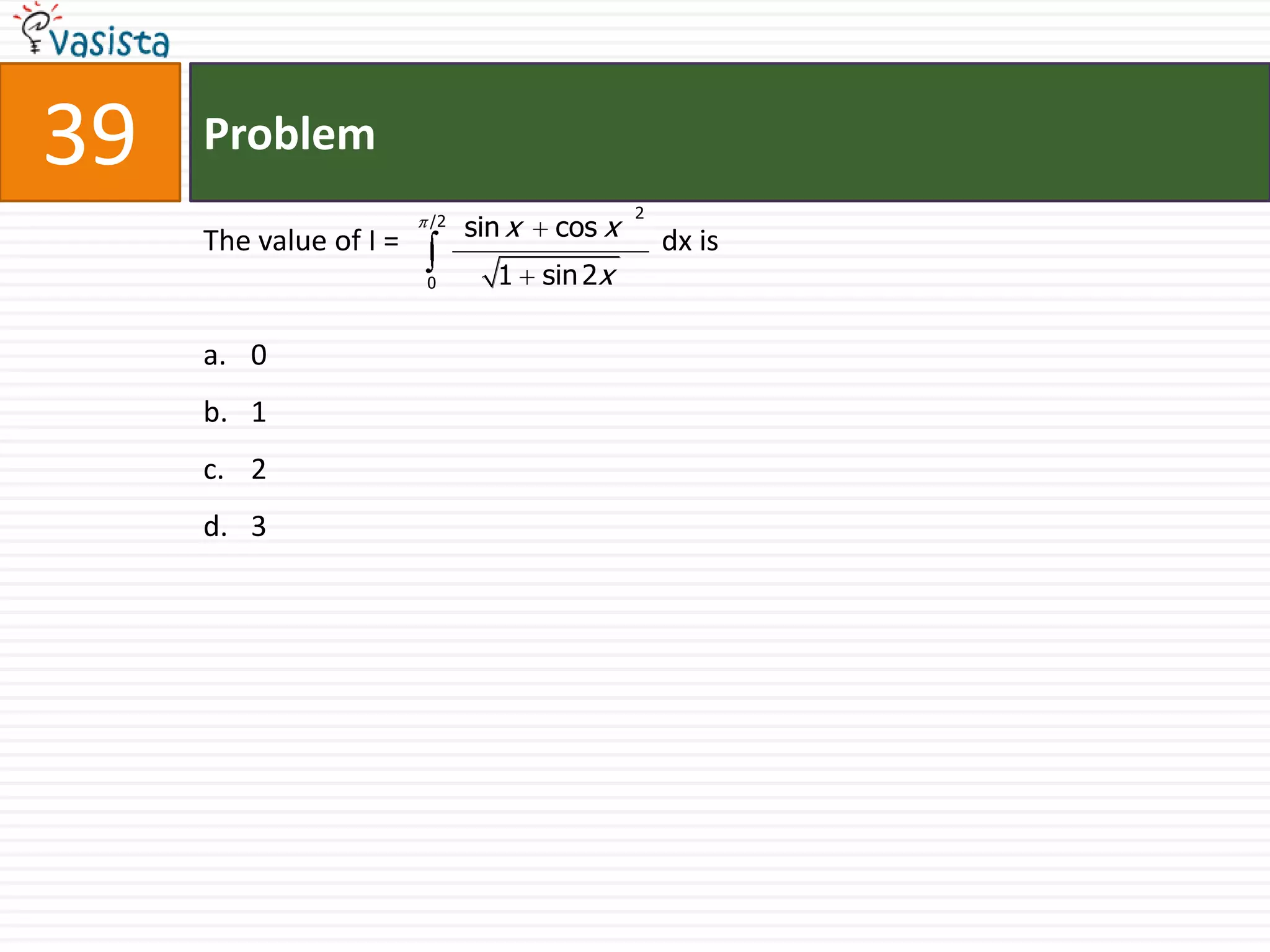
Problem39The value of I =                                    dxis0 12 3
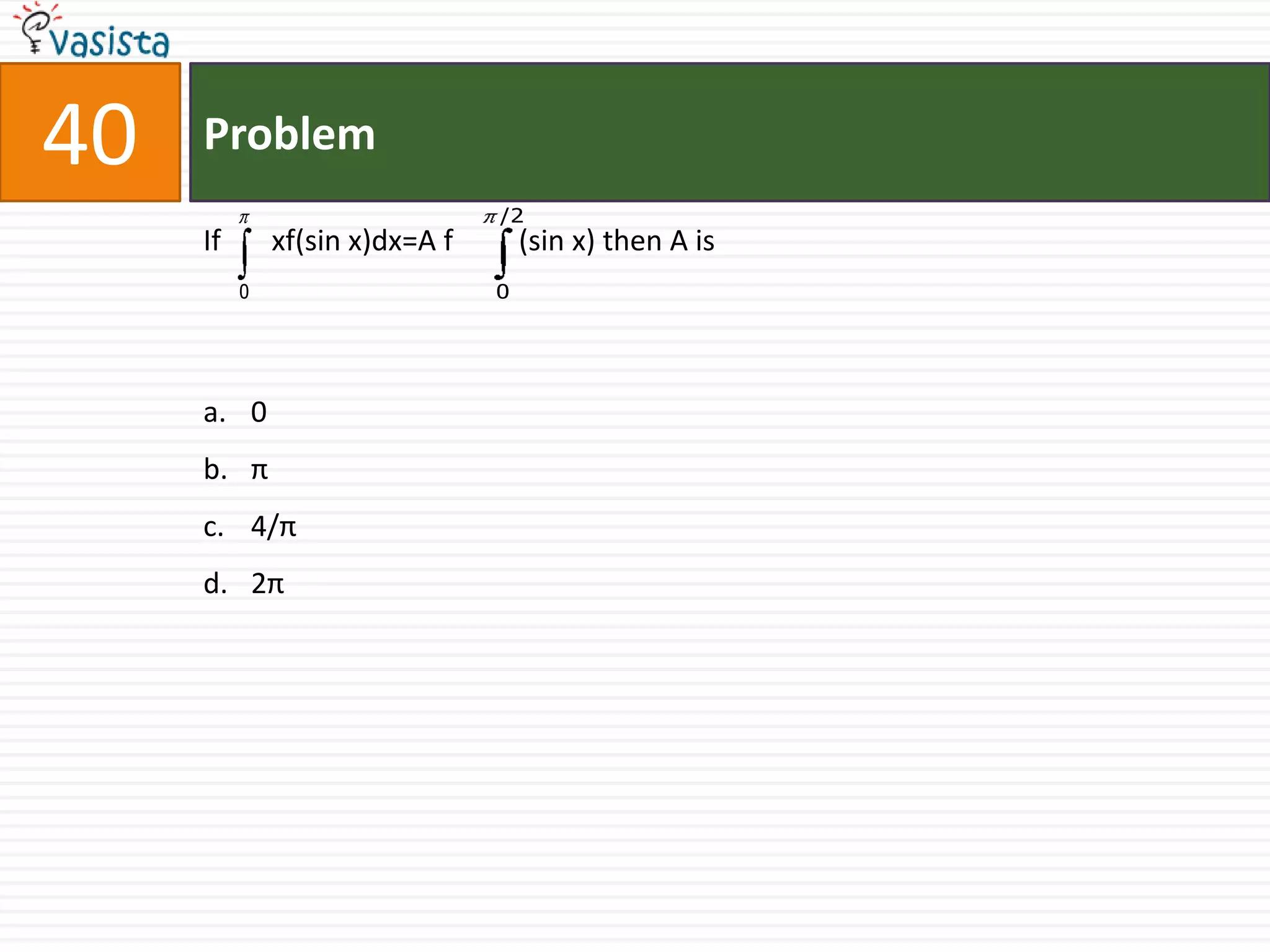
Problem40If       xf(sin x)dx=A f         (sin x) then A is0 π4/π2π
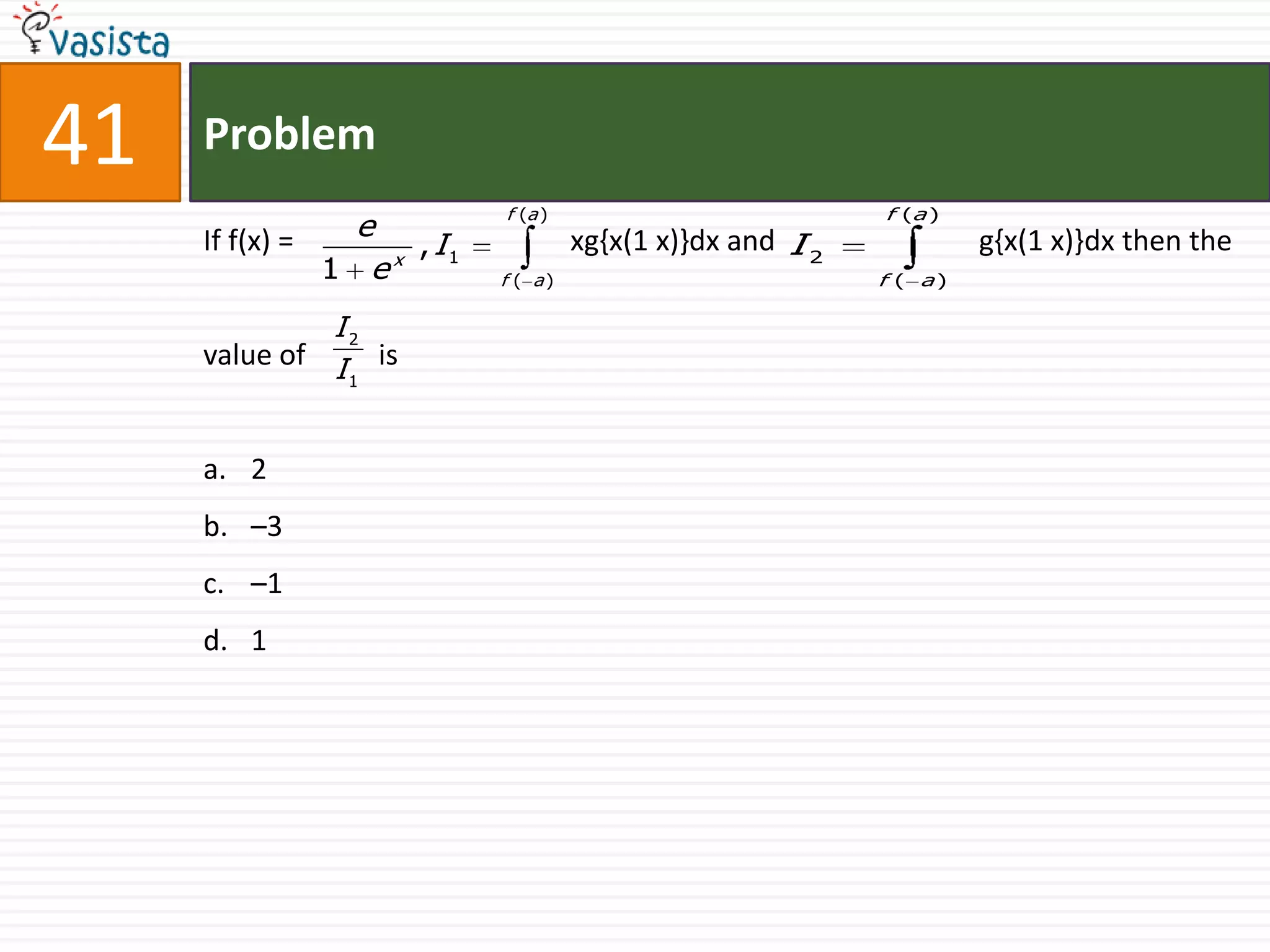
Problem41If f(x) =                                      xg{x(1 x)}dx and                            g{x(1 x)}dx then the value of          is2 –3–1 1
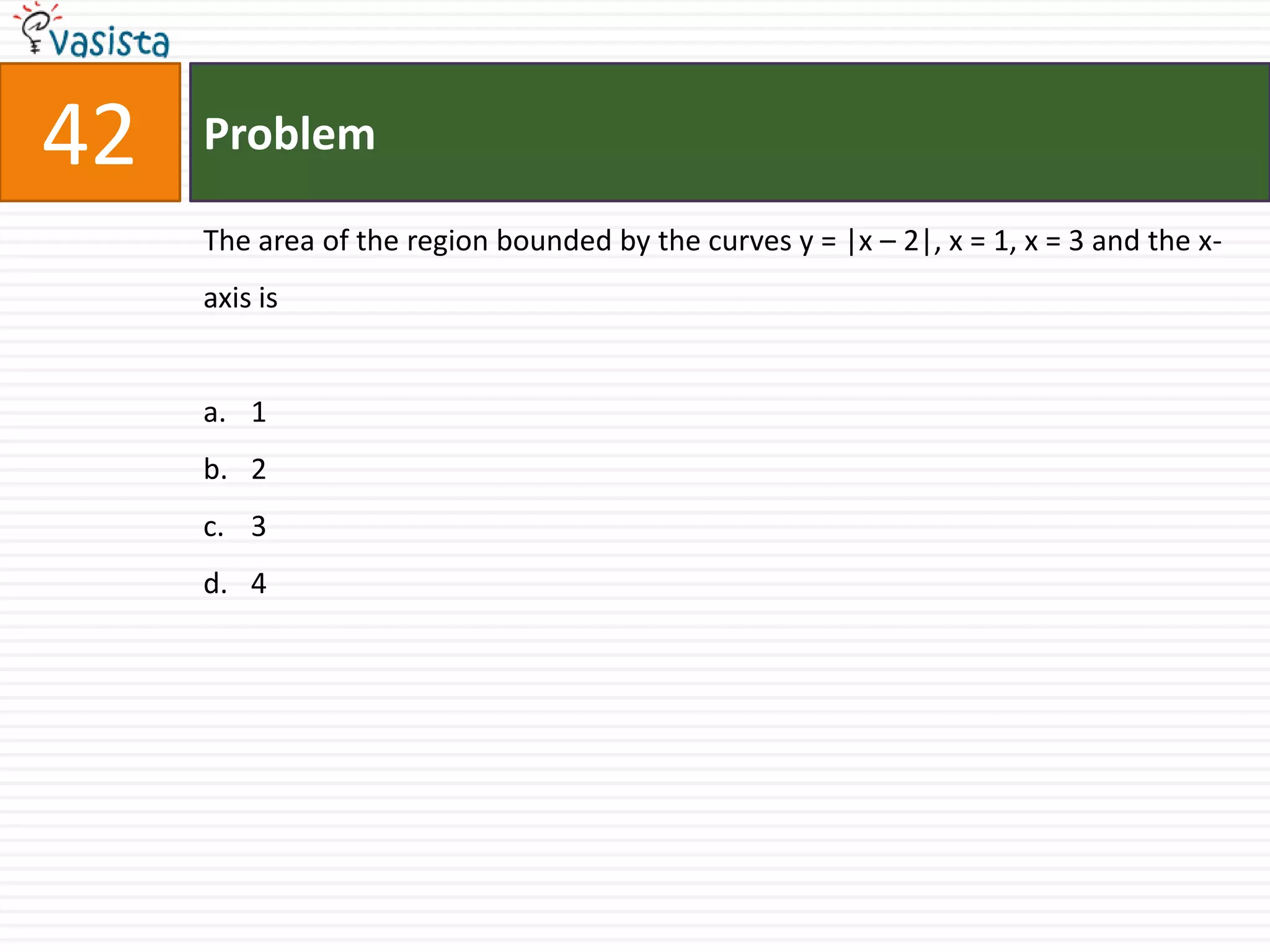
Problem42The area of the region bounded by the curves y = |x – 2|, x = 1, x = 3 and the x-axis is1 23 4
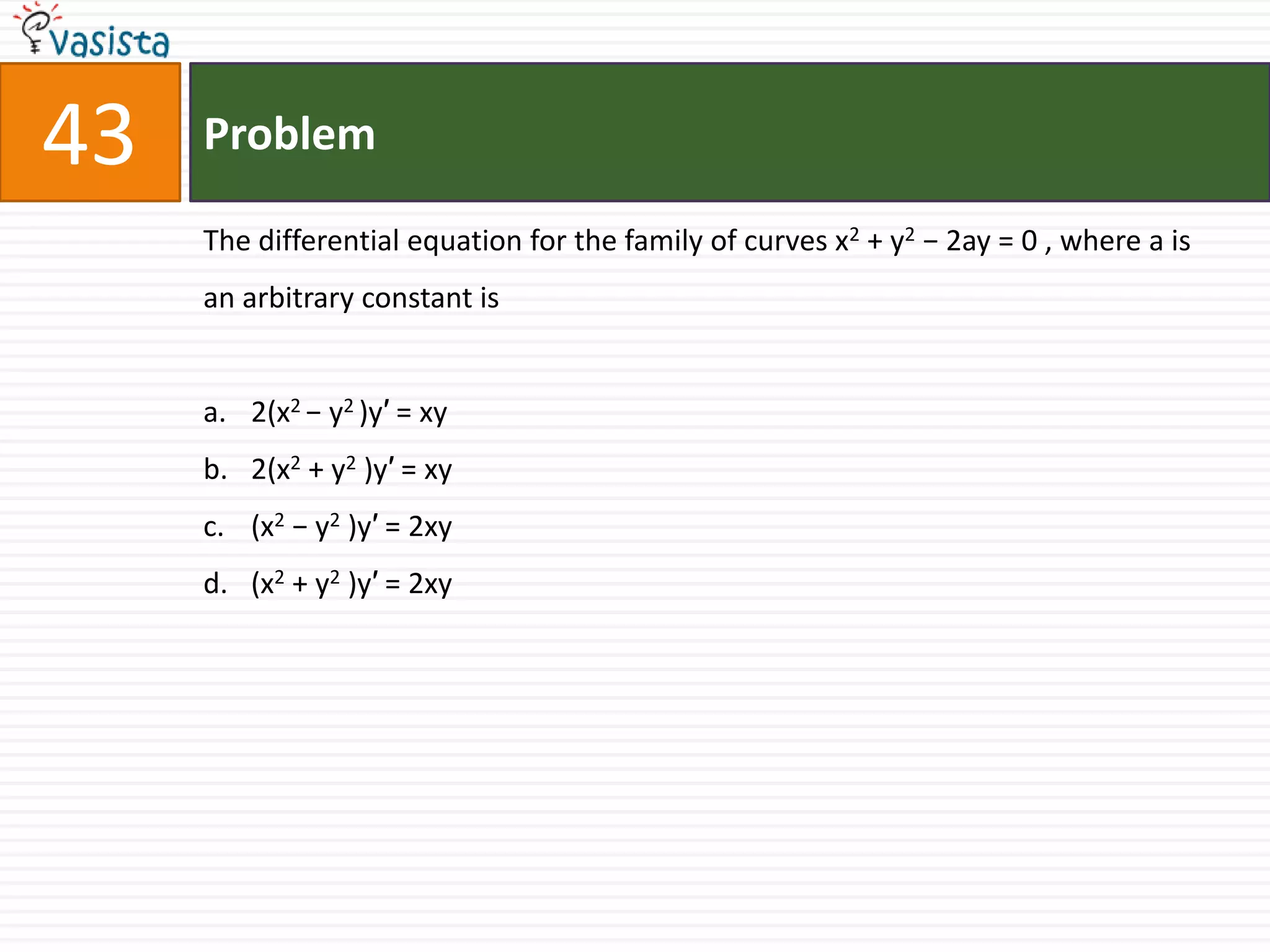
Problem43The differential equation for the family of curves x2 + y2 − 2ay = 0 , where a is an arbitrary constant is2(x2 − y2 )y′ = xy2(x2 + y2 )y′ = xy(x2 − y2 )y′ = 2xy (x2 + y2 )y′ = 2xy
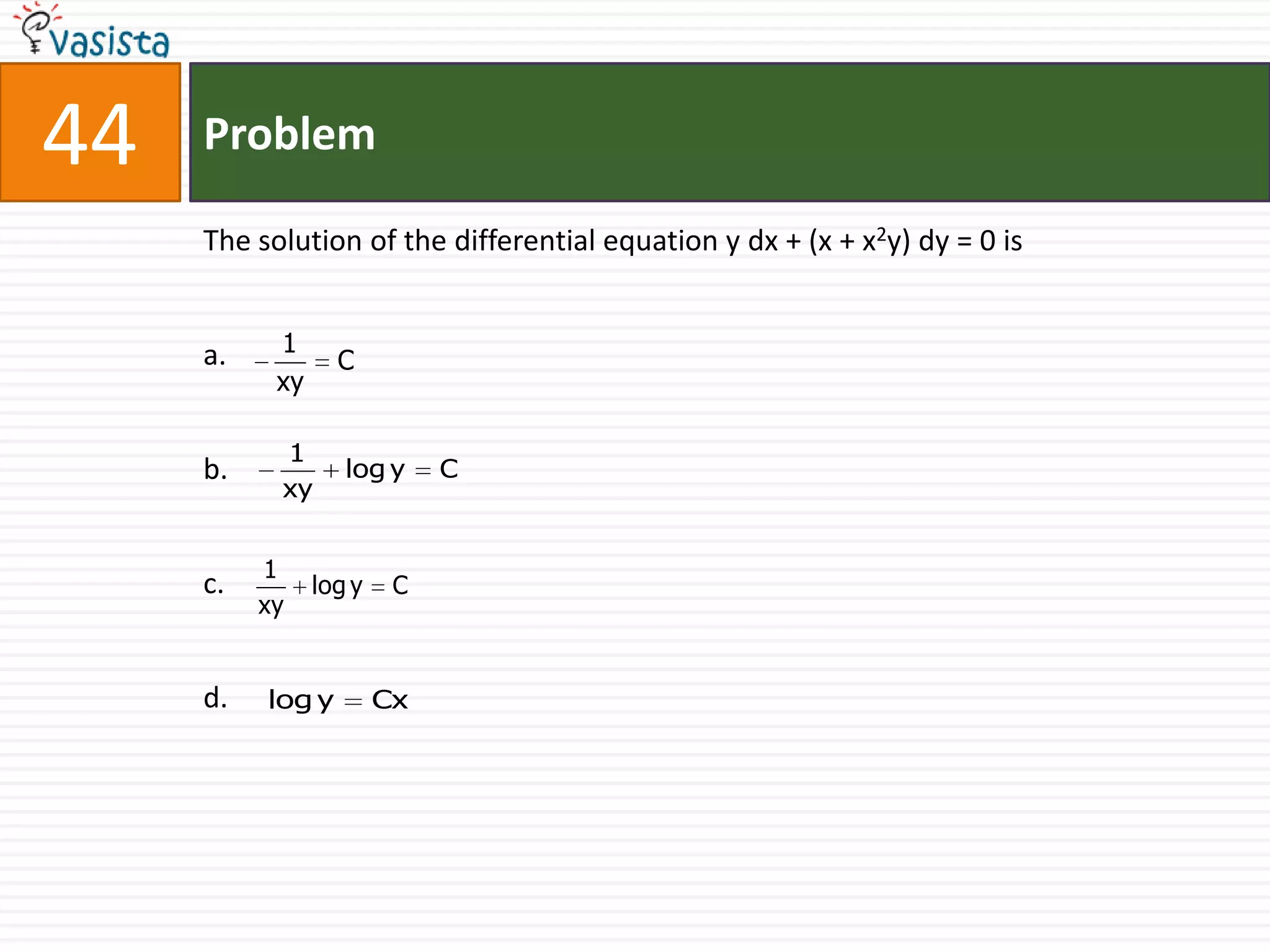
Problem44The solution of the differential equation y dx + (x + x2y) dy = 0 isa.b.c.d.
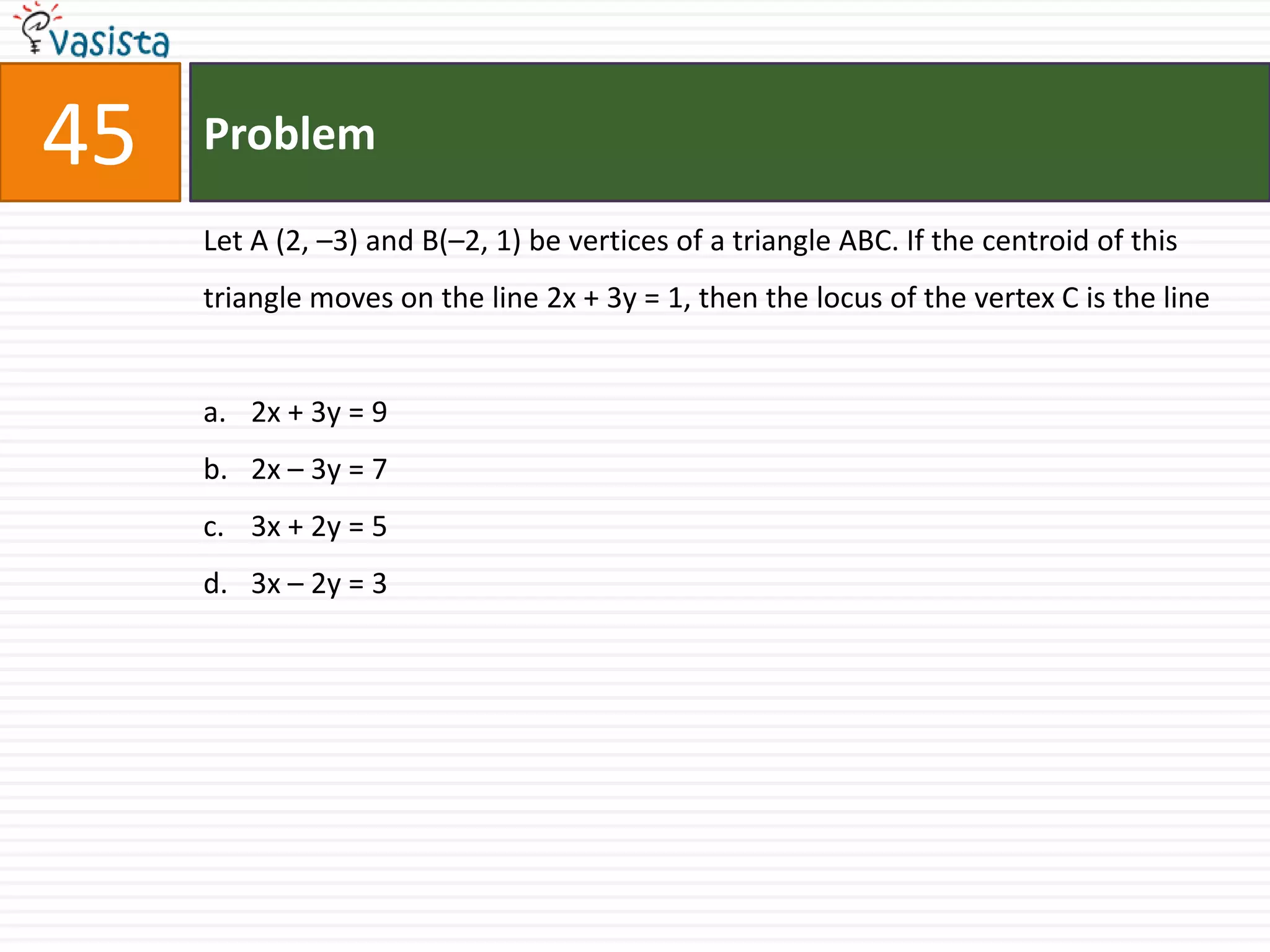
Problem45Let A (2, –3) and B(–2, 1) be vertices of a triangle ABC. If the centroid of this triangle moves on the line 2x + 3y = 1, then the locus of the vertex C is the line2x + 3y = 9 2x – 3y = 73x + 2y = 5 3x – 2y = 3
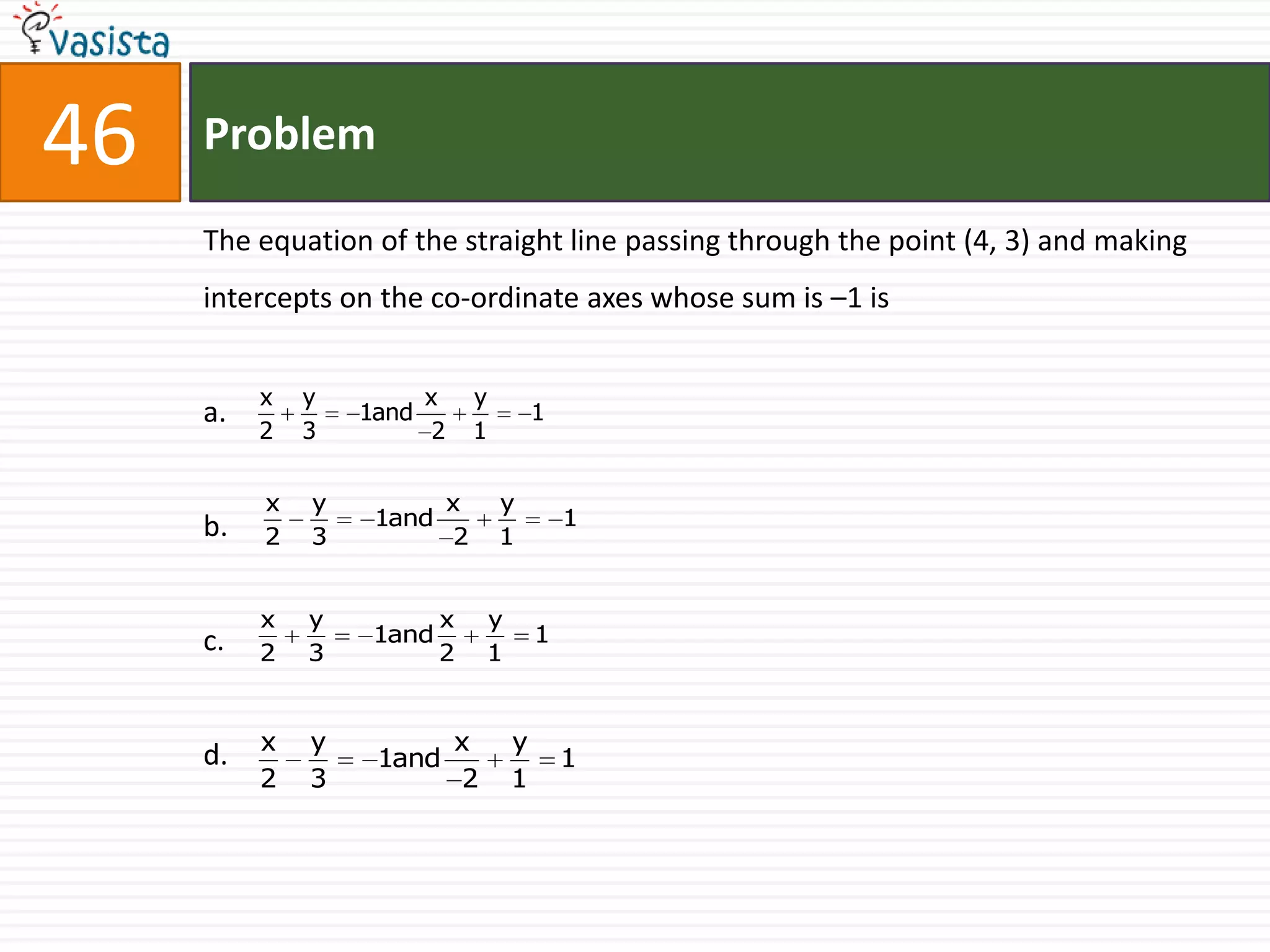
Problem46The equation of the straight line passing through the point (4, 3) and making intercepts on the co-ordinate axes whose sum is –1 isa.b.c.d.
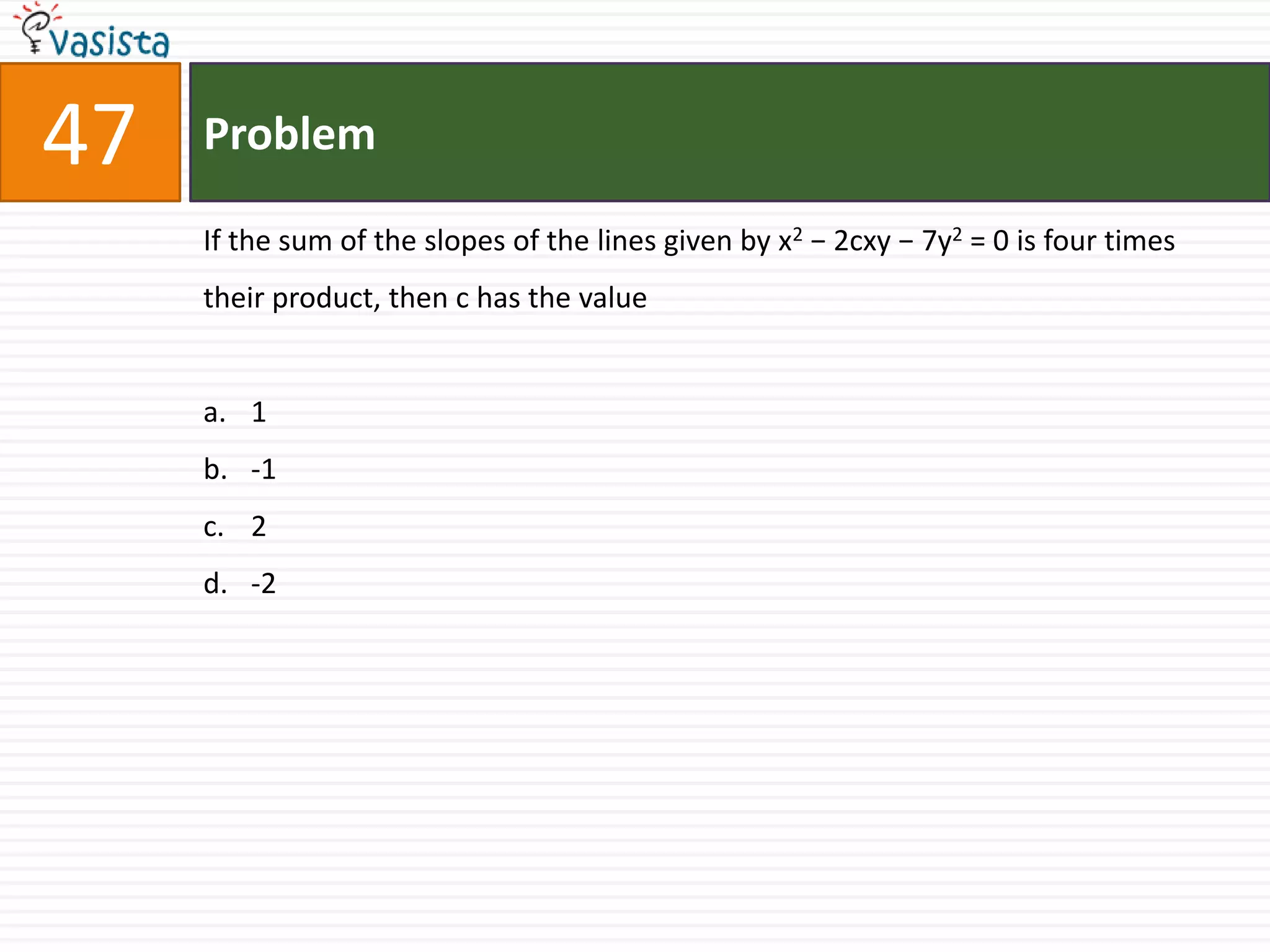
Problem47If the sum of the slopes of the lines given by x2 − 2cxy − 7y2 = 0 is four times their product, then c has the value1 -12 -2
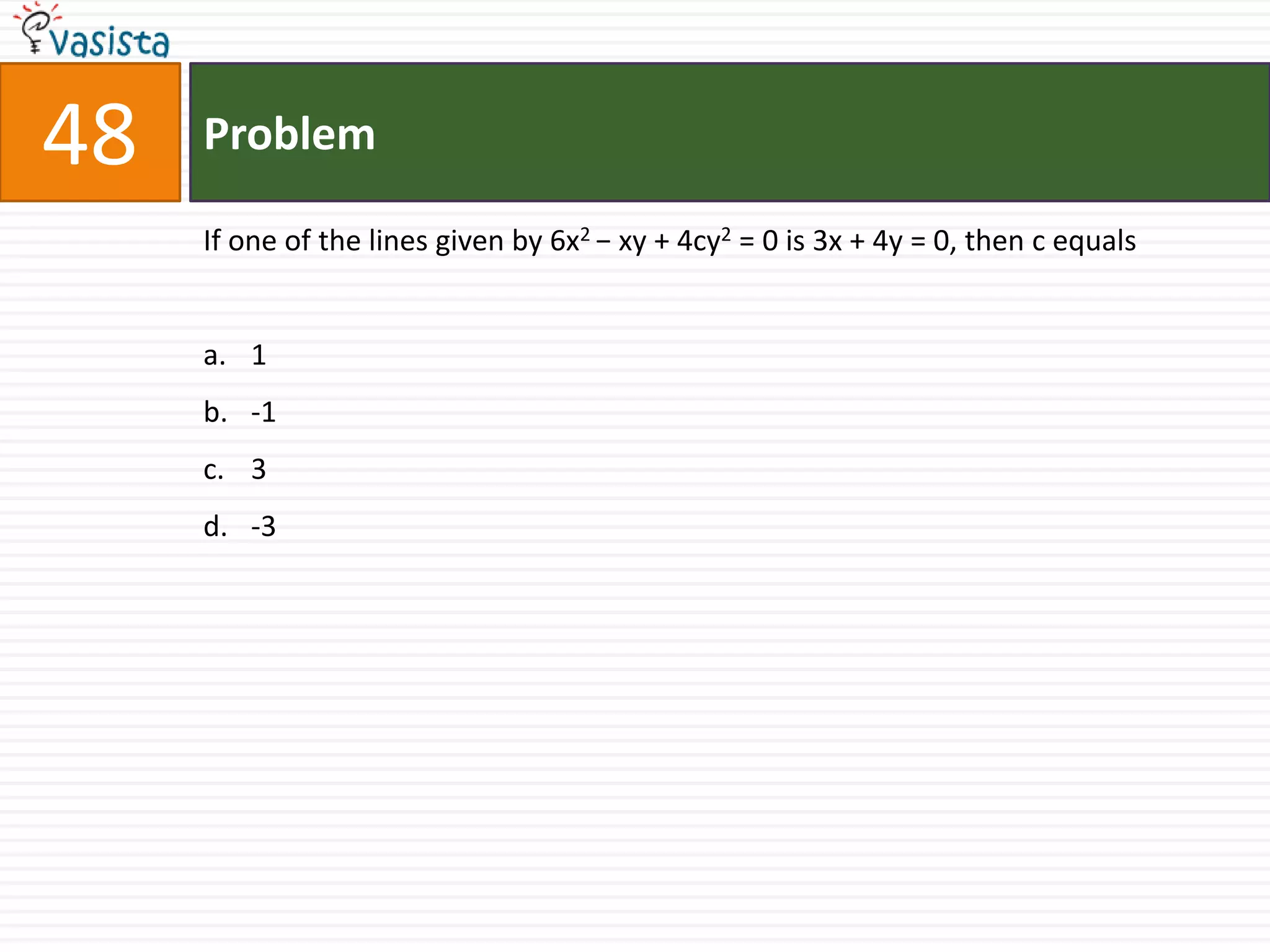
Problem48If one of the lines given by 6x2 − xy + 4cy2 = 0 is 3x + 4y = 0, then c equals1 -13 -3
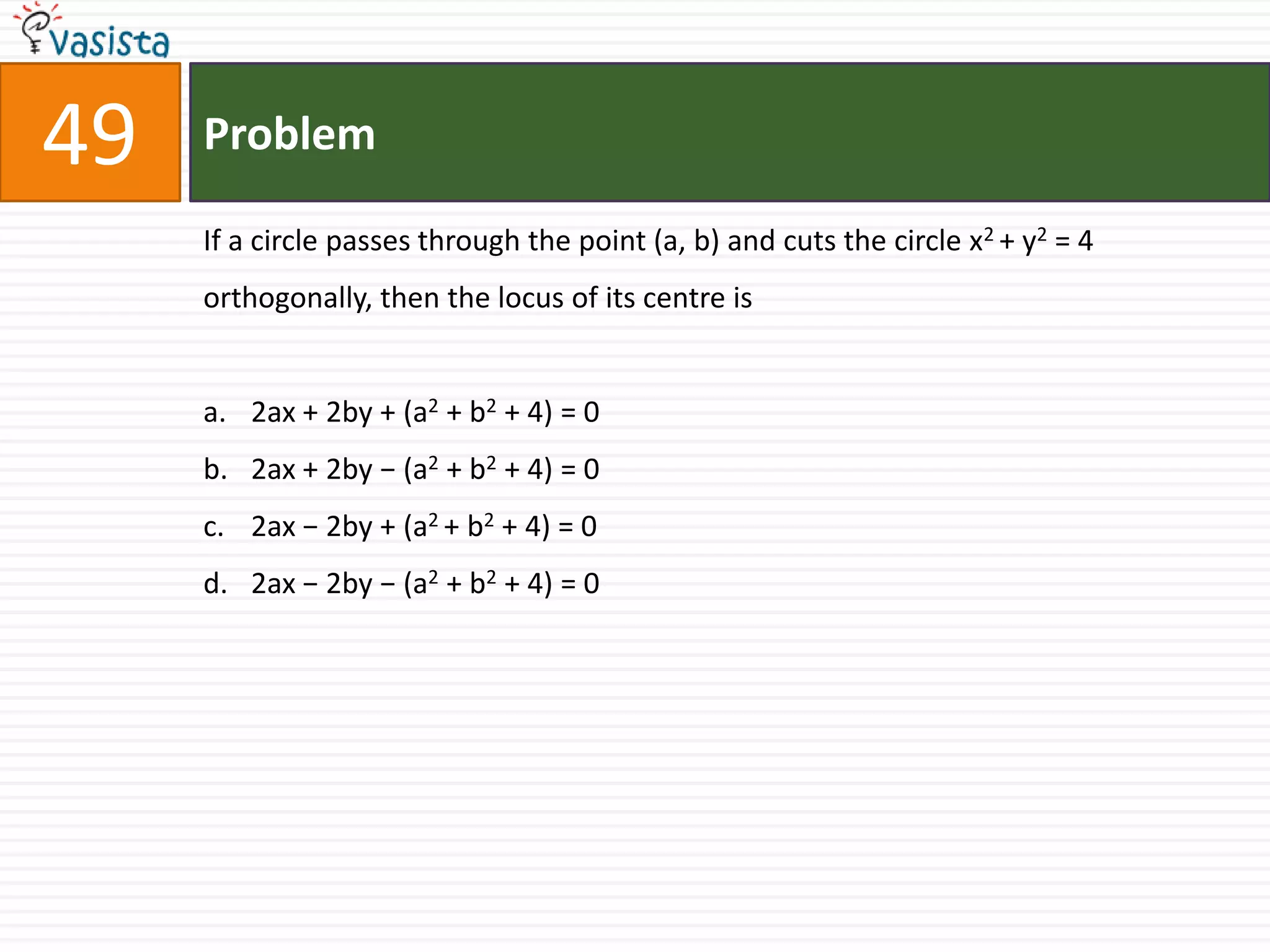
Problem49If a circle passes through the point (a, b) and cuts the circle x2 + y2 = 4 orthogonally, then the locus of its centre is2ax + 2by + (a2 + b2 + 4) = 0 2ax + 2by − (a2 + b2 + 4) = 02ax − 2by + (a2 + b2 + 4) = 0 2ax − 2by − (a2 + b2 + 4) = 0
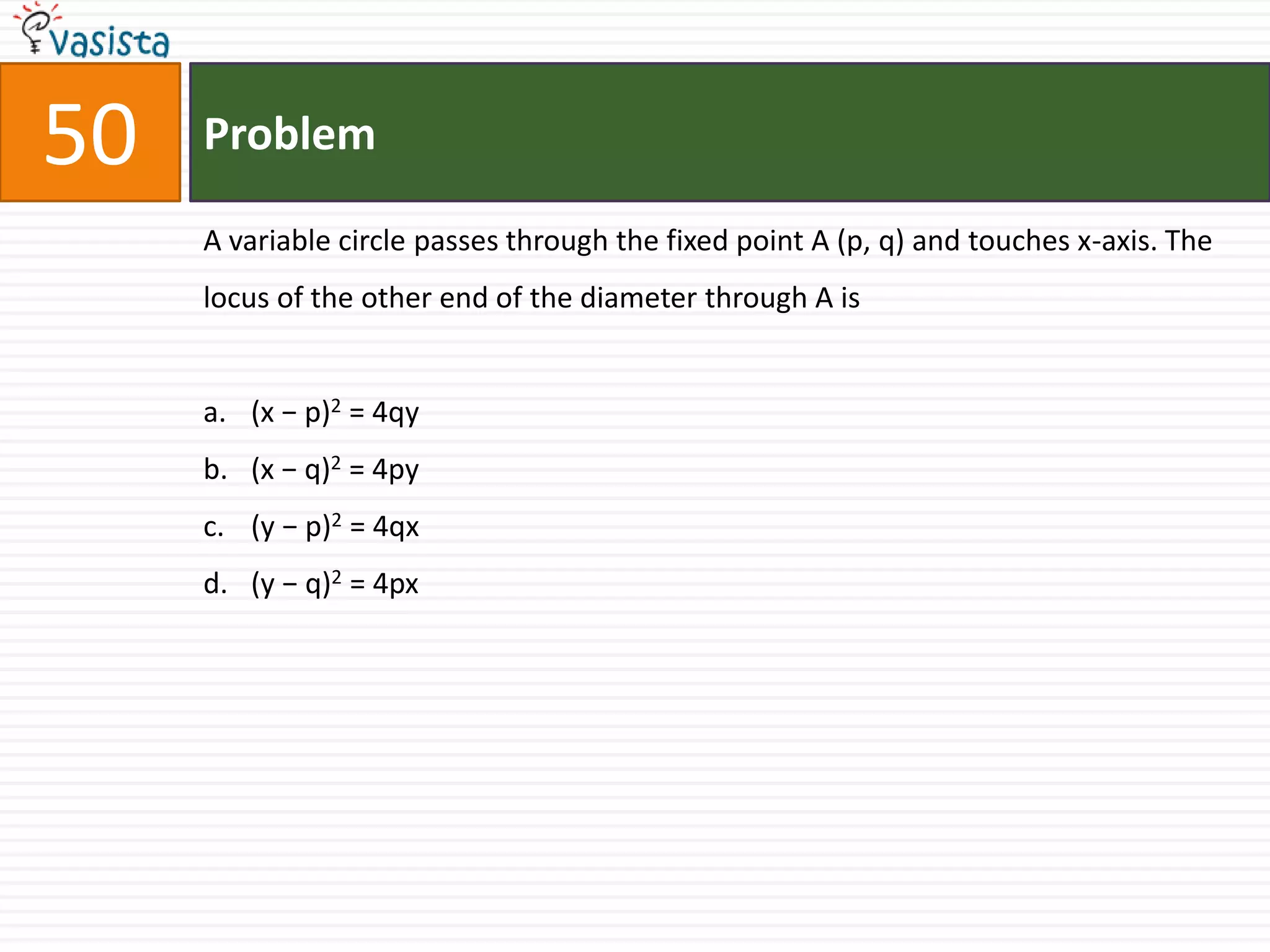
Problem50A variable circle passes through the fixed point A (p, q) and touches x-axis. The locus of the other end of the diameter through A is(x − p)2 = 4qy (x − q)2 = 4py(y − p)2 = 4qx (y − q)2 = 4px
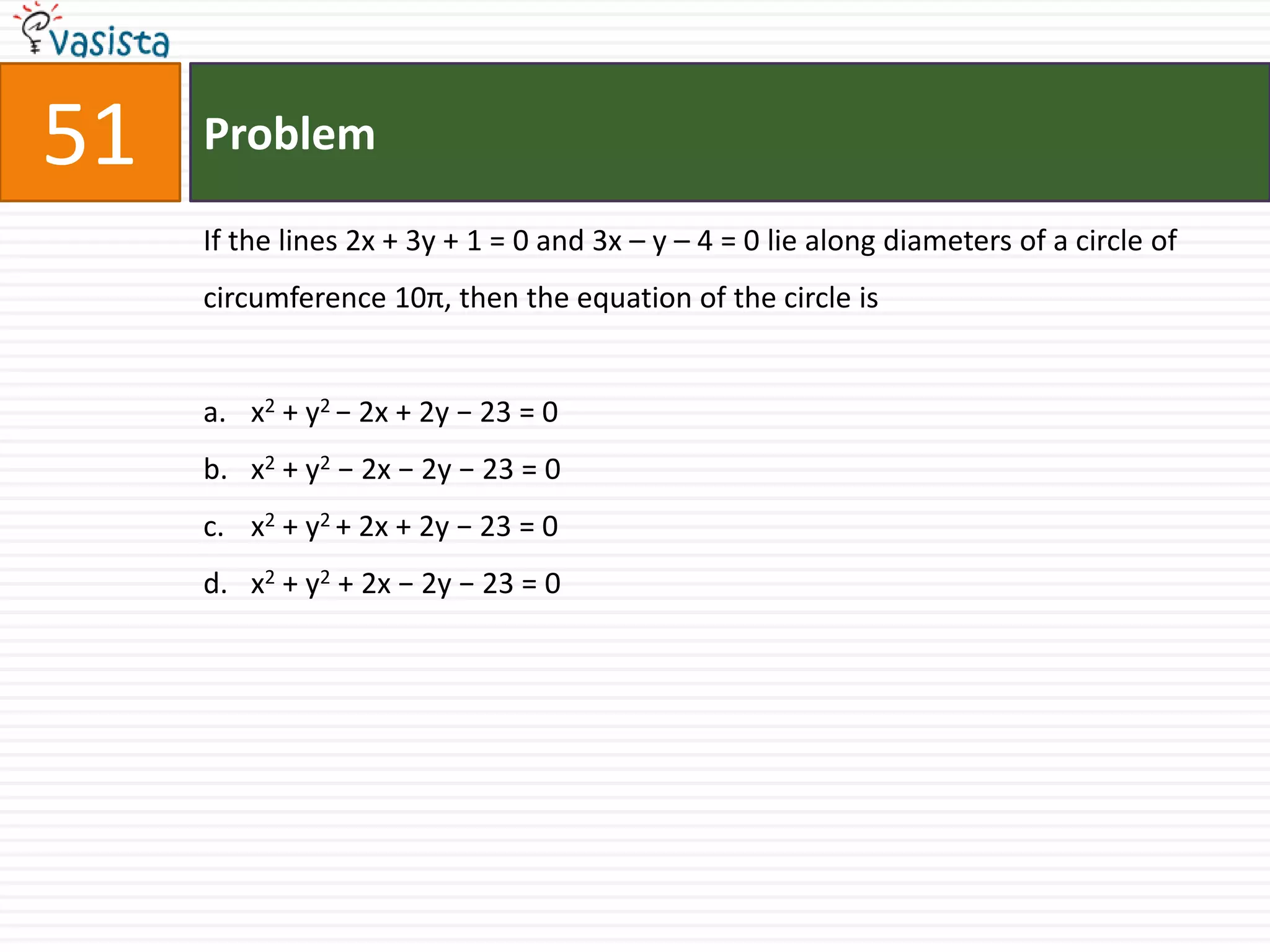
Problem51If the lines 2x + 3y + 1 = 0 and 3x – y – 4 = 0 lie along diameters of a circle of circumference 10π, then the equation of the circle isx2 + y2 − 2x + 2y − 23 = 0x2 + y2 − 2x − 2y − 23 = 0x2 + y2 + 2x + 2y − 23 = 0x2 + y2 + 2x − 2y − 23 = 0
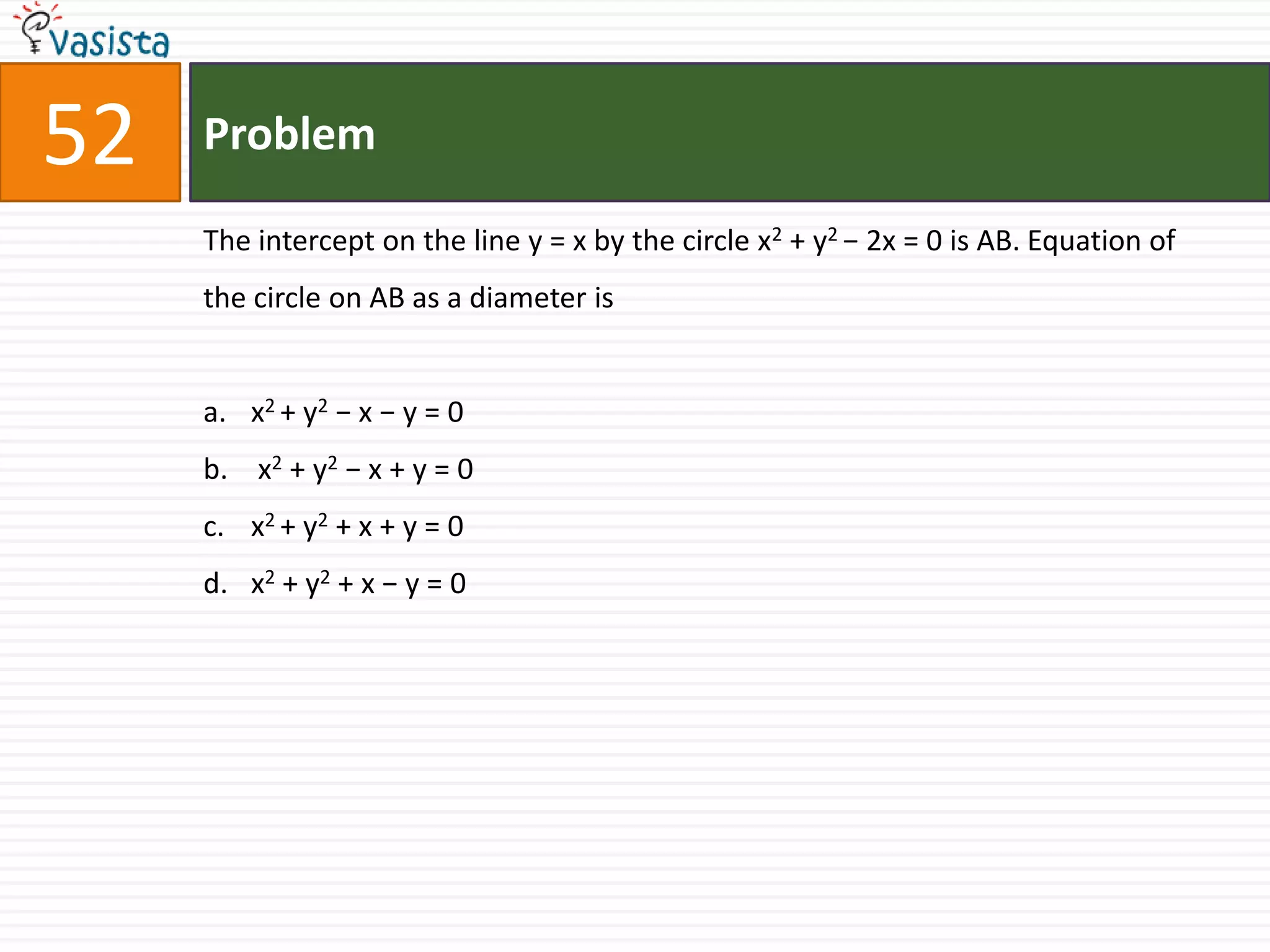
Problem52The intercept on the line y = x by the circle x2 + y2 − 2x = 0 is AB. Equation of the circle on AB as a diameter isx2 + y2 − x − y = 0  x2 + y2 − x + y = 0x2 + y2 + x + y = 0 x2 + y2 + x − y = 0
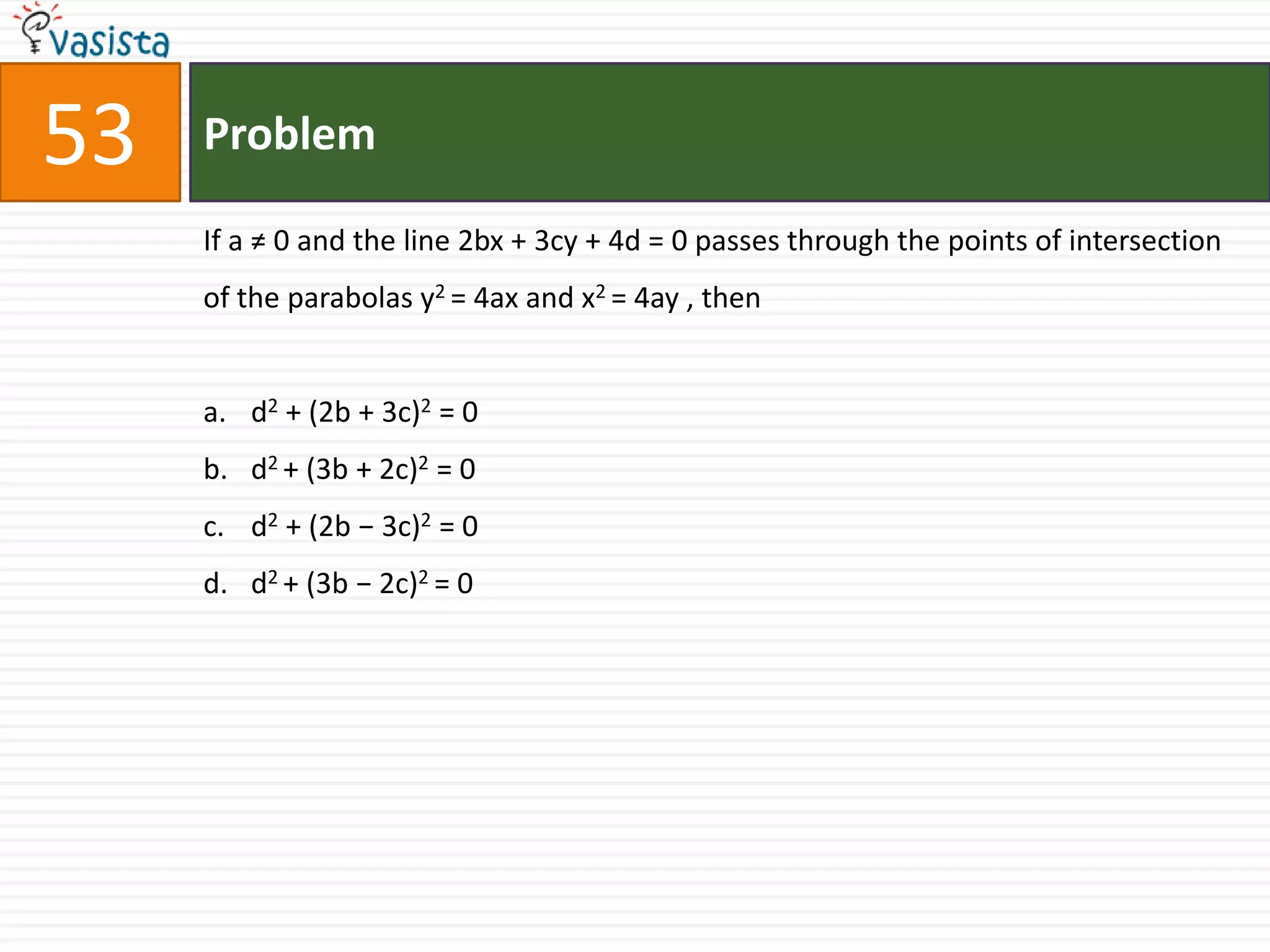
Problem53If a ≠ 0 and the line 2bx + 3cy + 4d = 0 passes through the points of intersection of the parabolas y2 = 4ax and x2 = 4ay , thend2 + (2b + 3c)2 = 0 d2 + (3b + 2c)2 = 0d2 + (2b − 3c)2 = 0d2 + (3b − 2c)2 = 0
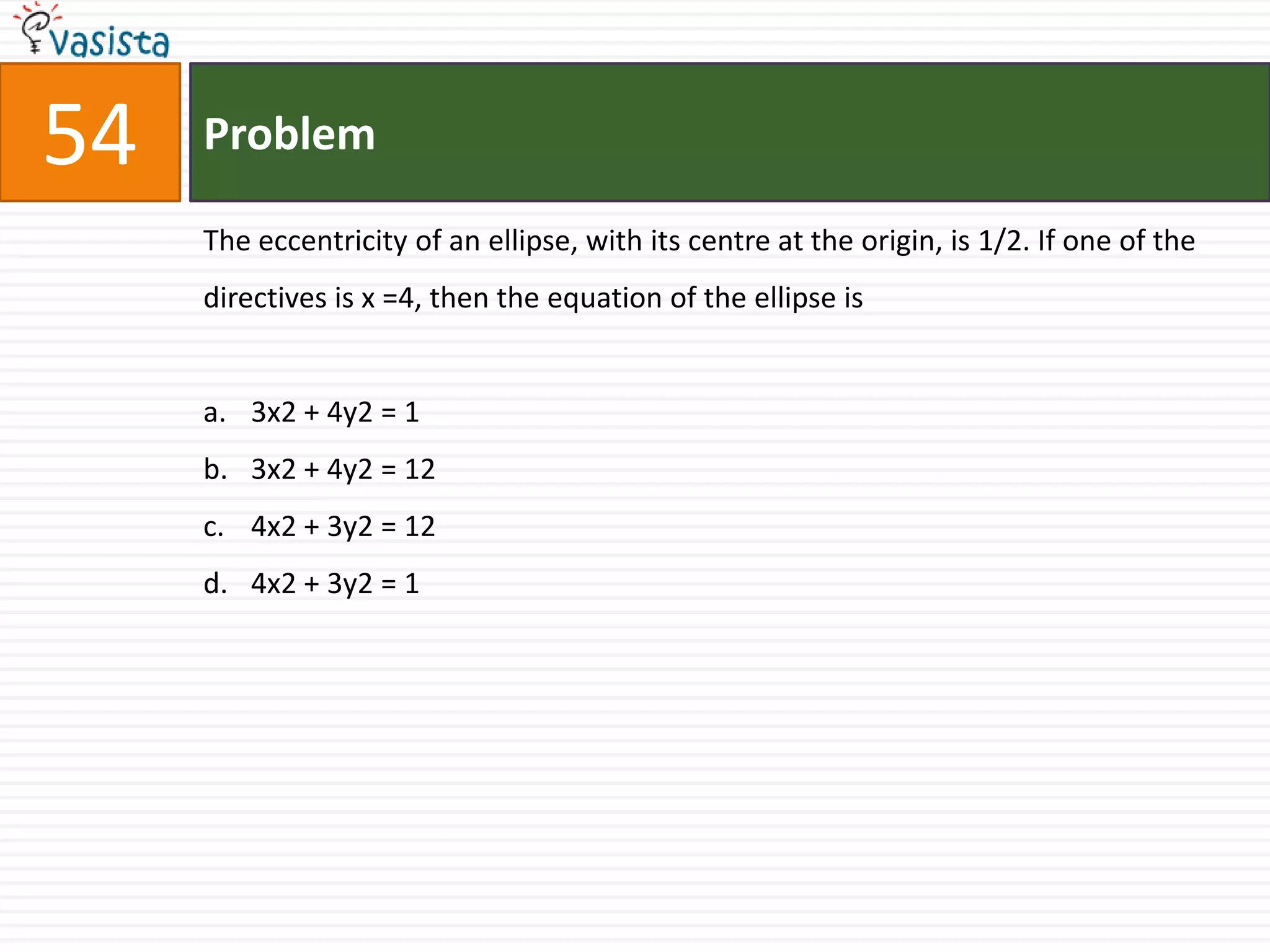
Problem54The eccentricity of an ellipse, with its centre at the origin, is 1/2. If one of the directives is x =4, then the equation of the ellipse is3x2 + 4y2 = 1 3x2 + 4y2 = 124x2 + 3y2 = 12 4x2 + 3y2 = 1
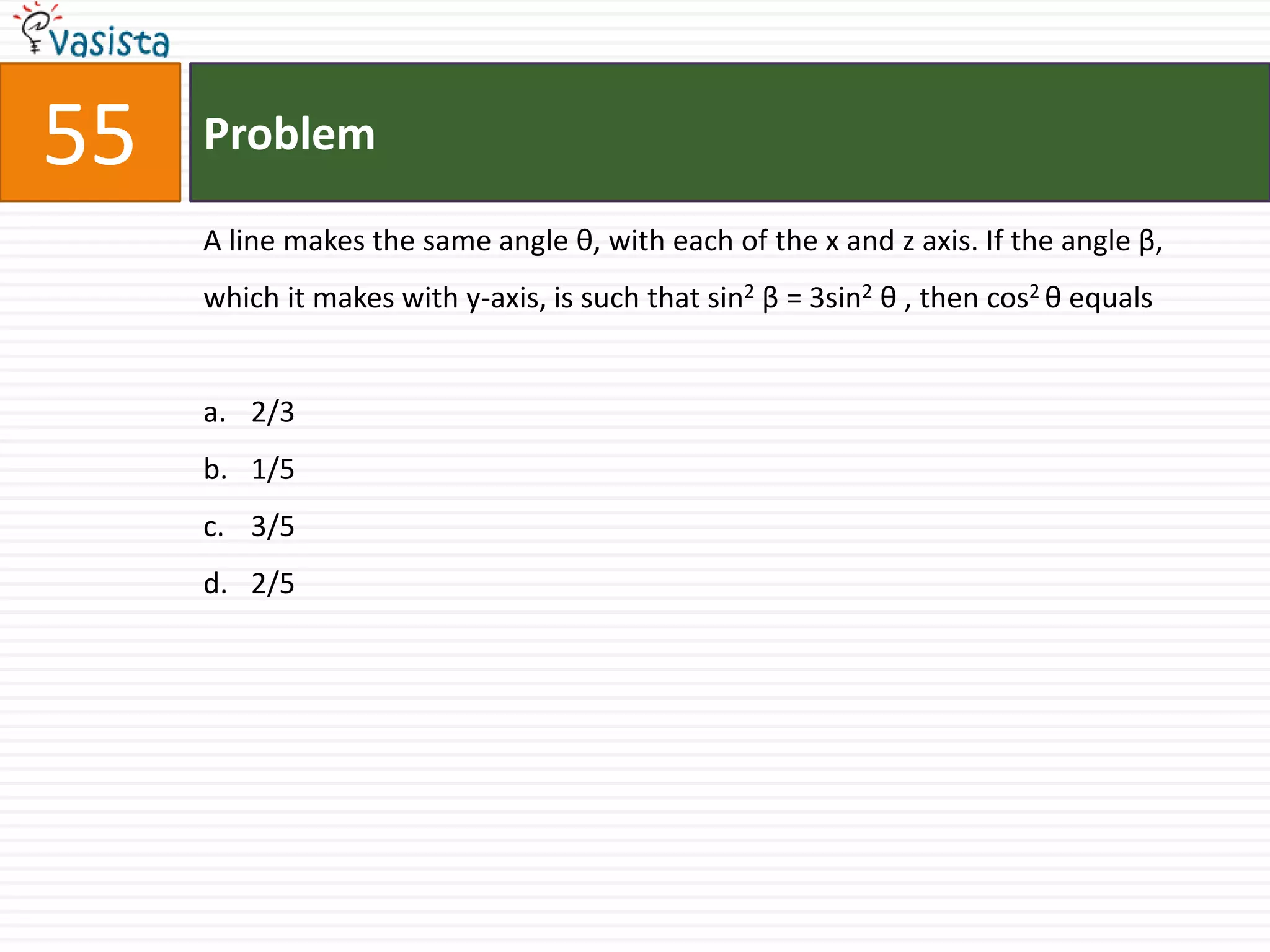
Problem55A line makes the same angle θ, with each of the x and z axis. If the angle β, which it makes with y-axis, is such that sin2 β = 3sin2 θ , then cos2 θ equals2/31/53/52/5
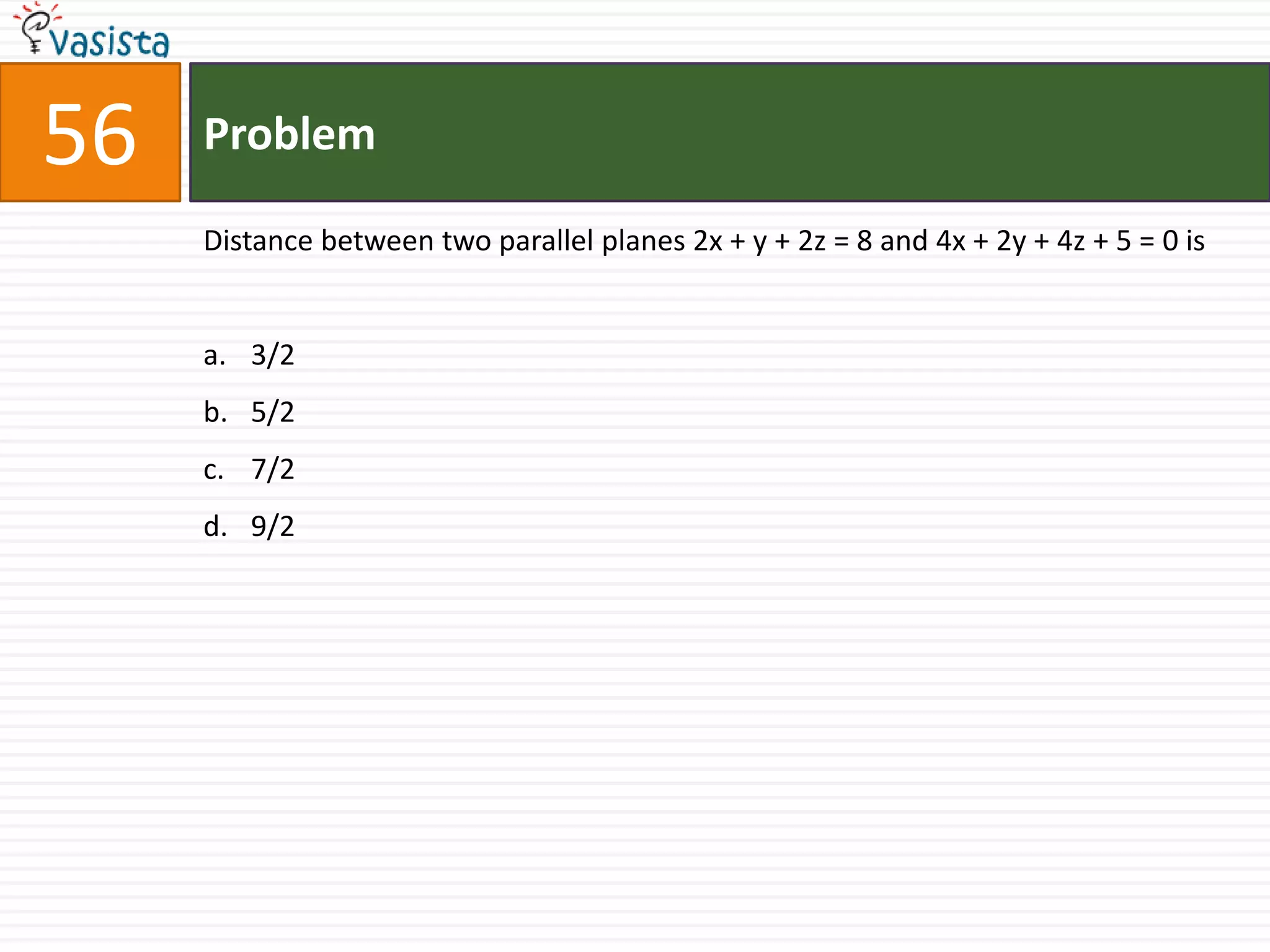
Problem56Distance between two parallel planes 2x + y + 2z = 8 and 4x + 2y + 4z + 5 = 0 is3/25/27/29/2
Problem57A line with direction cosines proportional to 2, 1, 2 meets each of the lines x = y + a = z and x + a = 2y = 2z. The co-ordinates of each of the point of intersection are given by(3a, 3a, 3a), (a, a, a) (3a, 2a, 3a), (a, a, a)(3a, 2a, 3a), (a, a, 2a) (2a, 3a, 3a), (2a, a, a)
Problem58If the straight lines x = 1 + s, y = –3 – λs, z = 1 + λs and x = t/2, y = 1 + t, z = 2 – t withparameters s and t respectively, are co-planar then λ equals–2 –1 – 1/2 0
Problem59The intersection of the spheres x2 + y2 + z2 + 7x − 2y − z = 13 andx2 + y2 + z2 − 3x + 3y + 4z = 8 is the same as the intersection of one of the sphere and the planex – y – z = 1 x – 2y – z = 1x – y – 2z = 12x – y – z = 1
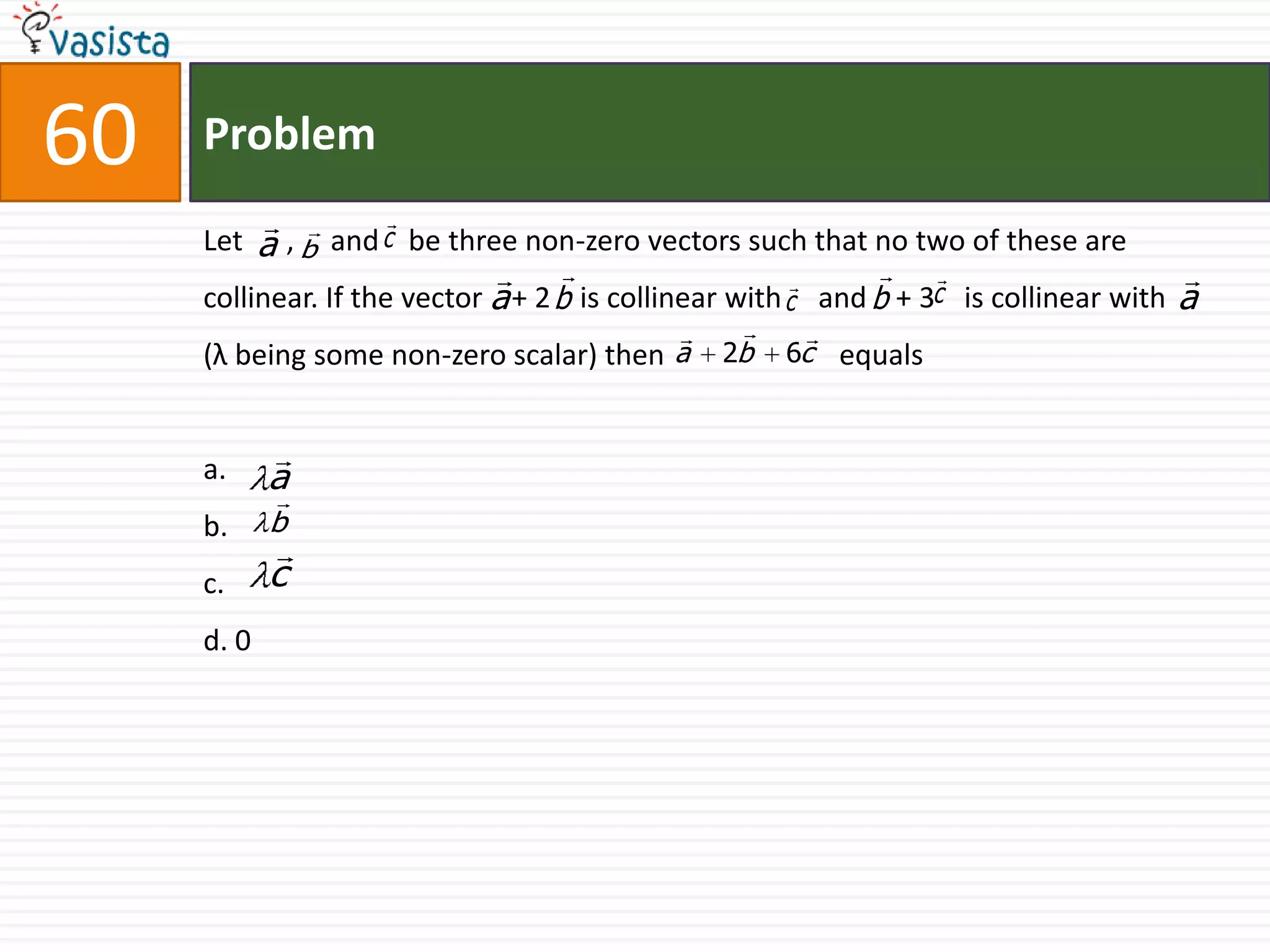
Problem60Let      ,     and    be three non-zero vectors such that no two of these are collinear. If the vector    + 2    is collinear with     and    + 3    is collinear with(λ being some non-zero scalar) then                        equalsa.b.c.d. 0
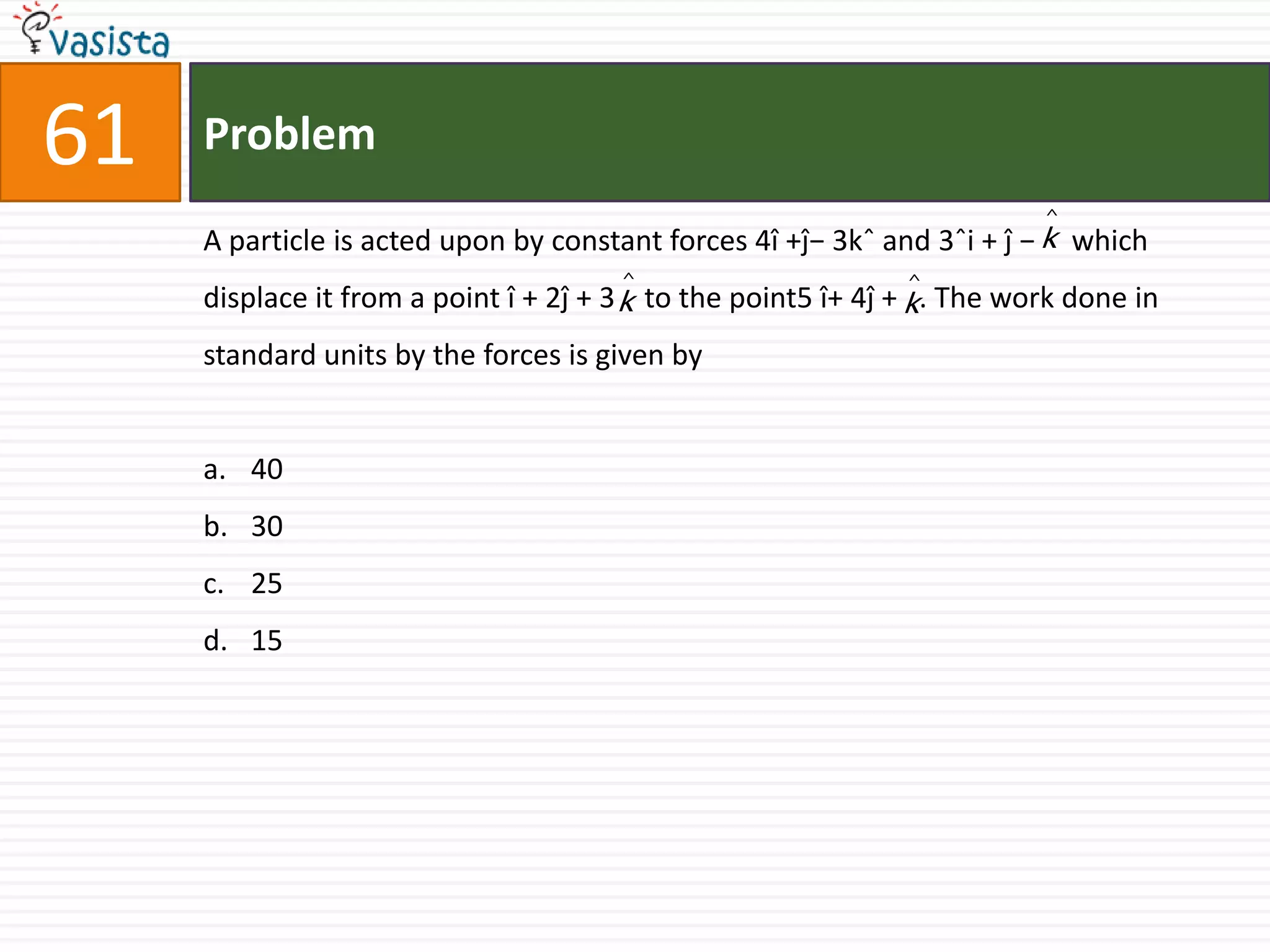
Problem61A particle is acted upon by constant forces 4î +ĵ− 3kˆ and 3ˆi + ĵ −     which displace it from a point î + 2ĵ + 3    to the point5 î+ 4ĵ +   . The work done in standard units by the forces is given by40 3025 15
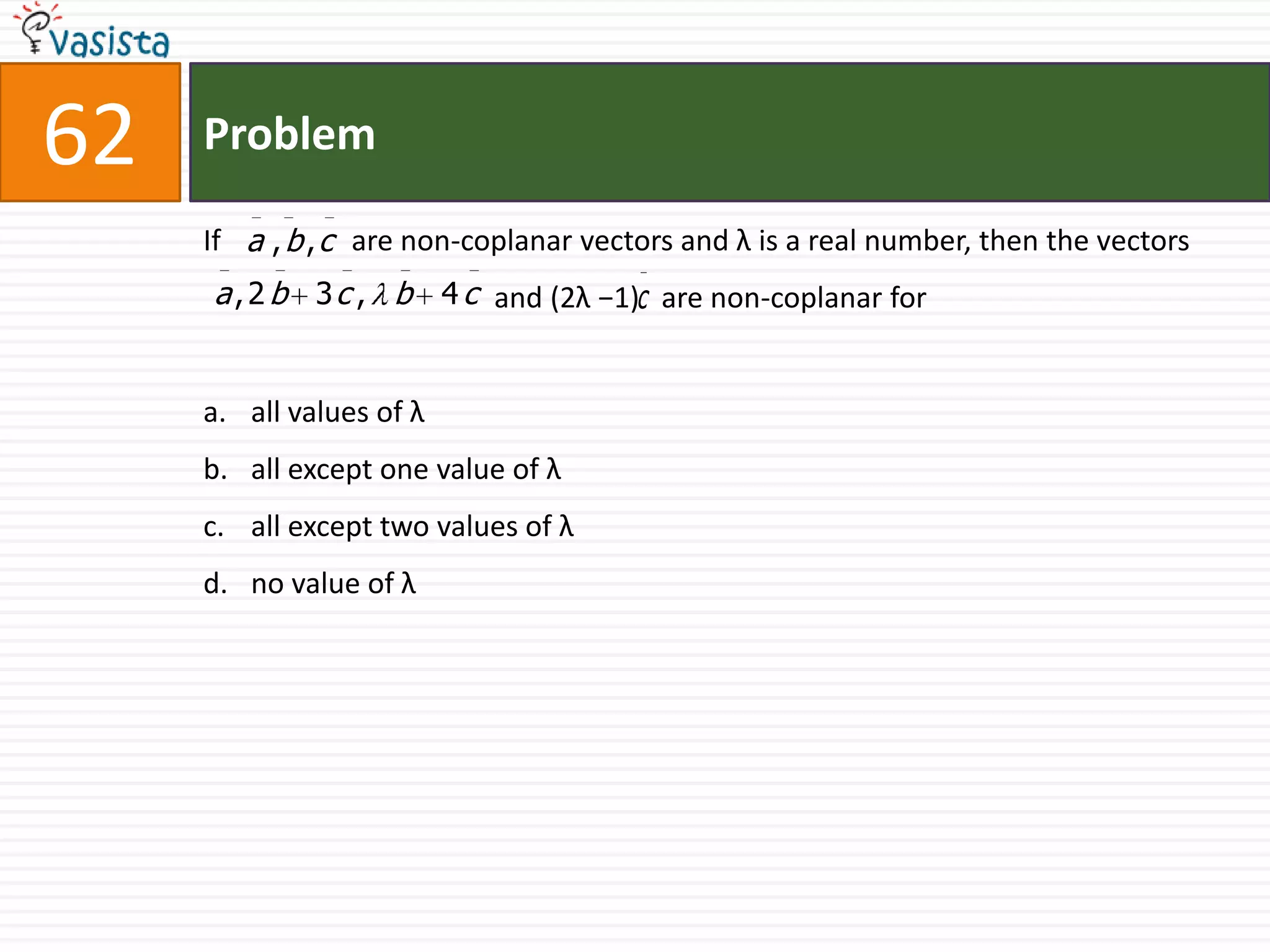
Problem62If                  are non-coplanar vectors and λ is a real number, then the vectors                                        and (2λ −1)   are non-coplanar forall values of λ all except one value of λall except two values of λno value of λ
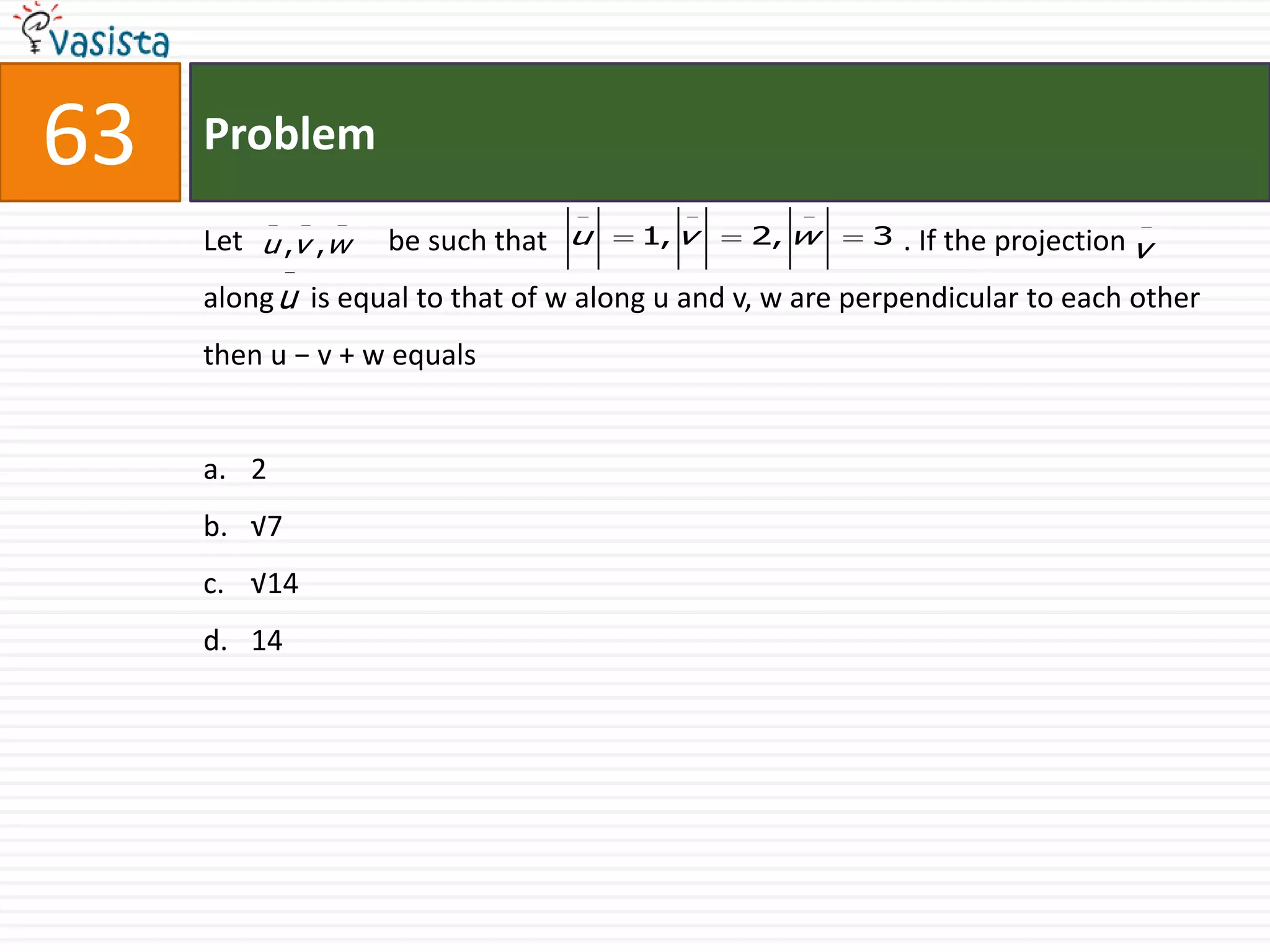
Problem63Let                    be such that                                                 . If the projection    along     is equal to that of w along u and v, w are perpendicular to each other then u − v + w equals2√7√1414
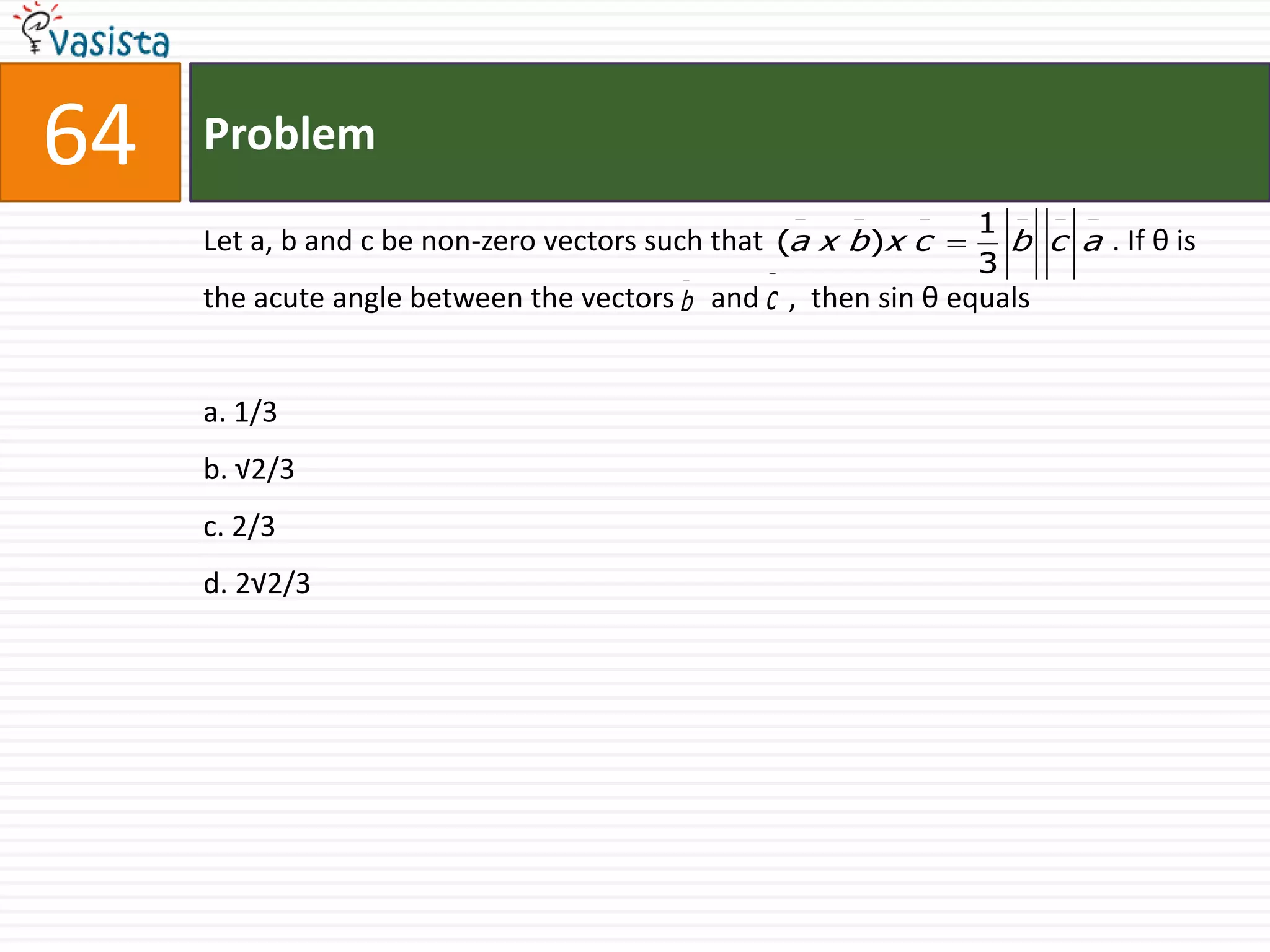
Problem64Let a, b and c be non-zero vectors such that                                                . If θ is the acute angle between the vectors     and    ,  then sin θ equalsa. 1/3b. √2/3c. 2/3d. 2√2/3
Problem65Consider the following statements:(a) Mode can be computed from histogram(b) Median is not independent of change of scale(c) Variance is independent of change of origin and scale.Which of these is/are correct?only (a)only (b)only (a) and (b)(a), (b) and (c)
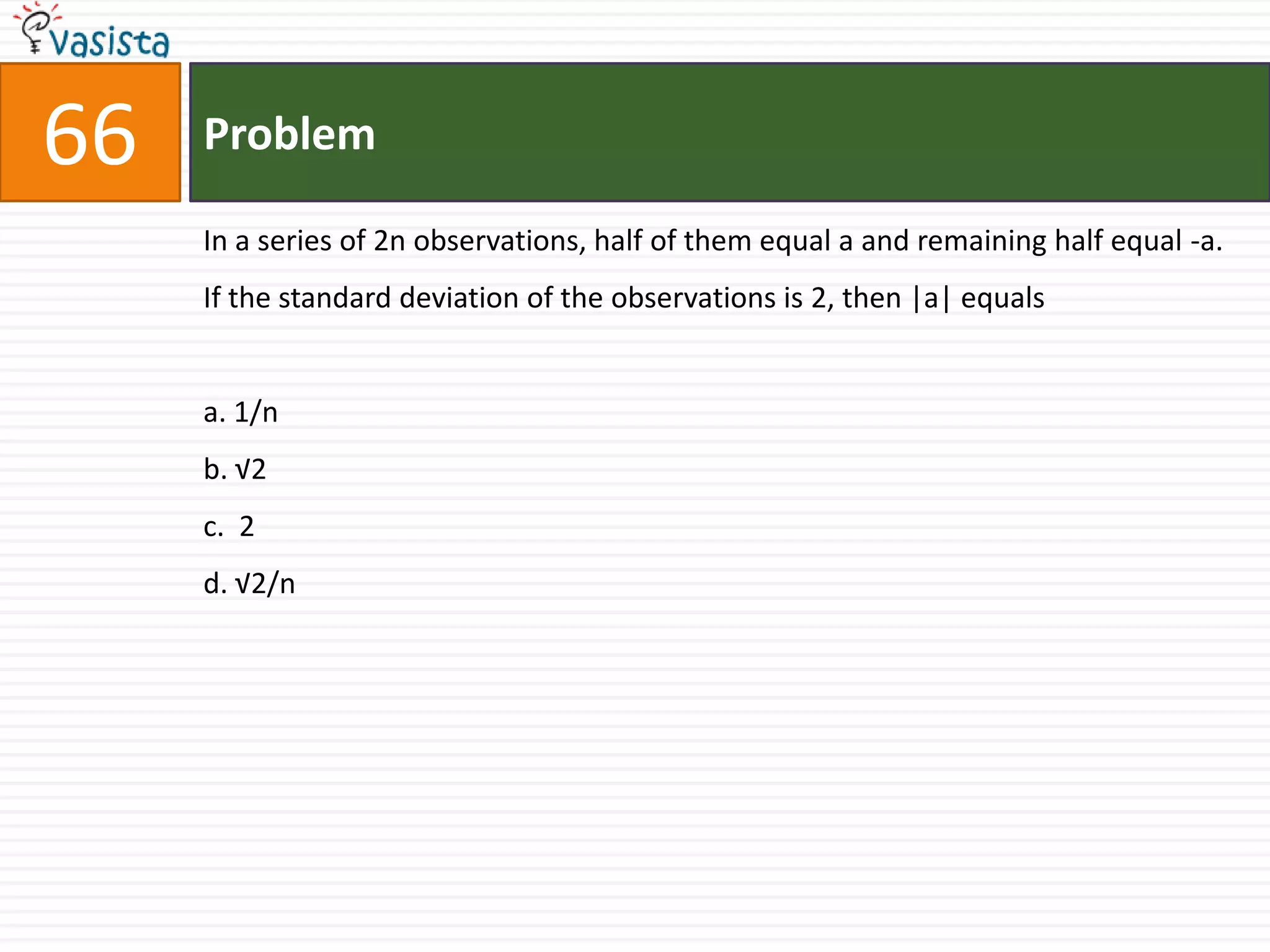
Problem66In a series of 2n observations, half of them equal a and remaining half equal -a. If the standard deviation of the observations is 2, then |a| equalsa. 1/nb. √2c.  2d. √2/n
Problem67The probability that A speaks truth is 4/5, while this probability for B is 3/4. The probability that they contradict each other when asked to speak on a fact isa. 3/20b. 1/5c. 7/20d. 4/5
Problem68A random variable X has the probability distribution: For the events E = {X is a prime number} and F = {X < 4}, the probability P (E ∪ F) is0.870.770.350.50
Problem69The mean and the variance of a binomial distribution are 4 and 2 respectively. Then the probability of 2 successes is37/256219/256128/25628/256
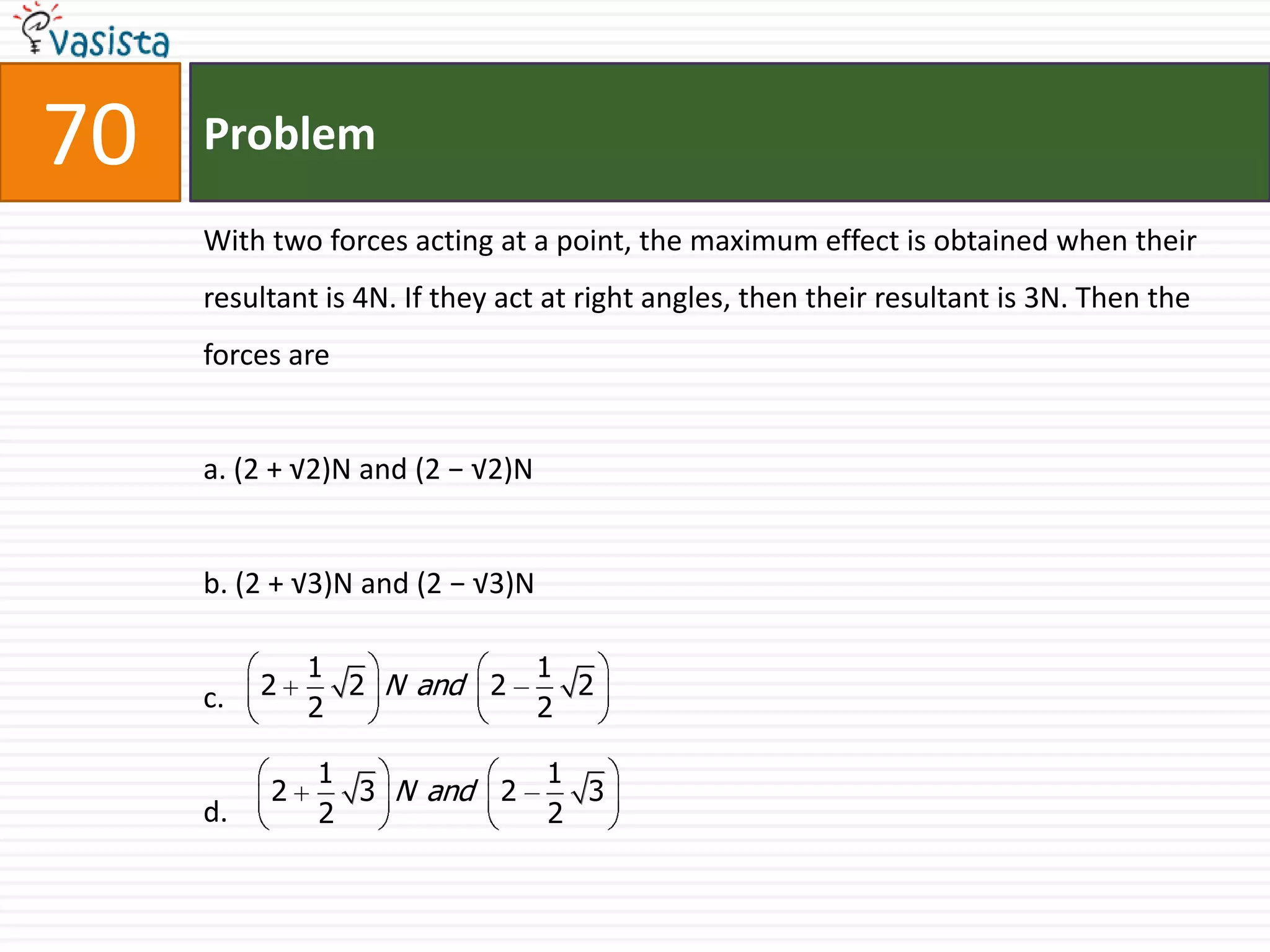
Problem70With two forces acting at a point, the maximum effect is obtained when their resultant is 4N. If they act at right angles, then their resultant is 3N. Then the forces area. (2 + √2)N and (2 − √2)Nb. (2 + √3)N and (2 − √3)Nc.d.
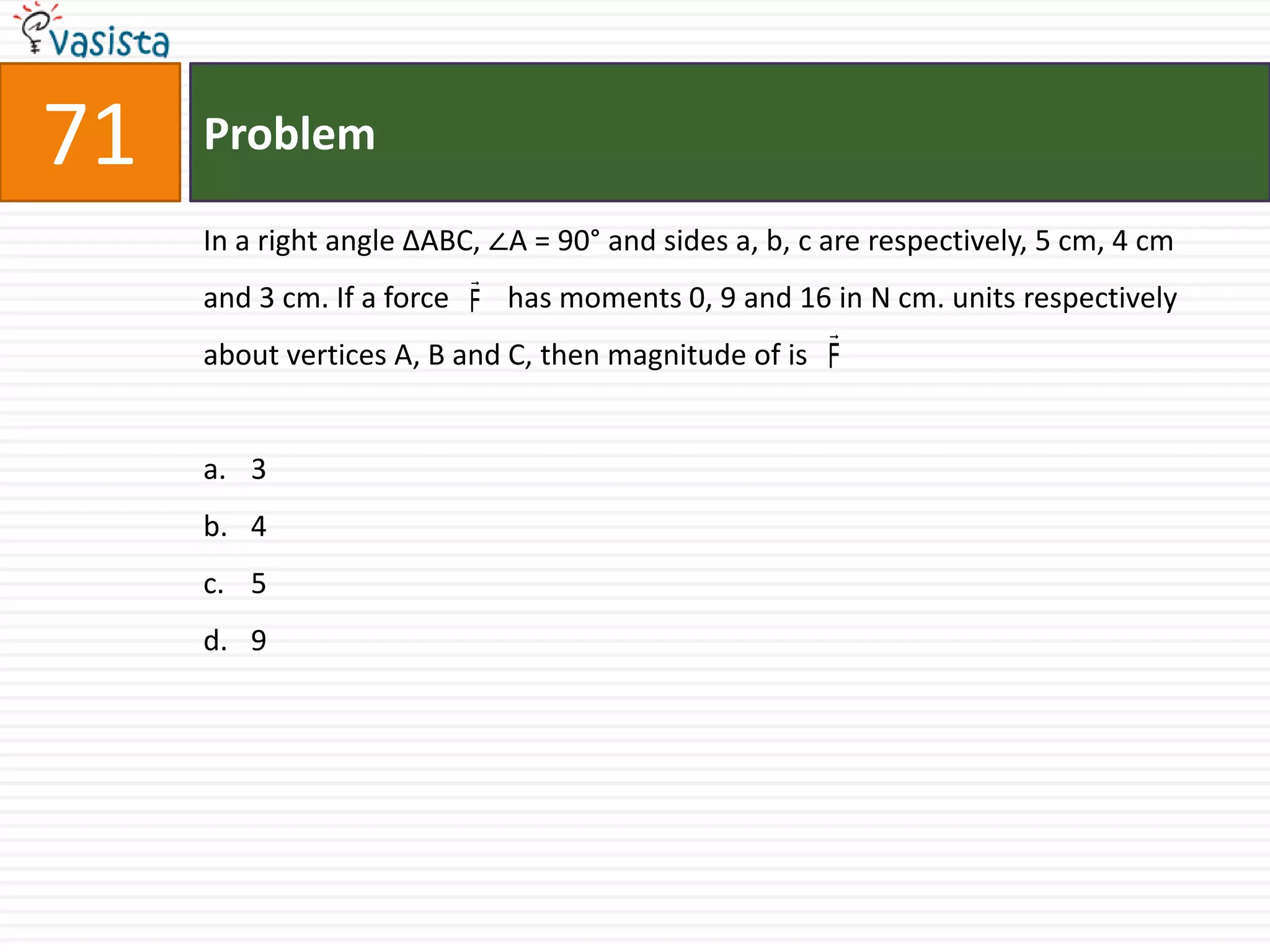
Problem71In a right angle ΔABC, ∠A = 90° and sides a, b, c are respectively, 5 cm, 4 cm and 3 cm. If a force        has moments 0, 9 and 16 in N cm. units respectively about vertices A, B and C, then magnitude of is3 45 9
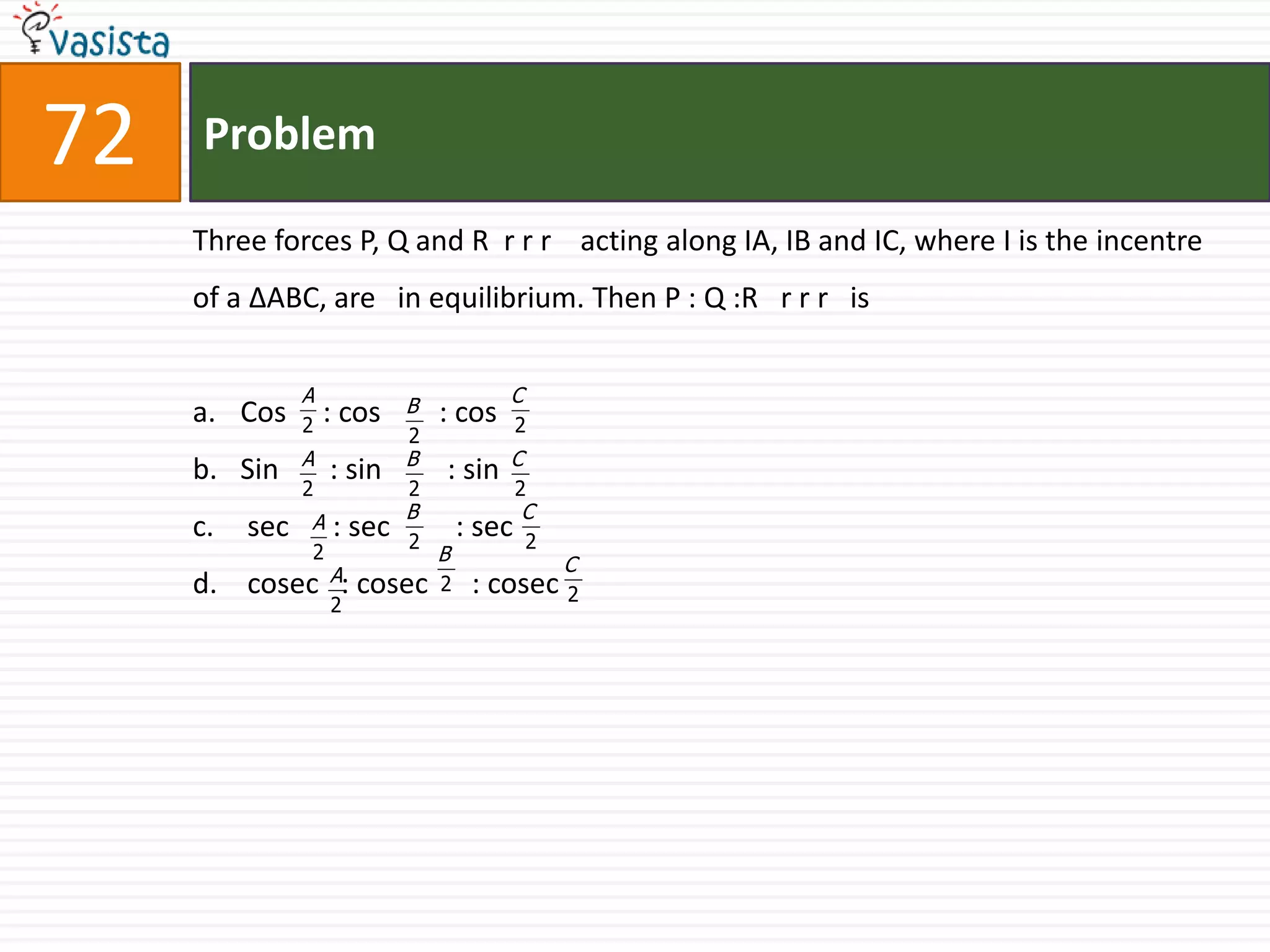
Problem72Three forces P, Q and R  rrr    acting along IA, IB and IC, where I is the incentre of a ΔABC, are   in equilibrium. Then P : Q :R   rrr   isCos     : cos        : cosSin       : sin         : sin sec      : sec         : sec cosec   : cosec      : cosec
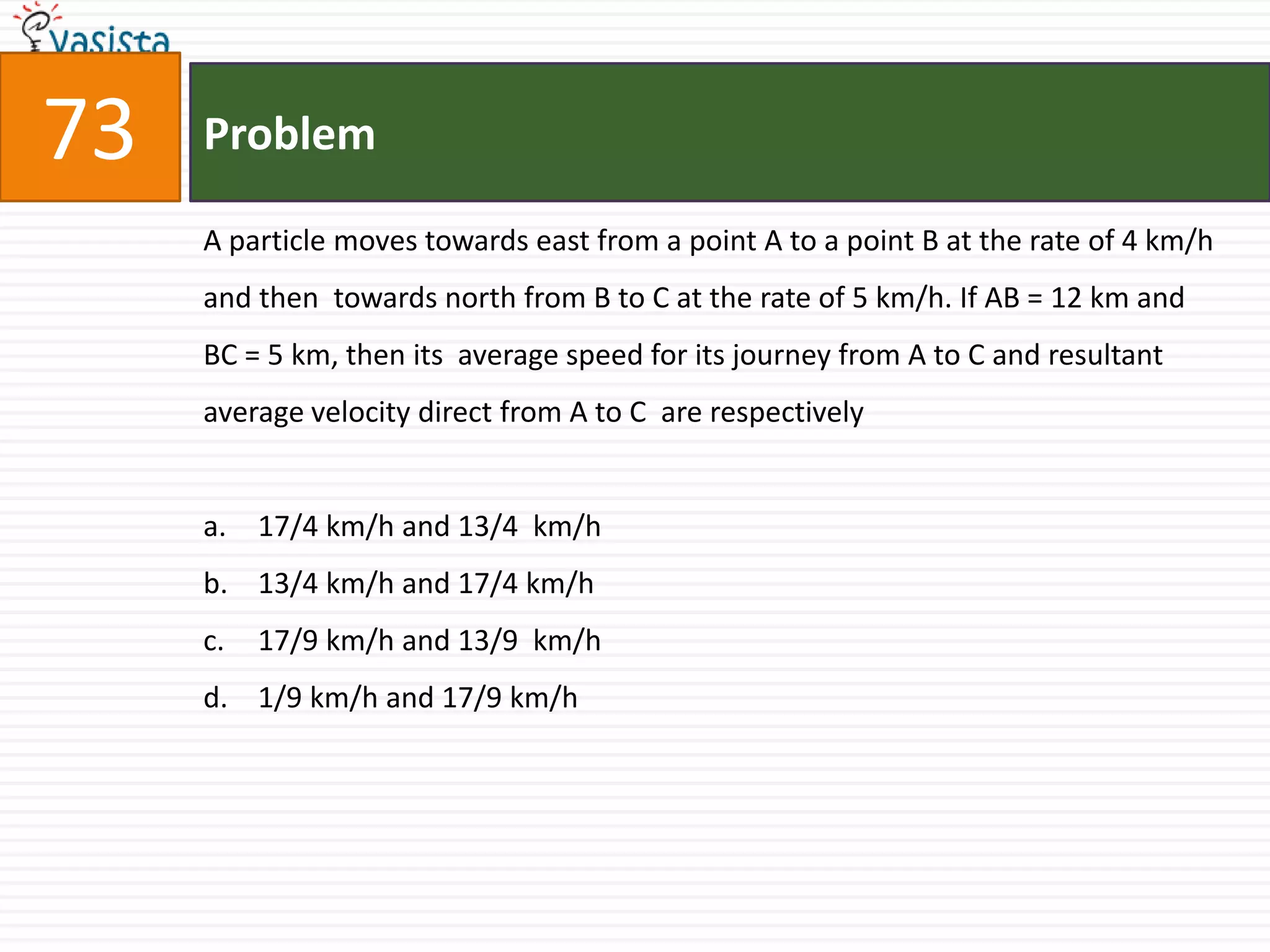
Problem73A particle moves towards east from a point A to a point B at the rate of 4 km/h and then  towards north from B to C at the rate of 5 km/h. If AB = 12 km and BC = 5 km, then its  average speed for its journey from A to C and resultant average velocity direct from A to C  are respectively 17/4 km/h and 13/4  km/h  13/4 km/h and 17/4 km/h 17/9 km/h and 13/9  km/h  1/9 km/h and 17/9 km/h
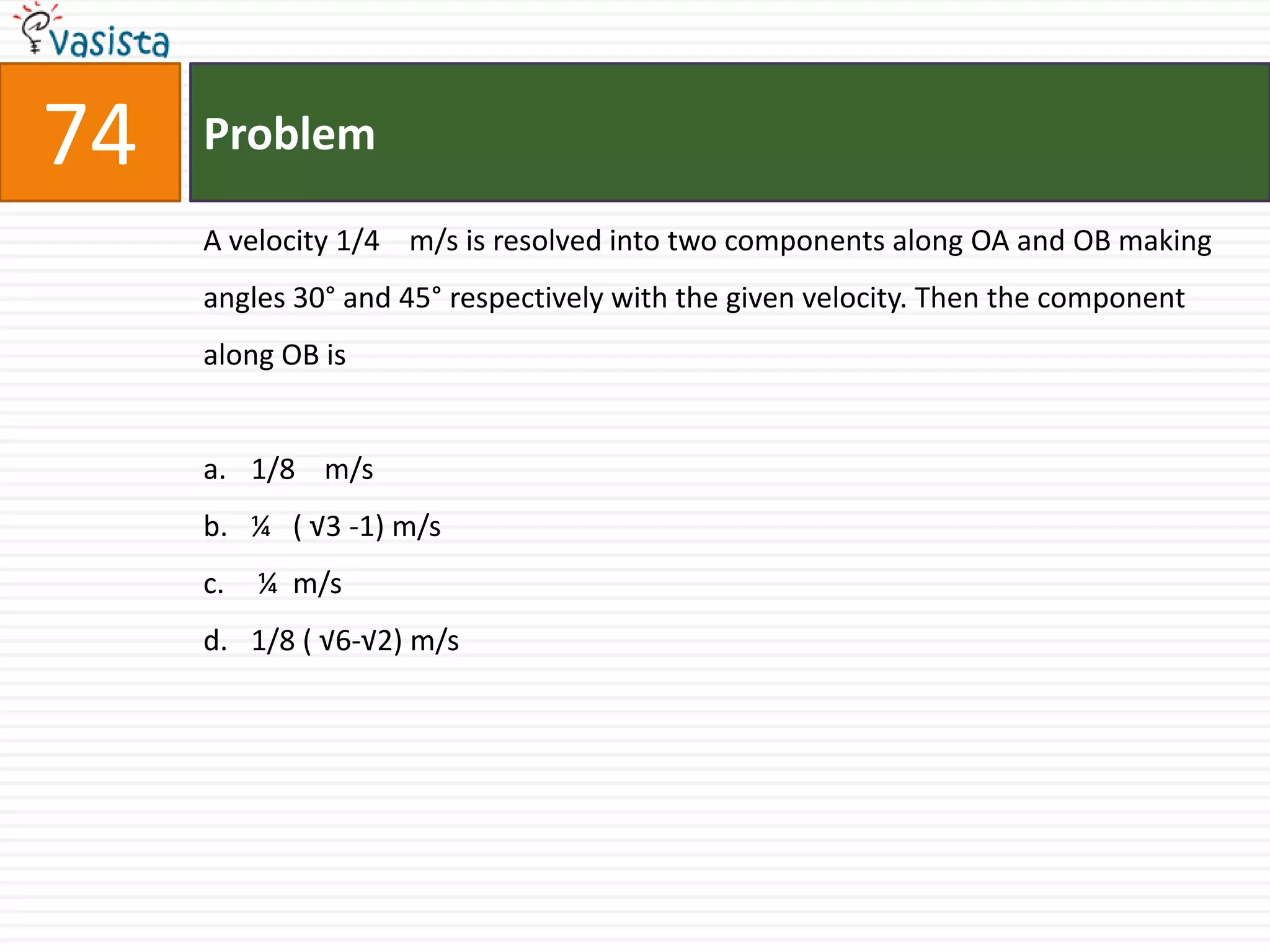
Problem74A velocity 1/4    m/s is resolved into two components along OA and OB making angles 30° and 45° respectively with the given velocity. Then the component along OB is1/8    m/s ¼   ( √3 -1) m/s ¼  m/s 1/8 ( √6-√2) m/s
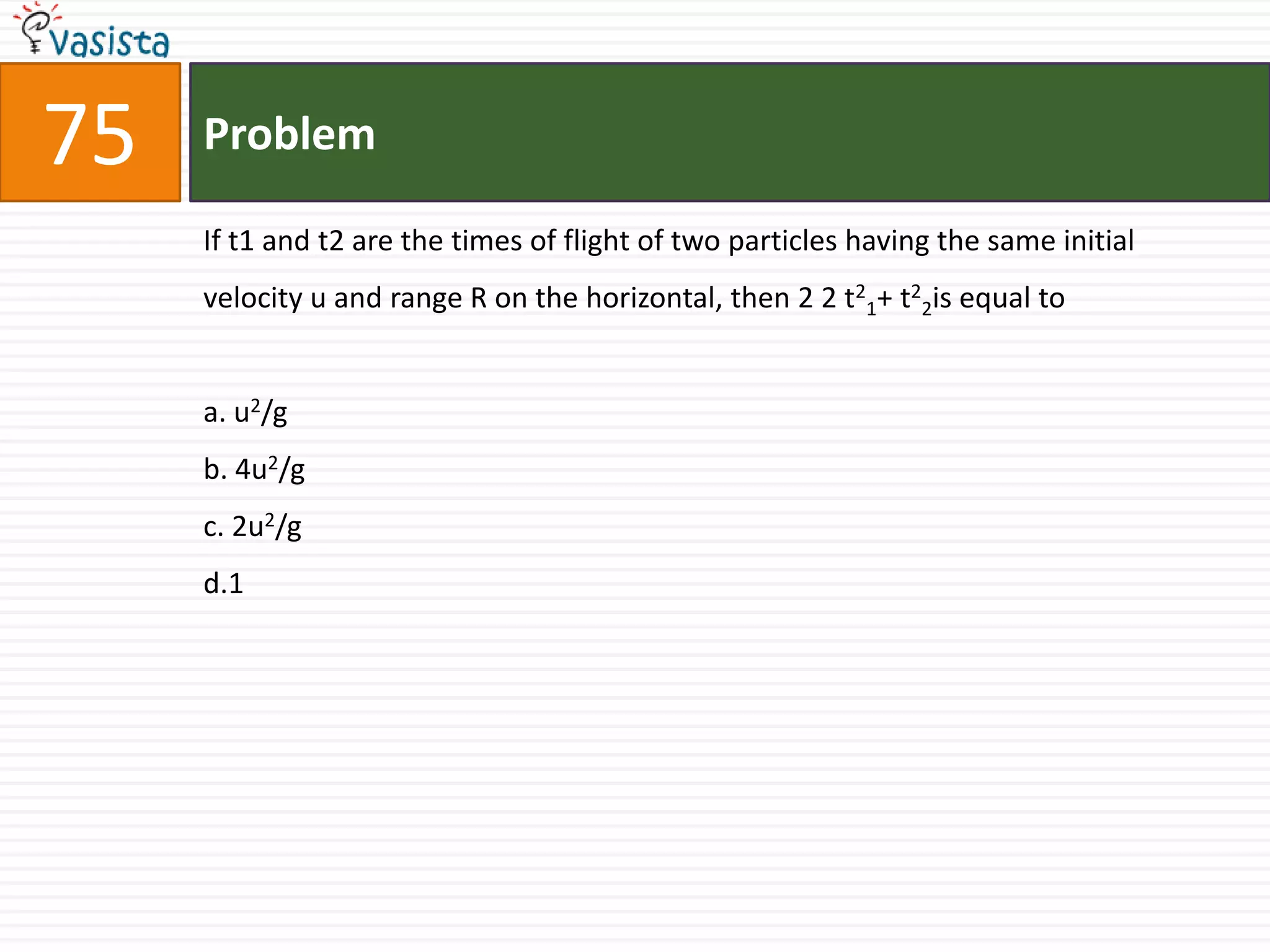
Problem75If t1 and t2 are the times of flight of two particles having the same initial velocity u and range R on the horizontal, then 2 2 t21+ t22is equal toa. u2/gb. 4u2/gc. 2u2/gd.1
FOR SOLUTION VISIT  WWW.VASISTA.NET

Aieee Maths 2004

  • 1.
  • 2.
    SECTION – ASingleCorrect Answer TypeThere are five parts in this question. Four choices are given for each part and one of them is correct. Indicate you choice of the correct answer for each part in your answer-book by writing the letter (a), (b), (c) or (d) whichever is appropriate
  • 3.
    01ProblemLet R ={(1, 3), (4, 2), (2, 4), (2, 3), (3, 1)} be a relation on the set A = {1, 2, 3, 4}. The relation R isa functionreflexivenot symmetric transitive
  • 4.
    Problem02The range ofthe function f(x)= 7-xPx-3 is{1, 2, 3}{1, 2, 3, 4, 5}{1, 2, 3, 4} {1, 2, 3, 4, 5, 6}
  • 5.
    Problem03Let z, wbe complex numbers such that and argzw = π. Then arg z equals4/π5π/43π/42/π
  • 6.
    Problem04If z =x – i y and Z1/33 = p + iq , then is equal to1-22 -1
  • 7.
    Problem05 then z lies onthe real axisan ellipsea circle the imaginary axis.
  • 8.
    Problem06Let A The only correct statement about the matrix A isA is a zero matrix A2 = IA−1does not exist A = (−1)I, where I is a unit matrix
  • 9.
    Problem07Let A= (10)B= . If B is the inverse of matrix A, then α is-2 52-1
  • 10.
    Problem08If a1, a2,a3 , ....,an , .... are in G.P., then the value of the determinant 0 -2 2 1
  • 11.
    Problem09Let two numbershave arithmetic mean 9 and geometric mean 4. Then these numbers are the roots of the quadratic equationx2 + 18x + 16 = 0 x2 −18x −16 = 0x2 + 18x −16 = 0 x2 −18x + 16 = 0
  • 12.
    Problem10If (1 –p) is a root of quadratic equation x2 + px + (1− p) = 0 , then its roots are0, 1 -1, 20, -1 -1, 1
  • 13.
    Problem11Let S(K) =1+ 3 + 5 + ... + (2K −1) = 3 + K2 . Then which of the following is true?S(1) is correctPrinciple of mathematical induction can be used to prove the formulaS(K) ⇒ S(K + 1)S(K)⇒ S(K + 1)
  • 14.
    Problem12How many waysare there to arrange the letters in the word GARDEN with the vowels in alphabetical order?120 480360240
  • 15.
    Problem13The number ofways of distributing 8 identical balls in 3 distinct boxes so that none of the boxes is empty is5 8C33821
  • 16.
    Problem14If one rootof the equation x2 + px + 12 = 0 is 4, while the equation x2 + px + q = 0 has equal roots, then the value of ‘q’ is49/443 12
  • 17.
    Problem15The coefficient ofthe middle term in the binomial expansion in powers of x of (1+ αx)4 and of (1− αx)6 is the same if α equals- 5/33/5-3/1010/3
  • 18.
    Problem16The coefficient ofxn in expansion of (1+ x) (1− x)n is(n – 1) (-1)n(1− n) (-1)n-1(1− n)2(-1)n-1n
  • 19.
    Problem17If = and , then nis equal toa.b.c. n-1d.
  • 20.
    Problem18Let Tr bethe rth term of an A.P. whose first term is a and common difference is d. If for some positive integers m, n, m ≠ n , and , then a – d equalsa. 0b. 1c. 1/mnd.
  • 21.
    Problem19The sum ofthe first n terms of the series 12 + 2 ⋅ 22 + 32 + 2 ⋅ 42 + 52 + 2 ⋅ 62 + ... iswhen n is even. When n is odd the sum isa.b.c.d.
  • 22.
    Problem20The sum ofseries isa.b.c.d.
  • 23.
    Problem21Let α, βbe such that π < α - β < 3π. If sinα + sinβ = and cosα + cosβ = , then the value of cosa.b.c.d.
  • 24.
    Problem22If u = , then the difference between the maximum and minimum values of u2 is given bya. 2(a2 + b2 ) b. c. (a + b)2d. (a -b)2
  • 25.
    Problem23The sides ofa triangle are sinα, cosα and for some . Then the greatest angle of the triangle is60o90o120o 150o
  • 26.
    Problem24A person standingon the bank of a river observes that the angle of elevation of the top of a tree on the opposite bank of the river is 60o and when he retires 40 meter away from the tree the angle of elevation becomes30o . The breadth of the river is20 m 30 m40 m 60 m
  • 27.
    Problem25If f :R-> S, defined by f(x) = sin x − √3 cos x + 1, is onto, then the interval of S is[0, 3] [-1, 1][0, 1] [-1, 3]
  • 28.
    Problem26The graph ofthe function y = f(x) is symmetrical about the line x = 2, thenf(x + 2)= f(x – 2) f(2 + x) = f(2 – x)f(x) = f(-x) f(x) = - f(-x)
  • 29.
    Problem27The domain ofthe function is[2, 3] [2, 3)[1, 2] [1, 2)
  • 30.
    Problem28If , then the values of a and b, area∈ , b∈a = 1, b∈a∈ , b = 2 a = 1 and b = 2
  • 31.
    Problem29Let f(x) . If f(x) is continuous in , then f isa. 1 b. 1/2c. -1/2d. -1
  • 32.
    Problem30If xy+e y+...to ∞ , x > 0, then dy/dx isx/1+ x1/x1-x/x1+x/x
  • 33.
    Problem31A point onthe parabola y2 = 18x at which the ordinate increases at twice the rate of the abscissa isa.(2, 4) b. (2, -4)c.d.
  • 34.
    Problem32A function y= f(x) has a second order derivative f″(x) = 6(x – 1). If its graph passes through the point (2, 1) and at that point the tangent to the graph is y = 3x – 5, then the function is(x −1)2 (x −1)2(x+1)3 (x+1)2
  • 35.
    Problem33The normal tothe curve x = a(1 + cosθ), y = asinθ at ‘θ’ always passes through the fixed point(a, 0) (0, a)(0, 0) (a, a)
  • 36.
    Problem34If 2a +3b + 6c =0, then at least one root of the equation ax2 + bx + c = 0 lies in the interval(0, 1) (1, 2)(2, 3) (1, 3)
  • 37.
    Problem35 ise e – 11 – e e + 1
  • 38.
    Problem36If dx=Ax+ B log sin(x ) C sin(x- α ) , then value of (A, B) is(sinα, cosα) (cosα, sinα)(- sinα, cosα)(- cosα, sinα)
  • 39.
  • 40.
    Problem38The value of dx is28/314/37/31/3
  • 41.
    Problem39The value ofI = dxis0 12 3
  • 42.
    Problem40If xf(sin x)dx=A f (sin x) then A is0 π4/π2π
  • 43.
    Problem41If f(x) = xg{x(1 x)}dx and g{x(1 x)}dx then the value of is2 –3–1 1
  • 44.
    Problem42The area ofthe region bounded by the curves y = |x – 2|, x = 1, x = 3 and the x-axis is1 23 4
  • 45.
    Problem43The differential equationfor the family of curves x2 + y2 − 2ay = 0 , where a is an arbitrary constant is2(x2 − y2 )y′ = xy2(x2 + y2 )y′ = xy(x2 − y2 )y′ = 2xy (x2 + y2 )y′ = 2xy
  • 46.
    Problem44The solution ofthe differential equation y dx + (x + x2y) dy = 0 isa.b.c.d.
  • 47.
    Problem45Let A (2,–3) and B(–2, 1) be vertices of a triangle ABC. If the centroid of this triangle moves on the line 2x + 3y = 1, then the locus of the vertex C is the line2x + 3y = 9 2x – 3y = 73x + 2y = 5 3x – 2y = 3
  • 48.
    Problem46The equation ofthe straight line passing through the point (4, 3) and making intercepts on the co-ordinate axes whose sum is –1 isa.b.c.d.
  • 49.
    Problem47If the sumof the slopes of the lines given by x2 − 2cxy − 7y2 = 0 is four times their product, then c has the value1 -12 -2
  • 50.
    Problem48If one ofthe lines given by 6x2 − xy + 4cy2 = 0 is 3x + 4y = 0, then c equals1 -13 -3
  • 51.
    Problem49If a circlepasses through the point (a, b) and cuts the circle x2 + y2 = 4 orthogonally, then the locus of its centre is2ax + 2by + (a2 + b2 + 4) = 0 2ax + 2by − (a2 + b2 + 4) = 02ax − 2by + (a2 + b2 + 4) = 0 2ax − 2by − (a2 + b2 + 4) = 0
  • 52.
    Problem50A variable circlepasses through the fixed point A (p, q) and touches x-axis. The locus of the other end of the diameter through A is(x − p)2 = 4qy (x − q)2 = 4py(y − p)2 = 4qx (y − q)2 = 4px
  • 53.
    Problem51If the lines2x + 3y + 1 = 0 and 3x – y – 4 = 0 lie along diameters of a circle of circumference 10π, then the equation of the circle isx2 + y2 − 2x + 2y − 23 = 0x2 + y2 − 2x − 2y − 23 = 0x2 + y2 + 2x + 2y − 23 = 0x2 + y2 + 2x − 2y − 23 = 0
  • 54.
    Problem52The intercept onthe line y = x by the circle x2 + y2 − 2x = 0 is AB. Equation of the circle on AB as a diameter isx2 + y2 − x − y = 0 x2 + y2 − x + y = 0x2 + y2 + x + y = 0 x2 + y2 + x − y = 0
  • 55.
    Problem53If a ≠0 and the line 2bx + 3cy + 4d = 0 passes through the points of intersection of the parabolas y2 = 4ax and x2 = 4ay , thend2 + (2b + 3c)2 = 0 d2 + (3b + 2c)2 = 0d2 + (2b − 3c)2 = 0d2 + (3b − 2c)2 = 0
  • 56.
    Problem54The eccentricity ofan ellipse, with its centre at the origin, is 1/2. If one of the directives is x =4, then the equation of the ellipse is3x2 + 4y2 = 1 3x2 + 4y2 = 124x2 + 3y2 = 12 4x2 + 3y2 = 1
  • 57.
    Problem55A line makesthe same angle θ, with each of the x and z axis. If the angle β, which it makes with y-axis, is such that sin2 β = 3sin2 θ , then cos2 θ equals2/31/53/52/5
  • 58.
    Problem56Distance between twoparallel planes 2x + y + 2z = 8 and 4x + 2y + 4z + 5 = 0 is3/25/27/29/2
  • 59.
    Problem57A line withdirection cosines proportional to 2, 1, 2 meets each of the lines x = y + a = z and x + a = 2y = 2z. The co-ordinates of each of the point of intersection are given by(3a, 3a, 3a), (a, a, a) (3a, 2a, 3a), (a, a, a)(3a, 2a, 3a), (a, a, 2a) (2a, 3a, 3a), (2a, a, a)
  • 60.
    Problem58If the straightlines x = 1 + s, y = –3 – λs, z = 1 + λs and x = t/2, y = 1 + t, z = 2 – t withparameters s and t respectively, are co-planar then λ equals–2 –1 – 1/2 0
  • 61.
    Problem59The intersection ofthe spheres x2 + y2 + z2 + 7x − 2y − z = 13 andx2 + y2 + z2 − 3x + 3y + 4z = 8 is the same as the intersection of one of the sphere and the planex – y – z = 1 x – 2y – z = 1x – y – 2z = 12x – y – z = 1
  • 62.
    Problem60Let , and be three non-zero vectors such that no two of these are collinear. If the vector + 2 is collinear with and + 3 is collinear with(λ being some non-zero scalar) then equalsa.b.c.d. 0
  • 63.
    Problem61A particle isacted upon by constant forces 4î +ĵ− 3kˆ and 3ˆi + ĵ − which displace it from a point î + 2ĵ + 3 to the point5 î+ 4ĵ + . The work done in standard units by the forces is given by40 3025 15
  • 64.
    Problem62If are non-coplanar vectors and λ is a real number, then the vectors and (2λ −1) are non-coplanar forall values of λ all except one value of λall except two values of λno value of λ
  • 65.
    Problem63Let be such that . If the projection along is equal to that of w along u and v, w are perpendicular to each other then u − v + w equals2√7√1414
  • 66.
    Problem64Let a, band c be non-zero vectors such that . If θ is the acute angle between the vectors and , then sin θ equalsa. 1/3b. √2/3c. 2/3d. 2√2/3
  • 67.
    Problem65Consider the followingstatements:(a) Mode can be computed from histogram(b) Median is not independent of change of scale(c) Variance is independent of change of origin and scale.Which of these is/are correct?only (a)only (b)only (a) and (b)(a), (b) and (c)
  • 68.
    Problem66In a seriesof 2n observations, half of them equal a and remaining half equal -a. If the standard deviation of the observations is 2, then |a| equalsa. 1/nb. √2c. 2d. √2/n
  • 69.
    Problem67The probability thatA speaks truth is 4/5, while this probability for B is 3/4. The probability that they contradict each other when asked to speak on a fact isa. 3/20b. 1/5c. 7/20d. 4/5
  • 70.
    Problem68A random variableX has the probability distribution: For the events E = {X is a prime number} and F = {X < 4}, the probability P (E ∪ F) is0.870.770.350.50
  • 71.
    Problem69The mean andthe variance of a binomial distribution are 4 and 2 respectively. Then the probability of 2 successes is37/256219/256128/25628/256
  • 72.
    Problem70With two forcesacting at a point, the maximum effect is obtained when their resultant is 4N. If they act at right angles, then their resultant is 3N. Then the forces area. (2 + √2)N and (2 − √2)Nb. (2 + √3)N and (2 − √3)Nc.d.
  • 73.
    Problem71In a rightangle ΔABC, ∠A = 90° and sides a, b, c are respectively, 5 cm, 4 cm and 3 cm. If a force has moments 0, 9 and 16 in N cm. units respectively about vertices A, B and C, then magnitude of is3 45 9
  • 74.
    Problem72Three forces P,Q and R rrr acting along IA, IB and IC, where I is the incentre of a ΔABC, are in equilibrium. Then P : Q :R rrr isCos : cos : cosSin : sin : sin sec : sec : sec cosec : cosec : cosec
  • 75.
    Problem73A particle movestowards east from a point A to a point B at the rate of 4 km/h and then towards north from B to C at the rate of 5 km/h. If AB = 12 km and BC = 5 km, then its average speed for its journey from A to C and resultant average velocity direct from A to C are respectively 17/4 km/h and 13/4 km/h 13/4 km/h and 17/4 km/h 17/9 km/h and 13/9 km/h 1/9 km/h and 17/9 km/h
  • 76.
    Problem74A velocity 1/4 m/s is resolved into two components along OA and OB making angles 30° and 45° respectively with the given velocity. Then the component along OB is1/8 m/s ¼ ( √3 -1) m/s ¼ m/s 1/8 ( √6-√2) m/s
  • 77.
    Problem75If t1 andt2 are the times of flight of two particles having the same initial velocity u and range R on the horizontal, then 2 2 t21+ t22is equal toa. u2/gb. 4u2/gc. 2u2/gd.1
  • 78.
    FOR SOLUTION VISIT WWW.VASISTA.NET

Editor's Notes