KNF1023
                                   Engineering
                                Mathematics II

                                   First Order ODEs
               Prepared By
              Annie ak Joseph


Prepared By
Annie ak Joseph                          Session 2008/2009
Learning Objectives


      Demonstrate how to find integrating
      factor for non-exact differential equation


          Demonstrate the solution of
          Homogeneous 1st order ODE in linear form


        Demonstrate the solution of
        inhomogeneous 1st order ODE in linear form
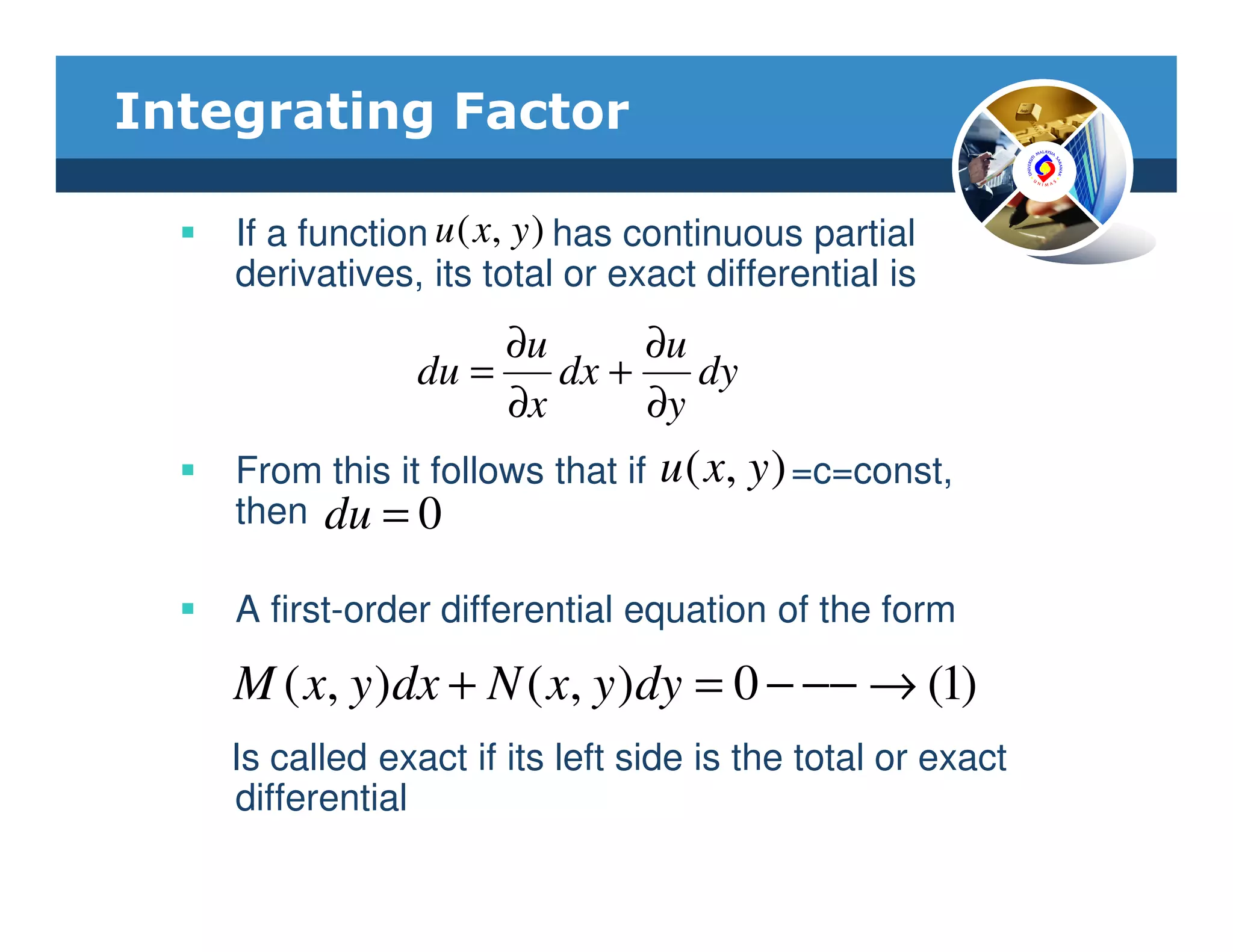
Integrating Factor

    If a function u ( x, y ) has continuous partial
    derivatives, its total or exact differential is
                     ∂u      ∂u
                du =    dx +    dy
                     ∂x      ∂y
    From this it follows that if   u ( x, y ) =c=const,
    then du = 0

    A first-order differential equation of the form

    M ( x, y )dx + N ( x, y )dy = 0 − −− → (1)
    Is called exact if its left side is the total or exact
    differential
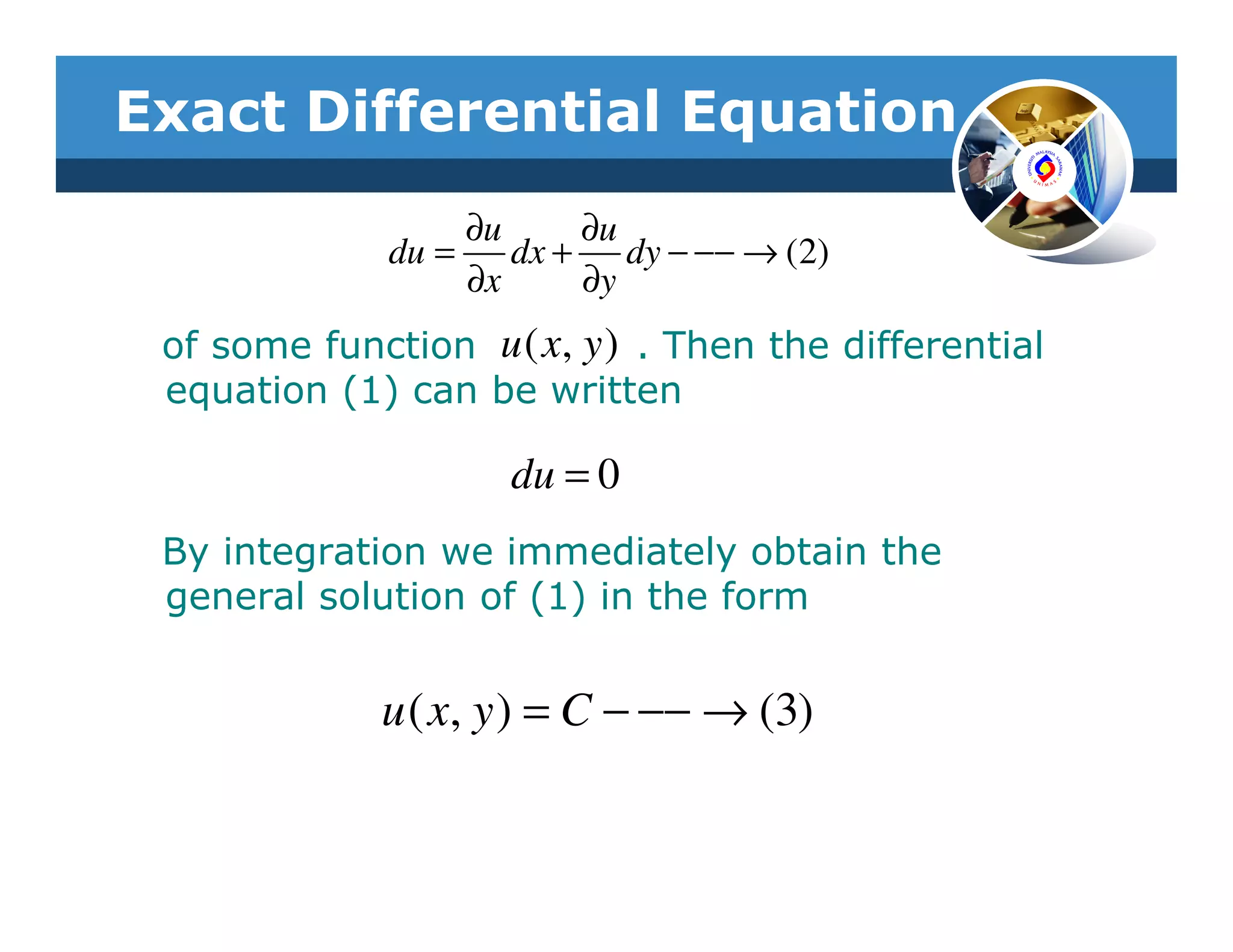
Exact Differential Equation
                   ∂u     ∂u
              du =    dx + dy − −− → (2)
                   ∂x     ∂y
 of some function u ( x, y ) . Then the differential
 equation (1) can be written

                     du = 0
 By integration we immediately obtain the
 general solution of (1) in the form


             u ( x, y ) = C − −− → (3)
Exact Differential Equation

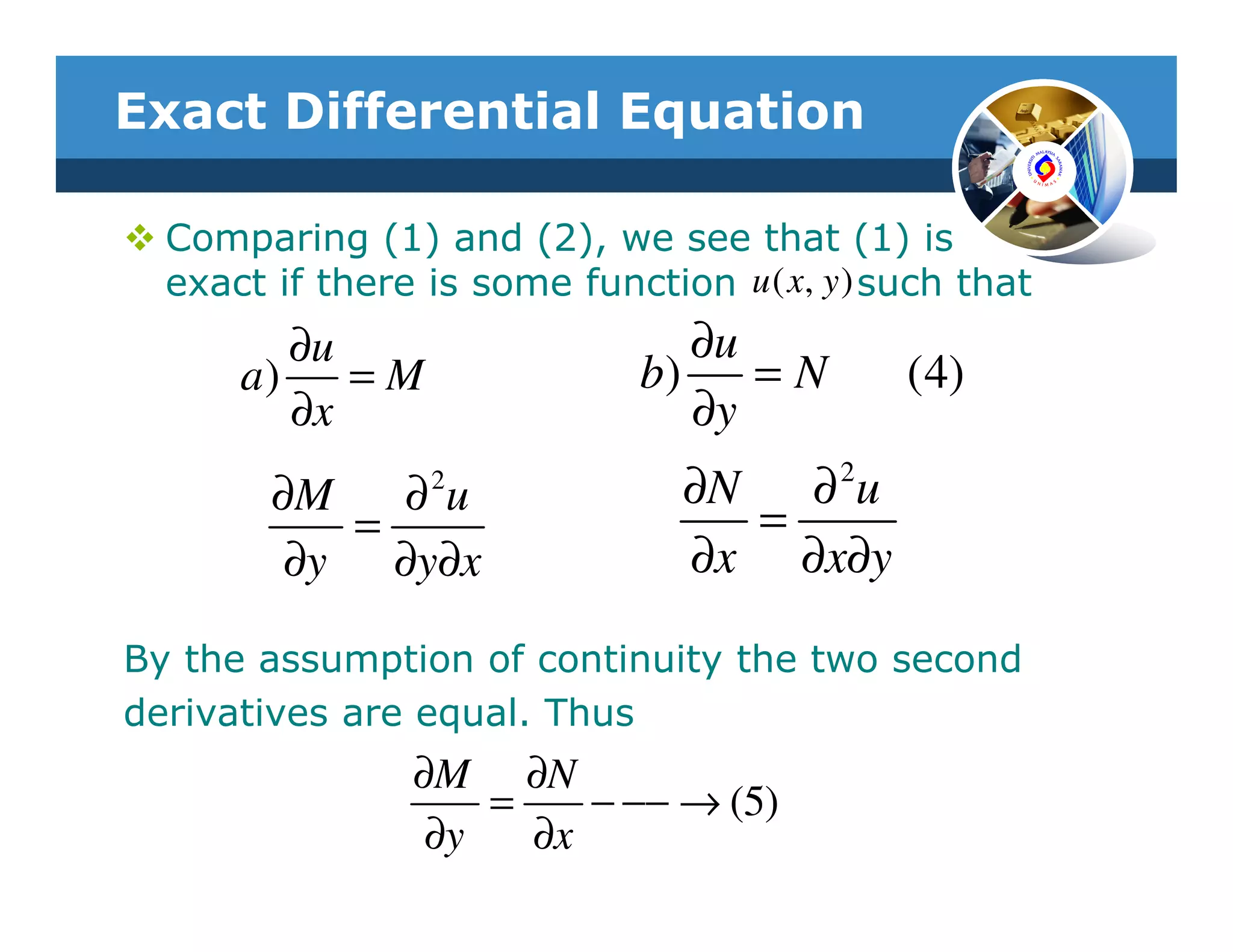
  Comparing (1) and (2), we see that (1) is
  exact if there is some function u ( x, y ) such that
         ∂u                      ∂u
      a)    =M                b)    =N        (4)
         ∂x                      ∂y
        ∂M   ∂u  2
                                 ∂N ∂ 2u
           =                       =
         ∂y ∂y∂x                 ∂x ∂x∂y

By the assumption of continuity the two second
derivatives are equal. Thus
                ∂M ∂N
                    =    − −− → (5)
                 ∂y   ∂x
Exact Differential Equation

 This condition is not only necessary but also
 sufficient for Mdx + Ndy to be an exact
 differential.


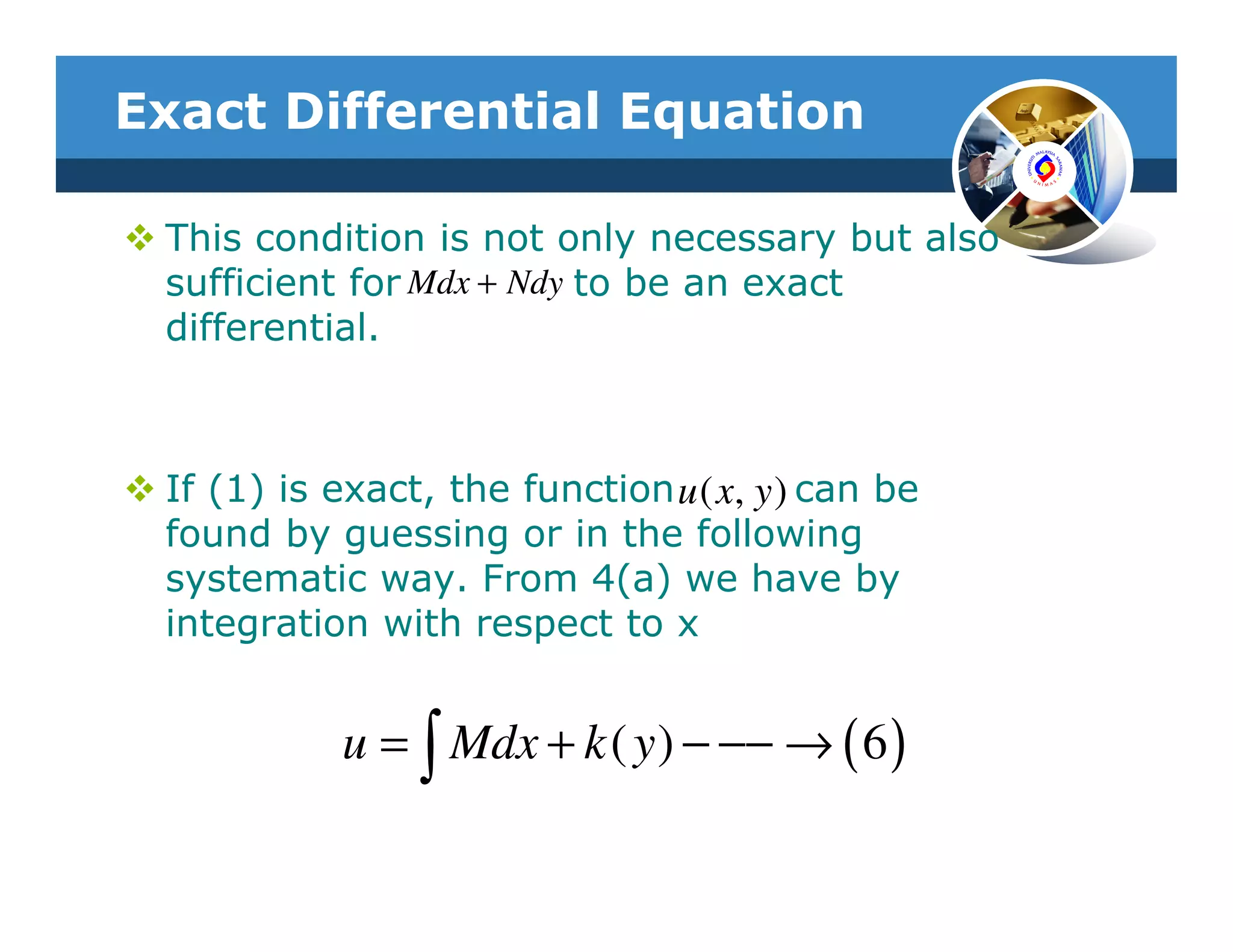
 If (1) is exact, the function u ( x, y ) can be
 found by guessing or in the following
 systematic way. From 4(a) we have by
 integration with respect to x


            u = ∫ Mdx + k ( y ) − −− → ( 6 )
Exact Differential Equation


 in this integration, y is to be regarded as a
 constant, and k(y) plays the role of a “constant” of
 integration. To determine k(y), we derive∂u / ∂y from
 (6), use (4b) to get ∂k / ∂y and integrate ∂k / ∂y to get
 k.

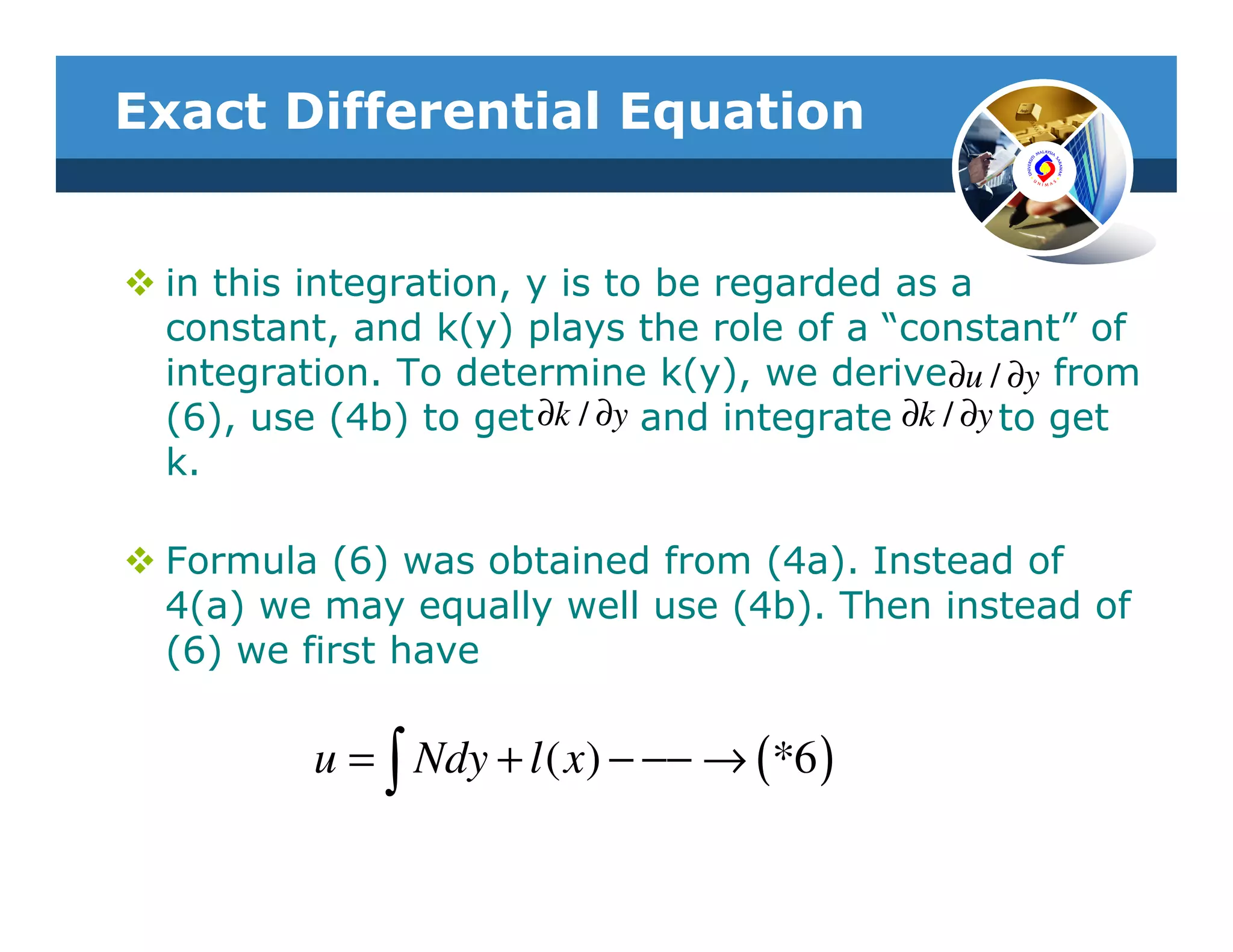
 Formula (6) was obtained from (4a). Instead of
 4(a) we may equally well use (4b). Then instead of
 (6) we first have

         u = ∫ Ndy + l ( x) − −− → (*6 )
Exact Differential Equation


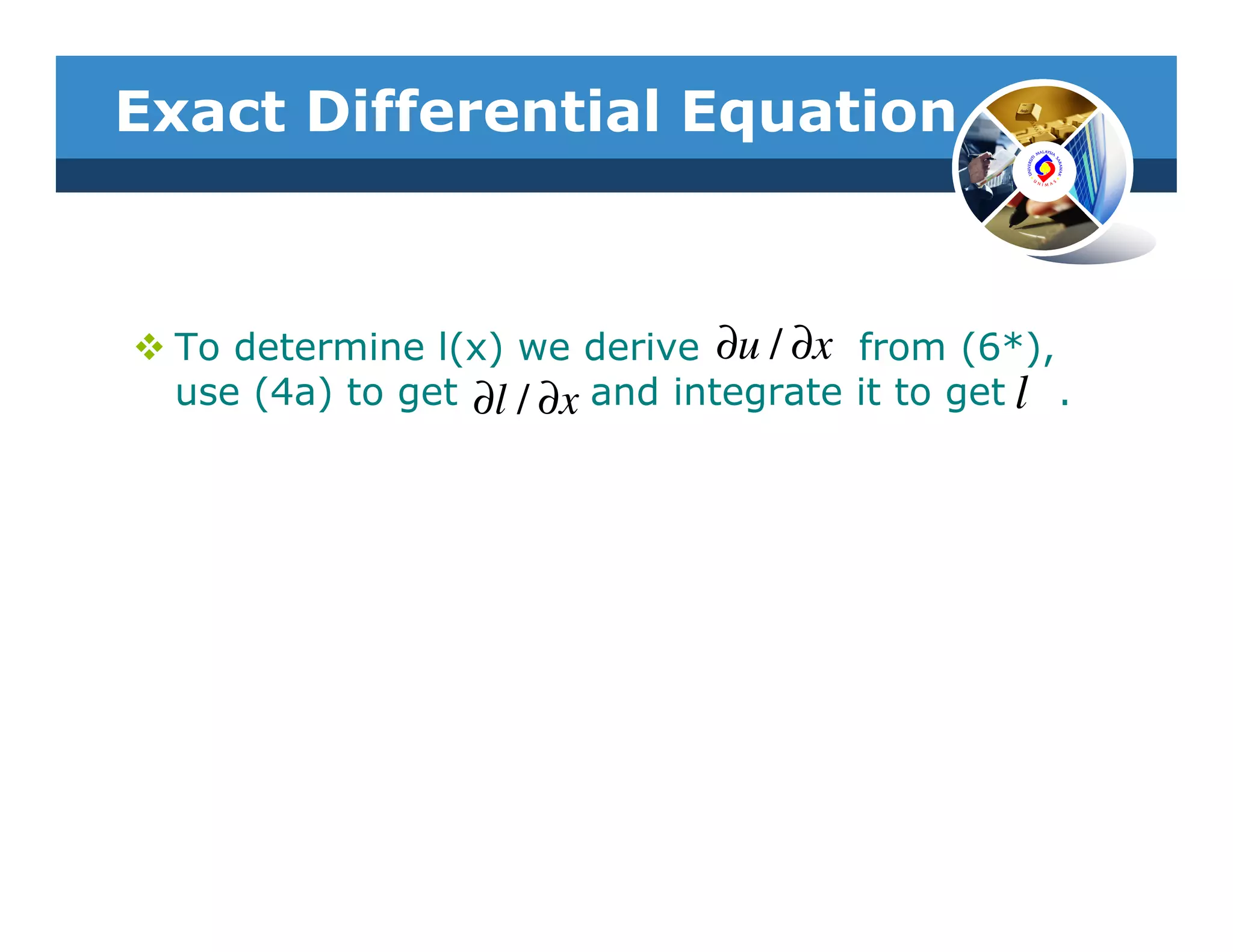
 To determine l(x) we derive ∂u / ∂x from (6*),
 use (4a) to get ∂l / ∂x and integrate it to get l .
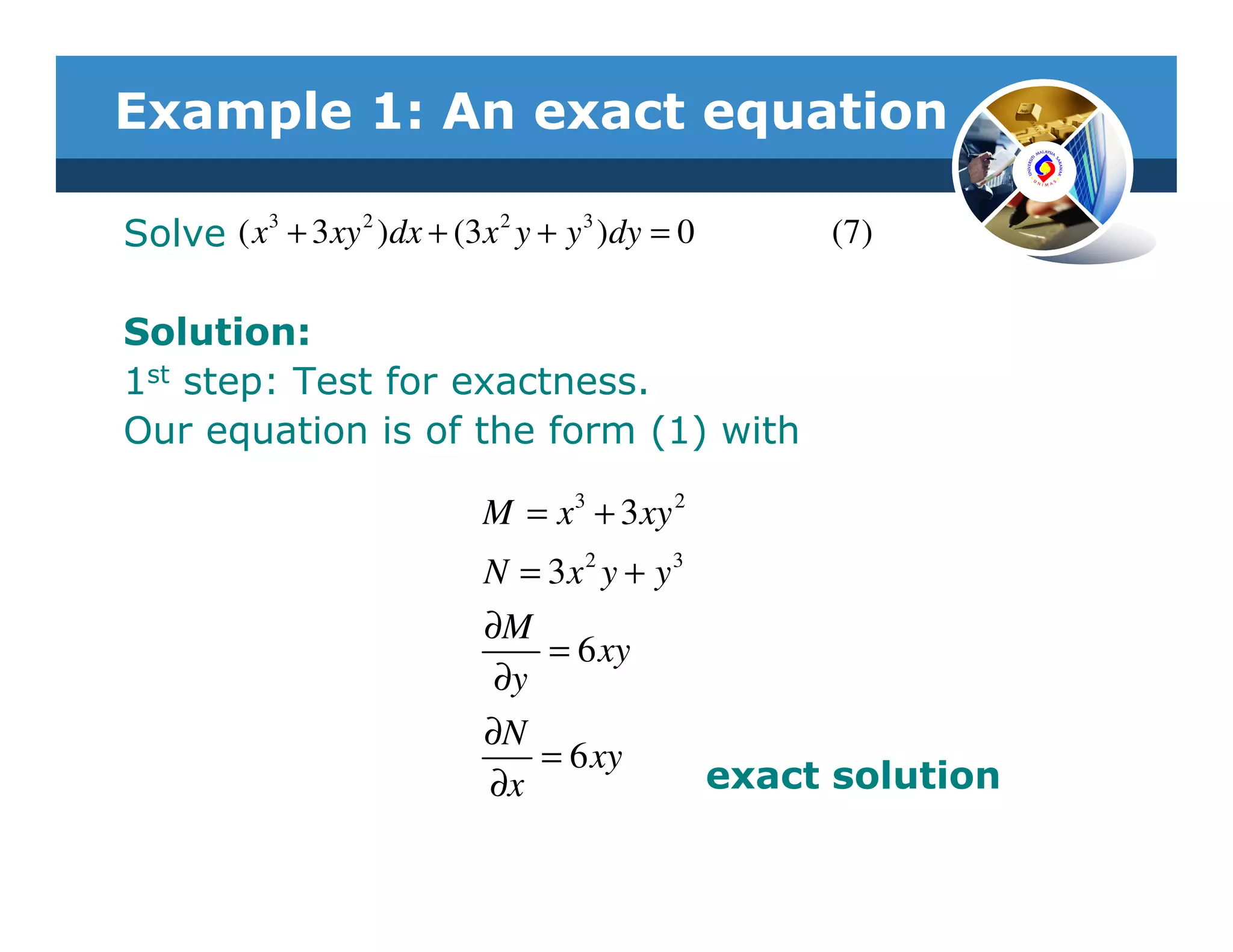
Example 1: An exact equation
         3      2         2     3
Solve ( x + 3 xy )dx + (3x y + y )dy = 0     (7)

Solution:
1st step: Test for exactness.
Our equation is of the form (1) with

                         M = x 3 + 3 xy 2
                         N = 3x 2 y + y 3
                         ∂M
                             = 6 xy
                          ∂y
                         ∂N
                             = 6 xy
                         ∂x               exact solution
Continue…

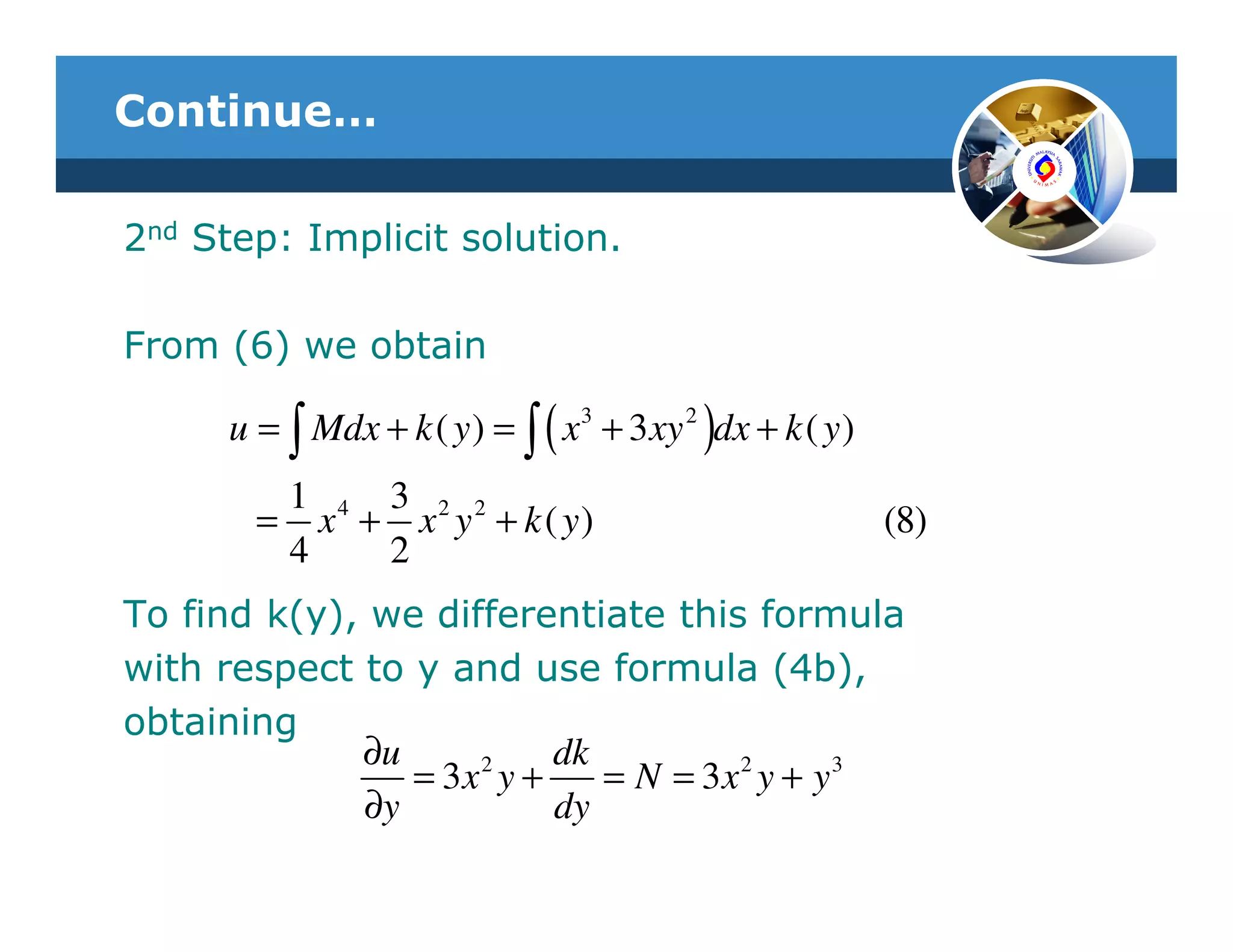
2nd Step: Implicit solution.

From (6) we obtain

      u = ∫ Mdx + k ( y ) = ∫ ( x 3 + 3 xy 2 )dx + k ( y )
         1 4 3 2 2
        = x + x y + k ( y)                                   (8)
         4   2
To find k(y), we differentiate this formula
with respect to y and use formula (4b),
obtaining
             ∂u     2    dk
                = 3x y +    = N = 3x 2 y + y3
             ∂y          dy
Continue…

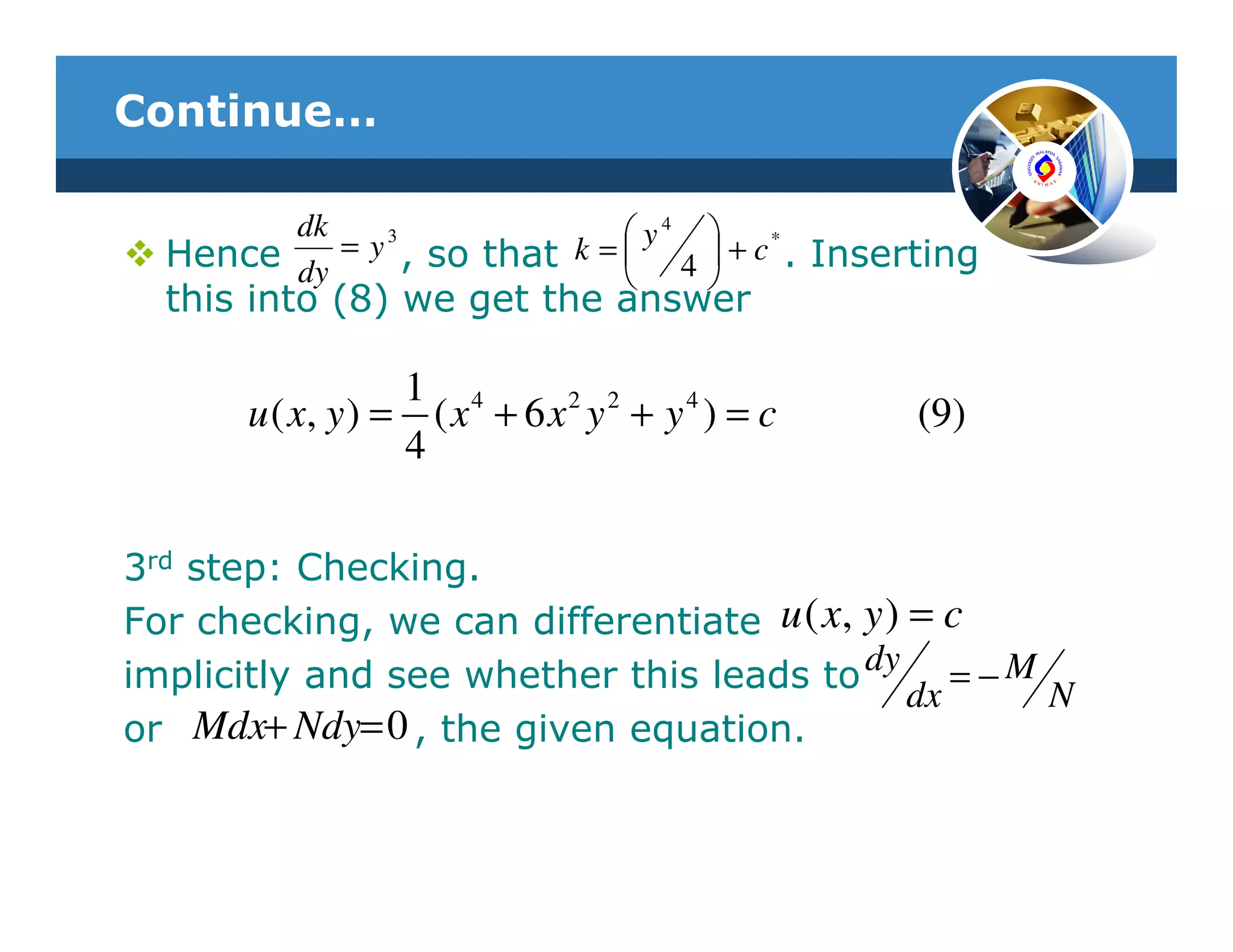
        dk    3               y4           *
  Hence dy = y , so that k =  4         + c . Inserting
                                       
  this into (8) we get the answer

                  1 4
      u ( x, y ) = ( x + 6 x 2 y 2 + y 4 ) = c       (9)
                  4

3rd step: Checking.
For checking, we can differentiate u ( x, y ) = c
implicitly and see whether this leads to dy = − M
                                              dx  N
or Mdx+ Ndy= 0 , the given equation.
Continue…

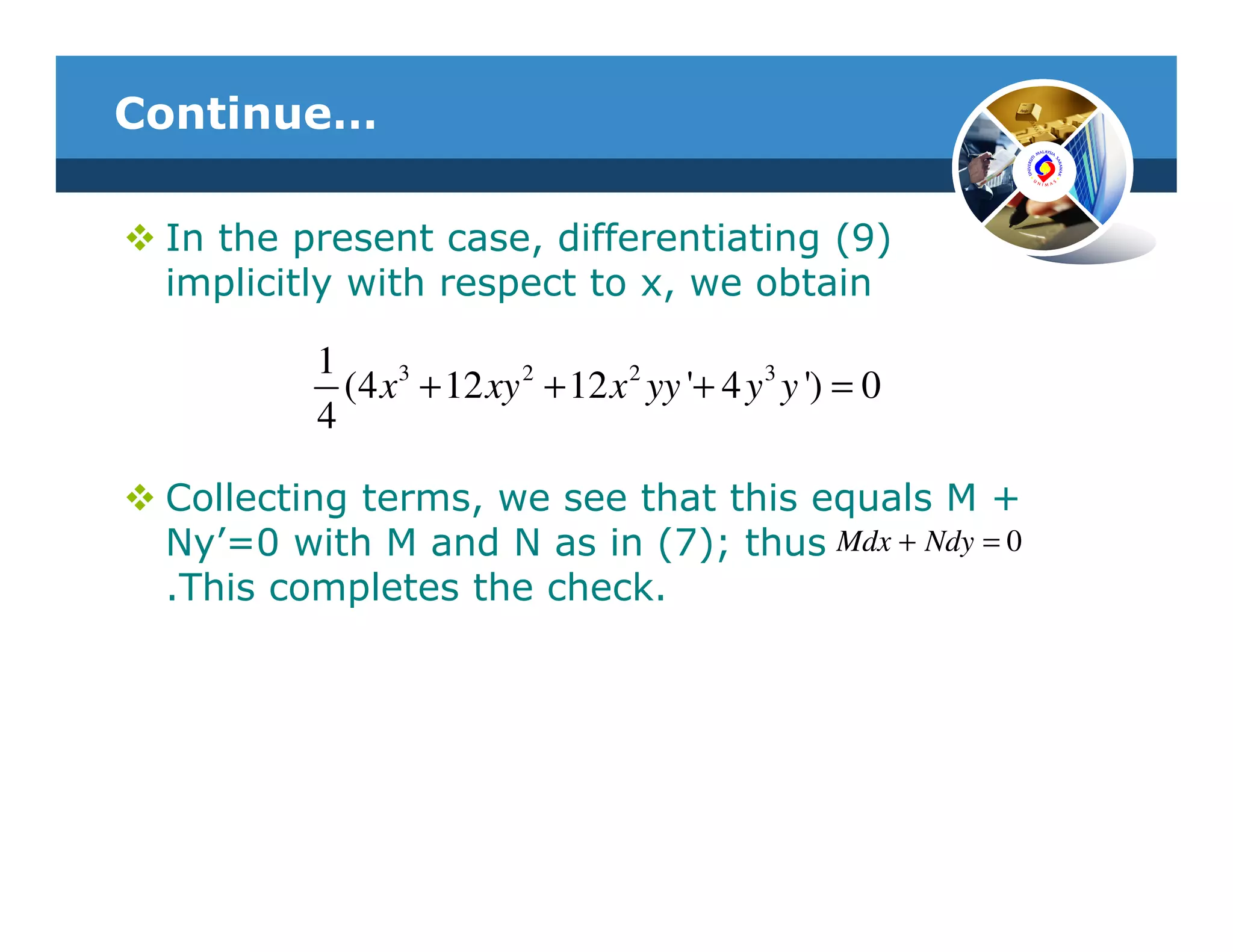
 In the present case, differentiating (9)
 implicitly with respect to x, we obtain

         1
           (4 x3 + 12 xy 2 + 12 x 2 yy '+ 4 y 3 y ') = 0
         4

 Collecting terms, we see that this equals M +
 Ny’=0 with M and N as in (7); thus Mdx + Ndy = 0
 .This completes the check.
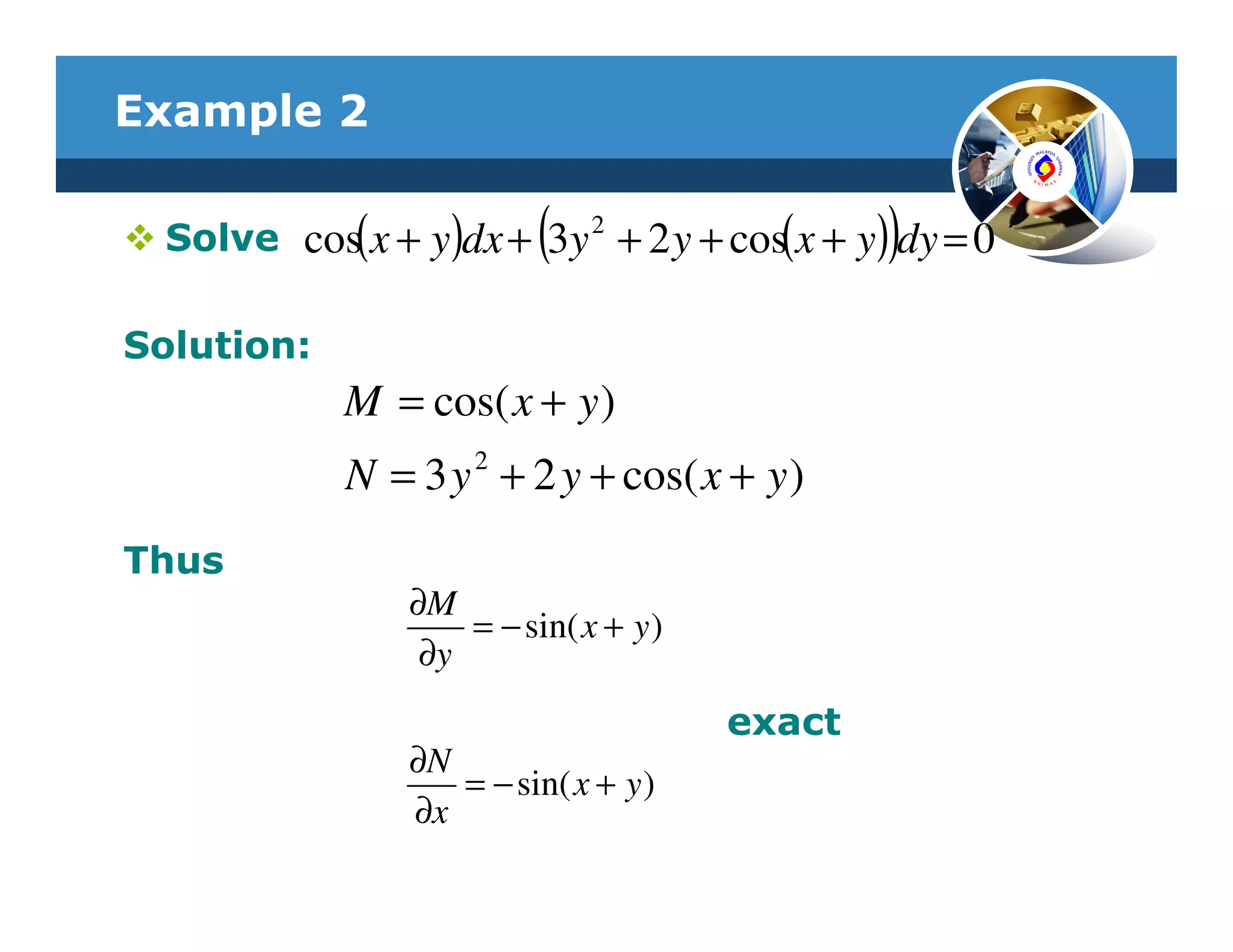
Example 2

                           (                    )
  Solve cos( x + y)dx + 3y 2 + 2 y + cos(x + y) dy = 0

Solution:
             M = cos( x + y )
             N = 3 y 2 + 2 y + cos( x + y )
Thus
                 ∂M
                     = − sin( x + y )
                  ∂y
                                        exact
                 ∂N
                    = − sin( x + y )
                 ∂x
Continue…

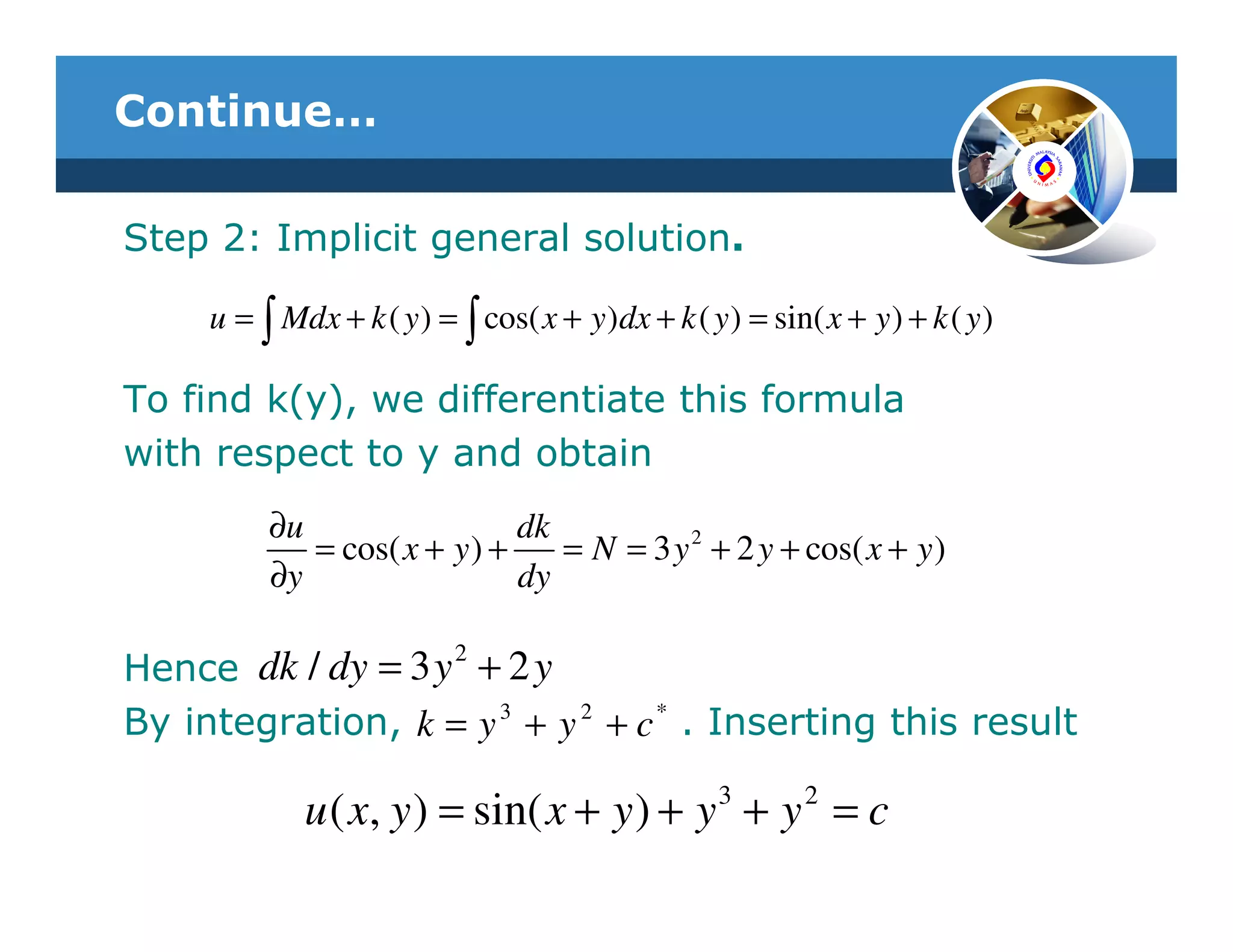
Step 2: Implicit general solution.

     u = ∫ Mdx + k ( y ) = ∫ cos( x + y )dx + k ( y ) = sin( x + y ) + k ( y )

To find k(y), we differentiate this formula
with respect to y and obtain
          ∂u                  dk
             = cos( x + y ) +    = N = 3 y 2 + 2 y + cos( x + y )
          ∂y                  dy

                   2
Hence dk / dy = 3 y + 2 y
By integration, k = y 3 + y 2 + c * . Inserting this result

             u ( x, y ) = sin( x + y ) + y 3 + y 2 = c
Continue…

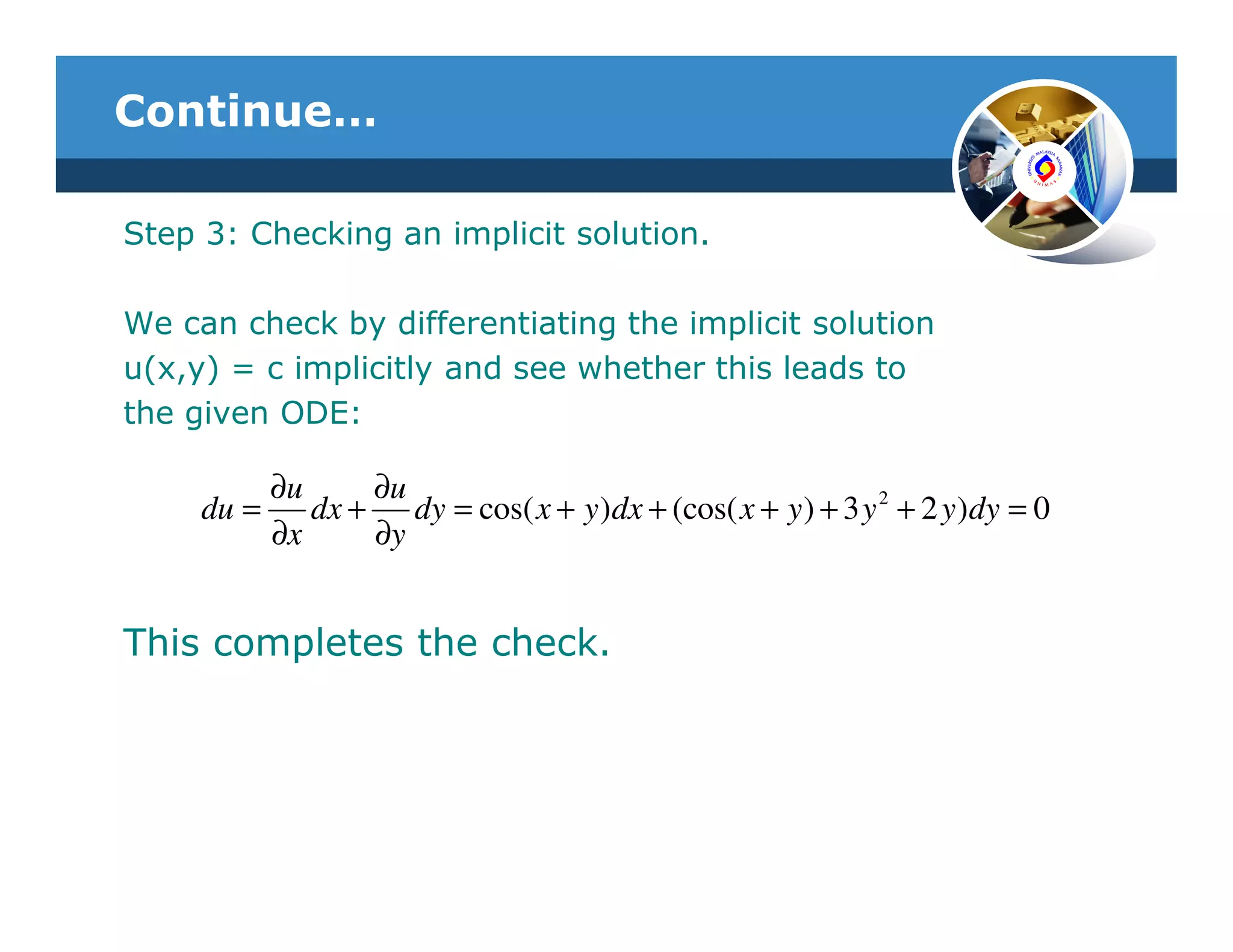
Step 3: Checking an implicit solution.

We can check by differentiating the implicit solution
u(x,y) = c implicitly and see whether this leads to
the given ODE:

            ∂u     ∂u
     du =      dx + dy = cos( x + y )dx + (cos( x + y ) + 3 y 2 + 2 y )dy = 0
            ∂x     ∂y


This completes the check.
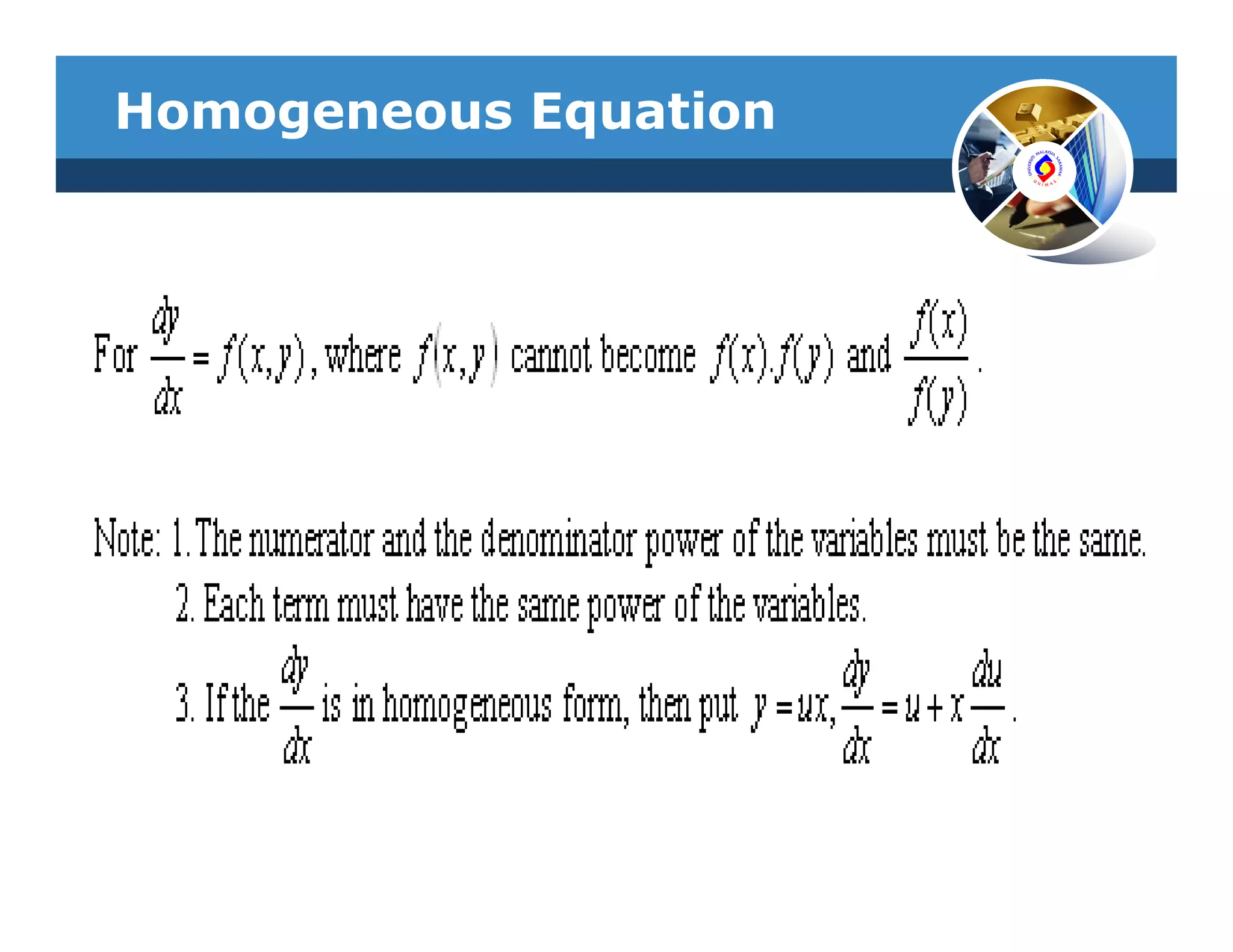
Homogeneous Equation
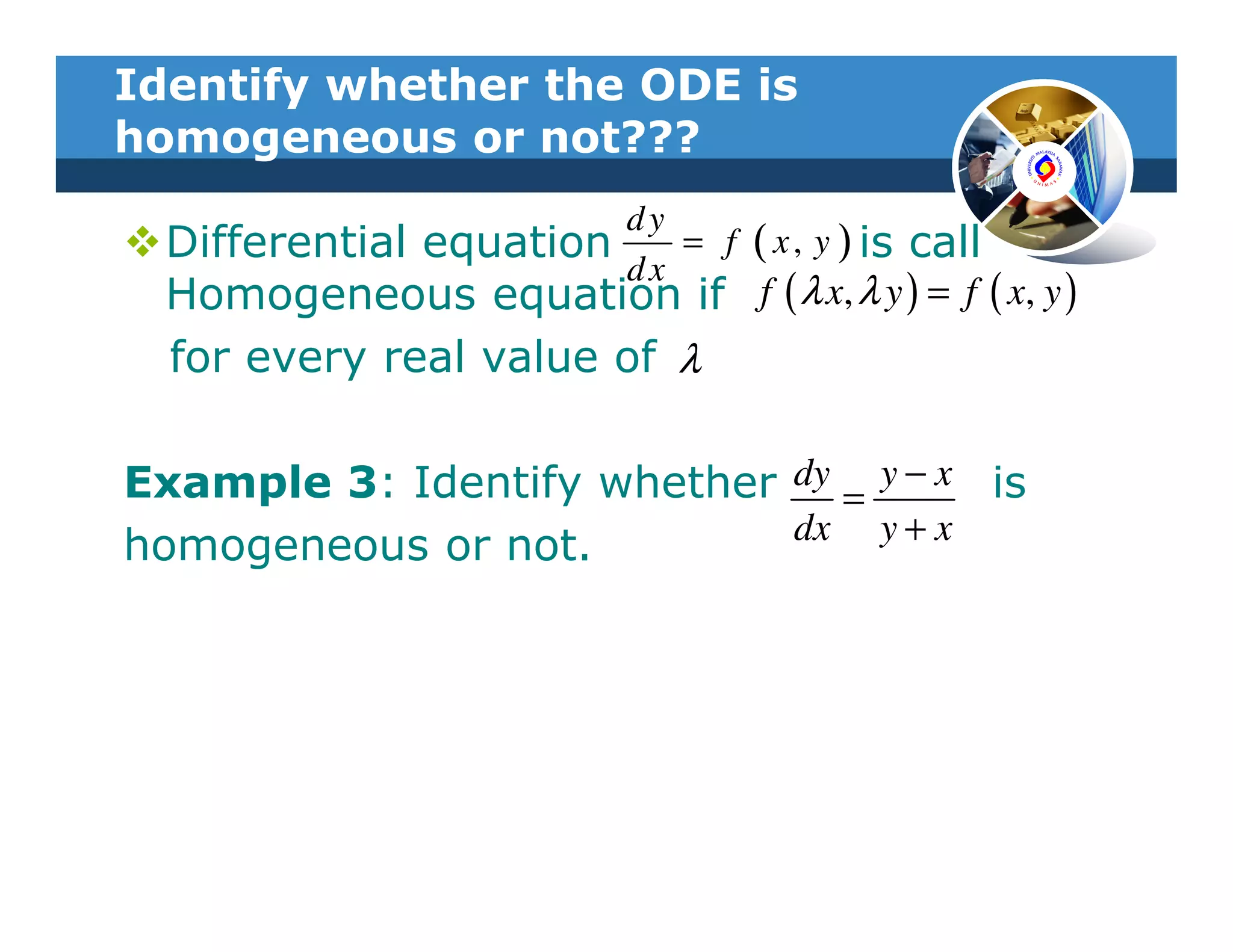
Identify whether the ODE is
homogeneous or not???
                           dy
  Differential equation     ( x , y ) is call
                              = f
                           dx
  Homogeneous equation if f ( λ x, λ y ) = f ( x, y )
  for every real value of λ

Example 3: Identify whether dy = y − x is
                            dx y + x
homogeneous or not.
Continue…


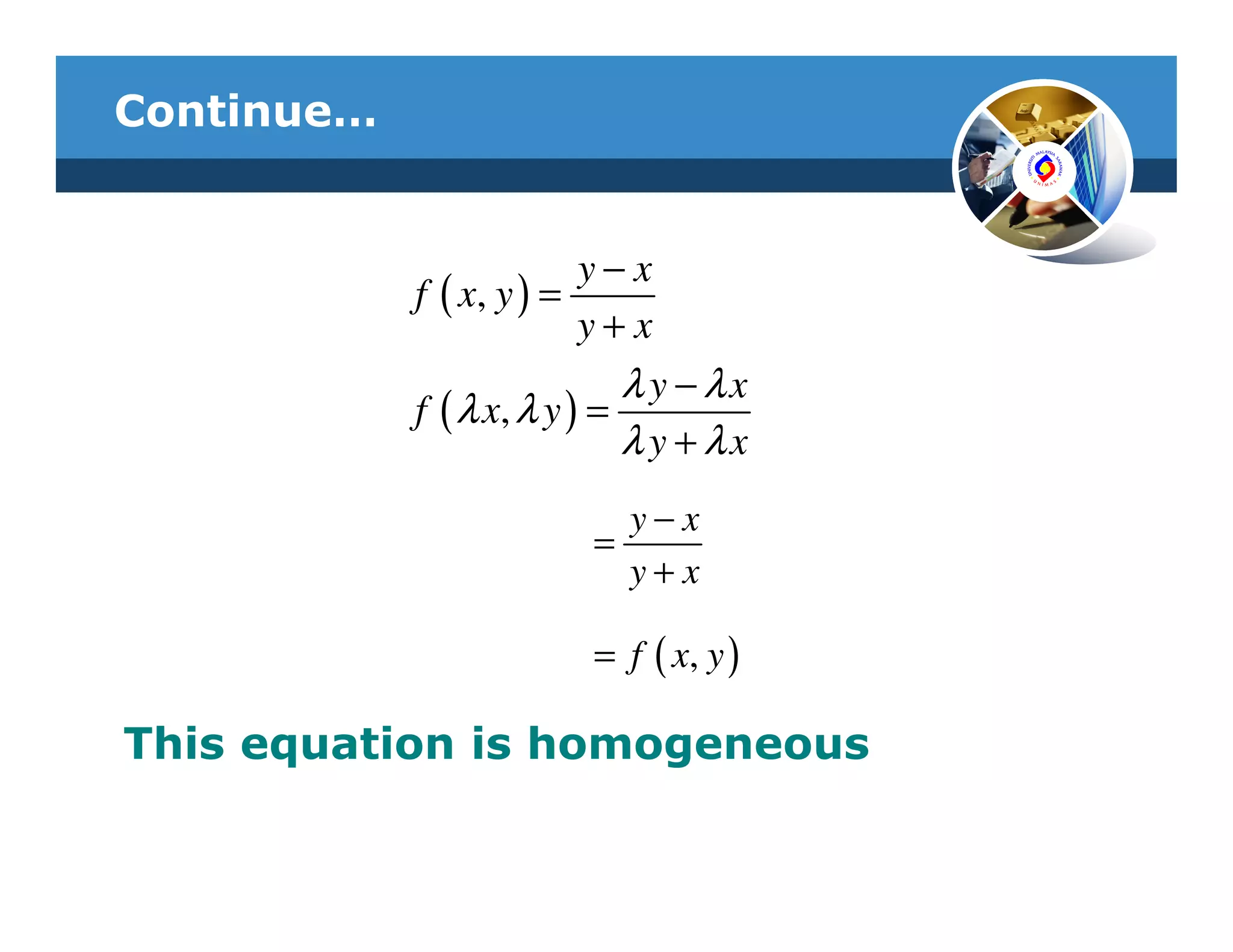
                          y−x
            f ( x, y ) =
                          y+x
                             λ y − λx
            f ( λ x, λ y ) =
                             λ y + λx
                           y−x
                         =
                           y+x

                         = f ( x, y )

This equation is homogeneous
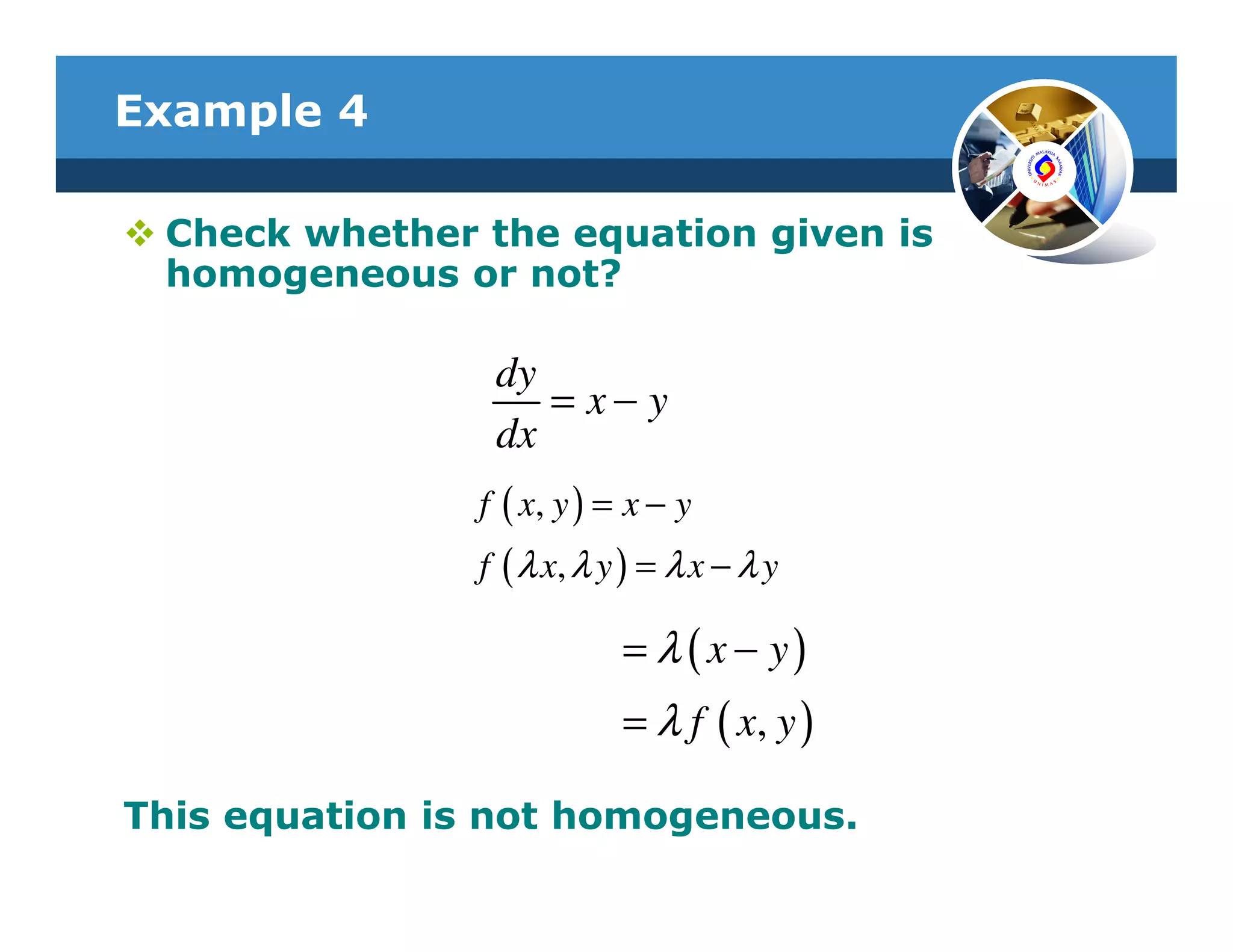
Example 4

 Check whether the equation given is
 homogeneous or not?

                dy
                   = x− y
                dx
               f ( x, y ) = x − y
               f ( λ x, λ y ) = λ x − λ y

                           = λ ( x − y)
                           = λ f ( x, y )

This equation is not homogeneous.
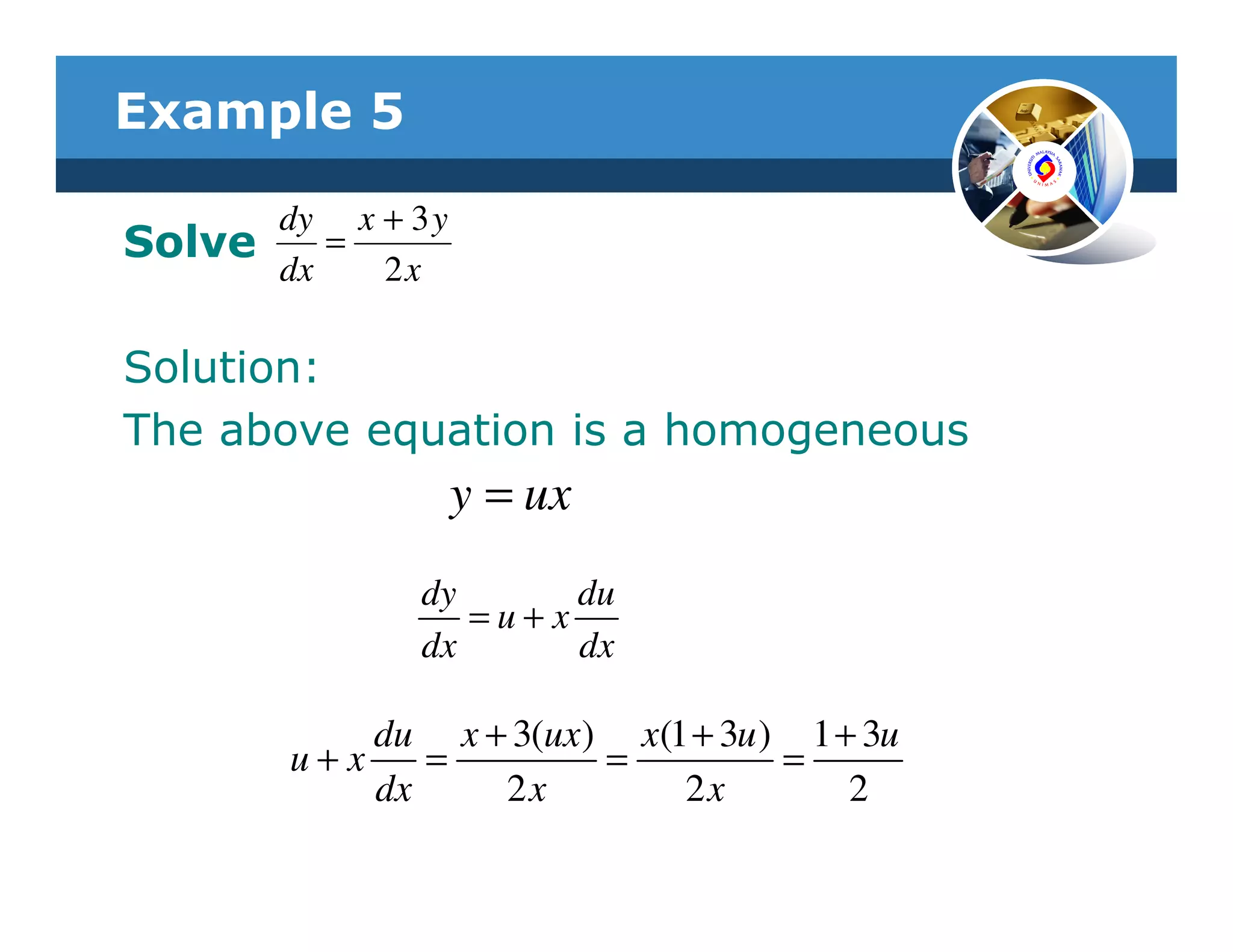
Example 5

        dy x + 3 y
Solve      =
        dx   2x

Solution:
The above equation is a homogeneous
                     y = ux
                dy      du
                   =u+x
                dx      dx

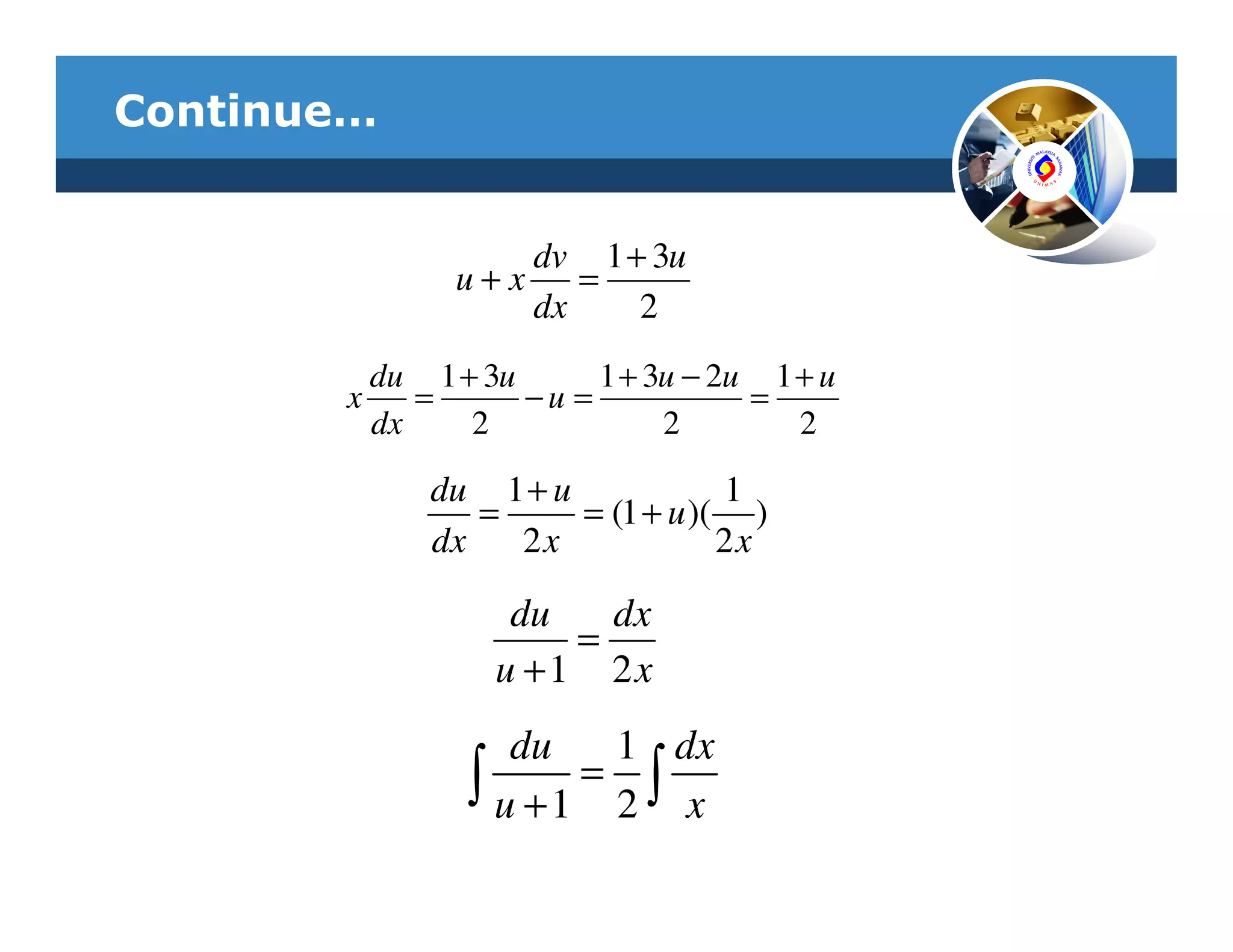
            du x + 3(ux) x(1 + 3u ) 1 + 3u
        u+x    =        =          =
            dx    2x        2x         2
Continue…


                    dv 1 + 3u
                u+x    =
                    dx    2
           du 1 + 3u      1 + 3u − 2u 1 + u
       x      =      −u =            =
           dx    2             2        2

               du 1 + u            1
                  =     = (1 + u )( )
               dx   2x             2x

                    du   dx
                       =
                   u +1 2x
                    du    1 dx
                 ∫ u +1 = 2 ∫ x
Continue…


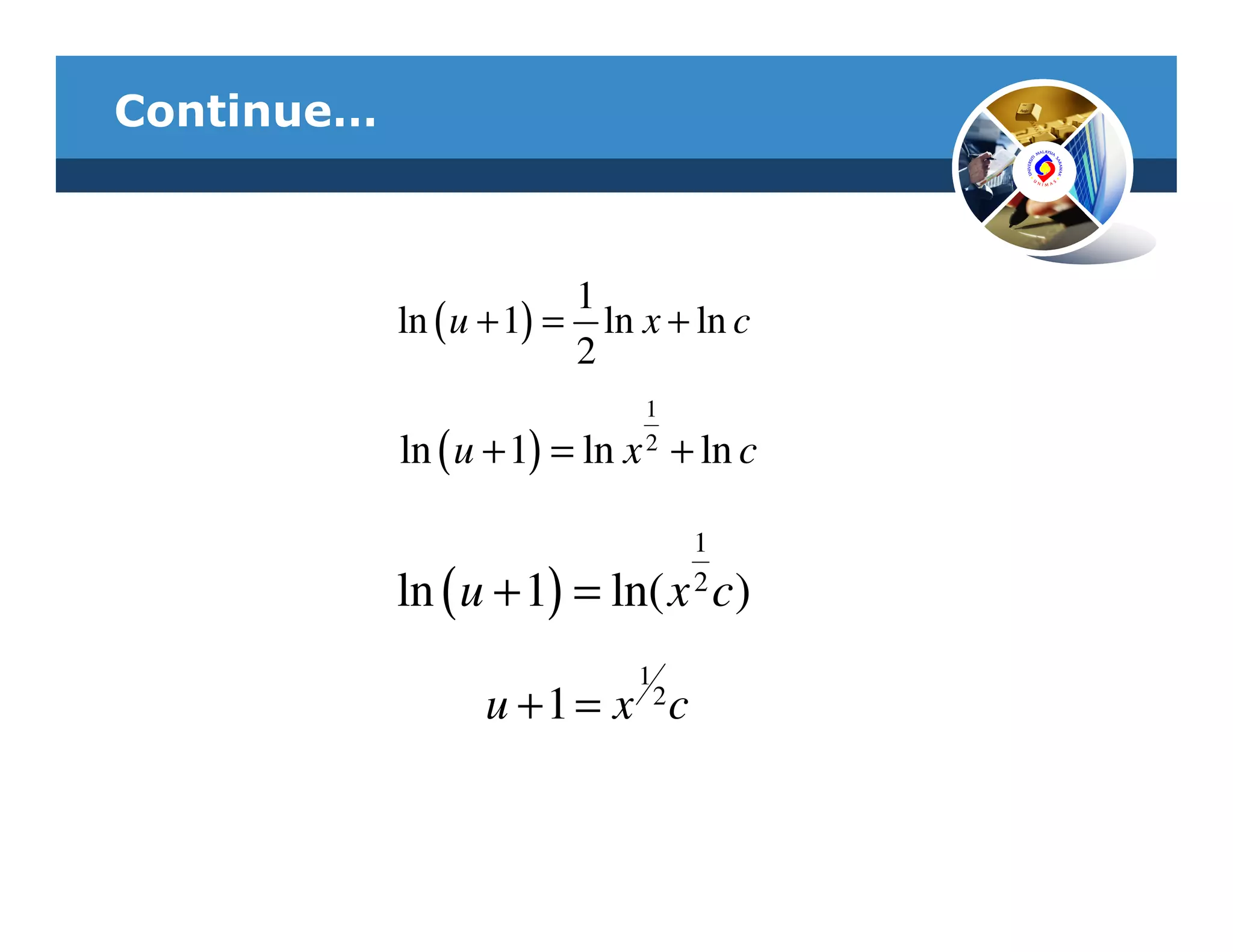
                         1
            ln ( u + 1) = ln x + ln c
                         2
                             1
            ln ( u + 1) = ln x + ln c
                             2


                                 1
            ln ( u + 1) = ln( x c)
                                 2


                             1
                  u + 1 = x 2c
Continue…


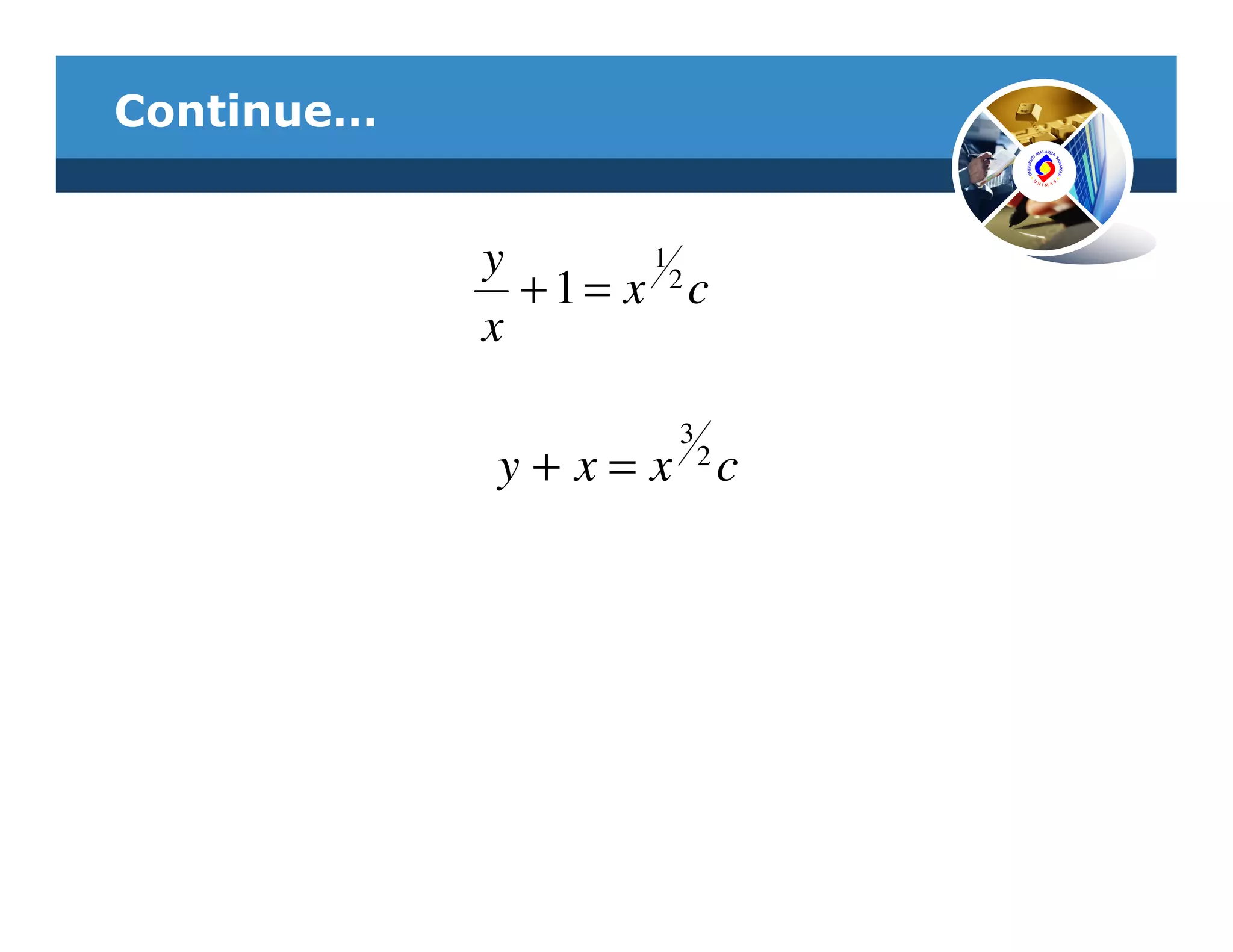
            y        1
              + 1 = x 2c
            x

                      3
            y + x = x 2c
Example 6

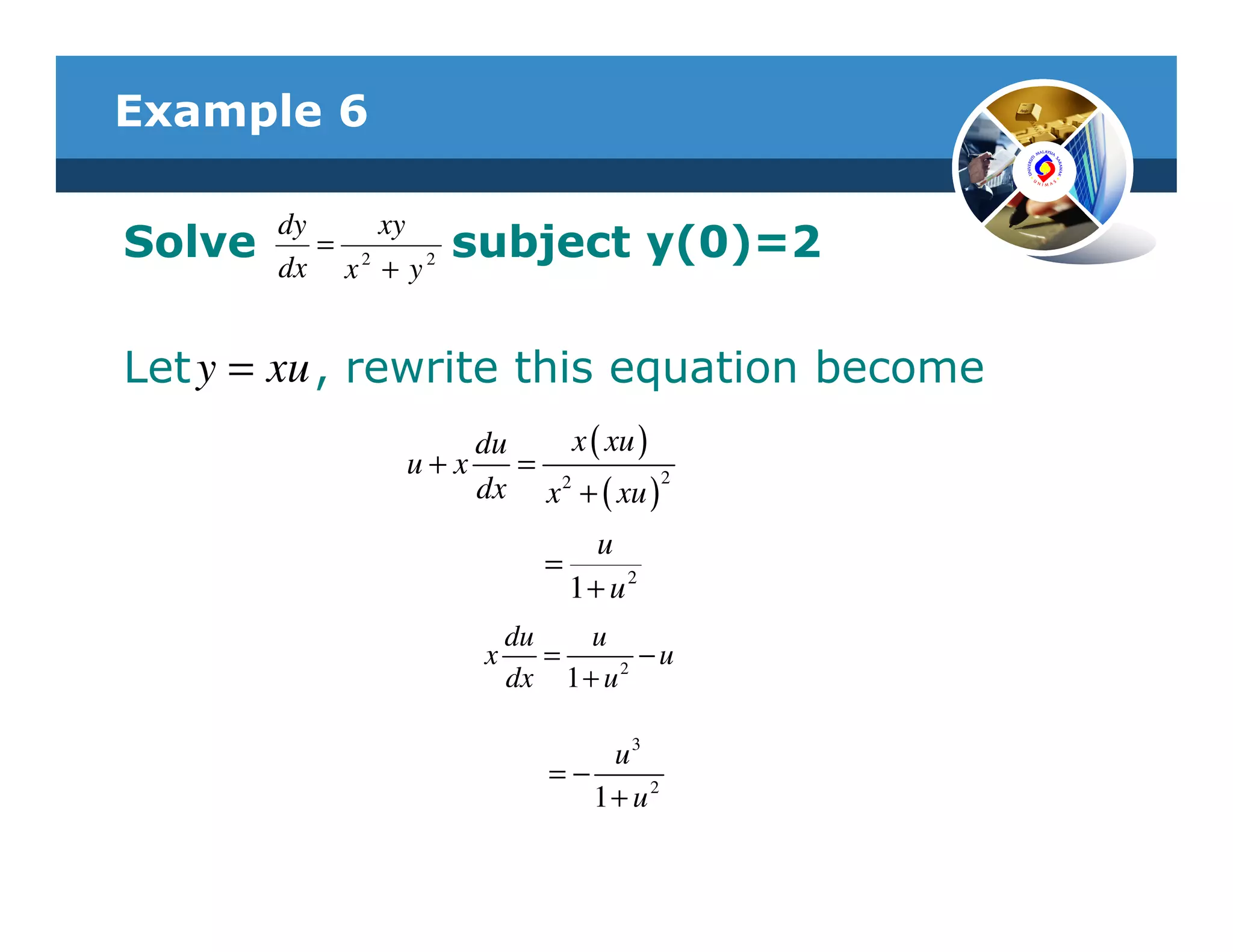
        dy     xy
Solve      = 2
        dx x + y 2
                     subject y(0)=2

Let y = xu , rewrite this equation become
                    du     x ( xu )
                u+x    = 2
                    dx x + ( xu )2
                                 u
                             =
                               1+ u2
                          du    u
                      x      =     2
                                     −u
                          dx 1 + u

                                 u3
                             =−
                                1+ u2
Continue…

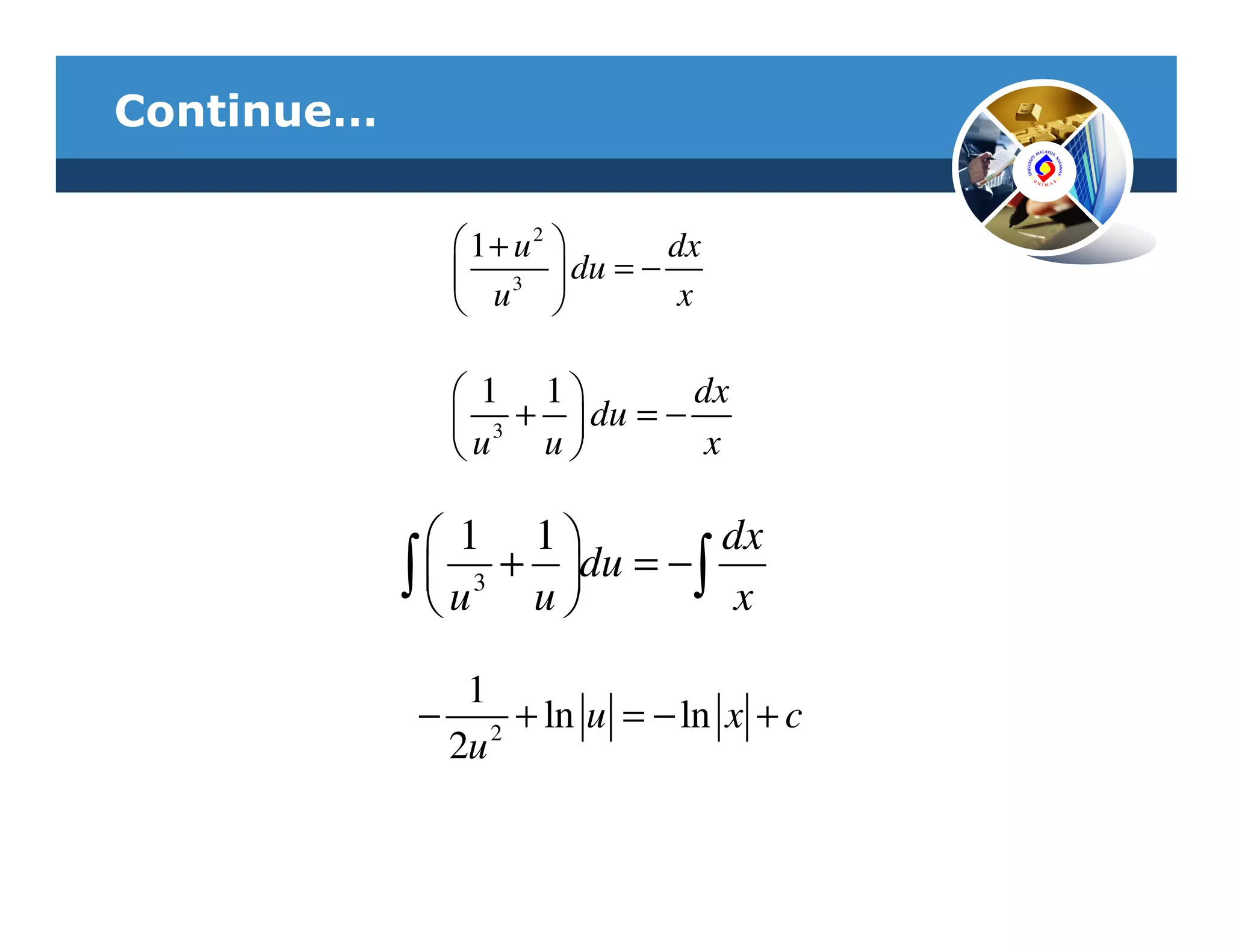
                1+ u2         dx
                3      du = −
                u              x

                1 1         dx
                3 +  du = −
               u u           x

               1 1             dx
            ∫  u 3 + u du = − ∫ x
              
                        

               1
             − 2 + ln u = − ln x + c
              2u
Continue…

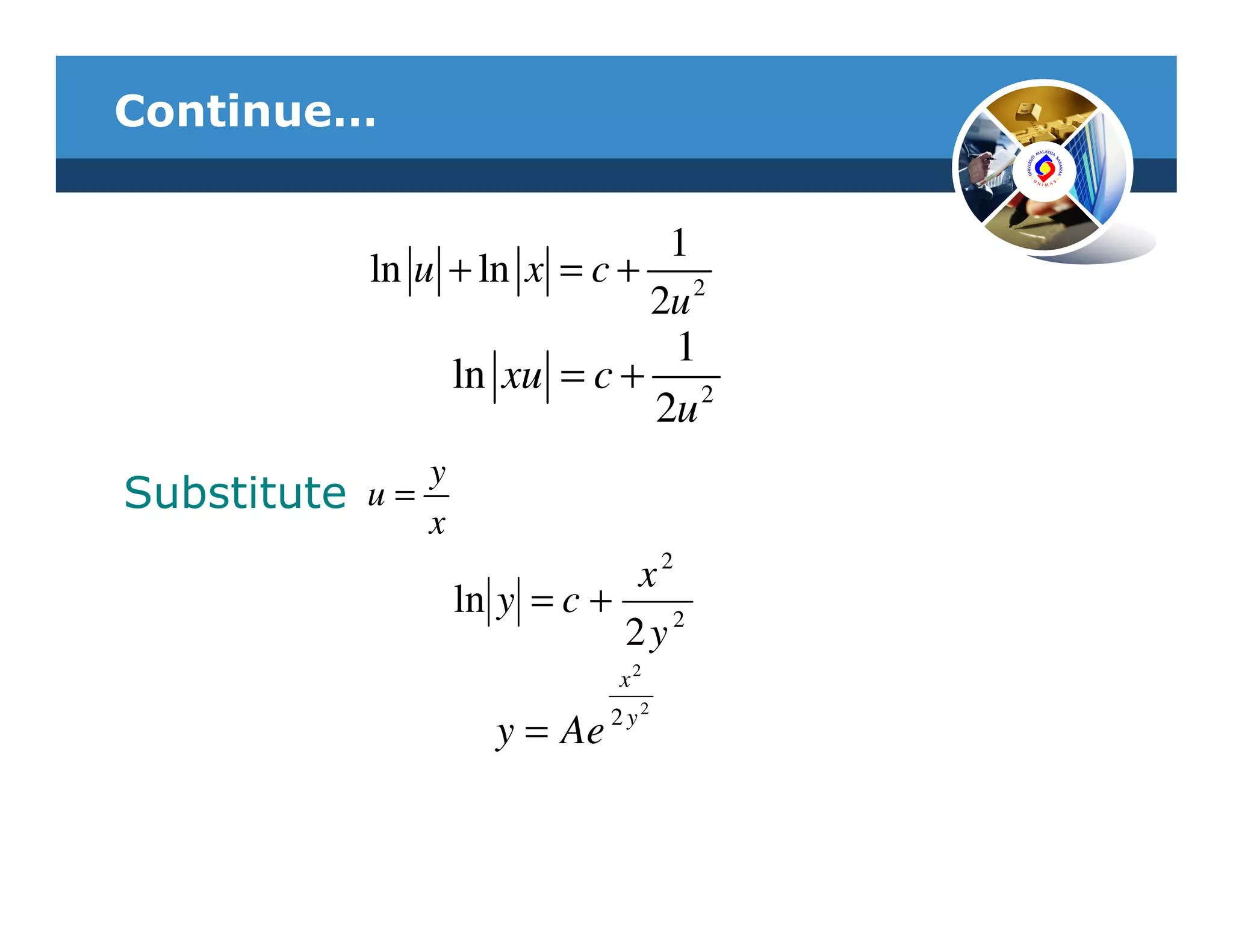
                               1
             ln u + ln x = c + 2
                              2u
                                1
                    ln xu = c + 2
                               2u
                y
Substitute   u=
                x
                                x2
                    ln y = c +
                               2y2
                               x2
                               2 y2
                      y = Ae
Continue…


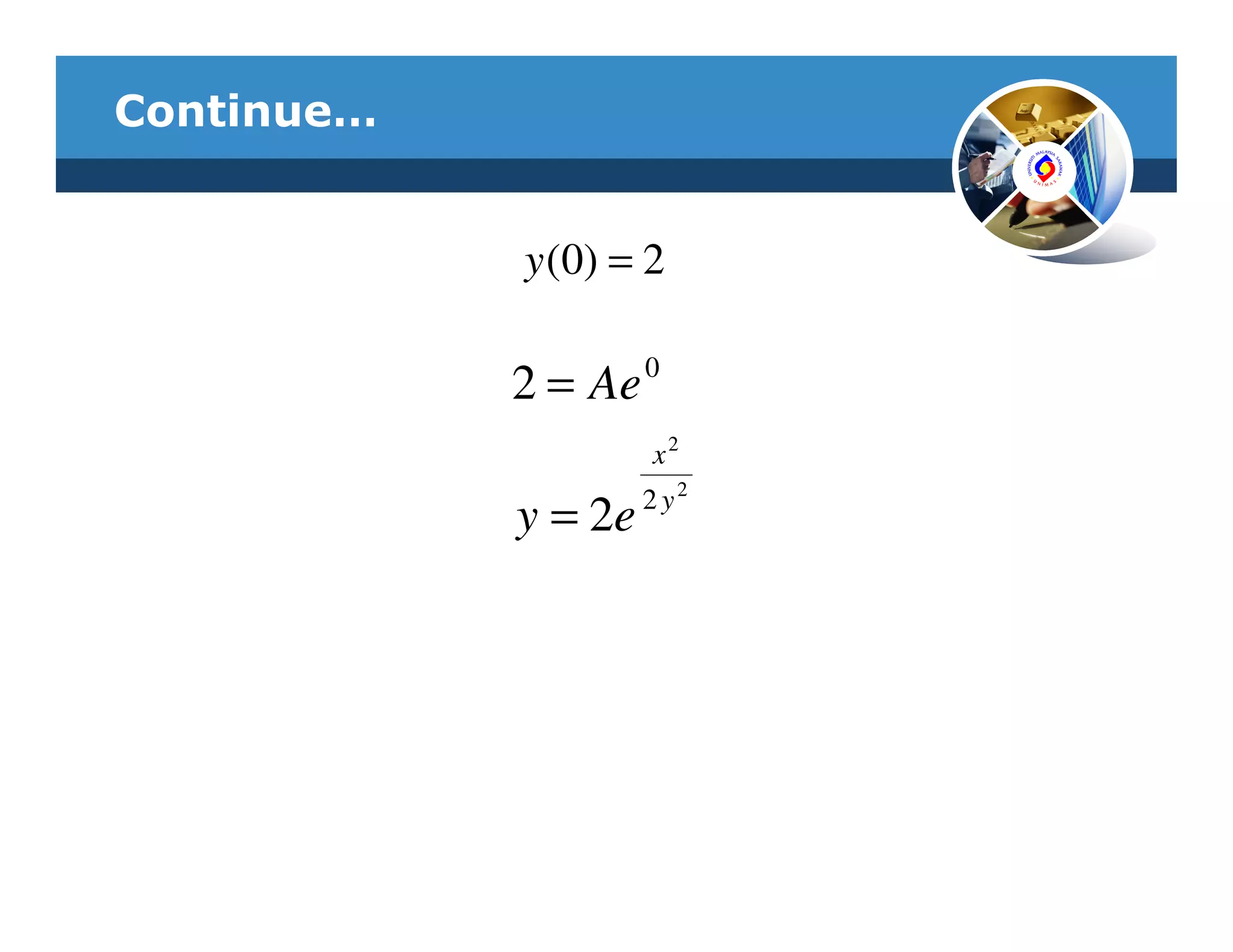
            y ( 0) = 2

                     0
            2 = Ae
                     x2
                     2 y2
            y = 2e
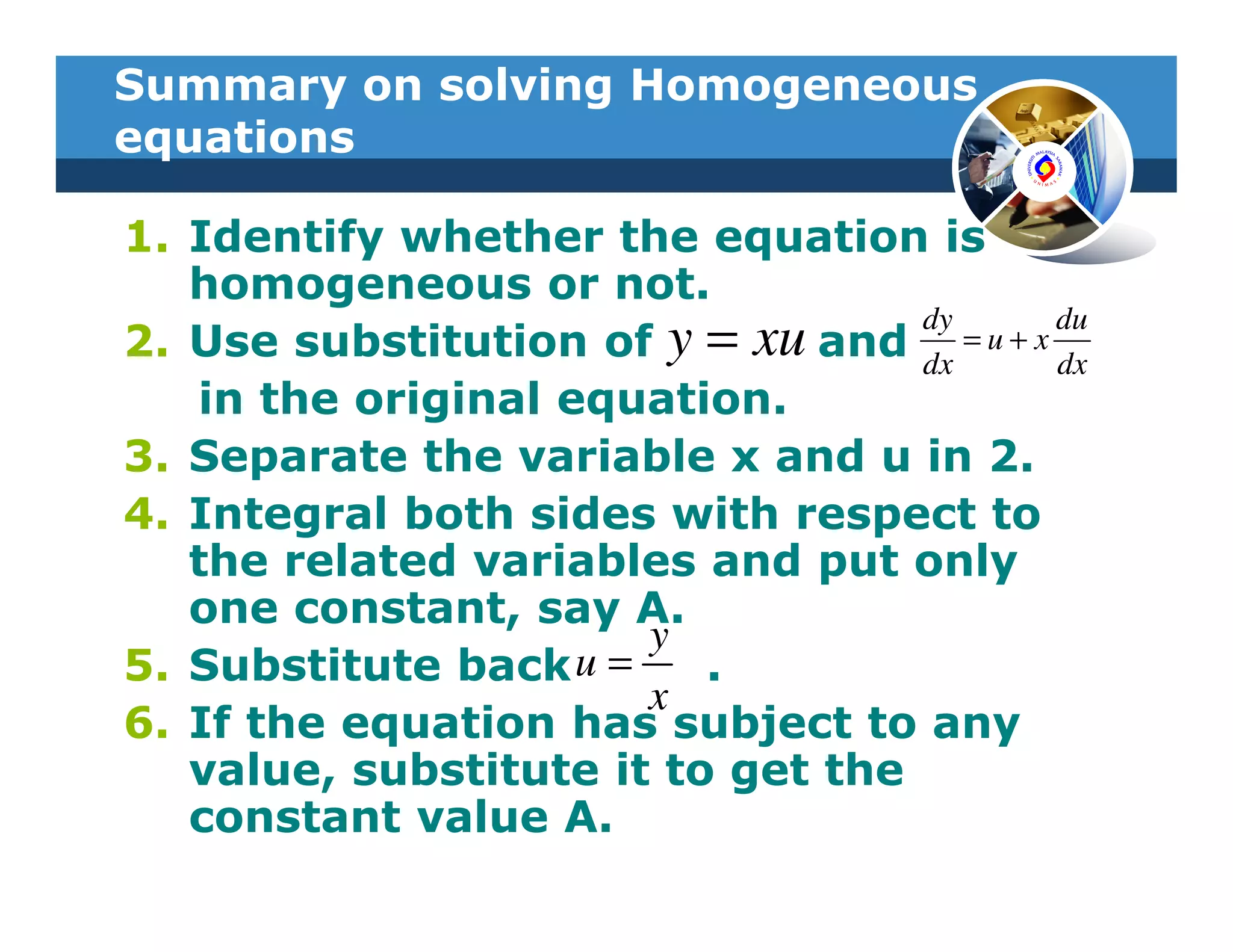
Summary on solving Homogeneous
equations

1. Identify whether the equation is
   homogeneous or not.
                                   dy        du
2. Use substitution of y = xu and dx = u + x dx
   in the original equation.
3. Separate the variable x and u in 2.
4. Integral both sides with respect to
   the related variables and put only
   one constant, say A.
                       y
5. Substitute back u =    .
                       x
6. If the equation has subject to any
   value, substitute it to get the
   constant value A.
Prepared By
              Annie ak Joseph


Prepared By
Annie ak Joseph                 Session 2008/2009

Week 3 [compatibility mode]

  • 1.
    KNF1023 Engineering Mathematics II First Order ODEs Prepared By Annie ak Joseph Prepared By Annie ak Joseph Session 2008/2009
  • 2.
    Learning Objectives Demonstrate how to find integrating factor for non-exact differential equation Demonstrate the solution of Homogeneous 1st order ODE in linear form Demonstrate the solution of inhomogeneous 1st order ODE in linear form
  • 3.
    Integrating Factor If a function u ( x, y ) has continuous partial derivatives, its total or exact differential is ∂u ∂u du = dx + dy ∂x ∂y From this it follows that if u ( x, y ) =c=const, then du = 0 A first-order differential equation of the form M ( x, y )dx + N ( x, y )dy = 0 − −− → (1) Is called exact if its left side is the total or exact differential
  • 4.
    Exact Differential Equation ∂u ∂u du = dx + dy − −− → (2) ∂x ∂y of some function u ( x, y ) . Then the differential equation (1) can be written du = 0 By integration we immediately obtain the general solution of (1) in the form u ( x, y ) = C − −− → (3)
  • 5.
    Exact Differential Equation Comparing (1) and (2), we see that (1) is exact if there is some function u ( x, y ) such that ∂u ∂u a) =M b) =N (4) ∂x ∂y ∂M ∂u 2 ∂N ∂ 2u = = ∂y ∂y∂x ∂x ∂x∂y By the assumption of continuity the two second derivatives are equal. Thus ∂M ∂N = − −− → (5) ∂y ∂x
  • 6.
    Exact Differential Equation This condition is not only necessary but also sufficient for Mdx + Ndy to be an exact differential. If (1) is exact, the function u ( x, y ) can be found by guessing or in the following systematic way. From 4(a) we have by integration with respect to x u = ∫ Mdx + k ( y ) − −− → ( 6 )
  • 7.
    Exact Differential Equation in this integration, y is to be regarded as a constant, and k(y) plays the role of a “constant” of integration. To determine k(y), we derive∂u / ∂y from (6), use (4b) to get ∂k / ∂y and integrate ∂k / ∂y to get k. Formula (6) was obtained from (4a). Instead of 4(a) we may equally well use (4b). Then instead of (6) we first have u = ∫ Ndy + l ( x) − −− → (*6 )
  • 8.
    Exact Differential Equation To determine l(x) we derive ∂u / ∂x from (6*), use (4a) to get ∂l / ∂x and integrate it to get l .
  • 9.
    Example 1: Anexact equation 3 2 2 3 Solve ( x + 3 xy )dx + (3x y + y )dy = 0 (7) Solution: 1st step: Test for exactness. Our equation is of the form (1) with M = x 3 + 3 xy 2 N = 3x 2 y + y 3 ∂M = 6 xy ∂y ∂N = 6 xy ∂x exact solution
  • 10.
    Continue… 2nd Step: Implicitsolution. From (6) we obtain u = ∫ Mdx + k ( y ) = ∫ ( x 3 + 3 xy 2 )dx + k ( y ) 1 4 3 2 2 = x + x y + k ( y) (8) 4 2 To find k(y), we differentiate this formula with respect to y and use formula (4b), obtaining ∂u 2 dk = 3x y + = N = 3x 2 y + y3 ∂y dy
  • 11.
    Continue… dk 3  y4  * Hence dy = y , so that k =  4  + c . Inserting   this into (8) we get the answer 1 4 u ( x, y ) = ( x + 6 x 2 y 2 + y 4 ) = c (9) 4 3rd step: Checking. For checking, we can differentiate u ( x, y ) = c implicitly and see whether this leads to dy = − M dx N or Mdx+ Ndy= 0 , the given equation.
  • 12.
    Continue… In thepresent case, differentiating (9) implicitly with respect to x, we obtain 1 (4 x3 + 12 xy 2 + 12 x 2 yy '+ 4 y 3 y ') = 0 4 Collecting terms, we see that this equals M + Ny’=0 with M and N as in (7); thus Mdx + Ndy = 0 .This completes the check.
  • 13.
    Example 2 ( ) Solve cos( x + y)dx + 3y 2 + 2 y + cos(x + y) dy = 0 Solution: M = cos( x + y ) N = 3 y 2 + 2 y + cos( x + y ) Thus ∂M = − sin( x + y ) ∂y exact ∂N = − sin( x + y ) ∂x
  • 14.
    Continue… Step 2: Implicitgeneral solution. u = ∫ Mdx + k ( y ) = ∫ cos( x + y )dx + k ( y ) = sin( x + y ) + k ( y ) To find k(y), we differentiate this formula with respect to y and obtain ∂u dk = cos( x + y ) + = N = 3 y 2 + 2 y + cos( x + y ) ∂y dy 2 Hence dk / dy = 3 y + 2 y By integration, k = y 3 + y 2 + c * . Inserting this result u ( x, y ) = sin( x + y ) + y 3 + y 2 = c
  • 15.
    Continue… Step 3: Checkingan implicit solution. We can check by differentiating the implicit solution u(x,y) = c implicitly and see whether this leads to the given ODE: ∂u ∂u du = dx + dy = cos( x + y )dx + (cos( x + y ) + 3 y 2 + 2 y )dy = 0 ∂x ∂y This completes the check.
  • 16.
  • 17.
    Identify whether theODE is homogeneous or not??? dy Differential equation ( x , y ) is call = f dx Homogeneous equation if f ( λ x, λ y ) = f ( x, y ) for every real value of λ Example 3: Identify whether dy = y − x is dx y + x homogeneous or not.
  • 18.
    Continue… y−x f ( x, y ) = y+x λ y − λx f ( λ x, λ y ) = λ y + λx y−x = y+x = f ( x, y ) This equation is homogeneous
  • 19.
    Example 4 Checkwhether the equation given is homogeneous or not? dy = x− y dx f ( x, y ) = x − y f ( λ x, λ y ) = λ x − λ y = λ ( x − y) = λ f ( x, y ) This equation is not homogeneous.
  • 20.
    Example 5 dy x + 3 y Solve = dx 2x Solution: The above equation is a homogeneous y = ux dy du =u+x dx dx du x + 3(ux) x(1 + 3u ) 1 + 3u u+x = = = dx 2x 2x 2
  • 21.
    Continue… dv 1 + 3u u+x = dx 2 du 1 + 3u 1 + 3u − 2u 1 + u x = −u = = dx 2 2 2 du 1 + u 1 = = (1 + u )( ) dx 2x 2x du dx = u +1 2x du 1 dx ∫ u +1 = 2 ∫ x
  • 22.
    Continue… 1 ln ( u + 1) = ln x + ln c 2 1 ln ( u + 1) = ln x + ln c 2 1 ln ( u + 1) = ln( x c) 2 1 u + 1 = x 2c
  • 23.
    Continue… y 1 + 1 = x 2c x 3 y + x = x 2c
  • 24.
    Example 6 dy xy Solve = 2 dx x + y 2 subject y(0)=2 Let y = xu , rewrite this equation become du x ( xu ) u+x = 2 dx x + ( xu )2 u = 1+ u2 du u x = 2 −u dx 1 + u u3 =− 1+ u2
  • 25.
    Continue…  1+ u2  dx  3  du = −  u  x  1 1 dx  3 +  du = − u u x  1 1 dx ∫  u 3 + u du = − ∫ x   1 − 2 + ln u = − ln x + c 2u
  • 26.
    Continue… 1 ln u + ln x = c + 2 2u 1 ln xu = c + 2 2u y Substitute u= x x2 ln y = c + 2y2 x2 2 y2 y = Ae
  • 27.
    Continue… y ( 0) = 2 0 2 = Ae x2 2 y2 y = 2e
  • 28.
    Summary on solvingHomogeneous equations 1. Identify whether the equation is homogeneous or not. dy du 2. Use substitution of y = xu and dx = u + x dx in the original equation. 3. Separate the variable x and u in 2. 4. Integral both sides with respect to the related variables and put only one constant, say A. y 5. Substitute back u = . x 6. If the equation has subject to any value, substitute it to get the constant value A.
  • 29.
    Prepared By Annie ak Joseph Prepared By Annie ak Joseph Session 2008/2009