Integer Fuctions
ITT9131 Konkreetne Matemaatika
Chapter Three
Floors and Ceilings
Floor/Ceiling Applications
Floor/Ceiling Recurrences
`mod': The Binary Operation
Floor/Ceiling Sums
Contents
1 Floors and Ceilings
2 Floor/Ceiling Applications
3 Floor/Ceiling Recurrences
4 `mod': The Binary Operation
5 Floor/Ceiling Sums
Next section
1 Floors and Ceilings
2 Floor/Ceiling Applications
3 Floor/Ceiling Recurrences
4 `mod': The Binary Operation
5 Floor/Ceiling Sums
Floors and Ceilings
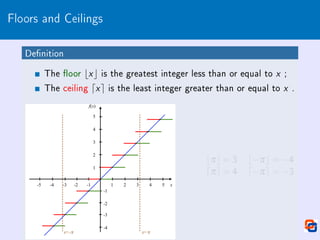
Denition
The oor bxc is the greatest integer less than or equal to x ;
The ceiling dxe is the least integer greater than or equal to x .
bπc = 3 b−πc = −4
dπe = 4 d−πe = −3
Floors and Ceilings
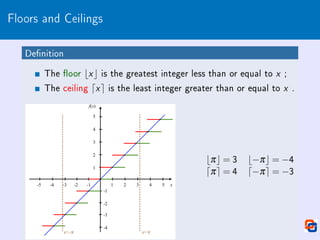
Denition
The oor bxc is the greatest integer less than or equal to x ;
The ceiling dxe is the least integer greater than or equal to x .
bπc = 3 b−πc = −4
dπe = 4 d−πe = −3
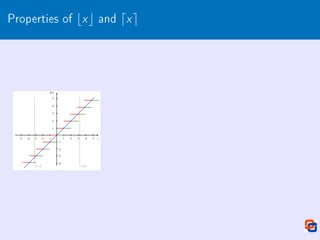
Properties of bxc and dxe
1 bx c = x = dx e i x ∈ Z
2 x −1  bx c 6 x 6 dx e  x +1
3 b−x c = −dx e and d−x e = −bx c
4 dx e−bx c = [x /
∈ Z]
Warmup: the generalized Dirichlet box principle
Statement of the principle
Let m and n be positive integers. If n items are stored into m boxes, then:
At least one box will contain at least dn/me objects.
At least one box will contain at most bn/mc objects.
Warmup: the generalized Dirichlet box principle
Statement of the principle
Let m and n be positive integers. If n items are stored into m boxes, then:
At least one box will contain at least dn/me objects.
At least one box will contain at most bn/mc objects.
Proof
By contradiction, assume each of the m boxes contains fewer than dn/me objects.
Then
n 6 m ·
l n
m
m
−1

or equivalently,
n
m
+1 6
l n
m
m
:
which is impossible.
Similarly, if each of the m boxes contained more than bn/mc objects, we would have
n  m ·
j n
m
k
+1

or equivalently,
n
m
−1 
j n
m
k
:
which is also impossible.
Properties of bxc and dxe (cont.)
1 bx c = x = dx e i x ∈ Z
2 x −1  bx c 6 x 6 dx e  x +1
3 b−x c = −dx e and d−x e = −bx c
4 dx e−bx c = [x /
∈ Z]
In the following properties x ∈ R and n ∈ Z:
5 bx c = n i n 6 x  n +1
6 bx c = n i x −1  n 6 x
7 dx e = n i n −1  x 6 n
8 dx e = n i x 6 n  x +1
9 bx +nc = bx c+n, but bnx c 6= n bx c
Properties of bxc and dxe (cont.)
1 bx c = x = dx e i x ∈ Z
2 x −1  bx c 6 x 6 dx e  x +1
3 b−x c = −dx e and d−x e = −bx c
4 dx e−bx c = [x /
∈ Z]
In the following properties x ∈ R and n ∈ Z:
5 bx c = n i n 6 x  n +1
6 bx c = n i x −1  n 6 x
7 dx e = n i n −1  x 6 n
8 dx e = n i x 6 n  x +1
9 bx +nc = bx c+n, but bnx c 6= n bx c
More properties:
10 x  n i bx c  n
11 n  x i n  dx e
12 x 6 n i dx e 6 n
13 n 6 x i n 6 bx c
Generalization of the property #9
Theorem
bx +y c =
(
bx c+by c, if 0 6 {x }+{y }  1
bx c+by c+1, if 1 6 {x }+{y }  2
where {x } = x −bx c is the fractional part of x .
Proof. Let x = bx c+{x } and y = by c+{y }
bx +y c = bbx c+by c+{x }+{y }c
= bx c+by c+b{x }+{y }c
and
b{x }+{y }c =
(
0, if 0 6 {x }+{y }  1
1, if 1 6 {x }+{y }  2
Q.E.D.
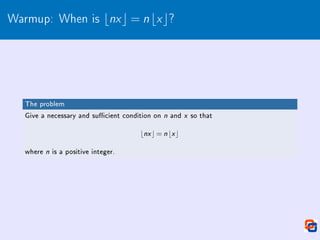
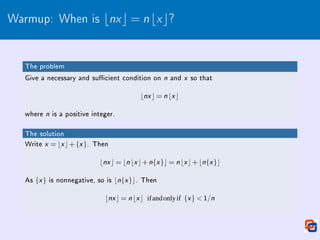
Warmup: When is bnxc = nbxc?
The problem
Give a necessary and sucient condition on n and x so that
bnx c = n bx c
where n is a positive integer.
Warmup: When is bnxc = nbxc?
The problem
Give a necessary and sucient condition on n and x so that
bnx c = n bx c
where n is a positive integer.
The solution
Write x = bx c+{x }. Then
bnx c = bn bx c+n{x }c = n bx c+bn{x }c
As {x } is nonnegative, so is bn{x }c. Then
bnx c = n bx c ifandonlyif {x }  1/n
Next section
1 Floors and Ceilings
2 Floor/Ceiling Applications
3 Floor/Ceiling Recurrences
4 `mod': The Binary Operation
5 Floor/Ceiling Sums
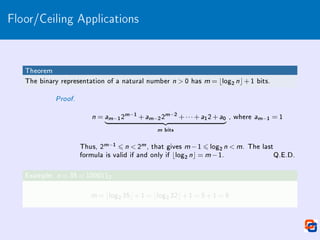
Floor/Ceiling Applications
Theorem
The binary representation of a natural number n  0 has m = blog2 nc+1 bits.
Proof.
n = am−12m−1 +am−22m−2 +···+a12+a0
| {z }
m bits
, where am−1 = 1
Thus, 2m−1 6 n  2m, that gives m −1 6 log2 n  m. The last
formula is valid if and only if blog2 nc = m −1. Q.E.D.
Example: n = 35 = 1000112
m = blog2 35c+1 = blog2 32c+1 = 5+1 = 6
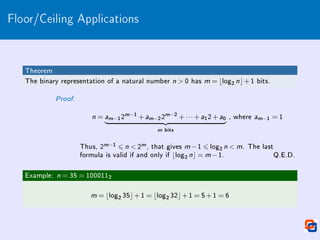
Floor/Ceiling Applications
Theorem
The binary representation of a natural number n  0 has m = blog2 nc+1 bits.
Proof.
n = am−12m−1 +am−22m−2 +···+a12+a0
| {z }
m bits
, where am−1 = 1
Thus, 2m−1 6 n  2m, that gives m −1 6 log2 n  m. The last
formula is valid if and only if blog2 nc = m −1. Q.E.D.
Example: n = 35 = 1000112
m = blog2 35c+1 = blog2 32c+1 = 5+1 = 6
Floor/Ceiling Applications (2)
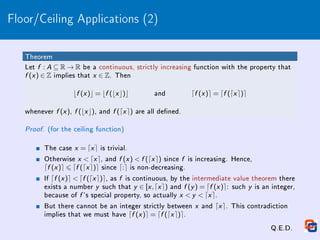
Theorem
Let f : A ⊆ R → R be a continuous, strictly increasing function with the property that
f (x ) ∈ Z implies that x ∈ Z. Then
bf (x )c = bf (bx c)c and df (x )e = df (dx e)e
whenever f (x ), f (bx c), and f (dx e) are all dened.
Proof. (for the ceiling function)
The case x = dx e is trivial.
Otherwise x  dx e, and f (x )  f (dx e) since f is increasing. Hence,
df (x )e 6 df (dx e)e since d:e is non-decreasing.
If df (x )e  df (dx e)e, as f is continuous, by the intermediate value theorem there
exists a number y such that y ∈ [x ,dx e) and f (y ) = df (x )e: such y is an integer,
because of f 's special property, so actually x  y  dx e.
But there cannot be an integer strictly between x and dx e. This contradiction
implies that we must have df (x )e = df (dx e)e.
Q.E.D.
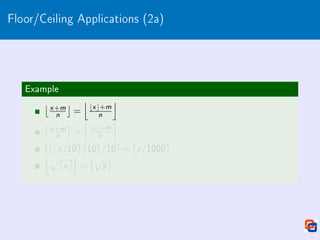
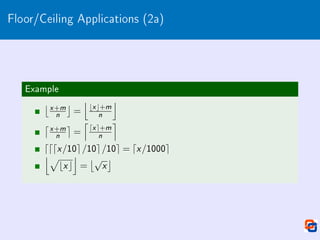
Floor/Ceiling Applications (2a)
Example
x +m
n

=
j
bx c+m
n
k
x +m
n

=
l
dx e+m
n
m
dddx/10e/10e/10e = dx/1000e
jp
bxc
k
=
√
x
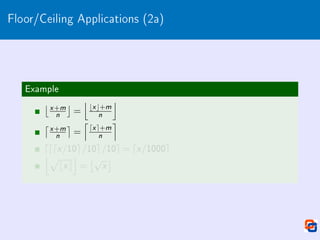
Floor/Ceiling Applications (2a)
Example
x +m
n

=
j
bx c+m
n
k
x +m
n

=
l
dx e+m
n
m
dddx/10e/10e/10e = dx/1000e
jp
bxc
k
=
√
x
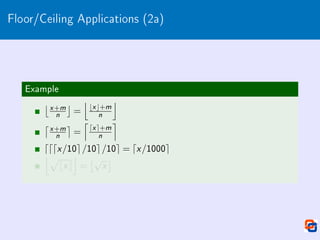
Floor/Ceiling Applications (2a)
Example
x +m
n

=
j
bx c+m
n
k
x +m
n

=
l
dx e+m
n
m
dddx/10e/10e/10e = dx/1000e
jp
bxc
k
=
√
x
Floor/Ceiling Applications (2a)
Example
x +m
n

=
j
bx c+m
n
k
x +m
n

=
l
dx e+m
n
m
dddx/10e/10e/10e = dx/1000e
jp
bxc
k
=
√
x
Floor/Ceiling Applications (2a)
Example
x +m
n

=
j
bx c+m
n
k
x +m
n

=
l
dx e+m
n
m
dddx/10e/10e/10e = dx/1000e
jp
bxc
k
=
√
x

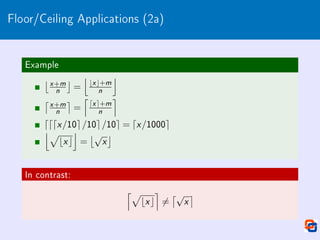
In contrast:
lp
bxc
m
6=
√
x
Floor/Ceiling Applications (3) : Intervals
For Real numbers α 6= β
Interval Integers contained Restrictions
[α..β] bβc−dαe+1 α 6 β
[α..β) dβe−dαe α 6 β
(α..β] bβc−bαc α 6 β
(α..β) dβe−bαc−1 α  β
Floor/Ceiling Applications (3) : Spectra
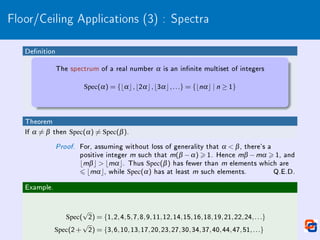
Denition
The spectrum of a real number α is an innite multiset of integers
Spec(α) = {bαc,b2αc,b3αc,...} = {bnαc | n ≥ 1}
Theorem
If α 6= β then Spec(α) 6= Spec(β).
Proof. For, assuming without loss of generality that α  β, there's a
positive integer m such that m(β −α)  1. Hence mβ −mα  1, and
bmβc  bmαc. Thus Spec(β) has fewer than m elements which are
6 bmαc, while Spec(α) has at least m such elements. Q.E.D.
Example.
Spec(
√
2) = {1,2,4,5,7,8,9,11,12,14,15,16,18,19,21,22,24,...}
Spec(2+
√
2) = {3,6,10,13,17,20,23,27,30,34,37,40,44,47,51,...}
Floor/Ceiling Applications (3a) : Spectra
The number of elements in Spec(α) that are 6 n:
N(α,n) = ∑
k0
[bkαc 6 n]
= ∑
k0
[bkαc  n +1]
= ∑
k0
[kα  n +1]
= ∑
k
[0  k  (n +1)/α]
= d(n +1)/αe−1
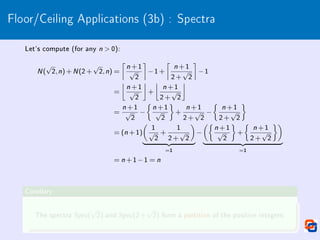
Floor/Ceiling Applications (3b) : Spectra
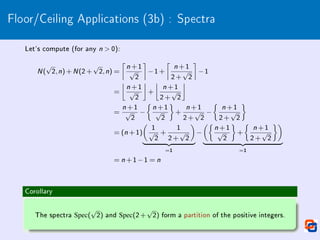
Let's compute (for any n  0):
N(
√
2,n)+N(2+
√
2,n) =

n +1
√
2

−1+

n +1
2+
√
2

−1
=

n +1
√
2

+

n +1
2+
√
2

=
n +1
√
2
−

n +1
√
2

+
n +1
2+
√
2
−

n +1
2+
√
2

= (n +1)

1
√
2
+
1
2+
√
2

| {z }
=1
−

n +1
√
2

+

n +1
2+
√
2

| {z }
=1
= n +1−1 = n
Corollary
The spectra Spec(
√
2) and Spec(2+
√
2) form a partition of the positive integers.
Floor/Ceiling Applications (3b) : Spectra
Let's compute (for any n  0):
N(
√
2,n)+N(2+
√
2,n) =

n +1
√
2

−1+

n +1
2+
√
2

−1
=

n +1
√
2

+

n +1
2+
√
2

=
n +1
√
2
−

n +1
√
2

+
n +1
2+
√
2
−

n +1
2+
√
2

= (n +1)

1
√
2
+
1
2+
√
2

| {z }
=1
−

n +1
√
2

+

n +1
2+
√
2

| {z }
=1
= n +1−1 = n
Corollary
The spectra Spec(
√
2) and Spec(2+
√
2) form a partition of the positive integers.
Next section
1 Floors and Ceilings
2 Floor/Ceiling Applications
3 Floor/Ceiling Recurrences
4 `mod': The Binary Operation
5 Floor/Ceiling Sums
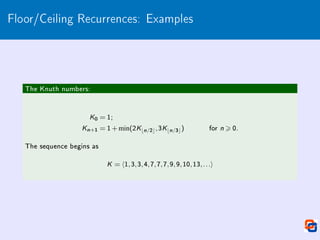
Floor/Ceiling Recurrences: Examples
The Knuth numbers:
K0 = 1;
Kn+1 = 1+min(2Kbn/2c,3Kbn/3c) for n  0.
The sequence begins as
K = h1,3,3,4,7,7,7,9,9,10,13,...i
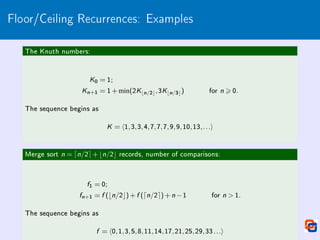
Floor/Ceiling Recurrences: Examples
The Knuth numbers:
K0 = 1;
Kn+1 = 1+min(2Kbn/2c,3Kbn/3c) for n  0.
The sequence begins as
K = h1,3,3,4,7,7,7,9,9,10,13,...i
Merge sort n = dn/2e+bn/2c records, number of comparisons:
f1 = 0;
fn+1 = f (bn/2c)+f (dn/2e)+n −1 for n  1.
The sequence begins as
f = h0,1,3,5,8,11,14,17,21,25,29,33...i
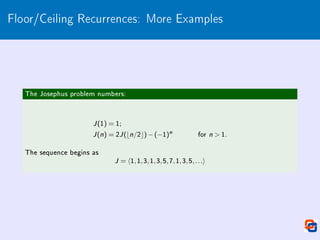
Floor/Ceiling Recurrences: More Examples
The Josephus problem numbers:
J(1) = 1;
J(n) = 2J(bn/2c)−(−1)n for n  1.
The sequence begins as
J = h1,1,3,1,3,5,7,1,3,5,...i
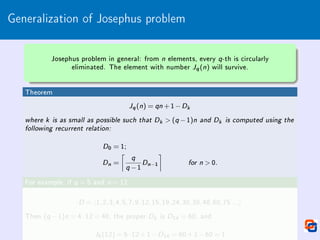
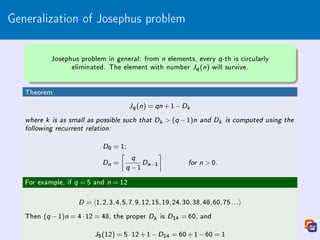
Generalization of Josephus problem
Josephus problem in general: from n elements, every q-th is circularly
eliminated. The element with number Jq(n) will survive.
Theorem
Jq(n) = qn +1−Dk
where k is as small as possible such that Dk  (q −1)n and Dk is computed using the
following recurrent relation:
D0 = 1;
Dn =

q
q −1
Dn−1

for n  0.
For example, if q = 5 and n = 12
D = h1,2,3,4,5,7,9,12,15,19,24,30,38,48,60,75...i
Then (q −1)n = 4·12 = 48, the proper Dk is D14 = 60, and
J5(12) = 5·12+1−D14 = 60+1−60 = 1
Generalization of Josephus problem
Josephus problem in general: from n elements, every q-th is circularly
eliminated. The element with number Jq(n) will survive.
Theorem
Jq(n) = qn +1−Dk
where k is as small as possible such that Dk  (q −1)n and Dk is computed using the
following recurrent relation:
D0 = 1;
Dn =

q
q −1
Dn−1

for n  0.
For example, if q = 5 and n = 12
D = h1,2,3,4,5,7,9,12,15,19,24,30,38,48,60,75...i
Then (q −1)n = 4·12 = 48, the proper Dk is D14 = 60, and
J5(12) = 5·12+1−D14 = 60+1−60 = 1
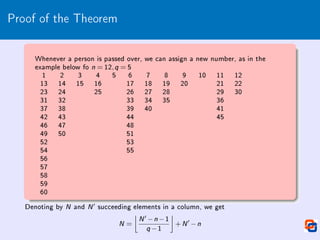
Proof of the Theorem
Whenever a person is passed over, we can assign a new number, as in the
example below fo n = 12,q = 5
1 2 3 4 5 6 7 8 9 10 11 12
13 14 15 16 17 18 19 20 21 22
23 24 25 26 27 28 29 30
31 32 33 34 35 36
37 38 39 40 41
42 43 44 45
46 47 48
49 50 51
52 53
54 55
56
57
58
59
60
Denoting by N and N
0 succeeding elements in a column, we get
N =

N
0 −n −1
q −1

+N
0
−n
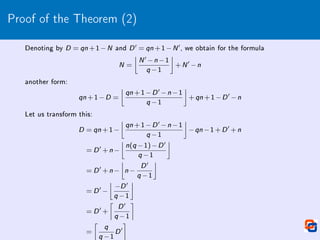
Proof of the Theorem (2)
Denoting by D = qn +1−N and D
0 = qn +1−N
0, we obtain for the formula
N =

N
0 −n −1
q −1

+N
0
−n
another form:
qn +1−D =

qn +1−D
0 −n −1
q −1

+qn +1−D
0
−n
Let us transform this:
D = qn +1−

qn +1−D
0 −n −1
q −1

−qn −1+D
0
+n
= D
0
+n −

n(q −1)−D
0
q −1

= D
0
+n −

n −
D
0
q −1

= D
0
−

−D
0
q −1

= D
0
+

D
0
q −1

=

q
q −1
D
0
Next section
1 Floors and Ceilings
2 Floor/Ceiling Applications
3 Floor/Ceiling Recurrences
4 `mod': The Binary Operation
5 Floor/Ceiling Sums
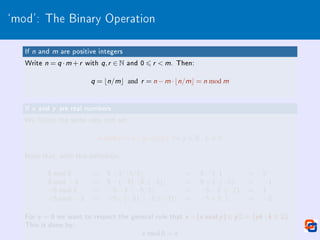
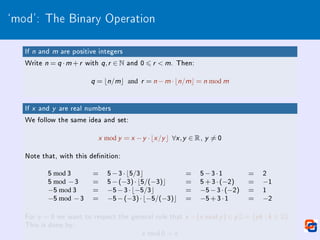
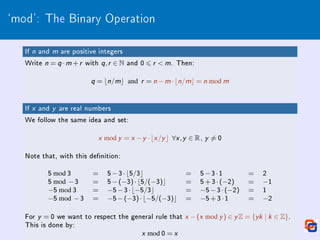
`mod': The Binary Operation
If n and m are positive integers
Write n = q ·m +r with q,r ∈ N and 0 6 r  m. Then:
q = bn/mc and r = n −m ·bn/mc = n mod m
If x and y are real numbers
We follow the same idea and set:
x mod y = x −y ·bx /y c ∀x ,y ∈ R, y 6= 0
Note that, with this denition:
5 mod 3 = 5−3·b5/3c = 5−3·1 = 2
5 mod −3 = 5−(−3)·b5/(−3)c = 5+3·(−2) = −1
−5 mod 3 = −5−3·b−5/3c = −5−3·(−2) = 1
−5 mod −3 = −5−(−3)·b−5/(−3)c = −5+3·1 = −2
For y = 0 we want to respect the general rule that x −(x mod y ) ∈ y Z = {yk | k ∈ Z}.
This is done by:
x mod 0 = x
`mod': The Binary Operation
If n and m are positive integers
Write n = q ·m +r with q,r ∈ N and 0 6 r  m. Then:
q = bn/mc and r = n −m ·bn/mc = n mod m
If x and y are real numbers
We follow the same idea and set:
x mod y = x −y ·bx /y c ∀x ,y ∈ R, y 6= 0
Note that, with this denition:
5 mod 3 = 5−3·b5/3c = 5−3·1 = 2
5 mod −3 = 5−(−3)·b5/(−3)c = 5+3·(−2) = −1
−5 mod 3 = −5−3·b−5/3c = −5−3·(−2) = 1
−5 mod −3 = −5−(−3)·b−5/(−3)c = −5+3·1 = −2
For y = 0 we want to respect the general rule that x −(x mod y ) ∈ y Z = {yk | k ∈ Z}.
This is done by:
x mod 0 = x
`mod': The Binary Operation
If n and m are positive integers
Write n = q ·m +r with q,r ∈ N and 0 6 r  m. Then:
q = bn/mc and r = n −m ·bn/mc = n mod m
If x and y are real numbers
We follow the same idea and set:
x mod y = x −y ·bx /y c ∀x ,y ∈ R, y 6= 0
Note that, with this denition:
5 mod 3 = 5−3·b5/3c = 5−3·1 = 2
5 mod −3 = 5−(−3)·b5/(−3)c = 5+3·(−2) = −1
−5 mod 3 = −5−3·b−5/3c = −5−3·(−2) = 1
−5 mod −3 = −5−(−3)·b−5/(−3)c = −5+3·1 = −2
For y = 0 we want to respect the general rule that x −(x mod y ) ∈ y Z = {yk | k ∈ Z}.
This is done by:
x mod 0 = x
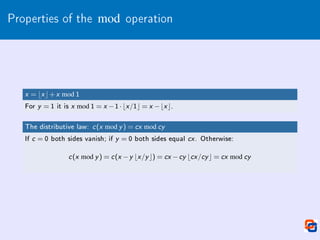
Properties of the mod operation
x = bx c+x mod 1
For y = 1 it is x mod 1 = x −1·bx /1c = x −bx c.
The distributive law: c(x mod y ) = cx mod cy
If c = 0 both sides vanish; if y = 0 both sides equal cx . Otherwise:
c(x mod y ) = c(x −y bx /y c) = cx −cy bcx /cy c = cx mod cy
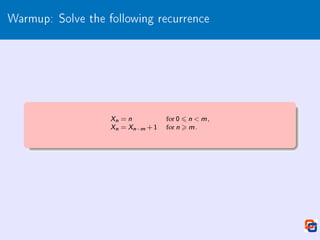
Warmup: Solve the following recurrence
Xn = n for 0 6 n  m ,
Xn = Xn−m +1 for n  m .
Warmup: Solve the following recurrence
Xn = n for 0 6 n  m ,
Xn = Xn−m +1 for n  m .
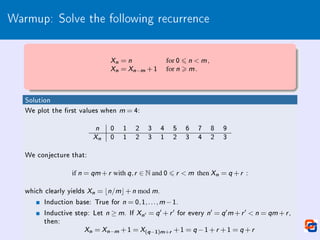
Solution
We plot the rst values when m = 4:
n 0 1 2 3 4 5 6 7 8 9
Xn 0 1 2 3 1 2 3 4 2 3
We conjecture that:
if n = qm +r with q,r ∈ N and 0 6 r  m then Xn = q +r :
which clearly yields Xn = bn/mc+n mod m.
Induction base: True for n = 0,1,...,m −1.
Inductive step: Let n ≥ m. If Xn0 = q
0 +r
0 for every n
0 = q
0m +r
0  n = qm +r ,
then:
Xn = Xn−m +1 = X(q−1)m+r +1 = q −1+r +1 = q +r

Integer_Functions .pdf

  • 1.
    Integer Fuctions ITT9131 KonkreetneMatemaatika Chapter Three Floors and Ceilings Floor/Ceiling Applications Floor/Ceiling Recurrences `mod': The Binary Operation Floor/Ceiling Sums
  • 2.
    Contents 1 Floors andCeilings 2 Floor/Ceiling Applications 3 Floor/Ceiling Recurrences 4 `mod': The Binary Operation 5 Floor/Ceiling Sums
  • 3.
    Next section 1 Floorsand Ceilings 2 Floor/Ceiling Applications 3 Floor/Ceiling Recurrences 4 `mod': The Binary Operation 5 Floor/Ceiling Sums
  • 4.
    Floors and Ceilings Denition Theoor bxc is the greatest integer less than or equal to x ; The ceiling dxe is the least integer greater than or equal to x . bπc = 3 b−πc = −4 dπe = 4 d−πe = −3
  • 5.
    Floors and Ceilings Denition Theoor bxc is the greatest integer less than or equal to x ; The ceiling dxe is the least integer greater than or equal to x . bπc = 3 b−πc = −4 dπe = 4 d−πe = −3
  • 6.
  • 7.
    Properties of bxcand dxe 1 bx c = x = dx e i x ∈ Z 2 x −1 bx c 6 x 6 dx e x +1 3 b−x c = −dx e and d−x e = −bx c 4 dx e−bx c = [x / ∈ Z]
  • 8.
    Warmup: the generalizedDirichlet box principle Statement of the principle Let m and n be positive integers. If n items are stored into m boxes, then: At least one box will contain at least dn/me objects. At least one box will contain at most bn/mc objects.
  • 9.
    Warmup: the generalizedDirichlet box principle Statement of the principle Let m and n be positive integers. If n items are stored into m boxes, then: At least one box will contain at least dn/me objects. At least one box will contain at most bn/mc objects. Proof By contradiction, assume each of the m boxes contains fewer than dn/me objects. Then n 6 m · l n m m −1 or equivalently, n m +1 6 l n m m : which is impossible. Similarly, if each of the m boxes contained more than bn/mc objects, we would have n m · j n m k +1 or equivalently, n m −1 j n m k : which is also impossible.
  • 10.
    Properties of bxcand dxe (cont.) 1 bx c = x = dx e i x ∈ Z 2 x −1 bx c 6 x 6 dx e x +1 3 b−x c = −dx e and d−x e = −bx c 4 dx e−bx c = [x / ∈ Z] In the following properties x ∈ R and n ∈ Z: 5 bx c = n i n 6 x n +1 6 bx c = n i x −1 n 6 x 7 dx e = n i n −1 x 6 n 8 dx e = n i x 6 n x +1 9 bx +nc = bx c+n, but bnx c 6= n bx c
  • 11.
    Properties of bxcand dxe (cont.) 1 bx c = x = dx e i x ∈ Z 2 x −1 bx c 6 x 6 dx e x +1 3 b−x c = −dx e and d−x e = −bx c 4 dx e−bx c = [x / ∈ Z] In the following properties x ∈ R and n ∈ Z: 5 bx c = n i n 6 x n +1 6 bx c = n i x −1 n 6 x 7 dx e = n i n −1 x 6 n 8 dx e = n i x 6 n x +1 9 bx +nc = bx c+n, but bnx c 6= n bx c More properties: 10 x n i bx c n 11 n x i n dx e 12 x 6 n i dx e 6 n 13 n 6 x i n 6 bx c
  • 12.
    Generalization of theproperty #9 Theorem bx +y c = ( bx c+by c, if 0 6 {x }+{y } 1 bx c+by c+1, if 1 6 {x }+{y } 2 where {x } = x −bx c is the fractional part of x . Proof. Let x = bx c+{x } and y = by c+{y } bx +y c = bbx c+by c+{x }+{y }c = bx c+by c+b{x }+{y }c and b{x }+{y }c = ( 0, if 0 6 {x }+{y } 1 1, if 1 6 {x }+{y } 2 Q.E.D.
  • 13.
    Warmup: When isbnxc = nbxc? The problem Give a necessary and sucient condition on n and x so that bnx c = n bx c where n is a positive integer.
  • 14.
    Warmup: When isbnxc = nbxc? The problem Give a necessary and sucient condition on n and x so that bnx c = n bx c where n is a positive integer. The solution Write x = bx c+{x }. Then bnx c = bn bx c+n{x }c = n bx c+bn{x }c As {x } is nonnegative, so is bn{x }c. Then bnx c = n bx c ifandonlyif {x } 1/n
  • 15.
    Next section 1 Floorsand Ceilings 2 Floor/Ceiling Applications 3 Floor/Ceiling Recurrences 4 `mod': The Binary Operation 5 Floor/Ceiling Sums
  • 16.
    Floor/Ceiling Applications Theorem The binaryrepresentation of a natural number n 0 has m = blog2 nc+1 bits. Proof. n = am−12m−1 +am−22m−2 +···+a12+a0 | {z } m bits , where am−1 = 1 Thus, 2m−1 6 n 2m, that gives m −1 6 log2 n m. The last formula is valid if and only if blog2 nc = m −1. Q.E.D. Example: n = 35 = 1000112 m = blog2 35c+1 = blog2 32c+1 = 5+1 = 6
  • 17.
    Floor/Ceiling Applications Theorem The binaryrepresentation of a natural number n 0 has m = blog2 nc+1 bits. Proof. n = am−12m−1 +am−22m−2 +···+a12+a0 | {z } m bits , where am−1 = 1 Thus, 2m−1 6 n 2m, that gives m −1 6 log2 n m. The last formula is valid if and only if blog2 nc = m −1. Q.E.D. Example: n = 35 = 1000112 m = blog2 35c+1 = blog2 32c+1 = 5+1 = 6
  • 18.
    Floor/Ceiling Applications (2) Theorem Letf : A ⊆ R → R be a continuous, strictly increasing function with the property that f (x ) ∈ Z implies that x ∈ Z. Then bf (x )c = bf (bx c)c and df (x )e = df (dx e)e whenever f (x ), f (bx c), and f (dx e) are all dened. Proof. (for the ceiling function) The case x = dx e is trivial. Otherwise x dx e, and f (x ) f (dx e) since f is increasing. Hence, df (x )e 6 df (dx e)e since d:e is non-decreasing. If df (x )e df (dx e)e, as f is continuous, by the intermediate value theorem there exists a number y such that y ∈ [x ,dx e) and f (y ) = df (x )e: such y is an integer, because of f 's special property, so actually x y dx e. But there cannot be an integer strictly between x and dx e. This contradiction implies that we must have df (x )e = df (dx e)e. Q.E.D.
  • 19.
    Floor/Ceiling Applications (2a) Example x+m n = j bx c+m n k x +m n = l dx e+m n m dddx/10e/10e/10e = dx/1000e jp bxc k = √ x
  • 20.
    Floor/Ceiling Applications (2a) Example x+m n = j bx c+m n k x +m n = l dx e+m n m dddx/10e/10e/10e = dx/1000e jp bxc k = √ x
  • 21.
    Floor/Ceiling Applications (2a) Example x+m n = j bx c+m n k x +m n = l dx e+m n m dddx/10e/10e/10e = dx/1000e jp bxc k = √ x
  • 22.
    Floor/Ceiling Applications (2a) Example x+m n = j bx c+m n k x +m n = l dx e+m n m dddx/10e/10e/10e = dx/1000e jp bxc k = √ x
  • 23.
    Floor/Ceiling Applications (2a) Example x+m n = j bx c+m n k x +m n = l dx e+m n m dddx/10e/10e/10e = dx/1000e jp bxc k = √ x In contrast: lp bxc m 6= √ x
  • 24.
    Floor/Ceiling Applications (3): Intervals For Real numbers α 6= β Interval Integers contained Restrictions [α..β] bβc−dαe+1 α 6 β [α..β) dβe−dαe α 6 β (α..β] bβc−bαc α 6 β (α..β) dβe−bαc−1 α β
  • 25.
    Floor/Ceiling Applications (3): Spectra Denition The spectrum of a real number α is an innite multiset of integers Spec(α) = {bαc,b2αc,b3αc,...} = {bnαc | n ≥ 1} Theorem If α 6= β then Spec(α) 6= Spec(β). Proof. For, assuming without loss of generality that α β, there's a positive integer m such that m(β −α) 1. Hence mβ −mα 1, and bmβc bmαc. Thus Spec(β) has fewer than m elements which are 6 bmαc, while Spec(α) has at least m such elements. Q.E.D. Example. Spec( √ 2) = {1,2,4,5,7,8,9,11,12,14,15,16,18,19,21,22,24,...} Spec(2+ √ 2) = {3,6,10,13,17,20,23,27,30,34,37,40,44,47,51,...}
  • 26.
    Floor/Ceiling Applications (3a): Spectra The number of elements in Spec(α) that are 6 n: N(α,n) = ∑ k0 [bkαc 6 n] = ∑ k0 [bkαc n +1] = ∑ k0 [kα n +1] = ∑ k [0 k (n +1)/α] = d(n +1)/αe−1
  • 27.
    Floor/Ceiling Applications (3b): Spectra Let's compute (for any n 0): N( √ 2,n)+N(2+ √ 2,n) = n +1 √ 2 −1+ n +1 2+ √ 2 −1 = n +1 √ 2 + n +1 2+ √ 2 = n +1 √ 2 − n +1 √ 2 + n +1 2+ √ 2 − n +1 2+ √ 2 = (n +1) 1 √ 2 + 1 2+ √ 2 | {z } =1 − n +1 √ 2 + n +1 2+ √ 2 | {z } =1 = n +1−1 = n Corollary The spectra Spec( √ 2) and Spec(2+ √ 2) form a partition of the positive integers.
  • 28.
    Floor/Ceiling Applications (3b): Spectra Let's compute (for any n 0): N( √ 2,n)+N(2+ √ 2,n) = n +1 √ 2 −1+ n +1 2+ √ 2 −1 = n +1 √ 2 + n +1 2+ √ 2 = n +1 √ 2 − n +1 √ 2 + n +1 2+ √ 2 − n +1 2+ √ 2 = (n +1) 1 √ 2 + 1 2+ √ 2 | {z } =1 − n +1 √ 2 + n +1 2+ √ 2 | {z } =1 = n +1−1 = n Corollary The spectra Spec( √ 2) and Spec(2+ √ 2) form a partition of the positive integers.
  • 29.
    Next section 1 Floorsand Ceilings 2 Floor/Ceiling Applications 3 Floor/Ceiling Recurrences 4 `mod': The Binary Operation 5 Floor/Ceiling Sums
  • 30.
    Floor/Ceiling Recurrences: Examples TheKnuth numbers: K0 = 1; Kn+1 = 1+min(2Kbn/2c,3Kbn/3c) for n 0. The sequence begins as K = h1,3,3,4,7,7,7,9,9,10,13,...i
  • 31.
    Floor/Ceiling Recurrences: Examples TheKnuth numbers: K0 = 1; Kn+1 = 1+min(2Kbn/2c,3Kbn/3c) for n 0. The sequence begins as K = h1,3,3,4,7,7,7,9,9,10,13,...i Merge sort n = dn/2e+bn/2c records, number of comparisons: f1 = 0; fn+1 = f (bn/2c)+f (dn/2e)+n −1 for n 1. The sequence begins as f = h0,1,3,5,8,11,14,17,21,25,29,33...i
  • 32.
    Floor/Ceiling Recurrences: MoreExamples The Josephus problem numbers: J(1) = 1; J(n) = 2J(bn/2c)−(−1)n for n 1. The sequence begins as J = h1,1,3,1,3,5,7,1,3,5,...i
  • 33.
    Generalization of Josephusproblem Josephus problem in general: from n elements, every q-th is circularly eliminated. The element with number Jq(n) will survive. Theorem Jq(n) = qn +1−Dk where k is as small as possible such that Dk (q −1)n and Dk is computed using the following recurrent relation: D0 = 1; Dn = q q −1 Dn−1 for n 0. For example, if q = 5 and n = 12 D = h1,2,3,4,5,7,9,12,15,19,24,30,38,48,60,75...i Then (q −1)n = 4·12 = 48, the proper Dk is D14 = 60, and J5(12) = 5·12+1−D14 = 60+1−60 = 1
  • 34.
    Generalization of Josephusproblem Josephus problem in general: from n elements, every q-th is circularly eliminated. The element with number Jq(n) will survive. Theorem Jq(n) = qn +1−Dk where k is as small as possible such that Dk (q −1)n and Dk is computed using the following recurrent relation: D0 = 1; Dn = q q −1 Dn−1 for n 0. For example, if q = 5 and n = 12 D = h1,2,3,4,5,7,9,12,15,19,24,30,38,48,60,75...i Then (q −1)n = 4·12 = 48, the proper Dk is D14 = 60, and J5(12) = 5·12+1−D14 = 60+1−60 = 1
  • 35.
    Proof of theTheorem Whenever a person is passed over, we can assign a new number, as in the example below fo n = 12,q = 5 1 2 3 4 5 6 7 8 9 10 11 12 13 14 15 16 17 18 19 20 21 22 23 24 25 26 27 28 29 30 31 32 33 34 35 36 37 38 39 40 41 42 43 44 45 46 47 48 49 50 51 52 53 54 55 56 57 58 59 60 Denoting by N and N 0 succeeding elements in a column, we get N = N 0 −n −1 q −1 +N 0 −n
  • 36.
    Proof of theTheorem (2) Denoting by D = qn +1−N and D 0 = qn +1−N 0, we obtain for the formula N = N 0 −n −1 q −1 +N 0 −n another form: qn +1−D = qn +1−D 0 −n −1 q −1 +qn +1−D 0 −n Let us transform this: D = qn +1− qn +1−D 0 −n −1 q −1 −qn −1+D 0 +n = D 0 +n − n(q −1)−D 0 q −1 = D 0 +n − n − D 0 q −1 = D 0 − −D 0 q −1 = D 0 + D 0 q −1 = q q −1 D 0
  • 37.
    Next section 1 Floorsand Ceilings 2 Floor/Ceiling Applications 3 Floor/Ceiling Recurrences 4 `mod': The Binary Operation 5 Floor/Ceiling Sums
  • 38.
    `mod': The BinaryOperation If n and m are positive integers Write n = q ·m +r with q,r ∈ N and 0 6 r m. Then: q = bn/mc and r = n −m ·bn/mc = n mod m If x and y are real numbers We follow the same idea and set: x mod y = x −y ·bx /y c ∀x ,y ∈ R, y 6= 0 Note that, with this denition: 5 mod 3 = 5−3·b5/3c = 5−3·1 = 2 5 mod −3 = 5−(−3)·b5/(−3)c = 5+3·(−2) = −1 −5 mod 3 = −5−3·b−5/3c = −5−3·(−2) = 1 −5 mod −3 = −5−(−3)·b−5/(−3)c = −5+3·1 = −2 For y = 0 we want to respect the general rule that x −(x mod y ) ∈ y Z = {yk | k ∈ Z}. This is done by: x mod 0 = x
  • 39.
    `mod': The BinaryOperation If n and m are positive integers Write n = q ·m +r with q,r ∈ N and 0 6 r m. Then: q = bn/mc and r = n −m ·bn/mc = n mod m If x and y are real numbers We follow the same idea and set: x mod y = x −y ·bx /y c ∀x ,y ∈ R, y 6= 0 Note that, with this denition: 5 mod 3 = 5−3·b5/3c = 5−3·1 = 2 5 mod −3 = 5−(−3)·b5/(−3)c = 5+3·(−2) = −1 −5 mod 3 = −5−3·b−5/3c = −5−3·(−2) = 1 −5 mod −3 = −5−(−3)·b−5/(−3)c = −5+3·1 = −2 For y = 0 we want to respect the general rule that x −(x mod y ) ∈ y Z = {yk | k ∈ Z}. This is done by: x mod 0 = x
  • 40.
    `mod': The BinaryOperation If n and m are positive integers Write n = q ·m +r with q,r ∈ N and 0 6 r m. Then: q = bn/mc and r = n −m ·bn/mc = n mod m If x and y are real numbers We follow the same idea and set: x mod y = x −y ·bx /y c ∀x ,y ∈ R, y 6= 0 Note that, with this denition: 5 mod 3 = 5−3·b5/3c = 5−3·1 = 2 5 mod −3 = 5−(−3)·b5/(−3)c = 5+3·(−2) = −1 −5 mod 3 = −5−3·b−5/3c = −5−3·(−2) = 1 −5 mod −3 = −5−(−3)·b−5/(−3)c = −5+3·1 = −2 For y = 0 we want to respect the general rule that x −(x mod y ) ∈ y Z = {yk | k ∈ Z}. This is done by: x mod 0 = x
  • 41.
    Properties of themod operation x = bx c+x mod 1 For y = 1 it is x mod 1 = x −1·bx /1c = x −bx c. The distributive law: c(x mod y ) = cx mod cy If c = 0 both sides vanish; if y = 0 both sides equal cx . Otherwise: c(x mod y ) = c(x −y bx /y c) = cx −cy bcx /cy c = cx mod cy
  • 42.
    Warmup: Solve thefollowing recurrence Xn = n for 0 6 n m , Xn = Xn−m +1 for n m .
  • 43.
    Warmup: Solve thefollowing recurrence Xn = n for 0 6 n m , Xn = Xn−m +1 for n m . Solution We plot the rst values when m = 4: n 0 1 2 3 4 5 6 7 8 9 Xn 0 1 2 3 1 2 3 4 2 3 We conjecture that: if n = qm +r with q,r ∈ N and 0 6 r m then Xn = q +r : which clearly yields Xn = bn/mc+n mod m. Induction base: True for n = 0,1,...,m −1. Inductive step: Let n ≥ m. If Xn0 = q 0 +r 0 for every n 0 = q 0m +r 0 n = qm +r , then: Xn = Xn−m +1 = X(q−1)m+r +1 = q −1+r +1 = q +r