(1) The student solved several integrals and derivatives.
(2) They sketched regions bounded by curves and found the areas.
(3) Properties of functions like extremes and concavity were examined.
Student ID: U10011024 Name: Kuan-Lun Wang
1. Evaluate the following integral.
π/2 1
3 2
(a) sin x cos xdx. (b) x(ex + 2)dx.
0 0
π/2 −2
cos x dx
(c) dx. (d) .
π/6 1 + sin x −3 4 − (x + 3)2
(a)
Let u = cos x, du = − sin xdx.
π/2 0
3 1 1
sin x cos xdx = − u3du = −[ u4]0 = .
0 1 4 1 4
(b)
Let u = x2, du = 2xdx.
1
x2 1 1 u 1 1
x(e + 2)dx = (e + 2)du = [eu + 2u]1 = e + 1.
0
0 2 0 2 2
(c)
Let u = 1 + sin x, du = cos xdx.
π/2 2
cos x du
dx = = [ln u]2 = 2 ln 2 − ln 3.
3
π/6 1 + sin x 3
2
u 2
(d)
x+3
Let u = 2 ,du = 1 dx.
2
−2 1
dx 1 2 du 1 1 π
= √ 2
= [arcsin x]0 = .
−3 4 − (x + 3)2 2 0 1 − u2 2 6
Final Exam 1
2.
Student ID: U10011024 Name: Kuan-Lun Wang
2. Find the indicated derivative.
d
(a) [(sin x)cos x].
dx
x4(x − 1)
(b)Find g (4) where g(x) = .
(x + 2)(x2 + 1)
x3 −4
x
(c)Find H (2) given the H(x) = √ dt.
2x 1+ t
(a)
d d
[(sin x)cos x] = (sin x)cos x (cos x ln sin x) = (sin x)cos x(cos x cot x−
dx dx
sin x ln sin x).
(b)
2x5(x − 1)
g (x) = g(x)[ln g(x)] = .
(x + 2)(x2 + 1)
g (4) = 1024 .
17
(c)
x x
H (x) = √ − √ .
1+ x 3−4 1 + 2x
H (2) = 0.
Final Exam 2
3.
Student ID: U10011024 Name: Kuan-Lun Wang
3. Sketch the region bounded by the x-axis and the curves
y = sin 2x and y = 2 cos x with x ∈ [−π, π], and find its
area.
Let sin 2x − 2 cos x = 0, x = ± 1 π.
2
π
|sin 2x − 2 cos x|dx
−π
−π2
π
2 π
= (sin 2x−2 cos x)dx− (sin 2x−2 cos x)dx+ (sin 2x−
−π −π
2
π
2
2 cos x)dx
1 −π 1 π 1
= [− cos 2x−2 sin x]−π −[− cos 2x−2 sin x]− π +[− cos 2x−
2 2
2 2 2 2
2 sin x]π
π
2
= 8.
Final Exam 3
4.
Student ID: U10011024 Name: Kuan-Lun Wang
4. Let P (x, y) be an arbitrary point on the curve y = x2.
Express as a function of x the distance from P to the origin
and calculate the average of this distance ax x ranges from 0
√
to 3.
√
P (x, y) = (x, x2), OP (x, y) = ( x2 + x4).
Let u√ x2 + 1, du = 2xdx.
= √ √ √
3√
1 3 4√ 32 34 7 3
√ x2 + x4dx = udu = [ u2 ] = .
3
0 6 1 6 3 1 9
Final Exam 4
5.
Student ID: U10011024 Name: Kuan-Lun Wang
5. Let f (x) = x−2/3 for x>0.
(a)Sketch the graph of f .
(b)Calculate the area of origin bounded by the graph of f
and the x-axis from x = 1 to x = b.
(c)The region in part (b) is rotated about the x-axis. Find
the volume of the resulting solid.
(d)What happens to the area of region as b → ∞? What
happens to the volume of the solid as b → ∞?
(a)
(b)
b
2 1 √
3
x− 3 dx = [3x 3 ]b = 3 b − 3.
1
1
(c)
b
2 1 1
π(x− 3 )2dx = [3πx− 3 ]b = 3π − 3πb− 3 .
1
1
Final Exam 5
6.
Student ID: U10011024 Name: Kuan-Lun Wang
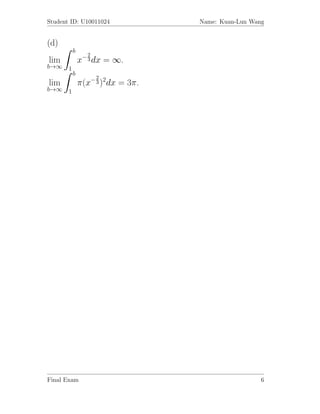
(d)
b
2
lim x− 3 dx = ∞.
b→∞ 1
b
2
lim π(x− 3 )2dx = 3π.
b→∞ 1
Final Exam 6
7.
Student ID: U10011024 Name: Kuan-Lun Wang
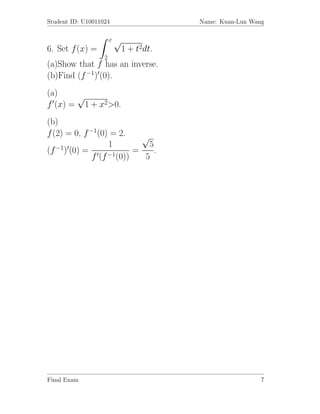
x√
6. Set f (x) = 1 + t2dt.
2
(a)Show that f has an inverse.
(b)Find (f −1) (0).
(a) √
f (x) = 1 + x2>0.
(b)
f (2) = 0, f −1(0) = 2. √
1 5
(f −1) (0) = = .
f (f −1(0)) 5
Final Exam 7
8.
Student ID: U10011024 Name: Kuan-Lun Wang
2
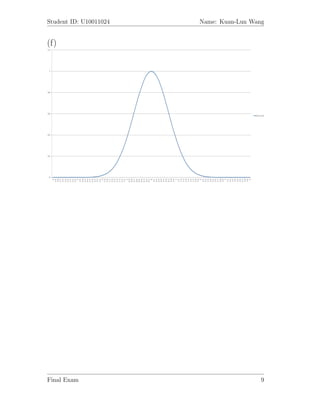
7. Set f (x) = e−x .
(a)What is the symmetry of the graph?
(b)On what intervals does the function increase? decrease?
(c)What are the extreme values of the function?
(d)Determine the concavity of the graph and find the point
of infection.
(e)The graph has a horizontal asymptote. What is it?
(f)Sketch the graph.
(a)
2
f (x) = f (−x) = e−x .
(b)
2
f (x) = −2xe−x .
f is increase on (−∞, 0].
f is decrease on [0, ∞).
(c)
2
Let f (x) = −2xe−x , x = 0.
f (0) = 0, lim f (x) = ∞, lim f (x) = −∞.
b→−∞ b→∞
f is ∞ on b → −∞;
f is −∞ on b → ∞.
(d)
2
f (x) = 4x2e−x .
f is concare up on (−∞, ∞).
(e)
lim f x = 0.
x→∞
y = 0.
Final Exam 8
Student ID: U10011024 Name: Kuan-Lun Wang
8. Prove that 1 + 1 + · · · n < ln(n)<1 + 2 + 1 + · · · n−1 for
2 3
1 1
3
1
all integer n ≥ 2.
1 1
Let f (x) = , f (x) = 2 .
x x
f is increase on (1, n).
1 1
m(b − a) = n (n − 1), is min on [1, n];
n
1
M (b − a) = 1 (n − 1), is max on [1, n].
2 2
1 1 1 1 1 1
+ +· · · < ln(n)<1+ + +· · · for all integer n ≥ 2.
2 3 n 2 3 n−1
Final Exam 10
11.
Student ID: U10011024 Name: Kuan-Lun Wang
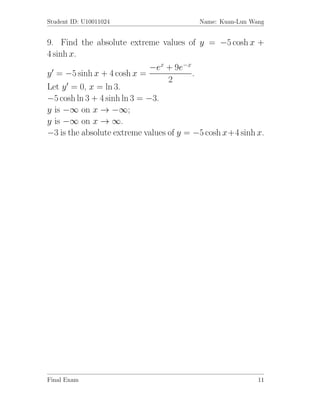
9. Find the absolute extreme values of y = −5 cosh x +
4 sinh x.
−ex + 9e−x
y = −5 sinh x + 4 cosh x = .
2
Let y = 0, x = ln 3.
−5 cosh ln 3 + 4 sinh ln 3 = −3.
y is −∞ on x → −∞;
y is −∞ on x → ∞.
−3 is the absolute extreme values of y = −5 cosh x+4 sinh x.
Final Exam 11
12.
Student ID: U10011024 Name: Kuan-Lun Wang
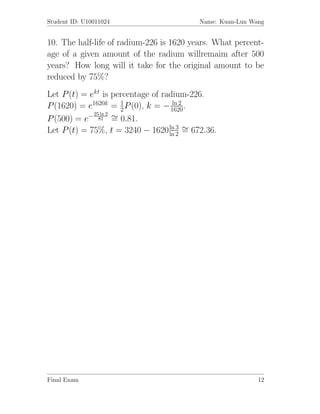
10. The half-life of radium-226 is 1620 years. What percent-
age of a given amount of the radium willremaim after 500
years? How long will it take for the original amount to be
reduced by 75%?
Let P (t) = ekt is percentage of radium-226.
1 ln 2
P (1620) = e1620k = 2 P (0), k = − 1620 .
P (500) = e− 81 ∼ 0.81.
25 ln 2
=
Let P (t) = 75%, t = 3240 − 1620 ln 3 ∼ 672.36.
ln 2 =
Final Exam 12
13.
Student ID: U10011024 Name: Kuan-Lun Wang
11. √
x a2
(a)Show that F (x) = √ a2 − x2 +
2 2 arcsin( x ), a>0 is an
a
antiderivative for f (x) a2 − x2.
a
(b)Calculate a2 − x2dx and interpet your result as an
−a
area.
(c)The circular disk x2 + y 2 ≤ a2, a>0, is revolved about the
line x = a. Find the volume of the resulting solid.
(a) √
a2 −x2 2 2 √
F (x) = − √x + √a = a2 − x2.
2 2 a2 −x2 2 a2 −x2
(b)
a
a2 π
f (x)dx = [F (x)]a
−a = .
−a 2
(c)
√ a
Let f (x) = a2 − x2, volume is 2 2π(a − x)f (x)dx.
−a
a a a
2π(a − x)f (x)dx = 2πaf (x)dx − 2πxf (x)dx =
−a −a −a
2 3
2π a .
Volume is 4π 2a3.
Final Exam 13
![Student ID: U10011024 Name: Kuan-Lun Wang
1. Evaluate the following integral.
π/2 1
3 2
(a) sin x cos xdx. (b) x(ex + 2)dx.
0 0
π/2 −2
cos x dx
(c) dx. (d) .
π/6 1 + sin x −3 4 − (x + 3)2
(a)
Let u = cos x, du = − sin xdx.
π/2 0
3 1 1
sin x cos xdx = − u3du = −[ u4]0 = .
0 1 4 1 4
(b)
Let u = x2, du = 2xdx.
1
x2 1 1 u 1 1
x(e + 2)dx = (e + 2)du = [eu + 2u]1 = e + 1.
0
0 2 0 2 2
(c)
Let u = 1 + sin x, du = cos xdx.
π/2 2
cos x du
dx = = [ln u]2 = 2 ln 2 − ln 3.
3
π/6 1 + sin x 3
2
u 2
(d)
x+3
Let u = 2 ,du = 1 dx.
2
−2 1
dx 1 2 du 1 1 π
= √ 2
= [arcsin x]0 = .
−3 4 − (x + 3)2 2 0 1 − u2 2 6
Final Exam 1](https://image.slidesharecdn.com/random-120331052506-phpapp01/85/slide-1-320.jpg)
![Student ID: U10011024 Name: Kuan-Lun Wang
2. Find the indicated derivative.
d
(a) [(sin x)cos x].
dx
x4(x − 1)
(b)Find g (4) where g(x) = .
(x + 2)(x2 + 1)
x3 −4
x
(c)Find H (2) given the H(x) = √ dt.
2x 1+ t
(a)
d d
[(sin x)cos x] = (sin x)cos x (cos x ln sin x) = (sin x)cos x(cos x cot x−
dx dx
sin x ln sin x).
(b)
2x5(x − 1)
g (x) = g(x)[ln g(x)] = .
(x + 2)(x2 + 1)
g (4) = 1024 .
17
(c)
x x
H (x) = √ − √ .
1+ x 3−4 1 + 2x
H (2) = 0.
Final Exam 2](https://image.slidesharecdn.com/random-120331052506-phpapp01/85/slide-2-320.jpg)
![Student ID: U10011024 Name: Kuan-Lun Wang
3. Sketch the region bounded by the x-axis and the curves
y = sin 2x and y = 2 cos x with x ∈ [−π, π], and find its
area.
Let sin 2x − 2 cos x = 0, x = ± 1 π.
2
π
|sin 2x − 2 cos x|dx
−π
−π2
π
2 π
= (sin 2x−2 cos x)dx− (sin 2x−2 cos x)dx+ (sin 2x−
−π −π
2
π
2
2 cos x)dx
1 −π 1 π 1
= [− cos 2x−2 sin x]−π −[− cos 2x−2 sin x]− π +[− cos 2x−
2 2
2 2 2 2
2 sin x]π
π
2
= 8.
Final Exam 3](https://image.slidesharecdn.com/random-120331052506-phpapp01/85/slide-3-320.jpg)
![Student ID: U10011024 Name: Kuan-Lun Wang
4. Let P (x, y) be an arbitrary point on the curve y = x2.
Express as a function of x the distance from P to the origin
and calculate the average of this distance ax x ranges from 0
√
to 3.
√
P (x, y) = (x, x2), OP (x, y) = ( x2 + x4).
Let u√ x2 + 1, du = 2xdx.
= √ √ √
3√
1 3 4√ 32 34 7 3
√ x2 + x4dx = udu = [ u2 ] = .
3
0 6 1 6 3 1 9
Final Exam 4](https://image.slidesharecdn.com/random-120331052506-phpapp01/85/slide-4-320.jpg)
![Student ID: U10011024 Name: Kuan-Lun Wang
5. Let f (x) = x−2/3 for x>0.
(a)Sketch the graph of f .
(b)Calculate the area of origin bounded by the graph of f
and the x-axis from x = 1 to x = b.
(c)The region in part (b) is rotated about the x-axis. Find
the volume of the resulting solid.
(d)What happens to the area of region as b → ∞? What
happens to the volume of the solid as b → ∞?
(a)
(b)
b
2 1 √
3
x− 3 dx = [3x 3 ]b = 3 b − 3.
1
1
(c)
b
2 1 1
π(x− 3 )2dx = [3πx− 3 ]b = 3π − 3πb− 3 .
1
1
Final Exam 5](https://image.slidesharecdn.com/random-120331052506-phpapp01/85/slide-5-320.jpg)
![Student ID: U10011024 Name: Kuan-Lun Wang
2
7. Set f (x) = e−x .
(a)What is the symmetry of the graph?
(b)On what intervals does the function increase? decrease?
(c)What are the extreme values of the function?
(d)Determine the concavity of the graph and find the point
of infection.
(e)The graph has a horizontal asymptote. What is it?
(f)Sketch the graph.
(a)
2
f (x) = f (−x) = e−x .
(b)
2
f (x) = −2xe−x .
f is increase on (−∞, 0].
f is decrease on [0, ∞).
(c)
2
Let f (x) = −2xe−x , x = 0.
f (0) = 0, lim f (x) = ∞, lim f (x) = −∞.
b→−∞ b→∞
f is ∞ on b → −∞;
f is −∞ on b → ∞.
(d)
2
f (x) = 4x2e−x .
f is concare up on (−∞, ∞).
(e)
lim f x = 0.
x→∞
y = 0.
Final Exam 8](https://image.slidesharecdn.com/random-120331052506-phpapp01/85/slide-8-320.jpg)
![Student ID: U10011024 Name: Kuan-Lun Wang
8. Prove that 1 + 1 + · · · n < ln(n)<1 + 2 + 1 + · · · n−1 for
2 3
1 1
3
1
all integer n ≥ 2.
1 1
Let f (x) = , f (x) = 2 .
x x
f is increase on (1, n).
1 1
m(b − a) = n (n − 1), is min on [1, n];
n
1
M (b − a) = 1 (n − 1), is max on [1, n].
2 2
1 1 1 1 1 1
+ +· · · < ln(n)<1+ + +· · · for all integer n ≥ 2.
2 3 n 2 3 n−1
Final Exam 10](https://image.slidesharecdn.com/random-120331052506-phpapp01/85/slide-10-320.jpg)
![Student ID: U10011024 Name: Kuan-Lun Wang
11. √
x a2
(a)Show that F (x) = √ a2 − x2 +
2 2 arcsin( x ), a>0 is an
a
antiderivative for f (x) a2 − x2.
a
(b)Calculate a2 − x2dx and interpet your result as an
−a
area.
(c)The circular disk x2 + y 2 ≤ a2, a>0, is revolved about the
line x = a. Find the volume of the resulting solid.
(a) √
a2 −x2 2 2 √
F (x) = − √x + √a = a2 − x2.
2 2 a2 −x2 2 a2 −x2
(b)
a
a2 π
f (x)dx = [F (x)]a
−a = .
−a 2
(c)
√ a
Let f (x) = a2 − x2, volume is 2 2π(a − x)f (x)dx.
−a
a a a
2π(a − x)f (x)dx = 2πaf (x)dx − 2πxf (x)dx =
−a −a −a
2 3
2π a .
Volume is 4π 2a3.
Final Exam 13](https://image.slidesharecdn.com/random-120331052506-phpapp01/85/slide-13-320.jpg)


![02[anal add math cd]](https://cdn.slidesharecdn.com/ss_thumbnails/02analaddmathcd-150416042529-conversion-gate01-thumbnail.jpg?width=640&height=640&fit=bounds)


