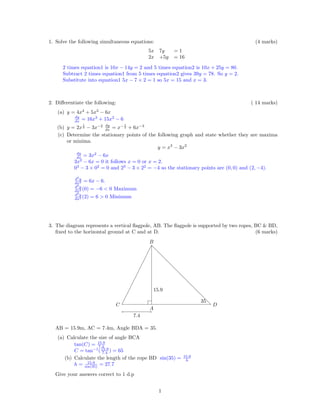
1. Solve the following simultaneous equations: (4 marks)
5x 7y = 1
2x +5y = 16
2 times equation1 is 10x − 14y = 2 and 5 times equation2 is 10x + 25y = 80.
Subtract 2 times equation1 from 5 times equation2 gives 39y = 78. So y = 2.
Substitute into equation1 5x − 7 × 2 = 1 so 5x = 15 and x = 3.
2. Differentiate the following: ( 14 marks)
(a) y = 4x4
+ 5x3
− 6x
dy
dx = 16x3
+ 15x2
− 6
(b) y = 2x
1
2 − 3x−2 dy
dx = x− 1
2 + 6x−3
(c) Determine the stationary points of the following graph and state whether they are maxima
or minima.
y = x3
− 3x2
dy
dx = 3x2
− 6x
3x2
− 6x = 0 it follows x = 0 or x = 2.
03
− 3 × 02
= 0 and 23
− 3 × 22
= −4 so the stationary points are (0, 0) and (2, −4).
d2
y
dx2 = 6x − 6.
d2
y
dx2 (0) = −6 < 0 Maximum
d2
y
dx2 (2) = 6 > 0 Minimum
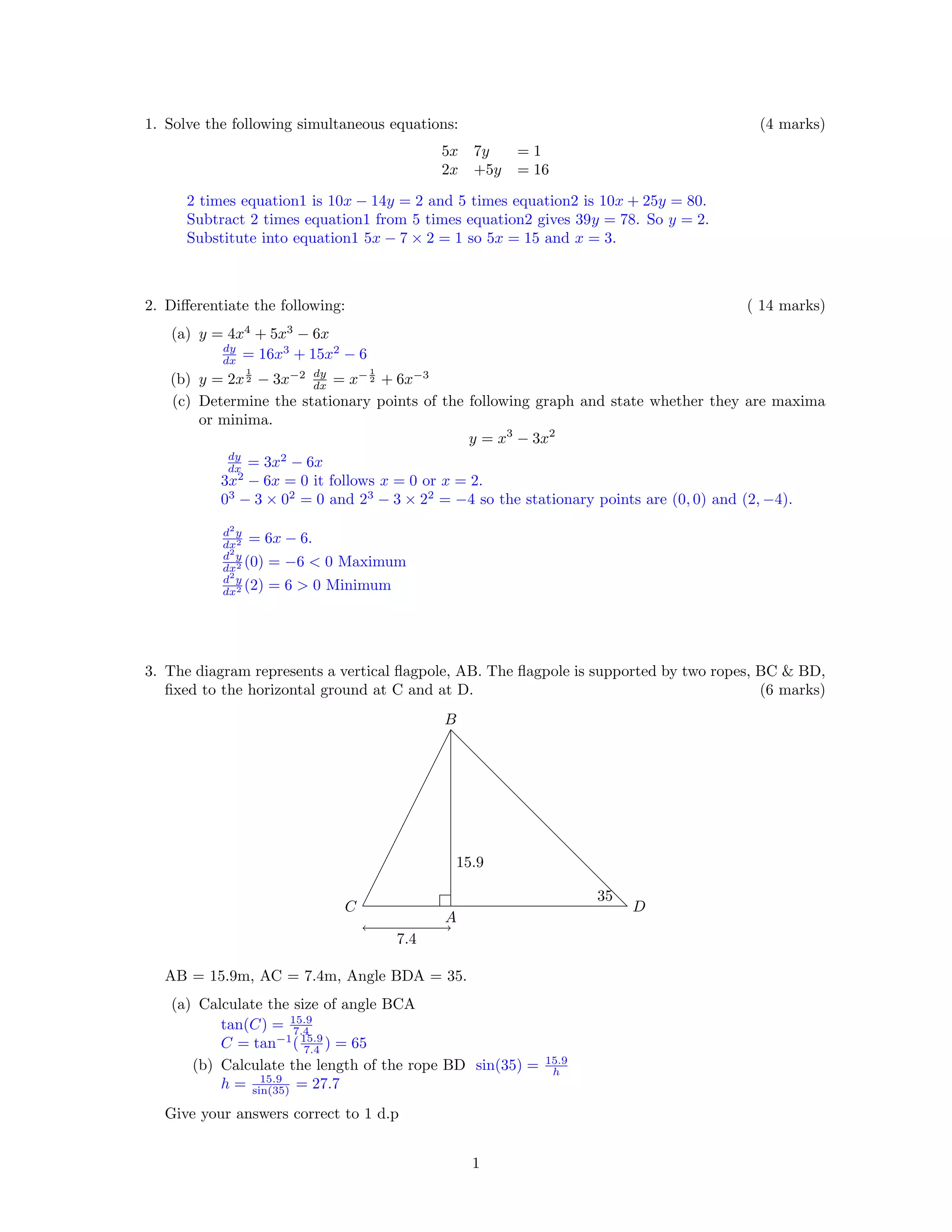
3. The diagram represents a vertical flagpole, AB. The flagpole is supported by two ropes, BC & BD,
fixed to the horizontal ground at C and at D. (6 marks)
C
B
D
A
15.9
7.4
35
AB = 15.9m, AC = 7.4m, Angle BDA = 35.
(a) Calculate the size of angle BCA
tan(C) = 15.9
7.4
C = tan−1
(15.9
7.4 ) = 65
(b) Calculate the length of the rope BD sin(35) = 15.9
h
h = 15.9
sin(35) = 27.7
Give your answers correct to 1 d.p
1
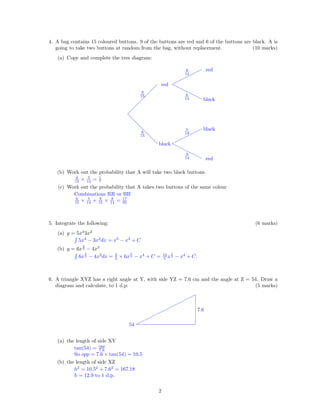
4. A bag contains 15 coloured buttons. 9 of the buttons are red and 6 of the buttons are black. A is
going to take two buttons at random from the bag, without replacement. (10 marks)
(a) Copy and complete the tree diagram:
red
black
red
black
red
black
9
15
6
15
8
14
6
14
9
14
5
14
(b) Work out the probability that A will take two black buttons.
6
15 × 5
14 = 1
7
(c) Work out the probability that A takes two buttons of the same colour
Combinations RR or BB
6
15 × 5
14 + 9
15 × 8
14 = 17
35
5. Integrate the following: (6 marks)
(a) y = 5x4
3x2
5x4
− 3x2
dx = x5
− x3
+ C
(b) y = 6x
3
2 − 4x3
6x
3
2 − 4x3
dx = 2
5 × 6x
5
2 − x4
+ C = 12
5 x
5
2 − x4
+ C.
6. A triangle XYZ has a right angle at Y, with side YZ = 7.6 cm and the angle at Z = 54. Draw a
diagram and calculate, to 1 d.p: (5 marks)
7.6
54
(a) the length of side XY
tan(54) = opp
7.6
So opp = 7.6 × tan(54) = 10.5
(b) the length of side XZ
h2
= 10.52
+ 7.62
= 167.18
h = 12.9 to 1 d.p.
2
7. Find the mean, median and standard deviation of the following set of numbers: (8 marks)
26 32 43 47 53 96
The mean is µ = 297
6 = 49.5.
The data is already in order. 6 × 1
2 = 3. The median is 43+47
2 = 45.
To work out the variance we square the data 676 1024 1849 2209 2809 9216
σ2
= 17783
6 − 49.52
= 6163
12
σ = 22.66 to 2 d.p.
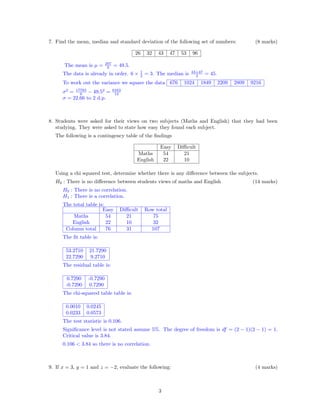
8. Students were asked for their views on two subjects (Maths and English) that they had been
studying. They were asked to state how easy they found each subject.
The following is a contingency table of the findings
Easy Difficult
Maths 54 21
English 22 10
Using a chi squared test, determine whether there is any difference between the subjects.
H0 : There is no difference between students views of maths and English (14 marks)
H0 : There is no correlation.
H1 : There is a correlation.
The total table is:
Easy Difficult Row total
Maths 54 21 75
English 22 10 32
Column total 76 31 107
The fit table is:
53.2710 21.7290
22.7290 9.2710
The residual table is:
0.7290 -0.7290
-0.7290 0.7290
The chi-squared table table is:
0.0010 0.0245
0.0233 0.0573
The test statistic is 0.106.
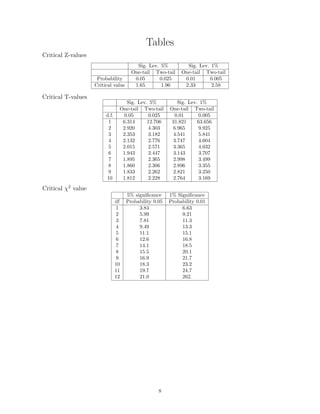
Significance level is not stated assume 5%. The degree of freedom is df = (2 − 1)(2 − 1) = 1.
Critical value is 3.84.
0.106 < 3.84 so there is no correlation.
9. If x = 3, y = 1 and z = −2, evaluate the following: (4 marks)
3
(a) 4x2
z3
4 × 32
− (−2)3
= 44
(b) 3x2
y
= 3 × 32
× 1 = 27
10. In a right angled triangle, what is the length of the longest side (the hypotenuse) when the two
short sides are both 4cm long? Give your answer to 1 decimal place (1.d.p.) (3 marks)
h2
= 42
+ 42
h = 4
√
2 = 5.7 to 1 d.p.
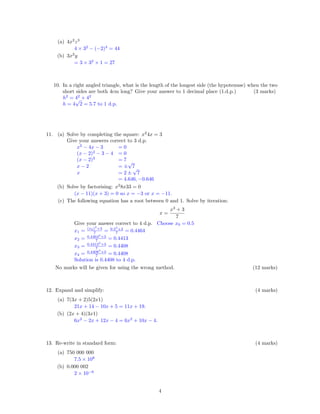
11. (a) Solve by completing the square: x2
4x = 3
Give your answers correct to 3 d.p.
x2
− 4x − 3 = 0
(x − 2)2
− 3 − 4 = 0
(x − 2)2
= 7
x − 2 = ±
√
7
x = 2 ±
√
7
= 4.646, −0.646
(b) Solve by factorising: x2
8x33 = 0
(x − 11)(x + 3) = 0 so x = −3 or x = −11.
(c) The following equation has a root between 0 and 1. Solve by iteration:
x =
x3
+ 3
7
Give your answer correct to 4 d.p. Choose x0 = 0.5
x1 = (x0)3
+3
7 = 0.53
+3
7 = 0.4464
x2 = 0.44643
+3
7 = 0.4413
x3 = 0.44133
+3
7 = 0.4408
x4 = 0.44083
+3
7 = 0.4408
Solution is 0.4408 to 4 d.p.
No marks will be given for using the wrong method. (12 marks)
12. Expand and simplify: (4 marks)
(a) 7(3x + 2)5(2x1)
21x + 14 − 10x + 5 = 11x + 19.
(b) (2x + 4)(3x1)
6x2
− 2x + 12x − 4 = 6x2
+ 10x − 4.
13. Re-write in standard form: (4 marks)
(a) 750 000 000
7.5 × 10⁸
(b) 0.000 002
2 × 10⁻⁶
4
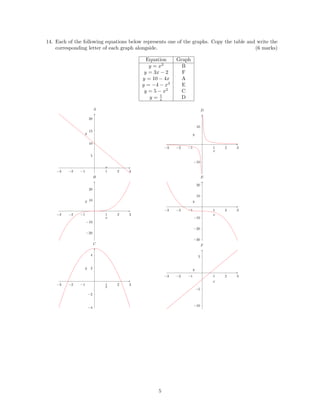
14. Each of the following equations below represents one of the graphs. Copy the table and write the
corresponding letter of each graph alongside. (6 marks)
Equation Graph
y = x3
B
y = 3x − 2 F
y = 10 − 4x A
y = −4 − x3
E
y = 5 − x2
C
y = 1
x D
−3 −2 −1 1 2 3
5
10
15
20
x
y
A
−3 −2 −1 1 2 3
−20
−10
10
20
x
y
B
−3 −2 −1 1 2 3
−4
−2
2
4
x
y
C
−3 −2 −1 1 2 3
−10
10
x
y
D
−3 −2 −1 1 2 3
−30
−20
−10
10
20
x
y
E
−3 −2 −1 1 2 3
−10
−5
5
x
y
F
5
Formulae
Let X be a list of data of size n.
Mean:
µ(X) =
n
i=1 X[i]
n
Variance
σ2
(X) =
n
i=1(X[i])2
n
− µ2
(X)
Absolute deviation
AD =
n
i=1 |X[i] − µ|
n
Z-statistic
Z =
µ(X) − µ
σ/
√
n
Sample Variance
σ2
(X) =
n
i=1(X[i])2
− nµ2
(X)
n − 1
T-statistic
T =
µ(X) − µ
σ(X)/
√
n
Alternative notation
Mean
¯x =
x
n
Variance
V ar =
x2
n
− ¯x2
Absolute deviation
AD =
|x − ¯x|
n
Z-statistic
Z =
¯x − A
σ/
√
n
Sample Variance
s2
=
x2
− n¯x2
n − 1
T-statistic
T =
¯x − A
s/
√
n
6
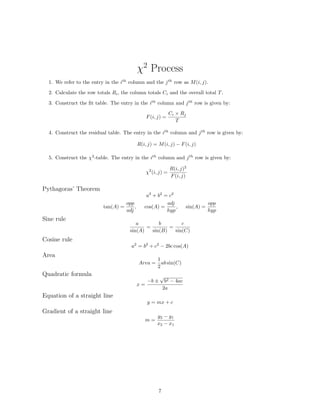
χ2
Process
1. We refer to the entry in the ith
column and the jth
row as M(i, j).
2. Calculate the row totals Ri, the column totals Ci and the overall total T.
3. Construct the fit table. The entry in the ith
column and jth
row is given by:
F(i, j) =
Ci × Rj
T
4. Construct the residual table. The entry in the ith
column and jth
row is given by:
R(i, j) = M(i, j) − F(i, j)
5. Construct the χ2
-table. The entry in the ith
column and jth
row is given by:
χ2
(i, j) =
R(i, j)2
F(i, j)
Pythagoras’ Theorem
a2
+ b2
= c2
tan(A) =
opp
adj
, cos(A) =
adj
hyp
, sin(A) =
opp
hyp
Sine rule
a
sin(A)
=
b
sin(B)
=
c
sin(C)
Cosine rule
a2
= b2
+ c2
− 2bc cos(A)
Area
Area =
1
2
ab sin(C)
Quadratic formula
x =
−b ±
√
b2 − 4ac
2a
Equation of a straight line
y = mx + c
Gradient of a straight line
m =
y2 − y1
x2 − x1
7
Tables
Critical Z-values
Sig. Lev. 5% Sig. Lev. 1%
One-tail Two-tail One-tail Two-tail
Probability 0.05 0.025 0.01 0.005
Critical value 1.65 1.96 2.33 2.58
Critical T-values
Sig. Lev. 5% Sig. Lev. 1%
One-tail Two-tail One-tail Two-tail
d.f. 0.05 0.025 0.01 0.005
1 6.314 12.706 31.821 63.656
2 2.920 4.303 6.965 9.925
3 2.353 3.182 4.541 5.841
4 2.132 2.776 3.747 4.604
5 2.015 2.571 3.365 4.032
6 1.943 2.447 3.143 3.707
7 1.895 2.365 2.998 3.499
8 1.860 2.306 2.896 3.355
9 1.833 2.262 2.821 3.250
10 1.812 2.228 2.764 3.169
Critical χ2
value
5% significance 1% Significance
df Probability 0.05 Probability 0.01
1 3.84 6.63
2 5.99 9.21
3 7.81 11.3
4 9.49 13.3
5 11.1 15.1
6 12.6 16.8
7 14.1 18.5
8 15.5 20.1
9 16.9 21.7
10 18.3 23.2
11 19.7 24.7
12 21.0 262.
8

Foundation c2 exam august 2012 sols

  • 1.
    1. Solve thefollowing simultaneous equations: (4 marks) 5x 7y = 1 2x +5y = 16 2 times equation1 is 10x − 14y = 2 and 5 times equation2 is 10x + 25y = 80. Subtract 2 times equation1 from 5 times equation2 gives 39y = 78. So y = 2. Substitute into equation1 5x − 7 × 2 = 1 so 5x = 15 and x = 3. 2. Differentiate the following: ( 14 marks) (a) y = 4x4 + 5x3 − 6x dy dx = 16x3 + 15x2 − 6 (b) y = 2x 1 2 − 3x−2 dy dx = x− 1 2 + 6x−3 (c) Determine the stationary points of the following graph and state whether they are maxima or minima. y = x3 − 3x2 dy dx = 3x2 − 6x 3x2 − 6x = 0 it follows x = 0 or x = 2. 03 − 3 × 02 = 0 and 23 − 3 × 22 = −4 so the stationary points are (0, 0) and (2, −4). d2 y dx2 = 6x − 6. d2 y dx2 (0) = −6 < 0 Maximum d2 y dx2 (2) = 6 > 0 Minimum 3. The diagram represents a vertical flagpole, AB. The flagpole is supported by two ropes, BC & BD, fixed to the horizontal ground at C and at D. (6 marks) C B D A 15.9 7.4 35 AB = 15.9m, AC = 7.4m, Angle BDA = 35. (a) Calculate the size of angle BCA tan(C) = 15.9 7.4 C = tan−1 (15.9 7.4 ) = 65 (b) Calculate the length of the rope BD sin(35) = 15.9 h h = 15.9 sin(35) = 27.7 Give your answers correct to 1 d.p 1
  • 2.
    4. A bagcontains 15 coloured buttons. 9 of the buttons are red and 6 of the buttons are black. A is going to take two buttons at random from the bag, without replacement. (10 marks) (a) Copy and complete the tree diagram: red black red black red black 9 15 6 15 8 14 6 14 9 14 5 14 (b) Work out the probability that A will take two black buttons. 6 15 × 5 14 = 1 7 (c) Work out the probability that A takes two buttons of the same colour Combinations RR or BB 6 15 × 5 14 + 9 15 × 8 14 = 17 35 5. Integrate the following: (6 marks) (a) y = 5x4 3x2 5x4 − 3x2 dx = x5 − x3 + C (b) y = 6x 3 2 − 4x3 6x 3 2 − 4x3 dx = 2 5 × 6x 5 2 − x4 + C = 12 5 x 5 2 − x4 + C. 6. A triangle XYZ has a right angle at Y, with side YZ = 7.6 cm and the angle at Z = 54. Draw a diagram and calculate, to 1 d.p: (5 marks) 7.6 54 (a) the length of side XY tan(54) = opp 7.6 So opp = 7.6 × tan(54) = 10.5 (b) the length of side XZ h2 = 10.52 + 7.62 = 167.18 h = 12.9 to 1 d.p. 2
  • 3.
    7. Find themean, median and standard deviation of the following set of numbers: (8 marks) 26 32 43 47 53 96 The mean is µ = 297 6 = 49.5. The data is already in order. 6 × 1 2 = 3. The median is 43+47 2 = 45. To work out the variance we square the data 676 1024 1849 2209 2809 9216 σ2 = 17783 6 − 49.52 = 6163 12 σ = 22.66 to 2 d.p. 8. Students were asked for their views on two subjects (Maths and English) that they had been studying. They were asked to state how easy they found each subject. The following is a contingency table of the findings Easy Difficult Maths 54 21 English 22 10 Using a chi squared test, determine whether there is any difference between the subjects. H0 : There is no difference between students views of maths and English (14 marks) H0 : There is no correlation. H1 : There is a correlation. The total table is: Easy Difficult Row total Maths 54 21 75 English 22 10 32 Column total 76 31 107 The fit table is: 53.2710 21.7290 22.7290 9.2710 The residual table is: 0.7290 -0.7290 -0.7290 0.7290 The chi-squared table table is: 0.0010 0.0245 0.0233 0.0573 The test statistic is 0.106. Significance level is not stated assume 5%. The degree of freedom is df = (2 − 1)(2 − 1) = 1. Critical value is 3.84. 0.106 < 3.84 so there is no correlation. 9. If x = 3, y = 1 and z = −2, evaluate the following: (4 marks) 3
  • 4.
    (a) 4x2 z3 4 ×32 − (−2)3 = 44 (b) 3x2 y = 3 × 32 × 1 = 27 10. In a right angled triangle, what is the length of the longest side (the hypotenuse) when the two short sides are both 4cm long? Give your answer to 1 decimal place (1.d.p.) (3 marks) h2 = 42 + 42 h = 4 √ 2 = 5.7 to 1 d.p. 11. (a) Solve by completing the square: x2 4x = 3 Give your answers correct to 3 d.p. x2 − 4x − 3 = 0 (x − 2)2 − 3 − 4 = 0 (x − 2)2 = 7 x − 2 = ± √ 7 x = 2 ± √ 7 = 4.646, −0.646 (b) Solve by factorising: x2 8x33 = 0 (x − 11)(x + 3) = 0 so x = −3 or x = −11. (c) The following equation has a root between 0 and 1. Solve by iteration: x = x3 + 3 7 Give your answer correct to 4 d.p. Choose x0 = 0.5 x1 = (x0)3 +3 7 = 0.53 +3 7 = 0.4464 x2 = 0.44643 +3 7 = 0.4413 x3 = 0.44133 +3 7 = 0.4408 x4 = 0.44083 +3 7 = 0.4408 Solution is 0.4408 to 4 d.p. No marks will be given for using the wrong method. (12 marks) 12. Expand and simplify: (4 marks) (a) 7(3x + 2)5(2x1) 21x + 14 − 10x + 5 = 11x + 19. (b) (2x + 4)(3x1) 6x2 − 2x + 12x − 4 = 6x2 + 10x − 4. 13. Re-write in standard form: (4 marks) (a) 750 000 000 7.5 × 10⁸ (b) 0.000 002 2 × 10⁻⁶ 4
  • 5.
    14. Each ofthe following equations below represents one of the graphs. Copy the table and write the corresponding letter of each graph alongside. (6 marks) Equation Graph y = x3 B y = 3x − 2 F y = 10 − 4x A y = −4 − x3 E y = 5 − x2 C y = 1 x D −3 −2 −1 1 2 3 5 10 15 20 x y A −3 −2 −1 1 2 3 −20 −10 10 20 x y B −3 −2 −1 1 2 3 −4 −2 2 4 x y C −3 −2 −1 1 2 3 −10 10 x y D −3 −2 −1 1 2 3 −30 −20 −10 10 20 x y E −3 −2 −1 1 2 3 −10 −5 5 x y F 5
  • 6.
    Formulae Let X bea list of data of size n. Mean: µ(X) = n i=1 X[i] n Variance σ2 (X) = n i=1(X[i])2 n − µ2 (X) Absolute deviation AD = n i=1 |X[i] − µ| n Z-statistic Z = µ(X) − µ σ/ √ n Sample Variance σ2 (X) = n i=1(X[i])2 − nµ2 (X) n − 1 T-statistic T = µ(X) − µ σ(X)/ √ n Alternative notation Mean ¯x = x n Variance V ar = x2 n − ¯x2 Absolute deviation AD = |x − ¯x| n Z-statistic Z = ¯x − A σ/ √ n Sample Variance s2 = x2 − n¯x2 n − 1 T-statistic T = ¯x − A s/ √ n 6
  • 7.
    χ2 Process 1. We referto the entry in the ith column and the jth row as M(i, j). 2. Calculate the row totals Ri, the column totals Ci and the overall total T. 3. Construct the fit table. The entry in the ith column and jth row is given by: F(i, j) = Ci × Rj T 4. Construct the residual table. The entry in the ith column and jth row is given by: R(i, j) = M(i, j) − F(i, j) 5. Construct the χ2 -table. The entry in the ith column and jth row is given by: χ2 (i, j) = R(i, j)2 F(i, j) Pythagoras’ Theorem a2 + b2 = c2 tan(A) = opp adj , cos(A) = adj hyp , sin(A) = opp hyp Sine rule a sin(A) = b sin(B) = c sin(C) Cosine rule a2 = b2 + c2 − 2bc cos(A) Area Area = 1 2 ab sin(C) Quadratic formula x = −b ± √ b2 − 4ac 2a Equation of a straight line y = mx + c Gradient of a straight line m = y2 − y1 x2 − x1 7
  • 8.
    Tables Critical Z-values Sig. Lev.5% Sig. Lev. 1% One-tail Two-tail One-tail Two-tail Probability 0.05 0.025 0.01 0.005 Critical value 1.65 1.96 2.33 2.58 Critical T-values Sig. Lev. 5% Sig. Lev. 1% One-tail Two-tail One-tail Two-tail d.f. 0.05 0.025 0.01 0.005 1 6.314 12.706 31.821 63.656 2 2.920 4.303 6.965 9.925 3 2.353 3.182 4.541 5.841 4 2.132 2.776 3.747 4.604 5 2.015 2.571 3.365 4.032 6 1.943 2.447 3.143 3.707 7 1.895 2.365 2.998 3.499 8 1.860 2.306 2.896 3.355 9 1.833 2.262 2.821 3.250 10 1.812 2.228 2.764 3.169 Critical χ2 value 5% significance 1% Significance df Probability 0.05 Probability 0.01 1 3.84 6.63 2 5.99 9.21 3 7.81 11.3 4 9.49 13.3 5 11.1 15.1 6 12.6 16.8 7 14.1 18.5 8 15.5 20.1 9 16.9 21.7 10 18.3 23.2 11 19.7 24.7 12 21.0 262. 8