Linux For Embedded Systems
ForArabs
Ahmed ElArabawy
Course 102:
UnderstandingLinux
Lecture 2:
Unwrapping Linux
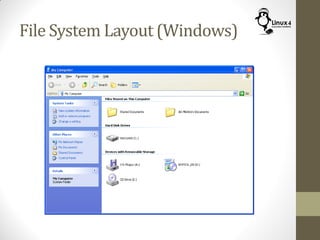
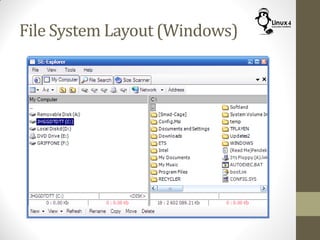
File System Layout (Windows)
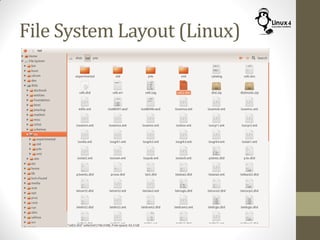
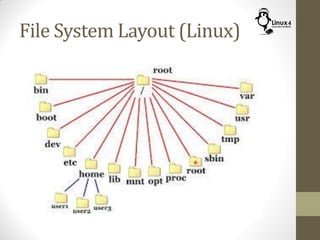
File System Layout (Linux)
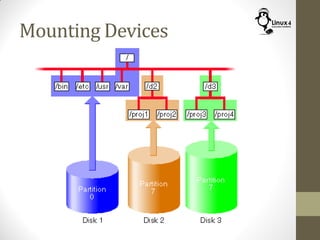
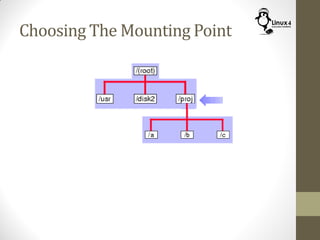
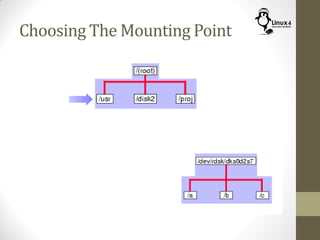
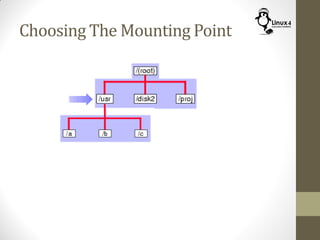
Mounting Devices
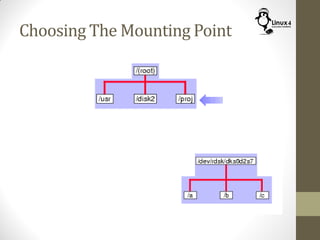
Choosing The Mounting Point
Linux File-System Layout
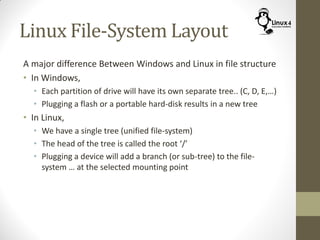
A major difference Between Windows and Linux in file structure
• In Windows,
• Each partition of drive will have its own separate tree.. (C, D, E,…)
• Plugging a flash or a portable hard-disk results in a new tree
• In Linux,
• We have a single tree (unified file-system)
• The head of the tree is called the root ‘/’
• Plugging a device will add a branch (or sub-tree) to the file-
system … at the selected mounting point
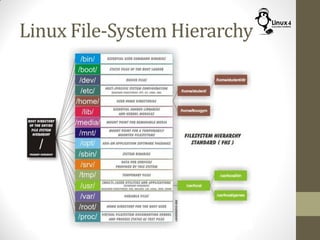
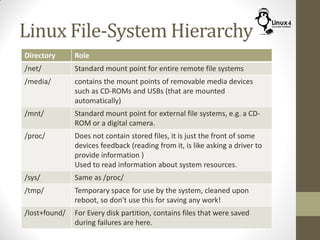
Linux File-System Hierarchy
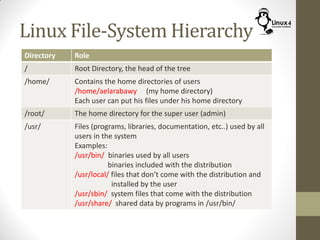
Directory Role
/ Root Directory, the head of the tree
/home/ Contains the home directories of users
/home/aelarabawy (my home directory)
Each user can put his files under his home directory
/root/ The home directory for the super user (admin)
/usr/ Files (programs, libraries, documentation, etc..) used by all
users in the system
Examples:
/usr/bin/ binaries used by all users
binaries included with the distribution
/usr/local/ files that don’t come with the distribution and
installed by the user
/usr/sbin/ system files that come with the distribution
/usr/share/ shared data by programs in /usr/bin/
Linux File-System Hierarchy
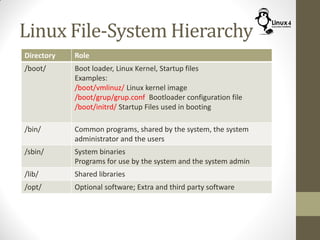
Directory Role
/boot/ Boot loader, Linux Kernel, Startup files
Examples:
/boot/vmlinuz/ Linux kernel image
/boot/grup/grup.conf Bootloader configuration file
/boot/initrd/ Startup Files used in booting
/bin/ Common programs, shared by the system, the system
administrator and the users
/sbin/ System binaries
Programs for use by the system and the system admin
/lib/ Shared libraries
/opt/ Optional software; Extra and third party software
Linux File-System Hierarchy
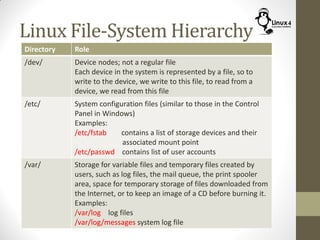
Directory Role
/dev/ Device nodes; not a regular file
Each device in the system is represented by a file, so to
write to the device, we write to this file, to read from a
device, we read from this file
/etc/ System configuration files (similar to those in the Control
Panel in Windows)
Examples:
/etc/fstab contains a list of storage devices and their
associated mount point
/etc/passwd contains list of user accounts
/var/ Storage for variable files and temporary files created by
users, such as log files, the mail queue, the print spooler
area, space for temporary storage of files downloaded from
the Internet, or to keep an image of a CD before burning it.
Examples:
/var/log log files
/var/log/messages system log file
Linux File-System Hierarchy
Directory Role
/net/ Standard mount point for entire remote file systems
/media/ contains the mount points of removable media devices
such as CD-ROMs and USBs (that are mounted
automatically)
/mnt/ Standard mount point for external file systems, e.g. a CD-
ROM or a digital camera.
/proc/ Does not contain stored files, it is just the front of some
devices feedback (reading from it, is like asking a driver to
provide information )
Used to read information about system resources.
/sys/ Same as /proc/
/tmp/ Temporary space for use by the system, cleaned upon
reboot, so don't use this for saving any work!
/lost+found/ For Every disk partition, contains files that were saved
during failures are here.
http://Linux4EmbeddedSystems.com

Course 102: Lecture 2: Unwrapping Linux

  • 1.
    Linux For EmbeddedSystems ForArabs Ahmed ElArabawy Course 102: UnderstandingLinux
  • 2.
  • 3.
  • 4.
  • 5.
  • 6.
  • 7.
  • 8.
  • 9.
  • 10.
  • 11.
  • 12.
    Linux File-System Layout Amajor difference Between Windows and Linux in file structure • In Windows, • Each partition of drive will have its own separate tree.. (C, D, E,…) • Plugging a flash or a portable hard-disk results in a new tree • In Linux, • We have a single tree (unified file-system) • The head of the tree is called the root ‘/’ • Plugging a device will add a branch (or sub-tree) to the file- system … at the selected mounting point
  • 13.
  • 14.
    Linux File-System Hierarchy DirectoryRole / Root Directory, the head of the tree /home/ Contains the home directories of users /home/aelarabawy (my home directory) Each user can put his files under his home directory /root/ The home directory for the super user (admin) /usr/ Files (programs, libraries, documentation, etc..) used by all users in the system Examples: /usr/bin/ binaries used by all users binaries included with the distribution /usr/local/ files that don’t come with the distribution and installed by the user /usr/sbin/ system files that come with the distribution /usr/share/ shared data by programs in /usr/bin/
  • 15.
    Linux File-System Hierarchy DirectoryRole /boot/ Boot loader, Linux Kernel, Startup files Examples: /boot/vmlinuz/ Linux kernel image /boot/grup/grup.conf Bootloader configuration file /boot/initrd/ Startup Files used in booting /bin/ Common programs, shared by the system, the system administrator and the users /sbin/ System binaries Programs for use by the system and the system admin /lib/ Shared libraries /opt/ Optional software; Extra and third party software
  • 16.
    Linux File-System Hierarchy DirectoryRole /dev/ Device nodes; not a regular file Each device in the system is represented by a file, so to write to the device, we write to this file, to read from a device, we read from this file /etc/ System configuration files (similar to those in the Control Panel in Windows) Examples: /etc/fstab contains a list of storage devices and their associated mount point /etc/passwd contains list of user accounts /var/ Storage for variable files and temporary files created by users, such as log files, the mail queue, the print spooler area, space for temporary storage of files downloaded from the Internet, or to keep an image of a CD before burning it. Examples: /var/log log files /var/log/messages system log file
  • 17.
    Linux File-System Hierarchy DirectoryRole /net/ Standard mount point for entire remote file systems /media/ contains the mount points of removable media devices such as CD-ROMs and USBs (that are mounted automatically) /mnt/ Standard mount point for external file systems, e.g. a CD- ROM or a digital camera. /proc/ Does not contain stored files, it is just the front of some devices feedback (reading from it, is like asking a driver to provide information ) Used to read information about system resources. /sys/ Same as /proc/ /tmp/ Temporary space for use by the system, cleaned upon reboot, so don't use this for saving any work! /lost+found/ For Every disk partition, contains files that were saved during failures are here.
  • 18.