The document discusses the process life-cycle in Linux, detailing the creation and termination of processes through the fork-exec procedure. It explains how a new process (child) is created from a parent process and the differences between processes and threads, particularly highlighting their memory management and scheduling by the kernel. Additionally, it covers process termination, the concept of zombie processes, and the need for a living parent for cleanup tasks.
Fork-Exec Procedure
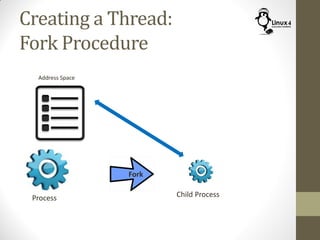
• Creatinga new process happens in two steps
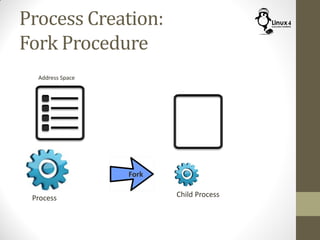
• Fork:
In this step the new process (child process) is created and inherits its
features from its parent
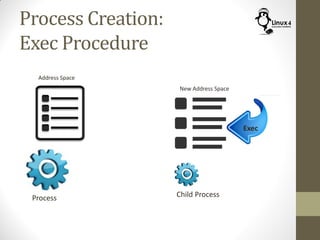
• Execute:
In this step the new process (child process) separates from its parent
and move on with its functionality
Fork
• The Jobof “Fork” in is to create a new process (child process)
and prepare it with what it needs to be able to run….
• This includes,
• Assign it a new pid
• Creates associated Structures in the Kernel
• Sets the ppid, pgid, sid, and any other attributes
• Add it to the Kernel scheduler queue to give it time slots to run
• Copy parent memory space (all memory associated with the
parent process) to the child process memory space
• Copy Other parent process resources,
• Normal file handlers
• Socket handlers
• Shared memory handlers
• ….
7.
Exec
• The jobof “Exec” is to send the child process on its own to do
its assigned job
• This means the child process will be loaded with,
• New memory space instead of its parent
• Will lose access to parent process resources
• A pointer to the new program to run
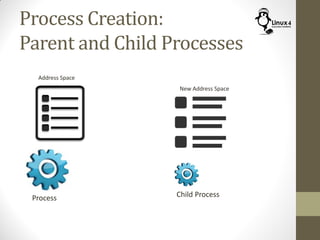
• This command separates the child process from its parent, and
the child process runs now on its own, using its own memory
address space, and running its own executable and
creating/reserving its own system resources
Process Vs. Thread
•Both processes and threads are threads of execution that enable
parallel operation (multi-tasking) with the help of the scheduler in
the kernel
• In both cases, the Linux kernel assigns time slots for the
process/thread to execute before another one is assigned
• In Linux a thread is a process with some special differences:
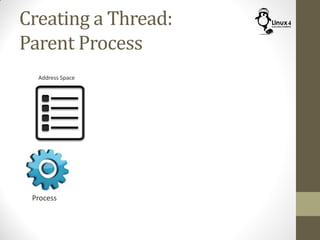
• When creating a thread, the address space (and some other
resources) are not copied from the parent. They are shared with the
parent
• This means threads run within the same address space of its parent
and never get a new address space
• Other than that, threads are treated exactly the same as processes
• For example the kernel scheduler deals with each thread
independently
• So, threads created by the same process are multiple processes that
share the same address space and resources of their parent process
Process Termination
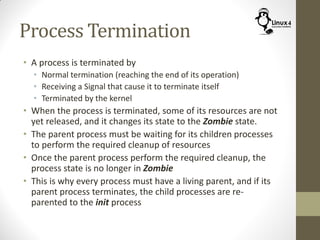
• Aprocess is terminated by
• Normal termination (reaching the end of its operation)
• Receiving a Signal that cause it to terminate itself
• Terminated by the kernel
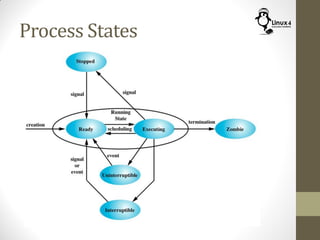
• When the process is terminated, some of its resources are not
yet released, and it changes its state to the Zombie state.
• The parent process must be waiting for its children processes
to perform the required cleanup of resources
• Once the parent process perform the required cleanup, the
process state is no longer in Zombie
• This is why every process must have a living parent, and if its
parent process terminates, the child processes are re-
parented to the init process