Module-3 Linux Softwares and UseModule-3 Linux Softwares and Use
Tushar B Kute
tushar@tusharkute.com
http://snashlug.org
contact@snashlug.org
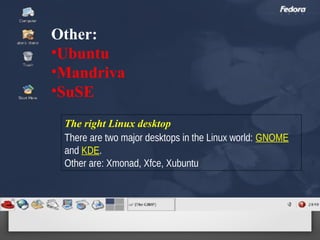
Other:
•Ubuntu
•Mandriva
•SuSE
The right Linux desktop
There are two major desktops in the Linux world: GNOME
and KDE.
Other are: Xmonad, Xfce, Xubuntu
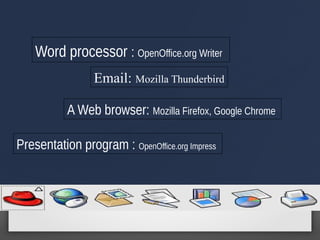
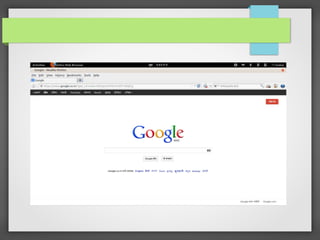
A Web browser: Mozilla Firefox, Google Chrome
Email: Mozilla Thunderbird
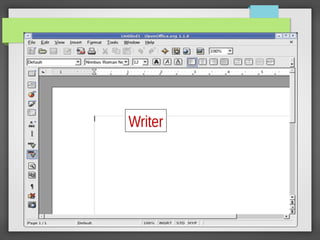
Word processor : OpenOffice.org Writer
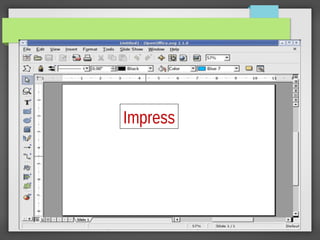
Presentation program : OpenOffice.org Impress
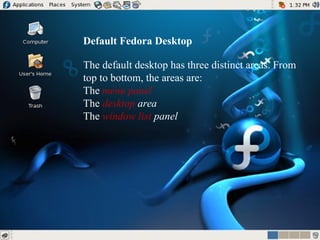
Default Fedora Desktop
The default desktop has three distinct areas. From
top to bottom, the areas are:
The menu panel
The desktop area
The window list panel
The Desktop AreaThe Desktop Area
●
Computer - This contains all volumes (or disks) mounted on
the computer. These are also listed in the Places menu.
Computer is equivalent to My Computer on Microsoft Windows.
●
Home - This is where the logged-in user stores all files by
default, such as music, movies, and documents. There is a
different home directory for each user, and by default users
cannot access each others' home directories. Home is
equivalent to My Documents on Microsoft Windows.
●
Trash - Deleted files are moved to Trash. Empty Trash by
right-clicking the icon and clicking Empty Trash.
OfficeOffice
SoftwareSoftware
word processor,
spreadsheet,
presentation and
database application
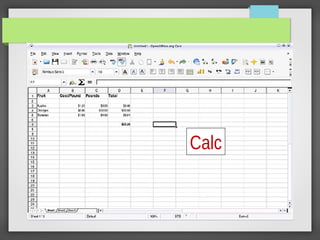
Calc
Writer
Impress
Web Browser:Web Browser: Firefox
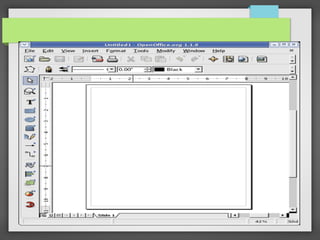
OOo Draw:OOo Draw: Drawing
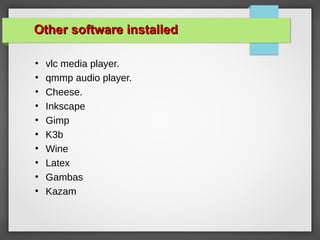
Other software installedOther software installed
●
vlc media player.
●
qmmp audio player.
●
Cheese.
●
Inkscape
●
Gimp
●
K3b
●
Wine
●
Latex
●
Gambas
●
Kazam
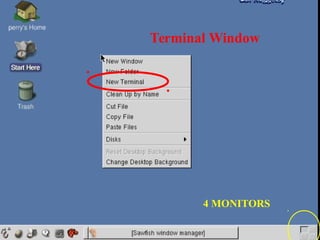
Terminal Window
4 MONITORS
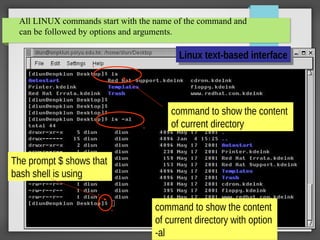
Linux text-based interfaceLinux text-based interface
command to show the content
of current directory
command to show the content
of current directory with option
-al
The prompt $ shows that
bash shell is using
All LINUX commands start with the name of the command and
can be followed by options and arguments.
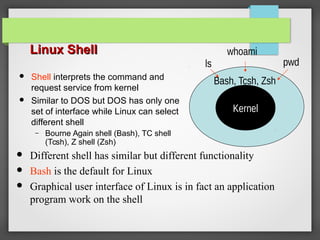
Linux ShellLinux Shell
 Shell interprets the command and
request service from kernel
 Similar to DOS but DOS has only one
set of interface while Linux can select
different shell
– Bourne Again shell (Bash), TC shell
(Tcsh), Z shell (Zsh)
Kernel
Bash, Tcsh, Zsh
ls pwd
whoami
 Different shell has similar but different functionality
 Bash is the default for Linux
 Graphical user interface of Linux is in fact an application
program work on the shell
File managementFile management
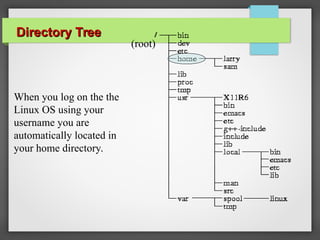
Directory TreeDirectory Tree
(root)
When you log on the the
Linux OS using your
username you are
automatically located in
your home directory.
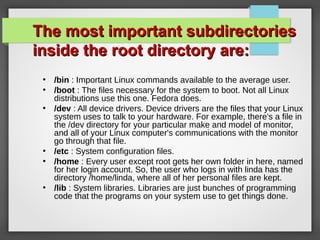
The most important subdirectoriesThe most important subdirectories
inside the root directory are:inside the root directory are:
●
/bin : Important Linux commands available to the average user.
●
/boot : The files necessary for the system to boot. Not all Linux
distributions use this one. Fedora does.
●
/dev : All device drivers. Device drivers are the files that your Linux
system uses to talk to your hardware. For example, there's a file in
the /dev directory for your particular make and model of monitor,
and all of your Linux computer's communications with the monitor
go through that file.
●
/etc : System configuration files.
●
/home : Every user except root gets her own folder in here, named
for her login account. So, the user who logs in with linda has the
directory /home/linda, where all of her personal files are kept.
●
/lib : System libraries. Libraries are just bunches of programming
code that the programs on your system use to get things done.
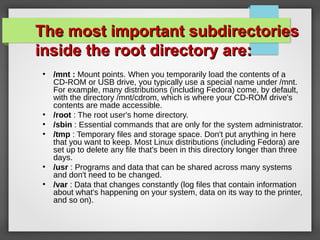
The most important subdirectoriesThe most important subdirectories
inside the root directory are:inside the root directory are:
●
/mnt : Mount points. When you temporarily load the contents of a
CD-ROM or USB drive, you typically use a special name under /mnt.
For example, many distributions (including Fedora) come, by default,
with the directory /mnt/cdrom, which is where your CD-ROM drive's
contents are made accessible.
●
/root : The root user's home directory.
●
/sbin : Essential commands that are only for the system administrator.
●
/tmp : Temporary files and storage space. Don't put anything in here
that you want to keep. Most Linux distributions (including Fedora) are
set up to delete any file that's been in this directory longer than three
days.
●
/usr : Programs and data that can be shared across many systems
and don't need to be changed.
●
/var : Data that changes constantly (log files that contain information
about what's happening on your system, data on its way to the printer,
and so on).
Home directoryHome directory
●
You can see what your home directory is called by
entering
• pwd (print current working directory)
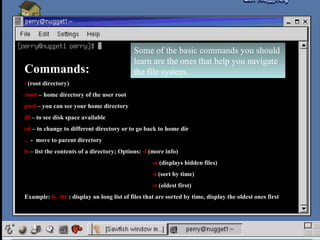
Commands:
/ (root directory)
/root – home directory of the user root
pwd – you can see your home directory
df – to see disk space available
cd – to change to different directory or to go back to home dir
.. - move to parent directory
ls – list the contents of a directory; Options: -l (more info)
-a (displays hidden files)
-t (sort by time)
-r (oldest first)
Example: ls –ltr : display an long list of files that are sorted by time, display the oldest ones first
Some of the basic commands you should
learn are the ones that help you navigate
the file system.
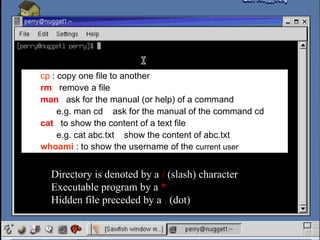
cp : copy one file to another
rm : remove a file
man : ask for the manual (or help) of a command
e.g. man cd ask for the manual of the command cd
cat : to show the content of a text file
e.g. cat abc.txt show the content of abc.txt
whoami : to show the username of the current user
Directory is denoted by a / (slash) character
Executable program by a *
Hidden file preceded by a . (dot)
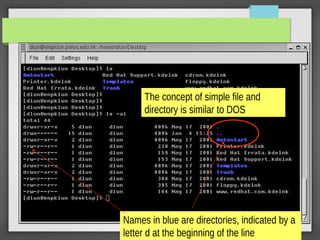
Names in blue are directories, indicated by a
letter d at the beginning of the line
The concept of simple file and
directory is similar to DOS
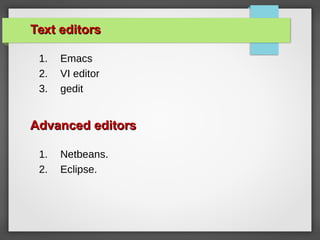
Text editorsText editors
1. Emacs
2. VI editor
3. gedit
Advanced editorsAdvanced editors
1. Netbeans.
2. Eclipse.
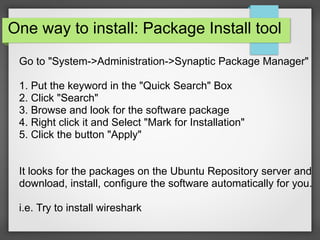
One way to install: Package Install tool
Go to "System->Administration->Synaptic Package Manager"
1. Put the keyword in the "Quick Search" Box
2. Click "Search"
3. Browse and look for the software package
4. Right click it and Select "Mark for Installation"
5. Click the button "Apply"
It looks for the packages on the Ubuntu Repository server and
download, install, configure the software automatically for you.
i.e. Try to install wireshark
Another way to install: Binary Install
Look for the software on the Internet
Download the prebuilt binary
Follow the installation instructions
if it is .deb package, double click and install it
if it is a self-extrating package, make it executable and run it
Try to install chrome browser
One more way: Command Line
There is a command for install the package: "apt-get"
• Open a terminal window
Click "Applications->Accessories->Terminal"
• Search a package and get the package name
Type on the terminal "apt-cache search xxxxx | more"
Notes: press "Space bar" to display next page
• Install a package from Internet
Type the command "sudo apt-get install xxxx"
Notes: You may be asked to your login password
You also may be asked "Y/N" for confirmation
i.e. Try to install gdb, Java, etc.
The last way to install
Download the source code
Compile and install it, using the command "make install"
That's how you programmed and executed it.
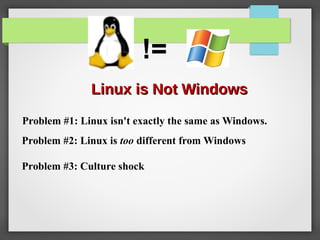
!=
Linux is Not WindowsLinux is Not Windows
Problem #1: Linux isn't exactly the same as Windows.
Problem #2: Linux is too different from Windows
Problem #3: Culture shock
This presentation is created using LibreOffice Writer 4.1.0.4 available freely
under GNU public license.
Thank you

Module 3 Using Linux Softwares.

  • 1.
    Module-3 Linux Softwaresand UseModule-3 Linux Softwares and Use Tushar B Kute tushar@tusharkute.com http://snashlug.org contact@snashlug.org
  • 2.
    Other: •Ubuntu •Mandriva •SuSE The right Linuxdesktop There are two major desktops in the Linux world: GNOME and KDE. Other are: Xmonad, Xfce, Xubuntu
  • 3.
    A Web browser:Mozilla Firefox, Google Chrome Email: Mozilla Thunderbird Word processor : OpenOffice.org Writer Presentation program : OpenOffice.org Impress
  • 4.
    Default Fedora Desktop Thedefault desktop has three distinct areas. From top to bottom, the areas are: The menu panel The desktop area The window list panel
  • 5.
    The Desktop AreaTheDesktop Area ● Computer - This contains all volumes (or disks) mounted on the computer. These are also listed in the Places menu. Computer is equivalent to My Computer on Microsoft Windows. ● Home - This is where the logged-in user stores all files by default, such as music, movies, and documents. There is a different home directory for each user, and by default users cannot access each others' home directories. Home is equivalent to My Documents on Microsoft Windows. ● Trash - Deleted files are moved to Trash. Empty Trash by right-clicking the icon and clicking Empty Trash.
  • 6.
  • 7.
  • 8.
  • 9.
  • 10.
  • 12.
  • 14.
    Other software installedOthersoftware installed ● vlc media player. ● qmmp audio player. ● Cheese. ● Inkscape ● Gimp ● K3b ● Wine ● Latex ● Gambas ● Kazam
  • 15.
  • 16.
    Linux text-based interfaceLinuxtext-based interface command to show the content of current directory command to show the content of current directory with option -al The prompt $ shows that bash shell is using All LINUX commands start with the name of the command and can be followed by options and arguments.
  • 17.
    Linux ShellLinux Shell Shell interprets the command and request service from kernel  Similar to DOS but DOS has only one set of interface while Linux can select different shell – Bourne Again shell (Bash), TC shell (Tcsh), Z shell (Zsh) Kernel Bash, Tcsh, Zsh ls pwd whoami  Different shell has similar but different functionality  Bash is the default for Linux  Graphical user interface of Linux is in fact an application program work on the shell
  • 18.
  • 19.
    Directory TreeDirectory Tree (root) Whenyou log on the the Linux OS using your username you are automatically located in your home directory.
  • 20.
    The most importantsubdirectoriesThe most important subdirectories inside the root directory are:inside the root directory are: ● /bin : Important Linux commands available to the average user. ● /boot : The files necessary for the system to boot. Not all Linux distributions use this one. Fedora does. ● /dev : All device drivers. Device drivers are the files that your Linux system uses to talk to your hardware. For example, there's a file in the /dev directory for your particular make and model of monitor, and all of your Linux computer's communications with the monitor go through that file. ● /etc : System configuration files. ● /home : Every user except root gets her own folder in here, named for her login account. So, the user who logs in with linda has the directory /home/linda, where all of her personal files are kept. ● /lib : System libraries. Libraries are just bunches of programming code that the programs on your system use to get things done.
  • 21.
    The most importantsubdirectoriesThe most important subdirectories inside the root directory are:inside the root directory are: ● /mnt : Mount points. When you temporarily load the contents of a CD-ROM or USB drive, you typically use a special name under /mnt. For example, many distributions (including Fedora) come, by default, with the directory /mnt/cdrom, which is where your CD-ROM drive's contents are made accessible. ● /root : The root user's home directory. ● /sbin : Essential commands that are only for the system administrator. ● /tmp : Temporary files and storage space. Don't put anything in here that you want to keep. Most Linux distributions (including Fedora) are set up to delete any file that's been in this directory longer than three days. ● /usr : Programs and data that can be shared across many systems and don't need to be changed. ● /var : Data that changes constantly (log files that contain information about what's happening on your system, data on its way to the printer, and so on).
  • 22.
    Home directoryHome directory ● Youcan see what your home directory is called by entering • pwd (print current working directory)
  • 23.
    Commands: / (root directory) /root– home directory of the user root pwd – you can see your home directory df – to see disk space available cd – to change to different directory or to go back to home dir .. - move to parent directory ls – list the contents of a directory; Options: -l (more info) -a (displays hidden files) -t (sort by time) -r (oldest first) Example: ls –ltr : display an long list of files that are sorted by time, display the oldest ones first Some of the basic commands you should learn are the ones that help you navigate the file system.
  • 24.
    cp : copyone file to another rm : remove a file man : ask for the manual (or help) of a command e.g. man cd ask for the manual of the command cd cat : to show the content of a text file e.g. cat abc.txt show the content of abc.txt whoami : to show the username of the current user Directory is denoted by a / (slash) character Executable program by a * Hidden file preceded by a . (dot)
  • 25.
    Names in blueare directories, indicated by a letter d at the beginning of the line The concept of simple file and directory is similar to DOS
  • 26.
    Text editorsText editors 1.Emacs 2. VI editor 3. gedit Advanced editorsAdvanced editors 1. Netbeans. 2. Eclipse.
  • 27.
    One way toinstall: Package Install tool Go to "System->Administration->Synaptic Package Manager" 1. Put the keyword in the "Quick Search" Box 2. Click "Search" 3. Browse and look for the software package 4. Right click it and Select "Mark for Installation" 5. Click the button "Apply" It looks for the packages on the Ubuntu Repository server and download, install, configure the software automatically for you. i.e. Try to install wireshark
  • 28.
    Another way toinstall: Binary Install Look for the software on the Internet Download the prebuilt binary Follow the installation instructions if it is .deb package, double click and install it if it is a self-extrating package, make it executable and run it Try to install chrome browser
  • 29.
    One more way:Command Line There is a command for install the package: "apt-get" • Open a terminal window Click "Applications->Accessories->Terminal" • Search a package and get the package name Type on the terminal "apt-cache search xxxxx | more" Notes: press "Space bar" to display next page • Install a package from Internet Type the command "sudo apt-get install xxxx" Notes: You may be asked to your login password You also may be asked "Y/N" for confirmation i.e. Try to install gdb, Java, etc.
  • 30.
    The last wayto install Download the source code Compile and install it, using the command "make install" That's how you programmed and executed it.
  • 31.
    != Linux is NotWindowsLinux is Not Windows Problem #1: Linux isn't exactly the same as Windows. Problem #2: Linux is too different from Windows Problem #3: Culture shock
  • 32.
    This presentation iscreated using LibreOffice Writer 4.1.0.4 available freely under GNU public license. Thank you