Hadoop and the Rise of Big Data

           February 21, 2013
             Donald Miner
            @donaldpminer
        Donald.Miner@emc.com
About Don
Hadoop
•   Distributed platform up to thousands of nodes
•   Data storage and application framework
•   Started at Yahoo!
•   Open source
•   Based on a few Google papers (2003, 2004)
•   Runs on commodity hardware


         I’M HERE TO TELL YOU WHY HADOOP IS AWESOME
Hadoop users
•   Yahoo!                 •   Riot Games
•   Facebook               •   ComScore
•   eBay                   •   Twitter
•   AOL                    •   LinkedIn


           Hadoop Companies
• Cloudera, Hortonworks, EMC/Greenplum, IBM
• Numerous startups
Buzzword glossary
•   Unstructured & Structured Data
•   NoSQL
•   Big Data (volume, velocity, variety)
•   Data Science
•   Cloud computing
Hadoop component overview
• Core components:
  – HDFS (Hadoop Distributed File System)
  – MapReduce (Data analysis framework)
• Ecosystem
  – HBase (key-value store)
  – Pig (high-level data analysis language)
  – Hive (SQL-like data analysis language)
  – ZooKeeper (stores metadata)
  – Other stuff
Use cases
• Text processing
    – Indexing, counting, processing
•   Large-scale reports
•   Data science
•   Mixing data sources (data lakes)
•   Ad targeting
•   Image/Video/Audio processing
•   Cybersecurity
HDFS
• Stores files in folders (that’s it)
    – Nobody cares what’s in your files
•   Chunks large files into blocks (~64MB-1GB)
•   Blocks are scattered all over the place
•   3 replicates of each block (better safe than sorry)
•   One NameNode (might be sorry)
    – Knows which computers blocks live on
    – Knows which blocks belong to which files
• One DataNode per computer (slaves!)
    – Hosts files
HDFS Demonstration
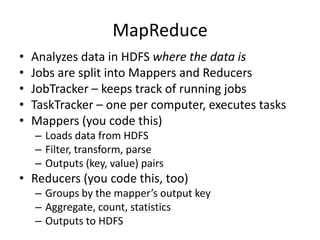
MapReduce
•   Analyzes data in HDFS where the data is
•   Jobs are split into Mappers and Reducers
•   JobTracker – keeps track of running jobs
•   TaskTracker – one per computer, executes tasks
•   Mappers (you code this)
    – Loads data from HDFS
    – Filter, transform, parse
    – Outputs (key, value) pairs
• Reducers (you code this, too)
    – Groups by the mapper’s output key
    – Aggregate, count, statistics
    – Outputs to HDFS
MapReduce Demonstration
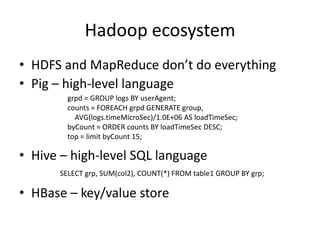
Hadoop ecosystem
• HDFS and MapReduce don’t do everything
• Pig – high-level language
        grpd = GROUP logs BY userAgent;
        counts = FOREACH grpd GENERATE group,
          AVG(logs.timeMicroSec)/1.0E+06 AS loadTimeSec;
        byCount = ORDER counts BY loadTimeSec DESC;
        top = limit byCount 15;

• Hive – high-level SQL language
      SELECT grp, SUM(col2), COUNT(*) FROM table1 GROUP BY grp;

• HBase – key/value store
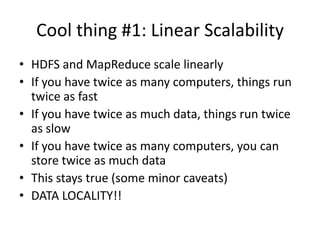
Cool thing #1: Linear Scalability
• HDFS and MapReduce scale linearly
• If you have twice as many computers, things run
  twice as fast
• If you have twice as much data, things run twice
  as slow
• If you have twice as many computers, you can
  store twice as much data
• This stays true (some minor caveats)
• DATA LOCALITY!!
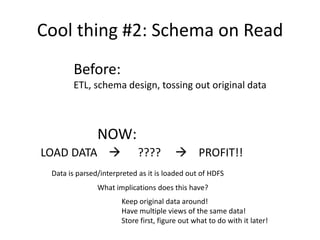
Cool thing #2: Schema on Read
       Before:
       ETL, schema design, tossing out original data


               NOW:
LOAD DATA                  ????        PROFIT!!
 Data is parsed/interpreted as it is loaded out of HDFS
               What implications does this have?
                      Keep original data around!
                      Have multiple views of the same data!
                      Store first, figure out what to do with it later!
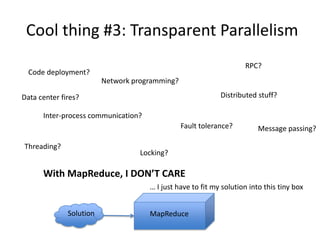
Cool thing #3: Transparent Parallelism
                                                                    RPC?
  Code deployment?
                         Network programming?

Data center fires?                                          Distributed stuff?

      Inter-process communication?
                                                Fault tolerance?        Message passing?

Threading?
                                   Locking?

      With MapReduce, I DON’T CARE
                                     … I just have to fit my solution into this tiny box


              Solution               MapReduce
Cool thing #4: Cheap
• Commodity hardware (meh)
• Open source (people cost more though)
• Add more hardware later
How to get started
• Install Hadoop in a Linux VM
  – Wait how is this helpful?? Hadoop is distributed!


• Use Google (seriously)

• Some prerequisites: Java, Linux, Data, Time
Stuff Hadoop is good at
•   Batch processing
•   Processing lots of data
•   Outputting lots of data
•   Storing lots of historical data
•   Flexible analysis of data
•   Dealing with unstructured or structured data
Stuff Hadoop is not good at
• Hadoop is a freight truck, not a sports car
• Updating data (think “append-only”)
• Being easy to use
  – Java
  – Administration
• Hadoop is not good storage (don’t throw away
  your EMC stuff!)
QUESTIONS?
Hadoop and the Rise of Big Data

           February 21, 2013
             Donald Miner
            @donaldpminer
        Donald.Miner@emc.com

Bw tech hadoop

  • 1.
    Hadoop and theRise of Big Data February 21, 2013 Donald Miner @donaldpminer Donald.Miner@emc.com
  • 2.
  • 3.
    Hadoop • Distributed platform up to thousands of nodes • Data storage and application framework • Started at Yahoo! • Open source • Based on a few Google papers (2003, 2004) • Runs on commodity hardware I’M HERE TO TELL YOU WHY HADOOP IS AWESOME
  • 4.
    Hadoop users • Yahoo! • Riot Games • Facebook • ComScore • eBay • Twitter • AOL • LinkedIn Hadoop Companies • Cloudera, Hortonworks, EMC/Greenplum, IBM • Numerous startups
  • 5.
    Buzzword glossary • Unstructured & Structured Data • NoSQL • Big Data (volume, velocity, variety) • Data Science • Cloud computing
  • 6.
    Hadoop component overview •Core components: – HDFS (Hadoop Distributed File System) – MapReduce (Data analysis framework) • Ecosystem – HBase (key-value store) – Pig (high-level data analysis language) – Hive (SQL-like data analysis language) – ZooKeeper (stores metadata) – Other stuff
  • 7.
    Use cases • Textprocessing – Indexing, counting, processing • Large-scale reports • Data science • Mixing data sources (data lakes) • Ad targeting • Image/Video/Audio processing • Cybersecurity
  • 8.
    HDFS • Stores filesin folders (that’s it) – Nobody cares what’s in your files • Chunks large files into blocks (~64MB-1GB) • Blocks are scattered all over the place • 3 replicates of each block (better safe than sorry) • One NameNode (might be sorry) – Knows which computers blocks live on – Knows which blocks belong to which files • One DataNode per computer (slaves!) – Hosts files
  • 9.
  • 10.
    MapReduce • Analyzes data in HDFS where the data is • Jobs are split into Mappers and Reducers • JobTracker – keeps track of running jobs • TaskTracker – one per computer, executes tasks • Mappers (you code this) – Loads data from HDFS – Filter, transform, parse – Outputs (key, value) pairs • Reducers (you code this, too) – Groups by the mapper’s output key – Aggregate, count, statistics – Outputs to HDFS
  • 11.
  • 12.
    Hadoop ecosystem • HDFSand MapReduce don’t do everything • Pig – high-level language grpd = GROUP logs BY userAgent; counts = FOREACH grpd GENERATE group, AVG(logs.timeMicroSec)/1.0E+06 AS loadTimeSec; byCount = ORDER counts BY loadTimeSec DESC; top = limit byCount 15; • Hive – high-level SQL language SELECT grp, SUM(col2), COUNT(*) FROM table1 GROUP BY grp; • HBase – key/value store
  • 13.
    Cool thing #1:Linear Scalability • HDFS and MapReduce scale linearly • If you have twice as many computers, things run twice as fast • If you have twice as much data, things run twice as slow • If you have twice as many computers, you can store twice as much data • This stays true (some minor caveats) • DATA LOCALITY!!
  • 14.
    Cool thing #2:Schema on Read Before: ETL, schema design, tossing out original data NOW: LOAD DATA  ????  PROFIT!! Data is parsed/interpreted as it is loaded out of HDFS What implications does this have? Keep original data around! Have multiple views of the same data! Store first, figure out what to do with it later!
  • 15.
    Cool thing #3:Transparent Parallelism RPC? Code deployment? Network programming? Data center fires? Distributed stuff? Inter-process communication? Fault tolerance? Message passing? Threading? Locking? With MapReduce, I DON’T CARE … I just have to fit my solution into this tiny box Solution MapReduce
  • 16.
    Cool thing #4:Cheap • Commodity hardware (meh) • Open source (people cost more though) • Add more hardware later
  • 17.
    How to getstarted • Install Hadoop in a Linux VM – Wait how is this helpful?? Hadoop is distributed! • Use Google (seriously) • Some prerequisites: Java, Linux, Data, Time
  • 18.
    Stuff Hadoop isgood at • Batch processing • Processing lots of data • Outputting lots of data • Storing lots of historical data • Flexible analysis of data • Dealing with unstructured or structured data
  • 19.
    Stuff Hadoop isnot good at • Hadoop is a freight truck, not a sports car • Updating data (think “append-only”) • Being easy to use – Java – Administration • Hadoop is not good storage (don’t throw away your EMC stuff!)
  • 20.
    QUESTIONS? Hadoop and theRise of Big Data February 21, 2013 Donald Miner @donaldpminer Donald.Miner@emc.com