

BIG DATA – HADOOP
Governance Team
6 Dec 16
• Big Data Fundamentals1
• Hadoop and
Components2
• QA3
Today’s Overview
Agenda – Big Data Fundamental
• What is Big Data ?
• Basic Characteristics
of Big Data
• Sources of Big Data
• V’s of Big Data
• Processing Of Data
– Traditional Approach
VS Big Data Approach
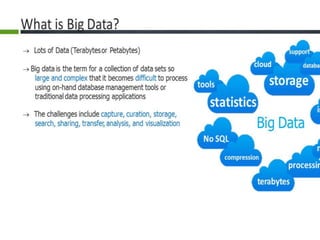
What is Big Data
What is Big Data –con’t
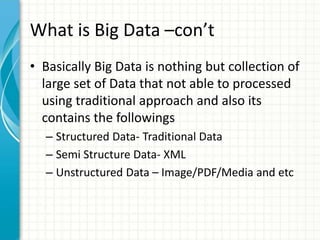
• Basically Big Data is nothing but collection of
large set of Data that not able to processed
using traditional approach and also its
contains the followings
– Structured Data- Traditional Data
– Semi Structure Data- XML
– Unstructured Data – Image/PDF/Media and etc
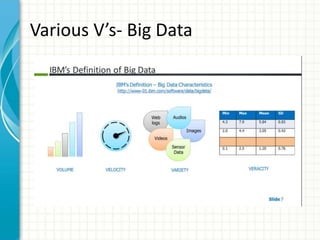
Various V’s- Big Data
Processing - Data
• Traditional Approach
• Big Data Approach
Hadoop Fundamental
• What is Hadoop ?
• Key Characterstics
• Components
• HDFS
• MapReduce
• Yarn
• Benefits of Hadoop
What is Hadoop
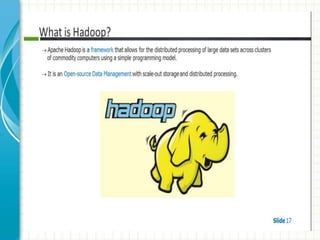
• Hadoop is an open-source software
framework for storing large amounts of data
and processing/querying those data on a
cluster with multiple nodes of commodity
hardware (i.e. low cost hardware).
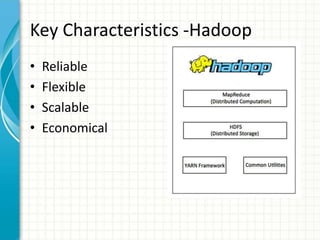
Key Characteristics -Hadoop
• Reliable
• Flexible
• Scalable
• Economical
Components
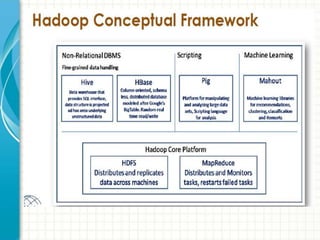
• Common Libraries
• High Volume of Distributed Data Storage
System –HDFS
• High Volume of Distributed Data Processing
Framework –MapReduce
• Resource and Meta Data Management -YARN
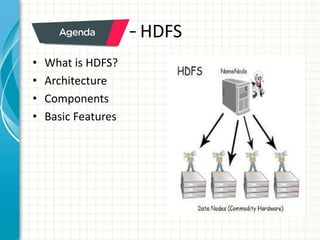
– HDFS
• What is HDFS?
• Architecture
• Components
• Basic Features
What is HDFS ?
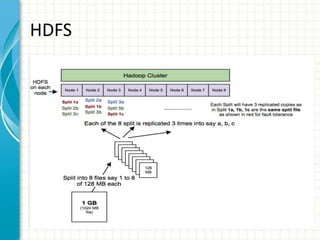
HDFS holds very large amount of data and
provides easier access. To store such huge data,
the files are stored across multiple machines.
These files are stored in redundant fashion to
rescue the system from possible data losses in
case of failure. HDFS also makes applications
available to parallel processing
Components- HDFS
 Master/slave architecture
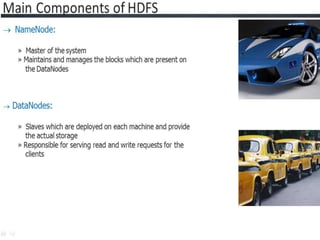
 HDFS cluster consists of a single Namenode, a
master server that manages the file system
namespace and regulates access to files by
clients.
 There are a number of DataNodes usually one
per node in a cluster.
 The DataNodes manage storage attached to the
nodes that they run on.
Components -HDFS
HDFS exposes a file system namespace and
allows user data to be stored in files.
A file is split into one or more blocks and set
of blocks are stored in DataNodes.
DataNodes: serves read, write requests,
performs block creation, deletion, and
replication upon instruction from Namenode
Features
• Highly fault-tolerant
• High throughput
• Suitable Distributed Storage for large
Amount of Data
• Streaming access to file system data
• Can be built out of commodity hardware
MapReduce
• What is MapReduce
• Tasks /Components
• Basic Features
• Demo
What is MapReduce
• Its framework mainly used to process the
large Amount of Data in parallel on the large
clusters of commodity hardware
• Its based on divide –conquer Principle which
provides built-in fault tolerance and
redundancy
• Its batch oriented parallel processing engine
to process the large volume of data
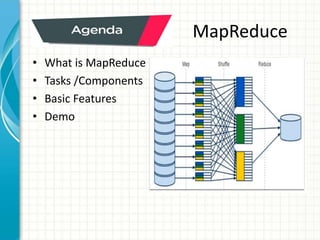
MapReduce
– Map stage : The map or mapper’s job is to process
the input data. Generally the input data is in the
form of file or directory and is stored in the Hadoop
file system (HDFS). The input file is passed to the
mapper function line by line. The mapper processes
the data and creates several small chunks of data.
– Reduce stage : This stage is the combination of the
Shuffle stage and the Reduce stage. The Reducer’s
job is to process the data that comes from the
mapper. After processing, it produces a new set of
output, which will be stored in the HDFS.
Stages of each Tasks
• Map Task have the following Stages
– Map
– Combine
– Partition
• Reduce Task have the following stages
– Shuffle and Sort
– Reduce
Demo
• Refer the PDF Attachment
• Mainly for reading the text and count the no
of word
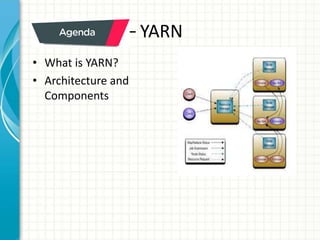
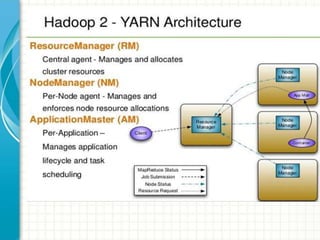
– YARN
• What is YARN?
• Architecture and
Components
YARN
• YARN (Yet Another Resource Nagotiator): A
framework for job scheduling and cluster
resource management
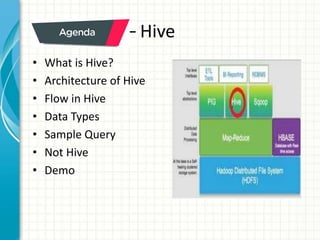
– Hive
• What is Hive?
• Architecture of Hive
• Flow in Hive
• Data Types
• Sample Query
• Not Hive
• Demo
What is Hive
• Its Data warehouse infrastructure tool to
process the structured data in Hadoop
platform
• Its originally developed by Facebook then
moves into apache umbrella
• Basic large volume of data is retrieve from
multiple resources and RDBMS system could
not fit as perfect solutions .We move into
Hive.
What is Hive
• Its Query Engine wrapper on top of the Hadoop
to perform the OLAP
• Provides the HiveQL is similar to SQL
• Targeted to the users/developer with SQL
background
• Its stores schema in database and process the
data in HDFS
• Data Stored in HDFS/HBASE and every tables
should reference to the file on HDFS/HBASE
Architecture - Hive
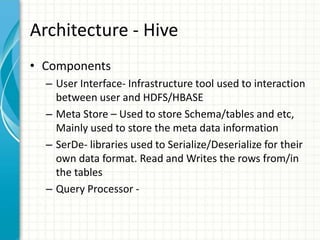
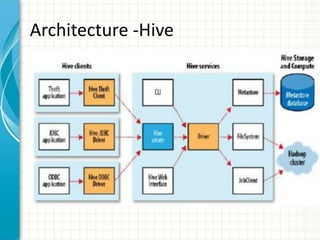
• Components
– User Interface- Infrastructure tool used to interaction
between user and HDFS/HBASE
– Meta Store – Used to store Schema/tables and etc,
Mainly used to store the meta data information
– SerDe- libraries used to Serialize/Deserialize for their
own data format. Read and Writes the rows from/in
the tables
– Query Processor -
Architecture -Hive
Data Type
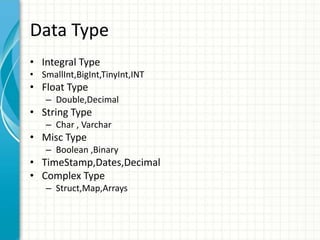
• Integral Type
• SmallInt,BigInt,TinyInt,INT
• Float Type
– Double,Decimal
• String Type
– Char , Varchar
• Misc Type
– Boolean ,Binary
• TimeStamp,Dates,Decimal
• Complex Type
– Struct,Map,Arrays
Sample Query
• Create Table
• Drop Table
• Alter Table
• Rename Table- Rename the table name
• Load Data –Insert
• Create View
• Select
Operator and Built in Function
• Arithmetic Operator
• Relational Operator
• Logical Operator
• Aggregate and Built in Function
• Supports Index/Order/Join
Disadvantages of HIVE
• Not for Real time Query
• Supports ACID from 0.14 version onwards
• Poor performance – It took more time to
process since each time Hive will
generate/process the Map Reduce or Spark
Program internally while processing the
Records sets
Disadvantages of HIVE
• It can process only for large volume of
Structured data not for other categories
Hive Interface Option
• CLI
• HUE(Hadoop User Experience)-
www.gethue.com
• JDBC/ODBC - JAVA
QUESTIONS?
APPENDIX
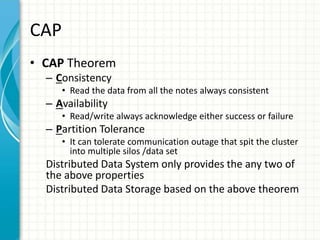
CAP
• CAP Theorem
– Consistency
• Read the data from all the notes always consistent
– Availability
• Read/write always acknowledge either success or failure
– Partition Tolerance
• It can tolerate communication outage that spit the cluster
into multiple silos /data set
Distributed Data System only provides the any two of
the above properties
Distributed Data Storage based on the above theorem
ACID
• ACID
– Atomicity
– Consistency
– Isolation
– Durability
BASE
• BASE
– Basic availability
– Soft state
– Eventual consistency
Above property mainly used in database
distributed data for non transactional data
SCV
• SCV
– Speed
– Consistency
– Volume
High Data Volume Data Processing is based on the
above algorithm
Data Processing should satisfied at max of two of
the above properties
Sharding
• Sharding
It’s the process of Horizontally partitioning of large
volume of data into smaller set of more
manageable data set
Replication
• Replication
Stores the multiple copies of the data set known as
replicas
Provides always high availability , scalability and
fault tolerance since its stores into multiple nodes
Replicas implements the following was
Master-slave
Peer -Peer
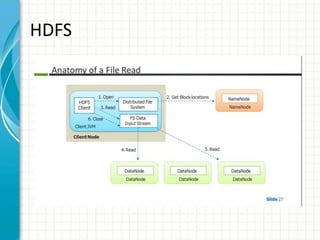
HDFS
HDFS-
HDFS Commands
• https://hadoop.apache.org/docs/r2.7.1/hado
op-project-dist/hadoop-
hdfs/HDFSCommands.html
HDFS
• Blocks
– In HDFS File can split into small segments which
used to store the Data .Each Segments called as
Block
– Default size of the Block is 64 MB (Hadoop 1.X) ,
you can change the size in HDFS Configuration
upto 128 MB(Hadoop 2.x Advisable approach)
Types of File Format -MR
• TxtInputFormat-- Default
• KeyValueTxtInputFormat
• SequenceFileInputFormat
• SequenceAsFileTxtInputFormat
Reader and Writer
• RecordReader –
– Read the Record from file line by line , Each line
in the file treat as a record
– Perform before the Mapper function
• RecordWriter
–Write content into file as a output
– Perform after the Reducer
Reducer
• IdentityReducer- Does not have the shuffle
capability
• CustomReducer- Shuffle and Sorting
Capability
BoxClasses in MR
• Its equivalent to wrapper in JAVA
• IntWritter
• FloatWritter
• LongWritter
• DoubleWritter
• TextWritter
• Mainly used for (K,V) in MR
Schema on Read/Write
• Hadoop –Schema on Read approach
• RDBMS – Schema on Write approach
Key Steps in Big Data Solution
• Ingesting Data
• Storing Data
• Processing Data
HDFS
Hadoop Tools
• 15+ frameworks & tools like Sqoop, Flume,
Kafka, Pig, Hive, Spark, Impala, etc to ingest data
into HDFS, store and process data within HDFS,
and to query data from HDFS for business
intelligence & analytics. Some tools like Pig &
Hive are abstraction layers on top of
MapReduce, whilst the other tools like Spark &
Impala are improved architecture/design from
MapReduce for much improved latencies to
support near real-time (i.e. NRT) & real-time
processing.
NRT
• Near Real time –
– Near real-time processing is when speed is
important, but processing time in minutes is
acceptable in lieu of seconds
HeartBit - HDFS
• Heartbeat is referred to a signal used
between a data node and Name node, and
between task tracker and job tracker
MapReducer – Partition
• all the value of a single key goes to the same
reducer from Mapper, eventually which helps
evenly distribution of the map output over
the reducers
HDFS VS NAS(Network Attached
Storage)
• HDFS data blocks are distributed across local
drives of all machines in a cluster
• NAS data is stored on dedicated hardware.
• HDFS there is data redundancy because of
the replication protocol.
• NAS there is no probability of data
redundancy
Commodity Hardware
• Commodity Hardware refers to inexpensive
systems that do not have high availability or
high quality. Commodity Hardware consists
of RAM because there are specific services
that need to be executed on RAM
Port Number
• NameNode 50070
• Job Tracker 50030
• Task Tracker 50060
Combine-MapReduce
• A “Combiner” is a mini “reducer” that
performs the local “reduce” task. It receives
the input from the “mapper” on a particular
“node” and sends the output to the
“reducer”. “Combiners” help in enhancing
the efficiency of “MapReduce” by reducing
the quantum of data that is required to be
sent to the “reducers”.
MapReduce Programs
• Driver – Main method class which invoke by
the scheduler
• Mapper
• Reducer
JobTracker –Functionality
– When Client applications submit map reduce jobs to the Job tracker. The
JobTracker talks to the Name node to determine the location of the data.
– The JobTracker locates Tasktracker nodes with available slots at or near the
data
– The JobTracker submits the work to the chosen Tasktracker nodes.
– The TaskTracker nodes are monitored. If they do not submit heartbeat
signals often enough, they are deemed to have failed and the work is
scheduled on a different TaskTracker.
– When the work is completed, the JobTracker updates its status.
– Client applications can poll the JobTracker for information.
DW –Data Warehouse
• Database specific for analysis and reporting
purpose
Hive Support File Format
• Text File (Plain raw data)
• Sequence File(Key value pairs)
• RCFile (Record Columnar files which are
stored columns of the table in columnar
Database)
NameNode Vs MetaNode
• NameNode- Stores the MetaData information
about the files in Hadoop
• MetaNode-Stores the MetaData information
about the Tables /Data Base in Hive
Tez- Hive
• execute complex directed acyclic graphs of
general data processing tasks
• Its better than the MapReduce
Bucketing -Hive
• Bucketing provides mechanism to query and
examine random samples of data.
• Bucketing offers capability to execute queries
on a sub-set of random data
Reference -Hive
• http://dl.farinsoft.com/files/94/Ultimate-
Guide-Programming-Apache-Hive-ebook.pdf
WHAT NEXT ………….
TOOLS OF HADOOP
PIG/SQOOP/HBASE
/HIVE/SPARK…….

Big data Hadoop

  • 1.
    BIG DATA –HADOOP Governance Team 6 Dec 16
  • 2.
    • Big DataFundamentals1 • Hadoop and Components2 • QA3 Today’s Overview
  • 3.
    Agenda – BigData Fundamental • What is Big Data ? • Basic Characteristics of Big Data • Sources of Big Data • V’s of Big Data • Processing Of Data – Traditional Approach VS Big Data Approach
  • 4.
  • 5.
    What is BigData –con’t • Basically Big Data is nothing but collection of large set of Data that not able to processed using traditional approach and also its contains the followings – Structured Data- Traditional Data – Semi Structure Data- XML – Unstructured Data – Image/PDF/Media and etc
  • 6.
  • 7.
    Processing - Data •Traditional Approach • Big Data Approach
  • 8.
    Hadoop Fundamental • Whatis Hadoop ? • Key Characterstics • Components • HDFS • MapReduce • Yarn • Benefits of Hadoop
  • 10.
    What is Hadoop •Hadoop is an open-source software framework for storing large amounts of data and processing/querying those data on a cluster with multiple nodes of commodity hardware (i.e. low cost hardware).
  • 11.
    Key Characteristics -Hadoop •Reliable • Flexible • Scalable • Economical
  • 12.
    Components • Common Libraries •High Volume of Distributed Data Storage System –HDFS • High Volume of Distributed Data Processing Framework –MapReduce • Resource and Meta Data Management -YARN
  • 14.
    – HDFS • Whatis HDFS? • Architecture • Components • Basic Features
  • 15.
    What is HDFS? HDFS holds very large amount of data and provides easier access. To store such huge data, the files are stored across multiple machines. These files are stored in redundant fashion to rescue the system from possible data losses in case of failure. HDFS also makes applications available to parallel processing
  • 17.
    Components- HDFS  Master/slavearchitecture  HDFS cluster consists of a single Namenode, a master server that manages the file system namespace and regulates access to files by clients.  There are a number of DataNodes usually one per node in a cluster.  The DataNodes manage storage attached to the nodes that they run on.
  • 18.
    Components -HDFS HDFS exposesa file system namespace and allows user data to be stored in files. A file is split into one or more blocks and set of blocks are stored in DataNodes. DataNodes: serves read, write requests, performs block creation, deletion, and replication upon instruction from Namenode
  • 19.
    Features • Highly fault-tolerant •High throughput • Suitable Distributed Storage for large Amount of Data • Streaming access to file system data • Can be built out of commodity hardware
  • 20.
    MapReduce • What isMapReduce • Tasks /Components • Basic Features • Demo
  • 21.
    What is MapReduce •Its framework mainly used to process the large Amount of Data in parallel on the large clusters of commodity hardware • Its based on divide –conquer Principle which provides built-in fault tolerance and redundancy • Its batch oriented parallel processing engine to process the large volume of data
  • 22.
    MapReduce – Map stage: The map or mapper’s job is to process the input data. Generally the input data is in the form of file or directory and is stored in the Hadoop file system (HDFS). The input file is passed to the mapper function line by line. The mapper processes the data and creates several small chunks of data. – Reduce stage : This stage is the combination of the Shuffle stage and the Reduce stage. The Reducer’s job is to process the data that comes from the mapper. After processing, it produces a new set of output, which will be stored in the HDFS.
  • 23.
    Stages of eachTasks • Map Task have the following Stages – Map – Combine – Partition • Reduce Task have the following stages – Shuffle and Sort – Reduce
  • 24.
    Demo • Refer thePDF Attachment • Mainly for reading the text and count the no of word
  • 25.
    – YARN • Whatis YARN? • Architecture and Components
  • 26.
    YARN • YARN (YetAnother Resource Nagotiator): A framework for job scheduling and cluster resource management
  • 28.
    – Hive • Whatis Hive? • Architecture of Hive • Flow in Hive • Data Types • Sample Query • Not Hive • Demo
  • 29.
    What is Hive •Its Data warehouse infrastructure tool to process the structured data in Hadoop platform • Its originally developed by Facebook then moves into apache umbrella • Basic large volume of data is retrieve from multiple resources and RDBMS system could not fit as perfect solutions .We move into Hive.
  • 30.
    What is Hive •Its Query Engine wrapper on top of the Hadoop to perform the OLAP • Provides the HiveQL is similar to SQL • Targeted to the users/developer with SQL background • Its stores schema in database and process the data in HDFS • Data Stored in HDFS/HBASE and every tables should reference to the file on HDFS/HBASE
  • 31.
    Architecture - Hive •Components – User Interface- Infrastructure tool used to interaction between user and HDFS/HBASE – Meta Store – Used to store Schema/tables and etc, Mainly used to store the meta data information – SerDe- libraries used to Serialize/Deserialize for their own data format. Read and Writes the rows from/in the tables – Query Processor -
  • 32.
  • 33.
    Data Type • IntegralType • SmallInt,BigInt,TinyInt,INT • Float Type – Double,Decimal • String Type – Char , Varchar • Misc Type – Boolean ,Binary • TimeStamp,Dates,Decimal • Complex Type – Struct,Map,Arrays
  • 34.
    Sample Query • CreateTable • Drop Table • Alter Table • Rename Table- Rename the table name • Load Data –Insert • Create View • Select
  • 35.
    Operator and Builtin Function • Arithmetic Operator • Relational Operator • Logical Operator • Aggregate and Built in Function • Supports Index/Order/Join
  • 36.
    Disadvantages of HIVE •Not for Real time Query • Supports ACID from 0.14 version onwards • Poor performance – It took more time to process since each time Hive will generate/process the Map Reduce or Spark Program internally while processing the Records sets
  • 37.
    Disadvantages of HIVE •It can process only for large volume of Structured data not for other categories
  • 38.
    Hive Interface Option •CLI • HUE(Hadoop User Experience)- www.gethue.com • JDBC/ODBC - JAVA
  • 39.
  • 40.
  • 41.
    CAP • CAP Theorem –Consistency • Read the data from all the notes always consistent – Availability • Read/write always acknowledge either success or failure – Partition Tolerance • It can tolerate communication outage that spit the cluster into multiple silos /data set Distributed Data System only provides the any two of the above properties Distributed Data Storage based on the above theorem
  • 42.
    ACID • ACID – Atomicity –Consistency – Isolation – Durability
  • 43.
    BASE • BASE – Basicavailability – Soft state – Eventual consistency Above property mainly used in database distributed data for non transactional data
  • 44.
    SCV • SCV – Speed –Consistency – Volume High Data Volume Data Processing is based on the above algorithm Data Processing should satisfied at max of two of the above properties
  • 45.
    Sharding • Sharding It’s theprocess of Horizontally partitioning of large volume of data into smaller set of more manageable data set
  • 46.
    Replication • Replication Stores themultiple copies of the data set known as replicas Provides always high availability , scalability and fault tolerance since its stores into multiple nodes Replicas implements the following was Master-slave Peer -Peer
  • 47.
  • 48.
  • 49.
  • 50.
    HDFS • Blocks – InHDFS File can split into small segments which used to store the Data .Each Segments called as Block – Default size of the Block is 64 MB (Hadoop 1.X) , you can change the size in HDFS Configuration upto 128 MB(Hadoop 2.x Advisable approach)
  • 51.
    Types of FileFormat -MR • TxtInputFormat-- Default • KeyValueTxtInputFormat • SequenceFileInputFormat • SequenceAsFileTxtInputFormat
  • 52.
    Reader and Writer •RecordReader – – Read the Record from file line by line , Each line in the file treat as a record – Perform before the Mapper function • RecordWriter –Write content into file as a output – Perform after the Reducer
  • 53.
    Reducer • IdentityReducer- Doesnot have the shuffle capability • CustomReducer- Shuffle and Sorting Capability
  • 54.
    BoxClasses in MR •Its equivalent to wrapper in JAVA • IntWritter • FloatWritter • LongWritter • DoubleWritter • TextWritter • Mainly used for (K,V) in MR
  • 55.
    Schema on Read/Write •Hadoop –Schema on Read approach • RDBMS – Schema on Write approach
  • 56.
    Key Steps inBig Data Solution • Ingesting Data • Storing Data • Processing Data
  • 57.
  • 58.
    Hadoop Tools • 15+frameworks & tools like Sqoop, Flume, Kafka, Pig, Hive, Spark, Impala, etc to ingest data into HDFS, store and process data within HDFS, and to query data from HDFS for business intelligence & analytics. Some tools like Pig & Hive are abstraction layers on top of MapReduce, whilst the other tools like Spark & Impala are improved architecture/design from MapReduce for much improved latencies to support near real-time (i.e. NRT) & real-time processing.
  • 59.
    NRT • Near Realtime – – Near real-time processing is when speed is important, but processing time in minutes is acceptable in lieu of seconds
  • 60.
    HeartBit - HDFS •Heartbeat is referred to a signal used between a data node and Name node, and between task tracker and job tracker
  • 61.
    MapReducer – Partition •all the value of a single key goes to the same reducer from Mapper, eventually which helps evenly distribution of the map output over the reducers
  • 62.
    HDFS VS NAS(NetworkAttached Storage) • HDFS data blocks are distributed across local drives of all machines in a cluster • NAS data is stored on dedicated hardware. • HDFS there is data redundancy because of the replication protocol. • NAS there is no probability of data redundancy
  • 63.
    Commodity Hardware • CommodityHardware refers to inexpensive systems that do not have high availability or high quality. Commodity Hardware consists of RAM because there are specific services that need to be executed on RAM
  • 64.
    Port Number • NameNode50070 • Job Tracker 50030 • Task Tracker 50060
  • 65.
    Combine-MapReduce • A “Combiner”is a mini “reducer” that performs the local “reduce” task. It receives the input from the “mapper” on a particular “node” and sends the output to the “reducer”. “Combiners” help in enhancing the efficiency of “MapReduce” by reducing the quantum of data that is required to be sent to the “reducers”.
  • 66.
    MapReduce Programs • Driver– Main method class which invoke by the scheduler • Mapper • Reducer
  • 67.
    JobTracker –Functionality – WhenClient applications submit map reduce jobs to the Job tracker. The JobTracker talks to the Name node to determine the location of the data. – The JobTracker locates Tasktracker nodes with available slots at or near the data – The JobTracker submits the work to the chosen Tasktracker nodes. – The TaskTracker nodes are monitored. If they do not submit heartbeat signals often enough, they are deemed to have failed and the work is scheduled on a different TaskTracker. – When the work is completed, the JobTracker updates its status. – Client applications can poll the JobTracker for information.
  • 68.
    DW –Data Warehouse •Database specific for analysis and reporting purpose
  • 69.
    Hive Support FileFormat • Text File (Plain raw data) • Sequence File(Key value pairs) • RCFile (Record Columnar files which are stored columns of the table in columnar Database)
  • 70.
    NameNode Vs MetaNode •NameNode- Stores the MetaData information about the files in Hadoop • MetaNode-Stores the MetaData information about the Tables /Data Base in Hive
  • 71.
    Tez- Hive • executecomplex directed acyclic graphs of general data processing tasks • Its better than the MapReduce
  • 72.
    Bucketing -Hive • Bucketingprovides mechanism to query and examine random samples of data. • Bucketing offers capability to execute queries on a sub-set of random data
  • 73.
  • 74.
    WHAT NEXT …………. TOOLSOF HADOOP PIG/SQOOP/HBASE /HIVE/SPARK…….