PROJECT REPORT WRITTING
MADE BY: ARHAM BOTHRA
B.COM(HONS)
1st SEMESTER
MEANING OF PROJECT REPORT WRITTING
 A project report is a record of any sort of project, whether it is
a school project, business project, or research project. A project
report can be written about almost any topic, in fields such as
science, marketing, education, or engineering.
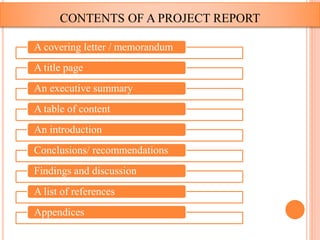
CONTENTS OF A PROJECT REPORT
A covering letter / memorandum
A title page
An executive summary
A table of content
An introduction
Conclusions/ recommendations
Findings and discussion
A list of references
Appendices
 Often a letter is attached to a report to officially
introduce the report to the recipient. If the recipient is
outside the organization , a letter format is appropriate; if
the recipient is inside the organization , a
memorandum/memo is appropriate.
COVERING LETTER/MEMORANDUM
 The title page should be brief but descriptive of the
project. It should also include the date
completion/submission of the report, the author/s, and
their association/ organization
TITLE PAGE
 The executive summary follows the title page. The
executive summary helps the reader quickly grasp the
report’s purpose, conclusions , and key
recommendations.The executive summary should be no
longer than one page .The executive summary differs
from an abstract in that it provides the key
recommendations and conclusions, rather than a
summary of the document.
EXECUTIVE SUMMARY
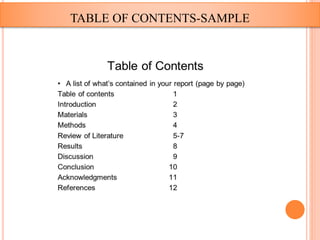
 The table of contents follows the executive
summary on a new page. It states the pages for
various sections.
 The reader receives a clear orientation to the report
as the table of contents lists all the headings and sub-
headings in the report.
TABLE OF CONTENTS
TABLE OF CONTENTS-SAMPLE
 The introduction sets the stage for the reader. It gives the
context for the report and generates the reader’s interest.
It orients the reader to the purpose of the report and gives
them a clear indication of what they can expect.
INTRODUCTION
 A business report usually needs both conclusions and
recommendations. The difference between conclusions
and recommendations in a report lies in the orientation to
time. Conclusions typically relate to the present or past
situation.
 Recommendations are oriented to the future: what
changes are recommended, or what actions are
recommended for the future? They are specific , action-
oriented suggestions to solve the report problem.
CONCLUSIONS AND RECOMMENDATIONS
FINDINGS AND DISCUSSIONS
 Present the outcome of your research in
a succinct and logical way, making sure that you include
enough information to demonstrate that you have
investigated the matter thoroughly.
 You can summarize the opinions of people you have
approached, present statistics in support of your points,
or describe any other relevant information. It will help
the reader if you organize these findings under further
headings, subheadings, or numbered subsections
 Whenever you use information from other sources, references
must be provided in text and in a list of references. The style of
referencing may be dictated by your faculty or organization.
A LIST OF REFFERENCES
 If you choose to keep all charts, illustrations, tables, and
so forth grouped together, they can be placed in an
appendix at the end of the report. Supporting material
such as maps, notes, questionnaires, or summaries of
data may also go here. If you have several
items appended, they would be headed as Appendix
A, Appendix B, and so on.
APPENDICES
Project report writting format

Project report writting format

  • 1.
    PROJECT REPORT WRITTING MADEBY: ARHAM BOTHRA B.COM(HONS) 1st SEMESTER
  • 2.
    MEANING OF PROJECTREPORT WRITTING  A project report is a record of any sort of project, whether it is a school project, business project, or research project. A project report can be written about almost any topic, in fields such as science, marketing, education, or engineering.
  • 3.
    CONTENTS OF APROJECT REPORT A covering letter / memorandum A title page An executive summary A table of content An introduction Conclusions/ recommendations Findings and discussion A list of references Appendices
  • 4.
     Often aletter is attached to a report to officially introduce the report to the recipient. If the recipient is outside the organization , a letter format is appropriate; if the recipient is inside the organization , a memorandum/memo is appropriate. COVERING LETTER/MEMORANDUM
  • 5.
     The titlepage should be brief but descriptive of the project. It should also include the date completion/submission of the report, the author/s, and their association/ organization TITLE PAGE
  • 6.
     The executivesummary follows the title page. The executive summary helps the reader quickly grasp the report’s purpose, conclusions , and key recommendations.The executive summary should be no longer than one page .The executive summary differs from an abstract in that it provides the key recommendations and conclusions, rather than a summary of the document. EXECUTIVE SUMMARY
  • 7.
     The tableof contents follows the executive summary on a new page. It states the pages for various sections.  The reader receives a clear orientation to the report as the table of contents lists all the headings and sub- headings in the report. TABLE OF CONTENTS
  • 8.
  • 9.
     The introductionsets the stage for the reader. It gives the context for the report and generates the reader’s interest. It orients the reader to the purpose of the report and gives them a clear indication of what they can expect. INTRODUCTION
  • 10.
     A businessreport usually needs both conclusions and recommendations. The difference between conclusions and recommendations in a report lies in the orientation to time. Conclusions typically relate to the present or past situation.  Recommendations are oriented to the future: what changes are recommended, or what actions are recommended for the future? They are specific , action- oriented suggestions to solve the report problem. CONCLUSIONS AND RECOMMENDATIONS
  • 11.
    FINDINGS AND DISCUSSIONS Present the outcome of your research in a succinct and logical way, making sure that you include enough information to demonstrate that you have investigated the matter thoroughly.  You can summarize the opinions of people you have approached, present statistics in support of your points, or describe any other relevant information. It will help the reader if you organize these findings under further headings, subheadings, or numbered subsections
  • 12.
     Whenever youuse information from other sources, references must be provided in text and in a list of references. The style of referencing may be dictated by your faculty or organization. A LIST OF REFFERENCES
  • 13.
     If youchoose to keep all charts, illustrations, tables, and so forth grouped together, they can be placed in an appendix at the end of the report. Supporting material such as maps, notes, questionnaires, or summaries of data may also go here. If you have several items appended, they would be headed as Appendix A, Appendix B, and so on. APPENDICES