The Business
      Cycle
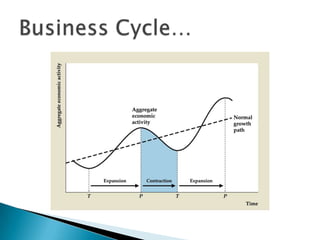
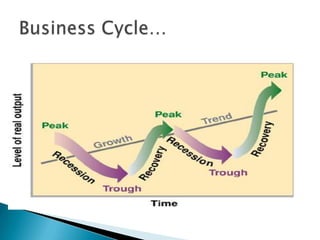
   A business cycle refers to periods of expansion and
    contraction. A peak is the high point following a period
    of economic expansion. A trough is the low point
    following a period of economic decline.
The recurring and fluctuating levels of economic activity
that an economy experiences over a long period of time.
   Business cycles are a type of fluctuation found in the
    aggregate economic activity of nations that organize
    their work mainly in business enterprises.

   A cycle consists of:
           Expansions.
           General recessions.
           Contractions
           And revivals which merge into the expansion
    phase of the next cycle.
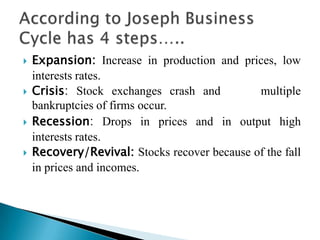
   Expansion: Increase in production and prices, low
    interests rates.
   Crisis: Stock exchanges crash and         multiple
    bankruptcies of firms occur.
   Recession: Drops in prices and in output high
    interests rates.
   Recovery/Revival: Stocks recover because of the fall
    in prices and incomes.
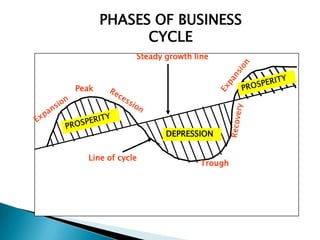
PHASES OF BUSINESS
             CYCLE
              Steady growth line


Peak


                     DEPRESSION

  Line of cycle
                              Trough
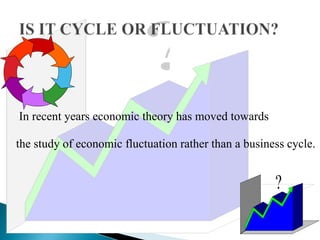
In recent years economic theory has moved towards

the study of economic fluctuation rather than a business cycle.


                                                      ?
   The business outlook is extremely optimistic.
   The important features of prosperity are:
    ◦ a high level of output ,trade, employment and
      income,
    ◦ a high level of effective demand and high marginal
      efficiency of capital,
    ◦ a large expansion of bank credit, and
    ◦ a rising trend in prices, profits and interest rates.
Characterized by
       Slackening in expansion rate

PEAK   Highest level of prosperity
       Downward slide in economic
       activities
       The phase of recession begins
   During recessions, many macro economic
    indicators vary in a similar way.
    Production, as measured by gross domestic
    product (GDP), employment, investment
    spending, capacity utilisation, household
    incomes, business profits, and inflation all
    fall
   while bankruptcies and the unemployment
    rate rise.
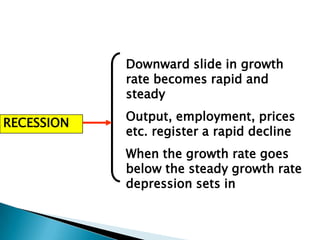
Downward slide in growth
            rate becomes rapid and
            steady
            Output, employment, prices
RECESSION
            etc. register a rapid decline
            When the growth rate goes
            below the steady growth rate
            depression sets in
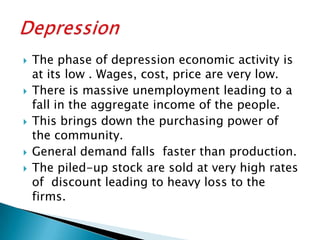
   The phase of depression economic activity is
    at its low . Wages, cost, price are very low.
   There is massive unemployment leading to a
    fall in the aggregate income of the people.
   This brings down the purchasing power of
    the community.
   General demand falls faster than production.
   The piled-up stock are sold at very high rates
    of discount leading to heavy loss to the
    firms.
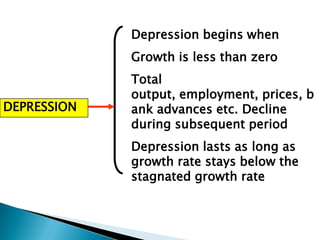
Depression begins when
             Growth is less than zero
             Total
             output, employment, prices, b
DEPRESSION   ank advances etc. Decline
             during subsequent period
             Depression lasts as long as
             growth rate stays below the
             stagnated growth rate
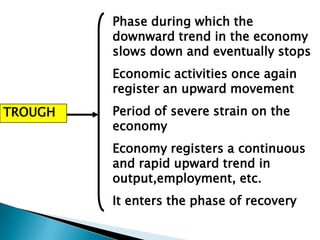
Phase during which the
         downward trend in the economy
         slows down and eventually stops
         Economic activities once again
         register an upward movement
TROUGH   Period of severe strain on the
         economy
         Economy registers a continuous
         and rapid upward trend in
         output,employment, etc.
         It enters the phase of recovery
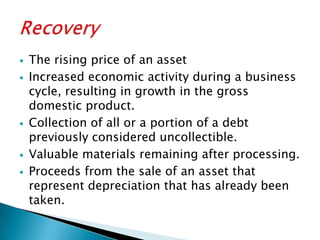
   The rising price of an asset
   Increased economic activity during a business
    cycle, resulting in growth in the gross
    domestic product.
   Collection of all or a portion of a debt
    previously considered uncollectible.
   Valuable materials remaining after processing.
   Proceeds from the sale of an asset that
    represent depreciation that has already been
    taken.
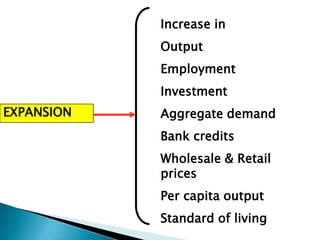
Increase in
            Output
            Employment
            Investment
EXPANSION   Aggregate demand
            Bank credits
            Wholesale & Retail
            prices
            Per capita output
            Standard of living
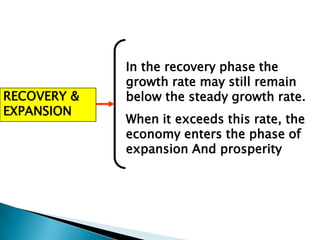
In the recovery phase the
             growth rate may still remain
RECOVERY &   below the steady growth rate.
EXPANSION
             When it exceeds this rate, the
             economy enters the phase of
             expansion And prosperity
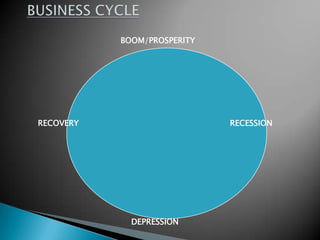
BOOM/PROSPERITY


RECOVERY                     RECESSION


             DEPRESSION
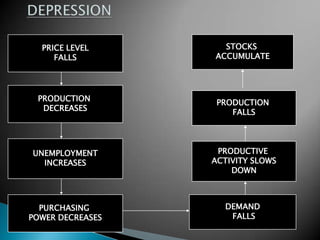
PRICE LEVEL       STOCKS
     FALLS        ACCUMULATE


 PRODUCTION        PRODUCTION
  DECREASES           FALLS


UNEMPLOYMENT       PRODUCTIVE
  INCREASES       ACTIVITY SLOWS
                      DOWN


  PURCHASING        DEMAND
POWER DECREASES      FALLS
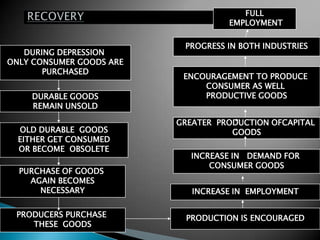
FULL
                                    EMPLOYMENT

                           PROGRESS IN BOTH INDUSTRIES
   DURING DEPRESSION
ONLY CONSUMER GOODS ARE
       PURCHASED
                           ENCOURAGEMENT TO PRODUCE
                               CONSUMER AS WELL
    DURABLE GOODS              PRODUCTIVE GOODS
    REMAIN UNSOLD

                          GREATER PRODUCTION OFCAPITAL
  OLD DURABLE GOODS                  GOODS
  EITHER GET CONSUMED
  OR BECOME OBSOLETE
                             INCREASE IN DEMAND FOR
                                 CONSUMER GOODS
  PURCHASE OF GOODS
    AGAIN BECOMES
      NECESSARY              INCREASE IN EMPLOYMENT

 PRODUCERS PURCHASE        PRODUCTION IS ENCOURAGED
    THESE GOODS
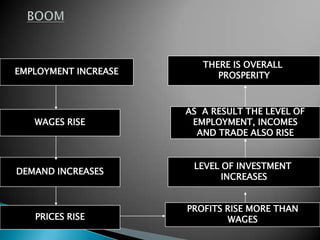
THERE IS OVERALL
EMPLOYMENT INCREASE         PROSPERITY


                      AS A RESULT THE LEVEL OF
   WAGES RISE          EMPLOYMENT, INCOMES
                        AND TRADE ALSO RISE


                       LEVEL OF INVESTMENT
DEMAND INCREASES
                             INCREASES


                      PROFITS RISE MORE THAN
   PRICES RISE                 WAGES
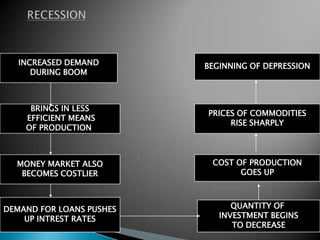
INCREASED DEMAND       BEGINNING OF DEPRESSION
      DURING BOOM


     BRINGS IN LESS
                          PRICES OF COMMODITIES
    EFFICIENT MEANS
                               RISE SHARPLY
    OF PRODUCTION


  MONEY MARKET ALSO        COST OF PRODUCTION
   BECOMES COSTLIER              GOES UP


DEMAND FOR LOANS PUSHES         QUANTITY OF
    UP INTREST RATES         INVESTMENT BEGINS
                                TO DECREASE
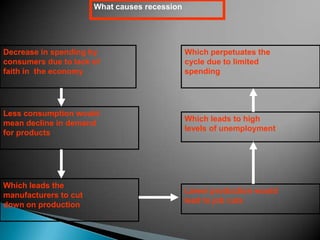
What causes recession


Decrease in spending by                        Which perpetuates the
consumers due to lack of                       cycle due to limited
faith in the economy                           spending


Less consumption would
                                               Which leads to high
mean decline in demand
                                               levels of unemployment
for products


Which leads the
                                               Lower production would
manufacturers to cut
                                               lead to job cuts
down on production
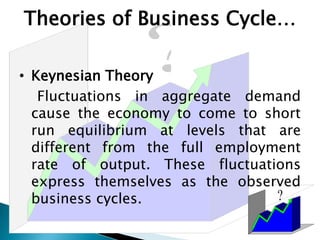
Theories of Business Cycle…

• Keynesian Theory
   Fluctuations in aggregate demand
  cause the economy to come to short
  run equilibrium at levels that are
  different from the full employment
  rate of output. These fluctuations
  express themselves as the observed
  business cycles.               ?
   Real business cycle theory..
     Economic crisis and fluctuations cannot
    stem from a monetary shock, only from an
    external shock, such as an innovation.


                                           ?
   Politically based business cycle….
     The political business cycle is an alternative
    theory stating that when an administration of any
    hue is elected, it initially adopts a contractionary
    policy to reduce inflation and gain a reputation
    for economic competence. It then adopts an
    expansionary policy in the lead up to the next
    election, hoping to achieve simultaneously low
    inflation and unemployment on Election Day.
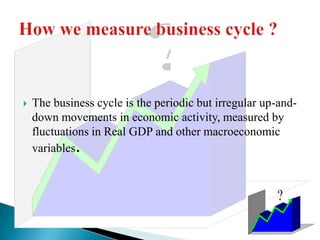
   The business cycle is the periodic but irregular up-and-
    down movements in economic activity, measured by
    fluctuations in Real GDP and other macroeconomic
    variables.


                                                       ?
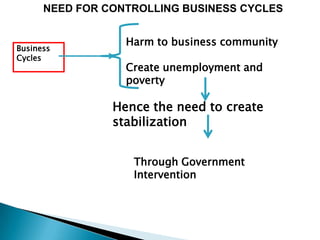
NEED FOR CONTROLLING BUSINESS CYCLES


                  Harm to business community
Business
Cycles
                  Create unemployment and
                  poverty

                Hence the need to create
                stabilization


                   Through Government
                   Intervention
Thanks

Business cycle

  • 1.
  • 2.
    A business cycle refers to periods of expansion and contraction. A peak is the high point following a period of economic expansion. A trough is the low point following a period of economic decline.
  • 3.
    The recurring andfluctuating levels of economic activity that an economy experiences over a long period of time.
  • 5.
    Business cycles are a type of fluctuation found in the aggregate economic activity of nations that organize their work mainly in business enterprises.  A cycle consists of: Expansions. General recessions. Contractions And revivals which merge into the expansion phase of the next cycle.
  • 6.
    Expansion: Increase in production and prices, low interests rates.  Crisis: Stock exchanges crash and multiple bankruptcies of firms occur.  Recession: Drops in prices and in output high interests rates.  Recovery/Revival: Stocks recover because of the fall in prices and incomes.
  • 8.
    PHASES OF BUSINESS CYCLE Steady growth line Peak DEPRESSION Line of cycle Trough
  • 9.
    In recent yearseconomic theory has moved towards the study of economic fluctuation rather than a business cycle. ?
  • 10.
    The business outlook is extremely optimistic.  The important features of prosperity are: ◦ a high level of output ,trade, employment and income, ◦ a high level of effective demand and high marginal efficiency of capital, ◦ a large expansion of bank credit, and ◦ a rising trend in prices, profits and interest rates.
  • 11.
    Characterized by Slackening in expansion rate PEAK Highest level of prosperity Downward slide in economic activities The phase of recession begins
  • 12.
    During recessions, many macro economic indicators vary in a similar way.  Production, as measured by gross domestic product (GDP), employment, investment spending, capacity utilisation, household incomes, business profits, and inflation all fall  while bankruptcies and the unemployment rate rise.
  • 13.
    Downward slide ingrowth rate becomes rapid and steady Output, employment, prices RECESSION etc. register a rapid decline When the growth rate goes below the steady growth rate depression sets in
  • 14.
    The phase of depression economic activity is at its low . Wages, cost, price are very low.  There is massive unemployment leading to a fall in the aggregate income of the people.  This brings down the purchasing power of the community.  General demand falls faster than production.  The piled-up stock are sold at very high rates of discount leading to heavy loss to the firms.
  • 15.
    Depression begins when Growth is less than zero Total output, employment, prices, b DEPRESSION ank advances etc. Decline during subsequent period Depression lasts as long as growth rate stays below the stagnated growth rate
  • 16.
    Phase during whichthe downward trend in the economy slows down and eventually stops Economic activities once again register an upward movement TROUGH Period of severe strain on the economy Economy registers a continuous and rapid upward trend in output,employment, etc. It enters the phase of recovery
  • 17.
    The rising price of an asset  Increased economic activity during a business cycle, resulting in growth in the gross domestic product.  Collection of all or a portion of a debt previously considered uncollectible.  Valuable materials remaining after processing.  Proceeds from the sale of an asset that represent depreciation that has already been taken.
  • 18.
    Increase in Output Employment Investment EXPANSION Aggregate demand Bank credits Wholesale & Retail prices Per capita output Standard of living
  • 19.
    In the recoveryphase the growth rate may still remain RECOVERY & below the steady growth rate. EXPANSION When it exceeds this rate, the economy enters the phase of expansion And prosperity
  • 20.
    BOOM/PROSPERITY RECOVERY RECESSION DEPRESSION
  • 21.
    PRICE LEVEL STOCKS FALLS ACCUMULATE PRODUCTION PRODUCTION DECREASES FALLS UNEMPLOYMENT PRODUCTIVE INCREASES ACTIVITY SLOWS DOWN PURCHASING DEMAND POWER DECREASES FALLS
  • 22.
    FULL EMPLOYMENT PROGRESS IN BOTH INDUSTRIES DURING DEPRESSION ONLY CONSUMER GOODS ARE PURCHASED ENCOURAGEMENT TO PRODUCE CONSUMER AS WELL DURABLE GOODS PRODUCTIVE GOODS REMAIN UNSOLD GREATER PRODUCTION OFCAPITAL OLD DURABLE GOODS GOODS EITHER GET CONSUMED OR BECOME OBSOLETE INCREASE IN DEMAND FOR CONSUMER GOODS PURCHASE OF GOODS AGAIN BECOMES NECESSARY INCREASE IN EMPLOYMENT PRODUCERS PURCHASE PRODUCTION IS ENCOURAGED THESE GOODS
  • 23.
    THERE IS OVERALL EMPLOYMENTINCREASE PROSPERITY AS A RESULT THE LEVEL OF WAGES RISE EMPLOYMENT, INCOMES AND TRADE ALSO RISE LEVEL OF INVESTMENT DEMAND INCREASES INCREASES PROFITS RISE MORE THAN PRICES RISE WAGES
  • 24.
    INCREASED DEMAND BEGINNING OF DEPRESSION DURING BOOM BRINGS IN LESS PRICES OF COMMODITIES EFFICIENT MEANS RISE SHARPLY OF PRODUCTION MONEY MARKET ALSO COST OF PRODUCTION BECOMES COSTLIER GOES UP DEMAND FOR LOANS PUSHES QUANTITY OF UP INTREST RATES INVESTMENT BEGINS TO DECREASE
  • 25.
    What causes recession Decreasein spending by Which perpetuates the consumers due to lack of cycle due to limited faith in the economy spending Less consumption would Which leads to high mean decline in demand levels of unemployment for products Which leads the Lower production would manufacturers to cut lead to job cuts down on production
  • 26.
    Theories of BusinessCycle… • Keynesian Theory Fluctuations in aggregate demand cause the economy to come to short run equilibrium at levels that are different from the full employment rate of output. These fluctuations express themselves as the observed business cycles. ?
  • 27.
    Real business cycle theory.. Economic crisis and fluctuations cannot stem from a monetary shock, only from an external shock, such as an innovation. ?
  • 28.
    Politically based business cycle…. The political business cycle is an alternative theory stating that when an administration of any hue is elected, it initially adopts a contractionary policy to reduce inflation and gain a reputation for economic competence. It then adopts an expansionary policy in the lead up to the next election, hoping to achieve simultaneously low inflation and unemployment on Election Day.
  • 29.
    The business cycle is the periodic but irregular up-and- down movements in economic activity, measured by fluctuations in Real GDP and other macroeconomic variables. ?
  • 30.
    NEED FOR CONTROLLINGBUSINESS CYCLES Harm to business community Business Cycles Create unemployment and poverty Hence the need to create stabilization Through Government Intervention
  • 31.