Download as PPSX, PPTX


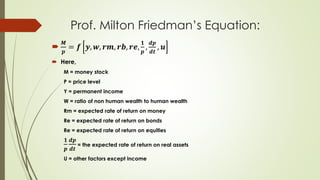
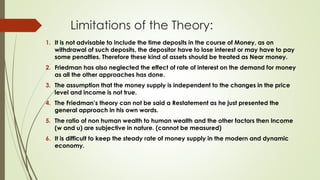

Milton Friedman proposed a restatement of the Quantity Theory of Money (QTM) that incorporated permanent real income and wealth. He argued that the demand for money depends on total wealth, expected returns on various assets, and tastes/preferences. Friedman defined permanent real income as the sustainable level of income without reducing wealth over time. His equation for the QTM included factors like the money stock, the price level, permanent income, expected rates of return on different assets, and other variables. While improving on prior theories, Friedman's restatement still had limitations like subjective terms that are hard to measure and challenges maintaining a steady money supply in a modern economy.


